

Isis Sophia III
by Willi Sucher
Part Two
Chapter I
The Impact of the Cosmos on the Earth
Some time ago an article appeared in Electrical Engineering (May 1952) that described the researches of a few scientists in the U.S. The investigators were mainly occupied with the effects of planetary interrelationships on radio signal behavior. Although the chosen field of research has a limited character, the results are rather revealing with regard to the interconnection between the planetary world and the Earth.
It has long been known that the sunspot cycles are connected with transatlantic short-wave signal variations, and that radio storms are to be expected at times of sunspot maximums. Systematic investigations revealed, however, that these sunspot cycles could be made responsible for radio signal disturbances only to a certain extent. The suggestion was that cosmic phenomena other than sunspots must be studied. Thus, the heliocentric angular relationships of the planets were observed over a long period of time in connection with day-to-day radio signal analysis, and very satisfactory and encouraging results were obtained. (The forecasting of radio signal disturbances was, on an average, close to 85% accurate.)
Heliocentric angular relationship of the planets is the position of two or more planets in the legs of an angle that has its apex in the place of the Sun. If we could transfer our standpoint from the Earth to the Sun, we would observe the planets in directions somewhat different from those in which we observe them from the Earth. Nevertheless, we should see the various planets at certain times standing in the directions of the legs of definite angles. Two or more planets can take up such positions according to their rhythms of revolution. According to classical astrology, these relative positions are the equivalents of the so-called aspects; but in the case of the researches, which have been mentioned, they are calculated from the place of the Sun in the cosmos.
Thus, angles of 0°, 90°, 180°, and 270° were used, and the times when two or more planets formed such angles were checked against the radio signal analysis. In this way, the satisfactory results were obtained.
As we said, this kind of research covers only a very limited part of the field of the interrelationship between the cosmos and the Earth. Other experiments have been made over years, and the results are highly convincing with regard to the affinity of earthly forces and substances to cosmic events. However, it seems rather difficult sometimes for modern humanity to assess properly the field of cosmic influences on the Earth and its limits. Here is the point where a close cooperation between natural science and spiritual science is needed in order to find the demarcation line between the sphere of necessity, based on cosmic influences, and the realm of spiritual freedom, for instance, in the human being.
So far, the above experiments, and others, have clearly shown that there exists a close affinity of terrestrial forces and substances to events in the cosmic world. The living organisms on the Earth must also necessarily be involved in this relationship, since they partake through their organism in the properties of the Earth planet. In so far as the bodily constitution of a living organism is essential for the development of some kind of consciousness, the cosmic impacts must also be noticeable in the realm of soul-emotions, etc. However, this does not imply that the soul life of a living being is entirely subject to cosmic influences. Here we must distinguish between the instrument, the organism that is permeated by the cosmic impacts and the character of the being that uses the instrument. We must acknowledge the possibility of a degree of independence within the conscious being.
To study these problems of obviously complicated interrelationships, and to aim at practical, helpful, and therapeutic conclusions, is the task of a modern star wisdom.
Reference books on the subject: Short-wave Radio Propagation Correlation with Planetary Positions, by J. H. Nelson. RCA Review (Princeton N. J.) March 1951. Influence of Planetary Configurations Upon the Frequency of Visible Sunspots, by F. Sanford, Smithsonian Institution, Washington D.C., 1936.
Astronomical Studies
The experiments, previously mentioned, suggest that the whole organism of the solar system must be studied in order to gain an insight into the interrelationship. What appears as a phenomenon in one part is related to and caused by events in other parts. For instance, the study of the sunspots alone did not suffice to come to clear conclusions concerning certain disturbances. The planets as well, and very probably other still unknown factors, have to be taken into consideration.
All this suggests that we must have a sound and extensive knowledge of astronomical facts if we embark on any kind of cosmological research. This knowledge is not easily obtained in our age. Generally speaking, it is advisable to study the great pioneers of astronomical science during the last few centuries, although the data of their researches are sometimes not up to date and partly even incorrect. However, a combination of study of classical astronomers together with modern books on astronomy should make up for this deficiency. Modern popular books on astronomy are inclined to impress the reader by the unimaginable vastness of the universe in which we live, whereby the sense for the cosmos as an integrated organism is easily lost. In the end, the readers are usually left with the idea that they are a totally insignificant part within that gigantic cosmic machine of modern astronomical conception.
Besides these more general indications, there exist a number of introductions to astronomy that try to build a bridge between natural and spiritual science. The works of various authors on this subject are available, and personal advice concerning the study of astronomy on this foundation can be given.
Observation and contemplation are the two pillars on which the genuine cosmologist must build his or her house. Very often one of the two principal foundations is neglected. Sometimes it happens that a person knows a good deal about the supposed influences of the stars on human destiny and historic events, but may never have observed a star nor acquired a proper astronomical knowledge. It is comparatively easy to learn about the day-to-day positions of the stars and planets by using astronomical ephemeredes, which are published in great numbers and varieties today. One does not even need to know how the planets move in cosmic space. This may suffice as long as we cling, in a sense, blindly to traditional rules. For a conscientious research, more is required than only the data given in the usual ephemeris. Thus, for instance, the angular positions of the planets from the standpoint of the Sun, which were mentioned in connection with the experiments of a number of American scientists, can only be calculated on the basis of a sound and modern conception of the universe. This basis is needed in order to consciously meet the unexpected in the relationship between the Earth and the cosmos. The knowledge that is contained in traditional astrology has come down to us from an age when humanity was still able to comprehend the laws of motion and rhythm in the universe by a powerful instinct. Modern humanity has lost this instinct almost entirely, though we may have gained the power of observation and thinking. If we do not want to swim, more or less helplessly, in a sea of traditional rules derived from an instinct to which we no longer have access, we must learn to use the newly acquired capacities: observation and thinking. Otherwise, we may expose ourselves to uncontrollable errors and misconceptions.
There is, of course, the other possibility that the modern cosmologist rejects the practice of contemplation. We may then find ourselves staring at a cosmos that we do not understand and that confronts us in every new discovery with an increasing barrier of unanswerable and haunting questions. In both directions we may lose, in a sense, the perception of a living universe with which we are vitally connected.
How can we combine observation and contemplation in any modern sense to the end that we may find a true spiritual understanding of the intricate connection between ourselves and the stars? There are several ways of achieving this. One is to observe the day-to-day positions of the planets in the ecliptic and learn to imagine these positions in the course of the day, even if the planets cannot be seen because of the bright light of the Sun. This can be done by practicing with one of the circular star maps that can be adjusted to any time of the day. The daily positions of the planets, the Sun, and the Moon can be found in the available ephemeredes, which are usually calculated on the basis of the Nautical Almanac. These positions can then be transferred to the circular and adjustable star maps, and the directions in which to find the planets can thus be ascertained at any given time. (A very suitable map has been published by J. Schultz at the Goetheanum, Dornach, Switzerland.)
So far, this is essentially a matter of observation. To this must be added exercises of contemplation; for instance, we may find the position of Mercury on May 1, 1953, given in the astronomical ephemeris, as being in 19° of the ecliptic sign of ♈︎ Aries. This corresponds to the fixed star constellation of Fishes. Therefore, Mercury is in the constellation of Fishes in that moment. (About conversion of “signs” into “constellations” see table at end of this section.)
We can now ask: How did Mercury reach that position? Where did it come from, and what is its aim? We can again make use of the ephemeris, and we will find that it was retrograde during March 1953. It performed a loop, which means that it was in inferior conjunction with the Sun during that period. This took place on 18 March in 28° of the sign of ♓︎ Pisces, corresponding also to the constellation of Fishes. The planet was then standing in one line between the Sun and the Earth. Furthermore, we will find that Mercury will be in superior conjunction to the Sun on 24 May in 4° of the sign of ♉︎ Taurus, corresponding to the constellation of Ram. From there it will move into another loop in the signs of ♌︎ Leo and ♋︎ Cancer in July/August 1953. The inferior conjunction in the course of this loop will take place on 25 July in 3° of the sign of ♌︎, corresponding to the constellation of Crab.
Thus we have achieved, in a certain sense, the biographical background of that position of Mercury on May 1, 1953. We can extend this over a whole year, or even longer periods. We shall thus discover the rhythmical laws, according to which Mercury moves through cosmic space in relation to Sun and Earth. We combine, in this way, the mere visual or observational aspect of Mercury at a given time with its rhythmical background. We know its derivations from the past and its aims in the future, which must be inherent in any momentary position. This can tell us a great deal about the nature and implications of the planet.
Such a study of the rhythms of the planets, over shorter or longer periods, can become very fruitful and can enable the student to form a background of personal experience, for instance, in connection with history. It is an advance from the mere observational picture that should be carried through with all possible clarity of thought, to the language of the planets.
This is a very illuminating study, especially in connection with the rhythms of the superior planets Mars, Jupiter, and Saturn. For instance, amazing facts can be gathered by contemplating the rhythms of Mars. Its loops (oppositions to the Sun and conjunctions with the Sun) advance rhythmically through the ecliptic and return to their approximate initial positions after a period of roughly sixteen years. It is very instructive to study the eight loops and conjunctions of Mars during such a cycle in connection with historic events.
There is also another way by which a combination of observation and contemplation can be achieved. If we observe the stars, we quite naturally look up from our standpoint into the sky. We then discover that in order to observe the Sun during daytime and the planets and the Moon during the night, we have to turn mainly toward the South. We may have to turn on certain occasions toward east or west, but we shall certainly not find any planets in the north. If we look toward the south, we notice that the east—where the Sun, the Moon, and the planets are rising—is to our left, whereas the west—the direction in which the celestial bodies are setting, with certain variations according to the seasons—is to our right.
This position is the only one possible, as far as observation is concerned. If we try to advance from observation to an understanding of the stars, we must change our position. Usually we do this unconsciously as soon as we begin to think about the cosmos. We then turn away from the external world and try to sort out our experiences in the realm of inner conception. Mostly, we are not conscious of this procedure as it happens in an uncontrolled way, and this is one of the reasons why “thinking about the stars” has become so unprofitable.
We can accompany the changeover from observation to contemplation with full consciousness. A great help in this direction is a conscious inner change of our position. For observation we must take up a central position. From the point of our eye, we reach out into cosmic space along the line of our focus.
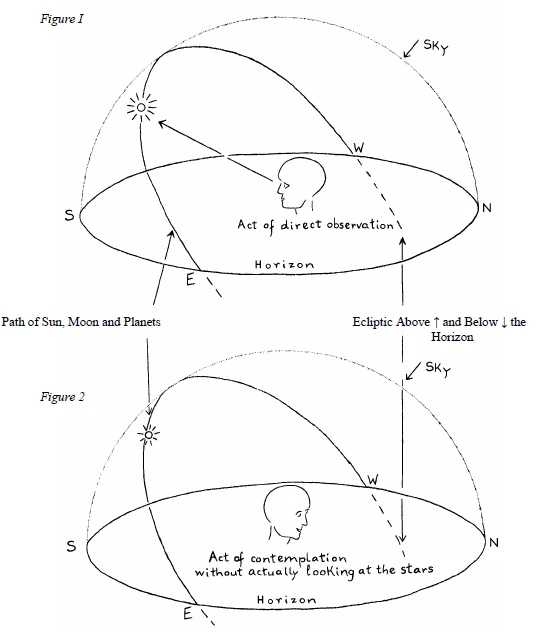
If we now imagine that we turn away from our central position and expand our being to the whole periphery, looking from the periphery down to the Earth, we will not see the stars anymore but have them “in our mind”. Of course, we should then also carry the data about the stars in our mind that we acquired by observation; but the direct visual perception would be eliminated for a certain time. (See Fig. 1 & 2.) If we try to practice such an attitude, we realize at once that it cannot be easily attained. Through our body, which is bound to the Earth by gravity, we are obliged to maintain a central position. Persistent exercise, however, will make it possible—at least for fractions of time—to achieve a peripheral attitude.
Through such a conscious act, the changing over from observation to contemplation can at least be facilitated. The more we succeed in extending our own being in this fashion to the whole cosmos, the more the world of the stars can speak to us. In order to rise to higher planes of perception, we must be prepared to bring sacrifices on lower levels of experience. We silence or eliminate for a time, in this case, the experiences that we have through the senses and can advance, thereby, to a much more comprehensive inner perception. The main condition is that we perform such an exercise in full consciousness. Any dim or dreamy condition of inner awareness would lead nowhere or could even have disastrous consequences.
It must be emphasized that any such external alteration of our position toward the stars can only give us a beginning. An essential and fundamental condition is a well-disciplined and rhythmic life in contemplation and meditation. This must become like our second being, our constant companion and self-chosen tutor. Only then can we expect to find the spiritual meaning of the world surrounding us and even advance to the higher worlds of the spirit itself. It should not be necessary to emphasize that this need is paramount, if we desire to learn to understand the language of the stars.
Contemplation and meditation have been practiced by a humanity that was eager to listen to the spiritual world, since the most ancient times. The existing literature of Eastern civilizations is full of proof. Through the ages, the methods have changed, together with the change of consciousness in humanity. The development of consciousness works much deeper into the human organization than we may expect from a superficial view point. Thus, Western civilization with its emphasis on modern technology, traffic, general external life-standards, etc., has hardened the body to such a degree that ancient methods of approach to the spiritual world can no longer be employed. Wherever they are employed, under such conditions, they are apt to bring disaster to the integrity of the Western human organization.
From our own experiences over many years, we can say that methods of inner discipline in contemplation and meditation, as they are described in the many books of Rudolf Steiner, are most effective and sound, especially for Western humanity. They take their start from no other foundation than the one that modern humanity has achieved in the course of the development of its consciousness, which is clear and well-controlled observation and thinking.
If such exercises as those suggested by Rudolf Steiner have become something like a second nature, then we can also attempt, at a certain stage, to launch out to a higher understanding of the world of the stars and its interrelationship with the Earth and with ourselves. Even in this direction Rudolf Steiner can give advice. However, we should not underestimate the difficulties of such a path. Penetrating to the mysteries of the cosmic world and to its reflections in the microcosmic universe, really means to ascend to the highest planes of spiritual consciousness that a human being can attain at present. Star wisdom of this kind was called the Royal Wisdom in ancient times and was entered only after many years of profound schooling. We cannot expect that the equivalent star wisdom of modern times can be attained any more easily.
One of the gravest dangers of the cosmologist, in the sense of spiritual science, is that he or she gets submerged in calculation; all the more so as modern science tends to move away from scientific materialism and enter an age of philosophic mathematism—“The old materialism is dead”, exclaims a modern scientist. Matter has been dissolved, as it were, in the course of development of modern physics, into very complicated mathematical equations. It is not our task here to go deeper into this, but if cosmologists fall into the trap of mere calculation, they may kill their sense for the tremendous flexibility in the cosmos. We have been accustomed to modern science’s concept of the universe of the stars as a stupendously gigantic machine, whose movements and rhythms can be calculated down to the smallest detail. The genuine occultists, however, know only too well that this is not correct with regard to spiritual aspects, and they can even prove it. In the midst of the vast, computable universe, there are still inexhaustible possibilities for the spiritual world when it manifests itself in a human individuality.
Calculation must be used, but it must not become a barrier for the creative employment of the faculties of Imagination, Inspiration, and Intuition—capacities that can be attained by the spiritual exercises indicated by Rudolf Steiner, the founder of Anthroposophy. The results of calculation should rather be used as pointers to higher insight. One who has many years of practice in these matters knows that the accuracy of cosmological research is not inhibited by such methods, but that it is enhanced.
Another danger for the scholar of occult cosmology is the inclination to look up to the stars in an attitude of expectancy, which will lead sooner or later into disappointment. One thing must be realized; just as the human race goes through stages of development, so the universe—the world of the stars— moves through certain stages of evolution. Once in the dim past, people experienced the direct language of the stars, and they were guided by what was speaking to them. Documents that have been dug up in Mesopotamia reveal that such incidents still happened in the days when the ancient civilizations flourished in that part of Asia. However, the situation has gradually changed in our present age. The stars have become silent, and we must search for new means of approach to our relationship with the Earth and with the cosmos.
The direction is indicated by those great events in Palestine at the beginning of our era. At that time Christ, the Spirit of the Cosmos, united with the Earth for the sake of the further continuity of evolution. In a spiritual sense, the Earth became the focus of the universe and its meaning; the working of the stars can only be properly comprehended through this new, Christ-permeated focus. The forces coming from the stars are still flowing into the Earth, and they are also penetrating the organization of each of us. Yet, they could produce no more than an eternal repetition of similitudes. The wheel of cosmic creation would become a kind of eternal death, if it were not renewed by the spiritual potentiality of the Earth. Spiritual progress can only be infused into the cosmos through virtues of real moral imagination, and these are the garments of Christ on the Earth.
Hence, we must learn to read the script of the stars through the medium of the Earth. We are urged once more to take up such an attitude as has been indicated before: to try to expand ourselves spiritually to the periphery, to feel the stars within ourselves, and to look down from the periphery to the Earth. In the mirror of the Earth, the place of those high aspirations of spiritual love and freedom—the very center of the Christ impulse, we can behold the stars anew, and they can become building stones of a new creation. The stars can become spiritually audible in a new fashion and can inspire our life on the Earth in hitherto unknown ways.
All this may appear rather vague, perhaps even presumptuous; however, only the practicing of the described methods and the personal experience obtained can provide the genuine proof and lead to conviction. The transformation of cosmic forces through the Earth and their reflection into space surrounding the Earth is a reality that will break into the modern consciousness more and more. What is necessary is that these forces are recognized with the clarity of consciousness that we have attained in the practical fields of our everyday life. Then they can become a magnificent source of inspiration and healing.
Chapter II
Ideas about Embryology and the Stars
In Part One of this series, we have described the connection between the human being and the stars from the viewpoint of historic events. We have also given some indication about the implications of the death asterogram. Much remains to be said about this latter aspect, which will be done in due course.
However, the most urgent problem for us seems to be to find comprehensible viewpoints concerning the incarnation of a human being. There exists an enormous amount of literature about our connection with the world of the stars in the moment of our birth. Assuredly, there is a great deal to be said about this viewpoint. From an esoteric standpoint, this approach has certainly much justification, but the usual deliberations on the subject show one deficiency. The esoteric background of the validity of the idea of the connection of the stars with the nativity is taken for granted and, therefore, usually omitted in those writings. The result is that the philosophic background of this kind of astrology is not in conformity with the standards of modern human consciousness and urge for clear knowledge. It remains a “belief” in star lore, even if experimental evidence is produced.
For instance, trained along the lines of prevailing scientific standards, the modern mind cannot accept, without a thorough and complete philosophic and experimental preface, the idea that the aspect of the sky in the moment of birth should be decisive for a human being. One must assume that the time of gestation, on the basis of modern research, is of much greater importance for the individual constitution as an antiquated and foreign assumption within the compass of modern civilization, and therefore one is inclined to regard the claims of astrology as superstition.
The question is: What can we do about this situation? For one who has had more than a generation of experience in this sphere, there is no doubt about the validity of the idea of a connection between the human being and the stars. Another question is, however, whether an astrology that has its roots mainly in eastern and south-eastern world conceptions has advanced with the development of human consciousness or has stayed behind. We have come to the conclusion that astrology, as it is, has never answered the fundamental questions of the searching mind of western humanity. Of course, we are free to renounce our intellectual birth-right and to fall back on some ancient religious or philosophical belief, but this would be against the progress of the human race. On the other hand it is our conviction, based on more than thirty years of research, that modern spiritual science can speak about the connection between the human being and the stars in terms that can be acknowledged by the western mind.
During the last decades, we have devoted a great deal of research to these problems. By experimental investigation of a great number of historic personalities, we tried to find an answer to the question of whether there is any evidence for a connection between human gestation and the stars. The guiding idea was that if there is any such affinity, it must be expected to become apparent in the whole bodily makeup after birth. The results have confirmed that there is such a relationship. On the following pages, we will give a brief account of the direction and the viewpoints gained by this kind of research work.
First of all, we should like to review very briefly the outlines of the early embryonic development. It must be emphasized that it is not our task here to give a full account of the various stages of gestation. These can be followed by a study of the appropriate handbooks on embryology. (A very good one with excellent illustrations is Human Embryology by W. J. Hamilton, J. D. Boyd and H. W. Mossman, published byW. Heffer & Sons Ltd., Cambridge, 1945.)
One of the first stages of embryonic development is the formation of two cavities within the ovum, the amnion and the yolk sac (Fig. 3). Soon after these cavities have been formed, the actual embryo comes into existence. First an almost round disc, built from the bottom of the amnion and the roof of the yolk sac (Fig. 4 & 5). Later on the disc of the embryo is transformed into a form that resembles a shoe sole, and by the folding in of the fringes, it gradually becomes a three dimensional, roughly tube-like body (Fig. 6). The amnion envelops the embryo more and more and finally expands to the peripheral limits of what has been the ovum. The yolk sac, which undergoes considerable transformation, seems to be pushed aside. In the course of gestation, it declines even in importance (Fig. 7 & 8).
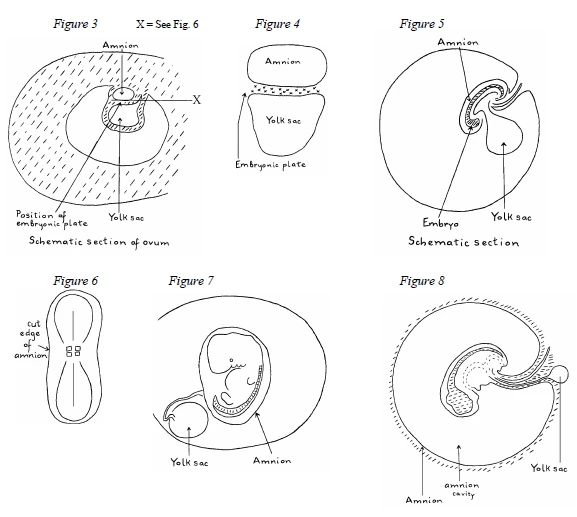
From the foundations connected with the amnion, there arise the materials necessary for the building up of the skin and its derivatives: hair, nails, the lens of the eye, parts of the cornea, the central nervous system including retina and optic nerve, the peripheral nervous system and parts of the organs of smell and hearing, etc. From the yolk sac are derived tissues mainly connected with the alimentary tract (concerning functions of nutrition). This gives a rough picture of the impact of amnion and yolk sac on the embryo. The amnion mainly provides the building-stones that will enable the individual, in later life, to go through the organization of the senses to the periphery of its surroundings, and to lead its perception to conscious realization. Therefore, we can call it a peripheral activity. The yolk sac, however, tends to build up the organization of the metabolism of the human organism. We recognize an activity in this that we may call centric, because compared with the organization of the senses and the nerves, it constitutes a realm of mainly inverted processes.
While these developments are going on, the stars are moving through cosmic space according to definite rhythms and forming certain angular relationships that work back on the Sun and the Earth. (See Chapter I.) Then, is the idea too abstruse that the stars are also having an influence upon a human embryo, however limited? It must certainly appear worth while to investigate this matter.
If we accept this as a working hypothesis, we must conclude that the main actors in this possible drama are, at first sight, the Sun and the Earth. In Part Three of Isis Sophia II, we have described the nature of the Sun and the Earth on the basis of spiritual science. There, we regarded the Sun as a “hole” in space, as a focus of non-space, and not as a solid ball of matter. Such a super vacuum would exert a suctional influence on its surroundings, whose orbit we imagine to go as far as the outer edge of our solar system.
In this activity of the Sun, we recognize a peripheral tendency. Through the suction, the solar system has been created and is maintained in space from the periphery toward the center, where we find the visible Sun. Ultimately such a peripheral entity in the cosmos produces the source of light and warmth that we experience through our senses. We must admit that without this light and warmth we could not exist, and that our conscious experience of the world surrounding us through sense perception would be reduced to a minimum.
Is it far-fetched, then, to consider the possibility of the embryo imitating the Sun by carrying the amnion-cavity, as it were, on its back? Certainly, all natural creation is a process of imitation of forms and laws that exist in the universe; therefore, we can expect that the embryo, recapitulating in a sense the stages of world evolution, also imitates the structure of the solar system to a certain extent. We ascribed to the amnion a peripheral activity, expanding gradually to the outer walls of what was the ovum, in conjunction with the building up of vital parts of the sense organs and the nervous system. This resembles the activity of the Sun on a microcosmic scale.
The embryonic development itself takes place on the surface of the Earth. The Earth as a planet is, with regard to its properties, almost the complete opposite of the Sun. It has a solid, smooth surface upon which living beings can move. Creatures of terrestrial structure could certainly not do this on the Sun, which shows in the telescope a surface of gigantic and unceasing turmoil, like the whirlpool of flames in a furnace. The Earth’s crust supports the growth of a rich plant world by which animals and human beings can maintain their own existence. If the Earth were alone in the cosmos, the conscious beings living on it would not be incited very much to use sense organs, especially not the sense of sight. Observation is enkindled by the light and other agencies that come from the cosmic world, from the Sun and the stars. Life on such a lonely Earth-planet would be like existence in some kind of eternally dark caves or bowels. Altogether, living and conscious beings could not exist on it, only kind of chemical transformations could be imagined.
This picture of the Earth, developed to an extreme, reminds us of the activity of the yolk sac in the embryo, creating mainly the alimentary organism. We can see in it a centric tendency that arranges everything according to the internal conditions and requirements of the body. Again, it is possible to think that the creative faculties inherent in the embryo imitate cosmic archetypes of existence; in this case, besides that of the Sun, also the implications of the Earth. The result of this imitation can be considered to be the yolk sac.
The existence of plants and living beings on the Earth, however, cannot be explained only by Earth properties. For this our planet needs its companion, the Moon. The Moon feeds the Earth with cosmic substances that alone make life in matter possible. The changing phases of the Moon are connected with the mysterious metabolism of our home planet that prevails also in its inhabitants. The dependence of this metabolism (“Stoffwechsel”), etc., on the movements and phases of the Moon has been established and demonstrated by numberless experiments of scientific research.
We can say, therefore, that the character of the yolk sac rather suggests that its activity is an imitation of the totality of the Earth including its Moon. (We should also like to point to the development of the so-called allantois during gestation, in which the yolk sac plays a decisive part. This provides a double aspect that is, in a certain sense, congenial to the duality Earth-Moon.)
All this may appear, so far, as a kind of cheap comparison. However, we shall endeavor to show in Chapter III the results of practical application of these ideas; but first, we should like to pursue them a stage further.
At the beginning of the third month of gestation, the embryo already shows the human form clearly. We give here two diagrams of this stage: one of an estimated age of 43 days, the other of about 60 days (Fig. 9 and 10). They show the typical inverted, curved position of the embryo. After this stage, there are no more dramatic external changes that take place; the embryo develops internally and grows in size.
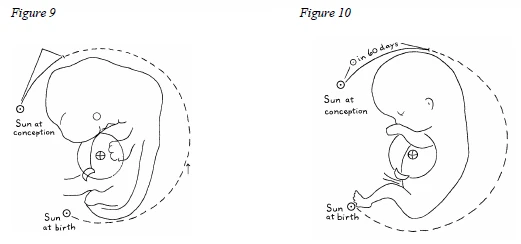
We have added the movement of the Sun to the two diagrams in the course of ten lunar months (273 days), the average time of gestation. In the place of the umbilical cord, which connects the embryo with the placenta and the mother-being, we have indicated the Earth with the Moon. (In a certain sense the umbilical cord replaces the function of the yolk sac at later stages.)
The first objection will be that this picture is Ptolemaic in its aspect and therefore not correct. According to the Copernican world conception, it is the Earth that moves around the Sun. We should, however, not forget that for the embryo, problems of the actual positions of the celestial bodies, their distances, the spatial structure of the solar system, etc., need not be essential. If, in the act of imitation, the aspect of the sky during gestation is taken as a copy, it can be impressed on the embryo as a relative image. A rubber stamp will imprint only the two-dimensional shape of its printing surface regardless of the rest of its three-dimensional structure. The embryo seems to be a Ptolemean; only the grown-up human being has an opportunity to think in Copernican terms.
Now we have arrived at a combination of cosmic and physiological facts that suggest the typical form of the embryo. Where the Sun stands at the time of conception would be the head, whereas the position at birth indicates the lower extremities. The slow growing of the Sun’s movement would then stand for the increase of the embryo in length. From a very superficial point of view, the increases of measures roughly agree with each other from about the fourth lunar month onward.
Thus far, we have some ideas as to a possible approach to an interpretation of the relationship between the processes of human incarnation and the stars. Now it remains to be seen whether this hypothesis is applicable and how far it can lead to practical results. We have selected a number of cases that are conspicuous enough with regard to physiological facts, and we hope to establish through them the proof for the efficacy of the theory in a general sense.
We should like to emphasize that the selected examples constitute only a fraction of a collection of several hundred historic cases. It is technically not possible to produce all of the material in a publication of this size, but we must make a beginning somehow.
Another problem is the determination of individual features in gestation, which in turn demands knowledge of the precise date of conception. The variation of similar cosmic events in individual embryos is also an intricate question. We shall refer to these problems at the end of this book and indicate our answers to them.
Chapter III
Physiological Deformities and the Stars
In the previous chapter, we developed the idea that the embryo is imitating, in its general composition, the relationship between the Sun and the Earth with its Moon. We will now go one step further and consider actual gestations on the background of the position of the Sun at the time. We will also include the gestures and movements of the main planets within the solar system. We have the impression that this can be done on the basis of what has been described in Chapter I. Obviously the Sun alone is not responsible for the prevailing conditions within the solar universe. The angular positions of the planets are making the general disposition and can be regarded as a basis for the judgment of the influences that, at a given time, permeate our solar world and affect the Earth also.
We have taken rather marked cases of physiological deformation for our considerations, because one can naturally expect that they clearly ought to show any response of the embryo to cosmic events, if any such relationship exists at all.
The accompanying diagrams are drawn up according to our suggestions in Chapter I, which is the position of contemplation. The constellations of the Zodiac and the movements of the planets, thus, seem to be the reverse of what they would appear to direct observation. If we turned our back to the southern part of the sky, we should come as near as possible to the desired position in inner consideration. Then the constellations of the Zodiac would rise to our right, would move past the back of our head, as it were, set to our left side and continue below the horizon from west to east. The planets would normally appear moving from left to right in that part of the ecliptic that is above the horizon. Below the horizon they would necessarily move from right to left.
The curves inside the circle of the Zodiac indicate the gestures of the planets, including retrograde movements or loops, in the course of the particular gestation, averaging ten lunar months. In all the diagrams, we have deliberately taken a geocentric point of view, because we imagine that the embryo imitates the events in the cosmos, like images on the curved plane of the apparent sphere of the sky. Unfortunately, we cannot produce perspective pictures of the embryo within three-dimensional cosmic space and have reduced the diagrams to the plane of the Zodiac, which is also the plane of the orbits of the planets.
Figure 11 below shows the sky during the gestation of a hydrocephalus (male), who was born on August 8, 1923. It was a rather severe case. About 11 months after birth, the skull measured 25½ inches (64 cm) in circumference. The child died about the age of 2 years and 4 months.
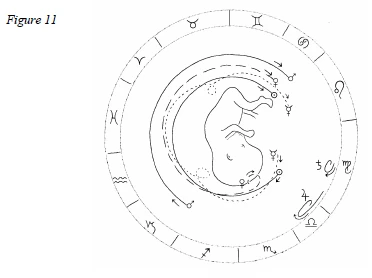
According to the diagram, the Sun was in transition from the constellation of Crab to Lion at the time of birth. It started in the constellation of Scales at conception and subsequently moved through all the constellations up to Lion. To this arc of the Sun, we have to adjust the position of the embryo picture in the center to conform with our idea explained in Chapter II.
At the time of conception, the Sun was in conjunction with Jupiter, which had been moving from Virgin to Scales and had performed a loop in Scales during gestation. It has had a direct impact on the region of the head of the embryo. Saturn was further back in Virgin, and about the time of conception, it was in conjunction with Mercury. At the same time, Venus was moving into a loop in Scorpion, from the geocentric point of view. It was then standing in a line between the Sun and the Earth. Mars was further forward in the Zodiac. It started in Goat and moved as far as Crab during the embryonic development, where it came into a conjunction with the Sun at the time of birth.
A superficial contemplation of the diagram shows a conglomeration of planets above the position of the head of the embryo. Especially Jupiter seems to weigh down upon it. For a more specified delineation of the given facts, as far as it is possible within the compass of this publication, we must fall back on considerations of the planets and the constellations of the Zodiac worked out in Isis Sophia II.
Jupiter is connected with the infusion of life into organisms that are destined to live. It works, therefore, more from within the body. Its influence makes the brain blossom, as it were, into the cavity of the skull. Altogether, Jupiter has a decisive share in the formation of the nervous system. Thus, the degree of its activity during gestation can be recognized especially in the individual formation of the forehead. However, it is generally connected with the “rounding” of the bony features of a human body, harmonizing and even beautifying it. We can imagine that if it is in close cooperation with the Sun, then its impact on the embryo is enhanced. We coordinated the Sun and its arc to the formation of the amnion, which is highly responsible for the creation of the nervous system. For this activity the cosmic Sun counterpart, the amnion, needs the cooperation of Jupiter, and we can imagine that a conjunction of the two, as in our case right in the beginning, would put great stress on this particular development of the embryo. It can even exaggerate it, as we see here.
Why have we, then, a deformation in this particular case? The answer is given in the position of Mars at the same time. It formed an angle of exactly 90° with Jupiter at the time of conception. Generally speaking, such an angle indicates disturbances concerning the cosmic influences. We have pointed out in Chapter I, that scientists investigating radio-signal behavior have realized this in connection with planetary angular positions from a heliocentric point of view.
It is very illuminating to investigate this particular angular position of 90° between Jupiter and Mars in greater detail. Mars is, in a sense, the great “realizer” in the cosmos. A lot depends on its cooperation as to whether putting the “idea” into practice and to the test is achieved harmoniously and successfully. Even the “idea” of the human form needs this participation of Mars during gestation. In the case of our hydrocephalus, this cooperation of Mars seems to have been seriously inhibited, as is indicated by the angular relationship of Mars and Jupiter. Therefore, the formation of the head and especially of the central nervous system, in which Jupiter was involved, did not come up to the standards of the general “idea” of a human form.
We should like to consider these facts briefly from the viewpoint of the constellations of fixed stars involved. Jupiter moved through Scales and performed a loop there. In other words, its influence has been drawn in by suctional activity of the Sun from the opposite direction of space. (The superior planets: Saturn, Jupiter, Mars are making loops—apparent gestures according to Copernican conceptions—when the Earth stands in a line between the planet and the Sun.) Jupiter in Scales would remember a long bygone stage of cosmic evolution when matter was still in a very ethereal condition and humanity had only reached the stage of plant-existence. (See Isis Sophia II, Part Three.) The Scales signify the final culmination of this stage, a flower-like attitude of our human predecessor without, as yet, any emotions or passions. As a cosmic memory-picture, this describes the attitude of a hydrocephalus condition very well on the basis of his physiological and biological particularity. Anyone who has worked with such human beings knows that they usually appear rather peaceful, incredibly wise, though inverted and passive.
Mars, on the other hand, in Goat and moving as far as Crab, indicates a slackening of fighting power that is needed by the human being in order to maintain integrity. Mars tends to “cover up” the constellation through that it moves. Goat is a cosmic memory-picture of stages in the past when great battles for the maintenance of the “normality” of evolution were fought. In our case, Mars in Goat obstructed the incarnation of the heritage of such capacities. Instead, it had the tendency to move out into cosmic space, until at the time of birth it stood far behind the Sun. It lost itself in a kind of formless universality, forming again at birth an angular relationship to Jupiter of 90°.
The events in the sky at the time of gestation only indicate possible tendencies. By no means, need they lead to similar results in seemingly similar cases. The question, however, is why they cause physiological deformation in an individual instance, whereas many others seem to be unaffected. The asterogram of gestation alone cannot answer this question. Only more individual consideration of the single case can provide a basis of judgment. We shall briefly refer to this later on.
We add another asterogram of gestation of a hydrocephalus. He was born on February 5, 1930.
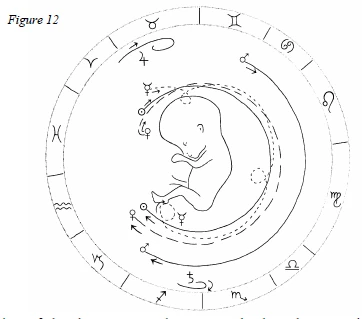
The positions of the planets seem to be considerably changed, compared with the preceding asterogram. However, the main features were very similar in a purely relative sense. The Sun started in Ram and went as far as Goat. Jupiter was in transition from Ram to Bull and also had a conjunction with the Sun about the time of conception or shortly afterward. Mars started in Twins and moved through to Goat. This gesture is reversed compared with the one in the previous example. One remarkable feature during this particular embryonic development was a conjunction of Mars with the Sun in Scorpion and, at the same time, an opposition to Jupiter in Bull. (In this case also, Mars is far removed from the Earth, though with a different cosmic memory value.) We must imagine Jupiter-Earth-Sun-Mars to have stood along one line in cosmic space, in other words an angular position of 180°.
The interpretation of this asterogram would have to be on somewhat similar lines as before. Jupiter in Ram reflected the character of Scales (opposite), which we have already described. The emphasis had been still more on the head processes, because Ram is the cosmic historiographer of the evolution of the head and brain. Mars was different here. It may be, that only during the 8th lunar month of gestation, when that angular position of 180° was reached, that the cause for the later deformation became acute.
One particular feature, especially, remains to be discussed. Venus made a loop at the beginning of the embryonic development. We noticed also a loop of the same planet about the time of conception in the preceding example. As a matter of fact, we have found such loops of Venus in other asterograms of gestation of hydrocephalic children. We have collected a number of such data, and all of them show this particular feature, partly in rather conspicuous places.
Why should this planet have an influence on the coming into existence of this particular deformity during its retrograde phases? Venus is especially connected with the rhythmic system, with breathing and circulation that is centered in the middle part of the organism. However, we have pointed out in Part Three of Isis Sophia II that this rhythmic activity works also in the head, as well as in the limb and metabolic systems. Through the influence of Venus during gestation, either of these processes can be strengthened by neglecting the others.
Thus, if Venus makes a loop—in other words, when it is nearest to the Earth—it can work upon an embryo so that the head processes, as far as they concern circulation, are over-emphasized at the cost of poor dispositions in the other two bodily regions. In the two cases that we have presented here, Venus performed such loops which had aggravated the disposition toward a hydrocephalic condition. This aspect of Venus is especially conspicuous in the two examples that we have produced, because they were situated in the head regions of the embryo images. This is, however, not always the case in asterograms of this type.
Let us consider the gestation asterogram below of another malformation described as: male, born December 19, 1907, without posterior cranial development—in fact, with merely a frontal mask.
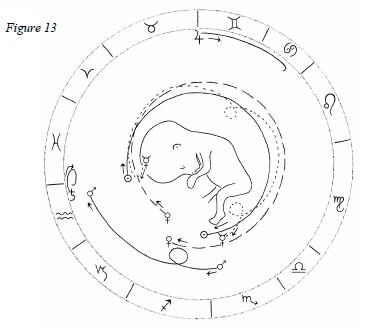
In the asterogram, we find Mars performing a loop above the head of the embryo, actually in the place of the umbilical cord of the embryo image. At the time of birth, it had arrived in the neighborhood of Saturn, which made a loop in the point of transition from Waterman to Fishes. Jupiter moved through Twins and Crab, going into a loop only at the very end of gestation.
These few features describe the disturbance very well. First of all, we should like to recall what we said about Jupiter in connection with the two examples of hydrocephalic cases. It has a decisive share in the formation of the head and the central nervous system. In the present case, it was far away from the head of the embryo image; it worked more in the lower parts of the organism, if at all. Furthermore, it did not perform a loop till the very end. It stood “beyond” the Sun (conjunction during the fifth lunar month) and was not very “interested” in earthly matters. Besides this, it was attacked, as it were, by Mars from the opposite part of the sky, by an angular relationship of 180°. We can therefore imagine that Jupiter’s forming power was not very strong, particularly not on this gestation.
Saturn was glued, as it were, to the back of the head of the embryo image. Jupiter exercises a molding activity on the embryo; it works to a certain extent from within the organism like a sculptor. As far as the head is concerned, Saturn checks this Jupiter impact from without. It puts, for instance, the helmet of the skull over the brain. (We notice that Saturn was near an angular relationship of 90° to Jupiter at the time of conception.)
To this, we add the particular relationship of Saturn to the Zodiac in this movement. It was mainly in Fishes. This reminds us, in a cosmic sense, of the very first stages of evolution. (See Isis Sophia II, Part Two.) Here the progenitive archetype of a human being appears like an automaton, still lifeless, only an ethereal expression of the divine idea of humanity, a mere mask of what a human being was to become. This comes very near the description of the case we are considering here.
Mars brought on an aggravation of this tendency. It had a conjunction with Saturn in Fishes after birth. In this region, it would inhibit the wise formative powers of those nature-forces that establish an equilibrium between spheric (Sun activities) and centric (Moon-Earth tendencies) capacities in the body. This example reveals that Saturn and Mars can work against the sculptural, plastic activities of Jupiter. Another asterogram of a micro-cephalic case confirms this. The child was born on September 22, 1926.
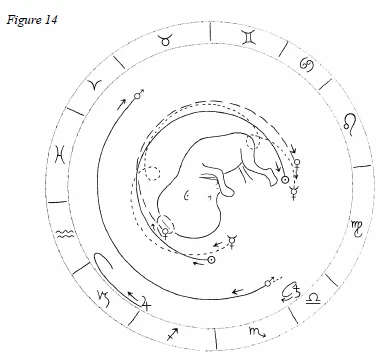
The Sun started in the constellation of Scorpion/Archer and entered Virgin at birth. Thereby, we again find the embryo image indicated. Above the head, Saturn and Mars were standing close together at the time of conception. This took place in Scales. Jupiter appeared pushed further down into the embryo. Venus made a loop in the place of Jupiter’s path during the gestation. Mercury performed a loop in front of the Sun at the time of conception, whereas it was in superior conjunction with the Sun at birth, meaning that it was beyond the Sun from the viewpoint of the Earth.
First, we should like to consider in this connection, the relative positions of Sun and Earth at conception. The Sun—the cosmic archetype for the amnion—was permeated by the forces of Scorpion. We see here how those powers that build the head of the embryo were penetrated by destructive cosmic derivatives. The Earth, standing in the opposite direction from the viewpoint of the Sun, was exposed to forces that were streaming into the solar system from the region of Bull through the suctional activity of the Sun. This would be, according to our hypotheses, the archetype that the embryo employed in the yolk sac (allantois) organization. We can, therefore, see an indication that the limb and metabolic forces are possibly over-emphasized. (See also the attitude of extreme motion of Bull on ancient star maps.) Of course, this particular relationship of Sun and Earth may only slightly facilitate deformation; standing alone, it need not lead to it.
A much stronger influence on this embryo seems to have been exerted by Saturn and Mars. The exact conjunction between the two took place December 15, 1925, which was 281 days before birth. It was in the point of transition from Scales to Scorpion. Saturn exercised its scleratizing influence, aggravated by a Mars that was inclined to exaggerate and enforce preponderance of the potential forces inherent in the limbs. The constellations of Scales and Scorpion belong to those regions of the Zodiac from where the archetypal derivatives of the limb system came in the course of cosmic evolution.
Jupiter was rather pushed into the background. In the beginning of this embryonic development, it came into conjunction with the Sun. It was then disinterested, as it were, in earthly affairs. In this position in Goat, it would not exercise much of its organizing and harmonizing power, especially with regard to the organization of the head forces. Here too the emphasis was more on the limbs.
This was aggravated by the loop of Venus in the place of the curve of Jupiter during gestation. Already in connection with the description of the two hydrocephalic asterograms, we have pointed out the character of a loop of Venus. We said that the equalizing power of these particular planetary influences, in such a case, may be disturbed by a weakening of the rhythmic and an over-emphasis of the head processes. This seems to contradict the micro-cephalic condition. However, we realize here that this Venus gesture is like a blow against empty air because this impact cannot amalgamate with a healthy Jupiter activity. It rather suggests something like being beheaded and, consequently, the whole body being substituted for the head. There are definite foundations for a development in this direction, indicated by this particular loop of Venus in Goat, but we cannot enter into a description of the astronomical facts here.
Thus, we can see how the constellation of the planetary cosmos may have initiated and accelerated a malformation. The one-sided development of the limbs at the price of the comparative smallness of the head is also indicated by the gesture of Mercury during gestation. At birth, it was in superior conjunction (beyond the Sun) from the viewpoint of the Earth. In the sphere of the head of the embryo image, we see a loop. The planet could not contribute to making this region a proper or normal expression of a personality, because in the loop it has the tendency to compress and contract. (Mercury endeavors to make the whole organism a vessel for the development of personality.) The limbs, indicated by the Sun at birth— in this case near the autumnal equinox, are exaggerated. The superior conjunction of Mercury suggests a stretching out of the limbs into space in an unbalanced manner.
We conclude this brief outline of a study of physiological deformations with two cases of malformation of the feet. The first one was born on March 16, 1798 (Fig. 15). He is described as a male cripple, whose feet were inverted, but who was active and intelligent. The asterogram of the embryonic development shows Saturn and Mars close together in Twins at conception. At the same time, this was the head of the embryo image as indicated by the Sun. Mars was in a 90° angular relationship to Jupiter, which was in transition from Fishes to Ram. The same happened again soon after birth when Mars moved through Archer. Another remarkable feature was the gesture of Venus. At conception, it was standing beyond the Sun from the viewpoint of the Earth, and at birth it was performing a loop in front of the Sun. Mercury made a loop at conception and had just completed one shortly before birth. The nearness of Saturn and Mars reminds us of the asterogram of the micro-cephalic case, which we described above, apart from the fact that it took place in a different constellation of the Zodiac. However, we must realize that Mars had already passed Saturn shortly before conception. Such seemingly inconspicuous facts alter the implications considerably.
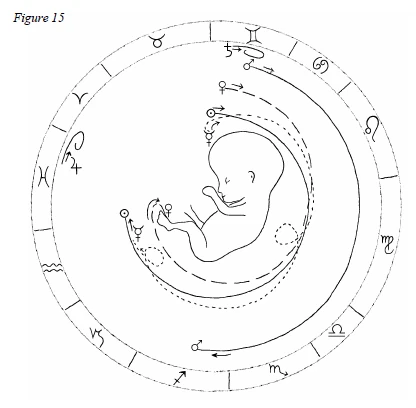
We are mainly interested in knowing whether any indication of the deformation can be found. Therefore, we must turn to the position of the Sun at birth, because the feet of the embryo image are there. Below this point, we find Jupiter in a lonely position. One has almost the impression that it had not been engaged during this gestation. Its wisdom had not been consulted, although it had the wisdom of Fishes and Ram. Fishes is connected with the cosmic archetypes of the feet. This, then, Jupiter was contemplating, but it carried this contemplation also into Ram (the cosmic image of the head and the “ideas”). One could perhaps say that there was the slight tendency indicated to keep the wisdom of Nature, which is essential for the creation of a so-called normal bodily constitution, too much in the realm of the “idea”. (One might think of the creative “ideas” that Plato still experienced and that Goethe saw again when he spoke of the archetypal plant.)
The main point, however, is the fact that Mars obstructed Jupiter with the angular relationship of 90°. The obstruction was closely connected with the head of the embryo image. Mars in that position in Twins would infuse a biological tendency of refraining from touching the Earth, a kind of physiological idiosyncrasy toward this planet. This would combine with the peculiar nature of Jupiter and ultimately appear externally as deformed feet. That this should happen to a human being is a question of his individual destiny. It cannot really be explained except by a consideration of past incarnations. Here in the asterogram of gestation, we can only observe how the forces of the cosmos hold out the possibility of acquiring a body that is in conformity with the destiny caused by experiences in previous incarnations. The gesture of Venus is very interesting. In a certain sense it happened the other way round. It was in superior conjunction with the Sun in the head of the embryo image, indicating limb tendencies. At birth it made a loop, which would point to head activities that were certainly in the wrong place, as we find the feet of the embryo there. However, the head tendencies may have found expression in the inversion of the feet.
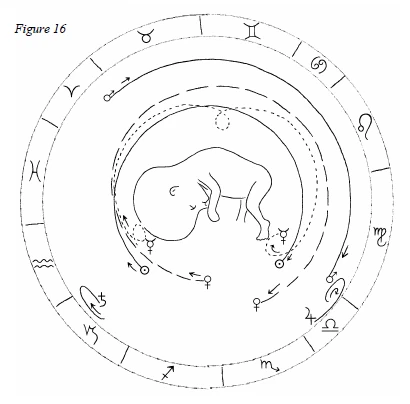
The following diagram, Fig. 16, was one belonging to a female cripple, born November 4, 1816. The description is rather similar to the preceding picture: feet turned inward, clever. Here we also find Jupiter in a relationship to the feet of the embryo image and almost in the opposite portion of the Zodiac. Again, Mars was obstructing Jupiter, but now it happened from an angular position of 180° at conception. Saturn we find above the head of the embryo image as in Fig. 15. Only Venus is different, though it performed a loop shortly before conception in the place of the Sun at birth, in other words, in the feet of the embryo. This case has such a great similarity to that of Fig. 15 that it does not seem necessary to delineate it any further.
Chapter IV
Cosmic and Physiological Foundations of Soul Life
After having indicated in the preceding chapter possible approaches to the asterograms of gestation, we will now go one step further and try to work out some facts about the soul-life of a person and investigate how far this is based on the cosmic and physiological background of a human being. The body is the platform on which the soul stands and by which it has a connection with the external world. This vessel of the body can enhance or hinder the development of a person’s inner faculties. A proper knowledge of this background can help to overcome difficulties or make use of possibly dormant potentialities. Here lies a wide field of therapeutic facilities. The acquisition of a thorough knowledge is, however, the primary condition for any attempt in this direction.
At the end of Chapter III, we spoke of a deformation of the feet of a human being. To this we add now another historic example, the gestation asterogram of Lord Byron, born on January 22, 1788 (Fig. 17). The Sun had entered the constellation of Goat, coming from Ram. Saturn had been performing a loop in the transition from Goat to Waterman. It was below the feet of the embryo image. Jupiter moved in a big curve through Bull. Mars started in Fishes, moved as far as Crab, became retrograde (loop), and it returned to Twins at the time of birth. Venus also started in Fishes, very near to Mars, and moved in a majestic gesture through the Zodiac until it had a superior conjunction with the Sun in Scales (Venus beyond the Sun). After that it went as far as Goat and at birth it was standing between Saturn and the Sun. Mercury had just come out of a loop at conception, and at birth it was standing in Archer.
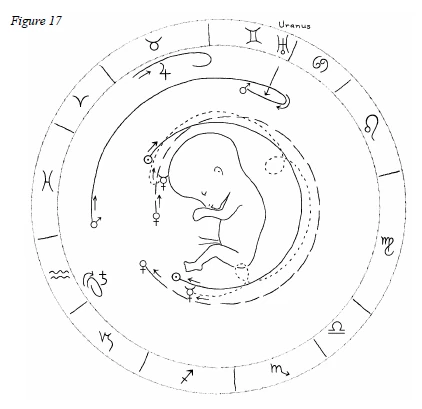
It is well-known that Lord Byron had a deformation of his foot from birth. This is indicated in the asterogram by the position of Saturn below the feet of the embryo image. However, this alone could not account for the deformation. We must take Mars into consideration, which had been performing a loop just opposite the feet. It combined its forces with Uranus (the first of the newly discovered planets), which was then in Crab and had formed an angular relationship to the Sun of 180° shortly before birth. The Sun itself entered Goat at birth, which is the archetypal region of all joint-like formations in the human body.
The background of this Mars activity in connection with the deformation will interest us most. In order to find the cause, we would have to go back to a former incarnation. We cannot embark on this question now, but we can study the impact of the underlying cosmic constellations on the Byron incarnation, because we have the impression that the deformation did not come by chance, even not by a cosmic chance, but by inner or soul affinities of Byron.
Mars started in Fishes. It went then through Ram, Bull, and finally put all emphasis on Twins by making a loop there. We now have to find a congenial interpretation of this gesture. According to the indications in Part Three of Isis Sophia II, those constellations are connected with an ancient stage of evolution that spiritual science calls Ancient Moon. Two cosmic principles opposed each other then: one that can be compared with the present Sun and another one that, to a certain extent, had a character similar to the present Moon of the Earth. The Sun entity and its development at these stages is born as cosmic memory, as it were, in the constellations from Fishes to Virgin via Twins. It acted as a kind of cosmic corrective in that cosmos, against certain tendencies of deviation from the normal path of evolution and even calcification, which prevailed in the Ancient Moon cosmos.
Mars, by moving through the Sun constellations—especially through Twins—remembers those bygone stages of evolution. It prepares the body of a person, as far as it is concerned with this task during gestation, to become a vessel, a platform for the realization of soul tendencies that are akin to developments representing a continuation of that “Moon-stage” into present times. (Of course, we keep in mind that we must seek the corresponding soul-affinities of Byron in former incarnations.)
Thus, a bodily background for the realization of such a “Sun” corrective was created by the activity of Mars in the case of Byron. However, though it remembers those past stages, Mars tries to obstruct these cosmic aspects. The result of this obstruction is usually an inner battle in the life of a human being that may sometimes lead to a tension between extreme psychological tendencies. Discrepancies of this kind may even create caricatures of the inherent impulses of such a soul.
Something in this direction had opened in the life of Byron. He was certainly a personality imbued with high ideals of humanitarian progress. His participation in the struggle of the Greeks for freedom from the Turkish yoke, and his death in the course of the events shows this quite clearly. However, his desire and longing for manifestation of the spiritual Sun corrective against a sterile society sometimes took on grotesque forms. It led him to eccentricities and erratic actions that were apt to conceal his true impulses in the eyes of his contemporaries. The struggle in his own soul often made him a wild revolutionary against the well-established laws of society, instead of giving him the chance of becoming a healthy example of the evolution of humanity.
Even in an external sense, Mars made Byron’s body a caricature of the ideal of a human form. The deformity of his foot prevented him from touching the Earth properly, in other words from penetrating the Earth with his inherent Sun qualities. Certainly one can dispute any influence of this deformation on Byron’s inner world. However, we take it as an external symptom of an inner condition. Besides this, we know that he was depressed at times by the fact of this deformity.
It would certainly be unjust to stretch the importance of Byron’s deformity and the background of it too far. It was a reminder of the past, and he overcame it, to a certain degree, by his will. Saturn in Goat/Waterman indicates that he had a deep connection, for instance, with nature and the beauty of the world. Waterman and especially Goat tell us of the stages of evolution in the very dim past, from Saturn’s point of view, when the first foundations of the sense organs were laid. (See Isis Sophia II, Part Two.) Through the capacities that Saturn built into this body, Byron certainly had a great connection with the external world through his senses. This is quite apparent in some of his poetry and became also manifest on his journeys and the experiences he derived from them.
Jupiter in Bull was connected with Byron’s degree of mastership of the word as a poet. We can see in the diagram that during gestation this planet moved above the region of the larynx and chest of the embryo image. The Bull is the archetypal region of the larynx, born out of the power of the divine creative Word.
The cosmic derivatives of this Jupiter became Byron’s property at an early age. Mercury, the planet that endows us with the biological qualities for expressing and manifesting our personality, started in Ram (the imagination of unimpeded individualism) and very soon entered Bull, where it came into conjunction with Jupiter. We see in this an indication that he was able to take up the biological heritage of Jupiter, the inner calling to poetry at a relatively early age.
Venus started in a conjunction with Mars and moved into the neighborhood of Saturn by the time of Byron’s birth. Here we see a picture of those forces, which Venus worked into this organization, that stand behind the rhythmic system and mark the mood and the trend of one’s vitality through life. In the beginning, he was more under the sway of those dynamic tendencies that Mars had built into his organism, but later he moved more to the serenity, perhaps even the tragic mood, of Saturn. He became more earthbound through his body.
Another asterogram of gestation, which we will consider from a similar cosmic-biological background, is that of Shakespeare. He is supposed to have been born on April 23, 1564, New Style (Fig. 18). The Sun of gestation leads us back to July 1563, when it was in the constellation of Crab. There, where the head of the embryo image is indicated, we find an extraordinary cosmic event. It was a conjunction of Saturn and Jupiter, which actually occurred during his embryonic development.
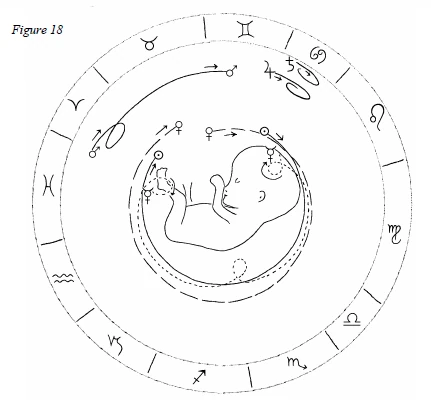
This kind of conjunction is rather rare. It takes place every twenty years, but each time in a different part of the Zodiac. It takes 60 years for this event to return, as it were, to approximately the same place. For instance, the conjunction in Crab in 1563 was preceded by an earlier one in 1503, which took place slightly further back in the Zodiac. Therefore, we can say that it was an unusual coincidence in connection with Shakespeare’s incarnation.
We can imagine that the biological impact of this event on Shakespeare’s organization must have been remarkable. We feel again obliged to point out that the coincidence is an expression of faculties attained in the past. From the viewpoint of spiritual science, it is correct to say that Shakespeare’s individuality had chosen this particular cosmic moment, because its biological implications suited his own spiritual heritage from past incarnations.
Saturn is chiefly concentrated cosmic memory. In an organic sense, it maintains—especially during the initial stages of gestation—the continuity of the species. It impresses on the embryo the typical human form, which is in existence as the result of immeasurably long stages of cosmic evolution. This, one might call organic cosmic memory, but the influence of Saturn extends its impact so deeply into the human organism, that the latter becomes capable of memory in a human sense. It can, therefore, also enkindle in one a sense for history.
If Jupiter combines with such a disposition as is indicated by the conjunction with Saturn, then the plastic, highly “artistic” capacity of Jupiter can enhance the sense for history. The radius of human expression of such a combination is enormous. Among many possible variations, it can become the foundation for making memory, in the garment of history, a vivid and artistic manifestation of human or cosmic evolution. The variation depends rather on the constellation where the event took place. In Crab, where we found the conjunction in connection with Shakespeare’s prenatal development, we can expect a strong forming power, perhaps even too strong and apt to bend the historic facts. We see an impact of this kind working in the place of the head of the embryo image of Shakespeare’s asterogram. Thereby, we can understand the biological foundation and organic pliability that made him what he is in modern humanity.
The gesture of Mars is also very interesting in this connection. It started in Fishes and came as far as Twins. In a certain sense, it reminds us of the Mars gesture of Byron, with the difference that the loop took place in Ram. We can also apply here, to a certain extent, what we said above the Mars constitution of Byron, except that eccentricity and an erratic attitude (Twins) are by no means so strongly pronounced. From the viewpoint of the loop in Ram, it is more a tendency toward caprice and tenacity, perhaps even obstinacy. It was perhaps the background of this cosmic-biological constitution that urged Shakespeare, in many of his creations, to deviate from the given historic and human facts and bend them to his own purposes.
Venus, the tutor of one’s forces of vitality and sense of communication, started in Twins and, after a big sweep through the Zodiac, arrived in Bull at birth. The emphasis was on the word, born out of the divine creative Word—in Bull. We see the cosmic-physiological background of the poet and great master of language.
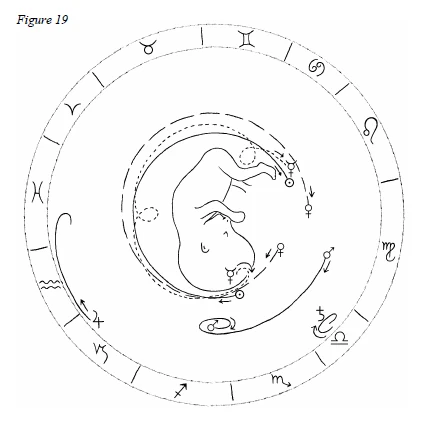
Shown in Fig. 19 below is the asterogram during the embryonic development of Goethe. He was born on August 28, 1749. The Sun was in the constellation of Lion. Concerning the conception, we come back to a Sun in Scorpion. At that time Saturn was in Scales where it remained during gestation. Mars and Venus started very near to it, but they were still in Virgin. During the second part of the embryonic development, Mars made a loop in Archer and Scorpion and, by the time of birth, returned to Archer. Venus went through the Zodiac in a majestic curve. During gestation it was in superior conjunction with the Sun in the horns of Bull. At birth it had just entered Virgin. Mercury started with a loop in Scorpion and was close to the Sun in Lion at birth.
The head of the embryo image is dominated by Saturn in Scales. Saturn is, in a general sense, inclined to slow down the processes in the human body. In an extreme case, it may initiate some kind of sclerotization, but usually it creates a disposition toward cautiousness and a conservative attitude. This tendency is more pronounced if Saturn is moving in the neighborhood of Scales. The latter constellation expresses a mood of receptivity, openness to ever new experiences, and a constitution inclined to resignation and adaptation to given facts. We can understand this on the background of the “biography” of Scales. (See Isis Sophia II, Parts Two & Three.)
Goethe had a nature that was very much inclined to such a disposition. This became more pronounced in his later years. He was lucky enough to have incarnated in an environment that permitted a slow, careful, and conservative development, at least in the second part of his life. Also, his great age (he died when he was 82) is an expression of the Saturn influence. It gave him the opportunity to complete his great work, Faust, in peace, which had actually taken him his whole lifetime. His sternness and dignified composure (still more pronounced by his position as Minister of State of Saxe-Weimar) also had its roots in the cosmic-biological influence of Saturn in Scales.
However, it would be wrong to pin everything in Goethe’s constitution down to Saturn. This was more the past, the man who had to adjust himself to the (certainly self-chosen) character and conditions of the time when he lived. The Goethe who lived for posterity is even, in a certain sense, in contradiction to the Goethe of the 18th and 19th centuries. This is expressed in the position of Jupiter in the asterogram. At the time of conception, it is in an angular relationship of 90° to Saturn.
We have spoken earlier about the influence of Jupiter on a growing organism. It makes the organism flexible and pliable and can thus create a sense for liberal acquisition of new and unorthodox views in life, the corporeal foundation of universality of mind. We have also pointed out that it takes a decisive share in the formation of the nervous system during gestation.
Concerning Goethe’s prenatal asterogram, we cannot say that Jupiter was connected with the formation of the brain alone. The angular relationship to Saturn, which dominates the head of the embryo image, would rather suggest that there was a certain tension. Jupiter itself worked mainly in the chest region, which would indicate that the qualities of this planet were more connected with the heart forces of Goethe. Therefore, his thinking power was different from what it would have been if Jupiter had been more related to the head region. In the latter case, purely philosophical thinking may have predominated. As it was, Goethe found an expression for his thinking capacities in the realm of poetic and artistic creation. This became especially evident in his relationship to Schiller. Once Schiller expressed his convictions about human evolution in a philosophical treatise, his Letters on the Aesthetic Education of Mankind (Briefe über die ästhetische Erziehung des Menschengeschlechts), concerning the function of art as the supreme educative agent of a human being. Goethe, when urged to make a confession of his humanitarian ideals, could not do it in such a form. Instead he wrote the famous fairy tale of The Green Snake and the beautiful Lily.
Jupiter was chiefly moving through Waterman and, during the second half of gestation, Fishes. This emphasized those Jupiter qualities still more. Waterman preserves the cosmic memory of bygone ages when humanity was much more under the healthy guidance of cosmic forces, whereas Fishes demonstrates, from the view point of Jupiter, the incarnation of divine wisdom in all that exists in the physical world. Goethe had certainly the gift, to a certain degree through his physiological Jupiter nature, of contemplating and perceiving the wisdom inherent in the kingdoms of nature. His scientific approaches, his methods of observation, and his experiences of the archetypal creative forces in nature stand witness to these capacities.
Mars is more associated with the Saturn side of Goethe, as we can see in the diagram. It moved from Virgin to Scales and Scorpion, finally into a loop in Archer. In this part, it emphasizes ancient heritages in humanity that led, in the past and still leads, to a strong estimation of an individual’s own independence and freedom. Such heritages are present in everyone, even as biological facts, however strongly pronounced. (See also, Isis Sophia II, Part Three, concerning Scorpion.) In Goethe this Scorpion tendency was very much emphasized, especially in his earlier years. We can imagine that a tremendous struggle prevailed in Goethe between the conservative tendencies of Saturn and the rebellious and dynamic character of Mars Scorpion. Many proofs can be found in his biography. Finally, he achieved a harmony that he expressed in terms of his Faust. Mephistopheles, Faust’s companion and tempter, is ultimately defeated by the higher spiritual affinities of humanity. This is the aspect of Mars in Archer Centaur, conquered by the powers of a purified Venus.
During the 7th lunar month of gestation, Goethe’s Venus came into a superior conjunction with the Sun between the horns of Bull, where ancient people perceived the golden Sun-disk of Hathor or Isis. This happened at a time when Mars, standing almost exactly opposite in the head of Archer, went through its loop. Venus, however, having started close to Mars at the feet of Virgin, had returned at Goethe’s birth to the head of the same constellation. It is a Venus that had to go through many trials in Goethe’s life, but ultimately it became his salvation. He was very conscious of this, and in the last scene of “Faust”, he described the reality of those forces in the great Imagination of the Heavenly Queen, the Mater Gloriosa. (Speaking about Goethe’s Mercury would need a consideration of many details of his biography. There is not the space to make such an attempt at this time.)
We shall conclude with a glance at Nietzsche’s prenatal asterogram. He was born on October 15th, 1844. We come to his conception as approximately January 15, 1844 (Fig. 20 below). About that time, the Sun was in conjunction with Saturn in Goat. This would indicate a constitution which we met in Goethe, but the affinity to Goat suggests a rather subtle Saturn organization. One could say that his organism of the senses (and nerves) was highly strung. It had something of the nature of Goat or Ibex, endeavoring to climb the highest peaks, yet fettered by its fish-like tail to the depths. Jupiter’s position in the Zodiac (Waterman and Fishes) and in the embryo image was rather similar to its position in the case of Goethe. This may have given the foundation for his feeling life, his eloquence of style and his love for music. Mars reminds us of Byron to a certain degree. It moved the whole way from Fishes to Virgin, and much that has been said about Byron’s Mars, its Sun-like character and reforming will, and also its revolutionary tendency and final failure, can be applied to Nietzsche’s biological Mars organization.
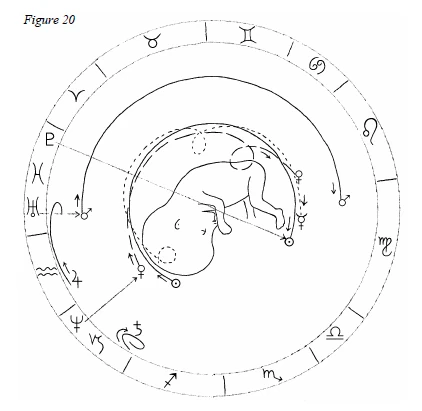
Nietzsche came in contact rather early with writings of the philosopher Schopenhauer. Through his love of music, he found a relationship to the famous composer Richard Wagner. Starting from this friendship, he went through a period of idealistic philosophy but became, in a certain moment, estranged from Wagner. After that, he developed more rationalistic trends of philosophy that came to an end about the time when he wrote his most famous book Thus Spake Zarathustra. It is more a poem than a philosophical treatise. Soon after the completion of Zarathustra there came books like The Will to Power, Beyond Good and Evil, etc. Gradually, he sailed into a complete breakdown and became insane in the years 1888/89. In January 1889, he had a stroke of apoplexy and his few friends had to take him to an asylum. He spent the last 12 years of his life helpless, cared for by his mother and sisters.
The tragic fate of Nietzsche must interest us most. Can we find any indication in his cosmicbiological make-up? In order to answer this question, we must resort to the planets that have been discovered during the last two hundred years: Uranus, Neptune, and Pluto. In the ancient order of the planets from the Moon to Saturn, we have the cosmic counter-pictures of practically all the functions within the boundary of the human physical body. The new planets go, as it were, beyond them. They describe the supersensible organization and affinities in a person; therefore, they create more inclinations toward the occult, the spiritual world, toward the development of higher capacities of consciousness or, in case of failure, caricatures of it that may border on mental disease.
Any elevation of consciousness can only take place by a using up and transformation of the natural organic functions. Whereas the order of the ancient planets builds up the organism, the new planets endeavor to dissolve it and to transform it into capacities of consciousness. This can be enhanced by the individual biological make-up, but it can also be accelerated to such a degree that the healthy balance between body and mind is prevented or destroyed.
Thus, roughly speaking, Uranus is an inversion of Saturn, Neptune of Jupiter, and Pluto of Mars. This is valid as far as the superior planets are concerned, but Uranus, Neptune, and Pluto can also be regarded as potentializing antidotes of Mercury, Venus, and the Moon.
In Nietzsche’s asterogram, we find the three new planets in rather conspicuous positions. Neptune was in conjunction with Venus and Mercury in Waterman at the time of conception. Shortly afterward Mercury went into a loop. All this took place in the head region of the embryo image. We can imagine that here was the root of the extremely delicate constitution of Nietzsche, especially as far as it concerns the senses and nervous system. A modern biographer of famous philosophers described him as having had “the nerves of Shelley, the stomach of Carlyle, and the soul of a girl under the armor of a warrior”. (The Story of Philosophy, by Will Durant.)
Furthermore, Mars was in conjunction with Uranus in Fishes. This must have aggravated his Mars disposition to a degree, which one can understand if one reads his later writings, especially Thus Spake Zarathustra. His revolutionary ideal was the Superman—he who is above restrictions set up by the standards of morality in modern society, which Nietzsche considered decadent and perverted to the utmost.
Finally, we find Pluto in exact opposition to the Sun at Nietzsche’s birth. This explains a good deal of his inner greatness and purity, his forcefulness and striving for the highest idealistic conception of humanity, but, also, his highly destructive and atomizing philosophical trends in later years. What appeared externally as a nihilistic world conception was obviously, to a high degree, the reflection of internal organic transformations and dissolutions, whose magnitude can only be grasped on the cosmic background of Nietzsche’s biological make-up.
Undoubtedly, he had great resources, but he had not the capacity to master them by his individuality and to force them into the boundaries of safe and sane human handling. If this is missing, then the gifts of the cosmos during gestation may become like wild horses that tear their charioteer into the abyss of disease and failure.
Conclusion
The facts presented in this book may raise the following question: What can be the practical use of such a knowledge of the relationship between the human being and the stars?
The answer is that, although definite conclusions may at this stage still be premature, there are indications that this kind of research can become the foundation of a new kind of psycho-hygiene. The examples we produced in Chapter IV, show that the prenatal asterogram of a human being reveals inherent capacities and faculties that are worked out in life, usually by an instinctive awareness and certainty. There are, however, signs in our present age that modern humanity is losing this instinctive certainty of its path and its tasks in life very rapidly. The old half-conscious supports in life are failing more and more, and full consciousness of the personal destiny and spiritual background of the individual are demanded for the building-up of a healthy human existence. At this stage, a proper knowledge of the cosmic-biological foundation of a human being will in future be able to enhance self-consciousness and help to develop dormant capacities and facilities. The psychological conditions of modern humanity show, to an alarming degree, that such dormant capacities may become the source of inner irritation and of all kinds of diseases, if they remain undeveloped. On the other hand, the freedom and independence of a person cannot be impeded by the application of such a psycho-hygiene. The few examples that we gave in Chapter IV, show that the spiritual activity of a human being can be enhanced to an unlimited extent by this kind of research, if it is done on a foundation of spiritual science. The greater difficulty will be to create the confidence in our personal sphere of spiritual capacity and freedom.
The reader will realize that the scope of this book offers no more than the possibility of a rather crude presentation of our connection with the stars through the prenatal asterogram. Altogether, the static diagram is not very helpful in these matters. If the embryo imitates the movements of the celestial bodies, then it would have to be drawn as growing in size, in accordance with the growth of the arc of the Sun’s path. This cannot easily be done in a static diagram. One would need a film in order to create an appropriate impression. These and other difficulties may make this presentation appear oversimplified and, therefore, unsatisfactory. However, we intended in this edition is only a kind of first outline of this particular kind of research.
Also the question can arise as to how it is possible to find out individual features, because thousands of incarnating human beings must necessarily partake in the same configuration of the planetary world at a given time. For instance, one can assume that thousands of contemporaries of Goethe incarnated under the same sky and yet, only one Goethe rose from among them.
The answer to this fully justified question can only be worked out satisfactorily in the course of future publications. For the moment, we must point out that a lot depends on a proper knowledge of the time of conception. This seems to be impossible on the basis of present means of embryological investigation. There exist, however, certain possibilities to determine the time-orbit of the individual conception. (We shall speak about it in a later volume.) With such an adjustment of the prenatal asterogram, one can come considerably nearer to the individual characteristics of a human being. Yet, all the possible connections of humanity with the stars cannot reveal the full nature of a human being. They can only show, as it were, one half of our total being. In the case of the prenatal asterogram, we witness the coming into existence of the physiological vessel that we use for our life journey on this planet. It cannot be regarded as being more than a vessel or instrument that provides us with the means of giving expression to our innermost impulses; however, we must not mistake the tool for the operator. Moreover, an instrument can be used by its owner in various ways. It limits one only to a certain degree, and much depends on one’s ingenuity.
The operator standing behind the tool in our case is the ego, the eternal individuality that moves from incarnation to incarnation, during which it is supposed to acquire ever greater capacities. This individuality cannot be found in the visible stars. It is akin to the Divine Intelligence that moves the stars; but a healthy measure of knowledge about the tools, the cosmic-biological foundation, can enhance our faculty to put them to ever better use.
TABLE
FOR CONVERSION OF ECLIPTIC “SIGNS” INTO FIXED STAR CONSTELLATIONS
(Valid for the earlier part of the 21st century)
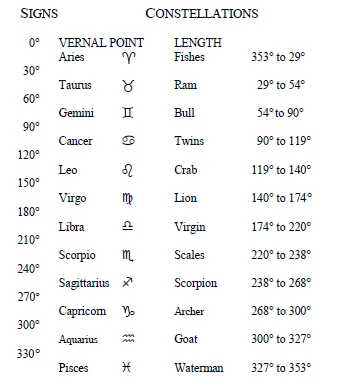
Example: On 8 April 1953, Jupiter was in 23° Taurus (Sign), according to the available astronomical ephemeris. Therefore, on that day it entered the constellation of Bull.