

Isis Sophia III
by Willi Sucher
Part Three
Chapter I
Cosmology and Embryology
Some time ago, in a well-known Swiss paper, an article appeared by Robert Jung (Author of Die Zukunft hat schon begonnen - Amerika’s Allmacht und Ohnmacht). This article contains the report of a lecture by Professor Dr. F. Zwicky during a conference of the American Rocket Society. Dr. Zwicky, a Swiss scientist who has been working for many years in the U.S., is one of the most prominent authorities on astrophysics and is at present professor at the Mount Palomar observatory in the U.S. He is a specialist in many branches of science and has occupied several important posts, especially during the last war. Dr. Zwicky gave in his lecture, so Robert Jung reports, a prophecy of future developments in astronomy that in his opinion are to be expected. He spoke of a coming “reconstruction” of the universe, and explained how this would be made possible by the unlimited resources of energy that will be provided by the perfection of atomic power. By these means, it will one day be possible to bring some of the planets of our solar system nearer to the Earth. Through atomic explosions, applied in oblique direction, these planets would be thrown out of their orbits and forced into orbits in the neighborhood of the Earth. However, our planetary system would not only be “reconstructed” in this fashion for human ends, for facilitation of interplanetary traffic and exploitation; it would also be possible with atomic power to “cut these planets to size”, to condense them to the degree of density of the Earth, to give them an atmosphere corresponding to that of our planet, and so on. Dr. Zwicky, of course, admitted that by intentional or unintentional mishandling, the Earth might be exploded instead.
If one reads such a report, one is inclined to pinch oneself in order to make sure that one is not dreaming. It sounds like fiction in Jules Verne fashion. The author of the article, however, who is a reporter for big Swiss and German newspapers, is reputable and sincere.
Many people regard Dr. Zwicky as a visionary and dreamer beyond reality; even his successes and the application of his ideas in several branches of technology can by no means support such views. Moreover, this is only the personal view of Prof. Zwicky, though based on practical considerations. Whether people will ever attempt such actions is altogether another question. By the time humanity will be able to apply the technical resources at hand to such dimensions, it may have reached different views on the matter.
There is also another aspect brought forward by this Swiss savant. Some people in prominent positions in the scientific and technological world in the U.S. speak openly of the discrepancy between theories on interstellar journeys, etc., and our present physiological capacities. Not a few have dared to consider human nature as it is at present as a failure, because it is simply not capable of standing up to the strains that those far-reaching projects demand with regard to the tremendous velocities, pressures, and changes of gravity involved. Here, too, Prof. Zwicky thinks that by education, etc., a “reconstruction” of human physiology and make-up can be achieved in time.
Why do such ideas as “reconstruction of the universe” and “reconstruction of humanity” enter human thinking at this stage of evolution? The answer is relatively simple. We have gradually lost all sense for the divine purpose inherent in the universe and ourselves. We no longer know why the universe exists. It just does exist, brought about by the rolling of the mighty dice of chance. Into this emptiness of consciousness shoot such ideas as those of which we spoke above. This stage had to come; it is no use deploring it. We have thereby attained the splendid opportunity of finding the divine background and “purpose” of the universe by objective accessories of our scientific discipline and out of free decision. At this stage, there is no longer any room for dogmas of the past and traditional fetters. Of course, humanity, or part of it, might abuse this freedom and make a gigantic specter of the universe and of itself instead of detecting the purpose and aim of divine creation. This is the risk that the divine world took when it released us into emancipation; however, we can imagine that even a partial success in numbers would justify the risk.
It has a great significance that the ideas of “reconstruction of the universe” and of “reconstruction of the human being” live side by side in the head of a modern scientist. The structure of the universe, especially of the starry world, and the organization of the human being are closely connected. The structure of the universe, of the starry world, is correlated to the processes, which take place during an embryonic development.
A relatively simple consideration of embryological facts can elucidate this statement. In very early stages of gestation (Fig. 1), two small cavities are formed within the ovum, the amnion and the yolksac. The separating wall between these cavities constitutes the first beginning of the actual embryo that develops its complexity through the activity of the three germ-layers:
1) the ectoderm - the floor of the amnion, 2) the endoderm- the ceiling of the yolksac, 3) the mesoderm- the layer between ectoderm and endoderm.
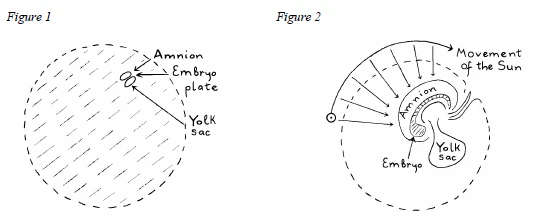
The actual embryo is, therefore, a threefold organism, as a result of the tension between amnion and yolksac. This picture alone can be taken as suggesting a microcosmic tension between two “stars” within the greater universe of the ovum.
This initial picture changes rapidly during later phases of the development. Figure 2 represents such a later stage. The two tendencies, expressed by the amnion and yolksac, show clearly their opposite directions. The amnion becomes curved and the yolksac forms a kind of globe. Later on this is even more pronounced. The amnion expands to the periphery of the ovum. It provides the “building stones” for the skin, the peripheral nervous system, etc. From the yolksac and its subsequent derivatives, tissues mainly connected with the alimentary tract (the metabolic system) arise.
We can see in these two main tendencies implanted into the embryo, an imitation of the activities of Sun and Earth with its Moon. This imitation works like the reflection of external objects on a photographic plate. Therefore, it does not illustrate the actual movements in the universe of Sun and Earth, for instance in a Copernican sense, it reflects “apparent” movement.
Thus the amnion imitates the “apparent” movement of the Sun in the sky during the embryonic development, the spheric tendency of the Sun, thereby creating the organization in us that enables us after birth to go to the periphery of the surrounding world via the senses, realized by the nervous system. The yolksac and its derivatives imitate the “apparent” stationary attitude of the Earth, enhanced by the circulating activity of the Moon, thus creating the metabolic system. It stresses the radial tendency of the lower organism of a person against the spheric inclination of the head and its accessories in the body. (More details and suggestions about the nature of Sun, Earth, and Moon are given in Part Two, and Isis Sophia II, Part Three.)
The idea that the embryo is created by an imitation of the apparent movements of Sun, Earth, and Moon has been used in all reality in corresponding researches. The results have been encouraging enough to carry it still further. Some of the conclusions have already been produced in Part Two, and we intend to go into greater detail in this section.
For experimental research, with regard to the duration of the embryonic development, the greatest difficulty is the determination of the moment of conception. The traditional time of gestation is considered to be 273 days, but this can be no more than an average. The individual time can be less or more, and the case of the seven- or eight-month old child suggests a drastic difference in time. There doesn’t seem to exist any scientific means by which the individual time of conception could be ascertained (excluding the aspect of artificial insemination).
We have adopted in our researches different ways of approach, though the collected material is still too incomplete and uncertain to say that the results have any direct bearing on the question of the time of actual conception. However, the outcome has led to success in directions different from purely embryological aspects, and we will produce the facts here as they have presented themselves.
The ancient Egyptians were already concerned with these and similar problems, and they also had their opinions about the matter. These were based on the so-called “Rule of Hermes”. Fragments of the latter have survived the ages in the writings of a number of Greek students of Egyptian Temple-culture. Those named, among others, are: Demophilos, Hephaiston of Thebes, and later Prochus Diadochus (Commentaries on Plato’s State). All of them speak independently of a knowledge that the ancient Egyptians are supposed to have possessed, by which they were able to ascertain the so-called moment of the “epoch” if the time of birth was given, or vice versa. The Egyptian priest-sages Nechepso and Petosiris, who are supposed to have lived about 1200 BC, are named as authorities, among others. (See Ernst Riess, Die magischen Fragmente des Nechepso and Petosiris. Philol. Zeitschrift, 68. Supp. Band 6, 1891.)
The text of these ancient fragments was found partly distorted or destroyed, but the method that the ancient Egyptians used to ascertain the length of gestation from the moment of birth is quite clear. They took into account the angular position of Sun, Moon, and Earth, and from these they calculated the individual aberration of the gestation-period of a normal ten-lunar-month child (273 days or 10 x 27.3 days). They also had methods of recognizing and calculating the time of gestation of a seven- or eightmonth child, but we shall mainly concentrate here on cases of the normal gestation averaging ten lunar months.
The ancient Egyptian rule is relatively simple. It states that the position of the Moon at the time of the epoch becomes the ascendant or descendant at the moment of birth. The meaning of the so-called epoch is not very clear. In the earlier manuscripts it is not identified with the moment of conception, but it is obvious that it was considered to be very near to that moment. However, we shall come back to this question later on.
In this simplified statement, is contained the rudimentary knowledge of the angular relationship between Sun, Moon, and Earth. The ancient rule maintains that a waxing Moon was in the place in the ecliptic that is rising (ascendant) at the moment of birth, and a waning Moon was in the place that was setting (descendant) at birth. In this way, the time between the epoch and the birth can be calculated.
It is quite obvious that the distinction between waxing and waning Moon constitutes an angular relationship between the Sun and the Moon. More difficult and strange may appear the inclusion of the rising or the setting point of the ecliptic at the moment of birth; however, this takes into account the third angular relationship, that of the Earth to Sun and Moon.
The plane of the horizon shifts through the ecliptic, caused by the daily rotation of the Earth. Once within 24 hours, all the points of the ecliptic are rising in the east and setting in the west. To regard this angular relationship of the plane of the horizon to the Zodiac as the criterion for the Earth’s position toward Sun and Moon may at first appear absurd. The infinite number of points on the surface of the Earth determines an equally infinite number of planes, which all have their individual points of zodiacal rising and setting. Therefore, the definition of the factor “Earth” within the triangular ratio Sun-MoonEarth, by singling out a minute part of our planet, seems to be irrelevant and inadequate; however, we must not forget that the place where a human being is born, which determines the plane of the horizon and also the points of rising and setting, is in that moment, for this human being, “the Earth”. Here we touch our planet for the first time, having become physiologically independent of the mother. Still, this viewpoint may be regarded as astrologically antiquated.
There are ample empirical proofs for the fact that the rising or setting points of any locality of the Earth have an influence on the composition of substances in that part. Extensive experiments over many years have shown that matter, especially in liquid form, spontaneously receives the impact of those cosmic facts. These influences exert a remarkable power if the Sun, or the Moon or planets are rising or setting. The evidence is so obvious, that this fact has been made use of for practical purposes.
In order to work out the angular relationship between Sun, Moon, and Earth, in the sense of the ancient Hermetic Rule of the Egyptians, we have to distinguish four possible cases.
1) The Moon can be waxing at the time of birth but above the horizon (Fig. 3). In this case, the rising point (at or near the east), which can be astronomically calculated, is the place in the ecliptic where the Moon was at the time of the epoch. We can assume that the Moon did not complete the ten cycles of 27.3 days each = 273 days. The time that it needs to move from its place in the drawing to the point where the eastern horizon intersects the ecliptic, must be subtracted from the average of 273 days. For instance, if the Moon would need another 5 days to move to the rising point in the east, the epoch would be 273 - 5 = 268 days before birth. In this case, one could simply consult an astronomical ephemeris in order to ascertain that the Moon was really, 268 days before birth, in that point of the ecliptic which is rising at birth.
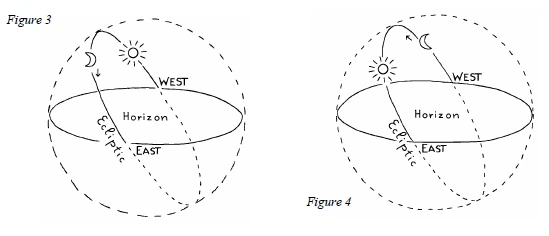
2) In Fig. 4, the Moon is waning. According to the Hermetic Rule, it was in the setting point of the ecliptic at the time of the epoch. In this case, it has overstepped the average of 273 days. It may need 5 days more to move from the point of the ecliptic at the western horizon to its present place. These 5 days would have to be added to 273 days, placing the epoch 278 days before birth.
Thus these differences can be up to a fortnight less than 273 days in the first case and up to a fortnight more in the second case.
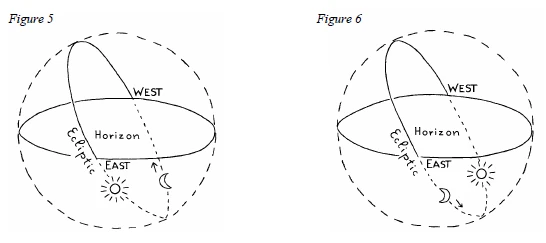
3) In Fig. 5 below, the Moon is waxing but standing below the horizon. If the Moon is waxing, it is supposed to have been, in any case, in the rising point several days before birth. This time must be added to 273 days in order to find the time between epoch and birth. Thus, as in the second case, we can calculate the moment of the epoch.
4) We consider now the possibility that the Moon is waning and below the horizon (Fig. 6). It has still a good distance to go until it will arrive at that place of the ecliptic which is setting at birth. Therefore, the interval between epoch and birth must have been shorter by the time that the Moon needs to move from its present position to the west of the birth horizon.
The triangular relationship, proposed by the Hermetic Rule, corresponds in its essentials to our earlier suggestions (in this present and in previous volumes) that the embryo imitates the movement of the Sun on the one hand and takes into account the properties of the Earth with its Moon on the other hand. We described how the amnion, with its impact on the embryo, is the result of the imitation of the (apparent) Sun orbit during the embryonic development, whereas the yolksac and its derivatives suggest a relationship to the Earth lying within the orbit of the Moon. From this point of view, a practical consideration of the angular relationship between Sun, Earth, and Moon may appear to be justified.
The question may arise as to whether the angular coordination of the three celestial entities, at the time of birth, can be taken as a criterion for the conditions at the beginning of and throughout gestation. We should like to point out that a birth from a pregnancy that was allowed to take its normal course, should still betray traces of the original position. So far, it is an open question whether any interference by artificial means, either at the time of birth or before, is liable to distort the picture. From our experience, we are inclined to say that it not only distorts but also brings disharmony into the organization of a human being. We should like to emphasize, however, that each case has to be considered on the basis of its individual merits.
Another question is whether empirical experience can maintain the trustworthiness and usefulness of this Hermetic Rule. Our answer is that we have investigated nearly a thousand cases of the embryonic development of historic and modern personalities. The result has led us to the certainty that the cosmic conditions during gestation prove to be a concise picture of the biological make-up of a human being.
As far as space permits in the following part of this volume, we shall produce a number of historic examples that will show our approach in general outlines. Because of limited space, we are not able to demonstrate another important fact that research has revealed. The cosmic-biological foundation of a human being is not revealed by the prenatal asterogram in “spatial” outlines only. The facts have proved that the chronology of the realization of single details of this cosmic-biological make-up, as experienced in later life, is already contained in the embryonic asterogram, when worked out on the basis of the Hermetic Rule. The presentation of these facts must be reserved for a later publication.
We should like to emphasize, as we did before, that we cannot see any inhibition of individual freedom in these connections of human beings with the starry world. We can certainly say that we take the ingredients of our organization, as far as it has a functional quality, from the stars. However, these are only the tools with which we build up earthly existence. Tools are a necessity; their quality and efficiency can hinder or enhance our progress. It is chiefly a matter of ingenuity and resourcefulness—in other words, of the “spiritual orbit”—what we make of and with the tools that are at our disposal. The practical problem is to awaken our inherent ingenuity and ability to cope with any situation. This is the task of any kind of education. If our inner spiritual being is developed, which is really rooted in the realm of the “I”, then we need not fear that the stars will impose their will on us. We will learn to transform them by transforming our part in our own destiny, our own organization.
It will not suffice, however, if we simply deny any connection of ourselves with the world of the stars. We have experienced very often that someone refusing to acknowledge these facts will fall headlong into situations that prove that he or she is completely dominated by the sidereal world without knowing it. The first step on the road to handle these connections freely is a knowledge as comprehensive as possible.
Chapter II
The Zodiac and the Embryonic Development
We will now consider the impact of the constellations of the Zodiac on the embryo during the average nine months of gestation. Through the fact that human beings are born all the year around, the corresponding arc of the Sun in the Zodiac is different in each individual case, and also the planets have individual affinities to the arc of the Sun. In Part Two, we have already presented a number of asterograms of gestation that show clearly this difference. We will now investigate these facts more thoroughly.
The Sun of the epoch, calculated on the basis of the Hermetic Rule, can be in any of the twelve constellations of the Zodiac, which gives it an individual color. This in turn is imitated by the embryo. Our question is how this differentiation influences the organism of the human being.
We shall have to find suitable terminology for the constellations of the Zodiac. As we have pointed out in previous volumes, especially in Isis Sophia II, these twelve constellations of the Zodiac are a chronicle of the evolution of the world and of humanity. The evolution of a person is chiefly contained in the formation of the head. Even the rhythmic and limb systems are already indicated in the head. In the upper part, we find the center of the nervous system; the middle part is associated with the breathing, etc.; the lower part, chiefly the jaws, suggest the freely moving limbs, and the mouth the connection with the metabolic organism. In later stages of evolution, these cosmic-embryonic tendencies have been emancipated and have developed the lower parts of the human organism.
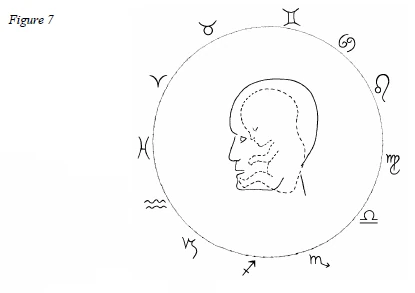
Therefore, we should be able to see in the dynamic potentiality of the human head the archetypal foundation of the totality of the human form, though it would show no more than the dispositions to later divergences. This archetype of the human form, the result of divine creation, is related to the great chronicle of evolution and to the Zodiac with its twelve constellations. (Details in Isis Sophia II, especially in Part Two.)
One possible connection of the archetypal human form with the Zodiac is suggested in Fig. 7. However, we should like to emphasize that this is only one aspect, which can be enlarged and which is supported by others. By no means do we want to suggest that this archetypal head should be imagined as the perfected complexity of the head organization of a present earthly human being. The more we are able to conceive it only as a cosmic focus of potentiality, being capable of exerting its forces at any moment in any direction, the more we shall come nearer to the reality that we have in mind.
Now we will describe how individual human beings partake, in this archetype of humanity, through the imitation that takes place during the embryonic development.
The Constellation of Ram
In Fig. 8a, we have the prenatal asterogram of Mozart. The Sun was in the constellation of Goat and the Moon in Scorpion when he was born. Rising was Lion and setting Waterman. As the Moon was waning, presumably it was in the setting point of the birth at the time of the epoch (Fig. 6). Waterman is west in the diagram; therefore, the interval between the epoch and the birth must have been shorter than 273 days (shorter by the time that the Moon needs to move from Scorpion to Waterman). Thus we come to May 5, 1755, as the time of the epoch.
The Sun was in Ram at that time, and it moved as far as Goat during the embryonic development. Now, we assume that the embryo imitated this cosmic gesture and that this imitation became the foundation of the organization that served Mozart to fulfill his individual earthly destiny. Figure 8a: Mozart - Born 27 January 1756; Salzburg, 8 p.m.
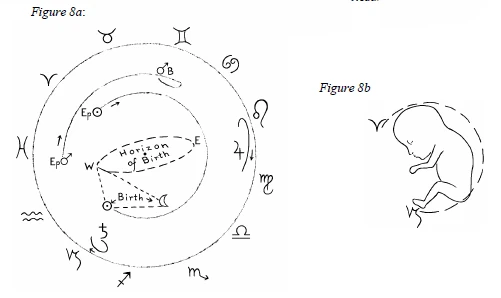
Ram is the archetypal cosmic region where we can find the roots of the human being. It speaks of the remotest ages of cosmic evolution when the impulse of the divine world created the first foundations of the human form. The very first steps of all creation are remembered, as it were, in this constellation. If we take the forces of Ram into the beginning of our earthly existence, by imitating them at the very start of the embryonic career, we must assume that we have funds in our cosmic-biological make-up that will enable us to manifest a close connection with, if not a limited resemblance to, that divine creative world of Ram in later life. It might work out in many ways, for instance, as an astounding wealth of ideas or instinctive capacities. A study of the details of the affinity to Ram can provide greater details. We see the Sun of Mozart moving into Goat, where it was when he was born. We see in Goat that archetypal region from which was created the lower part of the jaws with the chin; also later, the lower extremities and especially the knees. Quite generally speaking, it is that sphere of the human organism where we meet the resistance of the external world and where we have to exert counter-resistance in order to maintain ourselves. We can say, therefore, that Mozart’s lower organism, with which he had to step on to the Earth, was of such a quality that he was extremely sensitive to the resistance of the external world.
Mozart certainly displayed, since his earliest childhood, Ram qualities. We need not reiterate the fact that he was a musical miracle, who at the age of six was already called the “little magician”. Not only could he master any instrument, but once when he listened to Allegri’s Miserere in Rome, he wrote it down afterward from memory, to the consternation of everybody. If such capacities appear already at such an early age, we can be sure they are not acquired by education, etc. They are present as a gift in the whole physiological make-up. It was a spark from the world of the genius above the child, from the divine world. Here we witness a manifestation of Ram qualities. This is still more emphasized by the triangular (trine) relationship of Jupiter to the Sun at the time of the epoch. Thereby, Mozart received in his organization the fund of deep feeling that became apparent in his later mature compositions.
The relationship to the world of tone and music is apparent in the gesture of Mars. It started in the constellation of Fishes, moved as far as Twins, and performed a loop at the time of birth. Mars is connected with human speech and sound. Here we find it making its loop in that part of the embryo image that is destined to become the realm of the larynx and all that belongs to the utterance of speech and sound. (Compare with Fig. 8b.)
However magnificently the upper organization of Mozart appeared to be permeated by the corresponding forces, so was the lower organism weighed down by the opposite kind of affinities. Saturn in Goat stood at that part of the embryo image that was destined to become the lower extremities. Saturn can bring an extreme heaviness into the body, and it seems that Mozart had, in the sphere where he touched the Earth (not only in an external sense), a disposition that made it barely possible for him to maintain his stand in the world. Everybody knows how difficult life became for him as soon as he had to “stand on his own feet”. His greatest difficulty was the constant lack of money, and he died in a state bordering on poverty. He was also not very lucky in his human connections, for instance, with the Archbishop of Salzburg, or later, in his affiliations with the court of Vienna. (We shall omit the gestures of Venus and Mercury in the diagrams; otherwise, the pictures may get too congested and unintelligible.)
Another example of Ram affinities is the prenatal asterogram of Emanuel Swedenborg (Fig. 9). When he was born (29 January 1688, Julian date) the Moon was waxing and below the horizon.
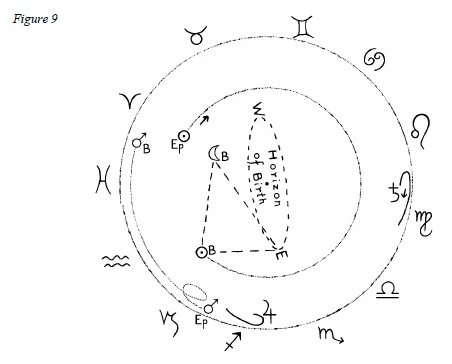
According to the Hermetic Rule, the epoch Moon was in the east of the horizon of birth (Scorpion/Archer) and the interval up to the birthday was longer than 273 days—the time that the Moon needed to move from Archer to Ram. This leads us back to 30 April 1687 (Gregorian) as the date of the epoch.
The Sun was then in Ram, and during gestation it moved as far as Waterman. Therefore, we should expect qualities, with regard to the cosmic-biological organization of Swedenborg, similar to those of Mozart. This is surely true with regard to Swedenborg, both as a scientist and later also as a seer. As soon as his scientific works were collected and published, toward the end of the 19th century, it became evident that in almost every department of scientific activity he was ahead of his time. He is credited by many modern scientists as being the predecessor of several branches of modern science. About the time of 1734 and later, he tried to solve the mystery of the nature of the human soul. He tried to approach it by anatomical studies. In connection with this, he made long journeys through Germany, France, and Italy. The question, of how the experience of the external world can become reflected in inner consciousness through the senses, occupied him deeply. In all this, we see the urge of the inherent Ram qualities in Swedenborg. He tried to go to the roots of existence and endeavored to open the doors to the primal secrets of creation. When the means of scientific approach of his time failed him, he turned to psychical and spiritual inquiry and became the seer, for which he is well-known. In this realm, too, he tried to open the gates to the spiritual world and enter into direct contact with the Divinity.
We do not witness here the kind of repression and resistance that Mozart experienced when he had to step into the world of material reality. Swedenborg’s life conditions were much easier in an external sense. This is due to his individual cosmic-biological make-up. At the time of his birth, the Sun was just entering Waterman, distinct from Mozart whose birth Sun was still in Goat. Swedenborg was capable of touching the Earth with much greater vigor. The connection of his limb organism (especially his feet, Fig. 8b) with Waterman suggests, even, that Ram inspiration prevailing in him as a root quality was allowed to flow freely into the word, in the many writings of his scientific and visionary career. He was, in a certain sense, really a mouthpiece (see Waterman in Fig. 7) of humanity with regard to some of its most modern problems, the question of finding the bridge between the natural and the psychical and spiritual universe.
He was not able to build the bridge. To a great extent this was due to the shortcomings of the age in which he lived. Instead, a breach occurred in his life between the scientist and philosopher, and the spiritualist. As far as his own organization is concerned with these facts, it is the outcome of the impact that Mars exerted on his body during gestation. Mars made a loop in Goat at the beginning of Swedenborg’s prenatal development. This imbued him with the vital power to search, on scientific ground, for comprehensive and universal views and facts. After the loop Mars entered Waterman. It refers to later stages in his life, especially to the time about 1734. Then should have come the union between the naturalistic and spiritualistic world of Swedenborg. He did not achieve it. Mars entered Fishes, which emphasizes more psychical and spiritual trends. Swedenborg fell away from investigation of the natural world and listened to what he was convinced divine spirits had to say to him.
His Mars is in that part of the asterogram (Fig. 9) that was left open by the Sun between epoch and birth; therefore, it was above the head—or below the embryo image—working from “outside” on to the organization. This is an indication that the impact of this planet brought on, all the more, the inclination to search for an objective spiritual (and natural) universe.
Saturn in the constellation of Virgin, in the respective particular part of the embryo image, imbued Swedenborg with that remarkable power of relentless search for the truth. The Virgin is that region in the Zodiac that harbors, in its spiritual-cosmic depths, the laboratory of the Gods. Everything in Swedenborg’s life was directed by his urge to search for the truth and the origins of existence. He remained unmarried.
Jupiter, which was mainly moving in the constellation of Archer, imbued Swedenborg with a tremendous vitality. It is the picture of the centaur that accumulated and preserved animal-like vigor in his body. Swedenborg certainly had a strong vitality. He was 84 years old when he died 29 March 1772.
Many more such examples of Ram qualities could be produced. One is the prenatal asterogram of the famous Russian philosopher Vladimir Soloviev (born 16-28 January, 1853). He became well-known in the western world by his tremendously inspiring ideas about religious philosophy and lofty thoughts on Christianity and mysticism. He also claimed to have had direct contact with the Divinity, and he spoke of the visions that he referred to as Hagia Sophia, the Mother of all natural and soul existence, which he experienced three times in his life.
The Sun was in Ram at the time of his epoch and was strongly emphasized by the junction with Uranus, Saturn, and Mercury—all in the same moment.
The Constellation of Bull
The prenatal asterogram of Thomas Edison (Fig. 10) indicates that the Moon was waning and below the horizon when he was born; therefore, it stood in the constellation of Ram during the epoch, which was setting at the moment of birth. Since the Moon had to move a considerable distance until it arrived at that point after birth, the interval between epoch and birth was shorter than 273 days. By calculation we arrive at 23 May 1846, as the actual date of the epoch.
Thomas A. Edison: Born at midnight 11-12 February 1847, Milan, Ohio. Epoch 23 May 1846
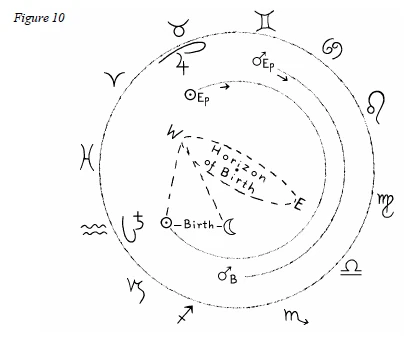
The Sun had just entered Bull on 23 May, thus its prenatal arc extended from that constellation to Waterman. The constellation of Bull, as a region of cosmic archetypes and creative ideas—in the Platonic sense—is close to Ram. However, as Ram is connected with the primal beginnings of all existence, with the origins in the divine world itself, so have the forces of Bull already moved further away from the origin toward realization of divine ideas in time and space. People who have been endowed in their organization with the forces of Bull have more the natural inclination toward rationalistic and pragmatic application of the “idea”. Ram people are more idealistic, their cosmic-biological organization does not yet urge them so much to put their ideas into practical deeds, as is the case with Bull natures. We need not point out that Edison had a typical Bull organization, because his fame as “inventor” is undisputed. Up to 1926, he had taken out 1,033 patents. This Bull organization was still more emphasized by Jupiter in Bull during the prenatal development, which enhanced the creative inventiveness in this position.
Saturn was at the feet of the embryo image in Waterman. This made that part of the organism which is orientated toward gravity— the limbs for instance—strongly earthbound. This was quite different from the Saturn of Mozart (Fig. 8a) in Goat. In Edison’s case it was a disposition toward Earth affinity that was not subject to the experience of restriction and frustration. It was just the opposite, a deep connection with the inner, flowing forces of the Earth. This is expressed by Waterman. On the continent of America, this inner life of the Earth itself is chiefly experienced as electricity and magnetism. (The magnetic Pole is in North America and the impact of magnetism is stronger than on any other continent.) This is emphasized still more by the impact of Mars on the embryo image. It started in the constellation of Twins and moved as far as Archer during gestation, where it was in conjunction with the Moon at the time of birth. The Twins suggests some kind of polarity, for instance, as is apparent in all that concerns electricity. However, the full details of the asterogram, especially the inclusion of the inferior planets, reveal that there must have been imparted on Edison’s organization, a strong affinity to the Earth and to those mysterious forces of electricity and magnetism.
Another example of similar Bull tendencies is the prenatal asterogram of Victor Hugo, the famous French poet and novelist. The calculations, based on the Hermetic Rule, lead back to 7 June 1801 as the time of the epoch. During those days, the Sun was in the constellation of Bull.
Victor Hugo: Born 26 February 1802, Besancon–shortly after midnight–Moon waning below horizon
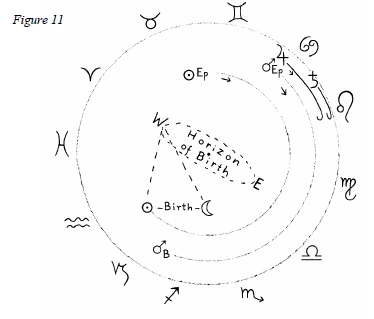
We need not say very much about the Bull capacities of Victor Hugo. He is so well-known for his capability of literary realism that it seems to be superfluous to dwell on it in detail. He inherited all the remarkable Bull qualities, including some detrimental trends of this constellation. The impact of the Sun at birth from Waterman enhanced still further the unique position that he attained among French writers of his age.
It is most interesting to study the influence of Mars and Jupiter on his organization during the time of gestation. The two planets were in conjunction in the constellation of Crab at the moment of the epoch. Working out the details of the asterogram, we find that this conjunction influenced that part of the embryo image which later on became the region of the larynx. There was a remarkable combination of strength (Mars) and thought (Jupiter), which manifested itself later as that mastery of language displayed by Victor Hugo. The connection of the two planets with Crab suggests that this mastery was, at least at times, too technical and perhaps even dominated too strongly by a trivial and boastful side of his character.
The instrument that people possess may not give them a full chance to express their true intentions. It may also be that they haven’t the strength of individuality to use their bodily instrument to its full inherent capacities. In such a case, the asterogram can give a glimpse of what a person had decided before incarnating and where the divergence occurred in later life. In Victor Hugo’s asterogram, we have such a case. Just about the time when he was born, Saturn and Jupiter were nearly in conjunction in the constellation of Lion. This conjunction suggests that Victor Hugo was imbued with strong forces of memory, and he had an inclination toward the past and a sense for history. This was, by disposition, amalgamated with the power of thinking (Jupiter). His historic novels speak of this capacity.
We see in the asterogram that this conjunction refers to a part of the embryo image that is lower down; it was associated with the chest, with the realm of feelings. This is still more accentuated by the position of the two planets in Lion. The capacities that speak through this conjunction are profound; they are almost of a royal nature. Yet, we must not overlook the fact that it had worked into the realm of feelings, where consciousness has more of a dreaming character. This does not mean that this realm is bound to be of less profundity than everything which one conceives through the forces of the head. It can be of a more valuable nature if one succeeds in controlling this sphere and permeating it with the light of clear thinking; otherwise, it may remain a world of beautiful dreams without moral power.
Victor Hugo did not fully lift the treasures that had been lowered, as it were, into his organization during the time of gestation. His typical Bull quality became an obstacle for him. One of his critics said, “Hugo was a master of language; he was a great literary figure; he might perhaps have been a great mystic had he been less worldly.” His worldliness, in other words the less admirable aspects of the Bull character, had prevented him from lifting up consciously those treasures of Saturn and Jupiter in Lion. They shine through his historic novels and poetry, but the lack of conscious control threw them in a turmoil of feelings such as pride, ambition, self-centeredness, and so on. He had the capacity to put into words what the average person of the 19th century felt but could not articulate; he had the faculty of pronouncing more constructive ideas beyond the mere average.
The Constellation of Twins
The constellation of Twins suggests at once polarity, tension, and multiplicity. This is anticipated in the Zodiac as archetype of the human head (see Fig. 7). It is the origin of the two hemispheres of the present human brain and also the beginning of the tendency to symmetry in the totality of the body. Thus, it refers to the tension between right and left and their cooperation in a physiological sense; it is, therefore, also responsible for the separation and individualization of the single organism. The tendency to symmetry manifests itself, also, with regard to the upper and lower organism; and in the head, for instance, as the polarity of cranium and jaws, rather displaying asymmetry.
People who inherited this Twins tendency through their prenatal development, are sometimes very strongly subject to psychological tensions that usually result from physiological causes. We have a great collection of data on people who had this peculiar Twins impact, mainly through the Sun at the time of the epoch. Many of them displayed tremendous psychological tensions and disturbances in life, which can lead to the point of insanity. However, well directed care and wakefulness can avoid these dangers.
An historic example of Twins tendencies is the asterogram of Pico della Mirandola (Fig. 12). He was the son of a prince of Mirandola, a small territory in Italy. Having already begun to study at the age of 14, he accumulated considerable knowledge. Besides Greek and Latin, he knew Hebrew, Chaldee, and Arabic. He was also introduced to the Kabbalah. At the age of 23, he led himself into difficulties by setting forth, for public disputation, a great number of questions on philosophy and theology that were prohibited by the pope. His personal life, too, was rather dramatic. He displayed the heritage from the constellation of Twins to the full extent by living and moving in extremes.
Figure 12 : Giovanni Pico della Mirandola: Born 24 February 1463 in the evening–Moon waxing above horizon–Epoch 6 June 1462–the Sun was in the constellation of Twins.
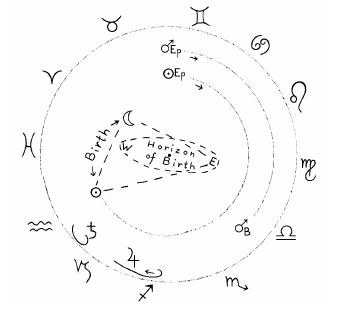
In his 28th year, he published his Heptaplus, a mystical exposition of the creation. After that he started a great work against the enemies of the Church; however, only a part of it was completed, which contains a treatise against astrology. On his many wanderings, he also came in contact with Savonarola at Florence. In consequence of this, three years before his death (November 17, 1494) he renounced his share of his ancestral heritage, gave away all he had, and wandered barefoot through the world. But a fever brought his earthly career to an end.
Just these last years reveal how much Pico della Mirandola was influenced by the Twins tendency and his difficulty in keeping to a middle line between extremes of any kind. This was still more emphasized by Mars in Twins at the beginning of his embryonic development and in Scales at the time of his birth.
Jupiter in Archer imbued him with an unquenchable desire of wandering, learning and acquiring the highest possible knowledge. This planet worked into the lower limb system of the embryo image, and we are of the opinion that such an impact not only manifests itself in a purely physical sense, but also works back on the psyche.
Saturn in Waterman we have met previously, in the position of the feet of the embryo image of Edison. It certainly infused, also in this case, a strong affinity to the Earth. But certain aspects of the asterogram suggest that it brought about a profound connection with our planet, and not only in an external sense. There was also a deep realization of the mysteries and the spiritual purposes of the Earth within the greater universe. The superb knowledge that Pico had of the Kabbalah and of astrology, though he was opposed to its practice for purposes of prognostication, reveal that he was a true occultist who was standing firmly and loyally on our planet. This corresponds precisely to the meaning of Saturn in Waterman.
The Sun of the epoch of Emile Zola, the French novelist, was also in the constellation of Twins (Fig. 13). His Twins tendency was remarkably manifest, both in his literary work and in his personal life. As a critic he was vigorous and aggressive, and his novels, such as Thérèse Raquin, Germinal, La Terre, and many others, were powerful but partly gruesome. He also liked to go to extremes in his descriptions, , just as Pico della Mirandola, mainly as far as the inequality and failing of social life are concerned. 75
Figure 13: Emile Zola, Born 2 April 1840 in Paris–Moon waning above horizon–Epoch 28 June 1839
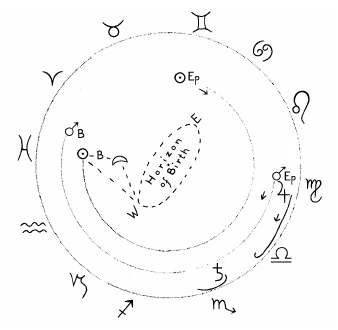
He betrayed his Twins disposition most outspokenly in connection with the so-called Dreyfus affair. Dreyfus was a captain in the French army. Toward the end of the last century, he was accused of high treason. Zola came to the conclusion that Dreyfus was the innocent victim of a conspiracy, and with his usual vigor and fearlessness, he openly attacked all those who had a hand in the accusation of Dreyfus. All details of his actions in connection with this case show beyond a doubt his Twins affiliation by throwing his full weight into an affair which was, at that time in France, the object of extreme public controversy. To live in tension and to create tension in the readers of his novels seems to have been the root of Zola’s existence.
Mars and Jupiter were in the constellation of Virgin at the time of the epoch. They worked into that part of the embryo image associated with the chest, the “house of life”. Thereby Zola inherited the almost scientific capacity and inclination to bring the world of human feelings to the surface, even where it revealed gruesome and unhealthy aspects of social life. This was assisted by a deep urge to strive and fight for social justice, which we see supported in a cosmic-biological sense by Saturn in Scorpion. This worked into the region of the thighs, which enable one to exercise will power toward the attainment of one’s aims, both in the physiological and psychological spheres.
The Constellation of Crab
With regard to the archetype of the human head (Fig. 7), the constellation of Crab is associated with the forming powers of the cranium and also with the fontanels—the opening in the baby’s cranium. We have forces at work here that tend to enclose the brain within a shell of hard and solid matter. It is the termination of a long process, both in the history of humanity as a whole and in the gestation of the single human being. The open fontanels of the small baby are an indication of states of evolution and of the embryo when the brain was not yet imprisoned in the cave of the skull. In our evolution, these were ages when the human being was not yet so strongly emancipated and estranged from an objective spiritual world as we are at the present time. The emancipation was a necessity that was facilitated by the closing of the skull and the hardening of the whole skeleton, in order to lead us to freedom.
People who are associated with this constellation of Crab, in the sense of cosmic-biological imitation, display a strong connection with these genetic facts. They are very often confronted, in their personal destiny, with the problem of whether or not they can maintain or re-establish a direct connection with the spiritual or cosmic world. For instance, the following historic personalities had the Sun in the constellation of Crab in their epoch: Christian F. S. Hahnemann, the founder of homoeopathy; Ulysses S. Grant, the famous general and president of the U.S.; Novalis the German poet (born 2 May 1772), who was a man of high spirituality and profound inspiration; Lenin the Bolshevist leader (born 22 April 1870, N.S.), who displayed the opposite disposition, complete negation of the spirit and application of absolute materialism in social life. He died from sclerosis of the cerebral arteries. The forces building up the prison of the skull were obviously overwhelmingly strong.
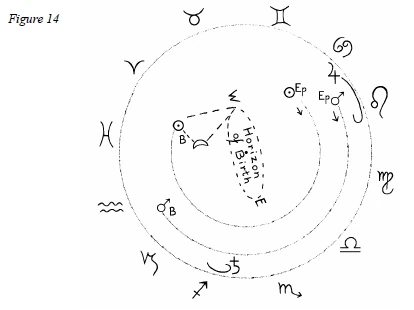
Hahnemann - Born 10 April 1755–Meissen/Saxony–Moon waning below horizon–Epoch 16 July 1754
We will concern ourselves with the first two cases in more detail. One can argue whether Hahnemann was a man of spirituality, but his views on homoeopathy, which he founded, betray that he had a deep understanding for the working and the laws of the spirit. Homoeopathy works with highly potentized substances that are, in some cases, diluted to such a degree that it is impossible to find any trace of the original substance. The homoeopaths are divided among themselves about the efficiency of these high potencies. Hahnemann, however, says in his Organon: “It is only by means of the spiritual influence of a morbic agent that our spiritual vital power can be diseased, and in like manner only by the spiritual operation of medicine can health be restored.” Obviously, he had convinced himself of the spiritual efficiency of substance that has been brought, by trituration and potentization, to a point where it has vanished from the space world as a quantity.
Altogether, one can only imagine that his discovery of the law of “similia similibus curtantur” (like is cured by like) and of the homoeopathic principle of high potencies were acts of direct inspiration; a positive Crab impact through the epoch Sun is quite obvious. He was, in a sense, a true cosmologist who had discovered the laws of the microcosmic world, which is a replica of the macrocosmos. For the dilutions of substances is an exact picture of what modern astronomy tells us about the great cosmos. The stars of the universe, including our own Earth, are “diluted” in a space of unimaginable dimension so that they “disappear” completely in it. How often are we told that our planet has not the slightest significance in the greater universe, that it is less than a grain of dust? Hahnemann has found similar facts in the world of his microcosmic dilutions, but he did not descend to the same conclusions. For him the “less than dust” entity, actually the spiritual force of a substance, was the most active thing.
We see the disposition toward this kind of cosmology in the impact of Mars and Jupiter in Lion at the time of the epoch (see Fig. 14). Lion is, altogether, deeply associated with cosmic orientation when one contacts these forces through one’s organization. In Hahnemann’s case, this was favorably amalgamated with the forces of a Sun from Crab.
Saturn in Archer can be taken here as an indication that Hahnemann’s organization was imbued with strong forces of vitality. He was actually 88 years old when he died, in spite of a life full of difficulties, setbacks, and frustrations.
Ulysses S. Grant, as general and finally as supreme commander, was involved in the American Civil War on the side of the Northern Union against the Southern Confederates. His conduct about the war, to the final victory of the Union, shows that he possessed more than just iron determination and indomitable energy. There was more that we can only understand on the background of his heritage from a Sun in Crab at the time of his prenatal epoch (Fig. 15). His endurance in spite of setbacks, terrible losses, and ceaseless fighting, reveals that something higher worked through him than only a limited human mind. He was inspired by the destiny of the United States in centuries to come by those spiritual forces that form and maintain a nation, though he may not have experienced it so consciously.
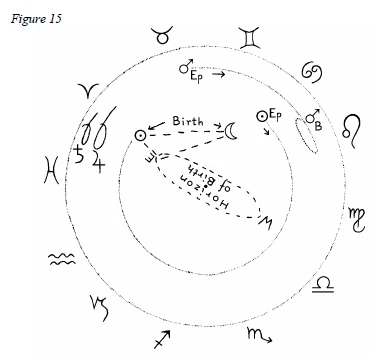
Grant - Born 27 April 1822–Point Pleasant, Ohio–Moon waxing below horizon–Epoch 22 July 1821 This instinctive confidence in the fate of the becoming nation, as well as his energetic action in preventing indictments for high treason against the leaders of the Confederates, were the result of his typically American connection with the spirit. To a high degree, the integration of the Northern and Southern States was brought about by this latter action. It was a demonstration of positive Crab facilities, cloaked in trustful simplicity but invested with great power.
A person with such capacities is, in a certain sense, a true cosmologist, though he may not appear to have anything to do with cosmology. Instinctively, there lived in Grant an awareness of the course of history, of the part that his nation had and will have to play in it. The progress of the ages, the course of time, is externally expressed in the courses of the stars. A person like Grant, who has an unshakable certainty of these facts in his organization, is a cosmologist nevertheless, possibly without even “knowing” it.
This kind of cosmologist we see in Grant’s possession of a Mars performing a loop in Lion. This impact worked into the head and larynx organization of the cosmic embryo image, the regions of self-expression and self-manifestation.
During Grant’s embryonic development, a conjunction of Saturn and Jupiter took place in the transition from Fishes to Ram. Its impact was directed toward the feet of the embryo image. In this conjunction we see the real background of the historic instinct possessed by Grant. Such events intimate a fusion between world memory (Saturn) and action out of wise foresight (Jupiter). In a sense, Grant trod upon it by walking over the American soil. He not only had head knowledge, it was “foot sureness”.
The Constellation of Lion
People who have had a strong connection with the constellation of Lion, through an epoch Sun in that part of the Zodiac, no longer question the possibility of contacting a spiritual world by individual effort. Of course, one cannot generalize. There are certainly a great number of people, especially in our age, for whom this is no question at all, because through the general trend of their education and the background of our civilization, it does not occur to them. However, we have asterograms of a sufficient number of personalities to support our statement. They demonstrated the acceptance of such possibilities by taking, more or less, to definite methods and paths leading to the direct experience of a spiritual world.
We can understand this if we again consult the archetypal human head in the Zodiac. After Crab, we enter a realm where active forces are centered that have built, throughout evolution, the mysterious internal parts of the brain and central nervous system, aiding the conscious perception of the external world. Within the total human organism, this realm is also connected with the heart and the circulatory system (Fig. 7).
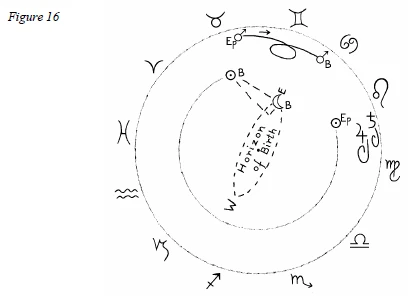
Edward Bulwer-Lytton - Born 25 May 1803, 8 am London–Moon waxing and rising Epoch 25 August 1802
One such personality was Edward Bulwer-Lytton (Fig. 16). At the time of his epoch, the Sun was in Lion. It is rather difficult to trace the real background of Bulwer-Lytton; however, it is apparent in some of his novels that he had at least a deep knowledge, if not a direct contact, with certain occult brotherhoods, who made it their task to guard and to promote methods of approach to the spiritual world. This is obvious in a book such as The Last Days of Pompeii, but especially in Zanoni, where the fate of certain initiates in occultism is described. VRIL The power of the coming race, which speaks of the mysterious force called “Vril”—connected with one’s life-forces—is also a witness of the fact that Bulwer-Lytton had more than a superficial and purely literary knowledge of the path of initiation.
The most remarkable feature of this asterogram is the position of Saturn and Jupiter. The epoch took place just after a conjunction of the two planets in Lion. There is, therefore, a certain similarity to Grant, a combination of an historic conscience ( ) and universal though ( ). But there is also an enormous difference. First of all, this conjunction was in Lion, the same constellation where the epoch Sun was. It would indicate a close connection with the classical past of humanity, of the great leading forces in history, but seen from the angle of esotericism. (The conjunction in Ram, as in Grant’s case, points more toward future capacities in humanity.)
The conjunction in Lion worked into the head of the embryo image of Bulwer-Lytton’s asterogram. Jupiter, which moved faster forward than Saturn (see Fig. 16), carried this impact into the region of the larynx. We see here the background of the writer.
Mars started in Bull, made a loop in Twins during gestation, and was in Crab at the time of birth. This Mars was in that part of the Zodiac which remained untouched by the Sun during the prenatal development and is, therefore, “outside” the embryo image—either above or below. This would indicate that there were some difficulties in mastering this impact. The loop in Twins would also point in a similar direction. We should think this is corroborated by Bulwer-Lytton’s difficulty in keeping to a middle line between extremes. In earlier years he had a strong affinity to what spiritual science calls Luciferic tendencies, usually described by biographical critics as a dandyism of considerable pretensions.
The date of birth of Dante, the author of the Divina Comedia, is uncertain. From the scanty information that we have, we gather that his epoch Sun was also in Lion. It is known that he had contacted certain streams of esotericism of his age, and that he had knowledge of occult paths of cognition through his teacher Brunetto Latini (author of the Tresoro). The fruits of this contact became obvious in Dante’s grandiose cosmography of the Divina Comedia.
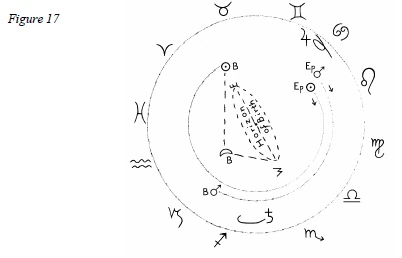
Richard Wagner - Born 22 May 1813 at sunrise–Moon waning above horizon–Epoch 15 August 1812
Richard Wagner’s epoch Sun was also in Lion. He certainly had a connection with esotericism, which is apparent in the subjects that he chose for his operas, especially in his last composition, Parsifal. A closer study of his work reveals that their chronological order is an exact picture of his own inner development toward a spiritual world conception. Against many obstacles in his own nature, he strove to break through to esoteric Christianity, and his operas are an indication of a path to higher knowledge in themselves. However, we must not forget that the 19th century offered very limited scope for the expression of such aspects. The obstacles in his own nature are expressed in the position of Saturn in Archer. We see again the imagination of the centaur, half human, half animal, striving toward perfection, battling against his own lower nature. The impact of this Saturn worked into the region of the procreative organism of the embryo image.
His disposition and temperament were more aggravated than enhanced by a so-called “good” angular relationship—a trine—between Saturn and Mars at the time of the epoch. Mars had just entered Lion and was still close to the epoch Sun, after a conjunction with the latter. It worked into the head of the embryo image. Thence came his difficulty of keeping his head out of rash and impulsive action, of making the head forces control feeling and willing.
Jupiter moved through the constellation of Crab. Its impact appears above the head of the embryo image. We recognize in this Jupiter, the inspiration from which Richard Wagner drew, as well as his power to condense these inspirations to artistic form. The Crab suggests this forming quality that ultimately succeeded in creating an external home for Richard Wagner’s works, the Festspielhaus at Bayreuth.
The Constellation of Virgin
Individuals who have received the impact of the constellation of Lion in their bodily nature are usually inclined to hold back their particular connection with paths, methods, and societies whose aim is the approach to the spiritual world. They regard these connections as strictly esoteric associations that should be kept apart from daily life and possibly from daily work. This is true, perhaps, even to a higher degree of those who bear in their nature the impact of the constellation of Virgin. The difference between Lion and Virgin natures lies in the fact that the latter are inclined to let their esoteric or religious views and approaches flow into their actions, however inconspicuously.
An excellent example is the asterogram of the German philosopher Leibniz (Fig. 18). The hour of his birth is not certain, but his epoch fell, in any case, into a time when the Sun was in Virgin.
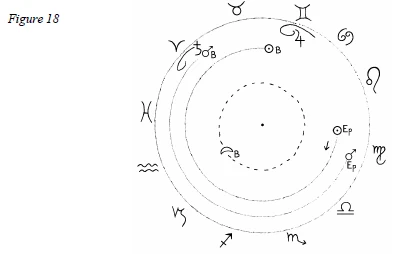
G. W. Leibniz - Born 1 July 1646 at Leipzig–birth hour uncertain Epoch possibly between 17 September 1645 and 15 October 1645
Leibniz is well-known as a mathematician and philosopher, but he also had some connection with political affairs. For instance, at the age of 23 he entered the service of the Elector of Mainz, and he was subsequently drawn actively into the policy of the elector to maintain the security of the German empire, which was then already involved in a kind of East/West problem. It was hemmed in between a highly aggressive France in the west and Russia and Turkey in the east.
Before that time, he had contacted the Rosicrucian movement whose center was at Nuremberg. He was only 21 years of age, had studied alchemistic writings, had acquired a deep knowledge of Rosicrucian tenets, and was even elected secretary of this movement.
Here we see the background of his Virgin nature, which gave him an inclination toward esotericism. We see in the representation of the archetypal head (Fig. 7), that this constellation is related to the spiritually-forming powers of the hind brain throughout evolution. The function of this part of the brain is still more mysterious than that of the fore brain, as it leads over into conscious or unconscious action and reaction.
This leading over into action became obvious in the philosophy that Leibniz developed; it is also apparent in his mathematical achievements. His philosophy is generally known as Monadism. The ultimate elements of the universe are the monads, which are individual centers of force. They are invisible, metaphysical points that act according to their degree of development and, thus, bring about the physical object-world by an inherent “pre-established harmony”. These monads are rather of the nature of spiritual beings, each one being in itself a microcosm, a reflection of the great universe in degrees. They are finally guided by a “Monas Monadum”, or God. Leibniz held similar tenets with regard to psychology and theology. The soul of a human being is also a monad called the entelechy, surrounded by the monads that make the body through their action. He speaks of God as “the universal harmony”, the highest creating monad who created substances by a sort of “emanation” proceeding from Itself, as we produce our thoughts. We see shining through this philosophy, the views of a spiritually-minded person who must have had a deeper esoteric background than one usually assumes.
The impulse to express his esoteric ideas in a form, which must have appeared to him as an adequate philosophy, was enhanced by the impact of Mars on his organization. It started in Virgin, where we find the head of the embryo image, and moved as far as Bull. There it came into conjunction with Saturn (and also Venus) about the time of birth; thus, it leads the inclination of the head organism right down into the limbs—into action. The conjunction with Saturn in Ram and Bull indicates the inherent impulse to go in search of the truth right back to the foundations of creation. (See the constellations of Ram and Bull.)
He stood, in a sense, upon Jupiter in Twins. In this we see the desire to “prove”, almost mathematically, the spirit inherent in matter. He was inclined to think about physical nature in terms of mechanical explanation, but he was quite aware that this cannot be done without presupposing an incorporeal principle, or God, for ultimate explanation. He was involved in the great problem of his age: to find the bridge between the moral and natural worlds. The somewhat unsatisfactory solution of the problem of evil in his philosophy betrays that he could not find the bridge. This is also a characteristic of the Twins Jupiter indication.
We have quite a collection of personalities whose epoch Sun was in the constellation of Virgin. Usually, they came to the front as occultists in some direction. All of them had some connection with esotericism and with societies and movements of an occult character. On this background they undertook to bring certain messages to humanity or to accomplish certain deeds, possibly in the social realm, which were regarded to be for the good of human progress. Sometimes their actions were not greatly appreciated in their time. Only later ages could see the significance of their impulses and accomplishments. An open mind will always be able to see the pattern of the working of the spirit, manifesting itself as inspiration in such personalities. They were mostly people who did not step into the limelight of publicity; they did and still do work as the silent and unknown benefactors of the human race. We see, therefore, little point in producing asterograms of individualities with such Virgo inclinations, because they are too little known.
We must also take into consideration that the present age, especially the time since the 15th and 16th century, does not lend a ready hand to the activities of people with the background of Virgin impact. It is a period in human history that is further than ever removed from the acceptance of an objective spiritual world. Therefore, personalities who have such connections, and are urged to act from this background, may appear as odd strangers in a world that is almost entirely given up to materialistic views. They are those people who are wandering through humanity as mouthpieces of unseen powers, whom modern public opinion cannot easily classify within its acknowledged patterns of social and scientific standards.
Examples are people like Garibaldi, the famous Italian revolutionary (born 4 July 1807); George Sand (pseudonym of Mme. A. L. Dudevant), the famous French writer known by such novels as Consuelo and La Comptesse de Rudolstadt (born 1 July 1804). King James I of England (born 18 June 1566) was also one who sought to act from a background of certain occult movements and was utterly misjudged by the public. To the present day he is called the “wise fool”.
The Constellation of Scales
The constellation of Scales leads to a remarkable change in connection with the archetype of the human head as well as the total human form in Fig. 7. Up to Virgin, we witness a process of progressive inversion. With Scales, however, we are confronted with a turning point toward the limb system both in head and body. This indicates tendencies of externalization and reaching out toward the reality of Earth existence.
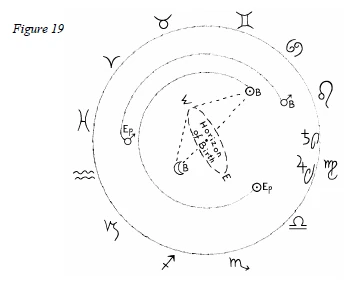
Henry Ford - Born 30 July 1863, Greenfield, Michigan–about 2:30 pm–Moon waning below horizon Epoch: 7 November 1862
One of the finest examples of Scales incentive is the asterogram of Henry Ford (Fig. 19). His epoch Sun was in Scales. We see the last traces of the “inversion” still at work up to the constellations of Lion and Virgin. Henry Ford worked and established his success entirely on the basis of healthy social ideas. His life, up to the foundation of the Ford Company, shows that he didn’t make any cheap compromise, even at the cost of hardship. His driving idea from the outset was service, working unrestrictedly for the consumer, and not building his production solely on the principle of profit and return. It was a courageous attempt to introduce “altruism” into economy, and his later success proved that his idea was right and sound. “Profit cannot be the basis, it must be the result of service.”
This economical idea is age-old, but Henry Ford conceived it anew under changed world conditions. He adapted it masterfully to the age of mechanization and industrialization. This confirms that he must have had a deep connection with that world of Lion and Virgin, whatever his affiliations with corresponding movements and institutions may have been. (For instance, he accepted the idea of reincarnation, another proof of his acquaintance with definite spiritual world conceptions.) However, he was certainly not a mystic. The Scales impulse was in his bones, as it were, the firm will to put into practice and economic efficiency what he had conceived as practical spiritual reality.
This was aided by the Sun in Crab at the time of his birth. It was, so to speak, the ground on which he stood. The Scales impact was combined with that of Crab. We can describe it as a capacity for spiritual communion with the properties and laws of the Earth and also a deep loyalty toward it. (See the section, The Constellation of Crab.)
The planets Saturn and Jupiter are above the head of the embryo image in the constellation of Virgin. This is the world of inspiration in which Henry Ford was living. It was, in a sense, a natural gift through his organism. It gave him the instinctive certainty that life cannot be regarded as an institution, providing from the outset security against failure and disaster. He knew that life was an experiment and that by holding on to and carrying through the experiment with relentless effort, security could be achieved. He may even have considered earthly human existence as an experiment of the divine world. The background of the constellation of Virgin, which can aptly be called the “laboratory of the Gods”, suggests this.
Mars had just come out of a loop in Fishes at the time of the epoch, and after that it moved as far as Lion where it was in conjunction with the fixed star Regulus, the Lion’s heart. Therefore, this Mars worked its impact into the limbs of the embryo image. Here is the background for the strong and determined will of Henry Ford—his “royal” bearing. The movement through the summer constellations of the Zodiac suggests that his will was by no means materialistic, but was entirely guided by the idea. Mars in Fishes at the time of the epoch gives the impression that there was the natural gift of consideration and wisdom concerning the substances of the Earth, but also with regard to the eternal image or aim of humanity.
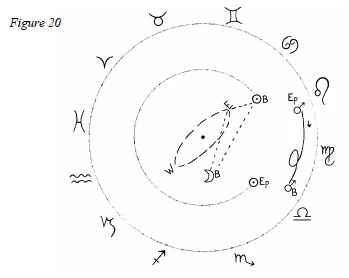
T.E. Lawrence - Born early hours of 16 August 1888, at Tremadoc, Carnarvonsh–Moon waxing, below horizon–Epoch: 8 November 1887
An example of Scales tendencies of a different kind is T. E. Lawrence, author of The Seven Pillars of Wisdom. There was also the strong inclination to work in the realm of practical reality. And in the background, there was a mysterious connection with the world of the Arabs. This affinity to the cause and destiny of the Arabs can only be explained by the idea of reincarnation, by accepting the possibility of a previous incarnation amidst medieval Arabic settings. A certain confirmation can be seen in the fact that he already made a tour through Syria in 1910 on foot, in order to study architecture dating from the time of the Crusades.
He was, however, not as successful as Henry Ford in the accomplishment of his political ideas concerning the independence of the Arabs. Great odds were working against him. Lawrence left government service because he was disgusted with the failure of the Allies to fulfill what he considered to be their moral obligations to the Arabs. The rest of his life showed different attempts of external activity. Scales tendencies did not give him any respite. It seems that there have been tremendous feelings of remorse hovering above Lawrence, after having been unable to realize that mysterious “something”, shining into the present incarnation as a whole world of impulses coming from the past.
We can understand this frustration if we study the asterogram more closely. Above the head of the embryo image was Jupiter, first in Scales and later in Scorpion. This was the background of Lawrence the Scholar who displayed his brilliant gifts, for instance, in his writings. We find it also in his natural connection with the Middle East, in the capacity to identify his own being and destiny with that of the Arabs. It became especially apparent during the Arabian campaign. He mastered the hardships of it with an almost superhuman will and against his constitution, which was not too strong.
On the other hand, we find Saturn in the constellation of Crab and moving in that part of the embryo image associated with the feet. Lawrence was dragged down by heavy weights, as it were. The nature of Saturn reveals that it was the historic setting of modern humanity that was against him. Saturn is the great historian of the cosmos. The Crab, where it stood, is a kind of cosmic arsenal of the progressive evolution of humanity; for instance, the Event of Golgotha is connected with it.
The progress of humanity, working through the medium of intricate political constellations, did not allow the ideals of Lawrence to be realized. In a certain sense, the whole complex of the historic relationship between Christianity and Mohammedanism, rooted in the ages of the Crusades, and all the unsolved problems of the Middle East, in their spiritual aspect, rose like specters. Lawrence was unable to view the Arab question from the healthy and progressive conception of a “spiritual” Christianity; therefore, he failed. His impulses were not worldwide enough; they did not fit into the pattern of humanity’s evolution.
Mars had been making a loop in Virgin, above the head of the embryo image. Lawrence could not fully incarnate these Mars forces and lift them up from the realm of the body to a conscious capacity. We do not know whether he had any views on reincarnation. Had he developed a clear conception of it, he might have been able to bring up those dim memory pictures of the past into a sphere of conscious control. Then he would have been able to pursue his ideas with more effective and spiritual means and with an unbiased perception of world historic necessities.
The Constellation of Scorpion
The constellation of Scales is the bridge that leads over from a relationship to the world and humanity, which is mainly introverted, to direct and unrestricted action in the world of given facts. Therefore, we find people who had acquired this impact on their organization, wavering with regard to their background and their urge to act externally. They are very often going through crises in the middle periods of their lives.
This tendency is still more pronounced in Scorpion. This constellation is connected with the region of the larynx in the picture of the archetypal human head (Fig. 7). People who have received this impact, for instance, through their epoch Sun, are usually prominent in the sphere of the word. They can be, in a certain sense, the mouthpiece of whole epochs of human evolution, expressions of stages of human history. Usually, they are still more urged to external action than the Scales type, but it is very often a question of whether they can balance their urge to action by a self-controlled cognition of the needs of a certain age and by the power of distinction between delusion and genuine inspiration.
An excellent example of a Scorpion impact is Goethe. We have already produced his prenatal asterogram in Part Two. There is no need to say much about Goethe as having been, and still being, a mouthpiece of the inherent problems, the hopes and requirements of the modern age on the road to future evolution. This is strongly emphasized and aided by the position of Saturn in his asterogram, above the head of the embryo image in Scales. We read in it the ingenious capacity of Goethe to cope with, embrace, and transform opposite viewpoints into a homogeneous and integrated world conception. The constellations below Scales are, in a certain sense, metamorphoses in the realm of action of the summer constellations. Thus Scorpion is closely associated with the tendencies of Crab. This means that we have, almost always, forces of the Crab nature playing into these Scorpion destinies.
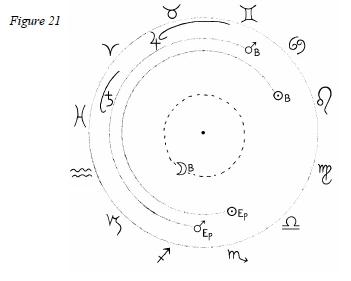
Johann Val. Andreae - Born 17 August 1586, hour unknown–Epoch Sun in Scorpion whether time between epoch and birth was longer or shorter.
An historic example of this aspect is the asterogram of Johann Val. Andreae. When he was about 17 years old, he wrote The Chymical Wedding of Christian Rosenkreutz in 1459, and later on he wrote other works. These writings were expressions of the efforts of the Rosicrucian movement to lead humanity to new capacities and approaches to the spiritual world, suited to the facilities and character of that age. In part, they were also attempts to make positive suggestions with regard to the improvement of the social conditions of humanity.
The character of the Chymical Wedding and the age when Andreae wrote it down, suggest that he could not have done it from purely intellectual reflection. It was a clear case of inspiration. He was predisposed to this capacity and helped by the impact of an epoch Sun from Scorpion on his bodily organization.
Furthermore, he was assisted by his particular Mars influx during the prenatal development. This planet started in the constellation of Archer and moved as far as Twins. By lifting up this impact into the realm of conscious control (the path of Mars is submerged, as it were, in the embryo image), he developed a sense of responsibility for the spiritual progress of humanity. In his later years, he was a minister of the Protestant Church in Swabia. He took up this task after it had become obvious that the efforts of the Rosicrucian movement had failed because of the resistance, and even active antagonism, of the dominating political powers of his age. He even dissociated himself from the writings of his youth.
(We have here an example of a Scorpion type that has enough self-control to keep silent if external circumstances require it.)
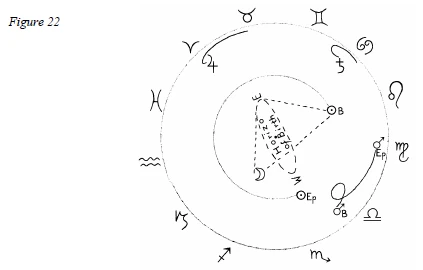
Archduke Rudolph of Austria - Born 21 August 1858–Moon waxing above horizon Epoch: 30 November 1857
A rather tragic example of Scorpion tendencies was the Austrian Crown Prince Archduke Rudolf (Fig. 22). He possessed unusual talents, and his chief interests centered on natural history and literature. He became rather estranged from his father, the Emperor Francis Joseph, and moved more and more into opposition to the whole political setting of the Austrian monarchy. His life ended with his suicide in Mayerling, 30 January 1889.
One can perhaps say that Archduke Rudolph was a living awareness of the impossibility of the Austrian and Hungarian empire. The defects of this highly complex conglomeration of nations became more and more apparent under Rudolph’s father, the Emperor Francis Joseph, and very soon after the latter’s death (1916) it broke into pieces. Rudolph grew up surrounded by the signs of a disintegrating monarchy, and he must have had no illusions about the facts, for it is said that he was a revolutionary. Thus his life story in itself and his tragic death are direct expressions of the tremendous processes of social transformation in humanity going on behind the veil of history, even during his lifetime. Individuals may also become a mouthpiece of their age through their own biography and thus demonstrate a Scorpion inclination. It need not only be expressed in speeches or writings.
The prenatal asterogram of Archduke Rudolph has a certain similarity with that of T. E. Lawrence (Fig. 20). The relationship of Sun and Mars are about the same, only in Rudolph’s case the positions of the two are shifted into Scales and Scorpion. (For instance the loop of Lawrence’s Mars was still in Virgin, the one of Rudolph was in Scales /Scorpion.) In a certain sense, Rudolph must have considered his life a failure, just as Lawrence did not get over his remorse with regard to his failure in the Arab question.
Another similarity is the position of Saturn. In Rudolph’s asterogram we also find it in Crab; its impact working into the region of the feet of the embryo image. He was also hemmed in with regard to his relationship to the destiny of the Earth planet. The reason was probably that he could not find a positive and spiritual connection to Christianity, to its apocalyptic background and meaning for the future of the Earth evolution. (Saturn in Crab is the witness of the events in Palestine at the beginning of the Christian era, since it moved through that constellation during that time.)
In order to understand this, we must take into account that the Austrian Court was dominated, to a high degree, by narrow-minded clerical circles in the days of Rudolph. The result was that Rudolph had little liking for Christianity. He was, in fact, anti-clerical, which increased his difficulties with his father and with the Austrian political setting in general.
As in Lawrence’s case, there also hovered above Rudolph the specter of an incarnation in the past that he was unable to grasp consciously. Therefore, it followed him like a haunting ghost, and much of his character and finally his tragic end is explained by this fact. We have here an example that shows how such an occult background in the life of an active human mind can become the source of serious disturbances, if the mysteries of reincarnation are not lifted up into the sphere and control of clear consciousness. This refers especially to the Scorpion type.
Jupiter in Ram and later in Bull, in opposition to Mars in Virgin, Scales, and Scorpion (loop in Scorpion), was the physiological foundation of a brilliant intellect. But it was also a disposition that exposed Archduke Rudolph to grave dangers. Mars in Scorpion, above the head of the embryo image, can often give rise to the development of liberal viewpoints and morality of a kind, whereby individuals may lose their integrated human nature.
The Constellation of Archer
The constellation of Archer is opposite Twins but transposed into the sphere of action. We find in Twins, the cosmic roots of all that concerns symmetry (or asymmetry) of the human form (Fig. 7). It creates some kind of spatial direction within an entity that otherwise, coming from Ram and Bull, would be only a point at rest.
This tendency to direction in space becomes a definite force in Archer, radiating into the external world. It is symbolized by the arrow of the Archer and is related to the development of the lower jaws in the archetypal human head (Fig. 7).
People who have acquired the Archer impact on their bodily nature by an epoch Sun in that part of the Zodiac are extremely active. They find means of activity even if they are frustrated by physical deformity. We have knowledge of a case of complete paralysis of all the limbs, and yet an epoch Sun in Archer induced the person to paint, embroider, and write with the aid of her tongue.
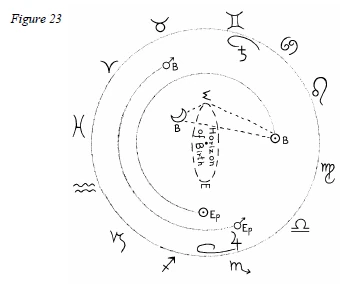
Elizabeth, Queen of England - Born 7 September 1533–Moon waning below horizon Epoch 12 December 1532
Queen Elizabeth of England is an historical example of this particular impact. We need not comment much on her fundamental Archer character. Her decisive part in English history—the expansion of England, the successful struggle for national independence in religion and politics—is proof enough of the typical heritage from Archer.
This was greatly assisted by the impacts of Jupiter and Mars in the constellation of Scorpion at the time of the epoch. They were above the head of the embryo image. Jupiter in that position is an indication of a considerable life wisdom that was able to cope with any situation with foresight. This she certainly displayed, even during the difficult times before her ascent to the throne. Mars in Scorpion, moving during the embryonic development as far as Bull, emphasized the sense of independence and the realistic capacity of tackling life.
Saturn moved mainly through the constellation of Twins during the prenatal time. This is a remarkable position. Saturn will often demonstrate the deeper reason why one has chosen a definite historic setting for one’s incarnation. As Twins, in particular, has been connected with the development toward individuality, we can well say that Queen Elizabeth had the necessary requisites in her organization to serve the impulse of the dawning age of individuality. Through her whole self, she prepared the ground for a nation whose task it is to realize in practice of life, the importance and the efficiency of the individuality in modern humanity.
Another asterogram with an epoch Sun in Archer is that of Wallenstein:
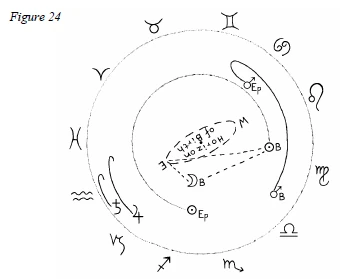
Wallenstein, Duke of Friedland - Born 14 September 1583, Bohemia–Moon waxing above horizon Epoch 18 December 1582
He was a German soldier and statesman who played a great part in the Thirty Years’ War. He had acquired huge estates in Bohemia through marriage, and at the height of the Thirty Years’ War, he raised and equipped an army that fought under his command in the service of the Emperor Ferdinand against the Protestants.
He was generally victorious in his campaigns, except in the famous battle of Luetzen when the imperialists were defeated by the Swedes, though their king, Gustavus Adolphus, was killed (1632). After this battle, he withdrew to Bohemia and, as far as documents prove, prepared to desert the Roman Catholic cause and the Emperor. Obviously, he attempted to bring the war to an end by negotiating with the Protestant states “in order to force a just peace on the Emperor in the interests of a united Germany.” The court of Vienna became increasingly suspicious of the loyalty of Wallenstein. It was decided to get rid of him, and he was finally murdered at Eger by a few of his own officers when the attempts to combine with the Emperor’s enemies became obvious.
This unique destiny and the grand political schemes that Wallenstein nursed and pursued, without a doubt, reveal the Archer impact. (His offer of a whole army to the Emperor was not an act of sheer idealism or altruism, it was an attempt to gain political power). Other details of the asterogram confirm and emphasize this fact.
The gesture of Mars in the limb part of the embryo image points to the will nature of Wallenstein, to the soldier. The loop in Twins, and later the movement through Crab and especially through Lion, stands in connection with Wallenstein’s conviction of astrological influences, but his views on astrology and the use he made of it, betray a rather fatalistic attitude. It is said that his downfall and end were accelerated by his over confidence in and dependence on the prediction of his astrologer.
In the course of his prenatal development, when Mars was in Lion, it came into opposition to Saturn and Jupiter, which both moved through Waterman—and Jupiter even further into Fishes. Their conjunction took place in Waterman. We have met such conjunctions before in other asterograms. They speak of great turning-points in the history of humanity. In Wallenstein’s make-up, he was certainly fitted for playing a decisive role in the destiny of Central Europe during the Thirty Years’ War. But he obviously did not come to clear conceptions about the real struggle that was going on, to a conviction of its spiritual significance. He behaved more like a gambler. This is accentuated by the fact that Jupiter and Saturn were somewhat embedded in the body of the embryo image, in the realm where feeling is prevalent over thinking.
Furthermore, this inclination was worked into a kind of inner tension by the opposition of Mars from Lion. Wallenstein’s belief that the destiny of a human being was ruled by the stars prevented him from breaking through to the free deed performed out of individual moral imagination. One can even say that he stood at the crossroads from an ancient fatalistic astrology to a new conception of the connection between the human being and the stars. Of course, such transitions can never be achieved momentarily. They are established by going along the painful road of human error and tragedies. One cannot expect that humanity in Wallenstein’s time were ready to acquire the idea of individuals being capable of using their individual connection with the stars as they would use a tool.
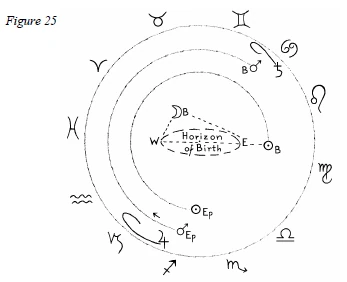
Cesare Borgia - Born 17 September 1475–Moon waning above horizon–Epoch 16 December 1474
An example that shows a rather negative side of the Archer impact is the asterogram of Cesare Borgia. The story of Cesare Borgia is so well-known that we need not add very much. He was the son of Pope Alexander VI and was involved in the execution of his father’s extensive political schemes as gonfalonier (commander of an army) of the Church. Cesare was a man of utmost and unchecked cruelty, unscrupulous and treacherous. All Italy feared him. He suffered no opposition.
We have here an example of an Archer type that shows all the cosmic-physiological characteristics of this constellation, but without the safety valve of moral and conscientious self-control. Cesare’s age was a period in human history that was an “interregnum” between traditional moral bonds and new morality out of free inner decision. This led many people into chaotic and rebellious soul conditions. Cesare was not the only one, but he was undoubtedly one of the most outstanding moral rebels of his time.
The uncontrolled depths of his will are indicated by the conjunction of Saturn and Mars at birth in Crab. It was in the limbs of the embryo image, in the region of the unconscious will. What a Lenin developed in and through his head as Crab impact, had sunk into the limbs in Cesare’s case.
The Constellation of Goat
The constellation of Goat appears to be connected with the chin of the archetype of the human head and with the knees in the body (Fig. 7). We know how deeply these regions of the organism are related to one’s power of resistance. For instance, we speak of “chattering of teeth” if we are confronted with some frightening experience, or our knees tend to become “weak” or “wobbly” under such circumstances. We also use the expression of “keeping our chin up” when we are faced with a tough situation. All this proves that there is in us an instinctive realization of a more occult function of the Goat organism in our body.
Those who have acquired an affinity to this constellation through their epoch Sun can be strongwilled to the point of being driven by fixed ideas. Because of their make-up, they may also meet strong resistance and frustration from the external world and from the limitations of their own organism.
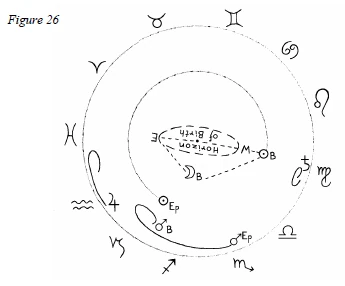
Savonarola - Born 21 September 1452–Moon waxing above horizon–Epoch: 30 December 1451
A classical example of a Goat affinity is the asterogram of Savonarola. He is famous through the religious revolution that he brought about at Florence. In 1491, he preached in the cathedral of Florence, and from that time onward his public influence increased to such a degree that he became the spiritual and religious dictator of that town. Savonarola spoke as a visionary, with mighty and even threatening language of the wrath of God to come, of the necessity of purification and renunciation of worldly wealth, and so on. His influence grew ever stronger, and he became something like the law-giver of Florence, who tried to infuse his tenets and his religious demands into the constitution of the republic. Here we see a strong will and determination resting on a Goat disposition. Of course, because of his almost fanatical tenacity, he soon met equally strong resistance from his surroundings. His age was not too keen on the strict rules of religious obedience and renunciation that he preached so forcefully. It was the time of Alexander VI, the Borgia Pope.
Gradually, Savonarola moved into opposition with the political powers of Florence, and also he was soon considered by the Holy See at Rome to be a rebel in the Church, because he also demanded—with his usual fervor—a reform of the Church. The day came when his many enemies succeeded in bringing about the fall of the friar. He was arrested, tried and tortured, and finally burnt at the stake. This happened in 1498. It is an example of the extreme self-will that can grow on the foundation of a Goat disposition, leading almost to the point of heedless fanaticism. But it was equally present in the strong resistance that Savonarola was bound to meet from his contemporaries.
A closer study of the asterogram reveals the background of this extreme power of resistance and determination; for instance, the head organism of the embryo image was penetrated by the impact of Mars performing a loop in the constellation of Goat. Jupiter working into the region of the larynx accounts for the oratorical eloquence of Savonarola. It moved through Waterman, a constellation that speaks of an unstemmed flow of religious imagination. Saturn was below the feet of the embryo image, where it moved in the constellation of Virgin. Here we have an impact Savonarola must have experienced through the Earth beneath his feet. It gave him the inclination and urge to his gloomy prophecies, which partly became true. But it also accounts for the opposition that he met in the world of his time.
In Part Two, we have already produced the prenatal asterogram of Fr. Nietzsche, the German philosopher, which shows also an epoch Sun in Goat (born 15 October 1844.) One can truly say of Nietzsche, that he had a strong affinity to the forces of the constellation of Goat, which revealed itself more and more during his later years. His utterances, for instance in Thus spake Zarathustra, his sharp criticism of almost everything that surrounded him in his time, his sarcasm to the point of nihilism, stand witness of a man who, by nature, clashed with his whole age. This is a typical Goat manifestation. Of course, by energetic inner culture, this inclination can be transmuted into a healthy power of distinction and selection, into a shining example of purity of mind and spiritual aspiration.
Nietzsche was bound to meet the resistance of his contemporaries. His tenets did not draw many adherents while he was still alive. He became more and more isolated and lonely. Before his illness he had very few friends left. Only after his death did he become the philosopher of those who, like him, were in opposition to the trends and the political, religious, or spiritual institutions of the present civilization. Many of the German Youth Movement, at the beginning of the 20th century, saw in him their profit in their rebellion against set and fixed forms of cultural life.
The Constellation of Waterman
We have pointed out previously that the winter constellations bear a reflection of the summer constellations. If we imagine Fishes and Virgin being pivots of an axis, we shall find that Scales is corresponding to Lion, Scorpion to Cancer, Archer to Twins, Goat to Bull. In the upper part of the Zodiac, the emphasis is much more on the head organization, thus providing the archetypal foundation of whatever appears in the direction of intellectual manifestation. In the lower constellations, we have the archetypes of the limbs where activity is more pronounced. (As far as this refers to the epoch Sun, we must not lose sight of the fact that the positions of the planets and their movements can cause considerable variations of the rule.)
For instance, the impact of an epoch Sun in Goat has a certain affinity to Bull, but in the sphere of action. The example of Savonarola is one of many incidents that demonstrate this connection.
The Waterman suggests a realization of Ram qualities in the realm of activity. The archetypal background of this constellation (Fig. 7) reveals a relationship to the human mouth, which serves to make speech audible. So to speak, the archetype of a human being, the integrated totality of humanity conceived as a spiritual being, speaks its mind and reveals the inherent purposes and significance of brotherhood in the universe. Of course, the manifestation through the single human being may be handicapped, owing to limitations of an individual kind or of a cultural setting.
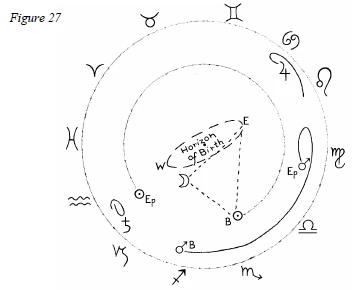
Paracelsus - Born 14 November 1493, about midnight, Switzerland–Moon waxing below horizon Epoch 2 February 1493
An excellent example is the prenatal asterogram of Paracelsus. He was a physician of considerable renown at his time, but he was also the object of great controversy among his colleagues, even up to the present age. He had acquired his medical knowledge in a unique fashion. When he was still very young, he set out on a twelve years’ journey looking out for secrets of healing everywhere. This led him through a great part of Europe and right to the borders of Asia, Russia, and the Arabian countries. After his return, he became famous for his cures and was engaged as town physician at Basle. He lectured also at the University of Basle but soon came in conflict with his medical colleagues. He openly denounced the classical authorities on the art of healing, like Galen and Avicenna. Soon he had to flee from Basle because of the threatening attitude of the medical faction. From that time onward, he led a life of endless wandering, always being called for treatment of illnesses because of his miraculous methods and remedies, but he never stayed very long in any place. He died at Salzburg in 1541.
In spite of his restless life, he managed to write a number of books and some were published. These books reveal a man of deep and comprehensive knowledge of the human being. It is true that they were written in a language which is almost incomprehensible for a person of today, but if one can penetrate the veil of occult terminology he used, one finds an immeasurable wealth of information about the spiritual roots of nature, of the causes of illness, of the connection of a human being with the stars, and of almost magic possibilities of healing. He went right back to the cosmic foundations of existence. In this we see the reflection of a Ram impact on an epoch Sun in Waterman. The difference is that Paracelsus did not intend to come as a preacher to the world; his aim remained action to the last moment, namely healing.
Paracelsus was a man through whom the spirit of humanity attempted to proclaim the spiritual compass of inherent human capacities. He had his limitations, and our present consciousness is, in general, still far from grasping (to say nothing of exercising) the hidden treasures of activity within us. Paracelsus stood at the threshold to the modern age, as one who made it his task to demonstrate that people are more than what modern materialism merely makes of them—“chance creatures” of heredity and environment.
A Waterman impact was strengthened by Saturn in that same constellation, working into the head of the embryo image. It also brought on the difficult fate that was certainly aggravated by the psychological make-up of Paracelsus, his choleric temperament, etc.
Jupiter in opposition to Saturn moved through Crab and finally into Lion. Here are the roots of the superb cosmological views of Paracelsus. In his last book, called Astronomia Magna, he set forth the principles of the relationship between the human being and the stars, as he saw it and wanted it to be applied in medicine. The time when he wrote this book is clearly connected with Jupiter in Lion, from several points of view.
Mars started with a loop in Virgin, moved through Scales, Scorpion, Archer, and was on the point of entering Goat at the time of birth. Its impact referred to the lower organism and the limbs of the embryo image. We see in this, Paracelsus’ affinity to the Earth and his knowledge of the properties of our planet, especially the loop in Virgin is an apt indication. It refers to the time before his “great peregrination”, when he studied alchemy under the abbot Trithemius of Sponheim, and later when he worked in mines in Tirol, where he introduced himself to the difficulties of mining, to the nature of minerals, and to the diseases of miners. Here he acquired much of the knowledge he practiced later on as a physician.
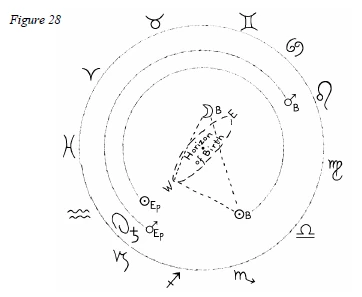
William Blake - Born 28 November 1757, London–Moon waning, above horizon Epoch 16 February 1757
The prenatal asterogram of William Blake reveals also an epoch Sun in Waterman (Fig. 28). Like Paracelsus, William Blake has also become the object of great controversy. One can even say that he has hardly been understood with regard to the message that he had to bring. He cannot be measured by the standards of ordinary poetry and art, which for him must have been only the limited means of expressing much higher intentions.
We attribute his strange position in our present age to the proximity of Saturn and Mars to his epoch Sun. This is also a similarity to Paracelsus’ asterogram. The emphasis here, however, is more on the constellation of Goat. It created a disposition that made him inclined to see in simple occurrences of daily life, a transcendent significance, which he transmuted into apocalyptic visions. He lifted up these visions to extreme heights of cosmic-spiritual dimensions. Through Mars in Lion at the time of birth, he had such inclinations and capacities. No language existed then for the expression of what he experienced. He had, therefore, to invent his own terminology, which is not an easy one. Where he was unable to express in words what he wanted to say, he used pictorial imaginations that are often equally difficult. He, thus, gives many people headaches if they try to understand him.
Nevertheless, we contend that the voice of the spirit of humanity also spoke through him. He was a true representative of Waterman impact in the sense of prenatal acquisition of cosmic influences. Everywhere in his poetry and art, we find the description of the apocalyptic battle for the pure, spiritual image of brotherhood. In certain aspects, his visions come very near the great imaginations of the Revelation of St. John.
Another controversial matter may be the question of whether he embodied in his creations only the products of his own mind or whether he had real vision. The movement of Jupiter in the asterogram, through Scales and into Scorpion, suggests that he had real spiritual experiences. Jupiter referred to the feet of the embryo image. William Blake’s deep love of the Earth and loyalty were the elements of his particular path to higher worlds.
The Constellation of Fishes
The last constellation of the Zodiac, which we have to discuss, sums up all the impacts of the previous ones. According to the archetypal background of the Zodiac (Fig. 7), it is connected with the eternal countenance of humanity. People who have received the influence of Fishes through their epoch Sun display, in some field of life, the tremendous struggle of humanity to conform with and to manifest the divine image of the human being.
This is an everlasting battle, because there exist constant attempts by adverse powers to divert the human race from its inherent divine purposes, to use individuals in directions different from the aims of the Divine since the beginning of creation. Our present age, especially with its materialistic tendencies, has little inclination to listen to such ideas that suggest an individual as being the potential spiritual expectation of a divine world. It seems, of course, much easier to sit back and to regard an individual only as the tiny earthworm, the product of chance, and the object of the universal process of becoming and dying. However, the inborn urge in us to strive for the attainment of our higher being cannot be eliminated, in spite of gigantic and powerful attempts by adverse forces to eradicate it. Usually, people who have an epoch Sun in Fishes are involved in one way or another in a representative fashion in this battle. They may act from seemingly high motives in life and idealistic aspirations, yet they may have one-sided views of the totality of the divine image of humanity. (Especially our present age is apt to develop one-sided, however suggestive, opinions of the position of the human being in the universe.) Then destiny, the invisible but almighty power of human self-correction, steps forth and puts human affairs into their proper perspective and in harmony with the whole. We find in connection with Fishes distinct patterns of dramatic human destinies, which reveal healthy divine correctives for the sake of our evolution as a totality.
An excellent example of how Fishes forces work through human beings is the opposition between Disraeli (born 21 December 1804; epoch 23 March, 1804) and William E. Gladstone (born 29 December 1809; epoch 24 March 1809) during the past century. Both their epoch Suns were in Fishes, almost exactly in the same place. The changeful story of their political activities has contributed much to the countenance of modern England, but it was the uninterrupted opposition of the two personalities for many years that caused the specific setting that was important for Great Britain in the play of modern history. Another personality with an epoch Sun in Fishes was the famous scientist Louis Pasteur (born 27 December, 1822; epoch 7 April, 1822). From his inherent capacities, he has certainly given the modern age most important facts about life and the “infinitely small” opponents of life, the germs working in fermentation, disease, etc. He has opened a gate to the physiological background of the battle between life and death with his researches. He said, “Two opposing laws seem in contest to me now: the one a law of blood and death, opening out each day new modes of destruction, forces nations always to be ready for the battle; and the other a law of peace, work, and health whose aim is to deliver people from the calamities which beset them ...”. This is certainly written into the countenance of humanity and will be the battle for a long time to come. It belongs to the essence of the impact of Fishes.
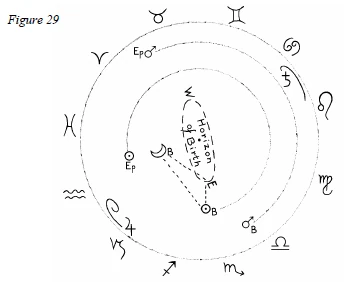
Gustavus Adolphus of Sweden - Born 9 December 1594 (Julian)–Moon waxing, below horizon Epoch 3 March 1594 (Julian)
Another case where we also see the influence of Fishes working through a human organization is the asterogram of Gustavus Adolphus of Sweden (Fig. 29). He was the one who interfered in the Thirty Years’ War on the side of the Protestants. Only for little more than two years was he the active and victorious leader of the operations against the imperial forces. In June 1630, he had landed at Peenemünde, and the first decisive battle was fought at Breitenfeld in 1631. However, a year later he was killed in the famous battle of Lützen (November 6, 1632).
His campaign was just sufficient to establish a balance between the forces of the Roman Catholics and the Protestants. No more was he allowed to achieve. We see here the mighty hand of destiny that forms the countenance of humanity according to patterns of evolution, whose significance may be discerned only much later. A person who has the corresponding cosmic-physiological disposition might be permitted to perform just one single deed that gives history the necessary twist of correction. His being, stopped at a certain point—for instance by death, may appear then as a tragic destiny; but behind the screen, we can detect the mighty alchemy of the divine world working for the good of evolution.
An extremely intricate divine alchemy in the molding of nations reveals itself in the prenatal asterogram of Mary, Queen of Scots. It is given in Fig. 30 below. The 44 years of her life were certainly a whirlpool of human destiny, and it is very difficult to see any logical and coherent purpose in her biography. Nevertheless, her existence was an important historic link in the molding of the British nation, though it might appear that during her lifetime it had just the opposite effect. We must, however, not forget that very often opposite ingredients have to be put together in the cauldron of destiny in order to bring about the desired mixture. And where we may have experienced great human opposition in life, an equally strong desire for harmonious amalgamation of opposites may occur after death.
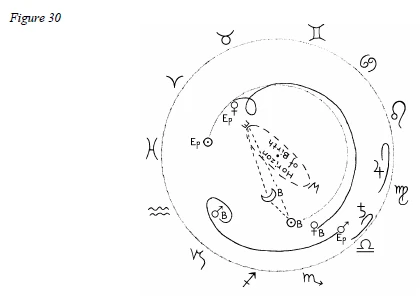
Mary, Queen of Scots - Born 7 December 1542–Moon waxing above horizon–Epoch 19 March 1542
In order to shed some light on this strange destiny, we introduce a feature in this asterogram that we have omitted so far. It is the gesture of the planet Venus (in the astronomical sense). It performed a loop during the first months of the embryonic development. This loop interests us immensely, because by certain methods (of which we cannot speak at present) we follow up this gesture of Venus in the rhythms of history. We have repeatedly pointed out that the rhythms of stars (the loops of Venus come back rhythmically) are the expressions of archetypal ideas also manifesting themselves in history. Thus, this particular loop of Venus leads us back to the times when John the Baptist was beheaded.
Such an execution is a deeply tragic event, but the Gospels also express another view. For instance, in St. Mark, Chapter VI, we hear of the mighty deeds the twelve apostles performed when they were sent forth by Christ: “When Herod heard thereof, he said, ‘It is John whom I beheaded; he is risen from the dead.’” Herod realized that John, after his beheading, was working more powerfully from the realm of the dead than he did when he was alive. In the deeds of Christ’s apostles, Herod recognized his presence.
There was something of a similar destiny in Mary’s life, at least in a symbolic sense. (Incidentally, the loop of Venus took place in the region of the neck of the embryo image.) It may sound strange, that we read in this gesture of Venus, that it was Mary’s destiny to reach a point where she had to be beheaded. After death, she had the chance to work “mighty deeds” among the so-called living for the progress of humanity. Who can know how much of the ascent of Great Britain to its historic position must be attributed to such influences, or if one can at all accept a positive connection between the living and the dead? From all our investigations, we cannot support the idea that she continued with any kind of antagonism after death, but that she acquired universal points of view.
Conclusion
The foregoing description cannot be regarded as conclusive in the relationship between a human being and the stars during the embryonic development. It is quite obvious that many other considerations must be taken into account before one can speak of a final and comprehensive foundation for the judgment of individual asterograms. The viewpoint of the twelve constellations offers no more than a general outline. For instance, there are still to be considered subtle degrees of transition from one constellation to the next. Also within the constellations of the Zodiac one has to distinguish between the fixed stars that constitute the constellations. In Twins, for example, we can speak of the general aspects of this part of the Zodiac. However, we may find an epoch Sun, or other planets near the fixed stars Pollux or Castor, or any other fixed star within this constellation. Pollux and Castor, which are only about 2° degrees apart, can be regarded as complete opposites. Castor would have a predominantly earthbound constitution, whereas Pollux has more of a cosmopolitan nature. This exemplifies how minute differences can change the picture completely. Other factors that provide infinite variations are the fixed stars of the extra-zodiacal constellations. Looking at this maze of potential inclinations, we come to the conclusion that it is ultimately the free individuality who must choose and decide consciously where, hitherto, an entirely instinctive certitude of varying degrees, aided their being. The kind of Astro-Gnosis that is demonstrated in these publications, regards as its noblest task: the creation of the foundation for our conscious decision toward a full realization of our inheritance from the stars.
Another set of facts omitted in this present publication due to limitations of space are the gestures and movements of the planets Venus and Mercury during the time of gestation. They are liable to completely change the picture of such a prenatal asterogram, of the impacts of the Sun and the superior planets. However, we have not yet demonstrated the principles for the interpretation of the inferior planets Venus and Mercury, and of the Moon, though we intend to do so in a future publication, which will probably be devoted solely to these problems. The last example in this present volume (Fig. 30) conveys the necessity for the inclusion of the inferior planets in the interpretation of the asterogram.
Finally, we should like to say a word about the nature of the epoch. From the volume of evidence collected, we conclude that this so-called epoch need not coincide with the actual conception. There is actually no necessity to identify the epoch with conception. All we must do is to restrict our consideration to the given facts and not overstep their orbit. First of all, the Hermetic Rule, by which the epoch is calculated, is an attempt to determine the individual relation of a human being with the stars. Certainly, somewhere during the embryonic processes, a link is obviously established between our “individual cosmos” and our physiological nature; otherwise, the facts demonstrated in Parts Two and Three could not have been produced. However, it does not follow that this link between the cosmic and physiological nature is brought about at the exact moment of conception. We conclude that the epoch is the moment when the cosmic image of an individual, as a formative principle, takes hold of the germ and directs the process of incarnation. This can also take place some time after conception.
There are certain difficulties in understanding this. So long as we retain the concept that a human being is the product of terrestrial forces and substances alone, namely, that which comes through the contribution of the parents, we cannot form an adequate picture. It may even appear futile to apply the cosmic aspect. Only if we can conceive the being of an individual as coming from and dwelling in a spiritual-cosmic world before conception, can we see things in a clearer perspective. A soul ready to descend into incarnation is offered the material requisites for existence on Earth—this is the moment of conception. After the offer has been accepted, the spiritual cosmic entity of the soul can combine with the germ. This cosmic being, permeated by impulses, intentions, decisions, etc., with regard to the pending incarnation, finds its expression in the aspect of the heavens at the time of the epoch. This moment has been deliberately chosen, because the soul regarded it as the congenial agency of combined cosmic forces with which it could mold the germ into a human organism of individual character.
We can regard all that comes from the world of matter through the parents, etc., as a kind of matrix that is permeated by the asterogram of the epoch as a complex world of force, chosen by the individual. The amalgamation between “matrix” and “force” would then take place at the moment of the epoch.
This suggestion of the relationship between the terrestrial germ and the cosmic image of an individual, corresponds also to the results of investigation in spiritual science. On this basis, we should be able to visualize the possibility that the epoch may take place, in certain cases, before conception. In other words, an individuality, surrounded by its own cosmic requisites of force, may have to wait for the offering of a suitable physical germ. Then the heavens of the epoch would represent, as it were, the “pre-established cosmic harmony”, which would lead earthly events through its dynamic characteristics into the desired direction.