Isis Sophia III
by Willi Sucher
Part Four
Chapter I
Cosmic Rhythms and Evolution
The present publication will be the first number of a new series dealing with an investigation of cosmic rhythms and the question of their reflection in world history. This problem has always occupied humanity since remotest times. There are many instances which prove that numberless attempts have been made to find practical connections between the events and rhythms in the world of the stars and historic development.
Perhaps one of the greatest examples of such endeavors is the Revelation of St. John the Divine, where the past and the future evolution of our planet are set forth in mighty cosmic pictures. The pictorial language used in the Revelation is, of course, almost incomprehensible to the ordinary faculties of a modern person. Attempts that have been made to use and read this document, within the compass of modern reasoning, have led to abstruse and untenable interpretations and prophecies that largely discredit it. The Revelation of St. John is written in the language of the ancient Mysteries, and it needs faculties similar to those cultivated in the old temple places in order to decipher its real meaning. Such a deeper insight will discover that this document was conceived on the foundation of a profound knowledge of the great rhythms in the cosmos, a wisdom of the stars of which our modern world knows very little.
One of the last representatives of that lost ancient star wisdom was the famous astrologer and Prophet Nostradamus, a Frenchman who lived during the 16th century. His prophecies, which are contained in his publications called Centuries, have become famous and have been regarded by many people as containing a description of coming historic events, following the age of the prophet up to the end of the 20th century. The language of these documents is very veiled, sometimes even vague, and to decipher their meaning is a very difficult task. Nevertheless, it is apparent that many of the prophecies became true, even with regard to the names of historic personalities who had an active hand in the shaping of events centuries after the death of Nostradamus. It usually happened that only afterward people discovered that names, times, and circumstances of events were contained in Centuries but were hidden in strange usage of words and pictorial descriptions.
It is not easy to find out how Nostradamus obtained his prophecies. However, one is aware that much of the obscurity in his writings is due to the fact that he lived in constant fear of being reproached for using some black, devilish art in order to gain his insight. This was, of course, a serious consideration in the Middle Ages, in the days of the Inquisition and witch hunt, when accusations of this kind led to certain torture and death. He had also to be careful not to offend people in high political positions by his prognoses. For instance, the Roman Church prohibited the reading of Centuries in 1781, because they contained veiled prophecies about the decline of the Papacy about the end of the present or beginning of the next century.
Nostradamus said very little and only in that same guarded language of the Centuries, about the foundations of his insight. He may have had a natural capacity of “second sight”. We know, of course, that he was a great astrologer, who was consulted by members of the French Royal Court, chiefly by Catherine de Medici. But it is quite obvious that he did not only employ an astrological knowledge, which by then had become absolutely stereotyped and petrified into applications of incomprehensible traditions about the supposed influence of the stars. However, the sources that Nostradamus used remain obscure. There are suggestions that he used to gaze into a basin filled with water and thus received his revelations in a state of consciousness bordering on a trance condition. Such methods have been known in occultism since the remotest times.
Methods like those which Nostradamus employed are no longer suitable to the present age. They are dependent on a conditioning of a human organism to a state of consciousness far removed from the required standard of a modern age. No doubt the human organization has changed since ancient times, and it is no longer pliable by external means, to such a degree that satisfactory results cannot be obtained. Moreover, it is a widely recognized fact that methods, which require the dimming down of human consciousness to trance and mediumistic conditions, have become dangerous for our health in this modern age.
If anything, we must seek new approaches to those realms lying beyond the normal scope of perception through the senses. They must be in harmony with the modern capacity of consciously controlled and disciplined thinking and in line with our desire for the full comprehension of the means involved. These requirements can be achieved, even in the modern world.
For this purpose, we will need a study and an understanding of the rhythms in the cosmos and in human history. We shall, therefore, have to investigate such cosmic facts as the precession of the vernal point, the slow movements of the nodes of the planets, and the rhythms of the planets themselves.
Apart from this, we will also require a contemplative and meditative attitude, such as the kind that Rudolf Steiner has spoken of in his many books and printed lecture cycles, and also possible ways of training he suggested. Such methods can lead to approaches of the great unknown, which lies beyond birth and death, beyond the inner world of a human being, and that can lead also to the spiritual background of all that exists in the kingdoms of nature. We may simply call it the spiritual world. Training of this kind, which anthroposophy suggests, can throw open those portals again to a world of spiritual reality and primal cause that were closed to us since some time in the past. However, the approach suggested here is in absolute line with the compass and capacities of any average person in this modern age. We need not fall back into ancient modes of training that may endanger our physical and mental health, nor need we withdraw into seclusion from any task that modern life may require of us.
This kind of approach—of the spiritual world working into the physical and results of investigations on this basis—will make the foundation of the presentations in the present publications.
Chapter II
The Precession of the Equinoxes
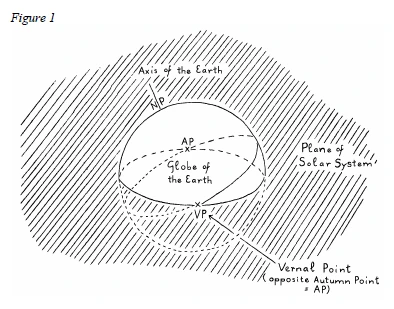
The precession of the vernal point or spring equinox has been well-known since ancient times. The time of one complete rotation of the vernal point in the Zodiac was called a Platonic Year and takes about 26,000 years. This suggests that the astronomical facts were perceived in Greek times, though very probably much earlier. What is the vernal point? It is common knowledge that the globe of our Earth is rotating around an axis, which goes through the North and South Poles. A complete rotation takes place in 24 hours and carries each point on the surface of the Earth from west to east. Thus it happens that the stars, the Sun, the Moon, etc., seem to rise in the east and set in the west.
Because of this rotation, each point on the Earth describes a circle in the course of one day. For instance, if we started out from one of the poles and watched all the points on the surface of our planet going in a straight line toward the equator, we would discover that all of them described circles which are concentric and at the same time become bigger and bigger. We should finally arrive at one such circle that is bigger than all the rest. This is the equator. It is situated exactly at equal distances from both North and South Pole, and its plane forms an angle of 90° with the axis of the Earth. This equator is the one fact that we need in order to understand the vernal point.
We must add another phenomenon of the heavens to this, and that is the plane of our solar system. It is well-known that the members of the solar universe to which the Earth belongs are moving through cosmic space. According to the Copernican world conception, they move in orbits of varying sizes and distances around the central Sun. Because of their distances from the Sun and of their properties, they move with different velocities, thus establishing a never-ending variety of relative positions among themselves. These moving entities of our solar universe are the planets, including the Earth’s Moon.
One of the most striking features, concerning these orbital movements of the planets, is the fact that their paths are all, with small aberrations, placed on a common plane (with the exception of Pluto whose orbit is rather more oblique). This plane of the solar cosmos is limited, and its boundary is indicated by the orbit of the outermost planet away from the Sun. Still, we can imagine that this plane is extending, ideally speaking, into outer space. At all the points of its ideal circumference, it would then enter the world of the fixed stars. This outer fringe of the plane of the solar world is the Zodiac of the fixed stars and the stars that happen to be in or near that gigantic circle forming the familiar twelve constellations of the Zodiac.
Based on the daily rotation of our plane, we must bring together these two astronomical facts—the plane of the solar system and the equator of the Earth—in order to understand the vernal point. However, as we permitted ourselves to imagine the plane of the solar universe extending into so-called infinite space, so ought we to think of the equator of the Earth extending into cosmic space, surrounding our planet like a collar. The ideal fringe of this collar in space is the celestial equator, which is important in modern astronomy for the location of the stars.
We then have two planes: one is that one on which all the members of the solar system move, and the other is the plane of the extended equator of the Earth. To this we simply add the fact that the plane of the equator is tilted with regard to the solar plane. This is caused by the axis of the Earth, which does not stand vertically upright on the plane of the solar system. It is inclined, and thereby the equatorial plane forms an angle with the other, an angle that is at present about 23°27’.
We know that if two planes intersect, the points of intersection form a straight line. Also, the two planes of the solar universe and of the celestial equator intersect along a straight line. At either end of this line are the vernal and the autumnal equinoxes. The one where the Sun is on 21 March, is the spring equinox and the one opposite, the position of the Sun on 23 September, is the autumn equinox. These two planes, and the points of intersection connected with them, are of great astronomical importance. Quite a lot more can be said about them; however, this is not our task here. We hope that in due course an English translation of Elizabeth Vreede’s book, Anthroposophy and Astronomy, will be available, where more details of astronomical interest concerning this matter are given.
We will now proceed with a more qualitative consideration of the two cosmic facts that we have indicated so far and which, at first, may appear only to be of mathematical and astronomical importance. The equator of the Earth is obviously an expression of our planet’s movement in space around the Sun, as we say in the sense of the Copernican world conception. Two points of this great circle are always exactly opposite each other on the plane of the solar system. The rest of it is either “above” or “below” that plane. In those two points, which correspond to vernal and autumn points, our planet is coordinated into the movements of the other planets of our solar system.
This coordination must have an intelligent background. Of course, one tries in our time to explain all cosmic movement, including that of the Earth, on the foundation of mechanical cause and effect, usually in terms of gravitational pull, etc. Most people don’t realize that this isn’t an explanation. It is only an escape or postponement of the answer, because gravitation, on the basis of electricity and magnetism, is an unknown quantity. Nobody knows where it comes from or where it goes to. Therefore, the real origin of cosmic movement is veiled in obscurity, as long as we seek its background in purely mechanical world aspects.
In the case of the movements of a human being, we usually do not make this mistake. We can investigate direction, speed, and so on, and can express it in mathematical and geometrical terms. However, we do not, in the normal case, assume that the body of a person is moved by external forces of which we are unaware. We know perfectly well that we move our body and direct it according to our inner or soul world.
It is difficult for a mind, trained according to current modern thinking, to accept the idea that the Earth is moved by similar “psychical” causes on a cosmic scale. One of the major obstacles is the suggestion of modern science that the movement of the Earth resembles that of a mechanism, because it appears to be uniform and ever repeating itself. Yet, this is fiction. Even on the foundation of Copernicanism, the Earth never returns to the same position because the Sun, itself, is supposed to move through cosmic space with tremendous speed, taking all the members of the solar family with it on this journey.
There is no real reason why it should not be possible to consider the Earth as the physical organism of a living, intelligent being. Why should we assume that only a creature with a human brain is capable of developing intelligence?
Spiritual science, which rests on the development of faculties that are capable of penetrating into that realm of the unknown closed to the senses—to the reality of the spiritual world, recognizes the Earth as an organism permeated by cosmic life and intelligence. Therefore, it also realizes that those points of contact of the Earth with the extra-terrestrial world—the equinoxes—are expressions of the relationship and exchanges between the life and intelligence of our planet and the other members of the solar family.
The objection against such ideas may be that these interplanetary exchanges appear to be of rather a stereotyped nature and not at all what we should expect of an intelligence of the magnitude of the Earth. The vernal point, this “sense organ” of our planet (also the autumn point), seems to be staring constantly in the same direction. However, a simple investigation shows that this is not the case. For instance, the planets are moving past those equinox points according to their intervals of revolution. This alone brings an enormous variety into the “perceptions” of the Earth. There is also another aspect apart from this, namely, the precession of the vernal point, which expresses the ever-changing character of our planet’s contact with the extra-terrestrial world.
We said before that the outer fringe of the plane of our solar system can be imagined going out into the sphere of the fixed stars, especially to the fixed stars of the Zodiac. We may now be allowed to assign to the whole solar universe a capacity of contacting, through “physical” organs but “intelligently”, the worlds beyond its own border. The sphere of contact would then be the whole Zodiac itself. There is, of course, no intersection between the plane of the solar organism and the fixed star world. (This may appear to be a rather boring affair, because the solar system would then always contact the same twelve constellations of the Zodiac. However, we know that over long intervals of time, which are really short according to cosmic perspectives, the constellations of the Zodiac are also changing their countenance, because of the movements of single fixed stars.) We may, therefore, consider the Zodiac as the expression or sphere of an extremely exalted cosmic Intelligence with which our whole solar universe is communicating—receiving inspiring impulses and forces of fundamental nature.
The Earth, as a member of the solar family, would also partake in this rejuvenating and inspiring impact from beyond the fringe of the house of the solar universe. How can we imagine this happening? We said above that the equinoxes are points where the Earth is contacting the plane of the solar system as a living organism. Through them our planet partakes in the common life of the whole solar family, being a member of it and moving on its common plane or sphere. Hence, the Earth also has its share in the communication of the solar universe with the Zodiac of the fixed stars, via that plane which serves all the planets, to a certain degree, as a foundation for their movements.
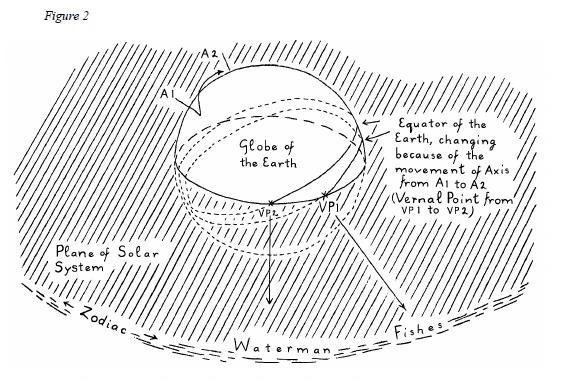
The equinoxes seem to point constantly to a definite direction in the cosmos, wherever the Earth is standing during its movement on the common plane of the solar family. This is also connected with the fact that the axis of the Earth points, or seems to point, always in the same direction. Just as we, in our imagination, extend the equator into cosmic space, so can we extend the axis and can then speak of a celestial Pole around which the whole sky appears to rotate. We know that this celestial Pole, in the Northern Hemisphere, is near one of the stars in the Lesser Bear.
Thus it happens that the spring equinox is at present pointing in the direction of the fixed star constellation of Fishes, just below the western fish of the two fishes. We can, therefore, assume that the Earth receives a definite impact of cosmic forces from the direction of that constellation, as they travel along the plane of the solar universe. Furthermore, we know that on the 21st of March each year, the Sun appears to stand in the point of the spring equinox and on the 23rd of September in the point of the autumn equinox, which is caused by the relative positions of Sun and Earth during those times of the year.
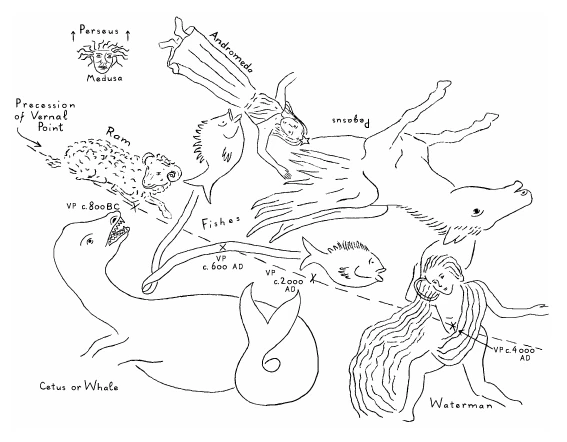
Humanity, already ages ago, experienced that this contact of the Earth with the Zodiac is slowly changing. It is established at present, via spring equinox and solar plane in the direction of Fishes; whereas, a few centuries before the beginning of the Christian era, it was orientated toward the stars of Ram. This is caused by the rotation of the axis of the Earth around an ideal double cone. As we said above, in the Northern Hemisphere the axis is at present pointing to the tail star of the Lesser Bear. About 3000 BC, the celestial Pole was in the tail of the constellation of the Dragon. Thus, the Northern celestial Pole moves through the sky in a circle, in about 26,000 years, that encloses the Dragon. Correspondingly, the celestial equator (the counter image of the earthly equator) must shift in a wavelike, circulating fashion. This causes the equinoxes to change their direction and contact with the Zodiac. The slow movement of these points of communication, which we thus envisage, is the so-called precession of the vernal and autumn points (Fig. 2).
Chapter III
The Precession of the Equinoxes and History
We have set ourselves the task of demonstrating the connection of the precession of the equinoxes with the historic evolution of humanity. This particular relationship was well-known in ancient cultures. Certain sections of the Revelation of St. John the Divine are based on it.
In the present age, Rudolf Steiner has revived these aspects in a language that is suitable to our modern capacities. Contained in many of his books and lectures are references to that cosmological background of our evolution. He speaks of seven great ages of cultural development, comprising the progress we have made in Asia, Europe, and America since the last so-called Ice Age, and reaching into the future some thousands of years hence.
According to these indications of Rudolf Steiner, each one of these cultural ages lasts about 2,160 years. They coincide with the precession of the equinoxes through the constellations of the Zodiac. A very simple investigation confirms that the time of 2,160 years corresponds to the movement of the equinox through one of the twelve constellations girding the great circle of the ecliptic. Thus, Rudolf Steiner speaks of the present cultural age as having started in 1413 AD. It was preceded by four such cultural divisions, each having lasted 2,160 years, and it will be succeeded by another two. This gives us the following picture:
The great overall epoch of modern humanity’s evolution started during the eighth millennium BC, exactly in 7227 BC. The first cultural age lasted 2,160 years, which brings us to 5067 BC. Rudolf Steiner calls it the Ancient Indian Age, according to his spiritual investigations, and he connects it with the impact of cosmic forces coming from the direction of the constellation of Crab, entering the Earth planet through the vernal point, which in 7227 BC, was in the center of that constellation. In 5067 BC, the second age of cultural development started under the influence of the constellation of Twins on the vernal equinox. Rudolf Steiner calls that the Ancient Persian Age.
After another 2,160 years (2907 BC), an age commenced that was under the impact of the vernal point in the constellation of Bull. This was the Egyptian and Chaldean civilizations. Again it lasted for a time of 2,160 years, and in 747 BC the Greco-Roman Age of culture started, inspired by the vernal equinox in the constellation of Ram. This lasted till 1413 AD, when our present age of civilization began—the fifth in the sequence of those mentioned before. It is especially influenced by the vernal equinox having moved into the zodiacal constellation of Fishes. It will last until 3573 AD, when the vernal point will have moved into Waterman. Then again, forces different from those working at present will exert an influence on the Earth planet and bring about changes in our cultural development.
About the time of 5733 AD, the vernal point will enter the constellation of Goat, or Goatfish as it was called in ancient times, and this will herald the beginning of the last of the seven cultural ages of which we have been speaking. It will last until 7896 AD, after which time the conditions on the Earth will change fundamentally. Therefore, our existence will also continue under standards entirely different from those to which the people of the previous seven great ages of civilization were, and still are, accustomed. It may even be that the connection the Earth had with the cosmos through the precession of the vernal equinox will gradually be changed.
The settings of the significance and integration of civilization, which we take—at present—as the foundation of human evolution, may be changed into something else of a more profound and, at the same time, apocalyptic nature. The element of time, accompanied by a radical change of the human physical organization, may also become different. There are some indications in the Apocalypse of St. John the Divine that, if they are properly interpreted, point to such developments.
Similarly, the conditions and standards of human existence before the advent of the first cultural age—before the eighth millennium BC—were also different from present conceptions of what humanity is. Then, evolution moved more along and through channels of racial development, which far surpassed anything that we may now conceive as racial differentiation of humanity. That phase of development took place on the continent of Atlantis, which existed, geographically, where the Atlantic Ocean is now, and which has disappeared in successive catastrophes, otherwise known as the Ice Ages. That setting, comprising seven long stages of cultural development, is called in occultism the Atlantean epoch, whereas the seven cultural ages, of which we spoke above, are simply summarized as the Post-Atlantean epoch.
Rudolf Steiner offered numberless details concerning the development of the seven civilizations of the Post-Atlantean epoch on the basis of his spiritual investigations. However, we do not consider it our task here to repeat only what Rudolf Steiner said. We shall attempt to find and to work out the picture of the cosmic background of those developments that are indicated by the movement of the vernal (and autumn) equinox through the Zodiac, and we will employ what sidereal mythology and modern spiritual science have to say about the constellations concerned.
In order to find a suitable starting point, giving us the opportunity of tracing the impact of cosmic forces on the Earth by direct observation, we shall first consider our present age, the Age of Pisces—as we may briefly call it—which started in 1413 AD and will last till 3573 AD.
Chapter IV
The Vernal Equinox in Fishes
The vernal equinox entered the constellation of Fishes about the time of Christ, and it left the neighborhood of the last star in Ram about 200 years BC, but as there is a narrow empty space between Ram and Fishes, it took another 200 years until the contact with the first stars on the east side of Fishes was actually established.
We are up against an apparent contradiction here. Rudolf Steiner said that the Age of Pisces/Fishes started in 1413 AD, and at that time the vernal point had moved well into the ribbon of stars that connects the two fish. We can reconcile this by considering the inevitable fate of any impulse becoming the inspiring force of an age one day. It may start in some dimness of history and struggle for a long time until it can break through and become effective enough to be capable of building up a civilization.
This is also the case in almost all the other instances of contact between the vernal point and constellations. The times that Rudolf Steiner suggests for those civilizations, with few exceptions coincide, with the moments when the spring equinox was in the center points of the fixed star groups concerned. This would then mean that the spiritual impulse preparing to lead a civilization, which we described above, must be existent somewhere in history long before it actually becomes effective in evolution.
In the case of the vernal point entering Fishes, there is the obvious coincidence with the historic Christ Events in Palestine. This can give us an idea of how such “subterranean” impulses may prepare for a long time until they come up and into the open. Nevertheless, we should like to make a fuller inquiry, for we cannot exactly say that the Christ Impulse alone is the inspiring agency of that civilization starting in 1413 AD. Christianity is of a far more comprehensive and supreme nature, which transcends the time-limited aspect of the civilizations. The cosmic impulse of our present age, whose impact entered the Earth at the beginning of the Christian era and came into the open in 1413 AD, rather must be something particularly decisive, because it coincided with the dawn of Christianity.
The momentum of the entry of the spring equinox, from the constellation of Ram to Fishes, was quite exceptional. That point of transition in the Zodiac was regarded as the beginning of the zodiacal circle by occultism since ancient times. This can be proven in several ways. Therefore, the transition would be connected with a gradual moving away from ancient forms of civilization and the establishment of new approaches. This is perfectly well indicated in the form and dynamics of the constellation of Fishes.
There are two fish in that group of stars that are held together by a cord or ribbon of faint stars. One of the fish can be seen swimming toward the constellation of Andromeda close to Ram. The other fish is moving toward Waterman. Thus they are dispersed in the cosmic “waters” between the past—Ram and the preceding groups of the Zodiac, together with their corresponding civilizations on Earth—and the future—Waterman, and that culture which is not supposed to start before 3573 AD.
Greek sidereal mythology associated Fishes with the fate of Venus and her son Cupid. The gods of the generation of Zeus established their rule only after age-long battles with their predecessors, the Titans and their helpers the Giants. Once, the race of Zeus was nearly defeated. They saved themselves by fleeing to Egypt, but they were not even safe there. One of the mightiest of the Giants, Typhon, caught up with them. Venus and Cupid saved themselves by changing instantly into fish. These were the two fish of the constellation which bears that name, so the Greeks said.
Typhon appears already in Egyptian mythology. Originally, he was recognized as a very exalted deity. The Pharaohs of the 19th dynasty bore his name. But later on he was considered to be an evil being, the famous Set, who slew his brother Osiris.
This is corroborated, to a certain extent, by the meaning of the constellations of Cetus to the south and Andromeda to the north of Fishes. They belong to the whole setting of the myth of Perseus and Andromeda, which we shall have to discuss in connection with the implications of Ram. Nevertheless, it is interesting in the present connection that the monster Cetus, sent to devour the chained Andromeda, seems to have been recognized in remote antiquity as an evil being—akin to Set and Typhon—and known in Sumeria and Chaldea as the dragon Tiamat, who was finally slain by the Sun deity Marduk. Andromeda was also known in Chaldean times as the “Chained Maiden”.
How can we read in this cosmic setting, the foundation of the age of civilization that started in 1413 AD, after it had been inaugurated already in a hidden fashion at the time of Christ? Before we answer this question, we shall try to extend our understanding of Fishes by introducing new aspects of sidereal mythology; not using the term “mythology” in the sense of arbitrary creations of human phantasy but as presenting spiritual truths in pictorial form. We have tentatively made such attempts in Isis Sophia II, especially in Part Two and Part Three.
The constellations of the Zodiac are an external symbol of past stages of evolution. They are, in that externalized sense, still working on during the present stages of world development. On this basis, we will now consider the inherent impacts of Fishes and also of the constellation of Virgin, where the autumnal equinox contacts the extra-solar universe.
Fishes and Virgin lead us back to the initial stages of past embodiments of the Earth, as they are described in Rudolf Steiner’s Occult Science—Ancient Saturn, Ancient Sun, and Ancient Moon of cosmic evolution. Thus Fishes contains as a working memory, the first and last great cycle of that beginning of beginnings—Ancient Saturn. What happened then? There was conceived and set into motion, the great cosmic idea or archetype of a human being that was to be developed in time. At the present stage of evolution, this cosmically great archetype is realized in the shrunken and seemingly insignificant human form. Only if we can conceive in our own creative thinking, our capacity to comprise the whole universe in a spiritual sense, and only if we can attach creative value to this activity, can we faintly realize the magnitude of that human being which was conceived by the divine world in the very beginning. Certainly the majesty of that human existence is still far removed at present. But there has entered our present Age of Pisces/Fishes, a deep stirring to find the meaning of our existence in the universe—to comprehend the universe itself. This is contained in the scientific trend of the present civilization. It is still much obscured by materialistic world conceptions that rather tend to eliminate beings, by conceiving them as totally insignificant entities in the vastness of the universe of modern cosmology. However, we must not forget that the Age of Pisces is still in its infancy and that the present standards of recognizing our true nature and that of the cosmos may be no more than children’s diseases.
There is also another aspect of Fishes as a working cosmic memory of that Ancient Saturn stage in the dim past. That divine image of humanity, as splendid as it was in cosmic conception, was still lifeless. It was, in a sense, no more than an automaton, which was only much later permeated with life, consciousness, and ego-realization. Therefore, it is possible that during the Age of Pisces, impulses can enter civilization that maintain and perpetuate “backward” views that cannot, or do not want to, comprehend the evolution of the human being since those very first beginnings on Ancient Saturn. They account for materialistic attempts to regard all humanity and the universe as machines. Still another aspect enters our civilization through the working memory of Fishes. This is the background of Ancient Sun. Life then penetrated the Saturn creations of the divine world, after having been transferred to that Sun stage. This mystery of life, working in matter, is like a haunting ghost of the present civilization. Modern science is still far from comprehending or handling the secrets of animation of lifeless mineral matter, but there is certainly a deep urge to discover them.
From another angle, a different cosmic background is penetrating our present civilization. This is connected with the constellation of Virgin, which is a working memory of the initial stage of the so-called Ancient Moon embodiment of the present solar system. Then the creations of the divine world, having been permeated by life on Ancient Sun, were endowed with the capacity of consciousness—at least as far as those species that were our predecessors were capable of receiving it. This impact works at present through the autumn equinox, which is connected, from the viewpoint of the Sun, with that season of the year during which the manifestations of external nature, especially vegetative life, dwindle away. Then it is our task to develop an inner life of consciousness and of the soul. Working from the cosmic background into human souls, are those active memory-pictures of past stages when consciousness, not yet self-consciousness, entered the ancestors of humanity for the first time. This is manifest in this fact: that present humanity is slowly obliged to recognize the fact that consciousness can only be kindled by a gradual wasting away of external nature. The mystery of death, which also haunts this present age, will more and more be recognized as the only portal to conscious spiritual existence. It must become, in the present age, the revealed mystery of attaining “life through death”, the realization in thinking, at least, of the Resurrection. The road to spiritual human existence was opened by most dramatic events on the Ancient Moon embodiment, the commencement of which we see still working on as an active cosmic memory in the constellation of Virgin.
Therefore, another impact will enter the present age coming from that direction of the Zodiac. The Virgin not only contains the past but also, in a germinal fashion, the very last stage of the present SunEarth-Universe. This is not yet very apparent at present, but it will break into this civilization sooner or later. It is the question of the meaning and significance of a human being; namely, that at the end of the days of the present cosmos, will we have attained the full capacity of the world embracing ego? Unless the Age of Pisces finds an opening to this fundamental problem, it will be but an empty shell—without fruit.
Equipped with this greater cosmic background, we can now return to the implications of sidereal mythology of the two constellations concerned. They seem to amplify more the immediate concerns of the present age of evolution in the whole setting of the circumstances in which humanity has actually arrived. For instance, we heard of the plight of Venus when she was persecuted by Typhon. A picture of a similar nature is contained in the story of Andromeda being exposed to destruction by Cetus.
The constellation of Virgin also presents a similar setting of mythological imaginations. In the famous Zodiac of Denderah, of Egyptian origin, Virgin is definitely represented as Isis nursing the holy child. It is the Isis whose husband, Osiris, was killed by the sinister Set. In Chaldean world conception, Virgin also seems to have been identified with the myth of Ishtar (the Chaldean equivalent of Isis) and her husband, Tammuz. He was slain by a wild boar and carried off to the underworld. Ishtar entered through the seven gates of the realm of the shades in search of him, and only after tremendous tribulations was she able to rescue Tammuz.
The story of Demeter and her daughter, Persephone, points in a similar direction. Persephone is carried away from the upper Earth by Pluto, the dark Prince of the Underworld. Demeter, in her grief, implored Zeus to interfere, after which a compromise was reached. Persephone was obliged to stay for half a year with Pluto in the depths, and the other half a year she was permitted to return to the upper world.
These myths are often explained as nature myths, signifying the change of the seasons. There is some truth contained in this, in so far as the seasons are an external expression of spiritual happenings that can be found in purity only in the soul of an individual. Thus we hear in all these stories of the sufferings of a woman of divine-cosmic nature: Andromeda, Isis, Ishtar, Demeter, Persephone, etc. She is persecuted by a monster of some kind. In the case of Andromeda it is that dreadful Whale, Cetus; whereas, concerning the constellation of Virgin, it is the Hydra, the long star-image of the Water Serpent that Hercules is supposed to have slain. It is situated to the south of Virgin.
We may see in the Virgin Goddess an image of the soul of humanity in the purity of her divine cosmic origin. But who is her adversary? and persecutor? In Greek mythology the Hydra is the son of Typhon and Echidna, another monstrous figure. He is the same as Set, the arch-villain of Egyptian cosmology who slew Osiris. In China already the Hydra, or part of it, seems to have had a bad reputation.
Thus the line is quite clear. The divine soul of humanity is threatened by a being, or beings, who want to destroy that divine nature of the human being. It is connected with darkness—the Boar of Winter who slays Tammuz—and the center of gravity-stricken Earth—the domain of Pluto, the robber of Persephone. This is, then, the immediate aspect of the present Age of Pisces/Fishes and Virgin. All that of which we spoke before as wanting to enter this civilization: the search for the cosmic divine image of humanity, the quest for the riddle of life, the conquest of conscious comprehension of the meaning of the human being and universe, is obstructed, ridiculed, and threatened with destruction by the Prince of Darkness—called Ahriman by spiritual science—and gravity. This is certainly a most dramatic fact that has become true in this Age of Pisces.
There is also another mythological picture connected with both Fishes and Virgin. Cetus and Hydra are descendants of Typhon, who is finally overcome by Horus. Also the Hydra is slain by Hercules, whereas Cetus is destroyed by Perseus. Furthermore, we have good reason to assume that those creatures, created by the adversary, are identical with the Chaldean Tiamat, the great world dragon who wrought destruction on humanity and the universe, but was finally destroyed by the Sun deity Marduk. Contained in this is the foundation of all those great imaginations of St. Michael’s or St. George’s fight with the dragon. These inspiring pictures have always accompanied humanity, but in our present age they will become of special significance. We can assume that this dramatic setting of the fight with the dragon will become an integral part of our civilization in all spheres of human life and activity. Thus it will be one of the profoundest tasks of this age: to save the divine cosmic soul of humanity, this God-inspired image of the human being, from destruction by those spirit-denying forces.
On this foundation, we can also understand why this Age of Pisces stands at the threshold of a long cycle of evolution coming to an end during the preceding Age of Ram. Its undercurrents received a totally new impulse through the Christ Event, which took place when the vernal equinox entered Fishes. From that time onward, we witness the evolution of humanity gradually losing all cultural traditions coming down from ancient phases of evolution. This has become apparent since the 15th century AD in all spheres of human life and civilization. At the present moment, there is not one section of spiritual culture that does not demonstrate the loss of the last heritage of our forefathers. This is especially obvious in the sphere of religion but also in philosophy and social life. One writer on the history of religions concludes his book with the words:
“Flowers, and even trees, are still growing on the ruins of religions and philosophies. That is all that the historian can tell, on reaching the verge of the present. He cannot but see, besides that, in the human soul around the ruins and the flowers and the trees, there is the menace of the desert.” (A History of Religions, by Denis Saurat.)
It is the impact of the fish, of the two fishes, that is turned toward Ram, the becoming aware of the final loss of traditions that were once upon a time our living and mighty supports. But there is the other of the two fishes swimming toward the future, toward Waterman. It reminds us that the decay of tradition is the necessary precondition for a new start. Where can we find the provisions for a beginning? The answer can only be in those events that took place at the very moment when the vernal equinox moved from Ram to Fishes, the Christ Events themselves. That greatest Event of the Earth evolution happened when the cultural storehouses of humanity were almost empty, and we were in the hour of greatest need.
There is only one point that must be remembered: It will not help this present age a bit, nor the future, if the Christ Events are approached with ancient means of cognition. This has been done in exoteric Christianity during the last nineteen hundred years, but the results are not very inspiring. Even philosophy and theology were unable to grasp the meaning of Christianity to the extent that it could be realized as the very foundation of the most profound change in human evolution. Christianity became a religion among religions, whereas from an esoteric viewpoint, it is the fulfillment of all religions and philosophies of the past.
Such a Christianity, conceived on the background of its cosmic significance, is the only provision that we can obtain on the road into the future. Without it there is no future for humanity. This is the supreme message of the constellation of Fishes. It is not compelling—only warning and pointing the way, leaving us free in this age to make our own decisions.
Chapter V
The Vernal Equinox in Crab
The results of our investigations with regard to the movement of the vernal equinox through Fishes can give us the assurance that we stand on firm ground. In the preceding chapter, we worked out the main characteristics of Fishes and their reflection in modern civilization. This is, of course, only an outline and can be amplified by the study of greater astronomical detail. For instance, in the picture that we drew of the spring and autumn equinoxes, we should also include the solstices and their positions in the Zodiac. This would enhance the description of the characteristics of our modern age. Nevertheless, the few indications given may inspire enough confidence to go beyond the boundaries of the civilization of Fishes in order to gain some information about the cultural development of humanity in the past and in the future.
We will investigate the age that was inspired through the vernal point in the constellation of Cancer/Crab. As we pointed out earlier, that civilization started toward the end of the eighth millennium BC. The vernal equinox was then near the center of Crab and is marked by the faint nebula of the Praesepe. Why should this have heralded the beginning of the first civilization—of a series of seven—in the course of what we earlier called the Post-Atlantean epoch?
One particular aspect of ancient sidereal mythology concerning Crab can give the answer. It was considered to be the Gate of Souls when they descended from the heavens to the Earth. The opposite constellation of Goat was the Gate to the Heavens, or to the Gods, through which souls entered after death, called The Beyond. Between these two symbols, the span of the seven cultures of the PostAtlantean epoch would then be lying—between the momentum of the entry of the soul into a particular and unique relationship to the earthly world and the exit at the end. We can also assume that this connection, which we have at present with the Earth, was different before the Post-Atlantean Epoch and will change after the seventh civilization.
What kind of culture was it that was far before documented history and whose character we may be able to read in Crab? First of all, we feel obliged to consider the ancient mythology of that constellation. This is a bit scanty, because Crab is one of the two groups of stars (the other is Scales) that seems to have been obscured or “lost” during the last centuries, perhaps even millennia before Christ. Therefore, it is slightly difficult to find out how those peoples, who still recognized it in ancient days as an independent constellation, experienced it. For a certain interval of time it appears to have been counted as part of Lion. This was the age when humanity introduced the decimal system in arithmetic in the place of the older duodecimal methods. (Incidentally, at the same time, humanity seems to have recognized only ten groups of stars of the Zodiac in the sky, Crab being swallowed by Lion and Scales having been the claws of Scorpion.) The story of Crab being amalgamated with Lion is beautifully hidden in the story of Samson in the Old Testament (Judges XIV and XV). It is contained, for instance, in the story of the swarm of bees in the carcass of a lion that was slain by Samson. The center part of Crab—the starcluster Praesepe—was indeed called in ancient times, and in certain parts of humanity, the Beehive.
However, there is some mythological evidence that can help us in our search. Strangely, it is also connected with the struggle of the Olympian gods with their predecessors for the supremacy in Greece, which we met before. The stars of Crab were two asses that were ridden by Bacchus (or Bakchos) and Silenus in the great battle against the Giants. The two animals made a frightening din with their braying, and the enemy was driven to flight. This seems to coincide with much older traditions of Asian cosmology, which speak of Crab as representing two asses. Two stars of the constellation are still today called the Aselli.
Bacchus, one of the two riders, is Dionysos, whose cult was well-known and practiced, for instance, in Greek Orphism. In those mysteries he was called Dionysos Zagreus (he who is torn to pieces). He was the deity who brought humanity the civilization of the wine, also the plantation of trees, etc. In some myths he appears as the tamer of the elemental and destructive forces in nature. But he had a terrible destiny. He was torn to pieces by the Titans, the pre-Olympian gods, and eaten by them. Deep mystery wisdom lived in this legend, which was cultivated by the Orphic movement. The god torn to pieces was experienced as a symbol of the soul of humanity originating in the Godhead. It is only a fragment of what was at one time integrated in the Divinity and, by destiny, is obliged to incarnate in the physical body. In the multitude of human souls on Earth, the Godhead is torn to pieces.
Thus Bacchus-Dionysos was the spiritual reality of the painful but necessary process of individualization in our evolution, of endowing us with an individual soul in which a spark of the divine origin was still alive. Moreover, the cultivation of the wine speaks for this, because the wine was used in ancient times to awaken the power of the ego in the human being.
This mythological aspect of Crab may lead right back into very ancient times, of course, suggesting different conceptions. It can be regarded as the key to an understanding of that very first Indian Age of the Post-Atlantean epoch. From another angle, through spiritual research of Rudolf Steiner, we hear that the people of the Indian Age took the first step to the development of the individuality, thus becoming the foundation of all human development in later civilizations. Before the time of Ancient India, which is the culture of Crab, single human beings were members of the race or tribe to which they belonged— certainly not nearly an individual in a modern sense.
It is not difficult to discover in the Dionysos aspect of Crab, the very foundation of all cultural development: first in Asia, later in Europe, and finally in America. Through the development of the individuality, we each pass through stages where it seems apparent that the connection of our soul with its origin in the Godhead is torn, and the spark of the Divine in it is almost killed.
Silenus, the second rider and companion of Bacchus in that great battle against the Titans, was the educator of Dionysos. He was the Son of Pan, and he knew the dim past and equally the future. When he was drunk or asleep, he could be induced to sing and to prophesy. We can see in him the counterpart of Dionysos, the spiritual reality of the fore-knowledge of the laws and necessities of human evolution through the ages of Post-Atlantis.
Two more aspects must be added in order to make the picture complete. Above Crab, some distance away, is the well-known Great Bear, and below it is the head of the Hydra. We have met the Hydra before in connection with the constellation of Virgin. We came to the conclusion that these creatures, like the Hydra and Cetus—the descendants of Typhon, were known long before Greece and were possibly identified with the great Tiamat of Chaldea. Tiamat was originally the great Mother who created everything that exists out of water, but she came eventually into opposition to the gods whom she had created, the dynasty of Anu. In her anger she brought forth destructive beings of terrible shapes. The gods heard through their messenger:
Tiamat, our mother, now hates us ... The mother of all, who gave birth to everything that is, She has brought forth enormous snakes Their teeth are sharp, they kill pitilessly She filled their bodies with venom, not with blood. She has brought out the snakes, monstrous reptiles, Tempest fiends, furious dogs , men-scorpions, Storms, fish-men, rams And they have weapons of terror, and they lust for fight. (A History of Religions, by Denis Saurat.)
Marduk was then chosen by the Gods to be their fighter. He killed the terrible Tiamat, divided her in two parts. The one part became the waters of heaven above, the other the waters of the Earth below. This is an exact mythological description of the condition that prevailed on the continent of Atlantis. For long ages that continent was heavily fog-bound. Then the mists cleared, causing a destructive amount of condensation that came down on the land as unimaginably severe rainfalls. The continent was gradually submerged in these flood catastrophes, while in other parts of the Earth caused the so-called Ice Ages. At the same time, the constellations of the stars appeared in the heavens for the first time—the men-scorpions, the fish-men, the rams. It must have been a tremendously frightening experience for the human beings of that dying continent. Then great leaders under Divine guidance, foremost among them Manu (known in oldest Indian mythology), gathered the remnants of Atlantean humanity and led them to the east, chiefly to the emerging continent of Asia. Thus, that great Manu founded the Ancient Indian civilization, and the future of evolution was saved from extermination.
It doesn’t seem to be too far fetched to connect the Hydra with Tiamat in her rage, the condensed waters of Atlantis, and revealing the terrifying countenances of the starry constellations. Incidentally, the Hydra stretches underneath Lion and Virgin, right into the neighborhood of Scales. Those were the constellations in which the vernal point was during the final stages of Atlantis. The head of that great serpent, underneath Crab, betrays the birth of Ancient Indian civilization out of the universal catastrophe of Atlantis. Marduk, the victorious deity inspiring the great initiate Manu, had created a place for humanity between the heavens and the waters of the deep, where it could continue its evolution toward spiritual freedom.
The stars of the Great Bear are above Crab, some distance away. The association with a bear is evident all over the world. Even the Red Indians saw in that group of stars the same animal, independently of the European and Asian continent. Yet, apart from these myths, there also appear in one place or another, conceptions that seem to have had a more hidden significance.
The most conspicuous stars of the Great Bear are those seven that at present form the so-called Dipper or Wagon, sometimes called the Plough. (In ancient times they may have stood in a different composition.) Those seven are also named the Septentriones or the Seven Sages. In Celtic mythology they appear as seven great heavenly rulers, or Knights, who sent out the boy Arthur to become King, in order that he might fashion his earthly kingdom according to their Kingdom of Heaven. Therefore he established the Round Table, which was a copy of the Round Table of these Seven in Heaven. After his death he returned to the Septentriones, and this is the reason why they are also called Arthur’s Chariot or Wain. There are even indications that some Red Indian tribes conceived the Septentriones as seven beings who went to heaven because of their persecution on Earth and shone as those stars.
In this we read another important feature of the Ancient Indian culture inspired by the vernal point in Crab. Once that civilization had been established, the great Manu withdrew to the secrecy of certain mystery places in the interior of Asia, from where he guided, and still guides, the evolution of humanity from a very lofty angle of divine intuition. However, the Ancient Indian people were now led by seven Holy Rishis, who received their training and inspiration from the great Manu. They were great teachers who were able to contact the cosmic fountains of supreme wisdom. Thus they worked in turns on the peoples of that ancient civilization and established, by revelations of the divine world that spoke through them, an extremely spiritual culture. Only a shadowy fraction of that wisdom is contained in the sacred books of later India, for instance, in the Vedas.
All this evidence, obtained through ancient sidereal mythology, can be corroborated and amplified by the application of what we may call modern mythology, which is a description of the spiritual-cosmic background of evolution in the language of the constellations of the Zodiac. In this sense, we will now consider, as far as Crab is concerned, those earlier embodiments of the present universe that are known as Ancient Saturn, Ancient Sun, and Ancient Moon.
The constellation of Crab can be conceived as a reflection of a phase on Ancient Saturn, during which the very first etheric rudiments of the human senses were created (See Isis Sophia II, Parts Two and Three). In that moment was inaugurated that long development of the human organization, going through many changes that finally enabled souls to establish a contact with the external world through the senses and, in a fashion, suited to their present condition.
The people of Ancient India took a decisive step toward the realization of this connection with the world through the senses. Ever since, this has been the fundamental principle of cultural development in ages following that of Ancient India. This first step was an extremely difficult task and felt like a painful incarnation on Earth for those people. In preceding times of Atlantis, the human being’s perception of the physical world was hazy as long as the Atlantean continent was shrouded in heavy mists. Still, the inner “senses” were more developed; something that may have been more akin to what is today called instinct, clairvoyance, etc. Then the Ancient Indians began to experience the full impact of a world of light and other qualities that can only be perceived by the physical senses. Gradually, the inner, more spiritual or clairvoyant perception of world facts was pushed into the background. It was the beginning of the end of those wonderful connections of the human being with the reality of the spiritual world. There are only weak and atavistically distorted remnants existing today.
The story of Crab, with regard to the Ancient Sun embodiment, speaks of a phase when the indistinct form of humanity, ever changing like a cloud, was made to maintain its definite and own integrated shape. Before, our organization was open to all cosmic influences, reacting to any impulse by spontaneously changing the form of the body. Something of this kind happened also in Ancient India. The human form was then still closely related to and under the influence of the cosmic world, of the planets, etc. The fontanels were still open, and the cosmos could work powerfully on the organization. (This is the case now only at the beginning of an infant’s life.) However, those openings of the skull began to close, and humanity advanced on the road toward becoming beings who emancipated themselves more and more from the influence of the cosmic-spiritual world. This was a necessity and was set as the chief task of the civilizations following Ancient India, although it was felt to be a painful and tragic experience, traces of which are still prevalent in the attitude of eastern people to this day. This development was inaugurated by the impact coming from the direction of the present constellation of Crab through the vernal point. From a certain aspect of the cosmic evolution of the human organization, Crab is closely associated with the fontanels of the skull (See also Part Three). It culminated in the Christ Events in Palestine, at the beginning of the Christian Era when the planet Saturn was in Crab and when preparations were made to give the emancipated human beings, divorced from the spiritual cosmos, the possibility of establishing a new connection with the spiritual world by their own free decision.
The aversion of eastern humanity (for instance, apparent in Hinduism) to the material world reveals another impact of Crab on those civilizations in prehistoric times. This is the aspect manifest in that group of stars, reflecting certain phases of evolution on the Ancient Moon. During the third great cycle of that past embodiment of the Earth, the equivalent of the present Sun had separated from the main body. The Earth had been engrossed in a densification that was uncongenial to the Sun. Subsequently, the Moon became the place of a kind of cosmic rebellion against the higher divine hierarchies who remained united with the Sun. The beings on the Moon, including the ancestor of present humanity, gained greater independence at the cost of emancipation from the spiritual cosmos. This phase is remembered, as it were, in the constellation of Scorpion, but the spiritual awareness of the gravity of that Moon-drama, from the viewpoint of the separated Sun, is contained as memory in Crab. Thus the Ancient Indians witnessed the commencement of descent into the material world, aided by the awakening of the physical senses, almost as an onlooker. But they viewed it with dismay and mourning for the fading capacity of direct, though unfree, contact with the divine world.
These are only the main outlines of the impact of Crab on civilization, but they may suffice to provide a picture of what the culture of that early humanity, at the beginning of the Post-Atlantean epoch, has been.
Chapter VI
The Vernal Equinox in Twins
The vernal equinox entered the constellation of Twins during the second half of the seventh millennium BC. Soon after that, it was directly below the twin stars Castor and Pollux. Yet the historic age of Twins did not start before 5067 BC when the vernal point had already moved into the feet of that constellation.
Before we study the ancient mythology of Twins, we should prefer to concentrate on the reflections of past world evolution as they are contained in that group of stars.
The very first stages of the development of the human being are already inscribed in Twins. Ancient Saturn, the primal beginning of the Earth existence, consisted of nothing but amorphous ethereal substance at first, manifesting itself at a certain moment as warmth only. Then mighty divine Intelligences, who are called in Genesis the Elohim, started to work upon that substance. Their ultimate aim was to mold it in time to such a degree that it could become the bearer of an ego. Thus, humanity was conceived as beings who took their share in the world of substance and matter; and who were, at the same time, capable of developing a realization of Self.
However, that primal substance of Ancient Saturn was far from realizing the supreme impulse of the Elohim, or Spirits of Form, as they are also called. Only a reflection, as it were, remained as an impression on what had come into existence in the Saturn universe. Thus it happened that the amorphous warmth was divided into individual parts, appearing like the sections of a mulberry. These were the very first beginnings of the physical bodies. In that moment, an evolution was inaugurated that lasted throughout the following stages of Creation. Only on the Earth did the time come when human beings, though in their bodily nature only a miniature or microcosmic representation of the whole created universe, were able to be endowed with the ego and the awareness of it by their particular connection with the cosmos. Only then could they realize the meaning of their being embodied in the world of substance and matter.
Something of this impact we should expect to have been working during the Twins civilization, or Ancient Persian Age. We find it there indeed. The Ancient Indian still had a certain antipathy against, even fear of, the material world. It was called “Maya”, an illusion, the only reality being the spiritual world. For the Indian, it was a state of misery to be incarnated in it. There was a tendency to see the only solution as getting out of it as quickly as possible. This is still apparent in the teachings of Hinduism.
The Ancient Persians had an almost diametrically different outlook on Earth existence. They felt in themselves the natural gift to accept the challenge of the material world; they were much more related to the Earth, to nature, and to the beauty of the world presenting itself to them through the senses than the Ancient Indian. For them it was much more a question how to maintain the integrity of their inner being in the swell of impressions coming from without.
Therefore, they had to have a spiritual guidance different from that of the Indians. One of the greatest initiates of humanity, who in one of his later incarnations (about the time of the Persian King Cyrus) was active as the Zarathustra, was delegated by the great spiritual leader of Post-Atlantis to guide the people who had settled in the highlands of Iran.
That great Zarathustra of Ancient Persia led the inner gaze of his people to the realization of a mighty Divinity, Ahura Mazdao, the great Aura of the Sun. It is significant that he did not point to the visible Sun in the sky but to the Aura of it. It was the Spirit of the Sun, none other than the cosmic guide of those Elohim, or Spirits of Form, who work from the Sun into the whole solar universe. The people then had not fully acquired the realization of the ego. It was still held by the Elohim, especially by their source, Ahura Mazdao. From indications contained in the holy scriptures of the Persians, we conclude that Zarathustra recognized in the Spirit of the Sun, the One who was to enter the earthly world as the Christ. Certain prophecies speak of events to come, which we find also in the New Testament, concerning the life and mission of Christ.
Thus Zarathustra pointed to Ahura Mazdao as the greater Ego of humanity on Earth, in Whom we could find the power to maintain the integrity of our own being in the surge of external nature through our senses.
There also existed in Persia, a striking spiritual conception of the elements of the Earth, which one can understand only on the background of the constellation of Archer, the group of stars were impacting the autumnal point during Ancient Persian times. Fire was then the purest element; therefore, it was considered to be a crime to disintegrate the human body after death by cremation. It was exposed to the vultures, a custom still practiced today by the last remnants of Zoroastrianism, the Parsees. Air, water, and earth were in degrees less pure; in fact, the forces of darkness opposing the light of Ahura Mazdao were mingled with them.
Archer describes a further stage of Ancient Saturn, following the one mentioned above. After the Spirits of Form, another hierarchy of divine beings worked upon that planet. They are called Spirits of Personality in modern occult language. They went through a phase of their own self-realization similar to present humanity, only under that totally different external setting. In those warmth entities, which had come into existence previously, they experienced something like their “bodies.” In the still lifeless and purely reflective capacity of those entities, the Spirits of Personality realized their own being, which they saw in the mirror, as it were, of warmth or fire. The impact of these developments, which appear in the cosmic memory of Archer, was also working into Persian civilization through the autumnal equinox. It became the foundation of the perception of fire as the most sacred element on Earth. Air, water, and earth came into existence much later, after the original substance of warmth had been successively condensed; in other words, when it was gradually adulterated in the course of evolution following Ancient Saturn, i.e., when humanity was successively involved in these stages of condensation of substance in Archer.
The aspect of the Ancient Sun evolution, which is also written into Twins, had an equally profound influence on the formation of Ancient Persian culture. A part of the warmth of Ancient Saturn had by then been condensed into air; another part remaining behind as warmth. Together with this descent of substance, there also had taken place an elevation of the creature. Those who had acquired a twofold body of warmth and air were permeated by life, or a life organism, as the result of the workings of very exalted divine hierarchies. Thus the predecessor of humanity on Ancient Sun had become a twofold being, consisting of a physical body and a life organism. This is expressed in the twofoldness of Twins, in the twins Castor and Pollux of Greek mythology, and in the corresponding stars in the heavens.
The twofoldness of these Sun ancestors had a profound influence on their connections with the world around them. Their physical corporeality acted more like the root organization of a present-day plant, though it can be compared with the plant only in the sense of dynamic quality. Certain hierarchical beings worked in it and developed further the subtle foundations of the sense organs, which had already been inaugurated on Ancient Saturn. Through these activities in the realm of the senses, a connection was established between the Sun ancestors and a kingdom below them, remaining in a repeated Saturn existence of warmth only.
The cosmic memory-impact of this phase of evolution revealed itself in the contact that the Persians established with external nature. We said before how they were much more devoted and receptive than Ancient Indians to the impressions flowing into them through the channels of the senses. The kingdoms of nature and the elements of the Earth planet were experienced as something more than illusion only, which one felt inclined to shun. The paramount need that was recognized was to work with “fallen” nature, to cultivate and redeem it. For instance, agriculture came more to the foreground, the cultivation of cereals, etc. It was felt that working on the soil laid open the darkness of the Earth, so that it could be permeated by the forces of the cosmos, by light and warmth, etc. For in the darkness and heaviness of the material Earth the power was conceived that opposed the workings of Ahura Mazdao, the God of Light. That opposing spirit was called Angra Mainyu or Ahriman. The task was to combat Ahriman and the host of demons who served him. All this was a realization of one side of the memory aspects contained in Twins.
The life organism or “etheric body” of our Ancient Sun ancestors was also permeated by Intelligences of the divine hierarchies. They permeated it with mighty Imaginations, revealing the events in the spiritual cosmos in pictorial form; the wonders of the leaves and of the many-colored blossoms of the present plant world are but a very faint recollection of the etheric pictures once woven into the life organism of our Sun ancestors. They had great creative power and shaped certain organic systems of their bodies.
This phase of evolution, working as cosmic memory impacts through Twins, was also apparent in these Ancient Persians. Those who had devoted their lives to the study and the practice of the interrelationship between Earth and cosmos were called Magi in later times. For instance, those who came to visit the Jesus child, according to the Gospel of St. Matthew, were such “Kings” or Magi, the last representatives of what one might call a holy order of Initiates of the Twins culture. They were disciples of the great Zarathustra. From the scanty remnants of ancient Persian documents, we know what is otherwise confirmed by spiritual investigation, that they had a tremendous insight into the working of cosmic rhythms in earthly affairs. They did not consider so much the single, visible stars as was done in an astrology of later time. In the rhythms of the stars, they read the manifestations and impulses of the divine world: of what was to be done at the moment and what was to be expected in the future. The most dynamic prophecies concerning the future of the world stemmed from this wisdom. In these capacities of the Magi, which have long since died out, there lived the last reflection of those mighty cosmic pictures flowing into the etheric body of our Sun ancestors.
That sublime wisdom of cosmic rhythms was applied to practical purposes, for instance, agriculture, etc. We can hardly imagine how it was used during classical Ancient Persia, but it certainly had more than just the character of a passive registration of the cosmic rhythms. Humanity still had a physical organization that enabled the use of these forces in a very active sense. In sacred ceremonies, the powers of the heavens were implanted into the Earth. The Ancient Persians could do it, because they also had a better knowledge of the elements of nature, etc., than we are inclined to imagine. Today, we should call such capacities “magic”, but the fact that we of the present age have bodies no longer suitable to magic practices, has cast a deep shadow of misunderstanding, apprehension, and suspicion that is justified where there is the pretension that the ancient ways are still valid.
The reflection of the events on Ancient Moon, imprinted in the constellation of Twins, is also apparent in Ancient Persian civilization. It tells us of the middle phase of that previous planetary embodiment of the Earth. Our Moon ancestor had been endowed by then with the capacity of inner or soul reflection of external events. They consisted of a physical, an etheric, and a soul-body. At the same time, greater independence had been achieved that led to a limited degree of emancipation from the spiritual cosmos. This same emancipation was bought at the price of greater fragility of the bodily organization. In rhythmic intervals of time, this body became uninhabitable for the soul, and it had to be left behind. With the higher principles of the organization, the soul was led out into the cosmos of the Sun. There, in the spiritual harmonies of the solar universe, souls rejuvenated and brought new vigor back to another existence on the Moon. This kind of division of our being, that inner contrast, is expressed in the duality of Twins but also in the image of Archer, in the mythological figure of the Centaur uniting in itself the animal nature with the rudiments of human nature.
Shadowy reflections of that state of evolution were the foundations of the world conception of the Ancient Persians. When one entered the world through incarnation, it was felt that one came into a place where darkness and heaviness reigned, where the forces of Ahriman, working from the center of the Earth, held sway. Death and decay was the ultimate end of that world. It had come about by the Great Fall, already on Ancient Moon, when retarding forces of Luciferic and Ahrimanic nature had brought a cleavage into the cosmos in which our Moon ancestors were also involved.
The forces of evil were experienced quite realistically in the events happening on the Earth. In the steppes to the north of Iran, wild tribes were living who pressed into Ancient Persia and were overcome only after age-long wars. They were regarded as the tools of the evil that opposed the civilization of Ahura Mazdao.
After death, the human soul who had outweighed the evil in its corporeal being by developing and practicing the good, returned to the realm of Ahura Mazda and united with its “Fravashi” (a kind of Guardian Angel or Higher Ego). Then the soul was able to prepare for a new incarnation.
These conceptions bear a striking similarity to the facts of evolution on Ancient Moon, as far as Twins and Archer are concerned. Probably much of what lived in later religions as the duality of good and evil, earthly life and life in the heavens, the idea of ultimate redemption, the aspect of heaven and hell, etc., has its origin in the world conception of Ancient Persia.
Essentially, truthfulness was the highest ideal. The evil, as personified in Ahriman, was the lie. That liar had woven before the senses of humanity, a net of unawareness of the Spiritual origin of all that existed. It was the result of that emancipation on Ancient Moon, which had been bought at the price of ignorance and denial of the spirit, causing decay and ultimately death.
All these implications of Twins can be corroborated by ancient mythology, as far as it refers to that constellation. There is the story of Castor and Pollux, after whom the two main stars of that group are named. Pollux was immortal, whereas Castor was of mortal nature. Once the brothers were involved in a fight, and Castor was killed. Pollux was overcome by grief. He appealed to Zeus, and finally a compromise was reached. It was decreed that both should live for half a day together in the underworld, and the other half they were allowed to return to the light of the upper world. In this conception the contrast of day and night was expressed, having a much deeper significance for the Greek soul than for those of our present age. The realm of the shades was shrouded in utter darkness and hopelessness. The Greeks had the saying: Rather be a beggar in the upper world than a king in the realm of the shades. Death and life after death had become something that instilled fear and revulsion. The upper world, where the Sun was shining, where the universe was manifest in the beauty of the object world, that was the realm where the Greek soul recognized reality of existence.
The contrast of an upper cosmic world and a lower realm, which is only a poor and defective reflection of the upper, is present in all ancient mythologies concerning Twins. For instance, in China they were identified with the two powerful and mystical principles of Yin and Yang. Yang was the principle of cosmic origin, of life and light, streaming down from the cosmos, especially from the Sun. Yin was the earthly, feminine principle, manifesting in the properties of the Earth and also of the Moon, reflecting only the Sun light. It was darkness and cold, living in the element of water.
There seems to be an element present of unredeemed contrast in these mythological pictures. Is it a permanent feature of the universe, the eternal contest between day and night, cold and warmth, light and darkness? Must we for eternities go between life on the dark Earth and an existence in the bright light of the spiritual world? The teaching of the great Zarathustra gave an answer in the prophecies of the coming of the Savior who was to be born of a Virgin, Who would raise the dead and purify the world. He will inaugurate the Last Judgment after the physical world will have been destroyed. Then the good will finally rise to heaven, and the evil will be burnt.
Then what is the meaning of existence on the dark Earth? The answer to this fundamental question seems to have been contained in extremely subtle teachings of Ancient Persian Zarathustrianism. It was not on the surface but was kept in the seclusion of the mysteries. Only fragments of it have survived into later times, for instance, in the Eleusinian Mysteries and appears to have been connected with the fixed star Sirius in the Greater Dog.
The Greater Dog is below the constellation of Twins. Its well-known main star, the brilliant Sirius, played a prominent part in all ancient mythologies. In Egypt it was called Sothis and was possibly associated with Isis. In Persia its name was Tistra, or Tishtrya, and was prominently mentioned in the Avesta, also in the Hindu Veda. In all these forms it was the inspector of the other stars, and on Earth it controlled the rain and the waters.
There is evidence that Sirius was also associated with the mysteries celebrated at Eleusis. It is a wellknown fact that the ancient temples, for instance in Egypt, were so orientated that the light of a certain fixed star would fall through a long passage or a sequence of dark chambers into the sanctuary. Thus, they must have appeared extremely enhanced in their brilliancy.
A similar arrangement seems to have existed in the temple of Eleusis. Sirius shone at a certain season and at a certain hour with extreme brilliancy into the innermost sanctuary. This was the time when the Eleusinian Mysteries were celebrated. Then in the temple, the Sacred Drama of the abduction of Persephone by Pluto, the Prince of the Underworld, was enacted: the grief and the diligent search of her mother Demeter, of the rescue of her daughter and her return to the upper world for a season. Of course, those mysteries had a connection with the change of the seasons, but the spectacle of everchanging nature was only a symbol of the fate of the souls who have to descend again and again into the darkness of the Earth. They were gradually called upon to redeem the fallen Earth and to help to rescue the Spirit Light that is imprisoned in it. This was the answer of the mysteries to that burning question of the meaning of incarnation. Upon it, fell the rays of the rhythmically returning Sirius that, in a sense, belongs to Twins.
This teaching was also the core of the Manichean movement in post-Christian times. It had a profound connection with Persian Zoroastrianism and Mythraism. The world we enter into by birth is evil, but by a life of intense purification, we can redeem that evil in ourselves, thus helping in the great cosmic struggle for the rescue of the good from the powers of evil. In all this we see the last sparks of a most sublime side of the Ancient Persian Twins civilization, and of this we still know very little.
Chapter VII
The Vernal Equinox in Bull
The entry of the vernal point into the constellation of Bull brings us nearer to what we call historic times. This happened in about 4600 to 4300 BC, when the first stars of Bull rose together with the spring Sun. However, following the law of inertia, with regard to cosmic impacts on the Earth, the age of Bull did not start until about 2900 BC, and the vernal point was already near the Hyades and Aldebaran.
The story of past evolutionary stages of the Earth, again, provides us with an excellent means for deciphering the shaping of the Egypto-Chaldean Bull civilization, according to those cosmic influences. The Bull leads us back into a cycle of development on Ancient Saturn that took place before the one we described in connection with Twins. The body of Ancient Saturn was then still more amorphous and lifeless. Mighty cosmic Intelligences had worked upon the planet, called Spirits of Wisdom and Spirits of Motion in modern spiritual science and Kyriotetes and Dynamis according to Greek esotericism. They had tried to permeate it with life—Spirits of Wisdom—and consciousness or soul activity—Spirits of Motion. However, they could not then achieve their aims. Only during the Ancient Sun and Ancient Moon stages was this possible. Ancient Saturn could only “reflect” their activities, as it were, in a mirror. Nevertheless, this “reflection” should not be seen as a “failure” or unreality. Such a thing does not exist in the spiritual world. Those reflections were a spiritual reality in the environment of Saturn, where they stayed and formed something like a gigantic aura.
We are especially interested in the reflections originally emanating from the Spirits of Motion, because their activity is particularly inscribed into Bull of our times. Before their influence, the cosmic life streaming forth from the Spirits of Wisdom had already been rejected by the planet and reflected into an aura of life around it. Now the soul-life of the Spirits of Motion was also thrown back. It amalgamated with the aura of life around the planet. Thereby, the very foundation of all planetary existence and movement in our present solar universe was preconceived.
It is understandable that our present materialistic age tries to explain the movements of the stars in terms of purely mechanical reaction caused by gravitation, etc. However, this kind of thinking is very weak, because it cannot give an explanation on its own grounds of where the force of gravity, if this theory is at all valid, came from. Altogether, the essence of gravitation—electricity and magnetism—is still a completely unknown quantity to our modern world. It is impossible to solve any of these questions without the acceptance of the idea of cosmic Intelligence, who set things in the cosmos into motion. Spiritual science has come to realize that first there was Intelligence in the cosmos. This created its own “bodies” and set them to move in the course of time. The moving planets, for instance, are an expression of the Intelligences of the gods who inhabit the cosmic bodies, as a human soul and spirit inhabits a physical body.
This great cosmic background of the Bull is manifest in Egypto-Chaldean civilization. It is the age where astrology has its roots. However, the astrology of those classical times was of a very respectable nature. Chaldean and Babylonian documents, still existing, clearly reveal that intentions and impulses of deities were perceived in the movements of the planets. For instance, the planet Venus was regarded as a manifestation of the goddess Ishtar. Priest-astronomers were able to read, in the gestures and rhythms of that planet, the will, and the decisions of the deity. Only much later were the planets themselves conceived as the originators of human destiny. Their ancient mythological background was lost. This was the birth hour of that astrology that has survived, at least in fragments, into our age. In Egypt the impact of the starry universe was conceived in connection with geographical and geological formation and seasonal rhythms, for instance, the floods of the Nile. In a way, the divine world wrote on the land through the hands of the stars. Originally, the rising of the star Sirius-Sothis on a certain date of the year was considered to be responsible for the rising of the Nile, the beginning of the all-nourishing inundation. So this was the external manifestation of a divine being, possibly of Isis. She was also perceived in the very constellation of Bull—the heavenly Cow. We find Isis often depicted as a cow or, at least, as a human figure with cow horns.
This particular kind of Bull impact was the foundation of Egypto-Chaldean civilization. It was different from the cosmology of the Ancient Persians who experienced the divine Intelligences much more “behind” the stars and did not reckon so much with their external appearance.
The Ancient Sun evolution presents, in connection with Bull and Scorpion, a very subtle picture. Implanted into the ancestor of humanity were the very first rudiments of magic capacities, which we will be able to develop in full consciousness only in the dim future. These powers are still deeply dormant in the faculty of speech. However, it is present in individuals as a subtle germ. Priest-sages who lived in the seclusion of the ancient temple places, both in Egypt and Chaldea, evolved their organizations to such a degree that they were able to practice the magic qualities of the divine Word within certain limits. This was the beginning of a Priest civilization that has survived in ritualistic practices into later times. The Priest, who had gone through long periods of stern and purifying inner preparation, was supposed to be able to invoke the blessing and the assistance of the God by uttering His holy name in the holy ritual in the innermost sanctuary. No layman could pronounce that name without danger of immediate death.
This was still the case in classical times of the Bull civilization. It may well be that many of those gigantic architectural structures in Egypt, Chaldea—but also, for instance, in Britain of that age—were erected with the employment of the magic Word. Soon, however, a decline set in. Altogether, that age witnessed a rapid deterioration of ancient faculties in humanity.
We read this, too, in the constellation of Bull and especially in Scorpion, as far as certain decisive stages of the Ancient Moon evolution are inscribed in them. The capacity of inner reflection and soullife was then infused into our ancestors, who were suddenly exposed to the danger of developing independence and emancipation for selfish reasons. Powerful spiritual forces, acting as adversaries of normal evolution, were instrumental in this development of the first traces of egoism. They were mentioned before in connection with Ancient Persia as forces of Lucifer and Ahriman.
This great cosmic temptation and deviation is described in Scorpion. It worked also into the Age of Bull and is mythologically expressed as the death of Osiris, caused by the evil Set. The legend says that the Sun was in Scorpion when Osiris was killed. The effect on civilization was that the Word and the spiritual faculties connected with it, as far as they were still genuinely alive, were misused for egoistical ends, chiefly by the great autocrats of the Asiatic empires. The Old Testament records such an incident in Numbers, Chapter XXII - XXIV.
The Israelites had entered the territory of the Kingdom of Moab during their forty-year journey in the desert. King Balak was frightened by their great numbers. Obviously, he could not have attempted to withstand them with physical arms. So he sent embassies to the great magician Balaam, who still had the capacity of using the sacred Word for spells, either for blessing or cursing. Balak asked him to ban the Israelites from his land by curse. Balaam, upon consulting the Divinity, was advised by them not to respond to the request of the King. Only after more urgent demands did he proceed to the court of King Balak. The road was beset with strange obstacles. It is described in the story how, on a narrow lane, his ass saw the “Angel of the Lord” with drawn sword, and would not go on. Only after this had happened three times, did Balaam perceive the Angel who stood “for an adversary against him.” And when he promised to speak only the Word that was put into his mouth by the Divinity, he was permitted to proceed.
Balaam was then led by Balak to a place where he could see the multitude of the Israelites. He ordered an altar to be built and sacrificial rites to be performed. But how great was the disappointment and anger of King Balak when Balaam did not curse the invaders. On the contrary, he spoke words of blessing, pointing prophetically to the future of the Israelites and their mission in history. Thus had the Divinity inspired him to do, and he had obeyed the call. This happened three times.
This story shows that it was already a matter of course, in those times, to misuse the magic power of the Word for egoistical purposes, even though they were against the divine plans of evolution. The consternation that Balaam created by refusing to pronounce a magic curse, confirms that he was doing something that was against the rule of decadent malpractice.
The ancient sidereal mythology of Bull and the neighboring constellations amplifies what we said about the civilization under this impact. There is, for instance, Orion below Bull. The more we go back into the dim past, the more we find Orion associated with great and powerful Sun deities. In Sumeria he was Uru-Anna, the Light of Heaven. Later he was Tammuz, the lover of the great Ishtar. Toward the end of the fifth millennium BC, he is in Egypt and mentioned in connection with the God Sahu, and later he seems to have been identified with Osiris himself. Sahu is a strange deity, who feeds on the bodies of the great gods; in other words, he absorbs their creative qualities. Thus he is the power of the magic, creative Word that once worked in the creation of the gods, but which has now entered the human being as the magic Word of ritualistic performance. In those very ancient Egyptian times, the Pharaoh was said to have become one with Sahu after death.
Yet, how deeply had Orion sunk in Greek mythology. During the intervening time, he must have lost much of his original splendor. In one story he is blinded for persistently wooing the daughter of a little island king. But by far the most tragic story is his love for Diana. He is then still a great hunter-giant and able to walk even across the sea. Diana, the Moon goddess, falls in love with him and meets him in the nightly darkness of the forests. Her brother, Apollo the daylight Sun, does not approve of it. He thinks of destroying Orion. Once when he is together with his sister, he perceives in the distance the giant walking across the sea. Quickly he seizes the opportunity and asks Diana to prove to him her famous skill with bow and arrow. She has no idea that the tiny speck in the distance is her beloved Orion. She shoots and the giant falls dead. With horror and unending grief Diana discovers too late what she had done.
Homer already mentions Orion as a soul wandering in the realm of the shades. A great transition has taken place. The creative Word of divine origin and all the other spiritual faculties of ancient splendor were dead. It came about when Osiris had been killed.
The constellation of Scorpion, where the autumn equinox was during Egypto-Chaldean times, speaks a similar mythological language. In practically all regions of the world, even beyond the Atlantic, Scorpion was connected with death and somehow affiliated with Mars. The latter planet is supposed to have been born within that constellation. For instance, its most brilliant star, Antares, seems to mean Equal of Mars.
Scorpion has a connection also with the Gilgamesh epic. Gilgamesh was king of the Sumerian town of Erech. He was two-thirds god, one-third human. His friend was Enkidu, or Eabani, who accompanied him on several adventures. One of them was the slaying of the Khumbaba, the guardian of the cedar forest of Inina or Ishtar. Thereafter, Ishtar herself wooed the mighty hero, but he rejected her. Ishtar is the same who was called in other mythologies the Queen of Heaven. In the story of Gilgamesh rejecting her, we can see an indication of an ancient humanity moving away from being dominated by divine Intelligences working through the stars. It was the first step on the road toward inner freedom, a road leading away from an ancient astrosophy, through the stages of star wisdom, becoming an ever more abstract astrology, until it comes to an end as humanity throws aside the kind of fatalism that astrology had become.
Ishtar was enraged by the refusal of Gilgamesh. She sent a terrible bull to revenge herself. But the two friends succeeded in killing the beast. This scene was often depicted on seal cylinders of Ancient Chaldea and Babylonia.
The next event was that Eabani became ill and finally died. Killing the Bull really meant losing the last remnants of a direct experience of the reality of the spiritual world—we could not see beyond the portal of death anymore. Disease and death had become the inevitable fate, presenting human souls with an unsolved riddle. This was the price at which the independence from cosmic influences was bought.
Gilgamesh was in deep despair at the death of his friend. He did not know what had happened to Eabani’s soul, where he had gone to. By rejecting Ishtar—the ancient living Wisdom of the stars—he had closed the gate to a certainty of experience about life after death. He searched during long and terrifying wanderings for his ancestor Ut-Napishtim, in order to learn from him about the mystery of death and how to escape this fate. He succeeded in penetrating to the realm where his ancestor lived, after having passed through the Gate of the Western Mountain, guarded by terrible Scorpion men, after having crossed the waters of death. But all that Ut-Napishtim could tell him was that death is the ultimate fate of earthly souls, there is no escape. Gilgamesh returned to Erech bewailing the death of Eabani.
Finally he was allowed, by a special favor of the God of the Dead, to have a glimpse of his friend in the underworld. He had a few words with him, but the information was depressing. Eabani told Gilgamesh:
“ ...the man whose corpse had been thrown into the fields –As you and I we have seen many His spirit is not at rest The man whom no one cares about –As you and I we have seen many He starves, he has no food. He has to eat the refuse of the streets …” (A History of Religions, by Denis Saurat.)
Such views would not have been possible in times preceding the age of Gilgamesh. At that time death was not an event in human life which created fear and doubt. Furthermore, there would have been no need to inquire into the fate of those who had passed over the threshold. The objective cognition of life after death, however dreamlike and dim, was as real as the awareness of our conscience is a reality to a person of our age.
The dying away of those more instinctive capacities of humanity is typical for the Age of Bull. It was a fact that was openly manifest everywhere before the time of Christ. For instance, the teaching of Gotama Buddha no longer counted on the human faculty to realize a spiritual world.
We see it as the result of the impact of the constellation of Scorpion on civilization through the medium of the autumn point. Working through it was the heritage of Scorpion events on the Ancient Moon—the beginning of the estrangement of our Moon ancestor from the divine world and, finally, the cause of illness and death—the Eabani destiny. But, however deep that Fall was, it became the foundation of our attainment of spiritual freedom.
The Bull of the East was sacrificed, and what was left of it was brought to the west and incorporated first into Greek civilization. This is contained in the beautiful myth of the bull and Europa. Europa was the daughter of King Agenor of Phoenicia. One day when she was watching the herds of her father near the shore, she noticed the most beautiful bull among them. She was so entranced by its beauty and behavior that she sat on its back. But then the animal plunged into the sea and brought Europa to the island of Crete. There he revealed himself to her as Zeus, the spiritual Father of Greek civilization. Thus were the remnants of a declining Bull culture saved for further evolution.
Chapter VIII
The Vernal Equinox in Ram
The Age of Ram started in 747 BC, the year of the foundation of Rome, according to the Roman historian Fabius Pictor. There exist a variety of dates given by various Roman sources. The one accepted by modern history is 753 BC, but we have no certainty whether it is correct. However, Rudolf Steiner confirmed the year 749 BC as being correct, from the viewpoint of spiritual investigation.
In 747 BC, the vernal point was only a few degrees away from the stars Alpha and Beta, representing the horns of Ram. We must assume, therefore, that it entered that constellation much earlier. There is a gap between the last stars of Bull and the first stars of Ram, but we can say that the transition took place between 2000 and 1800 BC. This was the age of Abraham, and the events around that biblical personality constitute one of the undercurrents of the Ram Age until it came into the open.
The constellation of Ram bears the imprint of the very first beginnings of Ancient Saturn. The initiative came from the very exalted hierarchy of the Spirits of Will or Thrones. They sacrificed an essential part of their own being, the divine Will, and once it had been separated from its origin, it became the foundation of an amorphous Will substance of which Ancient Saturn consisted in the beginning. All physical substances of later stages of evolution were derived from it. Following these developments the Spirits of Wisdom, whom we have mentioned already in connection with Bull, worked upon that planet.
The exalted members of this latter hierarchy endowed our Saturn ancestor with life at a later stage of evolution. Their Wisdom was life, but they were not yet able to achieve their aim on Ancient Saturn. That amorphous Will substance of the planet was not in a condition to receive the gift. Therefore, the cosmic life substance emanating from the Spirits of Wisdom was thrown back into the environment of Ancient Saturn where it formed a halo-like sphere of cosmic life.
We said, in connection with the description of the Age of Bull, that the cosmic life surrounding Saturn was later amalgamated with the forces that the hierarchy of the Spirits of Motion had emanated and then flung back into the cosmos. In this amalgamation we see the spiritual origin of the present cosmos of the stars. We are, however, concerned here with the preceding stage when that aura of life was not permeated by the “astral” impact derived from the activity of the Spirits of Motion.
These developments, from the dimmest past, have thrown their cosmic memory reflections into the Age of Ram. We said earlier that we see in the birth of ancient astrology, during the preceding civilization, the evidence of forces working from Bull. It was that kind of astrology that was very much alive in Sumeria. The towns were built around gigantic architectural structures that have been excavated and are known as the Ziggurats or Temple Towers. The one that was dug up at Ur had three terraces, like the early step pyramids of Egypt. In Babylon and other places, Ziggurats have been found that had seven terraces painted in different colors. They reveal that they were connected with the worship of Sun, Moon, and planets. At the same time they seem to have been used as astronomical observation posts.
We hear in the Old Testament that Abraham came from Ur. It may have been the Ur that has been discovered and excavated by Sir Leonard Woolley, but the opinions of the historians differ. The Ziggurat of that Ur was dedicated to the worship of Nannar, the Sumerian god of the Moon. In other places, other planetary Intelligences were venerated. Small sanctuaries stood on the top platforms where the images of the gods may have been kept. They were also used for “initiation”. By artificial creation of ecstatic and somnambulistic conditions, the neophyte was made the habitation of the planetary Intelligence. Abraham turned away from these places in Mesopotamia. His approach to the Deity was of a different nature.
It is generally assumed that he lived about 2000 BC. That was the time when the vernal equinox prepared to move from Bull into Ram. Abraham, according to legend, had an excellent knowledge of ancient cosmology and was probably well aware of the pending transition. Thus, he had the prerequisites of knowledge that were essential for the inauguration of a movement in humanity intended to represent a definite aspect of the Ram impulse. Of course, at his time it could be no more than an undercurrent in history.
What was the impulse of Ram? The fundamental question was how to attain spiritual guidance in the cultural tasks ahead. Until then the guidance was provided by the commands of cosmic Intelligences, expressing their wishes and intentions in the movements of the stars—the kind of astrology that was cultivated in the Chaldean and Egyptian temple places. This was typical for the Bull impulse, and we saw a revelation in it of the cosmic memory of the Bull cycle of Ancient Saturn. The Ram impact, as a working memory of the preceding stage during that previous embodiment of the Earth, had to prepare humanity to do without the agency of the stars and to contact the Divinity directly. It tried to find wisdom in the spiritual aura of the immediate neighborhood of the Earth. We see in this a reminiscence of the aura of cosmic life around Ancient Saturn.
This is the perfect picture of Yahveh worship that Abraham inaugurated and from which the foundation was laid for the Hebrew people. Yahveh was one of the Elohim dwelling on the Sun. During early stages of the Earth evolution, he had transferred his sphere of activity to the Moon, and from there he inspired evolution. This was the Aura of Wisdom, the spiritual sphere of the Moon, that guided the follower of Yahveh. In order to cultivate this contact, it was necessary, primarily, to develop the capacities of the brain and the experience of the flow of the blood through the generations. Yahveh was not approached in ecstasy, nor was there any necessity to watch the movements of the stars, except the phases of the Moon. Yahveh spoke from the sphere inside the orbit of’ the Moon, which was contacted directly by the human brain in a calm and resolved condition of the body.
Abraham, who is sometimes called the first philosopher, was a forerunner of the development of faculties that came in a different form and into the open during the Greek civilization. They are chiefly manifest in Greek philosophy. There, too, the body was carefully trained and cultivated as an instrument of thinking. However, we must admit that classical Greek thinking, prominent in Pythagoras, Socrates, Plato, and others, was quite different from modern intellectualistic thinking. The Greeks were able to contact much higher strata of thought than the moderns. Plato, for instance, spoke of Archetypal Ideas as real beings that were at least as real as people on Earth; it was that Aura of Divine Wisdom in the neighborhood of our planet, in the realm of the light-filled Ether where Zeus held sway (he was called Father Ether). From that realm the Greeks drew their inspired thoughts. This is the impact of Ram.
During the Age of Ram the autumnal equinox was in Scales. This constellation tells us of the concluding stages of the Ancient Sun evolution. The ancestor or prototype of humanity attained the status of the plant during that earlier embodiment of the Earth, though under entirely different physical conditions. Condensation had advanced only as far as the “air” condition. We must imagine a planet that was considerably bigger than the present Earth, consisting of air, surrounded by a mantle of fire or warmth but also permeated by it. The creative hierarchies on Ancient Saturn had been working from the environment of the planet. On Ancient Sun, certain of the cosmic Intelligences had created a Sun-like focus in the center of that celestial body. Toward this center grew plant-like beings that were our ancestors. They were not yet so deeply involved in physical substance as their equivalents on Earth, and they were able to express the influences, streaming forth to them from their Sun, in a much more vivid fashion. The present plant manifests its experiences by growth and form, color, scent, etc. The plant of the Ancient Sun expressed them in mighty cosmic manifestations, though in a kind of deep sleep.
The impact of these past cosmic memories worked from the direction of Scales into the civilization of Ram. We see it chiefly in the Greek world, in Greek art and the attitude of the Greeks toward existence. We mentioned earlier the fact that the Greek was deeply attached to the world of daylight, to the beauty that revealed itself through the senses. He dreaded the spheres beyond the world of the senses, Hades, etc. The physical plane was the only reality where it was worthwhile to live.
This alone can explain the creations of Greek art and the positivism of the Greek world conception. We see in it a memory impact from Ancient Sun. Yet, there was also another characteristic of the Ram Age connected with it. It was an attitude of expectation that prevailed during those times in many places. The “plants” of Ancient Sun were directed toward their Sun, so to speak, to their source and high symbol of life. In a similar sense, it is apparent that during Ram Age before Christ there was a yearning for the Messiah.
This was particularly alive in the Hebrew people. The Exodus from Egypt took place under the symbol of Ram, the Passover Lamb. Afterward, it was the constant reminder of the Jews to be prepared for the coming of Christ of Whom St. John the Baptist said, “Behold the Lamb (Ram) of God which taketh away the Sin of the World”. The prophets of the Old Testament spoke emphatically of the coming of the Messiah at a time when the Age of Ram commenced. At that time the Jewish nation was molded for its historic task in the bitter experiences of the exile.
But we find also in other nations of the Ram Age this mood of expectation. For instance, the myths of Isis and Osiris, of Ishtar and Tammuz, the Adonis Mysteries in Asia Minor, Orphism in Greece, and others had all expressed the hope of the coming of the Redeemer.
When the events did take place in Palestine, only a handful of people realized them. Yet, in the heavens a symbol appeared of what had happened on the Earth. Looking south from Jerusalem during the nights of the events on Golgotha, one would have seen the Southern Cross sliding along the edge of the horizon until it set early in the morning. This was a majestic cosmic symbol: the Cross—first standing upon the Earth and then descending into it. During the centuries following Golgotha, the Southern Cross receded more and more into the Southern Hemisphere and did not rise anywhere for the north. It stands deep below the constellation of Scales and can be regarded as an amplification of the latter. Thus it is connected with the precession of the vernal and autumn points through Ram and Scales.
The aspect of the Ancient Moon evolution, as far as it is contained in Scales and in Ram, became more apparent after the time of Christ. It leads us back to a stage during that earlier embodiment of the Earth that brought a further densification of substance into the water condition. Some of the hierarchies did not identify themselves with this development. They created another abode in the cosmos for themselves and those who followed them, the equivalent of our present Sun. This cosmic split and the departure of the Sun with its spiritual hierarchies became ever more apparent as a memory picture in the civilization spreading from Rome over the world of the early Middle Ages.
The foundation of Rome took place at the beginning of the Ram Age. Like the Greeks, the Romans also had a strong affinity to the physical plane, but they were more active in an external sense. The foundation and expansion of the Roman Empire was a mighty witness of their practical abilities as conquerors and administrators. Yet their earthly affinities were bought at the price of loss of contact with the spiritual reality.
This fact became very apparent in the development of Roman Christianity. Early Christianity was still mixed with the remnants of ancient clairvoyance. Thus the Gnostics and other sects came into existence. The Roman Church soon found itself in opposition to these movements, because the Romans were no longer able nor prepared to accept the mystical aspects of Christianity. Gradually they became instrumental in the destruction of all Christianity claiming to still have a spiritual awareness of the cosmic background of the Christ Events. Thus, Gnosticism was completely rooted out, the Celtic Church with its cosmic Christianity was destroyed, and later the Cathars, in the South of France, were eliminated in one of the cruelest wars. The Roman Church, as the heir of Roman imperialism, established an exoteric Christian civilization based almost solely on religious tradition, documents, etc.
This was the other side of the Ram Age. We see in it a reflection of that stage of the Ancient Moon imprinted in Scales. Materialism was standing at the doorstep, though it developed fully only much later. A chilly intellectualistic wind blew into civilization. In that climate, the more refined cosmic-spiritual aspects and movements of Christianity withdrew into secrecy, as far as they had not already been destroyed. The Sun of the spiritual understanding and experience of the Risen Christ had separated from a Moon existence of intellectual thinking, which could no longer go forward beyond the symbol of death and the crucifix.
However, the Sun of Christ was not dead. It worked on in secret during the last centuries of the Age of Ram and right into the present time. During the 8th and 9th century, it created an occult focus in the movement of the Holy Grail, drawing those who had become homeless in exoteric Christianity. Its symbol, the Cup containing the Holy Host from the heights of heaven, was the expression for the endeavor of the Grail Knights to find the invisible power of the Sun of the Risen Christ in the Earth. Under changed conditions, it appeared again in the ideal of the Knights Templars. Their order was founded on the Holy Sepulchre from which Christ had risen. Originally, it was not only their intention to keep the holy places in Palestine accessible to Christian pilgrims but primarily to preserve the Wisdom of the Resurrection. Other movements followed and took over the stream of esoteric Christianity, thus saving it for a later time when the “Sunset”, having taken place in Roman civilization, was superseded by a new spiritual dawn.
The last attempt to preserve the precious gift of the Age of Ram for a later humanity was made by Scholasticism. It was the great finale before the dawn of the Age of Pisces/Fishes. At a time already betraying the first signs of the coming storm of materialism, many great figures such as Thomas Aquinas, Albertus Magnus, and many others, strenuously kept the door open to an approach of the spiritual world by cultivating Greek Aristotelian thinking. They fought a bitter battle against misrepresentations of Aristotle by Arabistic philosophy, suggesting that human beings did not have an indestructible individuality, but that they were submerged and dissolved after death in an ocean of impersonal cosmic existence. Thoughts were only lent to them, as it were, and after death the thoughts were taken back into the sphere of the Moon.
Thus a decisive battle had commenced in humanity, which is not concluded even today. Ram represents that stage of Ancient Saturn when the planet was surrounded by an aura of cosmic Wisdom and Life. The important point during any civilization is not to simply repeat those happenings in the past, nor is it to incorporate them into civilization according to their ancient spiritual dynamic. Thus those of the Ram Age were called upon to make that aura of divine Wisdom and Thought their own, to find themselves in it as immortal individualities. The meaning of evolution is to advance, not to fall back or remain stationary.
Philosophic Arabism denied this call of the Ram Age. In this attack on evolution, we see a manifestation of the myth connected with the constellations of Andromeda, Perseus, and Cetus in the neighborhood of Ram. The Soul of humanity, Andromeda, was in danger of being swallowed by the seamonster, which is a representation that the human personality was supposed to perish in that ocean of cosmic existence after death, according to Arabism and its modified modern versions. Perseus, the Sunhero— a Michaelic pre-Christian fighter against the Dragon, the slayer of the deadening, sclerotising Medusa—rescued Andromeda. He transformed the Cetus into a rock, thereby exposing his true materialistic ego-denying thought nature.
Why should active spiritual thinking, such as what the Greek philosophy and Scholasticism tried to reach, be so important for humanity? The answer is, to a certain extent, contained in the myth of the Golden Fleece, which was associated with Ram in ancient mythology. A King of Thessaly had two children: a son, Phrixus, and a daughter, Helle. Their mother died early, and the two were disliked and persecuted by their step-mother. The gods noticed their plight and sent them a ram to take them away from their home. It wasn’t an earthly creature; it had a fleece of pure gold and could fly through the air like an eagle. The children sat on the animal’s back and flew away toward the east. Soon, however, Helle lost her hold on the animal and fell into the sea (since then known as Hellespont). Only Phrixus arrived in Colchis, where he was welcomed and offered asylum by the King. As an expression of thanks, he sacrificed the ram to the gods, but his fleece was hung up in a sacred grove where it was guarded by an ever-awake dragon. There it shone so brightly during the night that all the countryside around was lit up. Later the Argonauts brought the Golden Fleece back to Greece but not without the help of the sorceress Medea, the daughter of the King of Colchis.
What is the Golden Fleece? It seems to be essentially connected with the cosmic qualities of the constellation of Ram. The animal that had been sacrificed had the capacity to fly high in the air, indicating that it was able to survey earthly conditions from the height of supreme wisdom. Even the Fleece displays the traces of the golden light of divine Wisdom. Nearly all the great heroes of Greek mythology took part in the expedition of the Argonauts to Colchis. Hercules, Castor and Pollux, Nestor, Theseus, Cepheus, Orpheus are mentioned among others as members of the crew of the Argo. To fetch the Golden Fleece from Colchis must have been a mighty and important task for Greek civilization.
The ship that carried them through many strange adventures is represented in the constellation of Argo, at present deep below the star groups of Lion and Crab in the Southern Hemisphere. The remarkable fact is that this constellation appears connected in many ancient mythologies, with a ship where the remnants of an ancient humanity were rescued from the Great Flood. We seem to be near the mythological background of the transfer of a part of Atlantean humanity to Asia and Europe. In Greek mythology this very ancient ship is used to rescue that precious Golden Fleece. During the Age of Ram, the constellation of Argo came high above the horizon so that most of it was visible in places of the latitude of Athens. It crept along the Southern horizon during the nights at the time of the Winter solstice.
Apparently the Golden Fleece was the great symbol of the splendor and creativeness of divine Wisdom and Thought. The cosmic Ram had been sacrificed and the shining fleece hung up in the grove of the human brain, where the ever awake dragon guarded it. It had become small and seemingly insignificant indeed. Yet, there was contained in it the most precious seed for the future. The humanity that would free itself from the fetters of matter could hope to use the capacity of thinking in almost magical fashion; therefore, through the death of cosmic thought, the human being could gain spiritual freedom. This freedom could become the platform on which human beings could re-awaken that spiritual-cosmic thought but as an independent and self-aware being. This is an event of greatest cosmic importance.
The civilization of Ram was spiritually accompanying the greatest event of the Earth evolution, the Mystery of Golgotha. There was hardly any awareness in Greece and Rome of the historic Christ Events. Nevertheless, that civilization expressed in terms of world conception, a truth that is but another aspect of what took place on the soil of Palestine. On Golgotha the God died in order to bring new Life into Earth existence through the fact of the Resurrection. The Lamb (Ram) of God was sacrificed so that the Sin of the World may be taken away. So, too, was divine Wisdom sacrificed and died on its “Golgotha”—the place within the humanity skull. In that region must each of us enact our own resurrection by permeating it with spiritual thought.
Chapter IX
The Vernal Equinox in Waterman
[Editor’s Note: In this section Willi makes references to the importance of the development of thinking. By “thinking”, Willi means the kind of willed thinking filled with feeling that Rudolf Steiner speaks about in his book, Die Philosophie der Freiheit (variously translated as Philosophy of Freedom or Philosophy of Spiritual Activity and Intuitive Thinking as a Spiritual Path). A characteristic sentence from the book reads, “A true individuality will be the one who reaches up with his feelings to the farthest possible extent into the region of the ideal.”]
The Age of Waterman/Aquarius will not start before about 3600 AD. Yet, the vernal point will enter the constellation in about 400 or 500 years from now. Thus we must expect that the impact coming from Waterman will meet the Earth very soon and will work for a considerable time in history as a sub-current of great power.
We will first consider the imprints of early phases of cosmic evolution in this group of stars. In the primeval beginning on Ancient Saturn, the very first foundations of what would become the metabolic organism of the human being was created. We can imagine it as a very primitive exchange of substance between the primal creature, our human ancestor, and its ethereal surroundings. This phase of evolution has become a working memory in the constellation of Waterman, expressed in the picture of the water flowing from the vessel, or amphora, carried by a human form. A reflection of that working cosmic memory will fall on the Waterman humanity and shape its civilization. It will concern chiefly its relationship to the external world, to the substances of the Earth, but it will also greatly affect the relationship from individual to individual. Until now we have had an instinctive connection with nature and with each other. In this instinct, there lived a great heritage from the past. The great Initiates had given humanity of ancient times a feeling awareness of the divine origin of what was breathed as air or taken into the organism as food. They also imbued humanity with a sense of recognition of everyone’s connection with the spiritual world. Thereby, they created the foundations for human society.
Present humanity quickly lost this instinct. It has learned to think only of the chemical properties of the substances that it draws into its domain. The food that we take, we consider in terms of calories, vitamins, atoms, etc. This development has estranged us from the realization of what happens to the substances in our physiological metabolism and in the processes of civilization. Equally, we have become strangers to each other. We can no longer penetrate into the soul and spirit of others. Disruption of human society is the unavoidable consequence.
This will change as we move toward the time when the vernal point will be in Waterman. The threatening infertility of the soil of the Earth, the tendency toward “atomization” in all spheres will force us to advance to a conscious understanding of the interconnection between the cosmos, the Earth, and ourselves. We will need it in order to maintain at least a bare physical existence. Moreover, a sound organization of our society will demand a thorough spiritual knowledge of our cosmic nature. The still prevailing inclination to arrange our economical, cultural, and legal life, according to instinctive standards of narrow earthly welfare only, will utterly fail and fall into disrepute.
Our present age stands at the threshold of knowing the true nature of matter. Atomic physics has only touched the curtain, but it has not yet opened it. We can be sure that more discoveries will be made in that field, which will confront us with the necessity of realizing the spiritual-cosmic origin of matter.
We also witness what happens if society shuns this call. So far, the fact that atomic science has concentrated only on what the released energies are doing, without knowing what their nature is, has created a predominance of these forces over us. It has sent great numbers of human beings into paralyzing fear and resignation.
In preparation of the Aquarian/Waterman Age, a union must come between natural science and spiritual science. As in ancient days the Initiates provided guidance, so now must the revealed science of initiation lead to new faculties in the place of the waning instinct.
Thus will the future humanity of Waterman/Aquarius be able to fulfill its cosmic call. Our task then will be to establish a conscious realization of the constant stream of exchange—or metabolism— between cosmic and terrestrial forces. We can only do it with the assistance of spiritual investigation.
Equally, the idea of the spiritual “metabolism” of humanity, as a society-forming principle, will enter the culture of the Aquarius/Waterman Age with force. The realization of reincarnation, our passing between the spiritual and the earthly world, will receive wide recognition, not as a belief but as a matter of inner experience.
The Age of Aquarius will be dependent to a high degree on what the Age of Pisces will develop as a science of nature, of human beings, and of the cosmos. It is the task of the Age of Fishes to inaugurate a new cycle of evolution founded entirely on the free individuality. This is indicated in the two fishes swimming apart in the heavens. The one turning toward Ram stands for the past, coming from preChristian civilization; the other one is immersed in the waters of Waterman, indicating a formative power that is designed to lay the foundation of a knowledge necessary for the accomplishment of the specific Waterman tasks.
Fulfillment of the Ancient Saturn impact inherent in Waterman will not be attained by simply imitating the past. The meaning of evolution is that past stages are revived by elevating them according to conscious capacities. The capacity we of the Post-Atlantean epoch must develop is thinking; therefore, a realization in human thinking should take place of the far-reaching intentions of the divine world when, for instance, it inaugurated that archetypal “metabolism” on Ancient Saturn. From thinking it can then flow into the will and thus became creative in civilization.
Another important impact is working through Waterman that is connected with Ancient Sun. Our human ancestor attained then the level of plant existence—of course, under conditions totally different from those under which the present plant world is developing. That Sun plant was strongly under the influence of powerful manifestations of the first beginnings of a starry cosmos. The functions of its body imitated the movements and rhythms in its cosmic-astral environment much more than the present plant. The last traces of this relationship are operating in the circulatory and respiratory systems of our present human body.
This cosmic memory impact will appear during the Aquarian Age as a recognized awareness of the need of a spiritual cosmology and astrosophy. The present age has succeeded in creating a cosmology that has, in reality, put an immense materialistic barrier between the human being and the stars. The conception of the cosmos as a mechanism, with countless galaxies within an unimaginable void of space spanning millions of light years, has moved the stars into an unapproachable distance from an apparently utterly insignificant Earth and its humanity.
The Aquarian Age will not be able to live with such a picture of the universe. New aspects of cosmological science will rise and provide us with the possibility of realizing ourselves and the Earth as integrated parts of the whole cosmos. On strict scientific foundations, we will rediscover the cooperation between heavenly forces and terrestrial matter. We will find new ways to look at our own intimate relationship with the world of the stars. Spiritual cosmology and cosmogony will become the foundation of the cultural life of the Aquarian Age in all spheres of earthly existence, and we will experience and realize our own cosmic dignity through a new astrosophy.
The Ancient Moon aspect of Waterman speaks of a phase during which the Moon planet reached the end stages of its development. The predecessor of the present Sun had then reunited with the Moon body and had dissolved and etherized the previously identified substances of the planet.
The Age of Aquarius will witness the first beginnings of a similar development of the Earth. However, that future humanity will learn to maintain, by the development of consciousness, its own imperishable integration and entelechy on a planet that has entered the curve of decline. By realizing the trichotomy of body, soul, and spirit, we will become aware of the indestructibility of our being, even within changing Earth conditions.
Life after death will be approached differently by a future humanity. At present the conception of existence beyond the threshold of death is, in the best case, a belief. This will change. We of the Age of Pisces will comprehend more and more in our thinking, the facts that spiritual science reveals about life after death. Through living in these concepts, we will create in ourselves the capacity to remain conscious once we have stepped across the threshold. This increasing degree of consciousness, with regard to the beyond, will enable us in the future Age of Aquarius to carry these experiences right down into practical earthly life. It will widen our horizon concerning the judgment of earthly events and circumstances.
Another fact: the beginning of an emancipation from our purely material organization, will go hand in hand with the development characterized above. This will come like an event in nature in spite of our present tendencies to bind ourselves still more to our material organization. These tendencies are feeble attempts to hide the true facts.
The physical body is permeated by life-forces. Spiritual science recognizes this as an independent organization, or life-body, of invisible nature. It is not of earthly origin but has its roots in the cosmos. Just as the whole cosmos is a living memory of past stages of evolution, so does the individual life- or etheric-body contain a working, though unconscious, memory of the past development of the human race. Thus it works in the body like an architect and keeps it in line with the cosmic laws of evolution. It maintains the human form against the dissolving tendencies inherent in matter.
Our life-body is completely immersed at present in our material body. Only in death does it separate from the body, and then it can live in its own quality of memory. Therefore, many people who stood at the threshold of death but were brought “back to life", have experienced a kind of comprehensive pictorial biography of their past in that moment. This fact is well-known.
These conditions are fundamentally changing at present. Our life- or etheric-body is beginning to dissociate itself from the physical body. First, the part that is submerged in the head and brain will separate slightly from the physical. Many of the so-called psychological disturbances in the people of our time are the consequences of materialistic misinterpretations of this fact. A spiritual understanding of the background will bring a capacity of recognizing the corresponding symptoms and of finding means of curing diseases that may develop as deviations from the normal course of development.
The result of the healthy loosening of the life-body from the physical will be a new clairvoyance coming to us as a gift of nature, but a gift we must earn. If we learn to establish full control of these events through thinking, we will be able to use that free part of the life-body. The latter contains the evolution of the world and humanity in thought pictures. Therefore, we will realize in pictorial consciousness past stages of cosmic history and also the fact of reincarnation. These capacities are still very sporadic at present, but they will become more universal toward the Waterman Age.
Waterman was usually depicted in ancient mythology as a man pouring water from a vessel. Thus he appears in Chaldean representations, also in Greece, Egypt, etc. The water is the abundance of fructifying life-forces of the cosmos that, for instance, pour down when the Sun is moving through Waterman early in spring. They unite with the plant seeds buried in the Earth and bring them to germination. In the Aquarian Age we will come much nearer to these secrets of creation of life than we are at present. The increase of spiritual insight, of which we spoke above, will also bring a deeper understanding of what these life forces are and how they stream from the expanse of cosmic space into the Earth. This will enable us to develop hitherto unknown capacities of handling and using these forces. Edward Bulwer-Lytton had a knowledge of this when he conceived his novel, VRIL The Power of the Coming Race. He describes there a race still hidden beneath the surface of the Earth. It is able to use the mysterious power of “Vril”. By magical means this power can be radiated from the body into the surrounding space, thus creating light and heat, vegetation, and also wondrous works of technological perfection. But it can also bring about destruction of a hitherto unknown magnitude. It is a fiction that contains streaks of wishful thinking, but it has also a background of reality. Similar capacities will come in the future, and the Age of Aquarius will see the first beginnings of them.
In Greek mythology the goddess of youth, Hebe, was identified with Waterman. She acted as cupbearer of the Olympian gods and offered them nectar and ambrosia—the food that gave eternal youth. We recognize in the cup, the amphora of Waterman. According to one myth, she became the wife of Heracles, who was admitted into the realm of the Olympians after his death. In another version Hebe twisted her ankle, and she could not attend to her heavenly duties any longer. Zeus had to look for another cupbearer. He sent out his mighty eagle to search among the mortals. There is actually in the neighborhood of Waterman and Goat, a constellation called the Eagle, or Aquila, who carried the thunderbolts of Zeus during his terrible battles with the Titans and Giants. The Eagle found Ganymede, the son of Tros, King of Troy, watching his father’s flocks in the fields. He carried him up to the lofty heights of Olympus, where he was accepted in the place of Hebe.
It is interesting to notice in this myth that what once was the task of a divine being is taken over by the son of a mortal. Ancient mythology often has a manifold meaning. It usually refers to past stages of cosmic and human development, but it can also point to future events. Thus we have the impression that the assumption of Ganymede refers also to future stages of human evolution. The Waterman Age will see the beginning of our being imbued with faculties hitherto in the hands of divine hierarchies. The handling of etheric or life-forces is such an instance. It will place grave responsibilities on us that we will only fulfill if our moral evolution keeps pace with our occult development. In the dim future, we will be raised to the level of hierarchical existence, thus forming what is called in occultism, the Fourth Hierarchy. “Ye shall be as gods...” was the promise of the Dionysian mysteries. The prophets of the Old Testament envisaged similar aspects of future humanity, and Christ gave emphasis to these words (Gospel of St. John X). Thus, the Waterman humanity will be faced with the first steps toward those future vistas.
In Ancient Indian mythology, the constellation of Waterman was connected with the god Varuna. In later times he was recognized as the god of the waters, but originally he was the creator of cosmic order called “Rita”. It is the rhythmic regularity that is manifest in the alternation of day and night, of the seasons, of the stars, etc. In a sense it was Truth itself. “An-rita” (=non-rita) was the commonest concept for the lie and sin.
Varuna was present wherever two people were together, even in the most secret place, and was the Third, who guarded the truth and punished any deviation or sin. Varuna may have had some connection with the Persian Ahura Mazdao, whose domicile was a palace among the stars and was surrounded by a host of divine counselors. One among them was Mitra, who is supposed to be the same as Mithras of Greco-Iranian origin and whose cult spread far to the west during Roman times.
It is a great problem for the modern mind to realize that those ancient gods are real beings and not creations of a primitive phantasy. They were experienced by that kind of dreamlike clairvoyance which the ancient people had as a gift of nature. If they were real, we cannot imagine that they died. They stepped back from the reach of human consciousness, but they may come again, though they may be given different names.
We certainly do not suggest that the Aquarian Age, for instance, will fall back into pre-Christian heathenism. On the contrary, Christianity and our understanding of it will develop to such degrees of universality that many of the so-called heathen religions will find their integrated positions in the World of Christ. The example of the worship of Ahura Mazdao in Ancient Persia offers an explanation. Spiritual science reveals that Ahura Mazdao was the great Aura of the Sun. It was the God that descended at the time of the baptism by St. John, into the body of Jesus and dwelt in it for three years. Thus can the ancient Persian world conception be reconciled with the essentials of Christianity; it can even provide a profound understanding of the historic facts.
In a similar sense, other “heathen” religions can also be realized as roads to Christianity. Those Christian institutions that have maneuvered themselves into opposition to the non-Christian world do not stand much chance of making Christianity convincing in a world-wide sense. As we approach the Aquarian Age, we will need a universal view of Christianity that realizes its cosmic background.
Christ, as its guiding Spirit, descended from the Sun. In this capacity, Christ was Lord of the whole solar universe and then entered the Earth and Earth humanity. In the Deed of Golgotha Christ united with our Earth, with the cosmic aim to prepare it to become the Sun of the dim future. We can imagine that Christ retained all previous cosmic Majesty and Glory in uniting with the Earth. He is surrounded by the divine hierarchies and will become manifest through them. Thus we can also visualize that hierarchical being, whom the Indians called Varuna, as being near to Christ. When we hear of Varuna being omnipresent, even in the most secret places, we are reminded of the words of Christ, Who said that wherever two or more are together in “My name, I am among them”. Varuna may have also gone through a “conversion” and may experience in future new vistas of activity to prepare humanity for a direct experience of the Risen Christ.
This will be the Christianity that the Aquarian Age will require. However, it is obvious that the present Age of Pisces/Fishes has still a long way to go in order to realize such a cosmic outlook.
We are the greatest riddle to ourselves. This is quite obvious as far as we of the Age of Pisces are concerned. The countless controversial views on our origin and meaning are symptoms revealing the fact that we do not have conceptions powerful enough to explain our existence. We find it increasingly difficult to answer the burning question of why we exist at all.
This works as a disturbing factor into the existing patterns of society. For instance, scientists who are strenuously working for an adaptation of the human being to the requirements of interplanetary travel have come to the conclusion that we are a failure, owing to the limitations of our physical organism. This may be considered as an isolated instance, but it is significant that in some quarters the God-created image of a human being is considered to be a misfit. It is difficult to imagine that a humanity which touches the fringe of such self-denial will be able to develop satisfactory spiritual aspects with regard to its own integrity. These roads can only lead to a non-human robot existence. The approaching Waterman Age will face the full impact of these battles for an integrated and satisfactory spiritual picture of humanity.
Soon the autumnal equinox will enter the constellation of Lion, which is opposite Waterman. The Lion of the Zodiac played a great part in most ancient mythologies. One old version speaks of it as the prototype of the Sphinx, that famous mythological symbol with a human head and the body of a lion. It appears to harbor the deepest secrets of existence, which could only be attained in the process of initiation. Long double-rows of sphinxes guarded the approaches, for instance, of the Egyptian temples.
In Greek mythology we hear also about the Sphinx. Famous is the one that guarded the road to Thebes. She confronted those who passed her on the way with a riddle, which she had learned from the Muses: Who walks in the morning on four legs, at noon on two and in the evening on three? Whoever did not find the answer was thrown into a rocky abyss. Oedipus, who met her on his way to Thebes, solved the riddle. It is the human being. He realized deep mysteries of our evolution in the riddle. For the Sphinx this was the signal that her age had come to a close. Man had realized his own self. She then destroyed herself.
Contained in this is another aspect of the Waterman/Lion Age. Certainly, the myth of the Theban Sphinx refers to Greek and pre-Greek humanity. But it also has a bearing on the future of that humanity beginning to emancipate itself from ancient conditions of consciousness. People who realize their own self cannot rely any longer on being guarded and guided by the beings of the spiritual world. We must find the vision of our spiritual being through the capacity of our own Self. Before we became the creature of a complex universe, we were held by the cosmic Sphinx. We felt that we were created and ruled by the forces of the cosmos.
In the Age of Aquarius we will certainly know more than we do at present about the origin of our bodily organization in the cosmos, but we will also realize that the body is only the vessel for the manifestation of the Self. We will understand that we are not made only to receive but to pay back our “talents” with increase.
Incarnation and birth will become a revealed mystery. We will learn to look at our connection with the starry cosmos at the time of our entry into the physical world as a question, or a riddle, that must be answered during our sojourn on the Earth. We will feel that the cultivation of our spiritual-moral nature is the answer. Thus will the cosmic Sphinx, our individual connection with the stars at incarnation, stand at the threshold of birth.
Our relationship to the death experience will also change. We will realize it as the moment when the cosmic Sphinx, the silent stars, will stand again at the Portal. She will wait for the answer that each of us has to give. The substance of our experiences on the Earth, our struggle to evolve and perfect what we received as cosmic gift at birth, will be the solution of the riddle, or failure. We will realize in handing back our increased “talents” to the cosmos, our true human dignity.
When entering the Age of Aquarius, our challenge will be that we are faced with the decision to break through to such a moral and spiritual individualism or fall back into the abyss of a future humananimal race. Certain social experiments of the present age are the first forebodings of such a possible development—the ego denuded robot-human.
Chapter X
The Vernal Equinox in Goat or Goatfish
The groups of stars making up the constellations of Waterman and Goat are the only two in the Zodiac that overlap considerably. The left arm of Waterman is reaching out over the back of Goat/Capricorn. This means that even if the vernal point enters Capricorn in about 4500 AD, the impact of Waterman will prevail far into the Age of Capricorn, far more than in any preceding age of civilization. It may probably constitute a healing influence with regard to many developments during the seventh Post-Atlantean culture.
The Age of Goat/Capricorn will start in about 5800 AD, after the vernal point moves through more than half of the corresponding constellation. A few centuries afterward, about 6500, the vernal equinox will coincide with an important cosmic event, having to do with the Perihelion of the Earth.
Distances between the Sun and Earth change in the course of the year. At present the Earth comes nearest to the Sun about the time of Christmas during the twelve Holy Nights. It is then in its Perihelion. In the opposite part of the year, after midsummer, the Sun is furthest away from the Earth and is then in its Aphelion. During the next few thousand years, the Perihelion will slowly move into springtime so that about 6500 AD, it will be in the same place as the vernal equinox.
This is a very rare coincidence. The last time this took place, according to the standards of modern astronomical computation, was in about 15000 BC. That was still during the Atlantean epoch. Events of this kind are connected with the inter-continental geographical changes of the surface of the Earth. For instance, the time during which the Perihelion moved from the season of the spring equinox—in about 15000 BC—to the season of midsummer or summer solstice—in about 10000 BC—corresponds approximately to the last Ice Age that accompanied the destruction of the continent of Atlantis, when Europe and Asia acquired more or less their present shapes.
We can, therefore, assume that the Age of Capricorn, and the times immediately following it, will see the beginnings of radical changes of the geographical surface of our globe. Occult investigation is well aware of this. It speaks of the return of the Earth’s Moon, which left our planet in the dim past of primeval earthly evolution. The possibility of such an event is also visualized by astronomical science, though its feasibility is imagined in distances of time of astronomical remoteness. Occult investigation sees it taking place in about 6000 years hence, slightly beyond the Age of Capricorn.
We can imagine that the approach of these occurrences will decisively alter the geographical countenance of the Earth globe. It will mean the commencement of a series of catastrophes similar to those that brought on the decline of the continent of Atlantis. The end of Atlantis came in gigantic water catastrophes that were caused, according to the mythological records of many ancient peoples, by tremendous cosmic impacts on the Earth.
Catastrophes of such dimensions in earlier epochs were, to a certain extent, always accelerated by features of decadence in the human race. We realize this if we contemplate for a moment the present dangerous situation of humanity. Developments in this so-called “atomic age” have far outpaced our moral evolution, and the danger of a humanly-made cataclysm that would destroy the greater part of the population of our globe is only too apparent. Events might not yet lead to that end, but the possibilities can give us a foretaste of what can happen in the future if we continue on the road we have entered.
However, there is no need for resignation or despair. As in ancient Atlantis, preparations were already made by the spiritual guidance of the world and the great unseen leaders of humanity, to carry evolution forward beyond the aspects of decline inherent in the present. The faculties that we of the Ages of Fishes and Waterman are called upon to develop are the preparations. It will be our own free choice to take the road leading to the future cataclysms or the road leading to survival and spiritual progress. The paramount prerequisites of that free decision will be:
a) the comprehension by present humanity of the spiritual-cosmic implications of the Christmas Event, both in the sense of history and as an ever present experience in the soul (=Perihelion during the Christmas Tide); b) the understanding of the Mystery of Golgotha—the Death on the Cross and the Resurrection. A loving comprehension of the latter will provide us with a power that will enable us to stand spiritually erect in the external calamities of the Capricorn Age (=Perihelion about the time of the spring equinox and Easter).
In doomed Atlantis, the great Manu, inspired by the highest deity, gathered around him a small part of humanity and led them to the east, where he founded the Ancient Indian culture. Similarly, we may expect another Manu to step forth during the Age of Capricorn and assemble that part of humanity that will follow, out of their free decision, in order to be guided to new spiritual shores of existence amidst a declining world. It may not result in a “horizontal” emigration as in Atlantis, but it may lead to a “vertical” exodus, in a metaphorical sense, or migration to more ethereal levels of existence and contact with the physical world.
These aspects are well expressed in the ancient mythology of the constellation of Capricorn/Goat. Old star maps show us this group of stars as a goat or ibex, but with a fishtail instead of hind legs. In very Ancient Indian mythology, it was identified with one of the great “Avataras” (manifestations or revelations) of the god Vishnu. There are representations still in existence showing Vishnu with the upper part of a human form, whereas the lower half is that of a fish. Very often Capricorn is also depicted as the “Makara”, which could perhaps best be described as a sea elephant with a long trunk, sometimes wings of a bird and a long fishtail. In this form, it was the traditional steed of Varuna (=Waterman) but also of Vishnu. Vishnu says in the Bhagavad Gita: “...I am Varuna...” (The month corresponding to the Sun’s position in Capricorn is called “Makara” in the Indian calendar.)
Vishnu appeared, according to Ancient Indian cosmology, in this form to Manu and informed him about the impending destruction of Atlantis. He also advised him to gather his “family” and the seven holy Rishis (the initiated messengers of Manu in Ancient India) in a ship. After they had been assembled, Vishnu-Matsya (the Fish) towed the ship himself to the east, to the continent of Asia that was then beginning to take on its present form. Once they had arrived there, he taught Manu the rudiments of the new civilization that he was to inaugurate.
The mythology of the valley of Mesopotamia recognized, through the constellations of Waterman and Goatfish, the god Ea, or Oannes. He was one of a powerful trinity: Anu, the supreme deity of the creative heavens; Enlil or Bel, connected with the Earth; and Ea or Enki, the lord of the waters of the heavens and of the Earth. The latter’s son was the great Marduk, the slayer of the Tiamat, of whom we spoke in an earlier chapter. Ea also came to humanity of ancient times as a divine teacher of the rudiments of civilization. Like the Matsya-avatar of Vishnu, he manifested himself in a form half human, half fish.
Also the god Quetzalcoatl, of the Toltecs and Aztecs of America, rose from the sea to the east to bring those peoples the arts of culture. They belonged to that part of Atlantean humanity that migrated to the west.
Who is Vishnu of Indian cosmogony? He is the second entity of the great and Ancient Indian trinity or Trimurti: Brahma, the omnipotent Creator and Father-God; Vishnu, the divine sustainer and preserver; and Shiva, the God of mystical and ascetic practice, of purification and catharsis. Vishnu can be compared with the second entity of the Christian Trinity, the Son-God, because of his position and his deeds in the universe. In the Bhagavad Gita we hear of his manifestation to the warrior-prince, Arjuna, as Krishna. He says: “Arjuna, I am the cosmos revealed, and its germ that lies hidden.” Arjuna, having recognized him breaks out into the words:
“I behold in Thy body, O God, all the Gods and hosts of the orders of born beings ... I behold in Thee no end nor midst nor beginning, O All-Sovran of all forms ... Thou art to my thought the supreme Imperishable, the one to be known; Thou art this universe’s supreme place of ward; Thou art the warden of everlasting Law, Thou art the ancient Male ... For this mid-space between heaven and earth and all the quarters of the sky are filled with Thee alone. Seeing this Thy fearful and wonderful form, O great-hearted one, the threefold world quakes...” (A History of Religions, by Denis Saurat.)
Vishnu was the divine teacher and guide who stood behind the great Manu. The Son-God of Christian conception, Whom we call the Christ and Who has in the meantime united with the destiny of humanity and the planet Earth, will inspire the new Manu who will come at the end of the PostAtlantean epoch.
There is actually a prophecy contained in the Vishnu mythology pointing toward this. The tenth or last of the “Avataras” of Vishnu is still to come. It is Kalkin or Kalki, a rider on a white horse, holding a flaming sword in his hand. He will come to judge the wicked, reward the good, and re-establish the Golden Age.
We notice here a certain similarity with the imaginations contained in the Apocalypse of St. John the Divine, Chapter VI, where we hear after the opening of the first of the Seals: “And I saw, and behold a white horse, and he that sat on him had a bow and a crown was given unto him; and he went forth conquering, and to conquer.” We see in this picture an indication of the time when the vernal point will pass over from Capricorn to Sagittarius or Archer. The rider on the white horse, carrying a bow, is Archer, or Centaur.
The central task of the Post-Atlanteans was the development of independent thinking. The Atlanteans had a different relationship to thought. It came to them as an inspiration from higher worlds. They had no need to attain it by their own efforts. Thus they were still guided by external influences.
During the ages following the Ancient Indian civilization, human beings gradually acquired the capacity of developing their own independent thinking. This development became apparent especially in Greco-Roman times.
There are great opportunities of spiritual freedom contained in this, but also grave dangers. Having gained independence and emancipation to a degree where we are able to reject the idea of the reality of the divine spiritual world, we may uproot our own being. From simple observations in nature, we know that no living being can stand to be emancipated, for too long, from the natural setting into which it has been implanted. We are not only rooted in the physical world but also in the world of soul and spirit. If we deny either or both of them, we are like a plant that has been torn away from its soil and its participation in light and warmth, and we will find ourselves unprepared for the events during the Capricorn Age and become victims of the change of the nature of our globe.
There is the other possibility offered to this age and to that of Waterman, i.e., to use the acquired independence in thinking in order to re-establish the connection with the divine spiritual world by an act of free decision. This can be done, it is not a wild phantasy; the right approach and the method through thinking is offered to us.
We see a development, however, in our present time that we hope will only be temporary, which displays in all detail where an emancipated thinking, self-reliant in its isolation, can lead. Because of the achieved independence of thinking from external compulsion, we have formed innumerable conceptions of the nature of a human being. They range from philosophical Idealism to absolute Materialism. Many have given up the hope of finding the truth in this maze of controversies. However, we should not overlook the fact that this state of affairs is our real enemy. Those controversial world conceptions of our modern age have come to oppose each other bitterly. The whole globe is aflame, from east to west, through thought-out standards and philosophies that, however, are usually very little rooted in the reality of the world. The true enemies of humanity are those humanly-created ghosts of spirit-devoured thoughts. The terrifying weapons offered by modern technology are only their accessories to destruction.
If we trying to visualize this possible development calmly, and if we also take into account the probability of future acceleration, we can become convinced of the prospect of a “War of all against all” destroying the last of the Post-Atlantean civilizations of which occultism speaks. The aspects of previous stages of world evolution, imprinted in the constellation of Goatfish, confirm these vistas of the corresponding Age of civilization.
On Ancient Saturn, the first ethereal beginnings of the senses were created. Hierarchical beings of an exalted order sacrificed their own spiritual perceptions of the ensuing evolution of the world. Thus, those divine spiritual perceptions became the foundations of the senses. This stage is imprinted in Capricorn.
Those sense organs have gone through a very long evolution. Today we speak of five senses that we use in order to perceive the objects of the material world. There are, however, other “sense organs” of a much more subtle nature. They were well-known in ancient civilizations, but modern humanity has left them undeveloped. They are blurred, and their functions have been distorted by that kind of spiritually divorced, self-immolating thinking that has taken hold of our present world.
It will become an ever more paramount need for us, moving toward the Ages of Aquarius and Capricorn, to free those inner senses through acts of spiritual freedom from prejudice and dumbness of soul. Otherwise, we will be unable to find in ourselves the forces of guidance and cognition, which alone can reveal to us the true perspectives of world evolution, our true standing and tasks in the universe, and the bridge through the chaos of external disasters that come in the future.
There is no direct imprint in Capricorn of the events on Ancient Sun. However, the opposite constellation of Crab relates a stage of consolidation of the Ancient Sun universe, especially as far as our ancestors were concerned. Before that phase, the creations of the divine world had a more incohesive and constantly changing character. Capricorn in the opposite part of the Zodiac constitutes more the aspect of cosmic retrospection and contemplation of the effects of that consolidation, reaching right down into the present stage of world evolution.
Thus we can assume that in the Capricorn Age we will be expected to carefully gather the contemplative and meditative fruits of our sojourn on the material plane, the place of ultimate “consolidation” of all previous creation. We must not forsake the material world, as the civilization of the opposite constellation—the Ancient Indian culture of Crab—was inclined to do. We will be expected to comprehend and employ the forces of external nature with the new faculties, which we must have brought to birth in us by then. Thus we will find the treasures of truth that are hidden in material existence since the very beginning of the world, and it will reveal to us the patterns of divine creation. The material world is indeed the Imagination of divine thoughts, which in the course of its emancipation from divine beings has become static. It is a script that, if it is read with awakened spiritual organs of perception, reveals the beginning and the end of all creation, and it also reveals the intentions of the Spirit of the Sun, Who in the Apocalypse of St. John, Chapter I, says: “I am the Alpha and the Omega.”
The most dramatic Capricorn aspect is that derived from the Ancient Moon evolution. Earlier we pointed out that the significant feature of Ancient Moon was a universal split, in the course of which the predecessor of the present Sun separated from the Moon. The Moon had become too dense for the higher ranks of the spiritual hierarchies. It was left to its own course but was soon taken hold of by rebellious spirits of luciferic character. They succeeded in implanting the first beginnings of egoism in our Moon ancestor. This was accompanied by a higher degree of densification of the Moon substance than was originally visualized by the divine guidance. This development made it fall further away from its origin in the spirit. Therefore, the creatures living in bodies of Moon substance exhibited the first consequences of the luciferic emancipation from the higher spiritual world, and developed, thereby, the rudiments of illness and death.
However, the higher beings of the hierarchies still watched over them from their Sun-abode. In certain intervals of time, the higher principles of their being were lifted out of their Moon bodies and received into the sphere of the Sun. There they were imbued with new spiritual vitality with which they could counteract those adverse tendencies they found on their return to the Moon.
Finally, the hierarchical beings dwelling on the Sun became so powerful that they were able to proceed in overcoming the “rebellious” Moon. The Moon had been densified to such a degree that horny substances already appeared. The general body of the Moon was still in a liquid condition, but some of the creatures living in it developed kind of horny outgrowths. This is remembered in the horns of Capricorn (Goat, or Ibex) whereas the fishtail in the place of hind legs points to the watery element in which they lived. There exist indications suggesting that this constellation was conceived, at certain times in the past, as a crocodile having a similar cosmic background.
Gigantic cosmic battles ensued between the higher ranking hierarchies and the Moon beings trying to preserve the achieved densification and alienation from the higher spiritual worlds. This was the prototype of all later myths and versions of the “Great War in Heaven” (see Revelation of St. John, Chapter XII). In the course of these events Ancient Moon was broken up; its gross substances were dissolved, and its essence was raised to etheric levels of existence.
This great cosmic catharsis and transformation is imprinted as active memory in the constellation of Capricorn. We can, therefore, assume that the Age of Capricorn will have to expect a similar “War in Heaven.” Thinking, which is alienated from the spirit, is well on the way to condense into a kind of rigid “Moon existence”, becoming more and more passive in reflection and registration of external facts only. Such a development will denude us of the capacity to arrange our earthly affairs in a healthy fashion. It will lead to universal dissatisfaction and error, which in turn will create strife and destruction.
There is no other way out; we must consciously seek an inner contact with the spiritual world as an act of free decision. For this and no other purpose have we been permitted by the destiny of the world to attain independence and emancipation in our thinking, to learn to stand in inner freedom before the reality of the spiritual world.
This is the chief message to the Age of Capricorn, the stage concluding the cycle of the PostAtlantean civilizations. It will be the judgment as to whether or not each individual has achieved the aim of the Post-Atlantean epoch.
Pegasus, the winged horse, or the Winged Intelligence, rising from the heard of the freed Andromeda as the vernal point is progressing from Fishes to Waterman.