

Consciousness — Life — Form
GA 89
10 November 1904
Translate the original German text into any language:
Versions Available:
Consciousness — Life — Form, tr. SOL
Die planetarische Entwicklung XII
Planetary Development XII
[ 1 ] Heute wollen wir versuchen, den Übergang des Logos zu einem neuen System, zu einer neuen Schöpfung etwas uns klarzulegen.
[ 1 ] Today we want to try to shed some light on the transition of the Logos to a new system, to a new creation.
[ 2 ] Die Menschen fragen gewöhnlich zuerst: Wie ist alles entstanden? — Dies ist wohl die schwierigste Frage, die aber oft gestellt wird. Man kann davon nur eine annähernde Vorstellung geben. Vor allem muß man sich einmal klarmachen, daß es unser Verstand ist, der da frägt, wie die Dinge entstanden sind und sich ungefähr plausibel macht, wie man selbst die Welt geschaffen hätte, wenn man der Schöpfer gewesen wäre. Der Menschenverstand gehört aber schon zu denjenigen Dingen, die vom Logos stammen, und es ist klar, daß das Bewußtsein des Logos ein weit größeres ist; daher können wir den Logos nicht mit dem menschlichen Verstand beurteilen. Darum kann die Frage nicht so gestellt werden: Warum mußte die Welt aus dem Logos hervorgehen? —, sondern man kann nur fragen, wie sich das Hervorgehen der Welt aus dem Logos verhält, wie die Dinge entstanden sind, nicht warum — weil das Warum einen Zwang in sich schließen würde. Das Hervorgehen der Welt aus dem Logos muß eine freie Tat des Logos sein, nicht eine Tat der Notwendigkeit.
[ 2 ] People usually ask first: How did everything come into being? — This is probably the most difficult question, but it is asked often. One can only give a rough idea of this. Above all, one must realize that it is our intellect that asks how things came into being and tries to make a plausible explanation of how one would have created the world oneself if one had been the Creator. Human reason, however, is itself one of the things that originate from the Logos, and it is clear that the consciousness of the Logos is far greater; therefore, we cannot judge the Logos by human reason. For this reason, the question cannot be posed as follows: “Why did the world have to emerge from the Logos?”—but one can only ask how the emergence of the world from the Logos takes place, how things came into being, not why—because the “why” would imply a compulsion. The emergence of the world from the Logos must be a free act of the Logos, not an act of necessity.
[ 3 ] Durch ein Bild nur kann das Schöpferische des Logos bezeichnet werden, indem man sich ein Wesen und sein Spiegelbild vorstellt. Man muß sich sagen: In dem Spiegelbild ist alles das enthalten, was in dem Wesen selbst vorhanden ist. Es sieht genauso aus, aber es ist nicht lebendig, es enthält nicht das Lebensprinzip. Wollen wir begreifen, wie das Spiegelbild dem Wesen gleich werden kann, so müssen wir uns denken, es ist nur dadurch möglich, daß das Wesen sein Leben, seine Existenz, dem Spiegelbild abgibt — dann hat man den Begriff des ersten Opfers. Die Hingabe der eigenen Existenz, die Übertragung des eigenen Lebens an das Spiegelbild, das ist das ursprüngliche Opfer.
[ 3 ] The creative nature of the Logos can be described only through an image, by imagining a being and its reflection. One must tell oneself: The reflection contains everything that is present in the being itself. It looks exactly the same, but it is not alive; it does not contain the life principle. If we wish to understand how the reflection can become equal to the being, we must realize that this is possible only if the being imparts its life, its existence, to the reflection—and this gives us the concept of the first sacrifice. The surrender of one’s own existence, the transfer of one’s own life to the reflection—that is the original sacrifice.
[ 4 ] Genauso verhält es sich mit dem Logos. Der erste Logos verhält sich zum zweiten, wie wenn wir, vor dem Spiegelbild stehend, uns vornehmen, unser eigenes Leben an das Spiegelbild abzugeben. Die Hingabe des Lebens ist das ursprüngliche Opfer in freier Tat. Das ist die Tat des ersten Logos. Der zweite Logos ist genau dasselbe wie der erste Logos, nur daß er seine Existenz durch ein Opfer erhalten hat. Wenn man nun die Wirkung des zweiten Logos studiert, so findet man, daß das Wesen des zweiten Logos darin besteht, daß er das Wesen des ersten Logos nach dem ersten Logos hinstrahlt, zurückstrahlt. So ist der zweite Logos eine Widerspiegelung des ersten Logos, von dem er sein eigenes Leben erhalten hat, das Leben, welches vom ersten Logos ausströmte.
[ 4 ] The same is true of the Logos. The first Logos relates to the second as when, standing before our reflection in a mirror, we resolve to surrender our own life to that reflection. The surrender of life is the primordial sacrifice performed of one’s own free will. This is the act of the first Logos. The second Logos is exactly the same as the first Logos, except that it has received its existence through a sacrifice. If one now studies the effect of the second Logos, one finds that the essence of the second Logos consists in its radiating—reflecting back—the essence of the first Logos toward the first Logos. Thus, the Second Logos is a reflection of the First Logos, from whom he received his own life—the life that flowed forth from the First Logos.
[ 5 ] Zuerst spiegelt sich der erste Logos wider, dann gibt er dem Spiegelbild sein Leben. Während im ersten Logos alles sich nach außen richtet, die Existenz nach außen wirkt, hat der zweite Logos erstens die Existenz, die er erhalten hat und zweitens die Eigenschaft, seinen Inhalt zurückzustrahlen auf den ersten Logos. Damit haben wir nun im zweiten Logos eine Zweiheit. Das Leben und der Inhalt des zweiten Logos sind zweierlei. Der Inhalt ist dasselbe wie bei dem ersten Logos, aber das Leben ist etwas anderes als im ersten Logos:
[ 5 ] First, the first Logos is reflected; then it imparts life to the reflection. While in the first Logos everything is directed outward—existence acts outwardly—the second Logos possesses, first, the existence it has received, and second, the ability to reflect its content back onto the first Logos. Thus, we now have a duality in the second Logos. The life and the content of the second Logos are two distinct things. The content is the same as that of the first Logos, but the life is different from that of the first Logos:
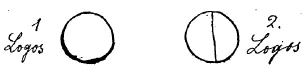
[ 6 ] Der Strich in der Mitte des zweiten Kreises bedeutet, daß im zweiten Logos Leben und Inhalt zweierlei sind, daß sie geteilt sind.
[ 6 ] The line in the middle of the second circle signifies that, in the second Logos, life and content are two distinct things—that they are separate.
[ 7 ] Wenn es sich um den Inhalt handelt, ist Bild und Spiegelbild bei beiden gleich, das Leben aber ist zweierlei. Dies würde als solches noch kein Weltsystem ergeben können, denn hier würde sich nur der eine Logos zum andern verhalten; eine Mannigfaltigkeit würde da nicht hineinkommen. Mannigfaltigkeit kann nur hineinkommen durch ein weiteres Opfer. Eine nochmalige Spiegelung muß stattfinden: das Verhältnis, das die beiden zueinander haben, muß sich auch spiegeln.
[ 7 ] As far as content is concerned, the image and the reflection are the same in both cases, but life is twofold. This, in and of itself, could not yet constitute a world system, for here only one Logos would relate to the other; there would be no diversity. Diversity can only enter through a further sacrifice. A further reflection must take place: the relationship that the two have to one another must also be reflected.
[ 8 ] Erstens spiegelt sich der erste Logos noch einmal zweitens spiegelt sich die Spiegelung. Dadurch entsteht dann der dritte Logos als die Widerspiegelung der zwei andern Logoi. Es enthält also der dritte Logos:
[ 8 ] First, the first Logos is reflected once more; second, the reflection itself is reflected. This then gives rise to the third Logos as the reflection of the other two Logoi. Thus, the third Logos contains:
1. das Spiegelbild des ersten Logos
2. das Spiegelbild dessen, was der erste Logos im zweiten Logos bewirkt hat, nämlich sein Leben
3. das Spiegelbild davon, was der zweite Logos zum ersten zurückstrahlt.
1. the reflection of the First Logos
2. the reflection of what the First Logos has brought about in the Second Logos, namely its life
3. the reflection of what the Second Logos radiates back to the First.
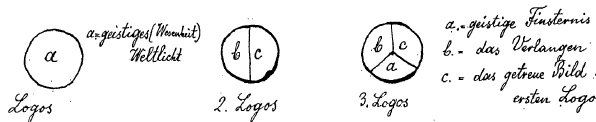
[ 9 ] Stellen wir uns nun vor: Der erste Logos ist gespiegelt in a. Wenn der erste Logos die nach außen strebende, schöpferische Tätigkeit ist, so ist sein Spiegelbild im dritten Logos gerade die umgekehrte Tätigkeit des ersten Logos. Im ersten Logos ist a das höchste geistige Weltlicht; im dritten Logos ist a die äußerste geistige Finsternis.
[ 9 ] Let us now imagine: The first Logos is reflected in a. If the first Logos is the outward-striving, creative activity, then its reflection in the third Logos is precisely the opposite activity of the first Logos. In the first Logos, a is the highest spiritual light of the world; in the third Logos, a is the utmost spiritual darkness.
[ 10 ] b ist im zweiten Logos das Leben, das der zweite Logos vom ersten Logos erhalten hat. Es ist nicht das Leben, das sich hinopfert, sondern dasjenige, das angenommen worden ist. Das Leben, das sich im ersten Logos hinopfert, ist die Liebe. Das Gegenteil davon im dritten Logos ist das absolute Verlangen, Sehnsucht, Streben nach Logos. b ist also im dritten Logos das absolute Verlangen.
[ 10 ] b is, in the second Logos, the life that the second Logos received from the first Logos. It is not the life that sacrifices itself, but the one that has been received. The life that sacrifices itself in the first Logos is love. The opposite of this in the third Logos is the absolute desire, longing, and striving for the Logos. b is therefore the absolute desire in the third Logos.
[ 11 ] c ist im zweiten Logos das Spiegelbild des ersten Logos, welches der zweite Logos zurückstrahlt.
[ 11 ] In the second Logos, c is the reflection of the first Logos, which the second Logos reflects back.
[ 12 ] Bei unserem eigenen Spiegelbild unterscheiden wir:
[ 12 ] When it comes to our own reflection, we distinguish between:
1. Das ausgestrahlte Bild, das aus der Finsternis zurückkommt.
2. Das, was wir hingegeben haben, kommt zurück als Verlangen.
3. Das Bild selbst, das wir selbst sind.
1. The radiated image that returns from the darkness.
2. What we have given away returns as desire.
3. The image itself, which is who we are.
[ 13 ] Dies entspricht im dritten Logos den drei Teilen:
[ 13 ] This corresponds to the three parts in the third Logos:
a die geistige Finsternis = Tamas
b das absolute Verlangen = Rajas
c das einfache Spiegelbild des ersten Logos = Sattwa
a spiritual darkness = Tamas
b absolute desire = Rajas
c the simple reflection of the First Logos = Sattwa
[ 14 ] Tamas, Rajas, Sattwa sind die drei Gunas, die drei Teile des dritten Logos.
[ 14 ] Tamas, Rajas, and Sattwa are the three gunas, the three aspects of the Third Logos.
[ 15 ] Zunächst sind a, b und c vorhanden. Wenn a allein vorhanden ist, ist es eben Tamas. Wenn a — die geistige Finsternis oder Tamas — sich kombiniert mit b — Rajas, dem absoluten Verlangen —, kombiniert sich Finsternis mit Verlangen, und es ist ein Hinstreben nach dem ersten Logos. Wenn a und c — Tamas und Sattwa — kombiniert werden, haben wir das Bild des ersten Logos, aus der Finsternis heraus geschaffen. Ebenso können wir b mit c kombinieren. Es kann jedes für sich auftreten und mit einem der andern kombiniert werden. Alle drei miteinander kombiniert, sind, was der erste Logos selbst ist. Wir haben sieben mögliche Kombinationen der drei Gunas:
[ 15 ] To begin with, a, b, and c exist. When a exists on its own, it is simply Tamas. When a—spiritual darkness or Tamas—combines with b—Rajas, absolute desire—darkness combines with desire, and there is a striving toward the First Logos. When a and c—Tamas and Sattwa—are combined, we have the image of the First Logos, created out of darkness. Similarly, we can combine b with c. Each can occur on its own and be combined with one of the others. All three combined together are what the First Logos itself is. We have seven possible combinations of the three gunas:
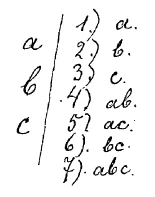
[ 16 ] Dies sind also die sieben verschiedenen Kombinationen der Gunas. Man stelle sich diese sieben möglichen Kombinationen vor als das nächste weltschöpferische Prinzip, das aus den drei Gunas hervorgehen kann. Diese sieben Wesenheiten existieren wirklich. Es sind die sogenannten sieben schöpferischen Geister vor dem Throne Gottes, nach den drei Logoi die sieben nächsten schöpferischen Kräfte:
[ 16 ] These, then, are the seven different combinations of the gunas. Imagine these seven possible combinations as the next world-creating principle that can emerge from the three gunas. These seven entities truly exist. They are the so-called seven creative spirits before the throne of God—the seven creative forces following the three Logoi:

[ 17 ] Aus diesen sieben schöpferischen Kräften geht dasjenige hervor, was wir als die Prajapatis bezeichnen. Indem jeder wieder diese Tatsache genau wiederholen kann auf untergeordneten Stufen des Bewußtseins, des Lebens und der Form, bekommen wir überall drei: also dreimal a, dreimal b, dreimal c, dreimal ab, dreimal ac, dreimal bc, dreimal abc, also zusammen dreimal sieben = 21 PraJapatis. Sie verhalten sich selbst jeder wie ein ursprünglicher Logos. Dadurch bekommen wir die 21 Schöpfer eines bestimmten Sonnensystems.
[ 17 ] From these seven creative forces arises that which we call the Prajapatis. Since each of these can repeat this fact exactly at lower levels of consciousness, life, and form, we get three of each everywhere: that is, three times a, three times b, three times c, three times ab, three times ac, three times bc, three times abc—which together amounts to three times seven = 21 Prajapatis. Each of them behaves like a primordial Logos. This gives us the 21 creators of a specific solar system.
[ 18 ] Der erste Begriff, der uns also begegnet, ist der des vollständig freien Opfers. Wenn man ihn faßt, hört die Frage nach dem Warum auf, eine Bedeutung zu haben. Der Fortschritt des Menschen besteht darin, daß man diese Frage nicht mehr stellt, sondern zu dem Begriff des schöpferischen Logos aufsteigt.
[ 18 ] The first concept we encounter, then, is that of the completely free sacrifice. Once one grasps it, the question of “why” ceases to have any meaning. Human progress consists in no longer asking this question, but rather in rising to the concept of the creative Logos.
[ 19 ] Wenn man ein mechanisches Instrument hat, zum Beispiel eine Uhr oder eine Maschine, so kann man voraussagen, wie sie sich verhalten wird. Etwas weniger ist dies dagegen möglich bei den Naturvorgängen, doch im gewissen Grade auch da. Eine Sonnenfinsternis zum Beispiel ist berechenbar. Man kann da von einer Notwendigkeit sprechen. Man wird noch bei der Pflanze angeben können, was sie unter bestimmten Verhältnissen tun wird. Je weiter wir aber hinaufrücken im Reiche der Natur, hört die Möglichkeit immer mehr auf zu sagen, was ein Wesen in einer gewissen Situation tun wird. Je höher ein Mensch steht an Begabung und Inhalt, desto weniger ist es möglich, etwas über seine Handlungen vorauszusagen, denn man kann nicht seine Gründe und Motive überschauen. Dann hat man nichts anderes zu tun als abzuwarten, was er in einer bestimmten Situation tun wird.
[ 19 ] If you have a mechanical device, such as a clock or a machine, you can predict how it will behave. This is somewhat less possible when it comes to natural phenomena, though it is possible to a certain extent there as well. A solar eclipse, for example, is predictable. In this case, one can speak of a necessity. One can even specify what a plant will do under certain conditions. However, the higher we move up in the realm of nature, the less we can say about what a being will do in a given situation. The greater a person’s talents and inner depth, the less it is possible to predict anything about their actions, for one cannot fathom their reasons and motives. Then one has no choice but to wait and see what they will do in a given situation.
[ 20 ] Ebenso muß man die Schöpfung der Welt hinnehmen als eine freie Tat des Logos. Und der Fortschritt besteht darin, zu wissen, daß man beim Weltall nicht zu fragen hat nach dem Warum, daß . die Frage nach dem Grund unberechtigt ist. Alle, die dies eingesehen haben, haben nicht von einem Grund der Welt gesprochen. Jakob Böhme spricht von einem «Ungrund» der Welt. Wollen wir aufsteigen zur Erkenntnis der schöpferischen Weltmacht, so können wir nichts anderes tun, als bis dahin gehen, wo wir wissen, daß im Ziel unsere eigene Entwicklung stehen muß, denn da muß der Schöpfer einmal gestanden haben. Der Schöpfer muß alles umgekehrt besitzen, was wir besitzen. Atma ist der tiefste Punkt in unserem Innern. Der Schöpfer aber hat Atma als lauter Punkte in seinem Umkreis. Der weltschöpferische Logos hatte bei Beginn des Sonnensystems die Eigenschaften, die wir als Ziel unserer Entwicklung gefunden haben, Atma, Budhi, Karana Sharira oder Manas, Kama, Linga Sharira, Prana, Sthula Sharira, alle in seinem Wesen.
[ 20 ] Likewise, one must accept the creation of the world as a free act of the Logos. And progress consists in knowing that, when it comes to the universe, one need not ask “why,” that the question of “why” is unwarranted. All who have realized this have not spoken of a “reason” for the world. Jakob Böhme speaks of an “unreason” of the world. If we wish to ascend to the knowledge of the creative power of the world, we can do nothing other than go as far as we know our own development must lead, for that is where the Creator must once have stood. The Creator must possess, in reverse, everything that we possess. Atma is the deepest point within us. The Creator, however, has Atma as a multitude of points within His sphere. At the beginning of the solar system, the world-creating Logos possessed the qualities that we have found to be the goal of our development: Atma, Budhi, Karana Sharira, or Manas, Kama, Linga Sharira, Prana, Sthula Sharira—all within His being.
[ 21 ] Wir müssen uns klar darüber werden, wo die Tätigkeit dieses schöpferischen Logos liegen kann. Dazu untersuchen wir zuerst, wohin wir durch die verschiedenen Metamorphosen gelangen. Die Form-Metamorphosen sind: eine physische, zwei astrale, zwei mentale, zwei arupische, also zusammen sieben. Wenn wir die Höhe des Mentalplanes erreicht haben, dann sind wir von außen Karana Sharira geworden; darauf werden wir Budhi, dann Atma [linkes Schema]. Wenn die Erde ihr Ziel erreicht hat, werden wir auf dem höheren Mentalplan tätig sein. Dann beginnt jener Übergang, welcher uns hinüberführt zu dem nächsten Planeten. Dazu müssen wir Atma außen haben. Also müssen auch Karana Sharira und Budhi außen verschwinden [rechtes Schema]:
[ 21 ] We must clarify where the activity of this creative Logos might lie. To do so, we will first examine where the various metamorphoses lead us. The metamorphoses of form are: one physical, two astral, two mental, and two arupic—seven in total. Once we have reached the height of the mental plane, we have become Karana Sharira from the outside; thereafter, we become Budhi, then Atma [left diagram]. When the Earth has reached its goal, we will be active on the higher mental plane. Then begins the transition that carries us over to the next planet. For this, we must have Atma on the outside. Thus, Karana Sharira and Budhi must also disappear from the outside [right diagram]:

[ 22 ] Amar Die Folge davon ist, daß wir uns nicht vorzustellen haben, daß beim Übergang zu einem neuen Planeten nichts geschieht — Pralaya ist nicht Untätigkeit und Schlaf —, sondern während Pralaya wird noch abgestreift Karana Sharira und Budhi. Auf dem Budhiplan müssen wir Karana Sharira abstreifen und auf dem Nirvanaplan
[ 22 ] Amar The consequence of this is that we must not imagine that nothing happens during the transition to a new planet—Pralaya is not inactivity or sleep—but rather, during Pralaya, the Karana Sharira and Budhi are shed. On the Budhi plane, we must shed the Karana Sharira, and on the Nirvana plane
[ 23 ] Budhi selbst. So gestaltet sich die Entwicklung folgendermaßen:
[ 23 ] Budhi himself. The development unfolds as follows:
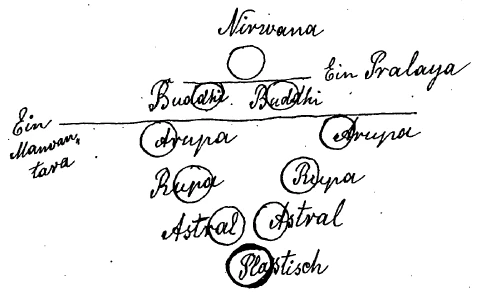
[ 24 ] Pralaya ist eine Tätigkeit ganz anderer Art als die Tätigkeit während eines Manvantaras. Um eine neue Planetenkette zu gestalten, muß die Wesenheit auf der anderen Seite hindurchgegangen sein durch den Budhi- und Nirvanaplan. Die Bedeutung des Budhiund Nirvanaplanes liegt darin, daß auf ihnen die Wesenheiten zwischen den Planeten ganz dasselbe durchmachen, was der Mensch im Devachan durchmacht. Es gibt auch große Pralajas: Mahapralajas. Wenn wir die Metamorphosen des Bewußtseins verfolgen von einem Planeten zum andern, so haben wir auf Erden das Tagesbewußtsein, auf dem Monde das Traumbewußtsein und so weiter (siehe Schema S. 201):
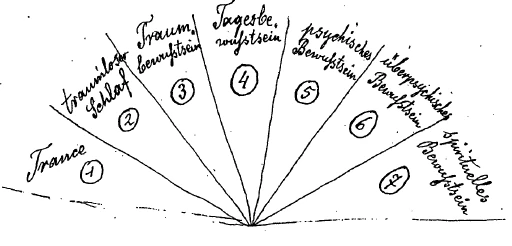
[ 24 ] Pralaya is an activity of a completely different nature than the activity during a Manvantara. In order to form a new planetary chain, the being must have passed through the Budhi and Nirvana planes on the other side. The significance of the Budhi and Nirvana planes lies in the fact that on them, the beings between planets undergo exactly the same process as humans do in Devachan. There are also great Pralayas: Mahapralayas. If we trace the metamorphoses of consciousness from one planet to another, we find that on Earth we have waking consciousness, on the Moon we have dream consciousness, and so on (see diagram on p. 201):
[ 25 ] Zwischen einem Bewußtsein und dem anderen muß hindurchgegangen werden durch den Nirvanaplan. Wenn nun der höchste Bewußtseinszustand erreicht ist, Atma sich aller Hüllen entledigt hat und wirklich das Allumfassende geworden ist, dann wird es fähig, ein neues Sonnensystem zu bilden. Dazu muß es noch durch zwei weitere Plane des Bewußtseins hindurchgehen. Bis dahin hat es eine Art Allschau erlangt, es kann dann das ganze Weltensystem überschauen.
[ 25 ] One must pass through the Nirvana Plane to move from one state of consciousness to another. Once the highest state of consciousness has been attained, and Atma has shed all its veils and truly become the All-Encompassing, it becomes capable of forming a new solar system. To do so, it must pass through two further planes of consciousness. By then, it has attained a kind of universal vision and can survey the entire world system.
[ 26 ] Das jetzige Tagesbewußtsein kann das Mineralreich, das psychische Bewußtsein kann das Leben, das intellektuelle Bewußtsein das Empfinden überschauen, und das spirituelle Bewußtsein kann alles Vorhandene überschauen. Atma ist dann auf der höchsten Stufe angelangt. Atma ist Allbewußtsein.
[ 26 ] Our current daily consciousness can encompass the mineral kingdom; psychic consciousness can encompass life; intellectual consciousness can encompass sensation; and spiritual consciousness can encompass all that exists. Atma has then reached the highest level. Atma is universal consciousness.
[ 27 ] Wenn Atma nach außen strahlen soll, so muß es erst die Fähigkeit erlangen, alles hinzugeben; es muß schöpferisch sein. Das wird es dadurch, daß es sich mit Budhi und Manas umhüllt. Dann kann es auf dem Arupaplan ein neues Weltensystem anfangen. Wenn also das Bewußtsein auf der letzten Stufe angelangt ist, muß es noch hindurchgehen durch zwei andere Plane. Der erste Plan ist der, wo es Budhi nicht abschält, sondern hinzufügt, den nennt man Paranirvana-Plan. Denjenigen, wo das Wesen wieder heruntersteigt, um auf dem Arupaplan wieder tätig sein zu können, den nennt man Mahaparanirvanaplan. Je zwei gegenüberliegende Plane entsprechen sich. Der unterste ist der physische, der ihm gegenüberliegende Nirwana:
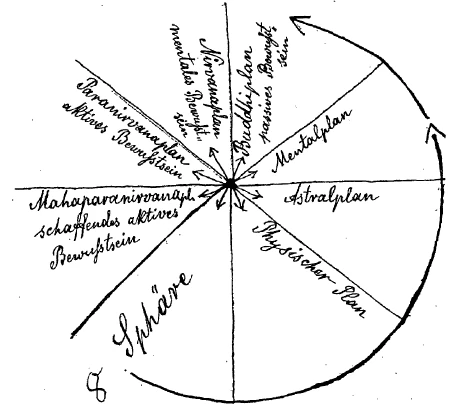
[ 27 ] If Atma is to radiate outward, it must first acquire the ability to surrender everything; it must be creative. It becomes so by enveloping itself with Budhi and Manas. Then it can begin a new world system on the Arupa plane. Thus, once consciousness has reached the final stage, it must still pass through two other planes. The first plane is the one where it does not shed Budhi but adds to it; this is called the Paranirvana plane. The one where the being descends again in order to be active once more on the Arupa plane is called the Mahaparanirvana plane. Each pair of opposing planes corresponds to one another. The lowest is the physical plane; its opposite is Nirvana:
[ 28 ] Auf dem Astralplan herrscht das Verlangen, auf dem Paranirvanaplan herrscht die Liebe, Budhi. Auf dem Mentalplan herrscht Erkenntnis, was den Gedanken aufnimmt, auf dem Mahaparanirvana-Plan herrscht der schöpferische Gedanke. Der Budhiplan ist die absolute, liebevolle Hingabe an das Göttliche. Es hat zu seinem Gegenteil die absolute Abkehr von allem Göttlichen. Hat der Budhiplan etwas Beseligendes, so sein Gegenteil die absolute Unseligkeit. Das ist der achte Plan, die achte Sphäre.
[ 28 ] On the Astral Plane, desire reigns; on the Paranirvana Plane, love—Budhi—reigns. On the Mental Plane, knowledge—which encompasses thought—reigns; on the Mahaparanirvana Plane, creative thought reigns. The Budhi Plane is absolute, loving devotion to the Divine. Its opposite is the absolute turning away from all that is Divine. If the Budhi Plane has something blissful, its opposite is absolute misery. This is the eighth plane, the eighth sphere.
[ 29 ] Man denke sich, irgendein Wesen hätte sich auf irgendeinem Plan in der Evolution von der Entwicklung abgekehrt, wäre eigene Wege gegangen, dann fiele es in die achte Sphäre und müßte dort warten, bis die ganze Entwicklung herumgegangen ist. Es könnte erst bei der nächsten Evolution wieder mitgenommen werden als unterstes Wesen. In dieser kosmischen Windrose kommen die Gegenteile gut zum Ausdruck. — Wenn wir auf dem Nirvanaplan angelangt sind, ist das Wesen an dem Punkt angelangt, daß sein Atma ganz nach außen liegt. Wir haben es dann zu tun mit einem solchen Logos, den wir als die Sieben bezeichnet haben. Es sind die sieben schöpferischen Geister, deshalb haben wir auch sieben verschiedene Rassen, [die sogenannten Wurzelrassen mit ihren je sieben Unterrassen].
[ 29 ] Imagine that some being, on some plane of evolution, had turned away from the course of development and gone its own way; it would then fall into the eighth sphere and would have to wait there until the entire cycle of development had run its course. It could only be taken along again in the next evolution as the lowest being. In this cosmic compass rose, the opposites are clearly expressed. — When we have reached the Nirvana plane, the being has reached the point where its Atma is entirely outward-facing. We are then dealing with a Logos of the kind we have designated as the Seven. These are the seven creative spirits; that is why we also have seven different races, [the so-called root races, each with seven subraces].
[ 30 ] Die sieben verschiedenen Geister gehören dem Nirvanaplan an. Wenn wir dann den Paranirvanaplan und den Mahaparanirvanaplan durchlaufen, kommen wir zum ersten und zweiten Logos selbst. Auf dem Paranirvanaplan entsteht der zweite Logos und auf dem Mahaparanirvanaplan der erste Logos. Auf dem Nirvanaplan wird das Weltsystem von den 7 mal 3 = 21 Prajapatis vollendet. Der letzte von ihnen ist abc, der dritte Logos selbst. Erst der erste Logos kann das, was in die achte Sphäre gefallen ist, wieder mitnehmen. Er nimmt es mit mit dem Weltenstaub. Hinaufgeworfen werden aus der Entwicklung heißt sein Leben verketten mit etwas, was unbedingt zurückbleibt, und darin warten, bis die Evolution wieder auf den betreffenden Zustand trifft. Ein Wilder, der von der Seele eines Wilden bewohnt wird, ist relativ glücklich; aber denken Sie sich ein entwickeltes Wesen im Körper eines Wilden oder eines Hundes, dann ist es in der Tat Verbannung. Die höhere Seele ist den Weg in eine niedere Manifestation gegangen. Tatsächlich heißt «in die achte Sphäre gehen»: nicht mit der Evolution fortschreiten, nicht mitmachen zu können die Entwicklung der andern, sondern auf niedere Stufe zurückgeworfen zu werden.
[ 30 ] The seven different spirits belong to the Nirvana Plane. As we then pass through the Paranirvana Plane and the Mahaparanirvana Plane, we arrive at the First and Second Logos themselves. The Second Logos comes into being on the Paranirvana Plane, and the First Logos on the Mahaparanirvana Plane. On the Nirvana Plane, the world system is perfected by the 7 × 3 = 21 Prajapatis. The last of them is abc, the Third Logos itself. Only the First Logos can take back what has fallen into the eighth sphere. It takes it along with the dust of the worlds. To be cast out of the course of evolution means to link one’s life to something that inevitably remains behind, and to wait there until evolution once again reaches that particular state. A savage inhabited by the soul of a savage is relatively happy; but imagine a developed being in the body of a savage or a dog—that is indeed exile. The higher soul has taken the path into a lower manifestation. In fact, “entering the eighth sphere” means: not progressing with evolution, not being able to participate in the development of others, but rather being cast back to a lower level.
[ 31 ] Das Bewußtsein ist zuerst ein Erkenntnisbewußtsein bis zum Nirvanaplan. Vom Nirvanaplan an ist es nicht mehr ein bloßes Erfassen, sondern ein innerliches Schaffen. Auf dem Paraniirvanaplan ist es ein Schaffen nach außen. Auf dem Mahaparanirvanaplan ist es das schöpferische Bewußtsein des Logos. Von da geht das Bewußtsein des Logos durch die achte Sphäre auf den physischen Plan über und wird dort zu schöpferischen Naturkräften. In Wahrheit sind sie der Ausdruck göttlicher Gedanken, die uns als Kräfte erscheinen, weil wir sie nicht überschauen.
[ 31 ] Consciousness is, at first, a consciousness of cognition up to the Nirvana Plane. From the Nirvana Plane onward, it is no longer mere perception, but inner creation. On the Paraniirvana Plane, it is outward creation. On the Mahaparinirvana plane, it is the creative consciousness of the Logos. From there, the consciousness of the Logos passes through the eighth sphere onto the physical plane, where it becomes creative forces of nature. In truth, they are the expression of divine thoughts, which appear to us as forces because we cannot comprehend them.