

Consciousness — Life — Form
GA 89
9 November 1904
Translate the original German text into any language:
Versions Available:
Consciousness — Life — Form, tr. SOL
Die planetarische Entwicklung XI
Planetary Development XI
[ 1 ] Man redet oft von den Prinzipien, als ob sie gleichartig wären und nur verschiedene Grade hätten. Aber will man die Zusammenhänge verstehen, so müssen wir die Prinzipien selbst ihrer Natur nach kennenlernen.
[ 1 ] People often speak of principles as if they were all the same and differed only in degree. But if we are to understand the connections, we must come to know the principles themselves according to their nature.
[ 2 ] Wir müssen dreierlei in der Welt unterscheiden, dreierlei Arten von Wirkungen. Weil für ein wahrnehmendes Wesen nur das, was zur Wirkung kommt, in Betracht kommen kann, richten wir unsere Aufmerksamkeit auf die Wirkungen. Es gibt also dreierlei Arten, wie etwas wirken kann: erstens die eigentlich geistige, zweitens die seelische, drittens die körperliche Art von Wirkung. Die geistige Wirkung, alles, was irgendwie als Geist wirken kann, nennt man Budhi; alles, was seelisch wirken kann, nennt man Kama; alles, was körperlich wirken kann, nennt man Prana. Das sind die drei Wirkungsformen: Budhi, Kama, Prana. Als Wirkungsformen sind sie gleichartig, nur auf verschiedenen Stufen.
[ 2 ] We must distinguish between three things in the world: three kinds of effects. Because, for a perceiving being, only that which produces an effect can be taken into account, we focus our attention on the effects. There are thus three ways in which something can exert an effect: first, the purely spiritual; second, the psychological; and third, the physical. The mental effect—everything that can act in any way as spirit—is called Budhi; everything that can act on the soul is called Kama; everything that can act physically is called Prana. These are the three forms of effect: Budhi, Kama, Prana. As forms of effect, they are of the same nature, only at different levels.
[ 3 ] Nun muß man sich vorstellen, daß die Wirkungen fortwährend flüssig, unbestimmt wären, wenn sie sich nicht begrenzen würden. Soll zum Beispiel Kama in einer bestimmten Weise auftreten, so muß es sich eine Grenze geben. Also um zu begrenzten Wirkungen zu werden, müssen sich Budhi, Kama und Prana Grenzen geben. Diese Grenzen nennt man in der theosophischen Literatur «Shariras», das heißt Schalen, Hüllen, Scheiden. Und zwar bezeichnet man, wenn sich Budhi begrenzt, diese Grenze als Karana Sharira; gibt sich Kama eine Grenze, so nennt man diese Linga Sharira; gibt sich Prana eine Grenze, nennt man sie Sthula Sharira. Diese Shariras sind also die Grenzen, die Hüllen, die sich die drei Wirkungsarten setzen.
[ 3 ] Now one must imagine that effects would remain constantly fluid and indeterminate if they were not limited. If, for example, Kama is to manifest in a certain way, it must set a limit for itself. Thus, in order to become limited effects, Budhi, Kama, and Prana must set limits for themselves. In Theosophical literature, these limits are called “Shariras,” meaning shells, sheaths, or envelopes. Specifically, when Budhi sets a boundary for itself, this boundary is called Karana Sharira; when Kama sets a boundary for itself, it is called Linga Sharira; and when Prana sets a boundary for itself, it is called Sthula Sharira. These Shariras are thus the boundaries, the sheaths, that the three modes of action impose upon themselves.
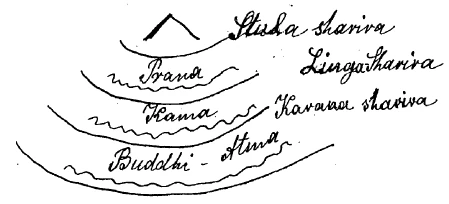
[ 4 ] Es kann nun folgendes eintreten [es wird nun das Schema I an der Tafel entwickelt und zwar von unten nach oben angeschrieben]
[ 4 ] The following may now occur [Scheme I is now drawn on the board, starting from the bottom and working upward]

[ 5 ] Wir haben zuerst Prana in Wirksamkeit; dann gibt sich Prana eine Grenze nach außen: Sthula Sharira. Prana begrenzt sich also nach einer Seite und bleibt nach der anderen wogend offen. Zu Prana tritt nun Kama hinzu und gibt sich hier eine Grenze: Linga Sharira. Dadurch bleibt Prana auch auf dieser Seite nicht mehr wogend offen, weil sich Kama mit seiner Grenze hineinschiebt; aber Kama bleibt wieder offen nach der anderen Seite. Nun tritt Budhi hinzu und gibt sich die Grenze gegen Kama und es entsteht Karana Sharira. Die drei Prinzipien haben also Zwischenlagen. Wenn dies ein Wesen ist, muß in diesen drei Prinzipien und ihren Zwischenlagen noch ein Ich-Bewußstsein leben: das bezeichnet man als Atma.
[ 5 ] First, Prana is active; then Prana sets a boundary outward: Sthula Sharira. Prana thus limits itself on one side and remains undulating and open on the other. Kama now joins Prana and sets a boundary here: Linga Sharira. As a result, Prana no longer remains open and undulating on this side either, because Kama pushes its way in with its boundary; but Kama, in turn, remains open on the other side. Now Budhi joins in and sets a boundary against Kama, and Karana Sharira comes into being. The three principles thus have intermediate layers. If this is a being, then a sense of self-consciousness must still dwell within these three principles and their intermediate layers: this is referred to as Atma.
[ 6 ] Aus den drei Prinzipien und den Zwischenlagen und dem IchBewußtsein oder Atma besteht der Mensch. Jedes einzelne kann Unterabteilungen haben. Wenn wir dies so fassen, haben wir die Zusammensetzung des Menschen als solchen gegeben.
[ 6 ] Human beings consist of the three principles, the intermediate layers, and the sense of self, or Atma. Each of these may have subdivisions. If we understand it this way, we have defined the composition of the human being as such.
[ 7 ] Hier, beim Menschen [Schema I], bildet der physische Körper die äußere Hülle, und Atma ruht im Innern. Nun kann die Anordnung auch ganz anders sein. [Beim Planetengeist ist es] nämlich so, daß sich Prana zunächst nach innen wirksam zeigt und sich eine Grenze setzt. Dann würde folgendes entstehen [Schema folgende Seite]:
[ 7 ] Here, in human beings [Scheme I], the physical body forms the outer shell, and Atma rests within. However, the arrangement can also be quite different. [In the case of the planetary spirit], it is the case that Prana first manifests inwardly and sets a boundary for itself. Then the following would arise [diagram on the next page]:
[ 8 ] Prana ist dann nach innen begrenzt durch Sthula Sharira, Kama durch Linga Sharira, Budhi durch Karana Sharira und wir hätten nun ein Wesen, bei dem zuerst außen Atma liegt, dann Budhi, dann Kama und zuletzt Prana. Dann [folgendes Schema] würde Atma ganz im Umkreis ausgespannt erscheinen [eine Kugel], und Sthula Sharira wäre ein Punkt in der Mitte.
[ 8 ] Prana is then bounded inwardly by Sthula Sharira, Kama by Linga Sharira, Budhi by Karana Sharira, and we would now have a being in which Atma lies on the outside, followed by Budhi, then Kama, and finally Prana. Then [according to the following diagram], Atma would appear to span the entire circumference [like a sphere], and Sthula Sharira would be a point at the center.

[ 9 ] Ein solches Wesen ist ein Dhyan-Chohan, ein Planetengeist und muß umgekehrt wirken wie ein Mensch. Beim Menschen liegt Sthula Sharira nach außen, bei den Dhyan-Chohans Atma, dann kommt Budhi und so weiter.
[ 9 ] Such a being is a Dhyan-Chohan, a planetary spirit, and must function in the opposite way to a human being. In humans, the Sthula Sharira is on the outside; in the Dhyan-Chohans, it is the Atma, followed by Budhi, and so on.
[ 10 ] Man kann sich davon eine klare Vorstellung machen durch folgendes Beispiel. Wenn wir unsere Augen schließen, ist es zuerst dunkel und wenn wir sie dann wieder aufmachen, dann sehen wir das Licht. Wir sehen das Licht aber nur, weil wir eine Empfindung dafür haben und es dadurch empfangen können. Es muß aber erst da sein, bevor wir es empfangen können. Und ebenso, wie wir da sein müssen, um Licht zu empfinden, so muß ein Wesen draußen sein, das Licht offenbart. Wir sind Lichtempfänger, draußen müssen Lichtgeber, Lichtoffenbarer sein. Und so wie wir das Licht nur dadurch empfinden können, daß wir in uns Kama, den Astralkörper haben, so muß ein planetarisches Wesen ein Kama haben, das Licht ausstrahlt. So daß also Kama hier gegen den Mittelpunkt hin wirkt und dort im Radius des Kreises.
[ 10 ] The following example helps illustrate this clearly. When we close our eyes, it is dark at first, and when we open them again, we see the light. But we see the light only because we have a perception of it and can therefore receive it. However, it must first be there before we can receive it. And just as we must be there to perceive light, so there must be a being outside that reveals the light. We are receivers of light; there must be light-givers, light-revealers, out there. And just as we can perceive light only because we have Kama, the astral body, within us, so must a planetary being have a Kama that radiates light. Thus, Kama acts here toward the center and there within the radius of the circle.

[ 11 ] Der Kreis, der nach oben hin konvex ist, ist für uns, für die Empfindung, für das Empfangende, das dem Gebenden Entgegenstrebende. Der Kreis, der nach unten zu konvex ist, ist das Kama der dhyanischen Wesenheit. So wirkt das Kama der Offenbarung nach unten: Karana Sharira. So wie der Mensch ein Kama hat, das nach seinem Mittelpunkt hinstrebt, so hat der Planetengeist ein nach außen, nach dem Umkreis strebendes Kama, welches lichtoffenbarend ist, während das Kama des Menschen lichtempfangend ist. Es gehören immer zweierlei Wesenheiten von sich ergänzenden Naturen zusammen. Fine Wesenheit muß das Verlangen besitzen: die empfangende Wesenheit; eine andere muß geben können: die gebende Wesenheit. Menschliches verlangendes Kama setzt voraus, daß gebendes Kama da ist, Kama der Liebe.
[ 11 ] The circle that is convex upward represents us, our perception, and the receiving aspect that strives toward the giver. The circle, which is convex toward the bottom, is the kama of the dhyanic entity. Thus the kama of revelation acts downward: Karana Sharira. Just as human beings have a kama that strives toward its center, so the planetary spirit has a kama that strives outward, toward the circumference, which reveals light, whereas the kama of human beings receives light. Two kinds of entities of complementary natures always belong together. One entity must possess the desire: the receiving entity; another must be able to give: the giving entity. Human desiring Kama presupposes the presence of giving Kama—the Kama of love.
[ 12 ] Menschliche Budhi vermittelt das Erkennen. Dasjenige, was uns von den Dingen an Erkennen offenbart wird, wird empfangen durch unsere Budhi. Der planetarische Geist muß also gedankengebend, menschliche Budhi muß empfangend sein. Der planetarische Geist verhält sich somit ganz entgegengesetzt und ergänzend zum Menschengeist.
[ 12 ] Human budhi mediates cognition. That which is revealed to us about things through cognition is received by our budhi. The planetary spirit must therefore be the source of thought, while human budhi must be receptive. The planetary spirit thus behaves in a manner that is entirely opposite to and complementary of the human spirit.
[ 13 ] Ein jedes einzelne Ding in der Welt existiert nur im Weltenzusammenhang, es ist ein Glied im Ganzen. Als Glied gehört es dem ganzen planetarischen Erdgeist an. So hat zum Beispiel der Tisch erstens eine Materie, durch die er ein Wesen ist, das uns im Raume entgegentritt; zweitens hat er.Kraft, dadurch daß er Widerstand gibt, denn sonst würde er für uns nicht da sein; und zum dritten äußert sich die Kraft nicht beliebig, sondern nach bestimmten Gesetzen (Naturgesetzen).
[ 13 ] Every single thing in the world exists only within the context of the world; it is a link in the whole. As a link, it belongs to the entire planetary spirit of the Earth. For example, the table first has a material substance through which it is an entity that confronts us in space; second, it possesses force by offering resistance, for otherwise it would not be there for us; and third, this force does not manifest arbitrarily, but according to specific laws (laws of nature).
[ 14 ] Was ist die Kraft? Was ist das, was in uns das Leben möglich macht? Es ist eine Kraft, die einnehmend ist, das Leben erhaltend. Des Menschen Lebenskraft äußert sich dadurch, daß sie, was an Materie in ihm ist, zusammenhält. Daher ist die Materie und die ihr zukommende Kraft beim Menschen nach innen gerichtet, sie baut den Menschen von innen auf; er könnte sonst nicht als lebendes Wesen wahrgenommen werden. Der Tisch dagegen hat die nach außen gerichtete Materie, und diese äußert sich durch das Gesetz. Materie an sich kann nicht wahrgenommen werden, nur ihre Eigenschaften, wie Farben, Töne und so weiter. Die Materie selbst entzieht sich vollständig der Wahrnehmung. Es ist ein Prana in der Materie, welches sich ganz der Wahrnehmung entzieht, aber sich dahingibt, um sich zu offenbaren. Daneben erkennen wir das Gesetz in der Materie, den Gedanken, der sich darin ausdrückt.
[ 14 ] What is this force? What is it that makes life possible within us? It is a force that is all-encompassing and sustains life. A person’s life force manifests itself by holding together the matter within them. Therefore, matter and the force associated with it in human beings are directed inward; they build up the human being from within; otherwise, he could not be perceived as a living being. The table, on the other hand, has matter directed outward, and this manifests itself through the law. Matter in and of itself cannot be perceived; only its properties, such as colors, sounds, and so on. Matter itself is completely beyond perception. There is a prana within matter that is entirely beyond perception, yet it gives itself up in order to reveal itself. In addition, we recognize the law within matter—the thought that expresses itself through it.
[ 15 ] Budhi äußert sich in der Natur nach außen. Jeder Körper, der der äußere Ausdruck des Planetengeistes ist, strahlt fortwährend nach außen, das heißt, er hat Budhi nach außen gekehrt. Es wird zum Licht, das wahrgenommen wird. Budhi ist in den Eigenschaften der Dinge, in dem, was nach außen liegt. Das Gesetz muß sich offenbaren durch Karana Sharira. Das sich offenbarende Manas ist das Gesetz. Indem ein Körper leuchtet, schickt er uns Budhi zu. Der Gedanke, die Geistesäußerung, durch die er es schickt, ist Karana Sharira. Kama dagegen behält der Planetengeist für sich; er entzieht es der Wahrnehmung. Seine Materie ... [in den Notizen von Marie Steiner-von Sivers ist hier eine Lücke markiert]. — Dagegen offenbart er die kosmischen Gedanken, die der Mensch erst tief im Innern ergründen muß. Und was der planetarische Geist ganz an der Oberfläche äußert, hingibt, das ist sein Budhi.
[ 15 ] Budhi manifests itself outwardly in nature. Every body, which is the outward expression of the planetary spirit, radiates continuously outward; that is, it has turned Budhi outward. It becomes the light that is perceived. Budhi is found in the qualities of things, in that which lies on the outside. The law must reveal itself through Karana Sharira. The Manas that reveals itself is the law. As a body shines, it sends Budhi to us. The thought, the expression of the spirit through which it sends it, is Karana Sharira. Kama, on the other hand, the planetary spirit keeps to itself; it withholds it from perception. Its matter ... [a gap is marked here in Marie Steiner-von Sivers’ notes]. — In contrast, it reveals the cosmic thoughts that human beings must first fathom deep within themselves. And what the planetary spirit expresses and bestows entirely on the surface—that is its Budhi.
[ 16 ] In der Bibel ist dies zum Ausdruck gebracht. Es wird gesagt, daß der planetarische Geist in seiner ersten Äußerung eine Lichtäußerung war. Es sind Budhi-Eigenschaften (Licht), die der Geist auf der ersten Stufe offenbart. Diese uralte heilige Lehre von dem Gegensatz des Menschen und des Planetengeistes ist in der christlichen Esoterik schön zum Ausdruck gebracht. Man nennt die sich offenbarenden Budhi-Eigenschaften in der kabbalistischen Sprache «Gewalten». Daher offenbaren sich zunächst die Gewalten des Lichtes und der Finsternis. So kann man die Genesis wieder wörtlich nehmen.
[ 16 ] This is expressed in the Bible. It is said that the planetary spirit, in its first manifestation, was a manifestation of light. These are qualities of Budhi (light) that the spirit reveals at the first stage. This ancient sacred teaching about the contrast between the human spirit and the planetary spirit is beautifully expressed in Christian esotericism. In Kabbalistic terminology, the manifesting qualities of Budhi are called “powers.” Thus, the powers of light and darkness are the first to manifest. In this way, one can take Genesis literally once again.
[ 17 ] Es sind also Budhi-Eigenschaften, die der Geist auf der ersten Stufe offenbart. Auf der zweiten offenbart er sein Karana Sharira; er ordnet die Dinge nach Gesetzen. Was im Makrokosmos nun konvex angeordnet ist, ist im Mikrokosmos konkav. Was der Mensch zuletzt erkennt, kommt im Makrokosmos zuerst, der Mikrokosmos kommt zuletzt dazu, die Empfindung im Makrokosmos zu erkennen.
[ 17 ] It is thus the qualities of Budhi that the mind reveals at the first stage. At the second stage, it reveals its Karana Sharira; it orders things according to laws. What is arranged convexly in the macrocosm is concave in the microcosm. What the human being perceives last comes first in the macrocosm; the microcosm comes last in recognizing the sensation in the macrocosm.
[ 18 ] Nun frägt es sich, ob es einen Übergang gibt zwischen den beiden Wesenheiten, zwischen Mensch und Planetengeist. Man denke eine Wesenheit mit einem Bewußtsein: Das ist der Mensch; er hat verschiedene Glieder, aber mit einem gemeinsamen Bewußtsein. (Streit der Patrizier und Plebejer). Das wäre etwa so darzustellen:
[ 18 ] The question now arises as to whether there is a transition between the two entities, between the human being and the planetary spirit. Consider an entity with a single consciousness: that is the human being; he has various parts, but they share a common consciousness. (The Conflict Between the Patricians and the Plebeians). This could be illustrated something like this:
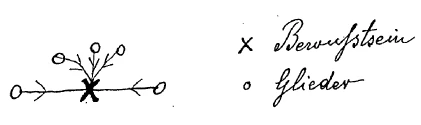
[ 19 ] Es sind einzelne Glieder, die alle hinstrahlen zu dem gemeinschaftlichen Bewußtsein. Wollen wir das gemeinschaftliche Bewußtsein als Kraft ansehen und die Glieder auch, so können wir sagen, das gemeinsame Bewußtsein ist das überwiegende, es wirkt auf die anderen alle. Man denke sich nun viele solcher Wesenheiten, die in dieser Weise wirksam sind:
[ 19 ] These are individual members, all of which radiate toward the collective consciousness. If we regard the collective consciousness as a force—and the members as well—we can say that the collective consciousness is the predominant one; it influences all the others. Now imagine many such entities acting in this way:
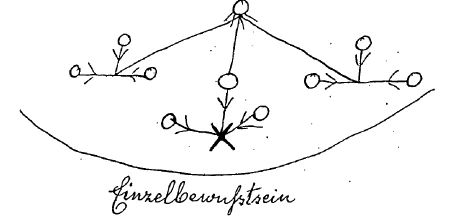
[ 20 ] Jede von den Wesenheiten hat ihre eigene Existenz. Durch [das gemeinsame Ideal] kann sie andere Existenzen mit ihrer verbinden. Diese verschiedenen Bewußtseine setzen sich selbst einen gemeinsamen Mittelpunkt, sie streben nach einem gemeinsamen bestimmten Ideal hin. Dieses lebt dann als gemeinschaftliches geistiges Ideal in den verschiedenen Bewußtseinen. Wenn diese dahin kommen, daß ihnen ihr geistiges Ideal wertvoller ist als sie selbst, dann werden sie von diesem Ideal genauso angezogen, wie sie selbst früher die Glieder ihres Bewußtseins zu sich herangezogen haben. Bildeten sie früher den Mittelpunkt für diese verschiedenen Sphären, so bildet das gemeinsame Ideal dann den Mittelpunkt für die große Sphäre. Die einzelnen Existenzen werden dann selbst Glieder der gemeinschaftlichen Existenz, geben ihr Sondersein auf und leben in dem gemeinschaftlichen Ideal. Sie hören auf, selbst Zentrum zu sein und geben sich ein gemeinschaftliches Zentrum. So entsteht aus einzelnen Menschen eine Bruderloge. Wenn ein so starkes gemeinschaftliches Ideal da ist, daß es die einzelnen Bewußtseinszentren alle anzieht, so bilden diese Menschen einen Körper, der eine Seele höherer Art hat. Dadurch entsteht eine Bruderloge mit einem vollständig gemeinschaftlichen Geist. Und so haben wir es mit einem neuen Wesen zu tun. Niemals hätte sich eine Seele in den Menschen senken können, wenn er nicht ein Gehäuse wäre aus Gliedern. Niemals kann sich ein Höheres herniedersenken, wenn nicht die einzelnen Bewußtseine zu Lebensgliedern werden, die Form für ein höheres Gehäuse, damit darin das gemeinschaftliche Bewußtsein zum Ausdruck kommt.
[ 20 ] Each of these entities has its own existence. Through [the shared ideal], it can connect other existences to its own. These various consciousnesses establish a common focal point for themselves; they strive toward a specific, shared ideal. This ideal then lives on as a communal spiritual ideal within the various consciousnesses. When they reach the point where their spiritual ideal is more valuable to them than themselves, they are drawn to this ideal just as they themselves had previously drawn the members of their consciousness toward themselves. Just as they once formed the center for these various spheres, the common ideal then forms the center for the great sphere. The individual existences then themselves become members of the collective existence, relinquish their separate identities, and live within the collective ideal. They cease to be centers in their own right and establish a collective center. Thus, a brotherhood emerges from individual human beings. When there is a communal ideal so powerful that it attracts all the individual centers of consciousness, these people form a body that possesses a soul of a higher order. This gives rise to a brotherhood with a fully communal spirit. And so we are dealing with a new being. A soul could never have descended into a human being if he were not a vessel made up of limbs. A Higher Being can never descend unless the individual consciousnesses become limbs of life—the form for a higher vessel—so that the collective consciousness may find expression within it.
[ 21 ] Damit haben wir den Übergang; es wird ein anderes Zentrum geschaffen. Eine Inversion, eine Umkehrung sämtlicher Prinzipien ist die menschliche Entwicklung. Da die Menschen sich in sieben Arten äußern, entsteht nicht ein Zentrum, sondern sieben Zentren. Dies werden die sieben Elohim, die Pitris für den nächsten Planeten sein.
[ 21 ] This marks the transition; a new center is being created. Human evolution is an inversion, a reversal of all principles. Since human beings manifest in seven forms, not one center but seven centers emerge. These will be the seven Elohim, the Pitris, for the next planet.
[ 22 ] So geht der Mensch von einem Wesen, das die Umgebung in sich aufnimmt, zu einem Wesen über, das sich offenbart. Die beiden ganz entgegengesetzten Wesenheiten, der Mensch und die Elohim oder Dhyani sind nur Formen einer Wesenheit. Was also der Mensch hier ist, wird er in Zukunft nicht mehr sein, sondern eine dhyan-chohanische Wesenheit. Das wird in der Esoterik das «Geheimnis der Gottwerdung des Menschen» genannt.
[ 22 ] Thus, human beings transition from beings that absorb their environment into themselves to beings that reveal themselves. These two completely opposite entities—human beings and the Elohim or Dhyani—are merely forms of a single entity. Thus, what a human being is here, he will no longer be in the future, but rather a Dhyan-Chohanic entity. In esotericism, this is called the “mystery of man’s deification.”
[ 23 ] Wenn die Einzelbewußtseine sich alle einem Zentrum zuwenden und draußen alles Atma wird, wird im Innern nur ein einziger Kern von Sthula Sharira sein, also die Einheit im höchsten Grade.
[ 23 ] When all individual consciousnesses turn toward a single center and everything outside becomes Atma, there will be only a single core of Sthula Sharira within—that is, unity at the highest degree.
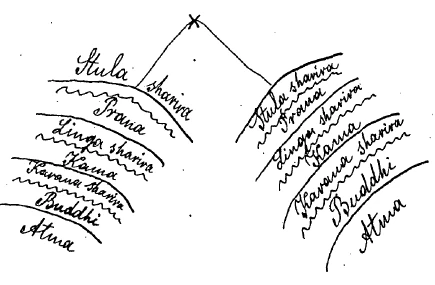
[ 24 ] Diese Einheit kann auf der Erde nicht erreicht werden; diese können erst sieben erhabene Geister bilden. Das ist dann der Logos, der Atma im Umkreis hat. In der Kabbala ist die Krone von allem das «Reich», die Vereinigung. Dieses Prinzip liegt auch der Kirche zugrunde, nämlich daß alle Menschen Glieder eines Bewußtseins werden.
[ 24 ] This unity cannot be achieved on Earth; it can only be formed by seven exalted spirits. This is then the Logos, which encompasses the Atma. In Kabbalah, the crown of all things is the “Kingdom,” the union. This principle also underlies the Church, namely that all people become members of a single consciousness.
[ 25 ] Das Gesetz der Form ist Geburt und Tod. Das Gesetz des Lebens ist die Wiedergeburt. Das Gesetz des Geistes ist Karma. Das Leben geht durch Geburt und Tod und erscheint in immer neuen Formen. Die Form ist vergänglich, das Leben wiederholt sich, der Geist ist unvergänglich, ewig.
[ 25 ] The law of form is birth and death. The law of life is rebirth. The law of the spirit is karma. Life passes through birth and death and appears in ever-new forms. Form is impermanent; life repeats itself; the spirit is imperishable, eternal.