

Self-Knowledge and God-Knowledge I
GA 90a
2 February 1904, Berlin
Translate the original German text into any language:
Versions Available:
Self-Knowledge and God-Knowledge I, tr. SOL
14. Der Zweite Logos
14. The Second Logos
[ 1 ] [Ich spreche heute zu Ihnen,] um zu zeigen, wie man die schwierige Materie der Runden nach [dem Buch] «Uralte Weisheit» von Annie Besant [verstehen kann].
[ 1 ] [I am speaking to you today] to show how one can [understand] the difficult subject of the rounds as described in Annie Besant’s book Ancient Wisdom.
[ 2 ] Ich will zuallererst davor warnen, zu abstrakt über den Logos zu sprechen. Man ist so sehr versucht, in allgemeinen Vorstellungen von erstem, zweitem, drittem Logos zu sprechen. Besonders Anfänger sprechen sehr gern gleich von «Logos und wollen mit Auseinandersetzungen, was erster, zweiter, dritter Logos für eine Aufgabe haben, die ganze Welt erörtern. Das ist nicht das, was wir tun wollen.
[ 2 ] First and foremost, I want to caution against speaking too abstractly about the Logos. It is so tempting to speak in general terms of a first, second, and third Logos. Beginners, in particular, are very quick to start talking about “Logos” and want to discuss the entire world by debating what roles the first, second, and third Logos play. That is not what we want to do.
[ 3 ] Wir wollen uns klar machen, was innerhalb der Entwicklung des Welt[ganzen] die einzelnen Wesen, die sich entwickeln, für eine Aufgabe haben, wodurch sie irgendein Glied im Logos werden. Denn selbstverständlich müssen wir uns ja klar sein, dass, wenn zum Beispiel eine Evolutionsepoche in die andere sich herüberentwickelt - zum Beispiel [die] lunarische in [die] terrestrische sich herüberentwickelt -, [dass] also [zum Beispiel] alles, was während der Mondentwicklung stattgefunden hat, durch [ein] Pralaya durchgeht und wieder in [Erscheinung] kommt, [und] dass [alles] das in ein inverses Pralaya [eingeht]. Was früher geschah, geht wieder in den Logos und in [Lücke in der Mitschrift] wird. [Es] ruht also gleichsam im Logos, schläft nicht, [es ist] bereit, eine neue Aufgabe zu erhalten.
[ 3 ] Let us clarify what role the individual beings that are developing play within the evolution of the [entire] world, through which they become a link in the Logos. For, of course, we must be clear that when, for example, one evolutionary epoch transitions into another—for example, [the] lunar epoch transitions into [the] terrestrial epoch—[that] everything that took place during the lunar development, for instance, passes through [a] Pralaya and reappears, [and] that [all] of this enters into an inverse Pralaya. What happened earlier returns to the Logos and becomes [gap in the transcript]. [It] thus rests, as it were, in the Logos; it does not sleep; [it is] ready to receive a new task.
[ 4 ] Nun klärt man sich am besten dadurch auf, dass man sich fragt: Was wird aus allem, was sich zum Beispiel heute bei unserer gegenwärtigen terrestrischen Entwicklung nach und nach während der verschiedenen Runden und Rassen heranbildet? Was wird aus alldem? Die Summe aller dieser Wesen wird, wenn [die] irdische Evolution zu Ende ist, die Summe dieser Wesenheiten wird eine zusammenhängende Masse von neuen Samen sein, welche in der nächsten Epoche sich weiter entwickeln soll. Sie kehren noch einmal in [den] Logos zurück. Das alles, was heute während unserer irdischen Epoche sich entwickelt, was übrig bleibt, was durch [ein] Pralaya hindurchgeht, wird für die nächste Epoche [ein] zweiter Logos sein. Das Ergebnis einer vorübergehenden Epoche ist für die nächste Epoche zweiter Logos.
[ 4 ] The best way to gain clarity on this is to ask oneself: What will become of everything that, for example, is gradually taking shape today in our current terrestrial evolution during the various cycles and races? What will become of all this? When [the] Earth’s evolution comes to an end, the sum total of all these beings—the sum total of these entities—will be a cohesive mass of new seeds, which are to develop further in the next epoch. They will return once more to [the] Logos. Everything that is developing today during our earthly epoch—what remains, what passes through [a] Pralaya—will be [a] second Logos for the next epoch. The result of a past epoch is the second Logos for the next epoch.
[ 5 ] Ich bitte zu berücksichtigen, dass man besser tut, dass man sich frägt: Wie wird der zweite Logos? Statt einfach zu sagen: erster, zweiter, dritter Logos. Man bleibe beim Konkreten und mache sich klar, dass alles dasjenige, was aus einer Epoche in die andere herüberkommt, für die nächste Epoche der zweite Logos ist.
[ 5 ] Please keep in mind that it is better to ask oneself: What will the second Logos be like? Rather than simply saying: first, second, third Logos. One should stick to the concrete and realize that everything that carries over from one epoch to the next is the second Logos for the next epoch.
[ 6 ] Und nun teilen wir uns die ganze Evolution während unserer irdischen Entwicklung in zwei Teile. Wir haben es mit sieben Runden zu tun. Zuerst nehmen wir die drei ersten und die erste Hälfte der vierten Runde. Das ist die Hälfte. Gerade bis zu diesem Zeitpunkt, in dem erst eine Hälfte der vierten Runde verflossen ist, hat sich alles dasjenige entwickelt, ist dasjenige zum Ausdruck gekommen, was als dritter Logos sich mit [dem] zweiten Logos verbunden hat. Der dritte Logos ist etwas, was /Lücke in der Mitschrift]. Logos [ist] im Allgemeinen noch nicht verwendet worden, ist etwas, was neu hinzugefügt worden ist.
[ 6 ] And now let us divide the entire course of evolution during our earthly development into two parts. We are dealing with seven cycles. First, let us consider the first three cycles and the first half of the fourth cycle. That is one half. It is precisely up to this point—when only half of the fourth round has elapsed—that everything has developed and come to expression that, as the third Logos, has united with [the] second Logos. The third Logos is something that /gap in the transcript]. Logos [has] generally not yet been used; it is something that has been newly added.
[ 7 ] Nehmen Sie Pflanzensamen, in [die] Erde hineingelegt. Die Samen, die Sie aussäen, die sind der zweite Logos. Das Beet, der Stoff, aus dem die neuen Formen entstehen, das ist der dritte Logos. Der dritte Logos wird verwendet, um Formen aufquellen zu lassen während der ersten Hälfte der Rundenentwicklung. Das ist das, was Annie Besant die Entwicklung der Form, die Involution nennt. [Es ist] das, was ich Weltenstaub nennen würde, sofern man es das substantielle Beet nennen würde. [Der zweite mit dem dritten Logos bauen die Formen auf, von außen hinein.]
[ 7 ] Take plant seeds placed in the earth. The seeds you sow are the second Logos. The garden bed—the substance from which new forms arise—is the third Logos. The third Logos is used to cause forms to swell during the first half of the round’s development. This is what Annie Besant calls the development of form, or involution. [It is] what I would call “world dust,” insofar as one might call it the substantial bed. [The second and third Logos build up the forms, from the outside in.]
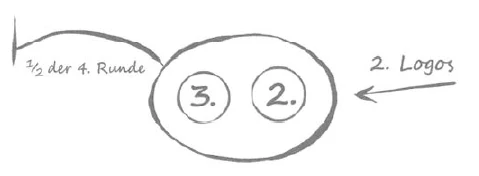
[ 8 ] Der Mensch ist von außen heran aufgebaut. Die Pitris - zweiter Logos - sind herübergekommen. Sie haben befruchtet den dritten Logos. Aus der Befruchtung des dritten Logos durch den zweiten Logos entsteht die tierische Grundlage der Menschen. [Das ist] bis zur Mitte der vierten Runde die lemurische/lunarische Rasse.
[ 8 ] Human beings are constructed from the outside in. The Pitris—the second Logos—have come over. They have fertilized the third Logos. The animal basis of human beings arises from the fertilization of the third Logos by the second Logos. [This is] the Lemurian/Lunar race up to the middle of the fourth round.
[ 9 ] Und nun geschieht die zweite Befruchtung aus dem, was bis hierher entstanden ist. Vom zweitem und drittem Logos entsteht jetzt dadurch, dass [der] erste Logos sich hier direkt verbindet, entsteht jetzt der weitere zweite Teil. [So entsteht die] zweite Hälfte der vierten Runde und die drei folgenden Runden.
[ 9 ] And now the second fertilization takes place from what has arisen thus far. From the second and third Logos—as a result of the first Logos connecting directly with them here—the second part now comes into being. [Thus arises] the second half of the fourth round and the three following rounds.
[ 10 ] Sodass wir uns vorstellen müssen: [Der] zweite Logos ist dasjenige, was herüberkommt von außen, [er] gliedert sich [mithilfe des dritten Logos] Form heran, quillt an. Alle Hüllen sind aufgebaut.
[ 10 ] So we must imagine: [The] second Logos is that which comes from outside; [it] takes on form [with the help of the third Logos] and swells. All shells are formed.
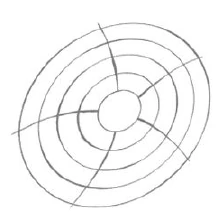
[ 11 ] Und nun kommt [die] Befruchtung vom ersten Logos. Es strahlt von innen heraus. Das ist die Befruchtung des ersten Logos. Das ist es, was in der Aura zu sehen ist.
[ 11 ] And now comes [the] fertilization by the First Logos. It radiates from within. This is the fertilization by the First Logos. This is what can be seen in the aura.
[ 12 ] Bis zur vierten Runde ist die Aura wolkenartig [von außen] gebildet, bis zur lemurischen Rasse. In der Mitte der lemurischen Rasse fängt [das] strahlenförmige Bild der Aura an. Und dies ist [die] Einströmung des ersten Logos. Und das ist, was Annie Besant die Entwicklung des Lebens nennt oder Evolution. Von innen heraus beginnt das Leben oder die Evolution. [Dritter Logos: Evolution des Lebens.]
[ 12 ] Up to the fourth round, the aura is formed in a cloud-like manner [from the outside], up to the Lemurian race. In the middle of the Lemurian race, the radiant image of the aura begins. And this is the inflow of the First Logos. And this is what Annie Besant calls the development of life, or evolution. Life—or evolution—begins from within. [Third Logos: Evolution of Life.]
[ 13 ] [Der] Mensch der lemurischen Rasse hat [eine] physische Hülle, [eine] astrale Hülle [und ein] Kama-Manas gebildet. Das alles hat sich aufgebaut. Jetzt entsteht ein schwarzer Punkt. In der Mitte über dem Kopf, der gleichsam den Platz anzeigt, von dem aus die Einströmung des ersten Logos einstrahlt.
[ 13 ] [The] human of the Lemurian race has formed [a] physical body, [an] astral body, [and a] Kama-Manas. All of this has developed. Now a black dot appears. In the center above the head, which, as it were, indicates the point from which the inflow of the First Logos radiates.
[ 14 ] Jede Evolutionsepoche hat eine ganz bestimmte Absicht des Logos auszuführen. Unsere jetzige Runde - terrestrische Epoche - hat den Menschen von vornherein beabsichtigt und hat den Menschen zur Vollendung zu bringen. Die gegenwärtige [Runde] hat die bestimmte Aufgabe, den Menschen von vornherein zu veranlagen und zur Entwicklung zu bringen.
[ 14 ] Every epoch of evolution is intended to fulfill a very specific purpose of the Logos. Our current round—the terrestrial epoch—has intended humanity from the very beginning and is meant to bring humanity to perfection. The present [round] has the specific task of endowing humanity from the very beginning and guiding it toward development.
[ 15 ] Zu diesem Zweck geschieht immer eine zweifache Befruchtung. Die erste besteht darin, [dass] das Ergebnis der vorhergehenden Epoche selbst befruchtet. Das, was aus der Befruchtung hervorgeht, sind die Tatsachen der ersten Hälfte der Evolution. Dann geschieht [die] zweite Befruchtung [durch den] ersten Logos. Das sind die Tatsachen der zweiten Hälfte der Evolution. Die eine Hälfte geht von außen nach innen und bildet die Form. Die andere geht von innen nach außen und bildet das Leben.
[ 15 ] To this end, a twofold fertilization always takes place. The first consists in [the fact that] the result of the preceding epoch fertilizes itself. What emerges from this fertilization are the facts of the first half of evolution. Then the second fertilization takes place [through] the First Logos. These are the facts of the second half of evolution. One half moves from the outside to the inside and forms the form. The other moves from the inside to the outside and forms life.
[ 16 ] Ich bezeichne [den] dritten Logos deshalb als Weltenstaub, weil alles in ihn aufgenommen wird, was von den anderen Welten abgestoRen ist. Um [Pflanzen]-Samen wachsen und blühen zu lassen, muss erst Materie herbeigezogen werden. Der [Pflanzen]-Samen muss in [den] Boden hineingesenkt werden, der für ihn gleichsam präpariert ist, [sodass] er die Kraft, die er braucht, herausziehen kann. So ist es auch mit [dem] dritten Logos. Er besteht aus Stoff mit lauter [Quell-] Kraft ausgefüllt. Die kamischen Wesenheiten ziehen den Stoff an und bilden einen Kosmos.
[ 16 ] I therefore refer to [the] third Logos as “world dust” because everything that has been cast off by the other worlds is absorbed into it. In order for [plant] seeds to grow and bloom, matter must first be drawn in. The [plant] seed must be planted in [the] soil, which is, as it were, prepared for it, [so that] it can draw out the power it needs. So it is with [the] third Logos as well. It consists of substance filled entirely with [source] power. The kamic beings attract the substance and form a cosmos.
[ 17 ] Die achte Sphäre gibt den Stoff ab, sie wird bei der Entstehung eines neuen Kosmos in die neue Entwicklung aufgenommen. [Die achte Sphäre, der Leichnam eines jeden Kosmos, gibt den Stoff zum Künftigen.] Jeder Weltenkörper wird am Schluss der Entwicklung hell-lila und verschwindet. Sämtliche Samen sind in demselben enthalten und /Lücke in der Mitschrift]
[ 17 ] The eighth sphere releases its substance; it is incorporated into the new development when a new cosmos comes into being. [The eighth sphere, the corpse of every cosmos, provides the substance for the future.] At the end of its development, every world body turns light purple and disappears. All seeds are contained within it, and [gap in the transcript]
[ 18 ] Man muss sich von der Raumvorstellung emanzipieren. Sie gibt nicht alles wieder.
[ 18 ] We must free ourselves from the concept of space. It does not capture everything.
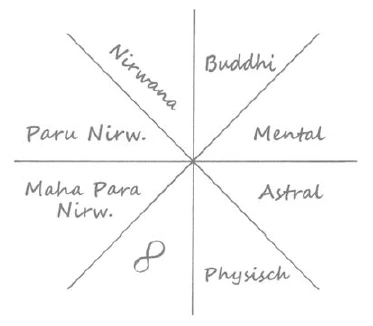
[ 19 ] Von der dritten Runde werden keine neuen Formen mehr gebildet. Äußerlich haben die Menschen die vollkommenste Form erreicht. Das nächste, was Menschen erreichen werden, ist, dass sie von innen her die anderen Hüllen vollkommener machen.
[ 19 ] No new forms will be created in the third cycle. Externally, human beings have attained the most perfect form. The next thing human beings will achieve is to perfect the other shells from within.
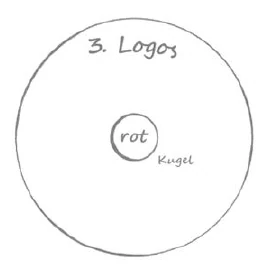
[ 20 ] Jetzt schon hat die Rückwirkung auf den Astralleib begonnen. Die vierte Runde wird vollendet sein, die fünfte kommt, und dann wird immer mehr auf [den] Astralleib eingewirkt werden. Und auf der fünften Kugel/Runde wird der Astralleib so sein.
[ 20 ] The effect on the astral body has already begun. The fourth round will be completed, the fifth will follow, and then the astral body will be increasingly affected. And on the fifth sphere/round, the astral body will be like this.
[ 21 ] [Von der Mitte der vierten Runde an sind die Formen vollendet; jetzt beginnt von innen heraus die Einwirkung auf den Astralleib.] Er wird lauter Räder im Astralkörper haben. Die Chakras bewegen sich, wie schon [heute] bei denen, die seelisch schauen können. Die Chakras drehen [sich].
[ 21 ] [From the middle of the fourth round onward, the forms are complete; now the influence on the astral body begins from within.] He will have numerous wheels in his astral body. The chakras move, just as they do [today] in those who can see with their souls. The chakras [rotate].
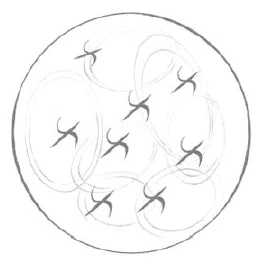
[ 22 ] Während der sechsten Runde bildet sich der Mentalleib aus. Es werden sich nicht nur Chakras bewegen, sondern von innen heraus glänzt immer mehr und mehr strahlend der Mentalleib. Jetzt ist er der strahlende Mentalleib. Das ist auf der sechsten Kugel vollkommen.
[ 22 ] During the sixth round, the mental body takes shape. Not only will the chakras move, but the mental body will shine more and more radiantly from within. Now it is the radiant mental body. This is perfected on the sixth sphere.
[ 23 ] In der siebten Runde bildet sich zur größten Vollkommenheit der Kausalkörper aus. [Er überragt die Grenze des Astralleibes, bis am Ende nichts als Kausalleib da ist.] Nämlich die Strahlen werden wirksamer Kausalkörper werden.
[ 23 ] In the seventh round, the causal body develops to its highest perfection. [It extends beyond the boundary of the astral body, until in the end nothing remains but the causal body.] Specifically, the rays will become the active causal body.
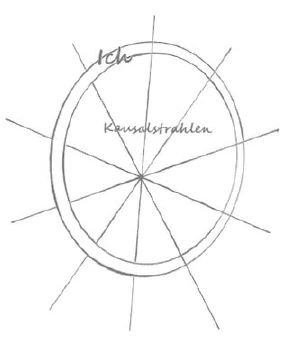
[ 24 ] Sie die [Lücke in der Mitschrift]
[ 24 ] She [gap in the transcript]
[ 25 ] Am Ende der siebten Runde ist nichts anderes da als der Kausalleib.
[ 25 ] At the end of the seventh round, there is nothing left but the causal body.
[ 26 ] Die oberste Schichte wird gebildet in der vierten Runde. Im obersten Gehirn ist das Werkzeug gegeben zur selbstständigen Betätigung. Bis dahin wirkt der dritte Logos von außen. Von dem Gehirn aus können dann die Kräfte ausströmen und die Chakras wieder in Bewegung setzen.
[ 26 ] The uppermost layer is formed in the fourth round. The upper brain provides the tool for independent action. Until then, the third Logos acts from the outside. From the brain, the forces can then radiate outward and set the chakras in motion again.
[ 27 ] Das, was von vorhergehender Entwicklung kommt, nennen wir Prakriti, was von der zweiten Hälfte, Mahat, und das, was von der dritten herüberkommt, Purusha.
[ 27 ] We call that which comes from the previous stage of development Prakriti, that which comes from the second half Mahat, and that which comes from the third Purusha.
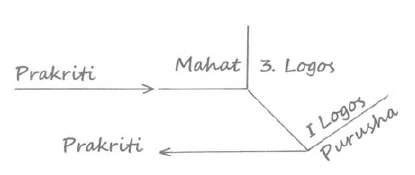
[ 28 ] Körper ist Mahat, Seele Prakriti, Geist Purusha. [Im Samen sind Mahat und Purusha verschwunden; weitergetragen wird Prakriti.]
[ 28 ] The body is Mahat, the soul is Prakriti, and the mind is Purusha. [In the seed, Mahat and Purusha have disappeared; Prakriti is carried forward.]
[ 29 ] Der Körper wird bereit durch den in ihm wohnenden Geist. Der Körper würde keine Fehler machen, wenn er nicht durch Geist [verführt] würde. Es gibt keine körperliche Sünde. Alle Sünde ist geistiger Natur. Grausam kann erst [ein] Mensch sein, der aufgegeben hat das Kama zu zügeln. Erst von [der] Mitte der lemurischen Rasse ab gibt es ein «Gut und Böse, vorher noch nicht. Geist und Körper sind zwei vollkommene Teile. In der Mitte von beiden liegt Kama, die Seele, sie ist der Träger der Unvollkommenheit.
[ 29 ] The body is made capable by the spirit dwelling within it. The body would not commit any errors if it were not [led astray] by the spirit. There is no such thing as physical sin. All sin is of a spiritual nature. Only a person who has given up restraining Kama can be cruel. It is only from the middle of the Lemurian race onward that there is “good and evil”; before that, there was none. Spirit and body are two perfect parts. In the middle of both lies Kama, the soul; it is the bearer of imperfection.
[ 30 ] [Der Körper ist der Geist von außen, Mahat. Die Seele ist Prakriti.]
[ 30 ] [The body is the mind from the outside, Mahat. The soul is Prakriti.]
[ 31 ] Es gibt nichts so Vollkommenes wie Ihre Lunge, Ihren Magen, Ihr Herz. Wären die geistigen Fähigkeiten so vollkommen [wie die Organe], so hätten Sie [die] geistige Vollendung erreicht. Das Physische irrt sich nicht, das Mineralische irrt sich überhaupt nicht. Es kann sich nicht irren.
[ 31 ] There is nothing as perfect as your lungs, your stomach, your heart. If your mental faculties were as perfect [as these organs], you would have attained [mental] perfection. The physical realm does not err; the mineral realm does not err at all. It cannot err.