

The Temple Legend and the Golden Legend
as a symbolic expression of humanity’s past
and future secrets of development
GA 93
22 May 1905 Berlin
Translated by Steiner Online Library
12. On the Lost and to-be-Rebuilt Temple in Connection with the“ Legenda Crucis” or Golden Legend II
[ 1 ] A Few More Reflections on the Lost Temple. We must regard the Temple of Solomon as the greatest symbol. The first step is to understand this symbol. As you know from the Bible, this is the story of how it came into being. We are not dealing here with mere symbols, but with actual external truths that simultaneously express a profound symbolism of world history. And those who built the Temple were aware of what they wanted to express through it.
[ 2 ] Let us consider why the temple was built. And you will see that every word the Bible says about it is a deeply meaningful symbol. You need only remember the time in which it was built. Above all, let us keep in mind the biblical description of what the Temple is to be. Yahweh says to David: “A house for my name.”—That is, a house for the name “Yahweh.” And now let us understand what the name “Yahweh” means.
[ 3 ] At a certain point in its history, ancient Judaism came to recognize the sacred nature of the name “Yahweh.” What does that mean? A child learns to use the word “I” at a certain stage in its life. Before that, the child regards itself as a thing. Just as it names other things, it also names itself with an objective name. Only later does it learn to use the word “I.” For great minds, the moment when they experience the “I” within themselves for the first time in their lives—when they become aware of it for the first time—is something significant. Jean Paul recounts this experience from his own life. As a young boy, he was once standing by a barn in the courtyard; it was there that he experienced his “I” for the first time. And so clear and solemn was that moment to him that he says of it: “As if into the veiled Holy of Holies, I gazed into the very depths of my being.”
[ 4 ] Human beings evolved through many races and, up until the Atlantean era, all viewed themselves objectively; it was not until the Atlantean race that human beings developed to the point where they could refer to themselves as “I.” The ancient Jews incorporated this into a doctrine.
[ 5 ] Humanity has passed through the realms of nature. Self-consciousness was ultimately realized within it. The astral, etheric, and physical bodies, together with the self, form the Pythagorean square. And Judaism added to this the divine Self, which comes down to us from above, in contrast to the “I” that comes from below. Thus, the square had become a pentagon. This is how Judaism perceived the Lord of its people, and it was therefore a sacred act to utter the “Name.” While other names, such as Elohim or Adonai, became increasingly popular, only the anointed priest in the Holy of Holies was permitted to pronounce the name “Yahweh.” It was during the time of Solomon that ancient Judaism came to recognize the holiness of the name Yahweh—this “I” that can dwell within human beings. We must regard Yahweh’s call to humanity as one that sought to make human beings themselves temples of the holy God. We have now received a new conception of the deity, namely: to make the God who is hidden in the human heart—in the deepest sanctuary of the human self—the moral God. The human body thus became a great symbol of the Holy of Holies.
[ 6 ] And now an external symbol was to be erected, because man is a house of God. The temple was to be a symbol, a representation of the human body itself. Therefore, the builders—Hiram Abiff—were called upon, those who understood the secular arts and were able to transform man himself into a god. Two images in the Bible are connected to this: one is Noah’s Ark, the other is the Temple of Solomon. Both are, in a sense, the same and yet fundamentally different. Noah’s Ark was built so that humankind could be saved and brought into its present state of existence. Before Noah, humankind lived during the Atlantean and Lemurian eras. At that time, they had not yet built the vessel that would carry them across the waters of the astral realm into earthly existence. Humankind came from the waters of the astral realm; Noah’s Ark carries them across. The Ark represents the structure built by the unconscious divine forces. There are measurements according to which the dimensions of the Ark correspond to those of the human body and, in turn, to those of the Temple of Solomon as well.
[ 7 ] Humanity has outgrown Noah's Ark, and now it must itself provide a home for the higher Self—a home created through its spirit, through its wisdom, through Solomonic wisdom.
[ 8 ] We enter the Temple of Solomon. The gate itself is distinctive. The square was regarded as an ancient symbol. Today, humanity has moved from the state of fourfoldness to that of fivefoldness as the fivefold human being who becomes aware of his higher self. The inner divine temple is shaped in such a way that it encloses the fivefold human being. The square is sacred. The gate, the roof, and the side posts together form a pentagon. When the human being awakens from the state of fourfoldness—that is, when he enters the interior—the interior being the most important part of the temple—one sees a kind of altar; we behold two cherubim hovering like two guardian spirits over the Ark of the Covenant, the Holy of Holies; for the fifth principle, which has not yet descended, is to be protected by the two higher entities—Buddhi and Atma. This marks the entrance into the manasic development of the human being.
[ 9 ] The entire interior is lined with gold, because gold has always been the symbol of wisdom. Now wisdom enters the manasic stage. We find palm leaves as the symbol of peace. This represents a certain epoch in human history and is presented here as something that was only later expressed in Christianity. The temple leaders had preserved this within themselves and, in this way, expressed here something that was decided upon later.
[ 10 ] Later, in the Middle Ages, the idea of the Temple of Solomon was revived by the Knights Templar, who sought to bring the concept of the Temple to the West. But the Knights Templar were not understood at that time. (Against Jacob von Molay, Grand Master.) If we want to understand the Knights Templar, we must look deeply into the history of humanity. The charges leveled against the Templars in the trial records are based solely on a great misunderstanding. The Knights Templar said at the time: Everything we have experienced so far is a preparation for what the Savior intended. For they said: There is a future for Christianity, a new mission. And we have the task of preparing the various sects of the Middle Ages—and humanity as a whole—for that future, when Christianity will emerge in a new clarity, in accordance with what the Savior actually intended. We have seen Christianity emerge in the fourth sub-race; in the fifth it will continue to develop, but it is only in the sixth that it will celebrate its resurrected glory. That is what we must prepare for. We must guide people’s souls in such a way that a genuine, true, and pure Christianity comes to expression, in which the name of the Most High dwells.
[ 11 ] Jerusalem was to become the center, and from there the mystery of man’s relationship to Christ was to flow out into the whole world. What was represented symbolically in the Temple was to become a living reality. It was said of the Templars—and they were reproached for this—that they had established a certain form of star worship, as well as sun worship. Behind this, however, lies a great mystery. The Mass was once nothing other than a great mystery. The Mass was divided into two parts: the so-called “small Mass,” in which everyone was permitted to participate; and once this was over and the general public had departed, the “great Mass” took place, which was intended only for those who wished to undergo occult training, who wished to embark on the “Path.” In this High Mass, the Apostolic Liturgy was first recited; then the development of Christianity throughout the world was depicted, along with how Christianity is connected to the great course of world development.
[ 12 ] The conditions on Earth were not always the same as they are today; rather, our Earth was once connected to the Sun and the Moon. The Sun, as it were, broke away and then shone upon our Earth from the outside; then the Moon broke away. Thus, in the past, Earth was a very different kind of habitat for human beings. At that time, human beings were still quite different physically. However, the entire course of human life on Earth changed when the Sun and the Moon separated from the Earth. It was then that birth and death first came into being; it was then that reincarnation first occurred; it was then that the human “I,” the individuality, first descended into the physical body and reincarnated in a continuous sequence. This will one day come to an end. The Earth will reunite with the Sun, and then human beings will be able to continue their development on the Sun. We have a sort of ladder of stages through which human beings merge with the Sun. Such things are connected with the Sun’s progression across the celestial vault.
[ 13 ] Now, everything that happens in the world is briefly repeated once more in the following stages. Everything has been repeated, including the development of the globes during the first, second, and third root races. Then it came to pass that human beings began to incarnate. The Sun separated from the Earth between the second and third Root Races, and the Moon separated during the third Root Race. Now the Earth is evolving from the third to the sixth Root Race, at which point the Sun will once again be united with the Earth. Then a new epoch will begin, in which humanity will have reached a much higher level and will no longer incarnate.
[ 14 ] As a religion, this teaching about the course of evolution spread throughout the world in the form of the story of Noah’s Ark. What is to happen in the future was anticipated in the teaching. The union of the Sun with the Earth is foretold in the appearance of Christ on Earth. With such teachings and so on, it is always the case that, for a time, what happens is a repetition of the past. Then the teaching begins to serve as a foretelling of the future. The individual subraces are now linked, in relation to the development of the peoples’ levels of consciousness, to the course of the Sun across the celestial vault. If you sketch out a section of the zodiac, you will get a picture of the Sun’s course across the celestial vault.
[ 15 ] You know that the period in which the third subrace was succeeded by the fourth is associated with the sign of Aries or the Lamb. The Assyrian-Babylonian era encapsulated what was remarkable about its time in the sign of Taurus; the preceding Persian era is marked by the constellation of Gemini. And if we were to go back even further, we would arrive at the era of the Sanskrit culture, associated with Cancer. This era, during which the sun rose in Cancer on the day of the vernal equinox, marked a turning point for humanity. Atlantis had sunk, and the first subrace of the fifth root race had emerged. This turning point was symbolized by Cancer. The next age begins when the sun rises in Gemini. The further course of history leads us to the Near Eastern-Egyptian culture, when the sun rises in Taurus. And as the sun advances even further, the fourth sub-race begins, which Greek mythology associates with Aries, the ram. (The legend of Jason and the quest for the Golden Fleece.) Even in the early days of Christianity, the Savior himself was depicted as a lamb. He calls himself the Lamb.
[ 16 ] We have traced the period from the first to the fourth sub-race. The Sun has advanced across the sky, and now that we ourselves are at a critical point, we are entering the sign of Pisces. Then the time will come—during the era of the sixth subrace—when human beings will be so purified inwardly that they themselves will become temples for the Divine. Then the Sun will enter the sign of Aquarius. Thus the sun—which is, in truth, merely the outer expression of our own spiritual life—follows its course across the celestial vault. When the sun rises in Aquarius at the beginning of spring, only then will it be understood in all its clarity.
[ 17 ] This is how the great Mass unfolded, during which those who were not initiated had been removed. To those who remained, it was explained that Christianity, which began as a seed, would in the future bear fruit that was something entirely different, and that “Aquarius” referred to John, who, like a mustard seed, scattered Christianity as a seed. Aquarius is another name for John, who baptized with water to prepare people to receive the baptism of fire from Christ. That a “John-Aquarius” will come, who will first reveal the true nature of the old John and proclaim a Christ who will renew the temple when the great moment arrives when Christ will speak anew to humanity—and to understand this moment—this was taught in the depths of the Templars’ mysteries.
[ 18 ] And the Templars went on to say: We are now at a point in time when people are not yet ready to understand the great teaching; we must still prepare them for John the Baptist, who baptizes with water. — The cross was placed before the one who wished to become a Templar, and he was told: ‘You must now deny this cross in order to understand it later; first become a Peter, first—like Peter, the rock who denied the Lord—deny the teaching.’ This was taught to the future Templar as a kind of preparatory course. Let us now consider this learning of the Peter stage.
[ 19 ] People in the wider circles understand so little of all this that they are not even able to interpret the letters on the cross correctly. P/a/o speaks of the world soul being crucified on the cross of the world body. The cross symbolized the four elements. The plant, animal, and human kingdoms are structured according to the four elements. On the cross are inscribed: Jam = water—James; Nour—fire, referring to Christ himself; Ruach—air, symbolizing John; and the fourth, Jabeschah—earth, rock, representing Peter. J Jabeschah Peter: Earth
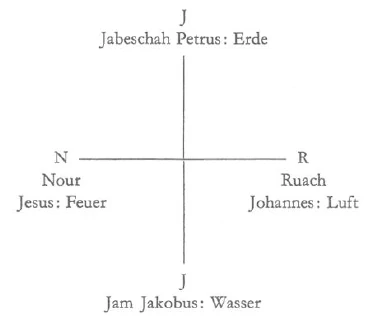
[ 20 ] Thus, the cross represents the same thing that is expressed in the names of the [three] apostles, whereas the single name “J.N.R.J.” refers to Christ himself. “Earth” is the place to which Christianity itself was first to be brought—to that temple where humankind has brought itself in order to serve as a vessel for the Higher. But this temple... [gap in the text, see notes].
[ 21 ] The “rooster crows” twice; it is the symbol of both the lower and the higher self of human beings. The first time “the rooster crows” is when man descends and materializes in the physical realm; the second time is when he ascends again, when he has come to understand Christ, when Aquarius has appeared. This will be in the sixth sub-race. Then man will comprehend in spirit what he is meant to become. The “I” will have transcended a certain level when, in the highest sense, what the Temple of Solomon represents is realized—when human beings themselves become temples for “Yahweh.”
[ 22 ] But before that, human beings must still go through three stages of purification. The “I” is enclosed in a threefold shell: first, in the astral body; second, in the etheric body; and third, in the physical body. By being in the astral body, we have denied the divine “I” for the first time; in the etheric body, for the second time; and in the physical body, for the third time. The first crowing of the rooster represents the threefold denial through the threefold envelope of the human being. And when the human being has passed through the three bodies, when the “I” has found its greatest symbolic fulfillment in Christ, then the rooster crows a second time.
[ 23 ] None of the Templars who were tortured at that time could make these profound ideas—this striving to reach a true understanding of Christ, which requires first passing through the Peter stage—clear to the judges.
[ 24 ] The Templars thus arrived there first, as if they had renounced the Cross. After all this had been explained to the Templar, he was shown a symbolic representation of the divine being in the form of a venerable man with a large beard. (Symbol of the Father.) When people have evolved and found their own guides among the Masters—when there are those who can lead humanity—then the Master will stand before them as the Word of the guiding Father, leading people to an understanding of Christ.
[ 25 ] And then the Templars were told: once they understood this, they were ready to help build the great temple of the world. They must play their part in arranging everything so that this great structure becomes a dwelling place for our true, deeper self—our inner Ark of the Covenant.
[ 26 ] When we take a broad view of all this, we see images that hold great significance. And the one in whose soul these images come to life will increasingly mature into a disciple of those great masters who are preparing this edifice of the temple of humanity. And such grand visions act as forces within our soul, leading us through the process of purification that is meant to guide us toward a living life in the Spirit.
[ 27 ] This characteristic of the Middle Ages, evident among the Knights Templar, is also found in two Round Tables: that of King Arthur and that of the Holy Grail. The old secular order was to be found in King Arthur’s Round Table, while the truly spiritual aspect of Christian chivalry was to be cultivated among those who guarded the mystery of the Holy Grail. It is remarkable how objectively and calmly the people of the Middle Ages reflected on the rising power (fruit) and outward form of Christianity.
[ 28 ] If you follow the teachings of the Templars, there is something at the center that was revered as a feminine principle. This feminine principle was called the divine Sophia, divine wisdom. Manas is the fifth principle, the spiritual self of the human being, which is to rise and for which a temple was to be built. And just as the pentagon at the entrance to Solomon’s Temple characterizes the five-fold human being, so too does this feminine principle characterize the wisdom of the Middle Ages. With his “Beatrice,” Dante sought to portray nothing other than this wisdom. Only those who view Dante’s “Divine Comedy” from this perspective can truly understand it. That is why you will find in Dante the same symbols that are expressed by the Templars, the Christian orders of knights, the Knights of the Grail, and so on. Everything that is to happen is prepared long in advance by the great initiates, who foretell what is to occur in the future in the same way as it happened in the Apocalypse, so that souls may be prepared for these events.
[ 29 ] According to legend, there were two distinct currents at the dawn of humanity: the children of Cain, whom one of the Elohim fathered with Eve, and the children of the world, among whom we find the great arts and the external sciences. This is the one current that was ostracized and is to be sanctified by Christianity once the fifth principle has come into the world. The other current consists of the children of God, who guided humanity up to the comprehension of the fifth principle. These are the ones whom Adam created. Then the sons of Cain were called upon to now enclose within a form that which the sons of God—the children of Abel-Seth—had created.
[ 30 ] The holy name of Yahweh is enshrined in the Ark of the Covenant. But that which is to transform the world—that which is to create the covering for the Holy of Holies—is to be restored by the sons of Cain. God created the human body; within it, the human ego arises and first destroys this temple. Man can only save himself if he first builds the house that carries him across the waters of the passions—if he builds Noah’s Ark. Man must rebuild this house. Thus, what came into the world as the children of Cain builds the exterior, and what the children of God have brought builds the interior.
[ 31 ] Even at the dawn of our race, these two trends were already making themselves felt ... [gap in the text; see notes].
[ 32 ] We will only understand Theosophy when we view it as a testament—one that is meant to prepare for what is recorded as the Temple of Solomon and what is to be expected in the future. We are to prepare the new covenant in place of the old covenant. The old is the covenant of the creative God, in which the Divine creates within the temple of man. The new is the one in which man himself envelops the temple of wisdom around the Divine, in which he restores it so that this “I” may find a refuge on this earth when it rises, liberated from matter.
[ 33 ] Such is the depth of these symbols, and such was the education the Templars sought to bestow upon humanity. The Rosicrucians are nothing other than the successors to the Order of the Templars; their goal was no different from that of the Knights Templar or from that of Theosophy: they are all working on the great temple of humanity.