

The Temple Legend and the Golden Legend
as a symbolic expression of humanity’s past
and future secrets of development
GA 93
29 May 1905 Berlin
Translated by Steiner Online Library
13. On the Lost and to-be-Rebuilt Temple in Connection with the“ Legenda Crucis” or Golden Legend III
The Legend of the Crosswood and the World-Historical Significance of Solomon's Temple
[ 1 ] Now that we have discussed Christianity and its development in the present and future on several occasions, we have reached the point where today we must also consider the significance of the symbol of the cross—not so much from a historical perspective as from a practical one.
[ 2 ] As you know, the cross is a symbol of profound symbolic significance in Christianity; and today I would like to shed light specifically on the connection between the symbol of the cross and the world-historical significance of the Temple of Solomon.
[ 3 ] There is, in fact, a so-called sacred legend concerning the entire history of the cross; and in it, we are concerned less with the sign of the cross or the cross’s general universal symbolism than with that specific, particular cross of which Christians speak—namely, the very cross on which Jesus Christ was crucified. But you also know that the cross is a universal human symbol, found not only in Christianity but in the religious beliefs and imagery of all peoples, so that its meaning must be a universal one. What interests us particularly today, however, is how the symbol of the cross came to have this fundamental meaning in Christianity.
[ 4 ] The Christian legend about the cross is as follows; we will take this as our starting point:
[ 5 ] The wood, or the tree from which the wood of the cross was taken, is not simply wood, but—as the legend goes—was originally a shoot from the Tree of Life that had been cut off for Adam, the first man. Adam’s son Seth planted this shoot in the ground, and this young tree sprouted three trunks that grew together. Later, Moses is said to have carved his famous staff from this very wood. Then, in the legend, the same wood plays a role again in connection with King Solomon’s Temple in Jerusalem. It was to be used as an important pillar in the construction of the Temple. But then something peculiar came to light. It turned out that it simply would not fit in any way. It could not be incorporated into the temple, so it was laid as a bridge across a river. Here it went largely unnoticed until the Queen of Sheba arrived; when she crossed it, she saw what this bridge timber truly was. Here, too, she was the first to recognize the significance of this bridge timber, which lay there between the two realms—the shore on this side and the shore on the other—enabling one to cross the river. Subsequently, this timber was used to construct the cross on which the Savior was crucified, and then it embarked on its various subsequent journeys.
[ 6 ] So you see that this legend concerns something related to the origin and development of the human race. Adam’s son Seth is said to have taken that shoot from the Tree of Life, which then sprouted three shoots. These three shoots symbolize the three principles, the three eternal powers of nature—Atma, Buddhi, and Manas—which have grown together to form the trinity that is the foundation of all becoming and all development. It is very significant that Seth, the son of Adam who took the place of Abel after he was killed by Cain, planted this shoot in the earth.
[ 7 ] You know that we are dealing, on the one hand, with the Cain current and, on the other hand, with the current of the descendants of Abel-Seth. The sons of Cain, who work in the outer world, are particularly devoted to the sciences and the arts. They are the ones who bring the building blocks for the temple from the outer world. The temple was to be built through their art. The descendants of the line of Abel-Seth are the so-called Sons of God, who cultivate the true spiritual essence of human nature. These two currents have always been in a kind of opposition to one another. On the one hand, we have the worldly pursuits of humankind—the development of those sciences that serve human comfort or external life in general; on the other hand, there are the Sons of God, who are concerned with the development of the higher attributes of humankind.
[ 8 ] We must realize that the worldview from which the sacred legend of the Cross arose makes a strict distinction between what science and technology contribute—merely the external construction of the temple of the world—and what acts as a religious permeation, as a religious influence for the sanctification of the entire temple of humanity. Only when this temple of humanity is given a higher purpose—when, so to speak, the external structure, which serves merely a utilitarian function, is transformed into an expression of the house of God—does the external structure become a shell for the spiritual interior, within which humanity’s higher purposes are cultivated. Only when the strength of striving for divine virtue, the outer form for beauty, and the word—which serves human interaction—are placed in the service of divine wisdom—that is, only when the worldly is transformed into the divine—does it attain its perfection. If the three virtues—wisdom, beauty, and strength—are the veils of the divine, then the temple of humanity will be complete. This is how the worldview, which operates in the spirit of this legend, envisioned the matter.
[ 9 ] We must therefore imagine, entirely in keeping with the legend, that until the appearance of Christ Jesus on Earth, two currents existed. One built the earthly temple and shaped human deeds so that later the divine Word, which had come to Earth through Christ Jesus, could be received. A dwelling place was to be prepared for the manifestation of the divine Word on Earth. Meanwhile, the Divine itself was to develop through the ages as a sort of secondary current within the second current. Therefore, a distinction was made between the sons of men—the lineage of Cain—who were to prepare the earthly realm, and the sons of God—the sons of Abel-Seth—who nurtured the divine, until both streams could be united. Christ Jesus united these two streams. The temple was first to be built outwardly, until Christ Jesus appeared—the one who could raise it anew in three days. On the one hand, then, we have the current of the sons of Cain, and on the other, the current of the descendants of Abel-Seth; both prepare the way for human development so that the Son of God could then unite the two sides and merge the two currents into one. This is expressed in a profound way in the sacred legend.
[ 10 ] Seth himself is the one who planted that shoot—which he had taken from the Tree of Life for Adam—into the earth and grew a tree with three shoots. What does this tree with three shoots signify? At first, nothing other than the Trinity of Atma, Buddhi, and Manas—the threefold higher nature of man—which is implanted into the lower principles. But in man, it is initially veiled; man is initially, through his three bodies—the physical, etheric, and astral bodies—like an outer covering of the actual divine Trinity of Atma, Buddhi, and Manas. So you must imagine that the trinity of the physical, etheric, and astral bodies is like an outward representation of the higher forces of Atma, Buddhi, and Manas. And just as an artist shapes external forms and depicts a certain idea in colors, so too do these three sheaths, as it were, represent a work of art. If you imagine that the higher principles are like the idea behind a work of art, then you have a rough idea of what constitutes the life of these three bodies.
[ 11 ] Now, man dwells in his physical, etheric, and astral bodies together with his “I,” through which he is to transform this threefold nature so that the three higher principles may find their proper dwelling place here on Earth and feel at home. The ancient covenant was meant to ensure this. Through the arts of the lineage of Cain, it was to bring the sons of man into the world, and through these sons of man, everything external that serves the physical, etheric, and astral bodies was to be created. What is all this?
[ 12 ] What serves the physical body is, first and foremost, everything that is provided by the technical arts for the satisfaction of the physical body and its comfort. Then there are the social and governmental institutions and organizations related to human coexistence, as well as those pertaining to nutrition and procreation; these serve to build up the life body. And acting upon the astral body, we have the realm of moral precepts and ethics, which are intended to bring order to the drives and passions, regulate the astral nature, and elevate it to a higher level.
[ 13 ] Thus, throughout the entire Old Covenant, the sons of Cain built this three-tiered temple. It is, insofar as it consists of our external institutions—you may think of our dwellings, tools, social and political systems, and moral institutions—in all of this, it is the structure of the sons of Cain, which serves the lower aspects of human nature.
[ 14 ] Alongside this, there was another current led by the Sons of God, their disciples, and their successors. From this source come the servants of the divine world order, the servants of the Ark of the Covenant. In them we find something that functions as a distinct current alongside the servants of the world. They occupied a special position. It was only after the Temple of Solomon had been erected that the Ark of the Covenant was to be placed within it; that is to say, everything else was to be, as it were, ordered in relation to the Ark of the Covenant, grouping itself around it. Everything that had previously been worldly was to become an outward expression, a structure, for what the Ark of the Covenant signifies for humanity. One can best imagine Solomon’s Temple by picturing it as something that outwardly—in its physical form—expresses what the Ark of the Covenant is meant to be as the soul.
[ 15 ] What animated the three outer bodies of the human being—what gave them life—was borrowed by the Sons of the Gods from the Tree of Life. This is symbolically expressed in the timber that was later used for the Cross of Christ. It was first given to the Sons of the Gods. What did they do with it? What is the deeper meaning of the wood of the cross? There is an immensely profound significance in this sacred legend of the wood of the cross.
[ 16 ] What, then, is the purpose of human beings in their earthly evolution? They are to elevate their three present bodies—which they have received—to a higher level. In other words, they are to elevate the physical body into a higher realm, and they are also to elevate the etheric and astral bodies into higher realms. This evolution is the responsibility of human beings. That is its true purpose: to transform our three bodies into three higher components of the entire divine world order.
[ 17 ] Above what human beings initially possess physically lies another realm. But to which realm does the human being belong by virtue of his physical nature? By virtue of his physical nature, he belongs to the mineral kingdom at his present stage of development. The physical, chemical, and mineral laws govern our physical body. But human beings also belong to the mineral kingdom by virtue of their spiritual nature, for with their intellect they comprehend only the mineral kingdom. He only gradually learns to comprehend life as such. It is precisely for this reason that official science denies life—because it is still in this phase of development, in which it comprehends only the inanimate, the mineral. It is in the process of comprehending this in the most subtle way. Therefore, it also comprehends the human body only insofar as it is inanimate, mineral. It essentially treats the body as a dead product, working with it as one would with a substance in a chemistry laboratory. Other substances are introduced into it, just as substances are introduced into a retort. Even when a doctor—who today is educated entirely in mineral science—performs surgery on the human body, it is as if the body were nothing more than a mechanical product.
[ 18 ] We are thus dealing with the human body in two respects at the level of the mineral kingdom: the human being is realized in the mineral kingdom through his physical body, and with mere intellect he comprehends only the mineral kingdom. This is a necessary transitional stage for human beings. But if they rely not merely on the intellect but on intuition—on spiritual power—then we will realize that we are moving toward a future in which our dead, mineral body will work against a living one. And our science must lead the way here; it must prepare for what is to happen to the physical being in the future. In the near future, science itself must become something that contains life within it; it must understand what lives on Earth as something living. For in a deeper sense, it is true that it is human thoughts that prepare the future. An ancient Indian proverb therefore rightly says: “What you think today, you will be tomorrow.”
[ 19 ] The entire existence of the world does not arise from lifeless matter; it arises from living thought. What is external matter is a result of living thought, just as ice is a result of water. The material world is, as it were, frozen thought. We must, in turn, dissolve it back into its higher elements by grasping the life within thought. If we can elevate the mineral realm into the living, if we can transform the thought of the entire human nature, then we will ensure that our science becomes a science of life and not of dead matter. In doing so, we elevate the lowest principle—first in our understanding and later in reality as well—into the next realm. And thus we elevate every aspect of human nature—including the etheric and the astral—one step higher.
[ 20 ] What humankind once was, we call—in theosophical terminology—the three elemental kingdoms. These preceded our mineral kingdom, in which we live today—that is, the kingdom in which our science finds its limits and in which our physical body lives. The three elemental kingdoms are past stages. However, the three higher kingdoms—which are built upon the mineral kingdom—are only in their infancy: the plant kingdom, the animal kingdom, and the human kingdom.
[ 21 ] The lowest principle of the human being must still pass through these three kingdoms, just as it passes through the mineral kingdom today. Just as the human being today, by virtue of his physical nature, dwells in the mineral kingdom, so will he later dwell in the plant kingdom and then ascend to even higher kingdoms. Today, in terms of our physical nature, we are in the transitional stage from the mineral to the plant kingdom; in terms of our etheric nature, we are in the transition from the plant to the animal kingdom; and in terms of our astral nature, we are in the transition from the animal to the human kingdom. And only through what we have as a starting point from the realm of wisdom—where we extend beyond what constitutes astral nature with our own nature—do we rise above the three kingdoms and enter the divine kingdom.
[ 22 ] Thus, humanity is in the process of ascending. But it is not an external institution, nor an external structure, that brings this about, but rather the living force itself, which awakens within us—a force that does not merely assemble the external building blocks, but works creatively and grows. This life force must intervene in the process of development, and it must first take hold of the innermost being of the human being; his religious life must be seized by this living force. That is why what the sons of Cain accomplished during the Old Covenant for the lower aspects of human nature served as a kind of preparation, and what the prophets—the guardians of the Ark of the Covenant—accomplished served as a prophetic hint of the future. But the Divine was now to descend into the Ark of the Covenant, into the soul, in order to dwell as the Holy of Holies within the temple itself.
[ 23 ] These living forces, which work to transform and reshape—the forces actively at work in the transformation of nature—had already been bestowed upon the first human, Adam, from the Tree of Life. But they were entrusted to those who were not concerned with outward structures—the Sons of God, the sons of Abel and Seth. Through Christianity, these forces were now to become the common heritage of all. The two currents were to merge. And today, essentially everything is Christian that stems from the view that no external form—no temple, no house, no social institution—should come into being that is not permeated by inner life, by the life-giving force rather than the merely compositional, mineral force.
[ 24 ] The first attempt made to elevate human nature from the lower to the higher, as we have seen, was the Temple of Solomon. The pentagon was visible as the great symbol at the entrance, for human beings were to strive toward the fifth principle—that is, human nature was to evolve from the lower principles to the higher and refine its individual parts.
[ 25 ] And here we come to the profound significance of the cross, which is why it has come to hold such a fundamental and actual meaning as a symbol in Christianity. What is the cross? There are three realms toward which human nature aspires: the plant kingdom, the animal kingdom, and the human kingdom. Today, the human being is realized within the mineral kingdom, which includes plants, animals, and humans. Understand this as it is stated in all wisdom traditions: that the human being, as a soul-spiritual being, is a part of the World Soul—what Giordano Bruno, for example, called the World Soul. Perhaps the individual soul is like a drop of the World Soul, which we imagine as a vast ocean. Plato himself spoke of the World Soul having been crucified on the body of the world.
[ 26 ] The world soul, as it manifests itself in human beings, is currently spread out across the mineral kingdom. It is meant to rise above this, evolving upward into the three higher kingdoms. To do so, it must still be incarnated in the plant, animal, and human kingdoms over the next three cycles. The fourth round is nothing other than the embodiment of the human soul in the mineral kingdom; the fifth round, that in the plant kingdom; the sixth, that in the animal kingdom; and only the seventh round is the embodiment in the human kingdom proper, where human beings will be the very image of the Deity. Until then, they must still take on the world body as their shell three more times.
[ 27 ] When we look toward this future of humanity, it appears to us as a threefold materiality: plant, animal, and human. This human materiality, however, is not the same as the materiality we have today—for that is the mineral materiality—since humanity has only just entered the mineral cycle. Only when the lowest kingdom becomes the human kingdom, when there will be no more lower beings, when humanity will have redeemed all beings through the power of its own life—only then will humanity have reached the seventh round, where God rests, because humanity itself creates. Then the seventh day of creation will have arrived, when humanity will have become the image of God. These are the stages in the history of creation.
[ 28 ] Today, plants, animals, and human beings, as they appear before us, are merely the seeds of what they are to become. The plant today is merely a symbolic hint of something that is to appear in greater glory and clarity only in the next cycle of human evolution. And when human beings have overcome and cast off their animal nature, they will become something of which they are today merely a foreshadowing. Thus, the plant, animal, and human kingdoms are the three material realms that human beings still have to pass through; they are their world-body, and the soul must be crucified upon this world-body.
[ 29 ] Now consider the contrast between plants, animals, and humans. The plant is the exact opposite of the human being. This has a very deep and meaningful significance when we view the plant as the exact opposite of the human being and the human being as the reverse of plant nature. Conventional science does not concern itself with such matters; it takes things as they present themselves to the external senses. Science, however, which has something to do with theosophy, considers the meaning of things in their connection with the rest of evolution. For, as Goethe says, every thing is to be understood only as a parable.
[ 30 ] The plant has its roots in the soil and unfolds its leaves and flower parts toward the sun. Today, the sun holds within itself the power that was once connected to the Earth. The sun has, after all, separated from our Earth. The entire power of the sun is thus something that once permeated our Earth. Back then, the power of the sun lived within the Earth. Even today, by turning its flower parts toward the sun’s power, the plant seeks to reconnect with those times when the sun’s power was united with the Earth. Solar power is the plant’s etheric power. By turning its reproductive organs toward the sun, the plant reveals its deep kinship with the sun; its reproductive principle is occultly linked to the sun’s power. The plant’s root, on the other hand, which lies in the darkness of the earth, is at the same time related to the earth. Earth and sun are two opposites in evolution.
[ 31 ] Human beings are the reverse of plants; plants have their reproductive organs turned toward the sun, with their heads pointing downward. In human beings, it is exactly the opposite: they hold their heads upward, turned toward the higher worlds to receive the spirit, while their reproductive organs point downward. The animal stands right in the middle, between the plant and the human. It has only made half the turn and thus, in a sense, forms a crossbar to the line of direction formed by the plant and the human. Its spine runs horizontally, thereby intersecting the line formed by the plant and the human in the shape of a cross. Imagine the plant kingdom growing downward, the human kingdom upward, and the animal kingdom growing horizontally—then you have formed a cross out of the plant, animal, and human kingdoms.
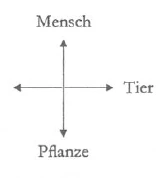
[ 32 ] This is the symbol of the cross.
[ 33 ] It represents the three kingdoms of life into which human beings must enter. The plant, animal, and human kingdoms are the three next material kingdoms. Everything grows out of the mineral kingdom; it is the foundation today. The animal kingdom stands as a kind of barrier between the plant and human kingdoms, and the plant is a kind of mirror image of the human being. This is why human life—that which lives physically within the human being—finds its closest affinity with that which lives in the plant. This could be thoroughly explored in many lectures; today I can only hint at it. If human beings wish to sustain their physical life activity, they can do so best through plant-based nutrition, because in this way they take in what is originally related to the Earth’s physical life activity. The sun is the bearer of life force, and the plant is that which grows toward the sun’s power. And human beings must unite what lives within the plant with their own life force. In this way, their nutrients are occultly identical to those of the plant. The animal kingdom represents a blockage, a reversal of the flow. It therefore interrupts the progression of evolution in the shape of a cross in order to begin a new phase.
[ 34 ] Humans and plants are opposites, yet related to one another. The animal nature, however—and what is initially expressed in the astral body is the animal nature—is a fusion of the two principles of life. At a higher level, the human etheric body will form the foundation for the immortal human being, who will no longer be subject to death. Today, the etheric body still dissolves upon a person’s death. However, the more a person perfects and purifies themselves from within, the more permanence they attain, and the less they perish. Everything that is worked on in relation to this etheric body contributes to its immortality. In this sense, it is true: the more natural the development and the more it is directed toward the forces of life—this does not refer to the animal’s genital or passionate nature—the more immortality takes hold of the human being.
[ 35 ] The animal nature is a current that interrupts human life; it was that delay that was necessary for the reversal of the current of life. Humanity had to unite with the animal nature for a time because the reversal had to take place. But it must free itself from it again and rejoin the flow of life.
[ 36 ] At the beginning of our incarnation, we were endowed with the power of life. This is symbolically expressed in the legend by the fact that Adam’s son Seth takes a shoot from the Tree of Life, which the Sons of God then continue to cultivate—that threefold human nature which is to be ennobled. Then Moses fashioned his staff from this wood of life. This staff of Moses is nothing other than the external law. But what is the external law?
[ 37 ] An external law exists when the person tasked with erecting an external structure has a plan—that is, the lawful relationships set forth on paper—and then the external building blocks are hewn and assembled according to that plan. The law that underlies a plan for a state is also an external law. People are under the rod of Moses. Even those who obey the moral laws out of fear or in hope of reward are obeying only the external law. But those who view science solely in an external manner are also obeying only the external law. For what else do they have but external laws! All the laws we learn about in science are such external laws. Through them, however, we cannot find that transition to the higher human nature, but only follow the law of the Old Covenant—that is, the staff of Moses. Yet this external law should serve as a model for the inner law. Human beings must learn to follow the law within. This inner law must become the impulse of life for human beings; from this inner law, they must learn to obey the external law. It is not the one who draws up a blueprint who realizes the inner law, but the one who builds the temple out of an inner impulse, so that the soul is thus embodied in the assembly of the building blocks. It is not the one who merely follows the laws of the state who lives by the inner law, but the one for whom they are the impulse of his life, because they have become one with his soul. And it is not the one who obeys moral precepts out of fear or for the sake of reward who is a moral person, but the one who obeys them because he loves them.
[ 38 ] As long as people were not ready to internalize the laws, as long as the staff of Moses—which forced people under a yoke—remained in the law, the law remained in the Ark of the Covenant. Until then, the Pauline principle—the principle of grace—came upon humanity, and people were given the opportunity to be set free from the law. Therein lies the depth of the Pauline view: that it distinguishes between law and grace. When the law is infused with love, when love has united itself with the law, then it is grace. This is how the Pauline distinction between law and grace is to be understood.
[ 39 ] Now we can explore the legend of the cross even further. The wood is used as a bridge between two shores because it was unsuitable as a pillar in Solomon’s Temple. This was a preparation. The Ark of the Covenant was in the Temple, but the Word made flesh was not yet there. The wood of the cross is laid as a bridge over a river, but it was only the Queen of Sheba who recognized the value of the wood for the Temple, which is to live in the consciousness of the entire human soul. Now the same wood is used to fashion the cross on which the Redeemer hangs. The one who unites the two earlier currents—who allows the worldly and the spiritual currents to converge—is Christ himself, united with the living cross. Therefore, he can carry the wood of the cross as something he takes upon his back, as something that lives apart from him. He himself is united with the wood of the bridge; therefore, he can take the dead wood upon himself.
[ 40 ] Human beings have now entered into higher nature. Previously, they lived in lower nature. In the Christian sense, they now live in higher nature, and they continue to carry the cross—lower nature—as something foreign through their inner, living power. Now religion becomes a living force in the world; now life in outer nature ceases, and the cross becomes mere wood. The outer body now becomes the vehicle of the inner living force. There the great mystery is fulfilled: the cross is taken upon one’s back.
[ 41 ] Our great poet Goethe also beautifully and meaningfully expressed the idea of the bridge in his “Fairy Tale of the Green Snake and the Beautiful Lily,” where he has a bridge built by the snake coiling itself across the river like a living bridge. All deeply initiated individuals use this same symbol to represent one and the same thing.
[ 42 ] Thus we have come to know the sacred legend of the Cross in its deep inner meaning. We have seen how the transformation was prepared—a transformation that took place through Christianity and must continue to unfold more and more in later times through the Christianization of the world. We have seen how the cross, insofar as it is an image of the three outer bodies, dies away; how it can establish only an outer connection between the three lower and the three higher realms—between the two shores separated by the river—for the wood of the cross could not become a pillar in Solomon’s Temple—until humanity recognizes it as its own symbol. Only then, when he sacrifices himself, makes his own body a temple, and becomes capable of bearing the cross himself, is the union of the two currents made possible.
[ 43 ] That is why the Christian churches, too, incorporate the sign of the cross into their very design. This is meant to express that the living cross is enshrined within the outer structure of the temple. But those two currents—on the one hand, the divine and living, and on the other, the worldly and mineral—have merged into one in the Savior hanging on the cross, where the higher principles lie in the Savior Himself and the lower ones in the cross. And the Apostle Paul expresses particularly profoundly that from now on this connection is to be an organic, living one. Without what we have discussed today, one cannot understand the writings of the Apostle Paul. It was clear to him that the old covenant, which established a contrast between human beings and the law, must come to an end. Only when human beings unite the law with themselves, take it upon their backs, and carry it, will there no longer be any contradiction between inner human nature and the outer law. Then what Christianity seeks to achieve will have been accomplished.
[ 44 ] “Sin entered the world through the law.” This is a profound statement by Paul. When does sin exist in the world? Precisely when there is a law that can be transgressed. But if the law is so united with human nature that whatever a person does is good, then there can be no sin. Man contradicts the law of the cross only as long as it does not live within him, as long as it remains external. Therefore, Paul regards Christ on the cross as the overcoming of the law and the overcoming of sin. It is a curse to hang on the wood of the cross—that is, to be subject to the law. Sin and the law belong together under the old covenant; law and love belong together under the new covenant. The law associated with the old covenant is a negative law; the law of the new covenant, however, is a positive law that is alive. He who has united the law of the old covenant with his own life has overcome it. But he has also sanctified it.
[ 45 ] This is what is meant by those words of Paul found in the Epistle to the Galatians (Chapter 3, verses 11–13): “It is clear, however, that no one is justified before God by the law, for the righteous will live by his faith.” The Law, however, is not based on faith; rather, the person who does what the Law requires will live by it. But Christ redeemed us from the curse of the Law by becoming a curse for us—for it is written: ‘Cursed is everyone who is hanged on a tree.’
[ 46 ] Paul associates the terms we have discussed today with the word “Holze.” Thus, we must delve ever more deeply into what the great initiates have said. We do not draw closer to Christianity by, so to speak, adapting it to our own demands—adapting it to today’s materialistic mind, which is averse to the higher realms—but rather by elevating ourselves more and more into the heights of the spiritual. For Christianity was born out of initiation, and only then will we be able to understand it and believe that infinite depths are contained within Christianity—not when we think we must bring Christianity closer to the modern mind, but when the materialistic mind, which is averse to the higher, once again elevates itself to Christianity. Today’s intellect must rise from the mineral-dead to the living-spiritual if it is to understand Christianity.
[ 47 ] I have presented these views in order to arrive at the concept of the New Jerusalem.