

The Temple Legend and the Golden Legend
GA 93
22 May 1905, Berlin
Translate the original German text into any language:
Versions Available:
The Temple Legend and the Golden Legend, tr. SOL
12. Über Den Verlorenen Und Wiederzuerrichtenden Tempel im Zusammenhang mit der Kreuzesholz- oder Goldenen Legende II
12. On the Lost and to-be-Rebuilt Temple in Connection with the“ Legenda Crucis” or Golden Legend II
[ 1 ] Noch einige Betrachtungen über den verlorengegangenen Tempel. Als das größte Symbol haben wir den Salomonischen Tempel anzusehen. Es handelt sich zunächst einmal darum, dieses Sinnbild zu verstehen. Aus der Bibel kennen Sie ja den Hergang, wie er entstanden ist. Wir haben es dabei nicht mit bloßen Sinnbildern zu tun, sondern tatsächlich mit äußeren Wahrheiten, in denen aber zugleich eine tiefe weltgeschichtliche Symbolik zum Ausdruck kommt. Und diejenigen, die den Tempel bauten, waren sich bewußt, was sie dabei zum Ausdrucke bringen wollten.
[ 1 ] A Few More Reflections on the Lost Temple. We must regard the Temple of Solomon as the greatest symbol. The first step is to understand this symbol. As you know from the Bible, this is the story of how it came into being. We are not dealing here with mere symbols, but with actual external truths that simultaneously express a profound symbolism of world history. And those who built the Temple were aware of what they wanted to express through it.
[ 2 ] Warum der Tempel gebaut wurde, wollen wir uns vor Augen führen. Und Sie werden sehen, daß jedes Wort, das die Bibel darüber bringt, ein tief bedeutsames Sinnbild ist. Sie müssen dabei nur daran denken, in welcher Zeit der Bau stattgefunden hat. Halten wir uns vor allem das biblische Wort vor Augen, was der Tempel sein soll. Jahve richtet an David das Wort: «Ein Haus für meinen Namen.» — Also ein Haus für den Namen «Jahve». Und nun machen wir uns klar, was der Name «Jahve» bedeutet.
[ 2 ] Let us consider why the temple was built. And you will see that every word the Bible says about it is a deeply meaningful symbol. You need only remember the time in which it was built. Above all, let us keep in mind the biblical description of what the Temple is to be. Yahweh says to David: “A house for my name.”—That is, a house for the name “Yahweh.” And now let us understand what the name “Yahweh” means.
[ 3 ] Das alte Judentum ist sich zu einer gewissen Zeit über das Heilige des Namens «Jahve» klargeworden. Was heißt das? Das Kind lernt in einer bestimmten Zeit seines Lebens das Wort «Ich» gebrauchen. Vorher betrachtet es sich als eine Sache. So wie es andere Sachen benennt, so benennt es auch sich selbst mit einem objektiven Namen. Erst später lernt es das Wort «Ich» gebrauchen. Für große Geister ist der Augenblick, in dem sie zum ersten Mal im Leben das «Ich» in sich erfahren, sich zum ersten Mal dessen bewußt werden, etwas Bedeutungsvolles. Jean Paul erzählt dieses Geschehnis von sich. Er stand als kleiner Knabe einmal an einer Scheune im Hofe; da erlebte er zum ersten Mal sein Ich. Und so klar und feierlich war ihm dieser Augenblick, daß er davon sagt: «Wie in das verhangene Allerheiligste habe ich da in mein Innerstes hineingeblickt.»
[ 3 ] At a certain point in its history, ancient Judaism came to recognize the sacred nature of the name “Yahweh.” What does that mean? A child learns to use the word “I” at a certain stage in its life. Before that, the child regards itself as a thing. Just as it names other things, it also names itself with an objective name. Only later does it learn to use the word “I.” For great minds, the moment when they experience the “I” within themselves for the first time in their lives—when they become aware of it for the first time—is something significant. Jean Paul recounts this experience from his own life. As a young boy, he was once standing by a barn in the courtyard; it was there that he experienced his “I” for the first time. And so clear and solemn was that moment to him that he says of it: “As if into the veiled Holy of Holies, I gazed into the very depths of my being.”
[ 4 ] Die Menschen haben sich durch viele Rassen hindurch entwickelt und haben sich bis zur atlantischen Zeit alle so objektiv aufgefaßt; erst während der atlantischen Rasse entwickelte sich der Mensch dahin, daß er zu sich «Ich» sagen konnte. Die alten Juden haben das in eine Lehre gefaßt.
[ 4 ] Human beings evolved through many races and, up until the Atlantean era, all viewed themselves objectively; it was not until the Atlantean race that human beings developed to the point where they could refer to themselves as “I.” The ancient Jews incorporated this into a doctrine.
[ 5 ] Der Mensch ist durch die Reiche der Natur hindurchgegangen. Das Ich-Bewußtsein ging zuletzt in ihm auf. Astral-, Äther- und physischer Leib und das Ich bilden zusammen das pythagoräische Quadrat. Und das Judentum fügte zu diesem das göttliche Selbst hinzu, das von oben herunter zu uns kommt, im Gegensatz zu dem Ich von unten. So war aus dem Viereck ein Fünfeck entstanden. So empfand das Judentum den Herrn seines Volkes, und etwas Heiliges war es daher, den «Namen» auszusprechen. Während andere Namen, wie zum Beispiel Elohim oder Adonai mehr und mehr populär wurden, durfte nur der gesalbte Priester im Allerheiligsten den Namen «Jahve» aussprechen. Zur Zeit Salomos war es, daß das alte Judentum zur Heiligkeit des Jahve-Namens kam, zu diesem «Ich», das im Menschen wohnen kann. Die Aufforderung Jahves an die Menschen müssen wir als eine solche nehmen, die den Menschen selbst zu einem Tempel des heiligen Gottes gemacht wissen wollte. Jetzt haben wir eine neue Auffassung von der Gottheit erhalten, die nämlich: den Gott, der in der Brust des Menschen, im tiefsten Heiligtum des menschlichen Selbst verborgen ist, zum moralischen Gott zu machen. Der menschliche Leib wurde so zu einem großen Sinnbild für das Allerheiligste.
[ 5 ] Humanity has passed through the realms of nature. Self-consciousness was ultimately realized within it. The astral, etheric, and physical bodies, together with the self, form the Pythagorean square. And Judaism added to this the divine Self, which comes down to us from above, in contrast to the “I” that comes from below. Thus, the square had become a pentagon. This is how Judaism perceived the Lord of its people, and it was therefore a sacred act to utter the “Name.” While other names, such as Elohim or Adonai, became increasingly popular, only the anointed priest in the Holy of Holies was permitted to pronounce the name “Yahweh.” It was during the time of Solomon that ancient Judaism came to recognize the holiness of the name Yahweh—this “I” that can dwell within human beings. We must regard Yahweh’s call to humanity as one that sought to make human beings themselves temples of the holy God. We have now received a new conception of the deity, namely: to make the God who is hidden in the human heart—in the deepest sanctuary of the human self—the moral God. The human body thus became a great symbol of the Holy of Holies.
[ 6 ] Und nun sollte ein äußeres Sinnbild errichtet werden, weil der Mensch ein Haus Gottes ist. Ein Symbol, die Versinnbildlichung des eigenen menschlichen Leibes, sollte der Tempel sein. Daher wurden die Bauleute gerufen - Hiram-Abiff -, die die weltlichen Künste verstanden haben, die den Menschen selbst zu einem Gott umgestalten konnten. Zwei Bilder in der Bibel sind damit verbunden: das eine ist die Arche Noah, das andere der Salomonische Tempel. Beide sind in einer Weise dasselbe und doch wieder grundverschieden. Die Arche Noah ist erbaut worden, damit sich der Mensch hinüberretten konnte in den jetzigen Zustand seines Daseins. Vor Noah lebte der Mensch in der atlantischen und lemurischen Zeit. Da hatte er noch nicht das Schiff gebaut, mit dem er über die Wasser des Astralen in das irdische Dasein kommen konnte. Von den Wassern des Astralen ist der Mensch gekommen, die Arche Noah trägt ihn hinüber. Die Arche stellt das Gebäude dar, welches die unbewußten göttlichen Kräfte gebaut hatten. Es gibt Abmessungen, wonach die Maße der Arche übereinstimmen mit den Maßen des menschlichen Körpers und mit den Maßen des Salomonischen Tempels auch wieder.
[ 6 ] And now an external symbol was to be erected, because man is a house of God. The temple was to be a symbol, a representation of the human body itself. Therefore, the builders—Hiram Abiff—were called upon, those who understood the secular arts and were able to transform man himself into a god. Two images in the Bible are connected to this: one is Noah’s Ark, the other is the Temple of Solomon. Both are, in a sense, the same and yet fundamentally different. Noah’s Ark was built so that humankind could be saved and brought into its present state of existence. Before Noah, humankind lived during the Atlantean and Lemurian eras. At that time, they had not yet built the vessel that would carry them across the waters of the astral realm into earthly existence. Humankind came from the waters of the astral realm; Noah’s Ark carries them across. The Ark represents the structure built by the unconscious divine forces. There are measurements according to which the dimensions of the Ark correspond to those of the human body and, in turn, to those of the Temple of Solomon as well.
[ 7 ] Aus der Arche Noah ist der Mensch hinausgewachsen, und nun soll er selbst das höhere Ich mit einem Haus umgeben, das durch seinen Geist, durch seine Weisheit, durch salomonische Weisheit geschaffen worden ist.
[ 7 ] Humanity has outgrown Noah's Ark, and now it must itself provide a home for the higher Self—a home created through its spirit, through its wisdom, through Solomonic wisdom.
[ 8 ] Wir treten ein in den Salomonischen Tempel. Das Tor ist schon charakteristisch. Das Viereck galt als ein altes Symbol. Der Mensch ist nun heute aus dem Zustand der Vierheit in den der Fünfheit getreten als der fünfgliedrige Mensch, der sich seines höheren Selbstes bewußt wird. Der innere göttliche Tempel ist so geformt, daß er den fünfgliedrigen Menschen umschließt. Das Quadrat ist heilig. Das Tor, die Bedachung und die Seitenpfosten geben zusammen ein Fünfeck. Wenn der Mensch erwacht aus der Vierheit, das ist, wenn er in das Innere hineingeht — das Innere ist das Wichtigste des Tempels -, da sieht man eine Art Altar; wir erblicken zwei Cherubim, welche wie zwei schützende Geister über der Bundeslade, dem Allerheiligsten, schweben; denn das fünfte Prinzip, welches noch nicht heruntergestiegen ist, soll von den beiden höheren Wesenheiten - Buddhi und Atma - in Schutz genommen werden. Das ist der Eintritt in die manasische Entwickelung des Menschen.
[ 8 ] We enter the Temple of Solomon. The gate itself is distinctive. The square was regarded as an ancient symbol. Today, humanity has moved from the state of fourfoldness to that of fivefoldness as the fivefold human being who becomes aware of his higher self. The inner divine temple is shaped in such a way that it encloses the fivefold human being. The square is sacred. The gate, the roof, and the side posts together form a pentagon. When the human being awakens from the state of fourfoldness—that is, when he enters the interior—the interior being the most important part of the temple—one sees a kind of altar; we behold two cherubim hovering like two guardian spirits over the Ark of the Covenant, the Holy of Holies; for the fifth principle, which has not yet descended, is to be protected by the two higher entities—Buddhi and Atma. This marks the entrance into the manasic development of the human being.
[ 9 ] Das ganze Innere ist mit Gold ausgekleidet, weil das Gold von jeher das Symbol der Weisheit ist. Nun tritt die Weisheit in das manasische Stadium. Palmblätter finden wir als das Friedenssymbol. Das stellt eine gewisse Epoche des Menschen dar und ist hier als etwas hingestellt, was erst später, im Christentum, zum Ausdruck gekommen ist. Jetzt hatten es die Tempelleiter in sich bewahrt und auf diese Art etwas für später Beschlossenes hier ausgedrückt.
[ 9 ] The entire interior is lined with gold, because gold has always been the symbol of wisdom. Now wisdom enters the manasic stage. We find palm leaves as the symbol of peace. This represents a certain epoch in human history and is presented here as something that was only later expressed in Christianity. The temple leaders had preserved this within themselves and, in this way, expressed here something that was decided upon later.
[ 10 ] Später, im Mittelalter, lebte die Idee des Salomonischen Tempels von neuem in den Tempelrittern auf, die den Gedanken des Tempels hinübertragen wollten in das Abendland. Aber man hat die Tempelritter damals nicht verstanden. (Gegen Jacob von Molay, Großmeister.) Wenn wir die Tempelritter verstehen wollen, müssen wir tief in die Geschichte der Menschheit hineinschauen. Was man in den Prozeßakten den Templern vorgeworfen hat, beruht nur auf einem großen Mißverständnis. Die Tempelritter sagten damals: Alles, was wir bisher erlebt haben, ist eine Vorbereitung zu dem, was der Erlöser gewollt hat. Denn sie sagten: Es gibt eine Zukunft des Christentums, eine neue Aufgabe. Und wir haben die Aufgabe, die verschiedenen Sekten des Mittelalters und die Menschen überhaupt auf jenes Zukünftige vorzubereiten, wo das Christentum in einer neuen Klarheit erstehen wird, in dem, was der Erlöser eigentlich gewollt hat. Wir haben das Christentum in der vierten Unterrasse aufgehen sehen, in der fünften wird es sich weiterentwickeln, aber in der sechsten soll es erst die wiederauferstandene Glorie feiern. Das haben wir vorzubereiten. Wir müssen die Seelen der Menschen so lenken, daß ein echtes, wahres, reines Christentum zum Ausdruck kommt, in dem der Name des Höchsten seinen Wohnsitz hat.
[ 10 ] Later, in the Middle Ages, the idea of the Temple of Solomon was revived by the Knights Templar, who sought to bring the concept of the Temple to the West. But the Knights Templar were not understood at that time. (Against Jacob von Molay, Grand Master.) If we want to understand the Knights Templar, we must look deeply into the history of humanity. The charges leveled against the Templars in the trial records are based solely on a great misunderstanding. The Knights Templar said at the time: Everything we have experienced so far is a preparation for what the Savior intended. For they said: There is a future for Christianity, a new mission. And we have the task of preparing the various sects of the Middle Ages—and humanity as a whole—for that future, when Christianity will emerge in a new clarity, in accordance with what the Savior actually intended. We have seen Christianity emerge in the fourth sub-race; in the fifth it will continue to develop, but it is only in the sixth that it will celebrate its resurrected glory. That is what we must prepare for. We must guide people’s souls in such a way that a genuine, true, and pure Christianity comes to expression, in which the name of the Most High dwells.
[ 11 ] Jerusalem sollte der Mittelpunkt werden und von dort aus das Geheimnis über das Verhältnis des Menschen zu Christus in alle Welt strömen. Was als Symbol in dem Tempel dargestellt war, sollte eine lebendige Wirklichkeit werden. Von den Templern wurde gesagt, und man machte es ihnen zum Vorwurf, daß sie einen gewissen Sternendienst, ebenso einen Sonnendienst errichtet hätten. Dahinter aber liegt ein großes Mysterium. Das Meßopfer war früher nichts anderes als ein großes Mysterium. Die Messe zerfiel in zwei Teile, in die sogenannte kleine Messe, an der alle teilnehmen durften, und war diese zu Ende, und die breite Masse hatte sich entfernt, so erfolgte die große Messe, die nur für diejenigen bestimmt war, die die okkulte Schulung durchmachen wollten, die den «Pfad» betreten wollten. In dieser großen Messe vollzog sich zuerst die Abbetung des Apostolikums; dann wurde gezeigt die Entwickelung des Christentums in der ganzen Welt, und wie das Christentum mit dem großen Gang der Weltentwickelung zusammenhängt.
[ 11 ] Jerusalem was to become the center, and from there the mystery of man’s relationship to Christ was to flow out into the whole world. What was represented symbolically in the Temple was to become a living reality. It was said of the Templars—and they were reproached for this—that they had established a certain form of star worship, as well as sun worship. Behind this, however, lies a great mystery. The Mass was once nothing other than a great mystery. The Mass was divided into two parts: the so-called “small Mass,” in which everyone was permitted to participate; and once this was over and the general public had departed, the “great Mass” took place, which was intended only for those who wished to undergo occult training, who wished to embark on the “Path.” In this High Mass, the Apostolic Liturgy was first recited; then the development of Christianity throughout the world was depicted, along with how Christianity is connected to the great course of world development.
[ 12 ] Die Tatsachen der Erde waren nicht immer die gleichen wie heute, sondern unsere Erde war einstmals verbunden mit der Sonne und mit dem Monde. Die Sonne hat sich gleichsam abgespalten und unsere Erde dann von außen beschienen; dann hat der Mond sich abgespalten. So war die Erde früher eine ganz andere Art von Wohnplatz für den Menschen. Damals war der Mensch physisch noch ganz anders. Das ganze Leben des Menschen auf der Erde wurde aber anders, als Sonne und Mond sich von der Erde trennten. Da gab es erst Geburt und Tod; da trat erst die Reinkarnation auf; da erst stieg die menschliche Ichheit, die Individualität, in den physischen Körper hinab und reinkarnierte sich in fortlaufender Folge. Das wird einst wieder aufhören. Die Erde wird sich wieder mit der Sonne verbinden, und dann wird der Mensch seine weitere Entwickelung auf der Sonne verleben können. Wir haben so eine gewisse Stufenleiter, wie der Mensch mit der Sonne zusammengeht. Solche Dinge hängen mit dem Fortschreiten der Sonne über das Himmelsgewölbe zusammen.
[ 12 ] The conditions on Earth were not always the same as they are today; rather, our Earth was once connected to the Sun and the Moon. The Sun, as it were, broke away and then shone upon our Earth from the outside; then the Moon broke away. Thus, in the past, Earth was a very different kind of habitat for human beings. At that time, human beings were still quite different physically. However, the entire course of human life on Earth changed when the Sun and the Moon separated from the Earth. It was then that birth and death first came into being; it was then that reincarnation first occurred; it was then that the human “I,” the individuality, first descended into the physical body and reincarnated in a continuous sequence. This will one day come to an end. The Earth will reunite with the Sun, and then human beings will be able to continue their development on the Sun. We have a sort of ladder of stages through which human beings merge with the Sun. Such things are connected with the Sun’s progression across the celestial vault.
[ 13 ] Nun wird in der Welt alles, was geschieht, in den folgenden Stadien noch einmal kurz wiederholt. Alles hat sich wiederholt, auch die Entwickelung der Globen in der ersten, zweiten und dritten Wurzelrasse. Dann ereignete sich, daß der Mensch in die Inkarnation stieg. Von der zweiten zur dritten Wurzelrasse hat sich die Sonne abgespalten, in der dritten der Mond. Nun entwickelt sich die Erde von der dritten bis zur sechsten Wurzelrasse, wo dann die Sonne wieder mit der Erde verbunden sein wird. Dann wird eine neue Epoche beginnen, wo der Mensch auf einer viel höheren Stufe angelangt sein und sich nicht mehr inkarnieren wird.
[ 13 ] Now, everything that happens in the world is briefly repeated once more in the following stages. Everything has been repeated, including the development of the globes during the first, second, and third root races. Then it came to pass that human beings began to incarnate. The Sun separated from the Earth between the second and third Root Races, and the Moon separated during the third Root Race. Now the Earth is evolving from the third to the sixth Root Race, at which point the Sun will once again be united with the Earth. Then a new epoch will begin, in which humanity will have reached a much higher level and will no longer incarnate.
[ 14 ] Als Religion kam diese Lehre über den Gang der Entwickelung in die Welt hinaus in Gestalt der Geschichte von der Arche Noah. Was in der Zukunft geschehen soll, wurde in der Lehre vorausgenommen. Die Vereinigung der Sonne mit der Erde ist vorausverkündet in der Erscheinung des Christus auf der Erde. Mit solchen Lehren und so weiter ist es immer so: einige Zeit lang ist das, was geschieht, eine Wiederholung des Vergangenen. Dann beginnt die Lehre eine Vorverkündigung für die Zukunft zu sein. Die einzelnen Unterrassen hängen nun mit Bezug auf die Entwickelung der Bewußtseinsstufen der Völker zusammen mit dem Gang der Sonne am Himmelsgewölbe. Wenn Sie sich ein Stück des Tierkreises aufzeichnen, so bekommen Sie ein Bild für den Gang der Sonne über das Himmelsgewölbe.
[ 14 ] As a religion, this teaching about the course of evolution spread throughout the world in the form of the story of Noah’s Ark. What is to happen in the future was anticipated in the teaching. The union of the Sun with the Earth is foretold in the appearance of Christ on Earth. With such teachings and so on, it is always the case that, for a time, what happens is a repetition of the past. Then the teaching begins to serve as a foretelling of the future. The individual subraces are now linked, in relation to the development of the peoples’ levels of consciousness, to the course of the Sun across the celestial vault. If you sketch out a section of the zodiac, you will get a picture of the Sun’s course across the celestial vault.
[ 15 ] Sie wissen, daß die Zeit, in welcher die dritte Unterrasse von der vierten abgelöst wurde, mit dem Zeichen des Widders oder des Lammes zusammengebracht wird. Das assyrisch-babylonische Zeitalter faßte das für seine Zeit Bemerkenswerte in dem Stierzeichen zusammen, das vorhergegangene persische Zeitalter wird markiert vom Sternbild der Zwillinge. Und würden wir noch weiter zurückgehen, so würden wir in der Zeit der Sanskritkultur zum Krebs kommen. Diese Zeit, in welcher die Sonne am Tage des Frühlingsanfanges im Krebs aufging, wurde eine Umkehrzeit der Menschheit. Atlantis war versunken und die erste Unterrasse der fünften Wurzelrasse aufgegangen. Diese Umkehr wurde mit dem Krebs bezeichnet. Das nächste Zeitalter beginnt dann, als die Sonne in den Zwillingen aufgeht. Der weitere Gang der Geschichte führt uns in die vorderasiatisch-ägyptische Kultur, als die Sonne im Stier aufgeht. Und als die Sonne noch weiter vorrückt, beginnt die vierte Unterrasse, die die griechische Sage mit dem Widder, mit dem Lamm in Zusammenhang bringt. (Die Jasonsage vom Herüberholen des Widderfelles.) Auch noch in den ersten Zeiten des Christentums wurde der Heiland selbst als Lamm dargestellt. Er nennt sich selbst das Lamm.
[ 15 ] You know that the period in which the third subrace was succeeded by the fourth is associated with the sign of Aries or the Lamb. The Assyrian-Babylonian era encapsulated what was remarkable about its time in the sign of Taurus; the preceding Persian era is marked by the constellation of Gemini. And if we were to go back even further, we would arrive at the era of the Sanskrit culture, associated with Cancer. This era, during which the sun rose in Cancer on the day of the vernal equinox, marked a turning point for humanity. Atlantis had sunk, and the first subrace of the fifth root race had emerged. This turning point was symbolized by Cancer. The next age begins when the sun rises in Gemini. The further course of history leads us to the Near Eastern-Egyptian culture, when the sun rises in Taurus. And as the sun advances even further, the fourth sub-race begins, which Greek mythology associates with Aries, the ram. (The legend of Jason and the quest for the Golden Fleece.) Even in the early days of Christianity, the Savior himself was depicted as a lamb. He calls himself the Lamb.
[ 16 ] Wir haben die Zeit der ersten bis vierten Unterrasse verfolgt. Die Sonne schritt am Himmel vor, und jetzt, wo wir selbst an einem kritischen Punkt sind, treten wir in das Zeichen der Fische ein. Dann wird die Zeit kommen, in der Zeit der sechsten Unterrasse, wo die Menschen innerlich so gereinigt sein werden, daß sie selbst für das Göttliche ein Tempel sein werden. Dann wird die Sonne in das Zeichen des Wassermanns treten. So geht die Sonne, die eigentlich nur der äußere Ausdruck unseres eigenen geistigen Lebens ist, ihren Gang am Himmelsgewölbe. Wenn die Sonne im Frühlingsanfang im Wassermann aufgehen wird, dann wird sie erst in ihrer vollen Klarheit verstanden werden.
[ 16 ] We have traced the period from the first to the fourth sub-race. The Sun has advanced across the sky, and now that we ourselves are at a critical point, we are entering the sign of Pisces. Then the time will come—during the era of the sixth subrace—when human beings will be so purified inwardly that they themselves will become temples for the Divine. Then the Sun will enter the sign of Aquarius. Thus the sun—which is, in truth, merely the outer expression of our own spiritual life—follows its course across the celestial vault. When the sun rises in Aquarius at the beginning of spring, only then will it be understood in all its clarity.
[ 17 ] So verlief die große Messe, bei der die Uneingeweihten entfernt worden waren. Denen, die geblieben waren, legte man dar, daß das Christentum, das als Saat angefangen hat, in der Zukunft noch etwas ganz anderes als Frucht bringen soll und daß mit dem «Wassermann» Johannes gemeint war, der wie ein Senfkorn das Christentum als Saat ausstreute. Aquarius oder Wassermann heißt dasselbe wie Johannes, der mit Wasser taufte, um die Menschen vorzubereiten, daß sie die Feuertaufe des Christus empfangen können. Daß ein «Johannes-Aquarius» kommen wird, der den alten Johannes erst zur Wahrheit machen und einen Christus verkünden wird, der den Tempel wiedererneuert, wenn der große Zeitpunkt gekommen sein wird, wo der Christus neuerdings zur Menschheit sprechen wird, diesen Zeitpunkt dann zu verstehen, das wurde in den Tiefen der Mysterien der Templer gelehrt.
[ 17 ] This is how the great Mass unfolded, during which those who were not initiated had been removed. To those who remained, it was explained that Christianity, which began as a seed, would in the future bear fruit that was something entirely different, and that “Aquarius” referred to John, who, like a mustard seed, scattered Christianity as a seed. Aquarius is another name for John, who baptized with water to prepare people to receive the baptism of fire from Christ. That a “John-Aquarius” will come, who will first reveal the true nature of the old John and proclaim a Christ who will renew the temple when the great moment arrives when Christ will speak anew to humanity—and to understand this moment—this was taught in the depths of the Templars’ mysteries.
[ 18 ] Und weiter sagten die Templer: Jetzt sind wir an einem Zeitpunkt, wo die Menschen noch nicht reif sind, die große Lehre zu verstehen, noch müssen wir sie auf den Täufer Johannes vorbereiten, der mit Wasser tauft. - Das Kreuz wurde vor den hingestellt, der Templer werden wollte, und ihm wurde gesagt: Du sollst dieses Kreuz jetzt verleugnen, um es später zu verstehen, erst ein Petrus werden, erst wie Petrus, der Fels, der den Herrn verleugnet hat, die Lehre verleugnen. Das wurde als eine Vorschule dem zukünftigen Templer beigebracht. Fassen wir einmal dieses Lernen des Petrus-Stadiums ins Auge.
[ 18 ] And the Templars went on to say: We are now at a point in time when people are not yet ready to understand the great teaching; we must still prepare them for John the Baptist, who baptizes with water. — The cross was placed before the one who wished to become a Templar, and he was told: ‘You must now deny this cross in order to understand it later; first become a Peter, first—like Peter, the rock who denied the Lord—deny the teaching.’ This was taught to the future Templar as a kind of preparatory course. Let us now consider this learning of the Peter stage.
[ 19 ] Man versteht so wenig in den weiteren Kreisen von dem allem, daß man selbst die Buchstaben am Kreuz nicht in der richtigen Weise zu deuten imstande ist. P/a/o spricht davon, daß die Weltenseele an das Kreuz des Weltenleibes gekreuzigt sei. Das Kreuz symbolisierte die vier Elemente. Das Pflanzen-, Tier- und Menschenreich sind mit den vier Elementen aufgebaut. Am Kreuze steht: Jam = das Wasser — Jakobus; Nour — das Feuer, das sich auf Christus selbst bezieht; Ruach — die Luft, Symbol für Johannes; und das vierte Jabeschah — Erde, Fels, für Petrus. J Jabeschah Petrus: Erde
[ 19 ] People in the wider circles understand so little of all this that they are not even able to interpret the letters on the cross correctly. P/a/o speaks of the world soul being crucified on the cross of the world body. The cross symbolized the four elements. The plant, animal, and human kingdoms are structured according to the four elements. On the cross are inscribed: Jam = water—James; Nour—fire, referring to Christ himself; Ruach—air, symbolizing John; and the fourth, Jabeschah—earth, rock, representing Peter. J Jabeschah Peter: Earth
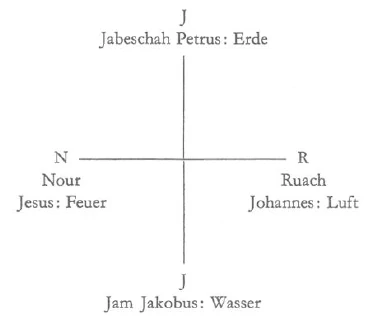
[ 20 ] Am Kreuze steht also dasselbe, was in den Namen der [drei] Apostel ausgedrückt ist, während mit dem einen Namen «J.N.R.J.» Christus selbst gemeint ist. «Erde» ist das, wohin zunächst das Christentum selbst gebracht werden sollte, zu jenem Tempel, wohin sich der Mensch selbst gebracht hat, um für das Höhere eine Umhüllung zu sein. Aber dieser Tempel ... [Lücke im Text, siehe Hinweise].
[ 20 ] Thus, the cross represents the same thing that is expressed in the names of the [three] apostles, whereas the single name “J.N.R.J.” refers to Christ himself. “Earth” is the place to which Christianity itself was first to be brought—to that temple where humankind has brought itself in order to serve as a vessel for the Higher. But this temple... [gap in the text, see notes].
[ 21 ] Zweimal «kräht der Hahn», der das Symbol für des Menschen niederes und auch für sein höheres Ich ist. Das erste Mal «kräht der Hahn», wenn der Mensch heruntersteigt und sich im Stofflichen materialisiert; das zweite Mal, wenn er wieder heraufsteigt, wenn er den Christus verstehen gelernt hat, wenn der Wassermann erschienen ist. Das wird in der sechsten Unterrasse sein. Dann wird der Mensch im Geiste begreifen, was er werden soll. Das Ich wird dann eine gewisse Stufe überschritten haben, wenn im höchsten Sinne das verwirklicht ist, was der Salomonische Tempel darstellt, wenn der Mensch selbst ein Tempel für «Jahve» ist.
[ 21 ] The “rooster crows” twice; it is the symbol of both the lower and the higher self of human beings. The first time “the rooster crows” is when man descends and materializes in the physical realm; the second time is when he ascends again, when he has come to understand Christ, when Aquarius has appeared. This will be in the sixth sub-race. Then man will comprehend in spirit what he is meant to become. The “I” will have transcended a certain level when, in the highest sense, what the Temple of Solomon represents is realized—when human beings themselves become temples for “Yahweh.”
[ 22 ] Vorher aber hat der Mensch noch drei Stadien der Läuterung durchzumachen. Das Ich ist in einer dreifachen Umhüllung: erstens im Astralkörper, zweitens im Ätherkörper, drittens im physischen Körper. Indem wir im Astralkörper sind, haben wir zum ersten Mal das göttliche Ich verleugnet, beim Ätherkörper zum zweiten Mal, und das dritte Mal beim physischen Körper. Der erste Hahnenschrei ist die dreifache Verleugnung durch die dreifache Umhüllung des Menschen. Und wenn er dann durch die drei Körper hindurchgegangen ist, wenn das Ich seine größte sinnbildliche Verwirklichung in Christus gefunden hat, dann ruft der Hahn zum zweiten Mal.
[ 22 ] But before that, human beings must still go through three stages of purification. The “I” is enclosed in a threefold shell: first, in the astral body; second, in the etheric body; and third, in the physical body. By being in the astral body, we have denied the divine “I” for the first time; in the etheric body, for the second time; and in the physical body, for the third time. The first crowing of the rooster represents the threefold denial through the threefold envelope of the human being. And when the human being has passed through the three bodies, when the “I” has found its greatest symbolic fulfillment in Christ, then the rooster crows a second time.
[ 23 ] Dieses Sich-Hinaufringen zum eigentlichen Verständnis des Christus — erst das Petrus-Stadium durchmachen -, diese tiefen Ideen konnte keiner der Templer, die damals gefoltert wurden, den Richtern klarmachen.
[ 23 ] None of the Templars who were tortured at that time could make these profound ideas—this striving to reach a true understanding of Christ, which requires first passing through the Peter stage—clear to the judges.
[ 24 ] Die Templer kamen also zuerst dahin, als wenn sie das Kreuz abgeschworen hätten. Nachdem dem Templer dies alles dargestellt worden war, zeigte man ihm eine symbolische Gestalt des göttlichen Wesens in einer ehrwürdigen Mannesgestalt mit einem großen Barte. (Symbol des Vaters.) Wenn die Menschen sich hinaufentwickelt und eigene Führer in den Meistern erhalten haben werden, wenn diejenigen da sein werden, die die Menschen führen können, dann wird vor den Menschen als das Wort des führenden Vaters, der Meister stehen, der die Menschen zum Begreifen des Christus hinführt.
[ 24 ] The Templars thus arrived there first, as if they had renounced the Cross. After all this had been explained to the Templar, he was shown a symbolic representation of the divine being in the form of a venerable man with a large beard. (Symbol of the Father.) When people have evolved and found their own guides among the Masters—when there are those who can lead humanity—then the Master will stand before them as the Word of the guiding Father, leading people to an understanding of Christ.
[ 25 ] Und dann wurde den Templern gesagt: wenn sie dies verstanden haben, dann sind sie reif, an dem großen Tempel der Welt mitzubauen. Sie müssen mitwirken daran, alles so einzurichten, daß der große Bau ein Wohnplatz ist für unsere eigentliche tiefere Ichheit, unsere innere Bundeslade.
[ 25 ] And then the Templars were told: once they understood this, they were ready to help build the great temple of the world. They must play their part in arranging everything so that this great structure becomes a dwelling place for our true, deeper self—our inner Ark of the Covenant.
[ 26 ] Wenn wir das alles überschauen, so haben wir Bilder, die eine große Bedeutung haben. Und derjenige, in dessen Seele diese Bilder Leben gewinnen, wird immer mehr zum Schüler jener großen Meister heranreifen, die diesen Bau des Menschheitstempels vorbereiten. Und solche großen Vorstellungen wirken als Kräfte in unserer Seele, daß wir dadurch die Läuterung durchmachen, die uns zum lebendigen Leben im Geiste führen soll.
[ 26 ] When we take a broad view of all this, we see images that hold great significance. And the one in whose soul these images come to life will increasingly mature into a disciple of those great masters who are preparing this edifice of the temple of humanity. And such grand visions act as forces within our soul, leading us through the process of purification that is meant to guide us toward a living life in the Spirit.
[ 27 ] Diesen Zug des Mittelalters, der bei den Tempelrittern erscheint, finden wir auch in zwei Tafelrunden, der des Königs Artus und derjenigen des Heiligen Grals. Das alte Weltliche war in König Artus’ Tafelrunde zu finden, während das eigentlich Geistliche der christlichen Ritterschaften in denjenigen vorbereitet werden sollte, die das Geheimnis des Heiligen Grals hüteten. Merkwürdig ist es, wie objektiv und ruhig die Menschen des Mittelalters über die aufgehende Macht (Frucht) und äußere Form des Christentums gedacht haben.
[ 27 ] This characteristic of the Middle Ages, evident among the Knights Templar, is also found in two Round Tables: that of King Arthur and that of the Holy Grail. The old secular order was to be found in King Arthur’s Round Table, while the truly spiritual aspect of Christian chivalry was to be cultivated among those who guarded the mystery of the Holy Grail. It is remarkable how objectively and calmly the people of the Middle Ages reflected on the rising power (fruit) and outward form of Christianity.
[ 28 ] Wenn Sie die Lehren der Templer verfolgen, so ist da etwas im Mittelpunkte, was als etwas Weibliches verehrt wurde. Dieses Weibliche nannte man die göttliche Sophia, die göttliche Weisheit. Manas ist das fünfte Prinzip, das geistige Selbst des Menschen, das aufgehen soll, dem ein Tempel errichtet werden sollte. Und wie das Fünfeck vom Eingang des Salomonischen Tempels den fünfgliedrigen Menschen charakterisiert, ebenso charakterisiert dieses Weibliche die Weisheit des Mittelalters. Dante hat mit seiner «Beatrice» nichts anderes als diese Weisheit zur Darstellung bringen wollen. Nur der versteht Dantes «Göttliche Komödie», der sie von dieser Seite betrachtet. Daher finden Sie auch bei Dante dieselben Symbole, die bei den Templern, den christlichen Ritterschaften, den Gralsrittern und so weiter zum Ausdruck kommen. Alles was geschehen soll, wird schon lange vorher von den großen Eingeweihten vorbereitet, die dasjenige, was in der Zukunft geschehen soll, in der Weise sagen, wie es in der Apokalypse geschehen ist, damit die Seelen vorbereitet werden für dieses Geschehen.
[ 28 ] If you follow the teachings of the Templars, there is something at the center that was revered as a feminine principle. This feminine principle was called the divine Sophia, divine wisdom. Manas is the fifth principle, the spiritual self of the human being, which is to rise and for which a temple was to be built. And just as the pentagon at the entrance to Solomon’s Temple characterizes the five-fold human being, so too does this feminine principle characterize the wisdom of the Middle Ages. With his “Beatrice,” Dante sought to portray nothing other than this wisdom. Only those who view Dante’s “Divine Comedy” from this perspective can truly understand it. That is why you will find in Dante the same symbols that are expressed by the Templars, the Christian orders of knights, the Knights of the Grail, and so on. Everything that is to happen is prepared long in advance by the great initiates, who foretell what is to occur in the future in the same way as it happened in the Apocalypse, so that souls may be prepared for these events.
[ 29 ] Zweierlei Strömungen haben wir nach der Sage beim Eingang des Menschengeschlechtes in die Welt: Die Kainskinder, die einer der Elohim mit Eva gezeugt, die Kinder der Welt, bei denen wir die groBen Künste und äußeren Wissenschaften finden. Das ist die eine Strömung, die geächtet wurde und dann durch das Christentum geheiligt werden soll, wenn das fünfte Prinzip in die Welt gekommen ist. Die andere Strömung sind die Gotteskinder, die den Menschen gebracht haben bis zur Erfassung des fünften Prinzips. Es sind die, die Adam geschaffen hat. Dann wurden die Kainssöhne aufgerufen, um jetzt dasjenige in einer Hülle einzufassen, was die Gottessöhne, die AbelSeth-Kinder geschaffen hatten.
[ 29 ] According to legend, there were two distinct currents at the dawn of humanity: the children of Cain, whom one of the Elohim fathered with Eve, and the children of the world, among whom we find the great arts and the external sciences. This is the one current that was ostracized and is to be sanctified by Christianity once the fifth principle has come into the world. The other current consists of the children of God, who guided humanity up to the comprehension of the fifth principle. These are the ones whom Adam created. Then the sons of Cain were called upon to now enclose within a form that which the sons of God—the children of Abel-Seth—had created.
[ 30 ] In der Bundeslade ist der heilige Name des Jahve geborgen. Aber das, was die Welt umgestalten soll, was für das Allerheiligste die Umhüllung schaffen soll, das soll wieder hergestellt werden durch die Kainssöhne. Gott hat des Menschen Leib geschaffen, darin geht des Menschen Ich auf und zerstört zunächst diesen Tempel. Der Mensch kann sich nur retten, wenn er sich zuerst das Haus baut, das ihn hinüberträgt über die Wasser der Leidenschaften, wenn er sich die Arche Noah baut. Dieses Haus muß der Mensch wieder aufrichten. So baut am Äußeren, was als die Kainskinder in die Welt gekommen ist, und was die Gotteskinder gebracht haben, das baut am Inneren.
[ 30 ] The holy name of Yahweh is enshrined in the Ark of the Covenant. But that which is to transform the world—that which is to create the covering for the Holy of Holies—is to be restored by the sons of Cain. God created the human body; within it, the human ego arises and first destroys this temple. Man can only save himself if he first builds the house that carries him across the waters of the passions—if he builds Noah’s Ark. Man must rebuild this house. Thus, what came into the world as the children of Cain builds the exterior, and what the children of God have brought builds the interior.
[ 31 ] Beim Aufgang unserer Rasse machten sich schon diese zwei Strömungen geltend ... [Lücke im Text, siehe Hinweise].
[ 31 ] Even at the dawn of our race, these two trends were already making themselves felt ... [gap in the text; see notes].
[ 32 ] Dann erst verstehen wir die Theosophie, wenn wir sie als Testament auffassen, das, was als der Salomonische Tempel aufgezeichnet und was als Zukünftiges zu erwarten ist, vorzubereiten. Vorbereiten sollen wir den neuen Bund anstelle des alten Bundes. Der alte ist der Bund des schöpferischen Gottes, wo das Göttliche am Menschentempel schafft. Der neue ist derjenige, wo der Mensch selbst den Weisheitstempel um das Göttliche herumhüllt, wo er ihn wieder herstellt, damit dieses Ich eine Zuflucht auf dieser Erde findet, wenn es befreit aus der Materie auferstehen wird.
[ 32 ] We will only understand Theosophy when we view it as a testament—one that is meant to prepare for what is recorded as the Temple of Solomon and what is to be expected in the future. We are to prepare the new covenant in place of the old covenant. The old is the covenant of the creative God, in which the Divine creates within the temple of man. The new is the one in which man himself envelops the temple of wisdom around the Divine, in which he restores it so that this “I” may find a refuge on this earth when it rises, liberated from matter.
[ 33 ] So tief sind die Symbole, und so war die Erziehung, die die Templer der Menschheit angedeihen lassen wollten. Die Rosenkreuzer sind nichts anderes als die Fortsetzer des Templerordens; sie wollten nichts anderes als die Tempelritter und was auch die Theosophie will: sie alle arbeiten am großen Tempel der Menschheit.
[ 33 ] Such is the depth of these symbols, and such was the education the Templars sought to bestow upon humanity. The Rosicrucians are nothing other than the successors to the Order of the Templars; their goal was no different from that of the Knights Templar or from that of Theosophy: they are all working on the great temple of humanity.