

Basic Elements of Esotericism
GA 93a
26 October 1905, Berlin
Translated by Steiner Online Library
Lecture XXIV
[ 1 ] We are now in the fifth root race, within the fifth subrace. This fifth root race is commonly called the Aryan race, and its first subrace is the ancient Indian race, which developed in South Asia. There was an ancient South Asian population there, long, long before the Vedas came into being. Everything we have in the Vedas is a faint echo of what was proclaimed by the ancient rishis as infinitely profound religious wisdom. Next, in the Near East, we find the ancient Persian race, which received its religious teachings and culture from Zoroaster. The later Zoroastrian cultures of Asia are merely echoes of this. Then, as the third subrace, we find the Egyptian-Chaldean-Babylonian-Assyrian tribes, from which Semitic-Jewish culture gradually developed. Then, as the fourth subrace, the Greek-Latin culture emerges in Southern Europe, lasting until the rise of the Germanic peoples in Northern, Central, and Western Europe. Two more follow. Seven subraces together form a root race.
[ 2 ] The preceding root race inhabited Atlantis, that part of the Earth which was later flooded by the Atlantic Ocean. It included the following seven sub-races: first, the Rmoahals; second, the Tlavatlis; third, the Toltecs; fourth, the Urturanians; fifth, the Proto-Semites; sixth, the Akkadians; and seventh, the Mongols.
[ 3 ] Going even further back, we come to the continent of Lemuria, located between Africa, Asia, and Australia. There we enter an era with entirely different conditions. Then we go even further back to the second root race, the Hyperborean, and to the first root race, the Polar. So now there are two more sub-races and two more root races to follow.
[ 4 ] As one goes back in time, one encounters human beings composed of matter that is much finer and increasingly finer. At the beginning of its evolution, the Earth was fine etheric matter; all beings at that time were also composed of such fine etheric matter. At the end of its evolution, the Earth will once again be composed of such fine etheric matter. Such a state, through which the Earth passes—beginning with the finest etheric matter, then becoming denser, and finally returning to a state of fine physical etheric matter—is called a globe. The physical globe thus develops from a state even finer than that of the finest physical ether. The etheric arises from the astral and returns to the astral.
[ 5 ] All beings on the preceding globe exist in an astral state. Today, the astral globe does not float somewhere in outer space; rather, the beings that were on it condensed, and the astral globe condensed along with them. This globe is the Earth itself. The transition from the astral globe to the physical globe is a transformation of state. Seven successive states also developed on the astral globe. In theosophical literature, it has become customary to refer to these states as races as well; thus, there were seven astral races. The astral globe, too, condensed into astral matter only gradually. The astral globe used to be much finer, consisting of the very matter from which our thoughts are woven today. It is therefore called mental matter, and the globe is called the mental globe. There, on the mental globe, there were seven successive mental races of humanity, with all that belongs to them. This is preceded by an even finer stage of development consisting of even finer matter, the Arupa Mental Globe: “arupa” because no forms yet exist, but everything is merely hinted at. These are called the four globes, but in reality they are four successive forms of the Earth. Thus, we have seven globes:
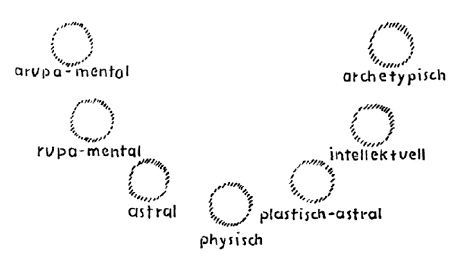
[ 6 ] Now let us follow the physical Earth until it reaches its end. It will once again transform into an etheric Earth, and then into an astral Earth. On the earlier astral Earth, beings are still undifferentiated entities that receive their forms through external forces. When humanity returns to an astral Earth, it will be able to shape itself. On the earlier astral Earth, Jehovah and his hosts gave humanity its form. But on the plastic-astral Earth, humanity will shape itself out of its own inner power; this is why it is called the plastic globe, and the following globes—a Rupa globe and an Arupa globe—function in a similar way. Human beings must refine themselves completely until, in the end, they are nothing more than a seed, a seed-like state, of all that they have absorbed within themselves. All experiences are then ultimately concentrated within him as a force, as if in a single point. The seeds that existed on the first globe did not yet contain this. But on the final globe, the seeds contain everything they have experienced on the various globes.
[ 7 ] There is no gradual difference between the individual material stages of these globes, but rather a somewhat abrupt transition. Just as when one takes salt, dissolves it in water, and then allows it to emerge again, so a globe enters a state of sleep (Pralaya), and the next globe emerges from it. Between two waking states, the globes pass through a brief state of sleep. When a human being reaches the final, seventh stage, they undergo a longer state of dormancy. They are enriched and can now traverse the path again at a higher level. To do so, they must first pass through a longer Pralaya. This longer Pralaya, however, is not an undifferentiated, uniform state of dormancy; rather, it is highly differentiated.
[ 8 ] When a person has developed occult abilities to the point where they sleep consciously during dreamless sleep, they have developed a devachanic consciousness. This enables them to observe what takes place between death and the next birth. This consciousness can be further enhanced. Then one becomes capable of observing what takes place between the globes. As the third degree of consciousness, one attains the ability to observe what takes place between the rounds. This third state thus corresponds to a consciousness between two rounds. Being able to observe between two earthly lives is the first degree of higher consciousness; between two globes, the second; and between two cycles, the third degree. The conscious sleep that enables this is of an entirely different nature.
[ 9 ] Between the last round of one planetary state and the first of the next, there are five additional states that lie beyond consciousness. The seven rounds and the five states of Pralaya are collectively called the twelve stages of the world year. Then the whole process is repeated, but at a higher level.
[ 10 ] We are now in the fourth round of the Earth, and three others preceded it. Before the seeds of present-day humanity existed, humanity had already existed in a seed-like form three times—once in each round. In each round, we have seven stages of development, called globes, and in turn seven on each globe, called races. Seven such cycles together make up a planet. The first cycle began with an Arupa state and condensed into the Earth. Our Earth has already become physical four times. It will become so three more times. Each such condensation and dissolution belongs to one cycle. Seven such cycles are called a planetary system.
[ 11 ] When the first Earth cycle began, the entire progeny of what had developed on the Moon planet was present in embryonic form. Between the last lunar cycle and the first Earth cycle, there was a long period of pralaya. At that time, the Lunar beings were human ancestors who stood at an intermediate stage between present-day humans and the present-day animal kingdom, in terms of their lower nature. Present-day animals are Lunar beings who have descended somewhat, and humans are Lunar beings who have ascended. But even the plants on the Moon were different from those of today. The plant kingdom stood between today’s mineral kingdom and the plant kingdom, much as a peat bog today is half mineral and half plant-like. The Moon was, in essence, a great plant. Its soil consisted of intertwined plants. There were no rocks at that time. This plant-like mineral kingdom only condensed on Earth into the present-day mineral kingdom. Our present-day quartz, malachite, and so on are condensed forms of the lunar plants; the dolomite masses originated from primordial plants. On the Moon, then, there was a realm intermediate between today’s minerals and plants. The lunar plants took root in it; they needed the Moon’s soil. Such plants, which failed to take root on Earth, became parasitic and must still grow on other plants—for example, mistletoe. It grows on plants, just as all plants on the Moon grew on a semi-plant basis. Loki, the god of the Moon, kills Baldur with mistletoe, the Moon plant. Thus, on the Moon we find:
a kingdom between the mineral kingdom and the plant kingdom
a kingdom between the plant kingdom and the animal kingdom
a kingdom between the animal kingdom and the human kingdom.
[ 12 ] These were the seeds that came down to Earth.
[ 13 ] During the first Earth cycle, the human kingdom gradually emerged. Humans became more human, and animals became more animal-like. The physical bodies of humans began to take on a more human form during the first Earth cycle. During the second cycle, the animal kingdom emerged; during the third, the plant kingdom; and during the fourth, the mineral kingdom. Then humankind embarked on a new ascent. The first three cycles were repetitions of earlier states and a preparation for assimilating the new in the fourth cycle, within the mineral kingdom. Now humanity is processing the mineral kingdom. When humanity has transformed the mineral kingdom into the product of its activity, a time will come when it will have transformed all of it to such an extent that not a single speck of the mineral kingdom will remain that humanity has not artificially processed. Then the whole can be transformed into nothing but astral forms.
[ 14 ] This is the redemption of a kingdom. In the fourth round, humankind redeems the mineral kingdom when it has transformed it into a work of art. Then everything passes through a pralaya; the mineral kingdom no longer exists, but the entire Earth has become a plant. Humankind is then raised half a level higher, and everything else with it; for example, Cologne Cathedral will blossom as a plant in the fifth round.
[ 15 ] One does not work in vain when shaping the mineral kingdom. The machine and Cologne Cathedral will later emerge as plant life from what will then be soil. In the atmosphere of the fifth round, we find in living cloud formations everything that has been painted today. We are dealing here with a repetition on a higher level, where all our work grows up around us in the mineral world.
[ 16 ] In the fifth cycle, we redeem the plant kingdom; in the sixth, the animal kingdom; and in the seventh cycle, the human kingdom. Then humanity is ready to enter a new planet. In order for humanity to evolve upward, the other kingdoms had to be pushed down somewhat, and humanity must redeem them later. After the seventh cycle and a Pralaya, humanity then moves on to another planet. Seven cycles, each with seven globes and seven races, amount to a total of 343 states on Earth. The entire evolution of the Earth serves the purpose of creating waking daytime consciousness in human beings, whereas the entire evolution of the Moon served the purpose of developing image consciousness in human beings. This was preceded by the dreamless state of sleep on the Sun; there, human beings were still like sleeping plants. An even earlier state—a deep trance-like state—existed on Saturn, which still occurs today in certain pathological cases. The individual planets thus serve to develop successive states of consciousness:
1. Saturn = Deep trance consciousness
2. Sun = Dreamless sleep consciousness
3. Moon = Dream sleep or visual consciousness
4. Earth = Wakefulness or object consciousness
5. Jupiter = Psychic or conscious imagery consciousness
6. Venus = Superpsychic or conscious life consciousness
7. Vulcan = Spiritual or self-aware universal consciousness.
[ 17 ] Just as human relationships are now governed by natural principles, they will later be governed by moral principles. They will be organized according to levels of karma, according to seven degrees of morality (ethical categories of humanity). The formation of castes is a foreshadowing of this later moral structure. It was intended to indicate these karmic categories.