

"You are experiencing today that you are growing up in a world where, among many other things—in the social sphere, for example—there are political parties: liberal, conservative, and all sorts of other parties. People are oblivious to what these parties actually are. When they receive their ballots, they declare their allegiance to one party or another without giving much thought to what it actually is that exists as “party opinion,” permeating all of public life. One simply cannot take these things seriously. There is a whole crowd of people who parrot all sorts of “Maya” concepts from the outer world in the most eloquent way; but as soon as they want to take a step into that outer world, they no longer stick to what they are parroting in the abstract. For otherwise they would ask, for example: “Maya? So are the parties also Maya? What, then, is the reality to which this Maya points?”
If we examine this matter more closely from a spiritual-scientific perspective—and we will discuss this in greater detail tomorrow—we find that political parties exist in the outer physical world because they have programs and principles; that is, because they pursue abstract ideas. But everything that exists externally in the physical world is always the image, the reflection of what is a reality of a more intense nature in the spiritual world. There we always have the physical world (see drawing, horizontal line). But everything here in the physical world points to the spiritual. And up there in the spiritual world lie the true realities corresponding to these physical things (see diagram, red). Down here, for example, are the political parties (white); what are they a reflection of? On Earth, these parties fight one another; there they seek to unite a multitude of people under an abstract program. What, then, are these parties a reflection of? What is it up there in the spiritual world if here in Maya there are political parties? In the spiritual world there are no abstractions, and political parties are subject to abstractions. Up there, there are only beings. Up there, one cannot commit to a party platform; rather, one can be a follower of this or that being, of this or that hierarchy. One cannot simply adhere to a platform with one’s intellect—that does not exist there; one must follow another being with one’s whole being. What is abstract here is essential up there; that is to say, the abstract here is merely a shadow of the essential up there. And if you take the two main categories of political parties—conservative and liberal—it is true that the conservative party has a platform and the liberal party has a platform; but when one looks up to see what these are reflections of, it becomes clear: The Ahrimanic being is reflected here (see drawing, lower part) in the conservative, while the Luciferic being is reflected here in the liberal. Here, one pursues a conservative or a liberal program; up above, one is a follower of an Ahrimanic being of some hierarchy or a Luciferic being of some hierarchy.
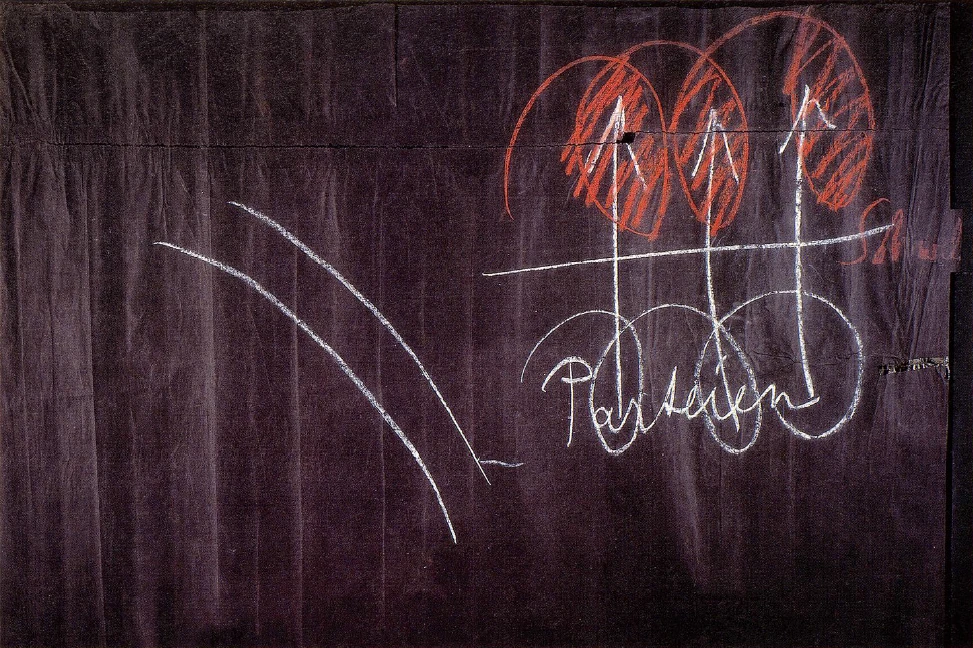
However, it may happen that at the very moment one crosses the threshold (the word “threshold” is written on the board), one must be truly clear that one is not deceived by words and does not give in to illusions. It is very easy to believe that one belongs to some kind of good being. But just because one gives a being a good name does not make it a good one. For example, someone might say: “I profess my faith in Jesus, the Christ.” — In the spiritual world, one cannot profess allegiance to a program; but judging by the very way in which the ideas and concepts of this Jesus, the Christ, live in one’s soul, it is only the name of Jesus, the Christ—in reality, one is then attached to Lucifer or Ahriman and merely gives the name Jesus or Christ to Lucifer or Ahriman.
But I ask you: How many people today are aware that party opinions are reflections of essential realities in the spiritual world? Some know this, and they then base their actions on this knowledge. I can point you to those who know such things. Take the Jesuits, for example; they know this. Do not believe that when the Jesuits, for instance, write against anthroposophy in their journals, they think their arguments strike at something specific that cannot be refuted. But refutations are not the point here. And the Jesuits know very well what one can ultimately object to regarding such refutations, for the Jesuits are not concerned with debating for or against with arguments; rather, they are concerned with being followers of a certain being—one I do not wish to name today—whom they call their leader, Jesus, to whom they belong. Whatever this being may be, they call it Jesus. I do not wish to go into the details of the matter; but they describe themselves as soldiers, him as the leader, and they do not fight to refute—they fight to recruit followers for the companies, for the army of Jesus—that is, of the being they call Jesus. And they know full well that, as soon as one looks beyond the threshold, it is not a matter of abstract categories, nor of logical assertions or refutations, but rather of which being’s army one follows, whereas down here on earth it is all a matter of rhetoric. But this is precisely what people today find so difficult to grasp: that if we want to emerge from the decline of our age, we can no longer deal with mere abstractions, not merely with what one can conceive of, but must deal with realities. We begin to ascend to realities when we no longer speak merely of right or wrong, but of healthy or sick. We begin to ascend to realities when we speak not of party platforms or ideological programs, but of the following of certain real entities that immediately meet us when we point to the things that lie beyond the threshold. The task today is to truly take that serious step from abstraction to reality, from merely logical knowledge to knowledge as action. And only that can lead us out of all the confusion in which the world finds itself today."
Read more: Rudolf Steiner, Spiritual Scientific Insight into the Fundamental Impulses of Social Organization, Lecture 1, GA 199, 6 August 1920, Dornach.