

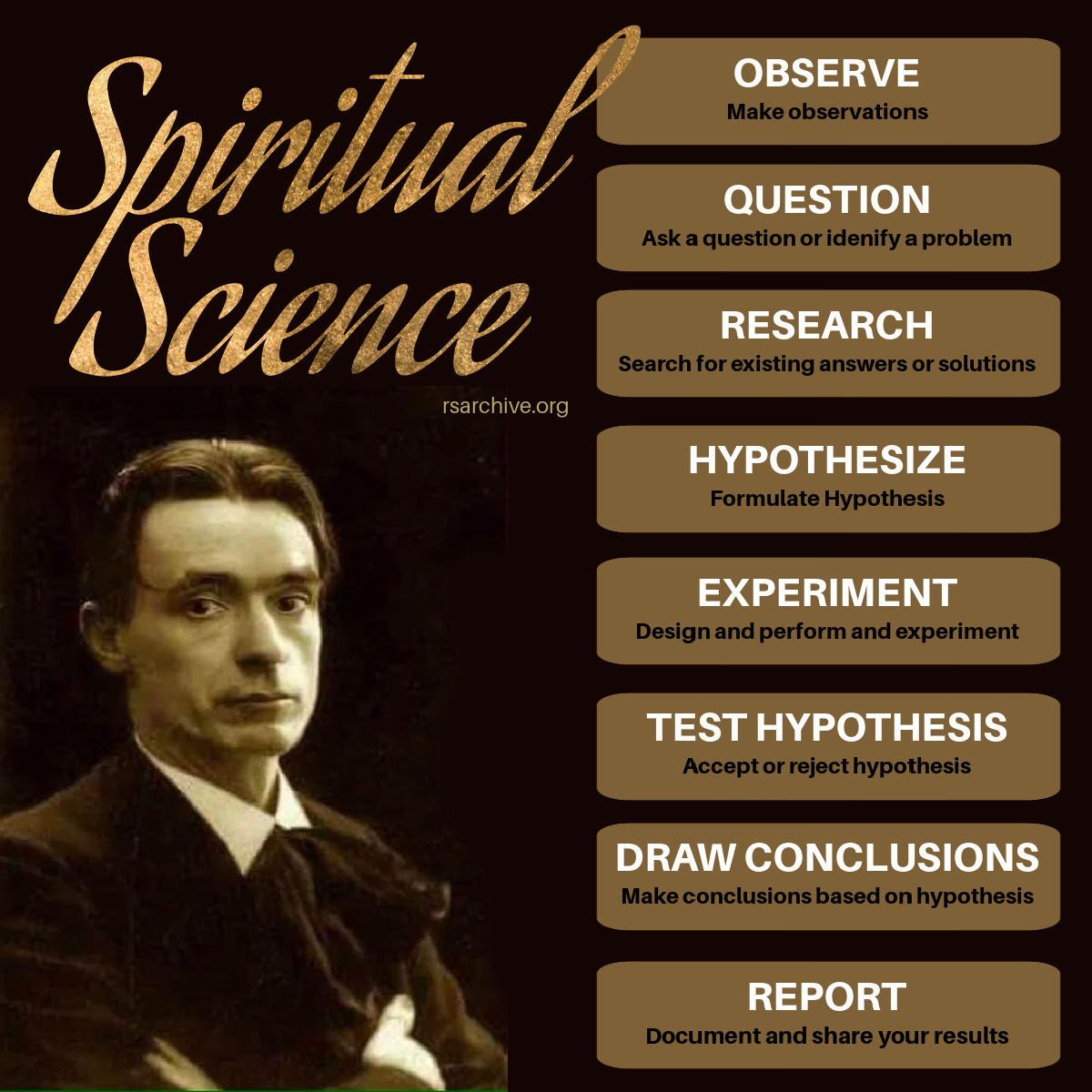
The Scientific Method
May anthroposophists use the term "spiritual science" and yet prefer not to engage in such intellectual efforts as research and testing of hypotheses. So, one might ask, what is spiritual science? Rudolf Steiner posited that not only must one research and investigate what can be seen by the human eye, but we must expand the field of study to include the forces that work behind the physical. Physicists today would find such a statement to go without saying since they routinely study such forces, albeit not commonly referring to them as "spiritual." However, if one allows oneself to apply such rigorous procedures to one's own study of the world, great insight can be realized. In this way, spiritual insights are gained by widely accepted scientific procedures. In fact, he asserted that such rigorous and "exacting approach" is necessary to rise above the material into entirely different realms of the spirit.
In 1920, shortly after the opening celebration of the First Goetheanum, Dr. Steiner continued his vigorous schedule of lecturing on a wide variety of issues, including the sciences. In September and October, Rudolf Steiner implored his listeners to develop themselves beyond the limits of ordinary cognition so they might perceive the Spirit active in the phenomena of nature.
We must begin by acquiring the discipline that modern science can teach us. We must school ourselves in this way and then, taking the strict methodology, the scientific discipline we have learned from modern natural science, transcend it, so that we use the same exacting approach to rise into higher regions, thereby extending this methodology to the investigation of entirely different realms as well. For this reason I believe—and I want this to be expressly stated—that nobody can attain true knowledge of the spirit who has not acquired scientific discipline, who has not learned to investigate and think in the laboratories according to the modern scientific method. Those who pursue spiritual science [Geisteswissenschaft] have less cause to undervalue modern science than anyone. On the contrary, they know how to value it at its full worth. And many people—if I may here insert a personal remark—were extremely upset with me when, before publishing anything pertaining to spiritual science as such, I wrote a great deal about the problems of natural science in a way that appeared necessary to me. So you see it is necessary on the one hand for us to cultivate a scientific habit of mind, so that this can accompany us when we cross the frontiers of natural science. In addition, it is the quality of this scientific method and its results that we must take very seriously indeed.
It is worth restating what the scientific method is since many are unaware of its principles. Aristotle is widely recognized as the "father" of empirical measurement and observation, asserting that knowledge could only be gained by building upon what is already known. One must study what others have written on the subject, look for consensus about the subject, and perform a systematic study of everything even tangentially related to the topic. Aristotle's approach was later built upon by adding the articulation of an explicit problem, the formulation of a hypotheses, rigorous testing of the hypothesis, drawing conclusions, and the recording of results for further review. Roger Bacon, Francis Bacon, and Galileo refined the scientific method through the seventeenth century.
In the twentieth century, Rudolf Steiner held that these same procedures were applicable to all investigation of our world—as applicable to both the seen and unseen. This is what he terms Geisteswissenschaft which is commonly translated as "Spiritual Science." It is not a mere belief in what Rudolf Steiner said and wrote, but a willingness to read the findings of his research as well as that of others. To follow this path, one must observe the surrounding world today, posit questions, research those questions, formulate hypotheses, test them, draw conclusions, and document one's findings for further consideration and testing. The legacy of Rudolf Steiner's complete works are presented here on our website so one may use them for such research necessary for spiritually scientific investigation.
Read more: Rudolf Steiner, The Boundaries of Natural Science, Lecture III, GA 322, 29 September 1920,Dornach.