

The Apocalypse of John
GA 104
20 June 1908, Nuremberg
Translated by Steiner Online Library
Third Lecture
[ 1 ] Yesterday, at the end of our discussion, we were able to point out what is specifically Christian and what is later—that is, Christian-Rosicrucian—in an initiation, as first expressed in a great and significant symbol. We pointed out the significance of this symbol, this sign of initiation, which is also referred to as the Son of Man, who holds the seven stars in his right hand and the sharp, double-edged sword in his mouth. We have seen that this initiation enables a person, to a certain higher degree, to see within their ego and their astral body, beyond the physical and etheric bodies. We will discuss all of this in greater detail.
[ 2 ] Through any form of initiation, however, a person comes to truly comprehend and recognize that which can only be perceived with the spiritual gaze, with spiritual eyes—that which is transparent only to supersensible perception. Now, among the first and most important things that the initiate—in the Christian sense—must recognize is the evolution of humanity in our age, so that everyone may gain a deeper understanding of humanity’s tasks. For everything that is meant to give humanity higher knowledge and higher perfection is connected to the question: Who am I, and what is my purpose in our age? It is the answer to this question that is of the greatest importance.
[ 3 ] Each stage of initiation leads to a higher vantage point of human perception. Already in the first session, we were able to point out how gradually the human being ascends—first into what we call the imaginative world, where, in the Christian sense, he learns to recognize the seven seals; then on to what we call inspired knowledge, where he hears the “trumpets,” and finally to an even higher stage, where he is able to perceive the true meaning and essence of the spiritual beings—the stage of the so-called bowls of wrath. Now, however, we must, so to speak, consider a specific stage of initiation. Let us imagine the human being having just reached that stage of initiation where what was described at the end of the last lecture has happened to him. Let us imagine him standing right on the threshold where, between the finest beings of our physical world and the next higher one—the astral world—he is permitted to stand, as if on a summit, and look down. What can a human being behold from this first summit of initiation?
[ 4 ] There, in his mind’s eye, he sees everything that has happened—in terms of its inner essence—ever since the Atlantean flood destroyed the ancient Atlantis and post-Atlantean humanity came into being. There he sees how the cycles of civilization follow one another until the moment when our own age, too, will meet its downfall, giving way to a new one. The ancient Atlantis perished in the waters of the Atlantean Flood. Our age will meet its downfall through what we call the war of all against all, through terribly devastating moral entanglements. And this great era, from the Atlantean Flood to the mighty war of all against all, we divide into seven successive major cultural epochs, into seven cultural periods, as can be seen from the diagram above. At one end we envision the great Atlantean Flood, at the opposite end the Great World War, and we divide this into seven sub-eras, into seven cultural epochs. The entire epoch comprising these seven sub-ages is, in turn, one-seventh of a longer age, so that you must imagine seven such segments: our age between the Flood and the war, two moving forward after the Great War, and four moving backward before the Atlantic Flood. Our age, the post-Atlantic age, is thus the fifth great age.
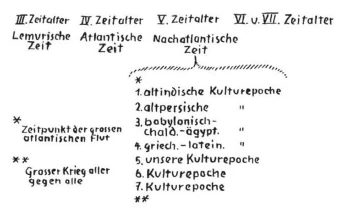
[ 5 ] One must climb to an even higher peak of initiation; then one can survey these seven times seven ages. They can be surveyed once one has reached the boundary between the astral and the spiritual, the devachanic, worlds. And so the ascent proceeds step by step. We will see what the even higher stages are.
[ 6 ] Now we must note that we can first reach a summit from which—as from a mountain overlooking a vast plain—the seven cultural epochs of the post-Atlantean era become visible to us. We are all already familiar with these cultural epochs. We know that, after the Atlantic flood had swept away the ancient Atlantis, the ancient Indian culture was the first to flourish, and that it was succeeded by the proto-Persian culture. We know that the Assyrian-Babylonian-Chaldean-Egyptian-Jewish culture followed, then the fourth cultural epoch—the Greco-Latin one—and after that the fifth, our own, in which we live. In the sixth, which will follow our own, what we have to build in terms of spiritual culture will, in a certain sense, have to bear fruit. The seventh cultural epoch takes place before the war of all against all. There we see this terrible devastation of culture approaching and we see the small handful of people who have understood how to take the spiritual principle into themselves and who will save themselves from the general destruction wrought by egoism.
[ 7 ] So, as I said, we are living in the fifth of the sub-ages. Just as cities, villages, and forests appear from the summit of a mountain, so too does the sequence of these cultural ages appear from the summit of initiation. We recognize their significance. They represent what unfolds on our physical plane as human culture. That is why we speak of cultural epochs as opposed to races. Everything associated with the concept of race is still a remnant of the period that preceded ours—the Atlantean era. We live in the era of cultural epochs. The Atlantean era was the period during which seven successive great races gradually formed. Of course, the fruits of this racial development extend into our own age as well; that is why we still speak of races today. But these are already blurred remnants of the sharp divisions that existed in the Atlantean era. Today, the concept of “culture” has already replaced the concept of “race.” That is why we speak of the ancient Indian culture, of which the culture described to us in the Vedas is merely an echo. The ancient, sacred Indian culture is the first dawn of post-Atlantean culture; it follows immediately after the Atlantean era.
[ 8 ] Let us once again recall how people lived in that time, which now lies more than eight or nine thousand years behind us. When we speak of actual time periods, these figures apply. The culture we are discussing here was directly influenced by the Atlantean flood—or the great Ice Age, as it is called in modern science. Atlantis had gradually sunk; one piece after another had been swallowed up by the flood. And now there lived a human race on Earth, a portion of which had worked its way up to the highest stage of development that could be attained. This was the ancient Indian people, a human race that dwelt at that time over in distant Asia and lived more in the memory of ancient times past than in the present. This is the greatness and power of that culture—of which written records such as the Vedas and the Bhagavad Gita are now merely echoes—that people lived in the memory of what they themselves had experienced during the Atlantean era. Think back to the first lecture in this series. It was stated there that people in that era were, for the most part, capable of developing a certain twilight-like clairvoyance. People were not confined to this physical-sensory world. They lived among divine-spiritual beings. They saw these divine-spiritual beings all around them. The transition from the Atlantean era to the post-Atlantean era consisted in the fact that people’s vision was closed off from the spiritual, astral-etheric world and restricted to this physical world. The first cultural epoch was characterized by the fact that people had a longing—a deep longing—for what their ancestors had seen in ancient Atlantis, but to which the gate had now closed. Our ancestors had beheld ancient wisdom with their spiritual eyes, albeit dimly. They dwelt among spirits, walked with gods and spirits. Thus did these people of the ancient and sacred Indian culture feel: with every fiber of their being, they longed to look back, to see what their ancestors had seen, what ancient wisdom had revealed. And so the land that had just appeared before people’s physical eyes—the rocks of the earth, which had only now become visible but had previously been perceived spiritually—all of this external reality seemed to them less significant than what they could remember. Maya, the great illusion, was the name given to everything that the physical eyes could see—the great delusion from which one sought to escape. And the best among this first age were to be raised, through that method of initiation—of which some remnants remain in yoga—to the level of their ancestors. From this arose a fundamental religious attitude that can be expressed in the following words: “Worthless, vain illusion is what surrounds us here in the outward appearance of reality.” The true, the genuine, is above in the spiritual world that we have left behind. — The spiritual leaders of the people were those who could transport themselves upward into the regions where they had once lived. That was the first epoch of the post-Atlantean era. And all epochs of the post-Atlantean era are characterized by the fact that human beings came to understand the outer sensory reality more and more, and came to recognize more and more: What is given to us here for the outer senses is not to be treated as mere illusion; it is a gift from spiritual beings, and it is not for nothing that the gods have given us our senses. What forms the basis of a culture of the material world here on Earth must gradually be understood.
[ 9 ] What the ancient Indian still referred to as “maya”—from which he fled and from which he longed to turn away—was addressed by those who belonged to the second epoch as their field of work, as something they had to grapple with. And so we now have the ancient Persian epoch, which dates back some five thousand years—that cultural epoch in which the land around them initially appeared hostile to human beings, but no longer, as in the past, as an illusion from which one must flee, but rather as a field of work into which one must imprint one’s own spirit. In its material nature, this Earth is ruled by evil—by a power opposed to the good—by the god Ahriman. He rules it, but the good god Ormuzd helps humanity—and humanity places itself in his service. When they carry out his will, they transform this world into a field of the higher spiritual world; they imprint upon the sensory-real world what they themselves recognize in the spirit. For the second epoch, the physical-real, the sensory-real world was a field of work. For the Indian, the sensory world was still an illusion, Maya. For the Persians, although it was ruled by evil demons, it was nonetheless a world from which human beings had to drive out the evil ones and into which they had to integrate the good spiritual beings, the servants of the God of Light, Ormuzd.
[ 10 ] And in the third epoch, human beings come even closer to external sensory reality. There, it is no longer merely a hostile force that they must overcome. The Indian looked up at the stars and said to himself: Ah, everything that is there, everything I can see with my physical eyes, is nothing but Maya, illusion. — The Chaldean priests observed the movements and positions of the stars and said to themselves: As I observe the positions of the stars and follow their movements, this becomes a scripture from which I discern the will of the divine-spiritual beings. I recognize what the gods will in what they have done.” — The physical, sensory world was no longer Maya to them; just as human writing is the expression of human will, so too was what is written in the stars in the heavens—what lives in the forces of nature—a divine script to them. And with love, they began to decipher the script of nature. Thus arose that wondrous study of the stars, which people today scarcely know anymore. For what is known today as astrology arose from a misunderstanding of the facts. It was deep wisdom in the script of the stars that was revealed to the ancient Chaldean priest as astrology—as the mysteries of what he saw with his own eyes. He regarded this as a revelation of something inner and spiritual. And what did the Earth become for the Egyptians? We need only point to the invention of geometry, where humanity learned to divide the Earth according to the laws of space, according to the rules of geometry. There, the laws were explored within the Maya. In ancient Persian culture, the Earth had been plowed; now humanity learned to divide it according to the laws of space. People began to explore these laws—and they did even more. They said to themselves: It is not for nothing that the gods have left us a script in the stars; it is not for nothing that the gods have made their will known to us through the laws of nature. If humanity wishes to bring about salvation through its own work, then it must create, in the structures it builds here, a replica of what it can discern from the stars. — Oh, if only you could look back into the working chambers of the Egyptian initiates! That was a different kind of work than what is done today in the field of science. There, the initiates were the scientists. They studied the movements of the stars and recognized the regularity in the positions and courses of the stars and in the influence of their positions on what was taking place down here on Earth. They said to themselves: When this or that constellation is in the sky, then this or that must take place in political life below, and when another constellation appears, something else must happen as well. After a century, certain constellations will be present, they said, and then a corresponding event must take place. — And for millennia to come, it was predetermined what was to be done. This is how what is known as the Sibylline Books came into being. What is written in them is no delusion. After careful observations, the initiates recorded what was to happen for millennia to come, and their successors knew: This must be adhered to. And they did nothing that was not foretold in these books for the millennia to come, according to the course of the stars. Let’s say the matter at hand was the enactment of some law. They did not vote on it as we do; instead, they sought guidance from the sacred books, in which it was written what must happen here on Earth so that it might be a reflection of what is written in the stars, and whatever was written in the books was carried out. When the Egyptian priest wrote these books, he knew: My successors will carry out what is written within them. — They were convinced of the necessity of following the law.
[ 11 ] The fourth cultural epoch developed out of this third one. Only a few remnants of this prophetic art of the Egyptians have survived. You can still see one such remnant. For when people in ancient Egypt sought to practice this prophetic art, they divided the coming period into seven parts and said: The first must contain this, the second that, the third the other, and so on. — The descendants then followed what was to come. But that was precisely the defining characteristic of the third cultural epoch. The fourth epoch showed only faint echoes of this. You can still recognize these faint echoes when you are told of the origins of ancient Roman culture. Aeneas, son of Anchises from Troy—a site of the third epoch—emigrates and eventually arrives in Alba Longa. This name alludes to a site of ancient, sacred priestly culture: Alba Longa, or “Long Alba,” the city of a priestly culture from which Roman culture was to emerge. We still find an echo of this in the chasuble worn by Catholic priests. There, a seven-part cultural epoch was foreshadowed in the ancient priestly tradition. Oh, those seven Roman royal ages were foreshadowed! And the historians of the nineteenth century once again allowed themselves to be played a nasty trick with regard to these seven royal eras. They concluded that, in the profane, material sense, there is nothing to these Roman kings; but they could not fathom what lay behind them—namely, that a culture prophetically structured according to the sacred number seven, as described in the Sibylline Books, is traced here.
[ 12 ] This is not the place to go into detail about the individual kings. You would be able to see in the individual kings—Romulus, Numa Pompilius, Tullus Hostilius, and so on—how they correspond exactly to the successive cultural epochs based on the seven principles that reveal themselves to us in such diverse fields.
[ 13 ] Thus, during the third epoch, humanity had gradually succeeded in imbuing the Maya with the human spirit. This was brought to completion in the fourth cultural epoch. Consider Greek-Latin culture, where, in its marvelous works of art, humanity creates a complete image of itself in the outer material world, and where, in drama, it gives rise to human destinies, as in the works of Aeschylus. In contrast, look at how Egyptian culture still seeks to fathom the will of the gods. That conquest of matter, as we see it in the Greek period, represents yet another step in which human beings grow to love material existence, and by the Roman period, human beings have fully emerged onto the physical plane. Anyone who understands this also knows that we must see in it the complete emergence of the principle of personality. That is why what we call the concept of law first arose in Rome, where we first encounter human beings as citizens. Only a confused science can trace jurisprudence back to all sorts of earlier periods. What was previously understood as law was something else entirely. The Old Testament, in the Ten Commandments, describes the ancient law much more accurately. What God commanded there was part of what constituted the concepts of law. It is absurd in our time to try to trace the concepts of law back to Hammurabi and so on. It was in Rome that true law—the true concept of the human being as a citizen—first came into its own. In Greece, the citizen was still a member of the city-state. The Athenian and the Spartan were citizens far more than they were individuals. They saw themselves as members of the city-state. It was only in Rome that the individual became a citizen; only there could he become one. This can be demonstrated in every detail. What we today call a will did not exist in this sense before ancient Roman times. The will, in its modern sense, first emerged at that time because it was only then that the individual was to be the decisive factor in his self-interested will, in order to pass this will on to his descendants. Previously, there were other forces at work besides personal will that held the whole together. Thus, many examples could be cited to demonstrate how humanity stepped onto the physical plane. |
[ 14 ] We are now living in the fifth epoch, the period in which culture has descended even deeper than to the level of human beings. We live in an age where human beings are slaves to external circumstances, to their environment. In Greece, the spirit was used to spiritualize matter, and this spiritualized matter appears to us in the form of Apollo, in the form of Zeus, in the dramas of Sophocles, and so on. There, humanity had risen to the physical plane but had not yet descended below the human realm. This is still the case in Rome as well. The profound descent into the sphere of the human has only just taken place. In our time, the spirit has become a slave to matter. An infinite amount of spirit has been employed in our era to penetrate the external plane with its natural forces, to make this external physical plane, so to speak, as comfortable a place as possible for human beings. Let us compare the ancient times with our own. In those ancient times, humanity beheld the great celestial script of the gods, but with what primitive means were the cultural achievements of that era—the pyramids, the sphinxes—created! How did humanity sustain itself! And what a wealth of external cultural resources has it acquired to this day! What power of the spirit was required to conceive and build the steam engine, to devise the railroad, the telegraph, the telephone, and so on! Enormous forces of spiritual life had to be expended to invent and produce these purely material cultural tools. And what are they used for? Does it really make a difference for spiritual life whether, in a primitive culture, a person ground grain between two stones—which naturally required very little spiritual energy—or whether we are able to send a telegram to America to obtain large quantities of grain from there and grind them into flour using wonderfully ingeniously designed mills? The entire apparatus is set in motion simply to feed the stomach. Let us realize what vast sums of spiritual life forces are poured into purely material culture. Very little of spiritual culture is yet conveyed through the means of external culture. The telegraph is used very rarely in, let’s say, anthroposophical matters. If you were to draw up a statistical comparison between what is used for material culture and what benefits spiritual life, you would realize that the spirit has sunk beneath the human realm and has become a slave to material life. Thus, in the most decisive sense, we have witnessed a downward trajectory of culture right up to our time, into the fifth cultural epoch, and it would continue to descend deeper and deeper. Therefore, before humanity slides completely into matter, it must be saved by a new impulse. Never before has the human being’s essence descended so deeply into matter. A powerful impulse—the most powerful of all earthly impulses—had to come. This was the appearance of Christ Jesus, which gave the impetus for a new spiritual life. Whatever upward-striving forces we have in spiritual life during this descent, we owe to that mighty impulse that came through Christ Jesus. Spiritual impulses were always present within this descent into matter. There, Christian life unfolded—at first slowly, then more and more—a life that is only just beginning today, but which will rise to immense glory in the future, because humanity will only come to understand the Gospels in the future. But when people come to understand them fully, they will see the immense wealth of spiritual life contained within these Gospels. The more the Gospel spreads in its true form, the more humanity will once again have the opportunity—despite all material culture—to develop a spiritual life and ascend once more into the spiritual worlds.
[ 15 ] Whatever develops from one period to the next in post-Atlantean culture, the apocalyptic thinker envisions it as manifesting itself in smaller communities; and so these smaller communities, scattered across the outer Earth, become to him the representatives of these cultural epochs. When he speaks of the congregation or church in Ephesus, he means: I assume that such a congregation existed in Ephesus, one that, in a certain sense, had indeed adopted Christianity. But because everything develops gradually, something from every cultural epoch always remains. In Ephesus we do indeed have a school for initiates, but we have colored Christian teaching there in such a way that the ancient Indian culture can still be recognized everywhere. — He wants to show us the first epoch of the post-Atlantean era. This first epoch of the post-Atlantean era is thus represented in the church at Ephesus, and what is to be proclaimed is to be proclaimed in a letter to the church at Ephesus. We must imagine it something like this: The character of that distant Indian cultural epoch remained, of course; it continued in various cultural currents. In the church of Ephesus, we still find something of this character. In this church, Christianity was understood in such a way that it was still shaped by the typical character of ancient Indian culture.
[ 16 ] Thus, in each of these letters, we have addressed a representative of one of the seven post-Atlantean cultural epochs. Each letter states: “You are such and such!” This or that aspect of your nature corresponds to what is in keeping with Christianity; the other must change. — Thus, the apocalyptic writer tells each cultural epoch what can be retained and what is no longer valid and must be changed.
[ 17 ] Let us try to determine whether the seven consecutive letters truly contain elements reflecting the character of the seven successive cultural epochs. Let us try to understand how these letters must have been structured if they were to correspond to what has just been said. The apocalyptic writer imagines: In Ephesus there is a congregation, a church. It has embraced Christianity, but it manifests Christianity in a manner characteristic of the first cultural epoch—detached from external life, lacking love for what is the true task of the post-Atlantean human being. —That it has abandoned the worship of crude sensuality and turned toward the spiritual life—so says the one who addresses the letters to the congregation—is what pleases him about it. We recognize what the apocalyptic writer meant by this in the fact that Ephesus was the site where the mystery cult of the chaste Diana was practiced. He points out that the turning away from the material world flourished there in a special way—the turning away from the sensual life and the turning toward the spiritual. “But I have this against you: you have abandoned your first love”—the love that the first post-Atlantean culture must possess, which expresses itself in regarding the earth as a field into which the divine seed must be planted.
[ 18 ] How, then, does the one who dictated this letter characterize himself? He characterizes himself as a forerunner of Christ Jesus, as it were, as the leader of the first cultural epoch. Christ Jesus speaks, as it were, through this leader or master of the first cultural epoch—that epoch in which the initiate looked up toward the worlds beyond. He says of himself that he holds the seven stars in his right hand and the seven golden lampstands. The seven stars are nothing other than symbols of the seven higher spiritual beings who are the leaders of the great cultural epochs. And regarding the seven lampstands, it is specifically stated that they are spiritual beings who cannot be seen in the sensory world. Thus, the Yoga initiation also points clearly to them, but it also points out that a person never acts in the spirit of development if they hate outward works or if they abandon their love for outward works. The church in Ephesus has abandoned its love for outward works. Thus, the Book of Revelation states quite correctly: “You hate the works of the Nicolaitans.”—“Nicolaitans” is nothing other than a term for those people who express life solely through the physical world. At the time to which this letter refers, there was a sect of Nicolaitans who saw everything that should be of value to human beings only in the external, carnal, physical life. “You must not do that,” says the One who inspired the first letter. “But do not abandon your first love,” He also says, “for by loving the outer world, you enliven it and raise it up to spiritual life.” — He who has ears to hear, let him hear: To the one who overcomes, I will give to eat, not merely from the perishable tree, but from the tree of life—that is, he will become capable of spiritualizing what is here in the sensual realm, in order to raise it up to the altar of spiritual life.
[ 19 ] The representative of the second cultural epoch is the congregation or church in Smyrna. The Leader of Humanity addresses this congregation through his second ancestor, the inspirer and master of ancient Persian culture. The spirit of ancient Persian culture is this: Once upon a time, there was the God of Light, who had an enemy—outer matter, the dark Ahriman. At first, I was united with the Spirit of Light, with the First One who was there. Then I was incorporated into the world of matter, into which the remaining hostile force—Ahriman—had entered. And now, together with the Spirit of Light, I will work upon matter and incorporate the Spirit into it; then, after the defeat of the evil deity, the good one—the God of Light—will reappear. — “I am the one who is the First and the Last,” the one who dies in material life and comes to life again in spiritual resurrection. Thus we read in the Second Letter: “I am the First and the Last, who is, and who was, and who is to come, who has come to life again” (Revelation 2:8). It would take us too far afield to go through every sentence in this way, but we must still cite one in greater detail—the sentence that precisely characterizes how a member of the church in Smyrna should conduct themselves when it is transformed according to the Christian principle. It states that one gives life to death, that one spiritualizes what is dead. One does not perish in death. If one were to perish, then death would be an event for the human being that leads him to a spiritual life in which the fruits of this earthly life could not be found. Let us take a person who has not lived his life in such a way as to reap the true fruits. He takes no fruits with him into spiritual life. But it is only from these fruits that he can live in the spiritual realm. If, therefore, he brought no fruits with him, he would experience the “second death.” By tilling this earthly field, he is saved from the “second death”: “Whoever has ears to hear, let them hear what the Spirit says to the churches. “He who overcomes will not be harmed by the second death” (Revelation 2:11).
[ 20 ] Now let us move on to the church in Pergamum. It represents that epoch of humanity in which people stepped more and more onto the physical plane, where human beings saw in the stars what their spirits were able to fathom. This is given to human beings in the third cultural epoch. Human beings act through what is within them. It is precisely because they have an inner life that they can explore the outer world. Only because they were endowed with a soul could they explore the paths of the stars and invent geometry. This was called exploration through the word, expressed in the Book of Revelation as “the sword of the mouth.” The one who had this letter written thus points out that the power of this epoch is a sharp word, a sharp, double-edged sword. This is the Hermetic Word of the ancient priests; it is the word through which the forces of nature and the stars were explored in the ancient sense; this is the culture that is attained primarily through the inner astral and soul forces of the human being here on the physical plane. When it is still attained in that ancient form, it is truly a very double-edged sword. There, wisdom stands precariously on the edge between what is white and black magic, between what leads to bliss and what leads to ruin. That is why he says that he knows full well that where the representatives of this epoch dwell, there is also Satan’s throne. This points to everything that can lead away from the truly great goals of evolution. And the “teaching of Balaam” is none other than the teaching of the black magicians, for that is the teaching of the devourers of the people. The devourers of the people, the destroyers of the people, are the black magicians who work solely in the service of their own egos and destroy all community, thereby devouring everything that lives within the people. But the good in this culture lies in the fact that it is precisely there that a person can begin to purify and transfigure his astral body. This is called the “hidden manna.” That which is merely for the world, transformed into the food of God; that which is only for the selfish human being, transformed into the Divine—this is called “hidden manna.” All the symbols here indicate that a person purifies his soul in order to become a pure bearer of manas.
[ 21 ] To achieve this, however, it is still necessary to pass through the fourth cultural epoch. There the Savior, Christ Jesus, appears in person. It is the church in Thyatira. There he reveals himself as the “Son of God, whose eyes are like blazing flames and whose feet are like burnished bronze.” Now He reveals Himself as the Son of God; now He is the leader of the fourth cultural epoch, in which humanity has descended to the physical plane, where it has created its own image even in the external cultural artifacts. Now the period has come in which the Deity Himself becomes human, becomes flesh, becomes a person—the age in which humanity has descended to the level of personality, where in the sculptures of the Greeks the individualized Deity appears as a personality, and where the Roman citizen brings personality onto the world stage. This age had to receive an impulse at the same time through the appearance of the Divine in human form. Humanity, having descended, could only be saved by God Himself appearing as a human being. The “I Am” or the “I” in the astral body had to receive the impulse of Christ Jesus. What had previously been visible only in embryonic form—the “I” or “I Am”—was to step onto the outer stage of world history. The Son of God may therefore say, as the guide of the future: “And all the churches shall know the I Am who searches hearts and minds” (Revelation 2:23). Here, emphasis is placed on the “I Am,” the fourth member of the human being. “As I have received from my Father, so I will give him the Morning Star” (Revelation 2:28).
[ 22 ] What does “Morning Star” mean here? We know that the Earth passes through Saturn, the Sun, the Moon, the Earth, Jupiter, Venus, and Vulcan. That is how it is usually pronounced, and that is also correct. However, I have also pointed out that Earth’s evolution is divided into the Mars period and the Mercury period because of the mysterious connection that exists in the first half of Earth’s existence between Earth and Mars, and in the second half between Earth and Mercury. That is why Mars and Mercury are sometimes substituted for Earth. It is said that Earth passes through Saturn, the Sun, the Moon, Mars, Mercury, Jupiter, and Venus in its development. Thus, Mercury is the celestial body that emerges as the truly dominant force—the guiding power—during Earth’s second period. Mercury is the star that represents for us the guiding force, pointing in the upward direction that humanity must take.
[ 23 ] Here I come to a point where we must, so to speak, reveal a little secret—one that, strictly speaking, can only be revealed at this point. For in occultism, there has always been—for those who would merely abuse spiritual science and, in particular, would have abused it in earlier times—what one might call a mask. They did not express themselves directly, but rather put forth something intended to conceal the true state of affairs. Now, medieval esotericism knew no other way to proceed than through crude means. It called Mercury “Venus” and Venus “Mercury.” In truth, if we wish to speak in the spirit of esotericism, as the Apocalyptic writer did, we should refer to Mercury as the Morning Star. By “Morning Star,” he means Mercury: “I have given your ‘I’ the direction upward, through the Morning Star, Mercury.” — You can also find in certain medieval books that truly capture the situation that the stars of our planetary system are listed as follows: Saturn, Jupiter, Mars; and Earth is followed not by Venus and Mercury, as is the case today, but rather, in reverse order, by Mercury and Venus. Hence it is written here: “As I have received from my Father, so I will give him the Morning Star.”
[ 24 ] And now we must turn to the era to which we belong, and ask ourselves: Is this revelation of the apocalyptic writer being fulfilled even in our own time? — If it were to be fulfilled, the one who has spoken through the four preceding epochs would have to speak to us, and we would have to learn to understand his voice; we would have to be able to find our way into what our task is for spiritual life. If there is to be a spiritual movement, and if it is to understand world mysticism, then this movement—insofar as it is to be in harmony with the Apocalypse of John—must fulfill what the speaker, the great inspirer, demands of this epoch. What does he demand, and who is he? Can we recognize him? Let us try. “And to the angel of the church in Sardis write”—we ourselves must feel addressed here—“Thus says he who has the seven spirits of God and the seven stars” (Revelation 3:1). What are they here, the seven spirits and the seven stars? In the apocalyptic tradition, the human being, as he appears to us here, is an outward expression of the seven human principles we have enumerated. The principle of the physical body, of which the outer physical body is the expression; the principle of the life body, of which the etheric body is the expression; the principle of the astral body, which, when transformed, yields Manas; Buddhi or the transformed etheric body, Atma or the transformed physical body, and standing at the very center, the I-principle: these are the seven spiritual ingredients into which the divine essence of the human being is unfolded, as if into the ribs of a fan. According to the technical terminology of occultism, these seven principles are called the seven spirits of God in man. And the seven stars—these are the stars through which we understand what humanity is today and what it is to become in the future. When we list the successive stars of earthly incarnation—Saturn, the Sun, the Moon, Earth, Jupiter, Venus, and Vulcan—these are the seven stars that make humanity’s evolution comprehensible to us. Saturn gave humankind the predisposition for its physical body, the Sun for its etheric body, the Moon for its astral body, and the Earth gave it the “I.” The next three—Jupiter, Venus, and Vulcan—form the spiritual aspects of the human being. If we understand the call of the Spirit who holds these seven stars and the seven Spirits of God—the sevenfold nature—in His hand, then we are practicing anthroposophy in the sense of the Apocalyptic writer. To practice anthroposophy means nothing other than to know that this points to the fifth epoch of human evolution in the post-Atlantean era, to know that in our time—when humanity has descended deepest into matter—we are to ascend once more into spiritual life in the wake of the great Individuality, who gives us the seven Spirits of God and the seven stars as our guides, so that we may find our way.
[ 25 ] And when we follow this path, we bring the true spiritual life of wisdom and love into the sixth epoch. Then what we cultivate as anthroposophical wisdom becomes the impulse of love for the sixth epoch, represented by the community that, even in its name, expresses itself as a representative of the sixth epoch: the Community of Brotherly Love, Philadelphia. All these names have been chosen for a reason. Human beings will develop their “I” to the proper level, so that they become independent and, in freedom, extend love to every other being in the sixth epoch, which is represented by the Philadelphia Community. This is to be prepared as the spiritual life of the sixth epoch. By then, we will have found the individual “I” within us to a greater degree, so that no external force can influence us unless we will it; so that we can lock the door and no one can unlock it without our will, and when we unlock it, no opposing power can lock it. This is the “key of David.” That is why the one who inspired the letter says that he has the key of David. “And to the angel of the church in Philadelphia write: Thus says the Holy One, the True One, who has the key of David, who opens and no one shuts, who shuts and no one opens”—“Behold, I have set before you an open door, and no one can shut it”—the I that has found itself within itself (Revelation 3:7).
[ 26 ] And the seventh period will gather those who have found this spiritual life around the great leader; he will unite them around this great leader. They will already belong so fully to the spiritual life that they will be distinct from those who have fallen away, from those who are lukewarm—“neither cold nor hot.” The small group that has found spirituality will understand the one who is permitted to say, as he reveals himself: “I am the one who embodies the true ultimate being toward which everything is moving.” — For this ultimate being is designated by the word “Amen.” Hence, Chapter 3, 14: “And to the angel of the church in Laodicea write: Thus says the Amen”—the one who, in his essence, represents the essence of the End.
[ 27 ] Thus we see how the Book of Revelation presents the content of an initiation. And the very first stage of this initiation—where we observe the inner progression of the seven post-Atlantean epochs, where we still perceive the spirit of the physical plane—shows us that we are dealing with an initiation of the will. For even down to our own time, this content can have an inspiring effect on our will if we recognize that we should listen to the inspirers who teach us, if we learn to understand what the seven stars and the seven spirits of God signify, and if we learn to understand that we are to carry spiritual knowledge into the future.