

The Apocalypse of John
GA 104
24 June 1908, Nuremberg
Translated by Steiner Online Library
Seventh Lecture
[ 1 ] For people today, there is always something unsettling about a prophetic prediction of future events. Now we have seen that even when discussing the seven seals, we had to point out certain facts regarding the course of human development that will come to pass—that is to say, we had to engage in what might be called the art of prophecy. As we continue to unravel the Book of Revelation more and more, we will have to apply this art of prophecy to the fullest extent. Now the question arises: On what grounds is it permissible to speak of these things at all? — We have, in part, mentioned what lies at the basis of this right at the beginning of our lectures. We have said, in fact, that at a certain stage of initiation, what will later descend and become a physical event is revealed to the initiate in the spiritual world. But with the two considerations we have made—the last and the one before that—we have laid yet another foundation for such prophetic arts. We have, in fact, described how human beings have evolved from spiritual spheres to their present-day existence. And now, in a certain sense, the entire future is also a repetition of the past. Not in the sense that the events of the past will play out exactly the same way again, but in a transformed sense, past events repeat themselves in future times.
[ 2 ] If, in our previous reflections, we have pointed out that human beings in the ancient Atlantean era possessed a kind of clairvoyance—that they consciously ascended into spiritual worlds, particularly during their sleep—then we must be clear that this state of a certain kind of clairvoyance will recur for humanity. Between this Atlantean era and the one that will follow the war of all against all lies our era, which we have already described. In a certain sense, after our era, what existed before—what existed in the Atlantean era—will be repeated, but with one enormous difference. Back then, in the ancient Atlantean era, human beings possessed a dreamlike, twilight-like clairvoyant consciousness, and when they ascended into higher worlds, their clear self-consciousness receded; they then felt as though they were within the group soul. After the great war of all against all, human beings will once again, in a certain sense, be able to glimpse into the higher world. What they once possessed as a twilight-like clairvoyance, they will have again after the great war, but they will have added to this clairvoyance what they have now gradually acquired in the outer physical world.
[ 3 ] Between the Atlantean Flood and the great war of all against all, human beings had to forgo looking into the spiritual worlds for a time. They had to be content with seeing only what is visible to them in so-called waking consciousness—that is, what surrounds them in the physical world. That is now the normal state of affairs. In return, however, it has become possible for human beings during this time to fully develop their self-consciousness, their individual “I,” and to feel, so to speak, within their own skin as a self-contained personality. They have achieved this. Now he retains this individuality even as he ascends once more into higher spiritual worlds, and this ascent will be possible for him after the great war of all against all. But this ascent would not be possible for him if he had not, in the midst of our present period unfolding in the physical world, become a participant in that great cosmic event which we contemplated yesterday. Humanity would have had to sink into a kind of abyss had it not been preserved from this descent by the coming of Christ into our world. We must imagine that, during this period of ours, humanity has descended all the way into the physical world.
[ 4 ] Imagine, in a single line, the physical plane, and above it what is called the spiritual, or heavenly, world. Below that lies what is called the abyss. In fact, human beings reach the line that separates the spiritual world from the abyss precisely in the fourth period we have described.
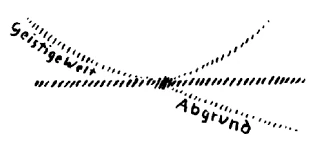
[ 5 ] We have described the ancient Indian era; at that time, human beings were still, relatively speaking, in a spiritual sphere. Before that, they were up in the spiritual world. In Atlantis, they still possessed a dim form of clairvoyance. Now humanity descends and reaches the point where, starting from Rome, the world empire spreads, and within this world empire, human beings become fully conscious of themselves as external, sensory beings—as personalities. That was the time when the Roman concept of law entered the world, when everyone wanted to be an individual personality, an individual citizen. At that point, humanity had reached this threshold. At this point, it was possible either to turn back or to sink downward.
[ 6 ] We have now, in fact—and everything I say is entirely consistent with the account in the Apocalypse—reached a point in human development where humanity faces a decision in a certain respect. We have already shown how, in our era, immense spiritual forces are being used to provide for the basest needs. We have shown how the telephone, the telegraph, the railroad, the steamship, and other things yet to come have absorbed—and will continue to absorb—enormous intellectual powers that are used solely for the mere satisfaction of base human needs. But human beings have only a certain amount of mental energy. Consider the following: Human beings have used an immense amount of mental energy to invent and construct the telegraph, and to build railroads, steamships, hot-air balloons, and so on, in order to advance external civilization. — It had to be that way. Humanity would have fared poorly if it had not come to pass this way. But humanity has also used these mental powers for many other purposes. Just think how humanity has gradually come to weave all social relationships into an incredibly intricate web of intellect. What intellectual powers were required to bring things to the point where one can write a check in America and cash it in Japan? Immense spiritual powers have flowed into this activity. These powers had to descend, so to speak, below the line of the physical plane that separates the spiritual realm from the abyss. For in fact, human beings have, in a certain sense, already descended into the abyss, and anyone who studies the times from the perspective of spiritual science can see, even in the most mundane phenomena, how this process continues from decade to decade, how a certain point is always reached where the personality can just barely catch itself. If, at this point, the personality surrenders to the descent, then it is lost; then the personality is not saved to ascend into the spiritual worlds.
[ 7 ] This can be demonstrated even in the most secular of matters. For example, I could demonstrate it to you through the details of the development of the banking system in the second half of the nineteenth century. Indeed, it may be left to future historians to clarify that a fundamental change has taken place, which we can describe as follows: In the banking system, individuality has gradually fragmented. — I would have to point you to that moment when the four Rothschilds set out into the world from Frankfurt—one to Vienna, another to Naples, the third to London, and the fourth to Paris—and how the entire banking system was brought into a personal sphere through the personal talents directed precisely toward that end. There, the individual took charge of the monetary system. Today you see the entire banking system becoming impersonal. Capital is passing into the hands of joint-stock companies; it is no longer managed by individual personalities. Capital is beginning to manage itself. We have purely objective forces operating within capital, and even forces within this realm that draw upon all the will of the individual, so that the individual has become powerless. Thus, with discerning eyes, one can trace the matter right into these worldly affairs and will be able to see everywhere how humanity has sunk to its lowest point with regard to the individual.
[ 8 ] Now the individual can save themselves and rise again. They can save themselves, for example, by truly learning—through the strengthening of their inner spiritual powers—to stand on their own two feet and become independent of the objective forces of capital. However, the personality can also throw itself into these forces; it can, in a sense, sail into them and plunge down into the abyss, allowing itself to be ensnared by the forces at work within capital.
[ 9 ] The most important point at which the human personality descends to Earth—and at which it would have to turn back—is the point of the appearance of Christ Jesus on Earth. He gave the Earth the power that made it possible for humanity to ascend once more. And humanity ascends to the same extent that it is in communion with Christ Jesus. To the extent that a greater portion of humanity comes to understand what this event was, and to the extent that for such people the Christ impulse becomes their own impulse within their inner being—from which they act and weave their existence—to that same extent will humanity ascend. More and more, human beings must learn to understand what Paul said: “It is not I who act, but Christ who acts in me.”
[ 10 ] So when the impulse that descended onto our physical plane during the fourth period takes root in people’s hearts, when it becomes the driving force behind their actions, then the ascent upward takes place. And all the souls who find this connection, who achieve union with the Christ Principle, will find the path upward. But all souls who fail to find this union will gradually sink into the abyss. They would have “conquered” the ego, but would be unable to ascend once more into the spiritual world with this ego. And the consequence for such a person, who finds no connection to the Christ Principle, would be that he becomes detached from spiritual ascent. Instead of ascending, he would descend and become increasingly hardened in his “I.” Instead of having found in matter merely the opportunity to acquire the “I” and then ascend again, he would only sink ever deeper into matter.
[ 11 ] Yes, everything repeats itself. Human beings have come to be able to enter our physical world. By surviving the Atlantean flood, they gained the opportunity to develop their present human form. This is truly a reflection of the spiritual “I”-deity dwelling within the human being. It is only because, toward the end of the Atlantean era, the etheric body united with the physical body and the forces of the etheric body entered the physical head that the human being acquired his present human form, which already allows the divine spirit to shine through. Suppose he were to deny that it is the Spirit that has given him the human form. Then he would not use the body as an opportunity to attain ego-consciousness and become spiritual again, but would become fused with the body, growing so attached to it that he would feel at home only within it. He would remain bound to the body and descend into the abyss, and because he has not made use of the power of the spiritual, his outer form would once again become similar to his former form. The human being who descends into the abyss would become animal-like. Thus, humanity will bring about what we have already indicated: those who do not use their sojourn in the body merely as an opportunity to attain self-consciousness will descend into the abyss, and they will form the evil race. They have turned away from the impulse of Christ Jesus, and out of the ugliness of their souls they will once again take on the animal form that human beings had in earlier times; and down in the abyss, the race of the wicked, with their wild instincts, will exist in animal form. And when, above, the spiritualized ones—who have absorbed the Christ principle within themselves—proclaim what they have to say regarding their union with the name of Christ Jesus, names of blasphemy will resound down here—names that seek to reject what appears as spiritual transformation.
[ 12 ] Someone who thinks only half-heartedly might now say: Yes, but so many people have lived who knew nothing of the Christ impulse—why shouldn’t they have shared in the impulse of Christ Jesus? — This is the objection raised by those with a materialistic outlook: Why should salvation have come only with Christ Jesus? — When people who are not anthroposophists say this, it is understandable. But when anthroposophists say this, it is incomprehensible, for they ought to know that the human being returns again and again. And the souls who have lived before will return in new bodies in the time following the appearance of Christ, so that there are no human beings who could miss the event of Christ Jesus. Only those who do not believe in reincarnation can raise objections such as those described above.
[ 13 ] Thus we see how the division is taking place and that a time will come when those who have striven for spiritualization will be able to live in the spiritual world; a time when what they have previously acquired will come to light, when they will bear the name of Christ on their foreheads because they have learned to look up to him. Now, after the seals have been broken, a person’s outward appearance will reflect what he carries within his heart. Those who carry Christ within their souls will, after the unsealing, bear the mark of Christ Jesus on their faces; outwardly, in their appearance, they will resemble Christ Jesus. But those who remain rooted in the cultures that predate the appearance of Christ Jesus will have to experience something different. These four cultures—the ancient Indian, the ancient Persian, the Assyrian-Babylonian-Chaldean-Egyptian-Jewish, and the Greek-Latin cultures—were preparatory eras. The soul had to pass through the bodies of these cultures in order to prepare itself for the great event of the appearance of Christ Jesus on Earth. Back then, during the time of preparation, two forces were at work. The forces that brought people together are forces that have their material basis in blood. If people had simply been placed side by side in their present form, what was meant to develop within humanity would never have come into being.
[ 14 ] Before the Earth, the Moon was the home of our creatures. That ancient Moon was the cosmos of wisdom; our Earth is the cosmos of love. Our evolution is directed toward uniting people in love. When the Earth is eventually dissolved after the seventh trumpet sounds—when it loses its physical substance and transforms into an astral celestial body—then the love that humanity has developed through all earthly things, the power of love, will be instilled in the entire human race. For it is this power of love that must be instilled as humanity’s earthly mission, just as you now see the power of wisdom in your surroundings. It has often been pointed out: If you look at just a piece of a thigh bone, what a marvelous structure it is! It does not consist of a compact mass, but of many fine skeletal fibers that are so wonderfully arranged that the greatest load-bearing capacity is achieved with the least amount of material—something no engineer today would be capable of producing. And if we were to search everything, we would find that what humanity has acquired as its wisdom in the course of its earthly evolution had already been instilled in the Earth beforehand.
[ 15 ] Time and again in history class, we are told how humankind has made progress upon progress, becoming wiser and wiser. You recall how the individual stages of this process of becoming wiser were presented to you—how, for example, you were shown that in the early modern era, humanity succeeded in inventing gunpowder, linen paper, wood pulp paper, and so on. Your soul rejoiced at how humanity had advanced. People learned to make paper through their intellect; they invented it from scratch, one might think. But to anyone who surveys the world in its broader context, this appears in a different light. Wasps were already capable of this much earlier, for a wasp nest is exactly the same as paper. Thus, what humanity later attained through its subjective wisdom was already present in the wasp nest millennia earlier. It is not the individual wasp that can produce paper, but the group soul—the “I” that encompasses the entire group of wasps—which is as wise as humankind has only recently become. And everywhere you look—if you are not blind but truly seeing—the wisdom of things will meet you.
[ 16 ] Do not think that this wisdom did not have to come into being. Oh, the world was not always so steeped in wisdom. During the lunar phase of evolution, this wisdom gradually flowed into what surrounds us today. During the lunar phase of evolution, what was once a chaotic interplay of forces took shape in such a way that it became wise. If you could turn your gaze toward the ancient Moon, you would find everything there still in a state of chaos, so to speak—not yet wise at all. In the course of the Moon’s evolution, wisdom was poured into and instilled in beings and creatures, and it was already present when the Earth emerged from the twilight. Now all things appeared imbued with wisdom. And just as human beings today look at their surroundings and see wisdom springing forth everywhere, so too, when they reach Jupiter, they will perceive all the beings around them in a wondrous way: they will radiate something like the fragrance of blissful love. Love will flow from all things, and it is the mission of Earth’s evolution to unfold this love. Love will then flow through all things, just as wisdom now reigns in all things. And this love is infused into Earth’s evolution through the fact that humankind has gradually learned to develop love. |
[ 17 ] But human beings could not immediately possess spiritual love; this love first had to be instilled in them at the lowest level. Love needed a material vehicle: that is, kinship by blood. Practicing love within the realm of kinship by blood—that was the first school. Through this, separated human beings were brought together, so that those who shared the same blood flowing through their veins would love one another. That was the preparatory school of love; that was the great school of love. And the great impulse that spiritualizes this love—that does not merely leave it where it acts physically as its foundation, but communicates it to the soul—that is the Christ impulse in the world.
[ 18 ] Throughout all of prehistory, human life would have taken a strange course if only this one impulse of loving communion had been at work in the blood. The beings who were the guides of ancient times—above all, Yahweh—brought people together in love so that they might unite through blood ties. But if, before the coming of Christ Jesus, human beings had been united solely through kinship, the individual would never have been able to develop into a personality. The individual would have been lost in the masses. Indeed, the individual was actually very much lost in the whole. In truth, the awareness of being an individual was something that developed only gradually. In the Atlantean era, there could be no question of human beings feeling themselves as individuals, but even later this sentiment still resonated. People simply do not understand the ancient naming conventions; otherwise, they would realize how people felt. Think of the believers of the Old Testament: in pre-Christian times, when they sought to truly feel their “I,” they did not perceive it at all in terms of their individual personality. Anyone who fully felt the impulse flowing from the Old Testament would say to himself: “I and Father Abraham are one.” For they felt secure in this community that reached all the way back to Abraham, whose blood flowed through every vein down to the youngest member. And so they said: “I feel that I am not a lost member when I sense that my blood is the same as that of Father Abraham.”
[ 19 ] And people tried to trace the community even further back. They felt secure within the group soul. They pointed to Noah, to Adam. People no longer know what these names mean. They do not know that in those ancient times, human consciousness was still different from what it is today. Today, at best, a person can remember what goes back to his childhood, and certainly all memory ends with birth. Back then, in the time of the patriarchs, in the time of the ancient forefathers, it was not so. Then, a person remembered not only what he himself had experienced, but also what his father, grandfather, and great-grandfather had experienced. This was as present in their memory as your memories of your childhood are to you. They did not know that their life began specifically with their birth. Their memory stretched back through the centuries. People did not give a name to this separate consciousness; they would have seen no point in doing so. Because they remembered their father, grandfather, great-grandfather, and so on, a single collective name encompassed the entire chain. “Adam” and “Noah” signify the memory passed down through the generations. As far back as people could remember Noah, they called the chain “Noah.” This was an inner human being, a spiritual being who lived through the generations. They would have found it meaningless to give the outer human being a name. Thus, the name “Adam” encompasses a spiritual being.
[ 20 ] The individual was thus not yet conscious of his or her own self. He would have been absorbed into the community had it not been for impulses that constantly countered this dissolution into the community, working to tear the human being away from the blood ties that were meant to lead him to independence. Such spiritual beings took up residence in his astral body, giving him the impulses to prevent his consciousness from becoming blurred. These beings are the Luciferic beings. It was they who, in pre-Christian times, counteracted the actual unification to which human beings owe their independence and emerging personality. It is absolutely essential to realize that what brought people together is attributable to Yahweh, and what drove them apart is attributable to the Luciferic spirits.
[ 21 ] In the early days of Christianity, there was a saying that went: “Christus verus Lucifer”—Christ is the true bearer of light—for Lucifer means “bearer of light.” Why is Christ called the true bearer of light? Because what was once unjustified has now been justified through him. In the past, there was a tearing apart; people were not yet ready for independence. Now, through the “I” impulse they received from Christ Jesus, people had reached a point where, despite the “I,” they could develop in love toward one another. Thus, what Lucifer, so to speak, had sought to give humanity prematurely—when humanity was still immature—was brought to humanity by the true Bringer of Light, by Christ Jesus. He brought the impulse toward independence, but also the spiritual love that unites those who are not related by blood. Through him came the era in which humanity matured into what Lucifer had previously sought to bring about. This saying, “Christus verus Lucifer,” was later no longer understood. Only those who understand it correctly come to know the first teachings of Christianity.
[ 22 ] This, then, is how we must understand this impulse; this is how we must recognize how humanity was prepared for the stage it was to reach. Thus, these four epochs—the Indian, Persian, Egyptian, and Greco-Latin—were times of preparation, pointing toward the great Christian event. But it is possible for a person to become, so to speak, set in their ways. Let us imagine a person living at the time of Christ Jesus, and let us imagine that he could consciously decide what he wants. Then, when Christ Jesus came, he might say: “Oh, what came before is enough for me. I want nothing to do with him; I want no communion with Christ Jesus.” — In that case, he would possess within his soul those forces, those impulses that could be acquired in the time before Christ Jesus. He would possess all the impulses that could be gained through Indian, Persian, Egyptian, and Greco-Latin culture. But in the course of cosmic development, one may possess such impulses only until a new impulse arrives. If one stands still, then one simply remains behind at that stage. Therefore, one must not display a lack of understanding for historical development; one must not say: “The same principle applies in all cultures.” — It is not for nothing that one culture is built upon another.
[ 23 ] Let’s suppose someone like that had wanted to sleep through Christian development; then he would live on into the future, beyond the great war of all against all. But there he would have nothing of Christ’s great principle of love, which unites the “I’s” and transforms people into communities. He would possess everything that actually drags the “I” down into the abyss. He would possess the forces that drive people apart, the forces that shatter them. And this is shown to us by the one circumstance that can lead us to the question: Why does the unveiling of the first four seals present us with such a bleak picture? — Because it reveals those people who wish to remain stuck in these four preparatory cultures, in which the old form of Lucifer is present, driving them apart. Thus, through the unveiling of the seals, we are shown how they take on the forms they have acquired. They have slept through the event of Christ Jesus; they are reborn in the forms that can be given to them without the influence of the Christ principle. Therefore, what mere intelligence, mere reason, indicates appears once again: the horse appears four times in a row! — The old form of humanity appears, the form it has acquired by embracing the horse-like nature. This form appears when the first four seals are unsealed.
[ 24 ] And at the very moment the fifth seal is unsealed, what is brought to our attention? Those who, during the preceding period, have come to understand the event of Christ Jesus. They are clothed in white garments; they have been spared; they have been figuratively slain; they are the ones who are preserved for the spiritualization of the world. Thus, it is the connection with the Christ Jesus principle that leads people to wear these white garments and to appear when the fifth seal is broken. Here we see how it is clearly and distinctly indicated to us that this moment, when Christ Jesus appears, marks an important epoch in human history—the epoch that brings about, after the war of all against all, the reappearance of the four periods, during which those who have been left behind are tormented by the materiality that has accompanied evolution and to which they have become bound—where they are tormented by all the evils and torments of hardened, coarsened materiality. And everything that is now further described to us in the unveiling of the seals represents nothing other than the descent into the abyss. While in the fifth period we are given only a brief reference to those who are chosen, we are otherwise shown all those who remain in materiality, who descend into the abyss, who take on the forms that were there before, because they did not come along, because they did not absorb within themselves the power to transform those forms.
[ 25 ] You can picture it this way: Imagine, today, that all human forms are made of rubber, and within these rubber human bodies lies your inner soul force, which gives these rubber bodies their human form. Imagine we were to remove that soul force: the rubber bodies would shrink, and the human beings would take on animal forms. — The moment you draw the soul out of the human rubber body, the human being would reveal his animal form to you. What the human being has attained is like something he brings forth today through his own power. If you could observe what they once created in their astral body, you would see how this animal-like quality is present. It is truly something like an inner force that gives the rubber-like human being their present form. Imagine this force removed; imagine humanity not fertilized by the Christ force—and humanity would recoil into its animal form. This is what will happen to those who fall back. They will subsequently form a world that lies, so to speak, beneath the present world—a world of the abyss, where humanity will once again have assumed an animal form.
[ 26 ] This is how we come to understand what the course of development will actually be. Bit by bit, what is now being prepared will come to light, just as, in our own time, what had been laid down during the Atlantean era has also come to light bit by bit. I have explained that in the last third of the Atlantean era, a small colony formed from which our cultures are derived, and from which the two later cultures that will follow are also descended. For the next era, which will succeed all these cultures, things will be somewhat different. There will not be a colony confined to a single location; rather, from the entire mass of humanity, those who are ready will be drawn from everywhere to form the good, the noble, and the beautiful aspects of the next culture following the war of all against all. This, in turn, represents progress compared to the earlier Atlantean era, when the colony developed in a small place; whereas now we have the opportunity for those from all tribes across the entire Earth to be recruited—those who truly understand the call of the Earth’s mission, who understand how to bring Christ to life within themselves, and how to unfold the principle of brotherly love across the entire Earth, and to unfold it in the true sense—not in the sense of the Christian denominations, but in the sense of true esoteric Christianity, which can emerge from all cultures. Those who understand this Christian principle will be there in the time that will follow the great war of all against all. A time will come for our present culture—our culture of pure intellect, everything that is increasingly developing toward the abyss of the intellect in the present—and you can observe this in all areas of life—when human beings will be slaves to intelligence, and their individuality will perish. There is only one way today to preserve the personality, and that is spiritualization. Those who understand how to develop the spiritual life will belong to the small band of the well-sealed from all nations and tribes who will appear in white robes after the great war of all against all.
[ 27 ] Now we are beginning to comprehend the spiritual world from within our immediate, present culture of the intellect. This is the true anthroposophical endeavor: to comprehend the spiritual world from within today’s culture of the intellect, and to bring together those who can understand the call for the spiritualization of the world. They will not form a closed colony, but will come from all nations, and little by little they will carry on into the sixth epoch—not yet beyond the Great War, but first into the sixth epoch. For the time being, there are still necessities there that are connected with old racial necessities. In our era, racial and cultural epochs are still intertwined. The actual concept of race has lost its meaning, but it still plays a role. It is by no means possible for every mission to be carried out in an equivalent manner by every people among us. Some peoples are particularly predestined for this.
[ 28 ] The nations that are today the bearers of Western culture were chosen to bring the fifth epoch to its zenith. These were the nations that were to develop the intellect. That is why, wherever this Western culture spreads, we find primarily a culture of the intellect, and this has not yet come to an end. This intelligence will continue to spread. With even greater intellectual power, people will acquire what is necessary for the body’s needs; with even greater intellectual power, they will tear one another apart in the great war of all against all. Many discoveries will be made to wage wars more effectively; boundless intelligence will be mobilized to satisfy base instincts. But in the midst of all this, what certain nations of the East—of the northeastern East—are predisposed toward is already taking shape. Nations are preparing to rise from a certain dullness and, in great and mighty surges, to bring forth what will be a spiritual impulse—something like the opposite pole to intelligence. Before the sixth cultural epoch—represented by the church in Philadelphia—we will experience something like a mighty marriage of nations, a marriage between intelligence, reason, and spirituality. Today we are only experiencing the dawn of this marriage, and no one should take what has just been said as a hymn of praise to our time, for one does not sing hymns of praise to the sun when only the first signs of dawn are visible. Yet we do observe remarkable phenomena when we compare the East and the West, when we look into the depths, shallows, and underlying currents of the nations.
[ 29 ] Let’s not interpret this as an attempt to take sides. These lectures, which aim to be objective, are as far removed as possible from taking any side. But objectively, you can compare what has been achieved in Western Europe as science and philosophy with what emerges in the East—let’s say, in Tolstoy. You don’t have to be a follower of Tolstoy, but one thing is true: in a book like Tolstoy’s On Life, you can read a single page—if you know how to read—and compare it to entire libraries in Western Europe. And you can then say to yourself: In Western Europe, intellectual culture is built with the mind; people piece together various things from details, which are meant to make the world understandable. And in this regard, Western European culture has achieved so much that no future age will surpass it. But what can be expressed in thirty volumes of such Western European libraries is sometimes condensed into ten lines when you understand a book like Tolstoy’s On Life. There, something is said with primal power, yet a few lines possess an impact equal to that which is meticulously crafted from details in those libraries. — One must be able to discern what springs from the depths of the spirit, what has spiritual foundations, and what does not. Just as overripe cultures have something withering about them, so do such emerging cultures possess fresh life and new vitality within them. Tolstoy is, after all, a premature blossom of such a culture, having arrived far too early for it to be possible for him to be fully formed at this stage. Consequently, he is afflicted with all the flaws of a premature birth. All the grotesque depictions of certain Western European phenomena that he presents—which are unfounded—and all the foolish judgments he offers, demonstrate precisely that great phenomena have the flaws of their virtues, and that great cleverness has the folly of its wisdom.
[ 30 ] This should be viewed merely as a sign of the times to come, when the spirituality of the East and the intellectualism of the West will unite. From this convergence will emerge the Age of Philadelphia. All those who embrace the impulse of Christ Jesus will find their place in this union, and they will form the great brotherhood that will survive the great war, that will be opposed, that will endure the most varied persecutions, but that will lay the foundation for the good race. After this great war has brought about the rise of bestiality among those who have remained in the old ways, this good race will arise. They will carry into the future what is to be the spiritually elevated culture of that future age. Thus we will also witness that in our time—between the great Atlantean flood and the great war of all against all, during the period represented by the Church of Philadelphia—a colony will form that will not emigrate but will be present everywhere, so that everywhere work will be carried out in the spirit of the Church of Philadelphia, in the spirit of the union of humanity, and in the spirit of the Christian principle.