

Anthroposophy, Psychosophy
and Pneumatosophy
GA 115
26 October 1909, Berlin
Translated by Steiner Online Library
Anthroposophy IV
[ 1 ] Yesterday we spoke about the various currents of force that shape the human organism and give it its form in such a way that this form must appear understandable to us. We have seen how it becomes strikingly clear that the heart and the eye must look exactly as they do when we come to understand the formative forces. As you have seen, we have traced and composed what takes place supersensibly in the human organism to bring the sensory image into being—consisting of currents flowing from left to right, from right to left, from top to bottom and from bottom to top, from front to back and vice versa.
[ 2 ] Now someone might say: We’re going to trap you in your own words! When you speak of these currents—from the right and left, above and below, front and back—you’re not explaining to us a very significant phenomenon in the human organism; you’re not explaining the phenomenon that lies in the following: In humans, there are organs that are located exactly symmetrically—identical on the left and right—and other organs that are asymmetrical, such as the heart, liver, stomach, and so on. One might object that, if necessary, we could understand the human organism based on your “currents” if it were constructed entirely asymmetrically—if, just as it looks different from bottom to top and from front to back, it also looked different from left to right.
[ 3 ] One might object to this. But it would be a short-sighted objection. For, as we have already indicated, that which flows from left to right and from right to left is precisely what brings about the physical body and the etheric body. Thus, the physical body and the etheric body flow in the very direction in which the human being is symmetrically structured; it is precisely in this direction—where the physical body and the etheric body flow—that the human being is symmetrically structured. Now, however, let us recall what spiritual scientific research says about this anthroposophical fact and the anthroposophical explanation that these currents exist, and let us ask ourselves whether we have any way of making it understandable that everything must be as it is.
[ 4 ] Research in the spiritual sciences shows us that this physical body of the human being is a very ancient entity that originates from the ancient Saturn; that the etheric body was added on the Sun; that the astral body was added on the Moon; and that the “I” was not added until on Earth. Now we may ask ourselves: What was the initial structure of the human physical body when it was first formed on ancient Saturn? Asymmetrical, of course, for it had to act in a direction that corresponds to the current orientation of the body—from left to right. What was the structure of the etheric body when it was first formed on the Sun? It was asymmetrical, for it had to be formed in the direction that today corresponds to the right-to-left orientation in human beings. But now the development continues. It does not remain at the stage of the ancient solar influence; rather, the lunar influence is now added. There the physical body continues to develop; there its form is further shaped. If this lunar influence had not come about, then the human being would indeed have remained a one-sided, asymmetrical being with regard to his physical body. But the formation of this physical body continued on the Moon, while everything else continued on Earth. Something therefore had to occur that would transform the entire earlier formation, making it something entirely different. There had to be, so to speak, a reversal, an exchange of directions. What was to happen to avoid this one-sidedness had to be brought about from the other side. That is to say, while the direction imprinted on the formation of the physical body by Saturn runs from left to right, this now had to be balanced out again by a formation proceeding from right to left. How did this come about?
[ 5 ] In earlier lectures, I told you that even during the ancient Lunar Era, the Sun had separated from the Moon, and that the forces were now acting from the outside, no longer from the same side—from the body of the Moon. And so it was also with the etheric body as its formation progressed. What had become of the physical body by the time of the ancient Moon era was received by the side that now came from the external Sun. Yes, but then we cannot understand—someone might say—why, since this other side was formed so much later, it is not much smaller than the other side; why the two sides are exactly symmetrical.
[ 6 ] In this connection, recall something else I have told you. Certain beings who were more highly developed had to separate themselves from the ancient Moon and from the Earth in order to exert a stronger influence. Precisely in order to exert stronger effects in the process of formation from right to left than those exerted on Saturn, these beings had to find another, higher arena. For they did not have it as easy as the Saturn beings did when the latter had unilaterally created the physical human body. They already had to overcome what had existed up to that point in evolution. The entire process of formation was already at a standstill. Therefore, they had to be stronger; they had to choose a realm outside the Earth, on the Sun. This strengthened the power, and the other side was made equal to the first side. The physical body became a symmetrical structure.
[ 7 ] Thus, if you are patient, you will find that everything that has been said in the course of the theosophical lectures is confirmed down to the smallest detail. The formative forces could be traced right down to the individual human organs. Of course, it would be going too far if I were to explain, for example, the earlobe to you in these brief lectures, but it would be possible.
[ 8 ] If you recall what was said yesterday: that currents flow from front to back, and that these are the effects of the feeling body—the outflows of the feeling body into the human organism—whereas the currents of the feeling soul flow from back to front, we thus have, in one direction, two currents acting against each other: from front to back and from back to front. How, then, should we imagine that the currents of the sensory body flowing from the front to the back and the currents of the sensory soul flowing from the back to the front shape the human organism? We could illustrate this with a brief sketch:
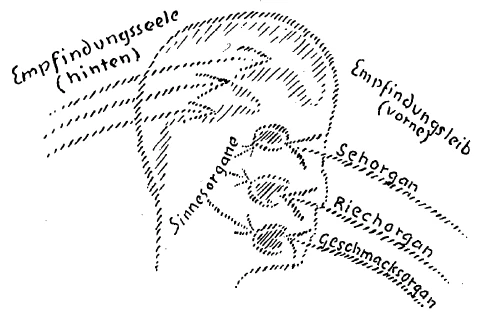
[ 9 ] As I said, the physical body, the etheric body, and the main part of the astral body were already there, and now those currents—coming from the sensory body—penetrate the human organism from front to back. And they work in such a way that they form all kinds of organs within the human organism, within what is already there. Now, let us assume that the feeling soul, in turn, works its way into the organism from back to front. This work is an inner one, precisely because it is the feeling soul. At the front, the currents will accumulate. They will accumulate in such a way that, when they penetrate into the physical organism, they will overlay what they form there. There, the currents from the soul of sensation flow forward, and where the physical body is bounded, they penetrate. While the currents of the sensory body penetrate from the outside to the inside—for the sensory body is, after all, on the outside—the currents of the sensory soul flow from the inside to the outside. So there must be some openings at that point; some holes must be drilled. You have certain currents flowing from back to front, and you have certain currents flowing from front to back. The currents flowing from back to front originate in the soul of sensation, from something inner; [the currents flowing from front to back] penetrate into the physical organism.
[ 10 ] If you look at this sketch, you will see a schematic side view of a human face: in the foreground are the currents that penetrate the sensory organs—the organs of sight, smell, and taste—and, moving from back to front, the formative forces that overlay the brain. You have viewed the schematic structure of the human head from the side.
[ 11 ] So we can say: If what spiritual science says is true, then this human head really cannot look any different from the way it actually does. Where, then, is the proof for what spiritual science claims? Spiritual science shows that if a human head were ever to come into being, it would have to look this way. — Why don’t you ask the human head if it looks this way? Yes, it does! There you have the confirmation, the evidence, presented to us by the world of phenomena itself.
[ 12 ] Or consider another fact. The activity of the sensory body is directed inward, while the activity of the sensory soul moves from the inside out, but becomes blocked before it reaches the outside. It does not reach the outside; it remains, so to speak, blocked inside the physical brain. It cannot escape; it emerges only at the points where something meets it through the holes that have been drilled into it from the front. That is where the activity of the sensory soul emerges; that is where it flows out. So we have a part of our inner life that pours outwards as the sensory soul. The sensory soul is capable of this.
[ 13 ] The intellectual soul is not capable of this. It, too, rests within; it must behave in the same way in its effects. It remains entirely within. It cannot go outward at all, for no currents from the outside encounter it. Therefore, human thinking takes place within; it cannot escape outward. Human beings must think within themselves. Things do not think for them, nor do they present thoughts to them from the outside; rather, human beings must direct their thoughts toward things. This, one might say, is the great mystery of the relationship between human thought and the external world. No thoughts come to a person through the sense organs; thus, if the sense organs themselves have a flaw, sensory illusions can easily occur. However, while in normal life the senses cannot err, the intellect—which cannot establish a relationship with things—can err. It is the first part of a person that can err, because its activity is confined within the brain; because its activity does not manifest outwardly. What follows from this? It follows that it is entirely impossible for a person to have thoughts about the external world and to form correct ideas about it unless they possess an inner capacity to allow correct thoughts to arise. Never—as you can see from this—could the external world give a person correct thoughts if correct thoughts did not arise from within. It can provide him with correct sensory perceptions. But sensory perceptions cannot think. Thought, however, is subject to error, and a person must possess the inner strength to ensure the correctness of his thoughts.
[ 14 ] For anyone willing to reflect, this fact alone shows that if true thoughts are to arise in a person about the things of the external world, yet these thoughts cannot come into contact with those things in this present life, this points to a pre-earthly existence for human beings. Just think about it: Human beings are meant to form true thoughts about the wisdom of the world, yet they cannot reach it with their thoughts at all. What flows through things in the outside world as wisdom must also arise within them. And there is a boundary between the two; the two cannot come together at all. So they must once have been together! That was in those ancient times when the human “I” had not yet held back these currents flowing from above to below, but allowed them to pass freely. You must therefore necessarily conclude that human beings must once have been organized differently, that what is now thought in the brain was once, like the sensory perception of the eye, connected to the outside world, so that human beings could look at their own thoughts.
[ 15 ] What does that mean: “People looked at what one can now only imagine”? It means they possessed clairvoyance. But since it is precisely the “I” that has separated human beings from that ancient form of clairvoyance, the “I” did not yet exist back then. So we must call it a form of clairvoyance that has not yet been illuminated by the “I,” that is still twilight-like. And we can practically reconstruct the very word we used for the old form of clairvoyance: human beings must have possessed a twilight-like form of clairvoyance. They must have gone through states in the past where they possessed this twilight-like clairvoyance. |
[ 16 ] Once again, it is our present organization that shows us that in times past, human beings lived with a different organization. If what has been said is true, then something very important for practical life follows from this. It follows that, for all aspects of the sensory world, sensory perception—apart from sensory illusions—is something that can express the truth. For, with regard to sensory perception, human beings stand in a direct relationship to the external world, in direct contact with it. It also follows that human beings can know anything about what is within them only through the power of their intellect. For example, when the “I” flows inward, it is, of course, within. So when a person applies their thinking to the “I,” it is entirely natural that this thinking about the “I”—because the “I” is within—is capable of determining something about this “I.” You have seen this in Dr. Unger’s lectures. And now you will also be able to pinpoint the process. It is the encounter of the intellectual soul with the “I” that gives rise to pure thinking—thinking directed inward. And you will understand that this thinking, which grasps itself, cannot be subject to error like that thinking which wanders about out in the world and seeks to derive judgments from things. For this thinking can only go so far in reflecting on the external world as it is first able to find within itself the concepts—the truth—about external things. Human beings must hold up the concepts of things as mirror images against them. Things themselves can provide only the sensory aspect. Human beings must allow the concepts of things—the thoughts of things—to rise up within themselves from a proper disposition toward truth. About what, then, do we actually have a judgment in the external world? In truth, human beings can form a judgment only about that which in the external world first presents itself to their senses. Regarding what eludes the senses, the senses themselves cannot decide anything. What, then, is it about human beings that appears solely and exclusively in its truth? The only thing about human beings—and also about the other beings of nature—that appears in its truth on the physical plane is what the senses can actually perceive. As soon as something eludes the senses in its immediate presence, no judgment can be made about it from the perspective of the physical plane. For at that moment, if the intellect is not guided and directed by inner correctness or a disposition toward truth, it will inevitably fall into all manner of errors.
[ 17 ] I would rather explain this matter to you using an example. I would like to present two teachings to you. You are familiar with one of them from spiritual scientific research: the teaching concerning the forms that human beings have undergone in earlier states of existence, through the Atlantean and Lemurian periods and so on, all the way up to the ancient Moon, Sun, and Saturn epochs. Here, spiritual scientific research shows you the various states that human beings have undergone. And today we have seen an example of how wonderfully what the senses perceive becomes comprehensible to us when we truly make this theory of human evolution our own and apply it to the outer world. And you can become more and more convinced of how striking it is that everything in the outer world provides confirmation for what spiritual scientific research establishes from the facts of the spiritual world.
[ 18 ] Let us now consider, as a counterpart, sensory research—the sensory theory of descent—which has only recently reached its full development. Above all, we see here that an important law has been established, one I have mentioned on several occasions: the fundamental law of biogenetics, which describes the external facts in such a way that, in its embryonic state, the human being briefly passes through all those forms that resemble certain animal figures; in certain stages, it resembles a small fish, and so on. One might say that he repeats the various forms of the animal kingdom. Now, as you all know, especially during the period when this theory of evolution had run amok, it was concluded from these observable facts that human beings had indeed passed through these forms in a pre-human existence, forms that repeatedly manifest themselves in the embryonic stage. In response to this fact, one might say: It was truly a blessing for humanity that this observation remained hidden, through the care of the gods, until the time when—almost simultaneously, since things almost always overlap—after it had been put forward in its wilder forms, it could be corrected by spiritual science. — What the human being goes through up to the point where he appears on the physical plane for sensory perception was veiled by the gods and could not be observed. For if it had been observed even earlier, the human being might have formed even more erroneous concepts about it. The facts are, of course, correct, for they are observed through the senses. But when it comes to judging them, what must be taken into account is the power of the intellectual soul. This faculty cannot grasp what cannot be perceived by the senses. Therefore, unless it possesses an inner capacity for truth, it is necessarily subject to error. And here we have a striking example of how the power of judgment, which arises from the intellectual soul, can steer us into error.
[ 19 ] What does the fact that, at a certain stage of its embryonic development, the human being resembles a small fish actually show? This fact shows that the human being has no use for the fish-like form, that it had to cast it off before entering human existence. And the next embryonic form is, in turn, one that human beings had to shed because it does not belong to them, just as human beings had to shed all animal forms because they do not belong to them. Human beings could not have become human if they had ever appeared on Earth in a form such as these animal forms. They had to separate themselves from them precisely so that they could become human. If you follow these thoughts correctly, you will also arrive at a correct judgment. What do the facts show when, for example, the human being looks like a little fish in the embryonic stage? These facts show that he has never resembled a little fish in the course of his lineage, that he has, precisely in the course of his development, cast off the fish form—he could not use it because he was not allowed to resemble it. Now consider all the other successive forms that modern science reveals to you in the forms of embryonic life. What do these forms reveal? They reveal everything that human beings were not in prehistory—everything they had to cast out of themselves. They reveal all those forms to which human beings have never resembled. Thus, through embryology, one can truly learn what human beings never looked like in prehistory. All the things that human beings did not go through, but rather expelled, can be learned through this. But if one draws the conclusion from this that human beings are descended from all of that—that they went through it in order to reach their present stage of development—then one is standing on the same ground as someone who might say: Here stands the son, here the father. If I compare the two, I will never believe that the son descends from the father. I will believe that the son descends from himself, or the father from the son. It is precisely the reverse order of evolution that has been assumed by drifting into error, because the intellect has truly proven quite unsuited to genuinely thinking through these facts of reality. Certainly, these images from ancient times are extraordinarily important to us, precisely because they show us what we have never looked like.
[ 20 ] But this can be seen much more clearly in something else. It can be seen in those realms that are presented to us directly through the external sensory world, which do not elude us. For all these forms are, after all, also given to us in the external world. These can be observed through what might be called ordinary, properly applied human perception. As long as people relied solely on this observation—as long as they applied their reason not to what is hidden from sensory perception but to what lies spread out before it—they did not arrive at that false judgment. Of course, in those days people did not judge their ancestry based on reason, but rather based on their natural, straightforward sense of truth. They looked at the ape and felt that peculiar sensation which every sound mind feels when looking at an ape—a sensation that can be compared to nothing other than a certain sense of shame. And this sense of shame was truer than what the erring intellect later claimed. Embedded within this sense of shame was the emotional judgment that the ape is, in fact, a being that has fallen away from the human lineage—a backward being—that it descends from the human line and had to be separated from it. So the feeling was that humanity could only have reached its present level by first having to eliminate from itself that which has become the present form of the ape. Had it retained it, it could never have become human. This lies in the natural, healthy feeling. Then these matters were investigated by reason, and through reason the error became apparent: that humans claimed the human form originated from the “ape lineage”! That is an error. The more you reflect on this, the more you will realize how profoundly true what has just been said really is. The idea that humans are descended from apes is a fallacy, as you can already see from something quite ordinary.
[ 21 ] Suppose you regard those aspects of human nature that are openly accessible to your own perception—that is, what you observe in yourself—or you regard that aspect of human nature which you can observe in other people, again as what is given to sensory observation. Since two currents now flow into one another within the human being—the current of the sensory body flowing from front to back and the current of the sensory soul flowing from back to front— we must distinguish, in what appears to us, so to speak, in a human being when we stand before them, between what acts from front to back as the flow of the sensory body, and what acts from back to front as the flow of the sensory soul. Let us look into a person’s face from this perspective. Insofar as we perceive the person through our senses, the image is, of course, correct. We cannot be mistaken about this; that is what sensory observation tells us. But now the human intellect comes into play—albeit still at a subconscious level. And here it immediately errs in a truly classic example. For how does it regard the human face in terms of its formative powers? It regards it as something that is somehow constructed from the outside. In truth, what we see in the human face is formed from the inside out by the feeling soul. And we make a false judgment when we look into a person’s face and say that it is, at all, the outer body. We must say: What the senses see here is the outer image of the soul of sensation—indeed, of the soul itself—acting outwardly. If you interpret the human face as a soul, and divert your attention from the idea that it might be a body, then you have reached the correct judgment. - Here you have the immense illusion: you look at a human face—the image of a soul—and you take it for a body by looking into the image of the soul—only the image of the soul, of course. - That is precisely the fundamentally false view; it shows how, as soon as human judgment comes into play, people misinterpret things. A person can only perceive external images correctly when they understand them properly—when they recognize that the human face is the image of the soul, and that anything learned about this human face through the mere forces considered as belonging to the physical or etheric nature leads to a false interpretation. For this human face must be interpreted from the forces of the soul itself—in this case, the visible from the invisible. You will be able to see this very clearly in spiritual science the deeper you delve into it: that it is a high school of thinking, and that the chaotic thinking that dominates all circles today—and most of all scientific circles—must come to an end. It may therefore sometimes seem strenuous to you to hear all that is presented here, particularly with regard to the thoughts you must form in the process. But at the same time, spiritual science is also the highest school of logical thinking, because it compels us to interpret the things in the world correctly. And we must also correctly interpret certain phenomena that lead us beyond the realm of the individual’s anthroposophy into the realm of the anthroposophy of all humanity.
[ 22 ] Let us look back once more at what we have called the sense of sound and the sense of concepts or imagination, and ask ourselves, with regard to human development on Earth: Has humanity developed in such a way that the sense of sound arose first, or did the sense of concepts or imagination arise first? — We have actually accomplished a great deal if we can look into human development in this basic realm in such a way that we can answer the question: Did human beings first learn to understand words, or did they first learn to perceive and comprehend the images that come to them? This question actually has little to do with the field of spiritual science, for anyone can answer it by observing how a child learns to speak and to perceive thoughts. Everyone knows that a child first learns to speak and only then learns to perceive thoughts. Language is the prerequisite for the perception of thoughts. Why is that? For the simple reason that the sense of sound is the prerequisite for the sense of imagination. A child learns to speak because it can hear, because it can listen to what the sense of sound can perceive, and speaking itself is then merely imitation. That is why you will also find that a child always imitates speech sounds long before it understands anything that is already a concept. Observe closely, and you will see that this is the case: First, the sense of sound develops, and it is only on the basis of the sense of sound that the sense of concept develops. The sense of sound is thus the ability not only to perceive sounds, but to perceive what we call speech sounds. And this raises the question for us: If, in the course of their development, human beings have become capable of perceiving sounds and, as a result, have become capable of acquiring language, how must this have happened? How did it come about that human beings acquired language in the course of their development?
[ 23 ] We need to make one thing clear here. If, then, human beings were to learn to speak—not merely to hear, but to speak—it was necessary that not only should something approach them from the outside and be perceived by them, but it was also necessary that something within them follow the same path as the currents of the sensory soul when they flow from back to front. Something like this was necessary. It therefore had to come to pass in human development that the sensory soul was permeated by a current acting in the same direction as those currents in the soul in general that produce what is brought about precisely by the movement from back to front. This had to happen for language to emerge. But this language was to come before the power of imagination; it was to come before people were able to perceive, within the words themselves—even within the very words they uttered—that which constitutes an idea. Indeed, humanity first had to learn to utter sounds and be able to live within the sensation of these sounds before it could associate certain ideas with them—ideas that could only come later. At first, it was something that was not yet a concept or an idea, but rather a feeling for what permeated the sounds as they were uttered. Language originated from this.
[ 24 ] This development had to take place at a time when the restructuring and the establishment of the circulatory system had already occurred, for animals cannot speak. The “I” must already have been working from above downward. But although this “I,” which worked from above downward, was already present, humanity could not yet conceive of it. For the power of imagination had not yet developed. What, then, follows from this? It follows that human beings could not have acquired language through their own “I,” but rather through another “I,” which we can compare to the animal group “I.” Language is therefore, in this sense, truly a gift from the gods; it was instilled in human beings from above along the path taken by the “I,” at a time when the “I” was not yet capable of developing language on its own. Thus, the “I” flowing down from above was not capable of developing language. It did not yet possess within itself the organs that could have provided the impulse to develop language. The group ego had to do that. But by then, the human being was already fully formed. The human being was already an upright human being. The group ego had to work from above down into the physical and etheric organisms and so on in order to bring about language. A current flowed toward this group ego from below. From above came the current of the group-ego; from below rose a current with which the current of the group-ego met. They converged and created a kind of vortex. If you draw a straight line through the center of the larynx, that is the direction of the current used by the spirits who bestowed language. And from these two converging currents, the distinctive form of the human larynx arose in physical matter. We must therefore conclude that human beings, under the influence of a group soul living in the vicinity of the Earth, were compelled to develop this language.
[ 25 ] Now you may recall that I spoke about how the group souls actually work on Earth. I said: The animal has its spinal cord lying horizontally, through which the current of the group soul flows. But these currents of force, flowing from top to bottom, constantly circle the Earth, just as they once circled the ancient Moon. These are therefore currents that do not remain where they are, but circle the Earth vertically. The group souls, whose paths are vertical, wander in circles around the Earth. What follows from this? If human beings were to learn, under the influence of group souls, to develop language, this could not have happened while they remained in the same place where they were; rather, they had to move, they had to wander, traveling from one region to another, so that they might encounter the directions of the group soul. Humanity would never have learned to speak if it had remained in the place where it once was, when it was still unable to speak.
[ 26 ] Now let’s ask ourselves: In which direction must people have been driven back then? — You can very easily determine this direction in the following way. We know that etheric currents in human beings flow from right to left, and that physical currents flow from left to right. Where, then, are the group souls that endowed human beings with language? We come close to the answer to this question through the following consideration.
[ 27 ] Let’s take a look at the Earth and its unique formation. If you consider that human beings learned to speak at a time when they were, so to speak, already fully formed, you will admit that a powerful force was necessary, for the larynx, in its soft state, first had to be reshaped into the human larynx. This had to take place under Earth conditions that were entirely different from those we have today. But what must those conditions have been like? Let’s take a look at the Earth. Imagine that we stand on the Earth facing east; then we have the west behind us, the north to our left, and the south to our right. Now let’s see what a remarkable fact emerges from this. The currents in human beings that are connected to the formation of the physical human body run from left to right. These currents also exist in the outer world and were therefore present during the formation of the Earth. There you have the strong currents that come from the north and flow toward the south. These are the currents that give rise to physical matter. On the other hand, you have the etheric currents that flow from right to left and do not aim to make physical matter denser and denser. In the Earth, therefore, you can still see this one-sidedness, this asymmetry: in the direction of the physical current, you have the northern hemisphere with its continents. There, the condensed physical matter contracts. And on the other side, in the southern hemisphere, you have the vast expanses of ocean. From the north comes the current that is essentially the same as the current flowing from left to right in the human being; from the south comes the current that is essentially the same as the one flowing from right to left in the human being. Let us now consider the other two currents in the human being: the current that flows from front to back, and the other that flows from back to front. The flow from front to back, as we have seen, goes from the sensory body into the sensory soul—indeed, into the soul itself; the other flow goes outward. If you now consider this—but I ask that you consider it very carefully; it is not entirely easy—then you will say to yourselves: In order to learn to speak, it was necessary for the human being to generate a current that traveled from the inside out, that is, into the sensory body. He therefore had to meet a group-soul current and offer his inner organization to it, so that what could form his own larynx might accumulate there. Within our Earth’s sphere, human beings had to meet a current capable of acting into their astral body. Thus, when they set out to learn to speak, they had to take neither the northern direction nor the southern direction, but rather the direction perpendicular to both. From this you will understand that human beings had to journey in a west-east or east-west direction when they were to learn language. Spiritual science tells us that human beings once lived in ancient Lemuria, where the sea now lies between Asia and Africa. Then they set out to learn language. They could not journey south or north; they had to journey west, and so they journeyed to ancient Atlantis. Thus, by traveling westward along this path to ancient Atlantis, human beings moved toward those group souls that could bring forth language within them. By truly understanding the structure of human language, you will find that what is derived from spiritual scientific observations is confirmed. This is how human beings learned language in ancient Atlantis. |
[ 28 ] But then he should develop his sense of imagination through language. He should not stop at language alone, but move on to the sense of imagination. How could that happen?
[ 29 ] Of course, he couldn’t continue in the same direction. He had to proceed in such a way that, with the same current, he now took the opposite direction. Why is that? We have seen, after all, what actually happens when the idea arises from the sound sense. We have seen how sound arises from melody; when one transforms the melody into harmony, one disregards the fundamental tones and perceives only the system of overtones. Then, in order to develop the sense of imagination, one had to omit from language that which had been developed on one side, in favor of the other side. Humanity had to turn back after learning to speak. It had to migrate eastward from Atlantis in order to further develop the sense of imagination based on the language it had learned. And here lies the meaning of the migration that spiritual science reveals to you when it says that the ancient Atlanteans, who were ready for it, set out to migrate from the West back toward the East. In this way, they were able to develop their sense of imagination in a fruitful manner. But then it would follow, in turn, that if people had migrated in the opposite direction—that is, toward the West—they would not have been able to develop a sense of imagination in a fruitful way. There were also people who migrated in the opposite direction at that time: these are the indigenous peoples of America. Why were they unable to sustain themselves? Why did what had been learned in the East have to be carried over to them later? Because they had migrated in the opposite direction. That is the cosmic destiny of the indigenous peoples of the Americas: that they had migrated in the opposite direction.
[ 30 ] In this way, you can practically grasp with your own hands what spiritual scientific research tells you. You can understand the entire structure of the Earth. Everything you see in the arrangement of the continents, the landmasses, and the oceans; everything you see in the migration of peoples—you can understand it all if you know the secret of those currents that we have come to know through anthroposophy by studying the human being itself. And so anthroposophy truly leads us into that life through which the human being and the external world become transparent and understandable to us. And now let us continue.
[ 31 ] We may further ask ourselves: But shouldn’t humanity, having developed the sense of imagination, continue to learn; shouldn’t it not merely remain at the level of images, but progress on to concepts? — To do so, it had to ascend once more from the mere sense of imagination into the life of the soul. Once again, it had to take the opposite direction there. Humanity first takes the direction toward the East to arrive at the life of imagination. Pure concepts, however, had to be conquered anew through a journey back; they could only be attained again in the West—and specifically after having journeyed westward. We could also understand, in detail, the migrations of the peoples through the four post-Atlantean cultural epochs if we had the time to compile everything that anthroposophy offers us on this subject. You would then be presented with a marvelous tapestry of the spiritual forces at work in the entire formation of the Earth—including humankind.
[ 32 ] So far, we have considered those currents that flow from top to bottom, from right to left, from front to back, and so on. But in a certain respect, we come to a standstill there. That is where we are held back. We can’t quite proceed any further here. Spiritual science now shows us that above the sense of imagination there are an imaginative sense, an inspirational sense, and an intuitive sense; that in ordinary life these flow inward in the life of the soul, but in clairvoyant consciousness they flow outward. Spiritual science shows us this. And now the question arises: If all these things are to live within the physical human being, they must surely also form organs and act in a certain way. Let us first consider something that is unique to human beings, something not yet found in the same way among animals: the inner soul activity of memory. For the idea that animals have memory is a fantasy of the natural scientists. It is not surprising that animals exhibit phenomena that can be explained by the same principle as in humans, but it is, in turn, a mistake to interpret them as phenomena of memory. For the main direction that the animal possesses—and which had to be established in humans so that the “I” could flow in and memory could develop—remains horizontal and forward-directed in animals, in the same orientation as in humans, so that there is no obstacle to the flow of the soul of sensation, the soul of understanding, and the soul of consciousness through it, but without the “I.” Therefore, it may very well be that an animal performs actions that are indeed rational but are by no means permeated by the “I.” For this reason, one must not speak of the “intellect” of animals. Here lies a major source of error in our modern science. The facts merely show that one can be guided by an intellect without being rational oneself. This is precisely what is at stake when it comes to animals. That one can encounter phenomena in the animal world that may resemble the phenomena of human memory is self-evident given the nature of the animal. But to speak of the “form of memory” is nonsense that confuses all concepts. In memory, we are dealing with something entirely different from what we have, for example, in mere rational thought or even in imagination. In memory, what we have before us is that an idea we have had remains—that it is still there even after the perception, the impression, has passed—not that one later does something that resembles something done previously. If that were the nature of memory, then Professor Hering would be right when he says: When a chick hatches from an egg, it can peck right away; therefore, it has memory because it repeats what its ancestors did. — One has simply not understood what memory is if one does the unheard-of things that are happening today in the field of psychology. Then a clock would also have memory, for it, too, repeats something it did yesterday! These are misleading concepts in the broadest sense of the word. We speak of memory when an idea remains internally, not when a fact is repeated externally. When an idea remains internally, it is retained by a “self.” That is the essence of memory: that the “self” takes possession of the idea and retains it.
[ 33 ] But if this is to be lived out in a human organism, then an organ must also be formed for this purpose; that is, the human ego must in turn generate currents. Such currents must emanate from the ego itself and flow into the various other currents coming from the front, from the right, and so on. Currents must flow out from the “I” into these. The “I” must pour itself into the other currents, into that which exists independently of the “I.” The “I” must overcome currents. If one direction runs from the outside to the inside, then the “I” must be able to generate a current in the opposite direction within itself. You can see that the ego is not capable of this from the outset in the fact that, when human beings learned language, such an opposing current had to arise, and the ego was not yet capable of that at that time. A group ego had to intervene to drive this current into the soul. But when the actual life of the soul begins, in which the ego participates, currents emanate from the ego itself and penetrate the already existing currents.
[ 34 ] Does the ego perceive this in a certain way when it drills a current into an already existing current? Yes, the ego perceives this very clearly. Up to the level of imagination, so to speak, the ego is not engaged in drilling currents into the existing one. But if the “I” is to develop a higher faculty—memory, for example—it must bore a stream into the already existing stream, one that must act in opposition to that other stream. This becomes apparent in that, as the “I” develops further, something else is added to the three streams of space inclined at right angles to one another. As the ego begins to develop memory, it drills something into one direction of space in the opposite direction, and this becomes perceptible to it in the consciousness of time. That is why memory is linked to the concept of time. A concept that we do not trace along a direction in space, but rather in the direction of the past, is drilled into the directions of space. This is the case with everything the “I” develops on its own. We can—elaborating on this in detail would take us too far afield—point to the current that flows when the “I” develops memory. This is a current that flows from the left to the right side. Similarly, currents flow from the left to the right side when the ego forms something like habits. These are the currents from left to right that are opposite to the earlier currents, which arose without the ego. The ego initially burrows its way against them.
[ 35 ] When we consider the life of the soul, we can distinguish between the soul of feeling, the soul of understanding, and the soul of consciousness. The soul of understanding can still be deceptive. I have already said that one can have intellect without being wise. For wisdom requires the “I.” In order to reach the “I” inwardly, the intellectual soul must have developed inwardly up to this “I.” Then it ascends to the soul of consciousness. Now, these are always opposite directions. When the soul of consciousness becomes conscious, the direction it takes is opposite to the direction pursued by the soul of understanding, which still operates in the unconscious.
[ 36 ] Is there any evidence anywhere that the currents of the intellectual soul and the currents of the conscious soul are opposed to one another? Under certain earthly conditions, we can see this. Consider, for example, that when a person learns to read, this is, in a certain sense, a very intellectual activity—one that does not necessarily originate from the intellectual “I.” What I am saying now applies primarily to European conditions, where, as you know, people have, in a certain sense, waited for later cultural developments. Thus, you arrive at something that was already present in Greco-Roman culture when the intellectual soul developed into what is called writing. As the intellectual soul developed, the very beginnings of reading and writing took place; but they were, after all, only the very beginnings. And this character has been retained. Then came the influence of the conscious soul. Conscious activities must, of course, take opposite directions, because the current of the conscious soul acts in the opposite direction to that of the intellectual soul. Human beings could only learn to calculate once they had developed the conscious soul, for that is a conscious activity.
[ 37 ] What appears here as a direction is evident in the illustration: The European peoples write from left to right because the forces of the intellectual soul were involved in this, but they calculate from right to left. When they add, for example, they add from right to left. There you see the two different currents overlapping. You see them overlapping in the image: the current of the intellectual soul and the current of the conscious soul. This is not the case everywhere. We can truly grasp the nature of the European people through this example. We can see that the people of Europe were destined to wait with the intellectual soul until a certain point in time had come, so as not to hasten the development of the conscious soul. In contrast, other peoples had to develop within the intellectual soul what in Western culture was to be developed only in the conscious soul. They therefore had to be given the opportunity to accomplish something with the intellectual soul that those who waited could accomplish only later with the conscious soul. The peoples whose mission was to lay the groundwork for the soul of consciousness already during the development of the soul of understanding—thus serving, as it were, as pioneers for the soul of consciousness—are the Semitic peoples. That is why the Semitic peoples write from right to left!
[ 38 ] In these matters, we have not only a means of understanding human beings as such, but also a means of understanding all cultural phenomena. Why, at a certain point in the Earth’s development, people write in one way or another, or calculate in one way or another—this can be understood from these facts. We could go even further and trace this all the way down to the shapes of the letters used by individual peoples—whether they draw a stroke from left to right or from right to left, and so on. Why a people writes a letter in this or that way follows from an understanding of these spiritual facts.
[ 39 ] From facts such as these, you can see what mission spiritual science has in the future: to bring light into people’s minds so that they may understand what would otherwise remain incomprehensible to them.
[ 40 ] It might not be quite right, after all, if we were to conclude these reflections at this point. Therefore, they will be continued in a certain way tomorrow, with the aim of reaching a conclusion—albeit only a rough one. I will therefore speak tomorrow, in the anthroposophical sense, about—one might say—one of Goethe’s daughters. You know that I wrote the book Goethe as the Father of a New Aesthetics. In it, I described Goethe’s role as a father with regard to the conception and understanding of the arts. Tomorrow I would like to present to you the daughter—Goethe’s child—within a truly modern conception of art history and aesthetics.