

The Gospel of St. Matthew
GA 123
11 September 1910, Bern
Translated by Steiner Online Library
Eleventh Lecture
[ 1 ] The story of the temptation, which we were able to present as an impetus for a special kind of initiation, was followed by what Christ Jesus could first become for his disciples as a transmitter of the ancient teachings in a completely new form, and then by what he could become not only as a transmitter of teachings but, if I may use the expression, as a power—a healing power for humanity. This is depicted in the healings. Then yesterday we made that transition which, as I said, requires a certain amount of good will on the part of the listener—a good will that arises from having assimilated the insights of Spiritual Science as they may have been taken in over the course of many years. We made the transition to that unique form of living instruction through the transmission of forces that emanated from Christ Jesus and, so to speak, radiated into the souls of his disciples. And we have tried, as best we could, to express a mighty mystery in human words. We have sought to draw attention to the nature of the teaching that Christ Jesus was to impart to his disciples. He was a kind of focal point, a being that gathered forces flowing from the macrocosm into earthly conditions—forces that were to stream toward the souls of the disciples—and which could be gathered only by those forces united in the being of Christ Jesus. The forces that otherwise flow to human beings only unconsciously during sleep flowed from the vastness of the worlds through the being of Christ Jesus to the disciples as the instructing and enlivening forces of the cosmos itself. In detail, of course, one can characterize these forces—which are enlightening forces concerning world existence—only by delving into the various constellations in the cosmos. And today we will still have to point to this mystery, insofar as it is presented in the Gospel of Matthew. For now, however, we must make it clear to ourselves how the disciples had to grow in wisdom in relation to earthly conditions through the radiance of the powers of Christ Jesus shining upon them. They had to grow, so to speak, within themselves, in their lives, in their living wisdom—growing in the most diverse ways.
[ 2 ] Now we are presented with a peculiar aspect of the development of one of the disciples or apostles. But we will only understand this single, particularly significant aspect of an apostle’s life if we view it within a broader context. We must realize that human beings do, in fact, progress through human evolution. It is not for nothing that we go through incarnation after incarnation. Thus, in the post-Atlantean era, it was not for nothing that we underwent incarnations within the first post-Atlantean cultural period—the Indian one—then in the Persian cultural period, in the Egyptian-Chaldean period, in the Greek -Latin, and so on—but we undergo these incarnations as a great school of life so that in each of them we may absorb something from our surroundings based on the conditions prevailing in those cultural periods. Through this, we gradually grow. And what does this growth of the human being consist of as we pass through the individual epochs of human evolution?
[ 3 ] As we know from the fundamental concepts of anthroposophy, human beings have various aspects of their being. If we were to list them in the way we understand them, we have the physical body, the etheric body, the astral body; linked to the astral body is the sensory soul, then the intellectual or emotional soul, and the conscious soul. Then there are the higher aspects of human nature toward which we evolve: the Spirit-Self, the Life-Spirit, and the Spirit-Man. Indeed, in each of the post-Atlantean cultural epochs, something was given to us for these individual aspects of our human nature. Thus, in the first epoch—the ancient Indian culture—certain powers were implanted in the human being, through which he became more in his etheric body than he had been before. What was to be imprinted upon him in this regard in his physical body had already been implanted in him during the final times of the Atlantean period. With the etheric body, however, begin those gifts that were to be bestowed upon the human being during the post-Atlantean era. Thus, in the ancient Indian era, the forces intended to be implanted in his etheric body were given to him; then, in the primordial Persian era, the forces intended to be implanted in his astral body, the body of sensation; and during the Egyptian-Chaldean era, the forces for the soul of sensation. During the fourth cultural epoch, the Greco-Latin period, the forces of the intellectual or emotional soul were imprinted upon humanity; and now we live in the age in which the corresponding forces belonging to this line are to be gradually imprinted upon the conscious soul. Humanity has not yet progressed very far in this process of imprinting. Then a sixth post-Atlantean epoch will come, in which the forces of the Spirit-Self will be imprinted upon human nature, and in the seventh cultural epoch, the forces of the Life-Spirit. And then we look toward a distant future, when the Spirit-Man, or Atma, is to be imprinted upon normal humanity.
[ 4 ] Now let us consider this human development in relation to the individual human being. Just as we must now view the human being, so too did those who knew something of the true nature of these things from the sacred mysteries always view him. In the same way, the disciples had to learn to view him little by little through the life-giving, instructive power that radiated from Christ Jesus and passed on to them. We can therefore say: When we look at a human being—whether now or in the time of Christ Jesus—there are potentials within them, just as there are potentials within a plant that are already present even when the plant has only green leaves and not yet flowers or fruit. When we look at such a plant, which has only green leaves, we know: Just as surely as the plant is there, it already has within it the potential for blossoms and fruit, which it will develop if all goes according to plan. Just as surely as blossoms and fruit will grow from the plant—even when it has only green leaves— it is just as certain that from the human being who, as was the case in the time of Christ Jesus, possesses only the sentient soul and the intellectual or emotional soul, the conscious soul will grow forth, which then opens itself to the Spirit-Self, so that the highest Trinity may flow into the human being as something new, like a divine-spiritual gift. Therefore, we can say: Human beings unfold from what their soul contents and soul qualities are. Just as a plant that has only green leaves unfolds into blossoms and fruit, so human beings unfold in such a way that, out of the sentient soul, intellect, and consciousness—presenting something like a blossom of his being to that which descends to him as the Divine from above, so that, through the reception of the Spirit-Self, he may traverse a further path into the heights of human evolution.
[ 5 ] In this way, people who, at the time of Christ Jesus, had developed only their outer nature in a completely normal way, could say: Yes, at present the intellectual or emotional soul—which cannot yet receive a Spirit-Self within itself—is the only part that has developed normally; but from the very same person who has now developed the intellectual or emotional soul to its highest degree, the consciousness soul will emerge as their child, as their result, and this consciousness soul will then be able to open itself to the Spirit-Self.
[ 6 ] And what did human beings, in their entire being, have to unfold—as it were—as their full flowering; what grew out of them; what arose from their nature—what was this called in the Mysteries? How, then, did one have to refer to it in the circle of Christ Jesus if the disciples truly wanted to make progress? It was called—if we are to translate it into our language—by the expression “Son of Man”; for the Greek word υἱὸς τοῦ ἀνθρώπου by no means has the limited meaning of our “son” as “son of a father,” but rather that of what emerges as the offspring of a being, what grows forth from a being just as a flower grows from a plant that until then had borne only leaves. Therefore, when ordinary people had not yet developed that blossom of their being within the consciousness soul—and thus had nothing within themselves of the υἱὸς τοῦ ἀνθρώπου—one could say: Yes, ordinary human beings have not yet developed anything of the “Son of Man,” but there must always be people who lead the way for their race, who already possess within themselves, at an earlier time, the knowledge and life of a later epoch. Among the leaders of humanity, there must be those who, in the fourth period—when normally only the intellectual or emotional soul is developed—have, despite outwardly appearing like other human beings, already developed within themselves the potential for the consciousness soul, into which the Spirit-Self shines. - And such “sons of man” did exist. And the disciples of Christ Jesus were therefore to grow to understand the nature and essence of these leaders of humanity.
[ 7 ] Then Christ Jesus, wishing to ascertain their views on the matter, first asked his closest disciples: “Tell me about this—of what kind of beings, of what kind of people, can one say that they are ‘sons of man’ of this lineage?” —That is roughly how one would have to phrase the question if one wanted to ask it in the spirit of the Aramaic original text of the Gospel of Matthew; for I have already pointed out that in the Greek translation—if one understands it correctly—everything is indeed better than it is interpreted today, yet nevertheless, some things have necessarily become unclear in the translation from the Aramaic original. So we must imagine Christ Jesus standing before his disciples and asking them: “What is the prevailing view regarding which of those people from the preceding generation—who already belonged to the Greco-Latin period—were Sons of Man?” They then listed for him: Elijah, John the Baptist, Jeremiah, and other prophets. The disciples knew—through the teaching power that had come to them through Christ—that those leaders had absorbed within themselves forces through which they had grown to the point of bearing the Son of Man within themselves. On the same occasion, one of the disciples, usually called Peter, gave yet another answer (Matt. 16:13–16).
[ 8 ] To understand this other answer, we must deeply engrave upon our souls what we have just demonstrated in the past few days as the mission of Christ Jesus in the sense of the Gospel of Matthew: that through the Christ impulse, human beings were given the opportunity to develop full self-consciousness and to bring to its highest flowering that which lies in the “I Am.” In other words: Even in initiation, human beings should grow into the higher worlds as they look toward the future in such a way that the “I”-consciousness—which we as ordinary human beings today possess only for the physical world—is fully preserved throughout all paths leading upward into the higher worlds. That this is possible was made possible by the presence of Christ Jesus in the physical world. Thus we may say: It is Christ Jesus who is the representative of that power which has given humanity the full consciousness of the “I am.”
[ 9 ] I have already specifically pointed out how interpretations of the Gospels by liberal or even anti-Gospel schools of thought typically fail to emphasize what is most important. They always point out that individual phrases in the Gospels and so on have appeared elsewhere before. For example, they might point out that even the content of the Beatitudes existed earlier. But what did not exist—and this is something we must emphasize again and again—what could not be achieved in the past while maintaining human self-consciousness, will be achieved through the Christ impulse for human individuality! This is extraordinarily significant. I have analyzed the individual parts of the Beatitudes and have shown that the first sentence must read: “Blessed are those who beg for the Spirit,” because, in the course of human evolution, the person who is poor in spirit is one who can no longer look into the spiritual world in the sense of the old clairvoyance. But Christ gives them comfort and enlightenment: even if they can no longer look into the spiritual world through the old clairvoyant faculties, they will now be able to look into it through themselves, through their “I,” for: “Through themselves they will find the kingdoms of heaven!” (Matt. 5:3). Likewise, the second sentence: “ Blessed are those who mourn” (Matt. 5:4). They no longer need to grow into the spheres of the spiritual world through the old clairvoyant abilities; they will develop their “I” in such a way that they can grow upward into the spiritual world. But for this to happen, the “I” must absorb more and more of the power that was once anchored on Earth in the Christ as a unique being.
[ 10 ] People today should really give these kinds of things a little thought: It is no coincidence that in each and every sentence of the Beatitudes in the Sermon on the Mount there is a Greek word that is very important: Ὅτι αὐτῶν ἐστιν ἡ βασιλεία τῶν οὐρανῶν. So if we take the first sentence: “Blessed are those who hunger and thirst for the Spirit,” it would then continue: “In themselves”—or “through themselves they will have the kingdom of heaven.” This “in themselves” is always alluded to; in the second sentence, in the third sentence, and so on—it is always pointed out. —Please forgive me if I now draw your attention to something significant regarding our time in a very trivial way. Our time will have to resolve not to apply the word αὐτῶν “auton”—which lies at the heart of our “automobile”—merely to machines, nor to understand it always only in the most superficial way; rather, it will have to resolve to understand, even in the spiritual realm, the distinctiveness of ὅτι αὐτῶν, the bringing into operation. This is something our age may well take to heart as a reminder: With regard to machines, it loves to set them in motion through their own nature; but with regard to what was formerly outside of ego-consciousness—and what was experienced outside of ego-consciousness in all the ancient mysteries up to the Christ event—humanity should also learn to “set into motion through individuality,” so that the human being can gradually become the self-creative originator of all this. And this is precisely what humanity today will come to understand as it allows itself to be permeated by the Christ impulse.
[ 11 ] When we consider this, we will say: The question that Christ Jesus posed to the disciples—following the other one—has a very special significance. First, he asked: “Who among the leaders of this generation could be called the Son of Man?” And the disciples pointed to various leaders. Then he asked something else. He wanted to gradually lead them to understand his own nature, to understand what he represents for the “I-ness.” This is contained in the other question: “And who do you say that I am?” And the “I am” must be particularly emphasized in every single instance, especially in the Gospel of Matthew. Then Peter gave an answer to the effect that he now designated the Christ not merely as the Son of Man, but that he designated him—and we can always translate the word as is customary—as the “Son of the living God.” What is the “Son of the living God” in contrast to the “Son of Man”? To understand this concept, we must supplement the facts we mentioned earlier.
[ 12 ] As we have said, the human being develops upward in such a way that, in his very being, he unfolds the soul of consciousness, within which the Spirit-Self can appear. But once human beings have developed the soul of consciousness, the Spirit-Self, the Life-Spirit, and the Spirit-Man must, as it were, rise to meet them, so that their blossoming being may receive this higher triad. We can also illustrate this upward development of human beings graphically, much like the upward growth of a kind of plant:
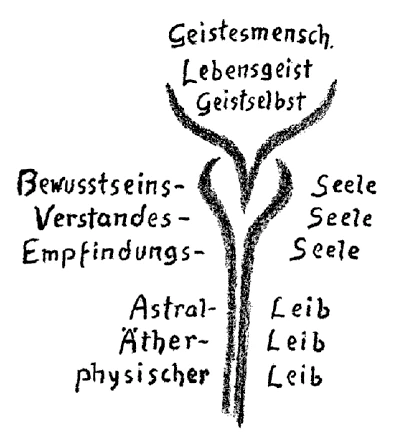
[ 13 ] In the soul of consciousness, the human being opens up, and the Spirit-Self or Manas, the Life-Spirit or Budhi, and the Spirit-Man or Atma come to meet him. This is, so to speak, something that comes to meet the human being from above as the spirit that fertilizes him. While the human being grows upward from below through the other members and opens up to the blossoming of the Son of Man, if he is to proceed further and receive complete I-consciousness, what must come to meet him from above is the Spirit-Self, the Life-Spirit, and the Spirit-Man. And who is the representative of that which is brought down to them from above—that which points toward humanity’s most distant future? We receive the first gift as the Spirit-Self. Whose representative is the one who will bring the gift of the descending Spirit-Self? It is the Son of the living God, the Life-Spirit, the “Son of the living God”!
[ 14 ] So at this very moment, Christ Jesus asks: What must reach humanity through my impulse? That which is the life-giving spiritual principle from above must reach humanity! Thus, the “Son of Man,” who grows from below upward, stands in contrast to the Son of God, the “Son of the living God,” who grows from above downward. We must distinguish between them. But we must understand that this question was a more difficult one for the disciples. The full difficulty of this question for the disciples will become particularly clear to you when you consider that the disciples first received everything that even the simplest people after the time of Christ Jesus had already been imbued with through the Gospels. The disciples first had to take it all in through the living teachings of Christ Jesus. Within the faculties they had already developed, there was no capacity to understand what could provide an answer to the question: Whose representative am I myself? It is pointed out here that one of the disciples, named Peter, gave the answer: “You are the Christ, the Son of the living God” (Matt. 16:16). At that moment, this was an answer that—if we may put it this way—did not come from Peter’s normal mental faculties. And Jesus Christ—let us try to bring this to life by appealing, so to speak, to the power of imagery—must have said to himself as he looked at Peter: It is significant that this answer came from his mouth, an answer that points, so to speak, to a time far in the future. — And when he then looked at what was in Peter’s consciousness—what was already present within him to such an extent that he could give such an answer with his intellect or with the powers he had attained through initiation—then the Christ must have said to himself: It does not stem from what Peter consciously knows; rather, it is those deeper forces within the human being that are speaking—forces that the human being only gradually transforms into conscious powers.
[ 15 ] We carry within us the physical body, the etheric body, the astral body, and the I. We ascend to the Spirit-Self, the Life-Spirit, and the Spirit-Man through the transformation of the forces of the astral body, the etheric body, and the physical body. This has often been described in elementary Spiritual Science. But the forces that we will one day develop in our astral body as the Spirit-Self are already present within our astral body; they have simply been developed there by divine-spiritual powers, not by us. And in the same way, a divine-spiritual Life-Spirit is already present within our etheric body. That is why Christ, looking at Peter, says: What is present in your consciousness at this moment did not speak from within you; rather, it was something that you will only develop in the future—something that is indeed within you, but of which you are not yet aware. What is already in your flesh and blood cannot yet speak in such a way that the words “You are the Christ, the Son of the living God” come to light; rather, it is the divine-spiritual forces lying deep beneath the threshold of consciousness—the very deepest ones residing within the human being—that are speaking. - The mysterious Higher Self within Peter—which Christ calls the “Father in heaven”—the powers from which Peter was indeed born, yet of which he is not yet conscious—these spoke through him at that moment. Hence the words: “It was not flesh and blood that revealed this to you, but the Father in heaven” (Matt. 16:17).
[ 16 ] But the Christ still had something else to say. He had to say to himself: In Peter, I see a nature before me, a disciple whose entire human constitution is such that the Father’s power within him is not disturbed by the forces that consciousness has already developed, nor by the entire manner in which spiritual activity operates; this subconscious human power is so strong that he can rely on it when he surrenders to it. “That is what is important in him,” Christ could say to himself. But what is present in him in this way is also present in every human being. It is simply not yet sufficiently developed in consciousness; that will only unfold in the future. If what I have to give to humanity—and for which I am the impulse—is to develop further and take hold of people, it must be grounded in what Peter has just spoken: “You are the Christ, the Son of the living God!” On this rock within the human being—which the surging waves of already developed consciousness have not yet destroyed—that which speaks as the Father’s power—upon this I will build what is to spring forth more and more from my impulse. - And when people develop this foundation, what will emerge is the humanity of the Christ impulse. - This is expressed in the words: “You are Peter, and on this rock I will build what a community of people can become—what a gathering of people who profess the Christ impulse can become!” (Matt. 16:18).
[ 17 ] As easily as the discussions flow today—for there is a particular controversy raging almost throughout the entire world over these words—these words, which are found in the Gospel of Matthew, are truly not to be taken lightly. They can only be understood if one draws them from the depths of that wisdom which is, at the same time, the wisdom of the mysteries.
[ 18 ] And now something else must be clearly demonstrated: namely, that Christ Jesus is truly building upon the deeper, subconscious power within Peter. For in the very next moment, Christ speaks of the events that are about to unfold. He begins to speak of what is to take place as the Mystery on Golgotha. And now the moment has already passed when that which lies deeper within Peter speaks; now what speaks within Peter is what is already conscious within him. Now he cannot understand what the Christ means by this, cannot believe that suffering and death are to occur. And where the conscious Peter speaks—he who has already developed his own conscious powers within himself—there the Christ must rebuke him, saying: “It is not some god speaking now, but rather that which you have already developed as a human being; this is unworthy of rising upward; it stems from a doctrine of deception; it comes from Ahriman; it is of Satan!” - This is contained in the words: “Get behind me, Satan! You are a stumbling block to me; for you are not setting your mind on the things of God, but on the things of man” (Matt. 16:23). Christ calls him Satan outright; he uses the very word “Satan” for Ahriman, whereas elsewhere in the Bible “Diabolus” stands for all that is Luciferic. Here, in fact, Christ uses the correct word for the deception to which Peter must still succumb.
[ 19 ] This is how things really are. What, then, has modern, popular biblical criticism made of this? It has concluded: It is simply impossible that Christ should stand before Peter and say to him on one occasion, “You alone have understood that a God stands before you!”—only to call him “Satan” on another occasion immediately afterward. And the biblical critics now say: We must therefore conclude that the word “Satan,” which Christ is said to have spoken to Peter, was inserted later by someone else—that it is, in other words, a forgery. - The only truth here is that the current opinion, based on philological research, regarding the deeper meaning of these words is worthless unless it is preceded by an objective understanding of the biblical documents. Only on the basis of an objective understanding of the Bible is it possible for a person to truly say anything about the historical origins of the relevant documents.
[ 20 ] But between these two words I have cited lies yet another. And we will only be able to understand this if we consider an ancient yet ever-new mystery teaching—the teaching that human beings, as they are on Earth, and not only individual human beings but every human community, are a kind of reflection of what takes place in the great cosmos, the macrocosm. We were able to describe this in particular when discussing the lineage of Jesus of Nazareth. We saw how that word spoken to Abraham actually means: “Your descendants shall be a reflection of the order of the stars in the heavens” (Genesis 22:17). What exists in the heavens—the order of the twelve constellations and the course of the planets through the zodiac—is to be repeated in the twelve tribes and in the experiences of the Hebrew people over the course of three times fourteen generations. Thus, in the succession of generations—with the unique pattern of inheritance through blood ties within the twelve tribes—a reflection of the macrocosmic relationships is to be manifested. This is what was said to Abraham.
[ 21 ] At the very moment when Christ Jesus stands before Peter—who, in his deeper nature, is able to comprehend what the Christ impulse actually entails—the spiritual power flowing down through the Son of the living God—Christ knows that he can point out to those present that something new is now beginning on Earth, that a new image can be given. While for Abraham the image of cosmic relationships was given through blood kinship, now an image of what a human being can become through his or her “I” is to be formed within ethical, moral, and spiritual relationships. When people come to understand, in the same sense that the better nature within Peter understands it, what Christ is, then they will not only establish communities and orders based on blood ties, but also those that consciously weave the bond of love from soul to soul. That is to say: Just as in the Jewish bloodline—in the threads that ran through the generations—was woven together what was to be woven together in the human race according to the model of the macrocosm, and just as what was separated in the human race was likewise separated according to the orders of heaven, so now, out of the conscious “I,” within ethical, moral, and spiritual relationships, that which separates people or holds them together in love should arise. Human social orders should be shaped or harmonized out of the conscious “I.” This is contained in the words spoken by Christ Jesus as a continuation of the answer he gave to Peter: “Whatever you bind on earth—whatever the deeper nature within you binds—is the same as what is bound in heaven, and whatever that same nature here below loosens is something that is also loosened in heaven” (Matt. 16:19).
[ 22 ] In ancient times, the entire significance of human relationships lay in blood ties. But more and more, however, human beings are meant to grow into intellectual, moral, and spiritual communities. When we consider this, we must say: What a person establishes as a community must become something meaningful to them. Speaking in anthroposophical terms, we can say: A person’s individual karma must be connected with the karma of communities. You are certainly already aware of this from what has been explained in past years. Just as it does not contradict the idea of karma when I give something to a poor person, neither does it contradict the idea of karma when a community relieves a person of what constitutes their individual karma. The community can share in the individual’s fate. Karma can be interconnected in such a way that the community shares in the individual’s karma. In other words, the following can occur in a moral context: An individual member within this community commits a wrongdoing. This will certainly be inscribed in the karma of the individual personality, and it must be worked out within the greater context of the world. But another person may come forward and say: “I will help you work through this karma!”—The karma must be fulfilled, but the other person can help him. In this way, entire communities can help the one who has committed a wrongdoing. An individual may have intertwined his karma with the community in such a way that, because the community regards him as one of its members, he consciously receives relief from something that concerns him; the entire community sympathizes with him and shares in the desire to help him improve—so that the community can say: “You, as an individual, have done wrong, but we stand up for you! We take upon ourselves what leads to the rectification of the karma.” - If one wishes to call the community “Church,” then the Church thereby takes upon itself the obligation to bear the sins of the individual, to share in his karma. This is not what is today called the forgiveness of sins, but rather a real bond, a taking upon oneself of sins. And this is precisely what the community consciously takes upon itself.
[ 23 ] If one understands “binding” and “loosing” in this way, then whenever sins are forgiven—if one understands this correctly—one should consider the obligation that arises for the congregation as a result. Thus, as the threads of the individual are woven into the karma of society as a whole, a net is formed. And this web, through what Christ brought down from spiritual heights, is meant to be, in its character, a reflection of the order in heaven; that is, according to the order of the spiritual world, the karma of the individual is to be connected to the collective karma—not in any arbitrary way, but in such a way that the community organism becomes a reflection of the order in heaven. Thus, for those who begin to understand it, this scene of the so-called Confession of Peter takes on an infinitely deep meaning. It is, so to speak, the foundation of the humanity of the future, built upon the “I”-nature. This is what takes place in this intimate conversation between Christ and his closest disciples: Christ transfers the power he brings down from the macrocosm to that which the disciples are to establish. And from this point on, the Gospel of Matthew depicts, step by step, the disciples’ ascent toward what can flow into them from the solar and cosmic forces that the Christ-Being gathers in order to impart them to the disciples. We know, of course, that one aspect of initiation is a stepping out into the macrocosm. And because the Christ is the impulse behind such an initiation, he leads his disciples—by guiding them—out into the cosmos. Just as the individual being initiated, when undergoing this initiation, consciously grows into the macrocosm and comes to know it bit by bit, so too does the Christ, as it were, traverse the macrocosm, revealing everywhere the forces that are at work and flowing in, and transmitting them to the disciples.
[ 24 ] I already pointed out yesterday how this happens. Let’s really picture the scene: A person falls asleep. Then the physical body and the etheric body lie in bed, while the astral body and the “I” have poured out into the cosmos, and the forces of the cosmos penetrate these bodies. If Christ were to approach him at that moment, he would be the being who consciously draws these forces to him and illuminates them. But this is precisely the case with the scene that is presented to us: The disciples are sailing along during the last night watch; then they see that what they had first taken for a ghost is Christ, who is allowing the power of the macrocosm to flow into them (Matt. 14:25–26). It is vividly depicted how he leads the disciples to the forces of the macrocosm.
[ 25 ] And the following scenes in the Gospel of Matthew depict nothing other than how Christ leads the disciples, step by step, along the paths that the initiate travels. It is as if Christ Himself had gone through this and, step by step, led His disciples by the hand to the places where the initiate is led. I want to tell you something that will allow you to see clearly how, step by step, Christ leads the disciples out into the macrocosm.
[ 26 ] When one has vivid insights into the spiritual world, and as one’s clairvoyant powers develop, one comes to know many things that were previously unknown. In this way, one learns to recognize, for example, the actual connection in the progressive stages of a plant’s growth. The materialistic mind will say of the plant: Here I have a flower—let’s assume a flower that bears fruit—from which a seed will develop. One can remove the seed, bury it in the earth; the seed rots, and a new plant appears, which in turn bears seeds. And so it continues from one plant sprout to the next. The materialistic mind will assume that something from the rotting seed is transferred into the new plant. The materialistic mind cannot help but think that, no matter how small or minute it may be, something material must be transferred. But that is not the case. In fact, in terms of the material, the entire old plant is destroyed. A leap occurs in terms of the material, and the new plant is, materially speaking, something entirely new. A new formation actually takes place.
[ 27 ] One comes to understand the most important relationships in the world by learning to grasp this peculiar law and apply it to the entire macrocosm—namely, that leaps do indeed occur in relation to material conditions. This was expressed in a very special way in the Mysteries. It has been said: As the initiate steps out into the cosmos, he must, at a certain stage, come to know the forces that bring about these leaps. Now, one comes to know something in the cosmos when one moves in a certain direction, which is expressed by using the constellations as a guide. These constellations are then like letters. When we thus expand outward in a certain direction, we experience the leap from the predecessor to the successor, whether in the realm of the plant, the animal, the human, or in the realm of planetary existence; for even, for example, in the transition from Saturn to the Sun, all that was material was lost. The spiritual remained; all that was material dissipated. It was the spiritual that brought about the leap. The same was true during the transition from the Sun to the Moon, and from the Moon to the Earth. This is true on the smallest and the largest scales. — There are now two symbols: an older one, which was used to represent this in a more figurative, imaginative manner, and a newer symbol representing this leap. You can find the new symbol in calendars. As evolution continues, the old symbol curls inward, much like a spiral, and the new evolution then emerges from the old as a second spiral, proceeding from the inside out. But the new evolution does not continue in such a way that it immediately follows the old; rather, there is a small leap between the end of the old and the beginning of the new, and only then does it continue.

[ 28 ] This is how we arrive at this figure: two spirals intertwined, with a small gap in the center—the sign of Cancer, which is meant to symbolize our expansion into the macrocosm and represent the emergence of some new offshoot within some evolutionary process.
[ 29 ] There was yet another symbol used to represent these relationships. As strange as it may seem to them, it was designed to depict a donkey and its foal—the ancestor and the descendant. This was meant to represent the actual transition from one state to another. And in fact, even the constellation Cancer is very often depicted in ancient illustrations as a donkey and its foal. It is not unimportant to know this. It is an important lesson for human beings to understand that even in the ascent into the macrocosm there is such a significant transition: as a person ascends into the spiritual world, they must then build upon entirely new insights, This is depicted quite accurately in the language of the stars, as if the physical sun were passing through the constellation of Cancer and, after reaching its highest point, were then descending again. It is the same when the initiate first undergoes the ascent into the spiritual world to become acquainted with the forces, and then, having recognized them, brings these forces back down to make them serve humanity.
[ 30 ] The fact that Christ Jesus demonstrates this to his disciples is recounted in the Gospel of Matthew (Matt. 21:1–11) as well as in the other Gospels. And it is recounted that he does not work through the mere word, but rather that he presents to his disciples the imagination—the living image—of what he himself is accomplishing as he moves toward that height to which humanity is to ascend through its development over time. Here he uses the image of the donkey and its foal; that is, he leads the disciples toward an understanding of what, in spiritual life, corresponds to the constellation of Cancer. This is thus an expression of something that took place in the spiritually alive, spiritual relationship between Christ and his disciples. And this is something of such majesty and grandeur that it cannot be expressed by choosing human words from any language, but only by Christ leading the disciples into the conditions of the spiritual world and creating for them, within physical conditions, images of the macrocosmic world. There he leads them up to the point where the powers of the Initiate once again become available to humanity. There he stands at a height that can only be hinted at when he says: He stands at the height of the Sun in the sign of Cancer! No wonder, then, that the Gospel of Matthew points out at this point that the Christ-life has reached its zenith during its time on Earth, and powerfully emphasizes this with the words: “Hosanna in the highest!” Every word is chosen so that, through what is happening there, the disciples may mature, so that in turn, through what is taking place within them, that which Christ Jesus was able to bring into the development of humanity may also mature within humanity.
[ 31 ] And the Passover story that follows is nothing other than the now-living infusion of what was first meant to be infused into the disciples as a teaching and then is to be magically infused into humanity through the forces that emanated from the Mystery of Golgotha. This is how we must understand the further course of the Gospel of Matthew. We will then also understand how the writer of the Gospel of Matthew always remained conscious of the fact that he must, so to speak, draw attention to the contrast between the living teaching—which was heard from the cosmic heights and applies to the disciples—and that which may confront outsiders who are not receptive to the forces of Christ Jesus himself. That is why we encounter these explanations in the discussions with the scribes and Pharisees, which we will consider tomorrow. Today, however, we would like to point out that Christ Jesus, after having guided his disciples as far as possible and allowing them to participate in the places to which the initiate is led, also held out the prospect that, if they follow this path, they themselves will experience growing into the spiritual world of the macrocosm. He tells them that they themselves possess the predisposition for initiation, that it lies ahead of them, and that they will extend their lives into the macrocosmic world, where they will be able to recognize more and more the true nature of the Christ as the Being who fills all spiritual realms and who found his image in Jesus of Nazareth. Christ had to tell his disciples that they would mature toward this initiation, that they would become initiates of humanity. He was also able to point out to them that one can only grow into independent initiation by allowing one’s inner being to mature through patience and perseverance.
[ 32 ] What, then, must develop within a person as their inner being grows ever more powerful and as they develop the clairvoyant, higher power? Their innate capacities must develop in such a way that they can receive the powers of the Spirit-Self, the Life-Spirit, and the Spirit-Man. But when that power from above will shine into him—the power that makes a person an initiate, a participant in the realms of heaven—that depends on the moment when the person can become ripe; it depends on the karma of the individual. Who knows this? Only the highest initiates know this. Those who stand on lower stages of initiation do not yet know this. If any individual is ripe to grow into the spiritual world, then the hour of that growth will come for them as well. Certainly, it will come, but it will come in such a way that the person does not anticipate it; it will come “like a thief in the night” (Matt. 24:43). But how does a person grow into the spiritual world?
[ 33 ] The ancient mysteries—and, in a certain sense, the more recent ones as well—had three stages for macrocosmic initiation. The first stage was that in which the human being grew into it to such an extent that he perceived everything that can be perceived through the Spirit-Self. There he is not merely a human being in the new sense, but has grown up to what, in the sense of the hierarchies, is called the angelic nature; this is the hierarchy immediately above the human being. Thus, in the Persian Mysteries, one who grew into the macrocosm so that the Spirit-Self was active within him was called either a “Persian”—because such a person was no longer an individual but belonged to the angel of the Persian people—or such people were directly called angels or divine beings. The next stage is then the one in which the Life-Spirit awakens accordingly. A person at this stage was called either a “Sun Hero” in the sense of the Persian mysteries—because he then absorbed the power of the sun, developing upward from below toward the forces of the sun, where the spiritual power of the sun met the earth—or he was also called a “Son of the Father.” And the one into whom the Atma, or the Spirit-Man, reached was called the “Father” in the ancient mysteries. These were the three stages of the initiate: angel, son or sun hero, and father.
[ 34 ] Only the highest Initiates can judge when Initiation can awaken within a person. That is why the Christ said: “Initiation will come as you continue along the paths I have now led you on.” You will ascend into the realms of heaven, but the hour is known neither to the angels, who are initiated into the Spirit-Self, nor to the Son, who is initiated into the Life-Spirit, but only to the highest initiates, who are initiated into the “Father.”—Thus, a passage from the Gospel of Matthew speaks to us here once again, one that is in perfect harmony with the mystery tradition. And we shall see that the proclamation of the Kingdom of Heaven is nothing other than the prediction to the disciples that they will experience initiation. Christ Jesus in the Gospel of Matthew speaks specifically about this (Matt. 24). If one reads the passage in question correctly, it becomes abundantly clear that Christ wishes to draw attention to certain teachings that were circulating at the time regarding ascending into the kingdoms of heaven. People had interpreted this ascent into the realms of heaven in a material sense, believing that the entire earth would ascend, whereas they should have known that only individual candidates for initiation ascend through their initiation; that is to say, the view arose among some that a material transformation of the earth into heaven would soon take place. And Christ draws special attention to this when He says that there will be those who make such claims. He calls them false prophets and false messiahs (Matt. 24:24). It is therefore quite strange that even today some interpreters of the Gospels still fabricate stories claiming that the notion of a physically approaching Kingdom of God was a teaching of Christ Jesus Himself. Anyone who can truly read the Gospel of Matthew knows that what Christ Jesus means is a spiritual process to which the initiate grows, but to which, in the course of Earth’s evolution, all of humanity—those who hold fast to Christ—will also grow, though this growth will occur as the Earth itself becomes spiritualized.
[ 35 ] “From this perspective, too, we must look more deeply into the entire structure of the Gospel of Matthew, and we then come to feel a profound reverence for this Gospel, particularly because—as it were—no other Gospel so readily leads us to literally eavesdrop on how Christ Jesus first instructs his disciples from the standpoint of the ‘I.’ We see his disciples standing around him and observe how the forces of the cosmos work through the human body. We see how he leads his disciples by the hand so that they may come to know what the initiate can learn. We overhear the human relationships that can form around Christ Jesus. This is what makes the Gospel of Matthew such a deeply human work. Through the Gospel of Matthew, we truly come to know the man Jesus of Nazareth, the bearer of Christ. We come to know everything he accomplishes by condescending into human nature. Indeed, even the celestial events are clothed in such truly human circumstances in the accounts of the Gospel of Matthew.
[ 36 ] As this is also the case for the other aspects—not just for the circumstances of initiation—I will discuss this in the next and final lecture.