

The Connection Between Man
and the Elemental World
GA 158
9 November 1914, Dornach
Translated by Steiner Online Library
First Lecture
[ 1 ] By inserting a brief reflection into our lectures, I hope to help us gain a deeper understanding of what has already been said—particularly those points related to the design of our building—and to enable us to add further insights in the future that will be better understood through an episodic reflection such as the one we will have today.
[ 2 ] We know that the human soul appears to us as being divided into the soul of sensation, the soul of understanding or emotion, and the soul of consciousness. We know that the human “I” works within these three soul components, just as described in Theosophy. Now, there is indeed much going on in human nature that does not enter consciousness in the way it actually occurs. It is precisely Spiritual Science knowledge that can gradually lead to much of what lies in the depths of the human soul being illuminated by the light of consciousness. But when the human soul lives in this way, it illuminates, as it were, only a small part of the entire soul’s horizon, and beneath this horizon lies much that has deep, deep significance for the soul but does not become conscious in ordinary life—which, in a sense, is far more significant for the shaping of the human soul than what is conscious. Above all, let us now turn our gaze to something that usually does not come to consciousness. For people today, it is even quite beneficial that this does not come to consciousness. But we shall see later that this was not always the case for all people. If only the ordinary everyday consciousness of human beings were to deepen just a little and were able to bring up what, I would say, is only one degree more unconscious than ordinary consciousness, then the human soul would very soon realize that it is the triad of which we have spoken, that it is really not simply a unity, but a triad. I have indicated in the treatise “How Does One Attain Knowledge of Higher Worlds?” that when a person begins to advance toward the spiritual worlds, they, as it were, fall apart into a triad. And as soon as one, as I said, looks just a little into the, so to speak, veiled part of consciousness, one very soon notices that this triad of the feeling soul, the intellectual or emotional soul, and the conscious soul is there. Beneath the threshold of consciousness—and not particularly deep for modern human beings—there truly is a kind of soul realm that is permeated not by a unity, but by a kind of triad, by the radiance of this triad, so that the moment a person pushes back what they have, in essence, only fully attained since the second half of the fourth post-Atlantean period and only clearly since the beginning of the fifth post-Atlantean epoch—that is, as soon as a person pushes this back—they can distinguish precisely between three worlds or realms within their soul. One realm is one that is more inspired, into which dreamlike, dreamy inspirations enter. The second realm is that through which the human being, as it were, animates himself, building himself up in the physical parts. And the third realm is that where he receives consciousness of the world.
[ 3 ] The first realm, then, is that into which inspirations enter—dreamlike inspirations that fill the soul, which is bound to the sensory soul. A second realm, where the soul builds up its body, as it were, through its own inner formations and creations, is connected to the intellectual or emotional soul. This is the inner master craftsman, the architect; we could also say the smith of the physical body. And the third, the mediation of external cognition, which enters into connection with the world bound to the senses—and is connected to the physical world in general—is bound to the conscious soul. We can therefore say: connected with physical forces.
[ 4 ] A kind of trinity of the soul reigns at the very depths of the human soul, and this trinity is counterbalanced by the influence and activity of that which strives toward unity. I wish to illustrate this by contrasting, as it were, one particular realm of the soul with another (see the following diagram). In a certain sense, this realm of the soul acts in a way that is entirely unified within itself. However, what acts in a naturally unified way is, as it were, that which the soul is in terms of its temperament and character—that which rests deep within the soul, yet as a unified soul. I would like to designate this as the “soul of unity,” in contrast to the “trinity.”
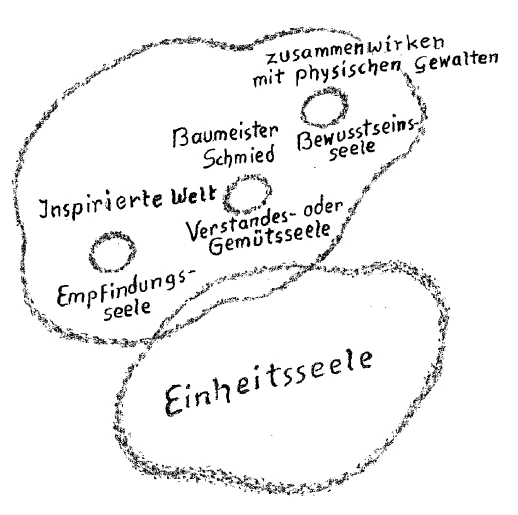
[ 5 ] Just as our soul is now, this soul of unity cannot emerge from a certain dull existence unless it is, as it were, illuminated from above. And in our time, this illumination always emanates in some form from the Mystery of Golgotha, so that I will symbolically sketch for you what shines into the unified soul in some way: some form in which the Mystery of Golgotha shines into the unified soul. Now, over the years, we have indeed devoted a great deal of effort to gradually forming a mental image of just how infinitely vast is everything connected with the Mystery of Golgotha. You can therefore imagine that when the Mystery of Golgotha shines into the human soul in some form, it is always only a certain stage, a certain degree of the Mystery of Golgotha. But we have a mental image of the situation in which the soul of unity is something that broods, as it were, in a subdued manner, yet contains what is particularly valuable for our time. As a result, this unity must be permeated in some form by the Mystery of Golgotha.
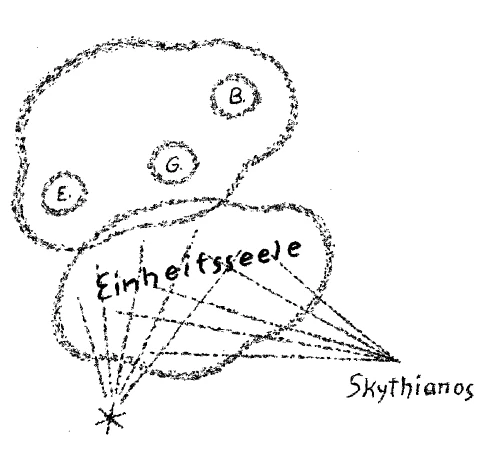
[ 6 ] Now, what emanates from the various centers of inspiration and initiation around the world penetrates into every soul, and this also forms part of the subconscious influences within the human soul. You see, the effect of the Mystery of Golgotha is comprehensive, universal; yet human beings, the human soul, can only receive this Mystery of Golgotha in a specific way. The center of initiation that works particularly deeply into the innermost part of the soul, so that the innermost part of the soul may be properly prepared to be permeated by the Mystery of Golgotha in a special way, I have often discussed in the past by saying: The initiate Skythianos always stands before this center of initiation. — Let us therefore assume that the soul has been prepared within the unity soul for what comes from the Mystery of Golgotha, ready to receive it through what works unconsciously into every soul from Skythianos.
[ 7 ] Here, as it were, we have divided the human soul into two realms: into one realm, which is a triunity, and into another realm, which is a unity: into a more spiritual realm and into a more natural, temperamentally brooding realm, I might say, into a realm that incorporates into its natural foundation, on the one hand, the forces of the Mystery of Golgotha and, on the other hand, the influences of Skythianos.
[ 8 ] Now, this unity cannot simply merge with the trinity; that would not be possible, and that is why this trinity remains below the threshold of consciousness for people today. This trinity is, as it were, drowned out; awareness of it must be extinguished. If the soul could truly descend to the trinity, it would immediately feel itself as a trinity, not as one. It would say: There is something within me that inspires me, something that builds me up, that forges me together, and something that is connected to the outside world. But this triad must, as it were, be obliterated or overshadowed by something that leads the human being, in a psychological sense, to say: I do not distinguish the three. — So something must shine into the three that causes the soul not to perceive the three within itself, that obliterates these three, allowing them to exist in relation to one another as if they were misty formations.
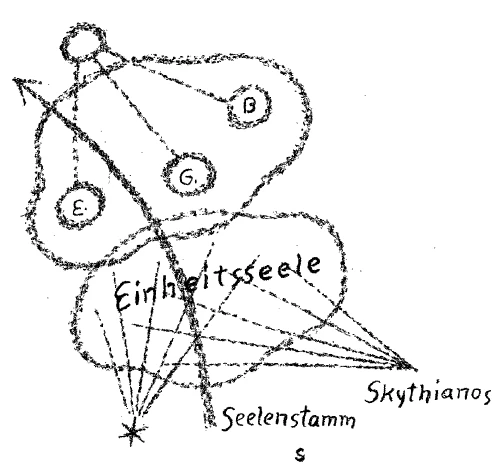
[ 9 ] You see, the connection can exist between what is meant to live as unity in the soul and what is present in the soul as a trinity only if there is communication, a kind of exchange—as it were, a kind of soul-stem that leads to the extinguished trinity and that emanates from what is unity, but is illuminated from two sides, so to speak, so that it is not merely a dull, uniform unity of nature corresponding to character and temperament, but is uniformly illuminated by what the human being is meant to be: by the consciousness of the human soul in its connection with the divine-spiritual Being. In fact, I have recorded here something that rests at the very foundation of every human soul. Not a single human soul in our time can exist without all these things being present within it.
[ 10 ] But now imagine the following. I have repeatedly emphasized this very point here to illustrate what our structure should be: that what lives within the human soul is also expressed outwardly, so to speak, in the external evolution of the Earth. If there is such a realm within the human soul that truly represents a kind of trinity—a realm that in today’s human beings is, as it were, already overshadowed by ordinary consciousness—then we must find a stage of evolution where this confronts us externally: where the soul truly experiences itself as a trinity, as it were, unfolded into three soul members. In other words, there must once have been a people who perceived these three soul members as distinct and who felt that, fundamentally speaking, the unity was perceived much less in the soul than the trinity, since the trinity was still conceived in connection with the cosmos. This people existed in Europe and left behind a significant cultural monument, of which I have spoken before. This people, who once—and specifically in that part of Europe where it had to be—perceived this triunity in the soul, is the Finnish people. And the expression of this cultural stage is laid down in the Kalevala. In what is depicted in the Kalevala, there is a clear awareness of the trinity of the soul, so that the ancient seers, whose seership forms the basis of the Kalevala, sensed: There is something inspiring in the world with which a part of my soul is connected—my feeling soul. It tends toward it, its forces flow toward it, and it receives its impulses from there. — As it were, this people or these ancient seers perceived something human-divine or human-heroic as the source of inspiration for the feeling soul. And they called it Wäinämöinen. This is nothing other than the source of inspiration for the feeling soul within the cosmos. All the destinies described in the Kalevala as the destinies of Wäinämöinen express that this consciousness once existed among a people who were widely spread across the northeastern part of Europe, and who perceived the three soul-members as distinct, with the feeling soul inspired by Wäinämöinen.
[ 11 ] Likewise, this people—as these ancient seers perceived—felt that the intellectual or emotional soul is, as it were, an extra limb of the soul that receives its impulses for forging; they perceived that what forges within the human soul, what builds it up, receives its inspiration from another elemental, heroic being, from Ilmarinen. Just as Wäinämöinen corresponds to the feeling soul, so in the Kalevala Ilmarinen corresponds to the intellectual or emotional soul. If you read the lecture on the Kalevala, you will find all of this there.
[ 12 ] And this people felt just as strongly — this must be noted — that in those days the soul of consciousness was perceived as that which first makes a human being a conqueror on the physical plane; these ancient seers perceived in Lemminkäinen a being connected with the forces of the physical plane, an elemental, heroic being in the inspirer of the soul of consciousness. Thus these three—one might say, heroic figures, speaking by analogy with other epics—originate from the ancient Finnish people, inspiring the threefold nature of the soul.
[ 13 ] What is remarkable is the connection between Ilmarinen and what is being forged there. I have already hinted at this. Humanity itself is forged from the elements of nature. This being, forged from all the atoms of nature—pulverized and then forged together—is depicted in a magnificent tableau in the forging of the Sampo in the Kalevala. And the fact that this formation of the human being from these three soul elements has once taken place, must then, as it were, enter into a Pralaya, and then emerge again, is also depicted in the Kalevala: just as the Sampo is lost and found again, so too is that over which a darkness of consciousness has initially spread found again.
[ 14 ] And now let us imagine that to the south, or rather to the southeast, there stands another people who, in ancient times, first developed those soul qualities of which I have spoken—the unifying principle in the soul, that which expresses this unifying principle in character traits, in dispositions, and in temperamental qualities. This people is a Slavic people, while the people standing opposite them is the Finnish people. This Slavic people receives its influences from Skythianos, who also lived for a time in ancient times surrounded by the ancient Scythian people. It is by no means necessary for a highly developed people to live around an initiation center; rather, what is necessary must happen in the course of development. And the penetration of a certain form of the Mystery of Golgotha is the penetration of Greek-Byzantine culture into Slavic culture. What I have described here as a center of Greek-Byzantine culture, you may, if you wish, regard as Constantinople on the map of Europe, for that is essentially Constantinople.
[ 15 ] So we now have souls who find themselves imbued with a Slavic archetype. These are souls who, on the one hand, are connected to that which can lead to a unified being through the Mystery of Golgotha—which can prepare them for Christianity as unified souls—and who, on the other hand, receive the Mystery of Golgotha in a very specific form, something like the inspiration and influence of the Mystery of Golgotha as it originated in Byzantine Greek culture.
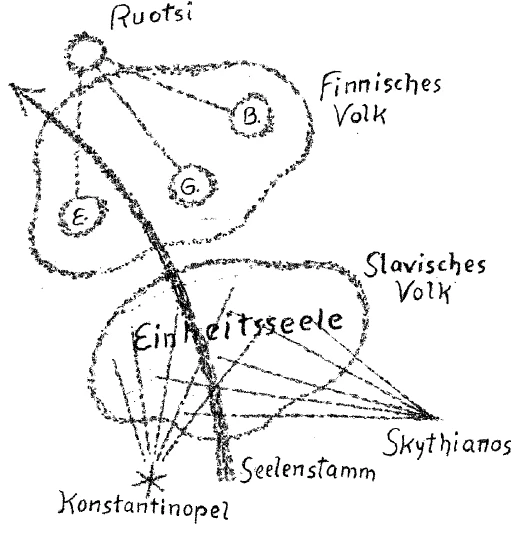
[ 16 ] But now something else must come into play, as it were, from a certain point. What existed among the Finnish people as the division, the separation into the three parts, the essence of which is so magnificently contained in the Kalevala, must be eradicated. This can only be eradicated if an influence comes from outside; it can only be eradicated by the emergence, as it were, of a people or a section of the people who are predisposed from the outset to feel not the Trinity but unity in the soul—not the unity derived from the Mystery of Golgotha, but the unity one possesses, as it were, by nature. If one considers the Finnish people, one finds them particularly predisposed to develop an awareness of the Trinity. And one cannot express this Trinity in its relationship to the cosmos more significantly than it has been done in the Kalevala. But then, in the North, this had to be whitewashed over, obscured by that which, as it were, extinguishes the awareness of this Trinity. A tribe moved down there that naturally carried within its soul what was then the striving for unity—something that found expression in a completely different way, on a completely different level, in Goethe’s Faust, but also in Faust in general—something that knows nothing of the threefold nature, that strives for the unity of the ego. Here, still at a primitive level, this has an erasing effect on the three soul members.
[ 17 ] But the Finnish people were a people who still felt things in a natural way; otherwise, they would not have perceived the three aspects of the soul. That which flows in, obliterating the trinity—this flowing-in, this pressing-in—was perceived as an r r r; and because it was perceived as something that, one might say, is best expressed in occult language by the letters, by the sounds u u o, so that one might say: It is approaching; one must actually be wary of it, as it breathes forth in the r r u u o and takes hold, whatever is perceived through the tau, t, when it penetrates into the human soul. Just as the penetration into the human soul in the case of the ancient Jehovah is expressed through the s, through the Hebrew “Shin,” so this penetration into the soul in general is expressed through the s-sound. All of this is connected to what penetrates the soul and takes hold in the soul; all of this pushes toward the i, whose meaning is well known—among the Finnish people, that which is connected to the r r u u. Hence they perceived this rutsi, ruotsi, and hence they called the peoples who press down there the Rutsi, Ruotsi. And the Slavs gradually adopted this name, and because they associated themselves with that which presses down from above—what the Finns called it—they called themselves Rutsi, which later became the name Russians.
[ 18 ] So you see, everything that is recounted in history had to happen: that the peoples living here below called upon the Varangian tribes—who were actually Norman-Germanic tribes—to join forces with the Slavic tribes. Underlying this is something that had to be, that was necessary due to the nature of the human soul. And so came about what later entered European folklore from the East of Europe as the Russian element. So everything I have spoken of truly lives within the Russian element. Above all, that Norman-Germanic element lives within it; it even lives within the name from which the name “Russian” is derived, for it came about in the way I have indicated.
[ 19 ] The Kalevala profoundly expresses that the greatness of the Finnish people lies in the fact that they actually prepare for unity through the trinity, and through the dissolution of the trinity, they prepare to receive that unity which is no longer merely human unity, but divine unity, in which lives the divine hero of the Mystery of Golgotha.
[ 20 ] In order for a group of people to be able to receive what comes to them, they must first be prepared. In this way, we gain an impression of everything that must take place internally so that what confronts us externally can be realized in the course of development. I said that the Kalevala expresses in a magnificent way that the Finnish people had to provide this preparation, in that the Mystery of Golgotha is introduced into the Kalevala in a unique way at the end. Christ appears at the end of the Kalevala, but as he casts his impulse into Finnish life, Wäinämöinen departs from the land, which expresses that the originally great and significant element that entered Europe through the Finnish element is a preparatory stage for Christianity and receives Christianity as a message, as a message from without.
[ 21 ] Just as we see with the individual human being that he must, as it were, be prepared in an extraordinarily complex way so that his soul may then find, from a wide variety of sources, what it needs to live in a particular incarnation, so it is with peoples. A people is not something entirely subtle or homogeneous, but rather something into which many elements converge. The people living over there in the East—all of that has converged within them. And everything that is inwardly spiritual, one might say, is indicated outwardly—albeit only in a subtle way. I have said that among this people there must be a soul-stem that leads from below to above, or conversely from above to below, if it is a unifying soul-stem. This was present in a mighty road that ran from the Black Sea to the Gulf of Finland, and along which an exchange took place between the Greek-Byzantine cultural element and the natural element of the Rutsi.
[ 22 ] Throughout the course of their various incarnations, human beings must go through many different experiences. One incarnation must always build upon the next. A human being can achieve this only when the forces through which human evolution can later take place truly converge, as it were, into the substance, into the material from which the individual peoples and their members are formed. A human soul must eventually find, in its incarnations, a physical form that has coalesced from the forces I have described here. And what is so simply said—that a human being is born as a Russian—has its profound, its colossally profound significance. A human being is born as a Russian means: through the various incarnations, they have arrived at the point in their earthly life where they can experience what can only be experienced by passing through a life between birth and death in a physicality that has been brought together in this way. If one were not to live through this in such a body, something would be missing in what one acquires from incarnation to incarnation. Foolish people—I say this without any emotional connotation, but rather as a technical term—have repeatedly cited the saying: “One understands the world best in its truth when it appears to one in its simplicity.”—That is not true; it is merely convenient. Deep minds have always expressed this—most forcefully, perhaps, for the last time, by Ralph Waldo Emerson—that one penetrates to the truth of facts only when one recognizes them in all their complexity. It is not so simple, that which lives in the world and is connected to the entire evolution of the world.
[ 23 ] And just as it is in the eastern half of the European peninsula, where souls are prepared to experience something special, so it is in all other regions of the Earth’s surface: the individual national characters are shaped in a complex manner. Now, above all, remember one thing that we have come to know well in the course of our reflections on Spiritual Science.
[ 24 ] In a sense, once a person has passed through the gate of death, they are, by looking back on their last earthly life, dependent on what they experienced in that life. We know that connections with the previous earthly life continue to influence life after death for many years. But this must be so. A human being must go through a physical incarnation so that, in this time between death and a new birth, they have certain memories of this previous incarnation, and certain impulses from this previous incarnation continue to reach them. Because they were a very specific human being with a specific organism, subject to certain influences determined by earthly conditions, the impressions that go back in memory continue to have an effect, so to speak, even after death. These are thereby influenced; they take on a certain nuance. This is the nuance that a soul receives by having passed through a specific nationality, which it derives from that particular nationality. This is shed more and more as the national gives way to the international. But today this is still present to a great extent; otherwise, today’s events could not have taken place. To a certain extent, people still look back on what they experienced through their organism—insofar as it is nationally determined—in the previous life between birth and death. Now, the souls that pass through bodies in the manner described today—bodies that have been prepared in precisely this specific way—are prepared in a very specific manner for the life they will embark upon after passing through the gate of death. Individuality is, of course, not affected; only that which is, as it were, the clothing, the covering of the actual individuality. But these clothes or coverings, with which nationality is connected, provide something that the soul retains even after death—something of which it knows that it was part of its passage through earthly life.
[ 25 ] When the soul has passed through a body that has been prepared in this way—exoterically, one would say, a body that has passed through a Russian body in an incarnation—it naturally takes on the nuances of the outer shell, which after death becomes a mental image that one has of oneself, just as one otherwise has mental images of oneself. Into this it has absorbed everything that is expressed here (see drawing $49) in this way, and if one wishes to describe what the soul undergoes internally by having such a composite body, one can say the following. Do we not know from our previous considerations that consciousness changes in a certain way after death; it attains a higher degree, becomes clearer and more intense after death than it is in a physical body? Having gone through what was previously described prepares the soul to enter into a particularly intimate relationship after death with those beings who, like special guardian spirits, live above the actual human individualities and belong to the next higher hierarchy, the hierarchy of the Angeloi. In the life after death that follows a Russian incarnation for a soul, it is, as it were, predisposed to identify in consciousness with its Angelos, to view the spiritual world, so to speak, to use a crude expression, through the eyes of the Angelos.
[ 26 ] Human beings strive toward the higher self. This higher self expresses itself in a wide variety of ways. Read the last Munich lecture series on “The Mysteries of the Threshold.” There you have explained how consciousness becomes something else, as it were, as the soul interpenetrates with the Angelos. It must interpenetrate with it and prepares itself for this interpenetration with the Angelos by entering through the gate of death into the spiritual world after life in a Russian body, which has been prepared as we have described. So that we can say: The one who has passed through a Russian body actually feels everything in nuanced detail after death because their entire being is permeated by an Angelos, the guardian genius of the next higher hierarchy who protects all human beings.
[ 27 ] But among the peoples of Western culture, the influence of the Angelos is less pervasive; after death, one is less deeply imbued with its essence. When one goes through a Western incarnation, one tends to experience the following after death: I still feel as I have always felt; I still look at the world as I have always looked at it. — One perceives it as a special art to grow together with one’s Angelos. For members of the Russian people, it is something natural to always be with their Angelos. On its path through incarnations, the soul passes through all manner of nationalities and must also pass through this incarnation, where it receives the impulse to merge more fully with the Angelos, to grow together with the Angelos, and to gaze into the spiritual world with its spiritual eye.
[ 28 ] Of course, this refers more to the period immediately following death—the next few years or one and a half to two decades—than to other periods between death and rebirth, for during the main period before and after the “midnight” I have already spoken of, the soul sheds such things. This therefore refers to the time when the person is still influenced by what they experienced in the physical body, when that is still having an effect.
[ 29 ] And now, having discussed this, let us turn our gaze to the spiritual world—as it were, to the inner realm of the world in which we live—by adding to our consideration the fact that it is only in keeping with the limited human senses to believe that one is surrounded solely by physical human beings. They are always also surrounded by the departed, by those who live in the spiritual world. Thus, we have around us departed souls who have passed through physical, Russian bodies, who have a great inclination—more so than angels, I would say—to live in their present state of being as souls rather than as human beings.
[ 30 ] Following such an incarnation, a particularly distinctive feature arises: the etheric body dissolves into the surrounding etheric world with exceptional speed, whereas among Western peoples the etheric body is more compact, holds together more firmly, and dissolves more slowly into the surrounding etheric world. But we are now already living in a time—namely since the last third of the 19th century, as I have often indicated—when Michael has assumed dominion in the spiritual world, after Gabriel had previously reigned. We now live in a time when these conditions are particularly prominent in the spiritual world; what has been described is having a particularly strong effect in the spiritual world. For it is incumbent upon our time to prepare for the great event that I already hinted at in the first Mystery Drama, “The Portal of Initiation”: the appearance of the Christ in a spiritual form before humanity. This event of the appearance of the Christ, as Theodora has indicated, can only be brought about if Michael’s dominion spreads more and more. This is still a process in the spiritual world. As it were, on the plane adjacent to our world, Michael is fighting for the approach of the Christ. He needs his hosts, his warriors, for this. Now important warriors are being provided to him—significant hosts drawn from those souls who have passed through a Russian body in their present incarnation. Thus we can observe, as it were, a kind of conquest campaign by Michael in the spiritual world to bring about the coming of the Christ. To this end, he is recruiting a host, a group of important warriors from among the souls who have passed through Russian bodies, because they are predisposed within themselves to identify with their Angelos. This makes them particularly suited to summon the forces necessary to present, in purity, the image through which Christ is to appear. So that he does not appear in a false form, in subjective human imagination, so that he appears in the correct image, Michael must fight the battle I have indicated. He can fight it especially through those souls who naturally carry this Angelos consciousness within themselves. This makes them particularly prepared. Also, because their etheric body dissolves particularly easily, they have nothing in their etheric body that would cause the Christ to appear in a false form, in false imaginings.
[ 31 ] In order for everything that is to happen in the world to happen correctly, various elements within the world order must work together. Now, in order for what I have described to happen—take this quite objectively—a peculiarity must be combated that is more prevalent in the West, especially among souls who have passed through a French incarnation. These souls acquire from their nationality the peculiar trait of holding fast to their etheric body, of retaining a very specific imaginative form within the etheric body for a long time. This cannot be combated by Western souls alone; rather, these Western souls must, so to speak, be assisted in this, and work must be done to disperse these etheric bodies into the general world ether, so that a false image of the Christ appearance is not evoked. Thus, the hosts fighting under Michael must work together to combat those souls who have passed through French bodies.
[ 32 ] This is precisely what clairvoyant consciousness was able to perceive—from the last third of the 19th century right up to the present day—as the foundation of our current evolution. More and more, a spiritual struggle developed in the spiritual world, in the astral world, between Russia and France—naturally in the spiritual realm that underlies them—and this struggle grew ever stronger and stronger. A struggle in the spiritual world actually means interaction in the physical world, but it is already an image of the struggle, of the opposition, and those who look into the spiritual world have witnessed, from the last third of the 19th century right up to our own time, an ever-increasing intensification of a spiritual struggle between West and East, across Central Europe—the struggle in heaven, one might well call it that, which consists in the fact that, under the rule of Michael, ever greater multitudes have been gathered in the East to combat all that might prevent—in the West, which is sinking ever deeper into materialism—the appearance of the Christ.
[ 33 ] Yes, my dear friends, where there is a highly developed culture—a culture as fully formed and mature as that of France—the soul has adopted certain mental images. These images remain after death, but they prevent something entirely new from emerging, something that must come through Christ. Therefore, what passes from a fully matured culture into the souls must be combated, above all in the spiritual world. Michael cannot choose his hosts from a fully matured culture; they are suited to a specific imagination; these imaginations must first be eradicated. Hence the grandiose image behind the scenes of the spiritual world: the struggle of the East against the West, the host of Michael against the souls of the West that have become independent.
[ 34 ] And you see, the outward physical expression of a spiritual struggle is a physical alliance. What unites on the physical plane thereby expresses that it is engaged in a struggle on the spiritual plane. One becomes allies on the physical plane when, on the spiritual plane, it is necessary to fight one another. From this, you can see once again how seriously we must take the concept of maya and truth. Time and again the words “maya” and “truth” are spoken, but they remain mere theory; for whoever looks into the spiritual world and observes there what underlies the physical world is overcome by a feeling of the most tremendous shock when, in earnest, they penetrate from maya to truth and find the truth behind what lives in maya. The truth must often be expressed in words quite different from those used on the physical plane.
[ 35 ] What is called an alliance on the physical plane is often called war on the spiritual plane. Of course, one must not draw false conclusions by seeking the opposite in the spiritual realm of what one finds on the physical plane, for this is not true of all things. One must seek the reality of things in the spiritual realm. In some cases, it is certainly true that what happens on the physical plane can be a direct reflection of what happens in the spiritual world. In other cases, there is a colossal contrast, such as here between the East and the West, where on the physical plane there is an alliance in maya, and in the spiritual world a struggle of infinitely greater significance. For through this struggle, a true image is to gradually emerge from the etheric world—an image of the Being who, in our time, in the course of the 20th century, is to approach humanity: Christ.
[ 36 ] We will continue with such reflections at the next opportunity. But I ask you to take matters such as those discussed today very seriously, for I assure you that when one encounters them for the first time, they are quite shocking.