

The Connection Between Man
and the Elemental World
GA 158
9 November 1914, Dornach
Translate the original German text into any language:
Versions Available:
The Connection Between Man and the Elemental World, tr. SOL
Erster Vortrag
First Lecture
[ 1 ] Ich möchte durch eine in unsere Vorträge eingeschobene Betrachtung dazu beitragen, daß wir das schon Gesagte, mehr oder weniger mit der Ausgestaltung unseres Baues zusammenhängend Gesagte, noch tiefer verstehen lernen und manches noch in Zukunft hinzufügen können, was besser wird verstanden werden können durch eine solche episodische Betrachtung, wie es die heutige sein soll.
[ 1 ] By inserting a brief reflection into our lectures, I hope to help us gain a deeper understanding of what has already been said—particularly those points related to the design of our building—and to enable us to add further insights in the future that will be better understood through an episodic reflection such as the one we will have today.
[ 2 ] Wir wissen, daß des Menschen Seelenwesen gegliedert uns erscheint in die Empfindungsseele, die Verstandes- oder Gemütsseele und die Bewußtseinsseele. Wir wissen, daß in diesen drei Seelengliedern arbeitet, so wie es in der «Theosophie» beschrieben ist, das Ich des Menschen. Nun geht in der menschlichen Natur wirklich viel vor sich, das nicht so, wie es vor sich geht, ins Bewußtsein hereindringt. Gerade die geisteswissenschaftliche Erkenntnis kann allmählich dazu führen, daß vieles, was in den Tiefen der menschlichen Seele liegt, beleuchtet wird von dem Lichte des Bewußtseins. Aber wenn so die Menschenseele hinlebt, so beleuchtet sie gleichsam nur einen kleinen Teil des gesamten Seelenhorizontes, und unter diesem Horizont liegt vieles, was tiefe, tiefe Bedeutung für die Seele hat, aber nicht für das gewöhnliche Leben bewußt wird, was gewissermaßen viel bedeutsamer ist für die menschliche Seelengestaltung als das, was bewußt ist. Vor allen Dingen wollen wir jetzt unseren Blick werfen auf etwas, was gewöhnlich nicht zum Bewußtsein kommt. Für den heutigen Menschen ist es sogar recht heilsam, daß das nicht zum Bewußtsein kommt. Wir werden aber später sehen, daß das nicht immer für alle Menschen so war. Wenn nur ein wenig sich das gewöhnliche Alltagsbewußtsein des Menschen vertiefen würde und würde heraufholen können, was, ich möchte sagen, nur um einen Grad unbewußter ist als das gewöhnliche Bewußtsein, dann würde die Menschenseele sehr bald dahinterkommen, daß sie die Dreiheit ist, von der gesprochen worden ist, daß sie wirklich nicht so ohne weiteres eine Einheit ist, sondern eine Dreiheit. Ich habe angedeutet in der Schrift «Wie erlangt man Erkenntnisse höherer Welten?», daß, wenn der Mensch anfängt vorzurücken gegen die geistigen Welten zu, er gleichsam auseinanderfällt in eine Dreiheit. Und sobald man nur, wie gesagt, ein wenig hereinblickt in den gleichsam zugedeckten Teil des Bewußtseins, so merkt man sehr bald, daß diese Dreiheit von Empfindungsseele, Verstandes- oder Gemütsseele und Bewußtseinsseele da ist. Unter der Schwelle des Bewußtseins — und zwar gar nicht besonders tief für den gegenwärtigen Menschen — ist wirklich eine Art von Seelenreich, das durchsetzt wird nicht von einer Einheit, sondern von einer Art Dreiheit, von dem Hereinstrahlen dieser Dreiheit, so daß in dem Augenblick, wo der Mensch zurückdrängt das, was er im Grunde genommen erst so völlig seit der zweiten Hälfte der vierten nachatlantischen Periode erlangt hat und so ganz klar erst nach dem Beginn des fünften nachatlantischen Zeitraums, sobald also der Mensch das zurückdrängt, kann er genau zwischen drei Welten oder Gebieten in seiner Seele unterscheiden. Das eine Gebiet ist ein solches, das mehr inspiriert wird, in welches traumhafte, träumerische Inspirationen hineinkommen. Das zweite Gebiet ist das, durch welches der Mensch gleichsam sich selbst durchseelt, auferbaut in den physischen Teilen. Und das dritte Gebiet ist das, wo er das Bewußtsein von der Welt erhält.
[ 2 ] We know that the human soul appears to us as being divided into the soul of sensation, the soul of understanding or emotion, and the soul of consciousness. We know that the human “I” works within these three soul components, just as described in Theosophy. Now, there is indeed much going on in human nature that does not enter consciousness in the way it actually occurs. It is precisely Spiritual Science knowledge that can gradually lead to much of what lies in the depths of the human soul being illuminated by the light of consciousness. But when the human soul lives in this way, it illuminates, as it were, only a small part of the entire soul’s horizon, and beneath this horizon lies much that has deep, deep significance for the soul but does not become conscious in ordinary life—which, in a sense, is far more significant for the shaping of the human soul than what is conscious. Above all, let us now turn our gaze to something that usually does not come to consciousness. For people today, it is even quite beneficial that this does not come to consciousness. But we shall see later that this was not always the case for all people. If only the ordinary everyday consciousness of human beings were to deepen just a little and were able to bring up what, I would say, is only one degree more unconscious than ordinary consciousness, then the human soul would very soon realize that it is the triad of which we have spoken, that it is really not simply a unity, but a triad. I have indicated in the treatise “How Does One Attain Knowledge of Higher Worlds?” that when a person begins to advance toward the spiritual worlds, they, as it were, fall apart into a triad. And as soon as one, as I said, looks just a little into the, so to speak, veiled part of consciousness, one very soon notices that this triad of the feeling soul, the intellectual or emotional soul, and the conscious soul is there. Beneath the threshold of consciousness—and not particularly deep for modern human beings—there truly is a kind of soul realm that is permeated not by a unity, but by a kind of triad, by the radiance of this triad, so that the moment a person pushes back what they have, in essence, only fully attained since the second half of the fourth post-Atlantean period and only clearly since the beginning of the fifth post-Atlantean epoch—that is, as soon as a person pushes this back—they can distinguish precisely between three worlds or realms within their soul. One realm is one that is more inspired, into which dreamlike, dreamy inspirations enter. The second realm is that through which the human being, as it were, animates himself, building himself up in the physical parts. And the third realm is that where he receives consciousness of the world.
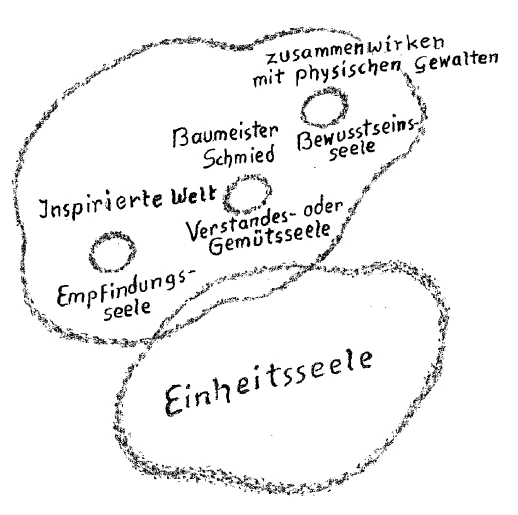
[ 3 ] Das erste Gebiet also ist das, in welches die Inspirationen hereindringen, traumhafte Inspirationen, welche die Seele ausfüllen, was an die Empfindungsseele gebunden ist. Ein zweites Gebiet, wo die Seele gleichsam durch ihre eigenen inneren Gestaltungen und Bildungen ihren Leib auferbaut, ist gebunden an die Verstandes- oder Gemütsseele. Das ist der innere Werkmeister, der Baumeister, wir könnten auch sagen der Schmied des physischen Leibes. Und das dritte, die Vermittlung des äußeren Erkennens, das in Zusammenhang tritt mit der Welt, die an die Sinne gebunden ist, überhaupt mit der physischen Welt zusammenhängt, ist an die Bewußtseinsseele gebunden. Wir können also sagen: zusammenhängend mit physischen Gewalten.
[ 3 ] The first realm, then, is that into which inspirations enter—dreamlike inspirations that fill the soul, which is bound to the sensory soul. A second realm, where the soul builds up its body, as it were, through its own inner formations and creations, is connected to the intellectual or emotional soul. This is the inner master craftsman, the architect; we could also say the smith of the physical body. And the third, the mediation of external cognition, which enters into connection with the world bound to the senses—and is connected to the physical world in general—is bound to the conscious soul. We can therefore say: connected with physical forces.
[ 4 ] Gleichsam eine Seelentrinität waltet auf dem Grunde der Seele des Menschen, und dieser Trinität steht gegenüber das Walten und Wirken desjenigen, was zur Einheit strebt. Ich will es dadurch andeuten, daß ich gleichsam ein besonderes Seelenreich dem andern hier gegenüberstelle (siehe folgende Zeichnung). Dieses Seelenreich wirkt in gewisser Beziehung ganz in sich einheitlich. Es wirkt aber naturhaft einheitlich gleichsam dasjenige, was die Seele ihrem Temperamente, ihrem Charakter nach ist, was tief unten in der Seele ruht, aber als einheitliche Seele. Das möchte ich mit diesem bezeichnen: Einheitsseele, im Gegensatz zu der Dreiheit.
[ 4 ] A kind of trinity of the soul reigns at the very depths of the human soul, and this trinity is counterbalanced by the influence and activity of that which strives toward unity. I wish to illustrate this by contrasting, as it were, one particular realm of the soul with another (see the following diagram). In a certain sense, this realm of the soul acts in a way that is entirely unified within itself. However, what acts in a naturally unified way is, as it were, that which the soul is in terms of its temperament and character—that which rests deep within the soul, yet as a unified soul. I would like to designate this as the “soul of unity,” in contrast to the “trinity.”
[ 5 ] So, wie einmal unsere Seele jetzt ist, kann diese Einheitsseele aus einem gewissen dumpfen Leben nicht herauskommen, wenn sie nicht gleichsam überhellt, überleuchtet wird. Und in unserer Zeit geht das Überleuchten immer aus in irgendwelcher Form von dem Mysterium von Golgatha, so daß ich das, was in irgendwelcher Weise hereinstrahlt in die Einheitsseele, symbolisch Ihnen hinzeichne: irgendeine Form, in der das Mysterium von Golgatha hereinstrahlt in die Einheitsseele. Nun haben wir wirklich schon im Laufe der Jahre vieles, vieles aufgewendet, um nach und nach uns eine Vorstellung davon zu verschaffen, wie unendlich weit all das ist, was mit dem Mysterium von Golgatha zusammenhängt. Sie können sich daher denken, daß, wenn so das Mysterium von Golgatha in irgendeiner Form in die Menschenseele hereinstrahlt, das immer nur eine gewisse Stufe, ein gewisser Grad des Mysteriums von Golgatha ist. Aber wir stellen uns vor, daß, weil die Einheitsseele etwas gleichsam dumpf Brütendes ist, aber das für unsere Zeit besonders Wertvolle enthält, so muß dieses Einheitliche in irgendeiner Form von dem Mysterium von Golgatha durchstrahlt werden.
[ 5 ] Just as our soul is now, this soul of unity cannot emerge from a certain dull existence unless it is, as it were, illuminated from above. And in our time, this illumination always emanates in some form from the Mystery of Golgotha, so that I will symbolically sketch for you what shines into the unified soul in some way: some form in which the Mystery of Golgotha shines into the unified soul. Now, over the years, we have indeed devoted a great deal of effort to gradually forming a mental image of just how infinitely vast is everything connected with the Mystery of Golgotha. You can therefore imagine that when the Mystery of Golgotha shines into the human soul in some form, it is always only a certain stage, a certain degree of the Mystery of Golgotha. But we have a mental image of the situation in which the soul of unity is something that broods, as it were, in a subdued manner, yet contains what is particularly valuable for our time. As a result, this unity must be permeated in some form by the Mystery of Golgotha.
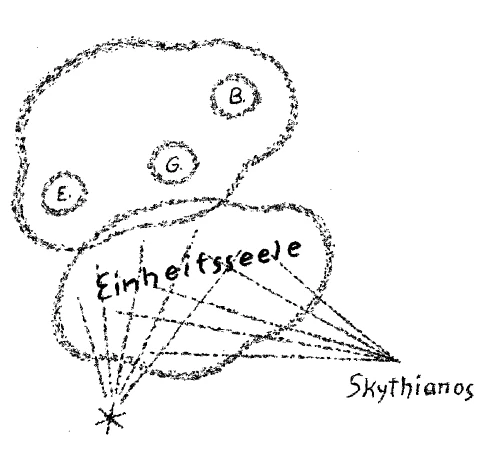
[ 6 ] Nun ragt in jede Seele dasjenige hinein, was von den verschiedenen Inspirations- und Initiationszentren der Welt ausgeht, und das gehört auch zu den unterbewußten Einflüssen in der Menschenseele. Sehen Sie, die Wirkung des Mysteriums von Golgatha ist eine umfassende, eine universelle, aber der Mensch, die Menschenseele kann dieses Mysterium von Golgatha nur in einer bestimmten Weise aufnehmen. Das Initiationszentrum, welches ganz besonders in das Innere der Seele hereinwirkt, damit das Innere der Seele richtig vorbereitet wird, sich von dem Mysterium von Golgatha ganz besonders durchstrahlen zu lassen, habe ich früher öfter so besprochen, daß ich gesagt habe: Es steht immer vor diesem Initiationszentrum der Eingeweihte Skythianos. — Nehmen wir also an, die Seele wäre vorbereitet worden in der Einheitsseele für das, was vom Mysterium von Golgatha kommt, bereit, es aufzunehmen durch das, was in jeder Seele unbewußt, von Skythianos her, hineinwirkt.
[ 6 ] Now, what emanates from the various centers of inspiration and initiation around the world penetrates into every soul, and this also forms part of the subconscious influences within the human soul. You see, the effect of the Mystery of Golgotha is comprehensive, universal; yet human beings, the human soul, can only receive this Mystery of Golgotha in a specific way. The center of initiation that works particularly deeply into the innermost part of the soul, so that the innermost part of the soul may be properly prepared to be permeated by the Mystery of Golgotha in a special way, I have often discussed in the past by saying: The initiate Skythianos always stands before this center of initiation. — Let us therefore assume that the soul has been prepared within the unity soul for what comes from the Mystery of Golgotha, ready to receive it through what works unconsciously into every soul from Skythianos.
[ 7 ] Da haben wir gleichsam die Seele des Menschen gespalten in zwei Reiche: in das eine Reich, das eine Dreigliedrigkeit ist, und in ein anderes Reich, welches eine Einheit ist: in ein mehr seelisches Reich und in ein mehr naturhaftes, temperamentmäßig brütendes Reich, möchte ich sagen, in ein Reich, das mehr aufnimmt in seine Naturgrundlage die Kräfte des Mysteriums von Golgatha auf der einen Seite und auf der andern Seite die Einflüsse des Skythianos.
[ 7 ] Here, as it were, we have divided the human soul into two realms: into one realm, which is a triunity, and into another realm, which is a unity: into a more spiritual realm and into a more natural, temperamentally brooding realm, I might say, into a realm that incorporates into its natural foundation, on the one hand, the forces of the Mystery of Golgotha and, on the other hand, the influences of Skythianos.
[ 8 ] Nun kann diese Einheit mit der Dreiheit nicht ohne weiteres sich verbinden, das ginge nicht, und deshalb ist es auch so, daß diese Dreiheit bei den gegenwärtigen Menschen unter der Schwelle des Bewußtseins bleibt. Es wird diese Dreiheit gleichsam übertäubt; es muß das Bewußtsein davon ausgelöscht werden. Wenn die Seele wirklich herunterkommen könnte zu der Dreiheit, würde sie sich sogleich als Dreiheit, nicht als eins, fühlen. Sie würde sagen: Da ist etwas in mir, das inspiriert mich, etwas, das baut mich auf, das schmiedet mich zusammen, und etwas, das steht mit der Außenwelt im Zusammenhang. Aber diese Dreiheit muß gleichsam durch etwas ausgelöscht, überschattet werden, was seelisch den Menschen dahin bringt, daß er sagt: Ich unterscheide nicht die Drei. — Es muß also etwas hereinstrahlen in die Drei, das macht, daß die Seele die Drei nicht in sich empfindet, diese Drei auslöscht, gleichsam wie Nebelgebilde zueinander sein läßt.
[ 8 ] Now, this unity cannot simply merge with the trinity; that would not be possible, and that is why this trinity remains below the threshold of consciousness for people today. This trinity is, as it were, drowned out; awareness of it must be extinguished. If the soul could truly descend to the trinity, it would immediately feel itself as a trinity, not as one. It would say: There is something within me that inspires me, something that builds me up, that forges me together, and something that is connected to the outside world. But this triad must, as it were, be obliterated or overshadowed by something that leads the human being, in a psychological sense, to say: I do not distinguish the three. — So something must shine into the three that causes the soul not to perceive the three within itself, that obliterates these three, allowing them to exist in relation to one another as if they were misty formations.
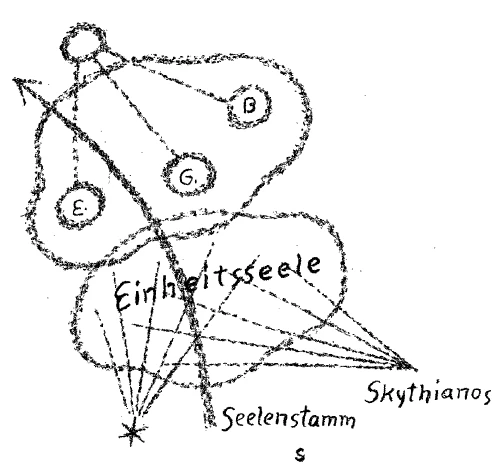
[ 9 ] Sehen Sie, dann kann die Verbindung bestehen zwischen dem, was in der Seele als Einheit leben soll, und dem, was als Dreiheit in der Seele ist, wenn eine Kommunikation, eine Art Austausch da ist, gleichsam eine Art Seelenstamm, der zur ausgelöschten Dreiheit hinführt und der ausgeht von dem, was Einheit ist, aber von zwei Seiten her durchstrahlt wird, gleichsam durchleuchtet wird dazu, daß es nicht nur eine dumpfe, gleichmäßige charakter- und temperamentgemäße Natureinheit ist, sondern daß es einheitlich durchleuchtet wird von dem, was der Mensch sein soll: von dem Bewußtsein der Menschenseele in ihrem Zusammenhang mit dem göttlich-geistigen Sein. Eigentlich habe ich da etwas aufgezeichnet, was auf dem Grunde jeder Menschenseele ruht. Keine einzige Menschenseele kann in unserer Zeit ohne das sein, daß alle diese Dinge in ihr vorhanden sind.
[ 9 ] You see, the connection can exist between what is meant to live as unity in the soul and what is present in the soul as a trinity only if there is communication, a kind of exchange—as it were, a kind of soul-stem that leads to the extinguished trinity and that emanates from what is unity, but is illuminated from two sides, so to speak, so that it is not merely a dull, uniform unity of nature corresponding to character and temperament, but is uniformly illuminated by what the human being is meant to be: by the consciousness of the human soul in its connection with the divine-spiritual Being. In fact, I have recorded here something that rests at the very foundation of every human soul. Not a single human soul in our time can exist without all these things being present within it.
[ 10 ] Aber nun stellen Sie sich das Folgende vor. Ich habe wiederholt gerade hier betont, um zu zeigen, was unser Bau sein soll, daß dasjenige, was in der Menschenseele lebt, äußerlich auch zur Darstellung kommt, sich auslebt sozusagen in der äußeren Evolution der Erde. Wenn es ein solches Gebiet in der Menschenseele gibt, das wirklich eine Art von Dreiheit darstellt, das bei den heutigen Menschen gleichsam schon überzogen ist von dem gewöhnlichen Bewußtsein, so müssen wir einmal ein Evolutionsstadium finden, wo uns das äußerlich entgegentritt, daß die Seele wirklich sich als eine Dreiheit empfindet, gleichsam auseinandergelegt in drei Seelenglieder. Mit andern Worten, es muß ein Volk einmal dagewesen sein, das diese drei Seelenglieder auseinandergelegt empfand und so empfand, daß im Grunde genommen die Einheit viel geringer empfunden wurde in der Seele als die Dreiheit, da die Dreiheit noch in Verbindung gedacht wurde mit dem Kosmos. Dieses Volk war da in Europa und hat ein bedeutendes Kulturdenkmal hinterlassen, von dem ich schon einmal gesprochen habe. Dieses Volk, das einmal, und zwar an der Stelle in Europa, wo es sein mußte, diese Dreiheit empfand in der Seele, ist das finnische Volk. Und der Ausdruck dieser Kulturstufe ist niedergelegt in Kalewala. In dem, was in Kalewala dargestellt ist, ist das deutliche Bewußtsein von der Dreiheit der Seele vorhanden, so daß von den alten Sehern, deren Sehertum Kalewala zugrunde liegt, empfunden wurde: Da ist etwas Inspirierendes in der Welt, mit dem steht ein Glied meiner Seele in Verbindung, meine Empfindungsseele. Sie tendiert dahin, deren Kräfte gehen dahin, sie bekommt von da die Impulse. — Gleichsam ein Menschlich-Göttliches oder Menschlich-Heroisches empfand dieses Volk oder empfanden diese alten Seher als das Inspirierende der Empfindungsseele. Und sie nannten das Wäinämöinen. Das ist nichts anderes als das im Kosmos Inspirierende der Empfindungsseele. Alle die Schicksale, die in Kalewala als die Schicksale von Wäinämöinen geschildert werden, drücken aus, daß dieses Bewußtsein einmal vorhanden war bei einem Volke, welches eine große Ausbreitung in dem Nordosten des europäischen Gebietes hatte, und das die drei Seelenglieder getrennt empfand und die Empfindungsseele inspiriert von Wäinämöinen.
[ 10 ] But now imagine the following. I have repeatedly emphasized this very point here to illustrate what our structure should be: that what lives within the human soul is also expressed outwardly, so to speak, in the external evolution of the Earth. If there is such a realm within the human soul that truly represents a kind of trinity—a realm that in today’s human beings is, as it were, already overshadowed by ordinary consciousness—then we must find a stage of evolution where this confronts us externally: where the soul truly experiences itself as a trinity, as it were, unfolded into three soul members. In other words, there must once have been a people who perceived these three soul members as distinct and who felt that, fundamentally speaking, the unity was perceived much less in the soul than the trinity, since the trinity was still conceived in connection with the cosmos. This people existed in Europe and left behind a significant cultural monument, of which I have spoken before. This people, who once—and specifically in that part of Europe where it had to be—perceived this triunity in the soul, is the Finnish people. And the expression of this cultural stage is laid down in the Kalevala. In what is depicted in the Kalevala, there is a clear awareness of the trinity of the soul, so that the ancient seers, whose seership forms the basis of the Kalevala, sensed: There is something inspiring in the world with which a part of my soul is connected—my feeling soul. It tends toward it, its forces flow toward it, and it receives its impulses from there. — As it were, this people or these ancient seers perceived something human-divine or human-heroic as the source of inspiration for the feeling soul. And they called it Wäinämöinen. This is nothing other than the source of inspiration for the feeling soul within the cosmos. All the destinies described in the Kalevala as the destinies of Wäinämöinen express that this consciousness once existed among a people who were widely spread across the northeastern part of Europe, and who perceived the three soul-members as distinct, with the feeling soul inspired by Wäinämöinen.
[ 11 ] Ebenso hat dieses Volk, haben diese alten Seher empfunden, daß die Verstandes- oder Gemütsseele gleichsam ein Glied extra in der Seele ist, das seine Impulse empfängt zum Schmieden, haben empfunden das, was schmiedet in der menschlichen Seele, was sie aufbaut, von einer andern elementarischen, heroischen Wesenheit empfängt, von Ilmarinen. Wie also Wäinämöinen entspricht der Empfindungsseele, so entspricht in Kalewala Ilmarinen der Verstandes- oder Gemütsseele. Wenn Sie den Vortrag über Kalewala nachlesen, so können Sie das alles darin finden.
[ 11 ] Likewise, this people—as these ancient seers perceived—felt that the intellectual or emotional soul is, as it were, an extra limb of the soul that receives its impulses for forging; they perceived that what forges within the human soul, what builds it up, receives its inspiration from another elemental, heroic being, from Ilmarinen. Just as Wäinämöinen corresponds to the feeling soul, so in the Kalevala Ilmarinen corresponds to the intellectual or emotional soul. If you read the lecture on the Kalevala, you will find all of this there.
[ 12 ] Und ebenso empfand dieses Volk — das muß festgehalten werden —, daß dazumal die Bewußtseinsseele empfunden wurde wie das, was den Menschen erst zu einem Eroberer auf dem physischen Plan macht, empfanden diese alten Seher in Lemminkäinen ein Wesen, das mit den Gewalten des physischen Planes zusammenhängt, ein elementares, heroisches Wesen in dem Inspirator der Bewußtseinsseele. So stammen diese drei, man möchte sagen, Heldenfiguren, wenn man in Analogie mit andern Epen spricht, von dem alten finnischen Volk her, inspirierend die Dreigliedrigkeit der Seele.
[ 12 ] And this people felt just as strongly — this must be noted — that in those days the soul of consciousness was perceived as that which first makes a human being a conqueror on the physical plane; these ancient seers perceived in Lemminkäinen a being connected with the forces of the physical plane, an elemental, heroic being in the inspirer of the soul of consciousness. Thus these three—one might say, heroic figures, speaking by analogy with other epics—originate from the ancient Finnish people, inspiring the threefold nature of the soul.
[ 13 ] Das Wunderbare ist der Zusammenhang zwischen Ilmarinen und demjenigen, was da geschmiedet wird. Ich deutete es schon an. Es wird geschmiedet aus den Naturelementen heraus der Mensch selber. Dieses Wesen, das aus allen Naturatomen zusammengeschmiedet wird, pulverisiert und zusammengeschmiedet wird, ist in einem großartigen Tableau in dem Schmieden des Sampo in Kalewala dargestellt. Und daß dieses Bilden des Menschen aus diesen drei Seelengliedern heraus einmal geschehen ist, dann gleichsam wie in ein Pralaya gehen muß und dann wiederum hervorkommt, ist auch dargestellt in Kalewala: wie der Sampo verlorengeht und wiedergefunden wird, gleichsam wie wiedergefunden wird das, über das sich zunächst Bewußtseinsdunkelheit verbreitet.
[ 13 ] What is remarkable is the connection between Ilmarinen and what is being forged there. I have already hinted at this. Humanity itself is forged from the elements of nature. This being, forged from all the atoms of nature—pulverized and then forged together—is depicted in a magnificent tableau in the forging of the Sampo in the Kalevala. And the fact that this formation of the human being from these three soul elements has once taken place, must then, as it were, enter into a Pralaya, and then emerge again, is also depicted in the Kalevala: just as the Sampo is lost and found again, so too is that over which a darkness of consciousness has initially spread found again.
[ 14 ] Und nun stellen wir uns vor, daß gegen den Süden zu, gegen den Südosten, können wir sagen, ein anderes Volk gegenübersteht, das diejenigen Seeleneigenschaften zunächst in alter Zeit ausgebildet hat, von denen ich gesprochen habe, das Einheitsmäßige in der Seele, das, was das Einheitsmäßige zum Ausdruck bringt in den Charakter-, den Gemütseigenschaften, in den Temperamentseigenschaften. Dieses Volk ist ein slawisches Volk, während das Volk, das ihm gegenübersteht, das finnische Volk ist. Dieses slawische Volk bekommt seine Einflüsse von Skythianos, der auch eine Zeitlang in alten Zeiten gelebt hat vom alten Skythenvolk umgeben. Es ist durchaus nicht notwendig, daß um ein Initiationszentrum herum auch ein hochentwickeltes Volk lebe, sondern es muß im Verlaufe der Entwickelung das geschehen, was notwendig ist. Und das Hereindringen einer bestimmten Form des Mysteriums von Golgatha ist das Hereindringen der griechisch-byzantinischen Kultur in das Slawentum. Was ich Ihnen hier als ein Zentrum der griechisch-byzantinischen Kultur aufgezeichnet habe, das können Sie ruhig, wenn Sie wollen, als Konstantinopel auffassen auf der Karte von Europa, denn das ist im Grunde genommen Konstantinopel.
[ 14 ] And now let us imagine that to the south, or rather to the southeast, there stands another people who, in ancient times, first developed those soul qualities of which I have spoken—the unifying principle in the soul, that which expresses this unifying principle in character traits, in dispositions, and in temperamental qualities. This people is a Slavic people, while the people standing opposite them is the Finnish people. This Slavic people receives its influences from Skythianos, who also lived for a time in ancient times surrounded by the ancient Scythian people. It is by no means necessary for a highly developed people to live around an initiation center; rather, what is necessary must happen in the course of development. And the penetration of a certain form of the Mystery of Golgotha is the penetration of Greek-Byzantine culture into Slavic culture. What I have described here as a center of Greek-Byzantine culture, you may, if you wish, regard as Constantinople on the map of Europe, for that is essentially Constantinople.
[ 15 ] So haben wir also jetzt Seelen, die sich mit einem slawischen Grundtyp imprägniert finden. Es sind Seelen, die auf der einen Seite verbunden sind mit dem, was zu einem Einheitswesen durch das Mysterium von Golgatha führen kann, was in Einheitsseelen zum Christentum vorbereiten kann, die auf der andern Seite das Mysterium von Golgatha in einer ganz bestimmten Form empfangen, etwas wie die Inspiration, die Influenzierung durch das Mysterium von Golgatha, wie sie von der byzantinisch-griechischen Kultur ausgegangen ist.
[ 15 ] So we now have souls who find themselves imbued with a Slavic archetype. These are souls who, on the one hand, are connected to that which can lead to a unified being through the Mystery of Golgotha—which can prepare them for Christianity as unified souls—and who, on the other hand, receive the Mystery of Golgotha in a very specific form, something like the inspiration and influence of the Mystery of Golgotha as it originated in Byzantine Greek culture.
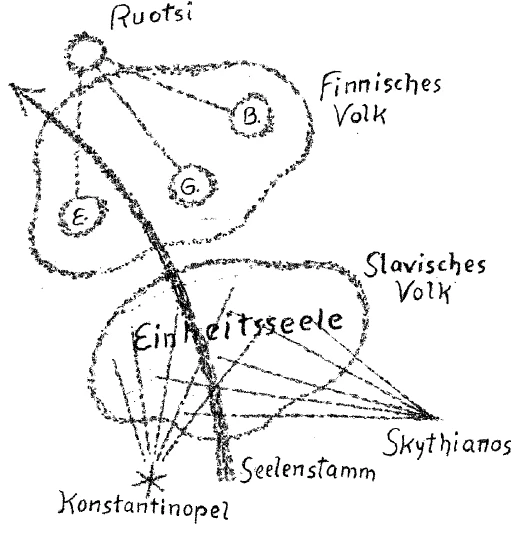
[ 16 ] Nun muß aber noch etwas anderes, von einem gewissen Punkte her gleichsam, kommen. Was im finnischen Volke da war als die Scheidung, die Trennung in die drei Glieder, deren Bodensatz so großartig in Kalewala enthalten ist, das muß ausgelöscht werden. Das kann nur ausgelöscht werden, wenn ein Einfluß von außen kommt, kann nur ausgelöscht werden dadurch, daß gleichsam ein Volk oder ein Volksteil da vordrängt, der von vornherein dazu veranlagt ist, nicht die Dreiheit, sondern die Einheit in der Seele zu empfinden, nicht die Einheit, die man bekommt von dem Mysterium von Golgatha aus, sondern die Einheit, die man gleichsam von Natur aus hat. Wenn man das finnische Volk betrachtet, so findet man es besonders veranlagt, das Bewußtsein der Dreiheit auszubilden. Und man kann nicht bedeutsamer diese Dreiheit in ihrem Verhältnis zum Kosmos ausdrücken, als das in Kalewala geschehen ist. Aber dann mußte das im Norden übertüncht, übernebelt werden von dem, was gleichsam auslöscht das Bewußtsein von dieser Dreiheit. Es drängte da ein Stamm herunter, der in einer naturhaften Weise das in seiner Seele trug, was damals als das Einheitsstreben da war, was in einer ganz andern Weise, auf einer ganz andern Stufe im Goetheschen «Faust», aber auch überhaupt in Faust zum Ausdruck gekommen ist, etwas, das nicht weiß von der Dreigliedrigkeit, das nach der Einheit des Ich strebt. Hier noch auf einer primitiven Stufe wirkt das auslöschend auf die drei Seelenglieder.
[ 16 ] But now something else must come into play, as it were, from a certain point. What existed among the Finnish people as the division, the separation into the three parts, the essence of which is so magnificently contained in the Kalevala, must be eradicated. This can only be eradicated if an influence comes from outside; it can only be eradicated by the emergence, as it were, of a people or a section of the people who are predisposed from the outset to feel not the Trinity but unity in the soul—not the unity derived from the Mystery of Golgotha, but the unity one possesses, as it were, by nature. If one considers the Finnish people, one finds them particularly predisposed to develop an awareness of the Trinity. And one cannot express this Trinity in its relationship to the cosmos more significantly than it has been done in the Kalevala. But then, in the North, this had to be whitewashed over, obscured by that which, as it were, extinguishes the awareness of this Trinity. A tribe moved down there that naturally carried within its soul what was then the striving for unity—something that found expression in a completely different way, on a completely different level, in Goethe’s Faust, but also in Faust in general—something that knows nothing of the threefold nature, that strives for the unity of the ego. Here, still at a primitive level, this has an erasing effect on the three soul members.
[ 17 ] Nun ist aber das finnische Volk ein solches gewesen, welches noch naturhaft empfand, sonst hätte es nicht die drei Seelenglieder empfunden. Das, was dahinflutet, auslöschend die Dreiheit, dieses Hinflutende, Hineindrängende empfand man als ein r r r, und weil man es empfand als etwas, was, man möchte sagen, in okkulter Sprache am besten ausgedrückt ist in den Buchstaben, in dem Laute u u o, so daß man sagen möchte: Es kommt heran, man muß eigentlich Scheu davor haben, so haucht es hin in dem r r u u o und setzt sich fest, was immer durch das Tau, t, empfunden wird, wenn das in die menschliche Seele hineindringt. Geradeso wie das Hineindringen in die menschliche Seele beim alten Jehova durch das s, durch das hebräische «Shin», ausgedrückt ist, so wird überhaupt dieses Eindringen in die Seele, das Durchdringende durch den s-Laut ausgedrückt. All das hängt zusammen mit dem, was in die Seele eindringt und festhält in der Seele, all das drängt zum i hin, dessen Bedeutung ja bekannt ist, im finnischen Volk das, was mit dem r r u u zusammenhängt. Daher empfand es dieses rutsi, ruotsi, und daher nannte es die Völker, die herunterdrängen da, die Rutsi, Ruotsi. Und diesen Namen haben allmählich die Slawen aufgenommen, und weil sie sich verbunden haben mit dem von oben nach unten Dringenden, was die Finnen so nannten, nannten sie sich selbst Rutsi, was später zu dem Namen Russen wurde.
[ 17 ] But the Finnish people were a people who still felt things in a natural way; otherwise, they would not have perceived the three aspects of the soul. That which flows in, obliterating the trinity—this flowing-in, this pressing-in—was perceived as an r r r; and because it was perceived as something that, one might say, is best expressed in occult language by the letters, by the sounds u u o, so that one might say: It is approaching; one must actually be wary of it, as it breathes forth in the r r u u o and takes hold, whatever is perceived through the tau, t, when it penetrates into the human soul. Just as the penetration into the human soul in the case of the ancient Jehovah is expressed through the s, through the Hebrew “Shin,” so this penetration into the soul in general is expressed through the s-sound. All of this is connected to what penetrates the soul and takes hold in the soul; all of this pushes toward the i, whose meaning is well known—among the Finnish people, that which is connected to the r r u u. Hence they perceived this rutsi, ruotsi, and hence they called the peoples who press down there the Rutsi, Ruotsi. And the Slavs gradually adopted this name, and because they associated themselves with that which presses down from above—what the Finns called it—they called themselves Rutsi, which later became the name Russians.
[ 18 ] Sie sehen also, das alles mußte sein, was in der Geschichte äußerlich erzählt wird, daß diese hier unten sitzenden Völker gerufen haben die Warägerstämme, die eigentlich normannisch-germanische Stämme waren, die sich verbinden mußten mit den slawischen Stämmen. Dem liegt etwas zugrunde, was sein mußte, durch die Einrichtung der Menschenseele notwendig sein mußte. Und so kam denn das zustande, was dann später im Osten von Europa als das Element des Russischen in das europäische Volkstum eintrat. In dem Element des Russischen lebt also all das wirklich drinnen, von dem ich gesprochen habe. Es lebt vor allen Dingen darinnen jenes normannisch-germanische Element, lebt sogar in dem Namen drinnen, von dem der Name Russe gekommen ist, denn der ist auf dem Wege gekommen, den ich angedeutet habe.
[ 18 ] So you see, everything that is recounted in history had to happen: that the peoples living here below called upon the Varangian tribes—who were actually Norman-Germanic tribes—to join forces with the Slavic tribes. Underlying this is something that had to be, that was necessary due to the nature of the human soul. And so came about what later entered European folklore from the East of Europe as the Russian element. So everything I have spoken of truly lives within the Russian element. Above all, that Norman-Germanic element lives within it; it even lives within the name from which the name “Russian” is derived, for it came about in the way I have indicated.
[ 19 ] In tiefsinniger Weise wird in Kalewala ausgedrückt, daß die Größe des finnischen Volkes darauf beruht, daß es eigentlich vorbereitet in der Dreiheit die Einheit, vorbereitet durch Auslöschung der Dreiheit das Entgegennehmen derjenigen Einheit, die nun nicht mehr nur menschliche Einheit ist, sondern die göttliche Einheit ist, in welcher lebt der göttliche Held des Mysteriums von Golgatha.
[ 19 ] The Kalevala profoundly expresses that the greatness of the Finnish people lies in the fact that they actually prepare for unity through the trinity, and through the dissolution of the trinity, they prepare to receive that unity which is no longer merely human unity, but divine unity, in which lives the divine hero of the Mystery of Golgotha.
[ 20 ] Damit eine Gruppe von Menschen aufnehmen kann dasjenige, was an sie herankommt, muß sie erst vorbereitet werden. Wir bekommen auf diese Weise einen Eindruck davon, was alles innerlich geschehen muß, damit das in der Entwickelung sich vollziehen kann, was einem äußerlich entgegentritt. Ich sagte, in Kalewala wird in großartiger Weise ausgedrückt, daß das finnische Volk diese Vorbereitung zu liefern hatte, dadurch, daß am Schlusse in eigentümlicher Weise das Mysterium von Golgatha in Kalewala eingeführt wird. Christus tritt am Schlusse von Kalewala auf, aber indem er seinen Impuls in das finnische Leben wirft, geht Wäinämöinen aus dem Lande fort, was ausdrückt, daß das ursprünglich Große, das Bedeutungsvolle, das durch das finnische Element in Europa hereingekommen ist, ein Vorbereitungsstadium für das Christentum ist und das Christentum wie eine Kunde, wie eine Botschaft von außen empfängt.
[ 20 ] In order for a group of people to be able to receive what comes to them, they must first be prepared. In this way, we gain an impression of everything that must take place internally so that what confronts us externally can be realized in the course of development. I said that the Kalevala expresses in a magnificent way that the Finnish people had to provide this preparation, in that the Mystery of Golgotha is introduced into the Kalevala in a unique way at the end. Christ appears at the end of the Kalevala, but as he casts his impulse into Finnish life, Wäinämöinen departs from the land, which expresses that the originally great and significant element that entered Europe through the Finnish element is a preparatory stage for Christianity and receives Christianity as a message, as a message from without.
[ 21 ] Wie wir beim einzelnen Menschen sehen, daß er in außerordentlich komplizierter Weise gleichsam zubereitet werden muß, damit dann seine Seele das finde von den verschiedensten Seiten her, was sie braucht, um in einer bestimmten Inkarnation zu leben, so ist es auch mit den Völkern. Ein Volk ist nicht etwas ganz so Finheitliches, Homogenes, sondern ein Volk ist etwas, worin viel zusammenfließt. Das Volk, das da im Osten drüben lebt, in ihm ist all das zusammengeflossen. Und all dasjenige, könnte man sagen, was innerlich spirituell ist, ist äußerlich — wenn auch äußerlich in leichter Weise nur — angedeutet. Ich habe gesagt, bei diesem Volk muß ein Seelenstamm sein, der von unten nach oben respektive auch von oben nach unten führt, wenn es ein verbindender Seelenstamm ist. Das war vorhanden in einer mächtigen Straße, welche vom Schwarzen Meer zum Finnischen Meerbusen ging, und auf der ein Austausch stattfand zwischen dem griechisch-byzantinischen Kulturelement und dem Naturelement der Rutsi.
[ 21 ] Just as we see with the individual human being that he must, as it were, be prepared in an extraordinarily complex way so that his soul may then find, from a wide variety of sources, what it needs to live in a particular incarnation, so it is with peoples. A people is not something entirely subtle or homogeneous, but rather something into which many elements converge. The people living over there in the East—all of that has converged within them. And everything that is inwardly spiritual, one might say, is indicated outwardly—albeit only in a subtle way. I have said that among this people there must be a soul-stem that leads from below to above, or conversely from above to below, if it is a unifying soul-stem. This was present in a mighty road that ran from the Black Sea to the Gulf of Finland, and along which an exchange took place between the Greek-Byzantine cultural element and the natural element of the Rutsi.
[ 22 ] Der Mensch muß im Laufe seiner verschiedenen Inkarnationen verschiedenes durchmachen. Eine Inkarnation muß sich immer auf die andere aufbauen. Das kann der Mensch nur dadurch, daß gleichsam in die Substanz, in das Material, aus dem die einzelnen Völker und ihre Angehörigen gebildet werden, wirklich die Kräfte zusammenfließen, durch welche später die Menschenevolution sich vollziehen kann. Es muß eine Menschenseele einmal in ihren Inkarnationen solch eine Leiblichkeit finden, die zusammengeflossen ist aus den Kräften, die ich hier dargestellt habe. Und was man so einfach sagt, ein Mensch wird als Russe geboren, das hat seine tiefe, seine kolossal tiefe Bedeutung. Ein Mensch wird als Russe geboren, heißt: er ist auf dem Wege durch die verschiedenen Inkarnationen dabei angelangt, innerhalb seiner Erdenlaufbahn das zu erleben, was man nur dadurch erleben kann, daß man in einer Körperlichkeit durchläuft ein Leben zwischen Geburt und Tod, die auf solche Weise zusammengetragen ist. Würde man nicht in einem solchen Körper das durchleben, so würde einem etwas fehlen in dem, was man von Inkarnation zu Inkarnation sich erwirbt. Törichte Menschen — ich sage das, ohne daß damit irgendeine Empfindungsnuance verbunden ist, sondern ich sage das als Terminus technicus — haben immer wieder und wiederum von dem Sprichwort gesprochen: Die Welt begreift man in ihrer Wahrheit am besten, wenn sie einem in ihrer Einfachheit erscheint. — Das ist nicht wahr, das ist nur bequem. Tiefe Geister haben es immer ausgesprochen, zum letzten Mal am eindringlichsten wohl Ralph Waldo Emerson, daß man zur Wahrheit der Tatsachen erst eindringt, wenn man sie in ihrer ganzen Kompliziertheit erkennt. Es ist nicht so einfach, das, was in der Welt lebt und was mit der ganzen Weltenevolution zusammenhängt.
[ 22 ] Throughout the course of their various incarnations, human beings must go through many different experiences. One incarnation must always build upon the next. A human being can achieve this only when the forces through which human evolution can later take place truly converge, as it were, into the substance, into the material from which the individual peoples and their members are formed. A human soul must eventually find, in its incarnations, a physical form that has coalesced from the forces I have described here. And what is so simply said—that a human being is born as a Russian—has its profound, its colossally profound significance. A human being is born as a Russian means: through the various incarnations, they have arrived at the point in their earthly life where they can experience what can only be experienced by passing through a life between birth and death in a physicality that has been brought together in this way. If one were not to live through this in such a body, something would be missing in what one acquires from incarnation to incarnation. Foolish people—I say this without any emotional connotation, but rather as a technical term—have repeatedly cited the saying: “One understands the world best in its truth when it appears to one in its simplicity.”—That is not true; it is merely convenient. Deep minds have always expressed this—most forcefully, perhaps, for the last time, by Ralph Waldo Emerson—that one penetrates to the truth of facts only when one recognizes them in all their complexity. It is not so simple, that which lives in the world and is connected to the entire evolution of the world.
[ 23 ] Und so wie es auf der östlichen Hälfte der europäischen Halbinsel ist, daß die Seelen zubereitet werden, um etwas Besonderes zu erleben, so ist es für alle andern Fälle der Erdenoberfläche, so sind die einzelnen Volkscharaktere in einer komplizierten Weise zubereitet. Nun erinnern Sie sich vor allen Dingen an eines, das wir genügend im Verlaufe unserer geisteswissenschaftlichen Betrachtungen kennengelernt haben.
[ 23 ] And just as it is in the eastern half of the European peninsula, where souls are prepared to experience something special, so it is in all other regions of the Earth’s surface: the individual national characters are shaped in a complex manner. Now, above all, remember one thing that we have come to know well in the course of our reflections on Spiritual Science.
[ 24 ] Der Mensch ist gewissermaßen, wenn er durch die Pforte des Todes gegangen ist, dadurch, daß er zurückblickt auf sein letztes Erdenleben, abhängig von dem, was er in seinem letzten Erdenleben erlebt hat. Wir wissen, daß jahrelang hineinspielen in das Leben nach dem Tode die Zusammenhänge mit dem früheren Erdenleben. Das muß aber so sein. Der Mensch muß durch eine physische Inkarnation hindurchgehen, damit er in dieser Zeit zwischen dem Tode und einer neuen Geburt bestimmte Erinnerungen an diese vorhergehende Inkarnation hat, bestimmte Impulse aus dieser vorhergehenden Inkarnation hereinreichen. Dadurch, daß er ein ganz bestimmtes Menschenwesen mit einem bestimmten Organismus war, der durch die Erdenverhältnisse bestimmten Einflüssen unterworfen war, wirken auch noch gewissermaßen die Eindrücke nach dem Tode, die erinnerungsmäßig zurückgehen. Diese werden dadurch influenziert, beeinflußt, sie bekommen eine gewisse Schattierung. Das ist die Schattierung, welche eine Seele dadurch empfängt, daß sie durch eine bestimmte Nationalität hindurchgegangen ist, die sie aus einer gewissen Nationalität heraus bekommt. Das wird immer mehr und mehr abgestreift, je mehr das Nationale in das Internationale übergeht. Aber heute ist das noch in hohem Maße vorhanden, sonst hätten die heutigen Ereignisse nicht eintreten können. Die Menschen blicken in gewissem Maße noch zurück auf dasjenige, was sie durch ihren Organismus — insofern dieser national bestimmt ist — im vorhergehenden Leben zwischen Geburt und Tod erlebt haben. Nun werden die Seelen, die auf die heute beschriebene Weise durch Leiber hindurchgehen, die gerade auf diese bestimmte Art zubereitet worden sind, in einer ganz bestimmten Art präpariert auf das Leben, welches sie antreten, nachdem sie durch die Todespforte gegangen sind. Die Individualität wird natürlich nicht beeinflußt, nur das, was gleichsam wie die Kleider, die Hüllen der eigentlichen Individualität ist. Aber diese Kleider oder Hüllen, mit denen die Nationalität zusammenhängt, geben da noch etwas, was die Seele auch nach dem Tode hat, von dem sie weiß, das hat zu deinem Durchgange durch das Erdenleben gehört.
[ 24 ] In a sense, once a person has passed through the gate of death, they are, by looking back on their last earthly life, dependent on what they experienced in that life. We know that connections with the previous earthly life continue to influence life after death for many years. But this must be so. A human being must go through a physical incarnation so that, in this time between death and a new birth, they have certain memories of this previous incarnation, and certain impulses from this previous incarnation continue to reach them. Because they were a very specific human being with a specific organism, subject to certain influences determined by earthly conditions, the impressions that go back in memory continue to have an effect, so to speak, even after death. These are thereby influenced; they take on a certain nuance. This is the nuance that a soul receives by having passed through a specific nationality, which it derives from that particular nationality. This is shed more and more as the national gives way to the international. But today this is still present to a great extent; otherwise, today’s events could not have taken place. To a certain extent, people still look back on what they experienced through their organism—insofar as it is nationally determined—in the previous life between birth and death. Now, the souls that pass through bodies in the manner described today—bodies that have been prepared in precisely this specific way—are prepared in a very specific manner for the life they will embark upon after passing through the gate of death. Individuality is, of course, not affected; only that which is, as it were, the clothing, the covering of the actual individuality. But these clothes or coverings, with which nationality is connected, provide something that the soul retains even after death—something of which it knows that it was part of its passage through earthly life.
[ 25 ] Wenn nun die Seele durch einen Leib durchgegangen ist, der so zubereitet worden ist — exoterisch würde man sagen, die durch einen russischen Leib in einer Inkarnation durchgegangen ist —, so hat sie selbstverständlich die Nuancierung des äußeren Hüllenhaften, das nach dem Tode zu einer Vorstellung wird, die man von sich hat, wie man sonst Vorstellungen von sich hat. In das hat sie aufgenommen alles das, was hier (siehe Zeichnung $. 49) auf diese Weise ausgedrückt ist, und wenn man aussprechen will, was die Seele innerlich dadurch durchmacht, daß sie einen so zusammengesetzten Leib hat, so kann man folgendes sagen. Nicht wahr, wir wissen aus den bisherigen Betrachtungen, daß sich das Bewußtsein in einer gewissen Weise verändert nach dem Tode, es erlangt einen höheren Grad, wird deutlicher, intensiver nach dem Tode, als es in einem physischen Leib ist. Das durchgemacht zu haben, was vorher gemeint ist, bereitet die Seele vor, in besonders intime Beziehung nach dem Tode zu denjenigen Wesen zu kommen, die wie besondere Schutzgeister über den eigentlichen menschlichen Individualitäten leben und in die nächst höhere Hierarchie gehören, in die Hierarchie der Angeloi. In dem Leben nach dem Tode, das bei einer Seele auf eine russische Inkarnation folgt, ist sie gleichsam veranlagt, sich zu identifizieren im Bewußtsein mit ihrem Angelos, die geistige Welt gleichsam anzusehen, um einen groben Ausdruck zu gebrauchen, mit den Augen des Angelos.
[ 25 ] When the soul has passed through a body that has been prepared in this way—exoterically, one would say, a body that has passed through a Russian body in an incarnation—it naturally takes on the nuances of the outer shell, which after death becomes a mental image that one has of oneself, just as one otherwise has mental images of oneself. Into this it has absorbed everything that is expressed here (see drawing $49) in this way, and if one wishes to describe what the soul undergoes internally by having such a composite body, one can say the following. Do we not know from our previous considerations that consciousness changes in a certain way after death; it attains a higher degree, becomes clearer and more intense after death than it is in a physical body? Having gone through what was previously described prepares the soul to enter into a particularly intimate relationship after death with those beings who, like special guardian spirits, live above the actual human individualities and belong to the next higher hierarchy, the hierarchy of the Angeloi. In the life after death that follows a Russian incarnation for a soul, it is, as it were, predisposed to identify in consciousness with its Angelos, to view the spiritual world, so to speak, to use a crude expression, through the eyes of the Angelos.
[ 26 ] Der Mensch strebt zum höheren Selbst hinauf. Dieses höhere Selbst lebt sich in der verschiedensten Weise aus. Lesen Sie den letzten Münchner Zyklus über «Die Geheimnisse der Schwelle». Da haben Sie auseinandergesetzt, wie das Bewußtsein etwas anderes wird, gleichsam sich die Seele mit dem Angelos durchdringt. Sie muß sich damit durchdringen und bereitet sich zu dem Durchdringen mit dem Angelos dadurch vor, indem sie sich hineinlebt durch die Pforte des Todes in die geistige Welt nach dem Leben in einem russischen Leibe, der so zubereitet worden ist, wie wir es beschrieben haben. So daß wir sagen können: Derjenige, der durch einen russischen Leib gegangen ist, fühlt eigentlich alles nuanciert nach dem Tode dadurch, daß er besonders durchsetzt ist in seinem ganzen Wesen von einem Angelos, von dem alle Menschen beschützenden Genius der nächst höheren Hierarchie.
[ 26 ] Human beings strive toward the higher self. This higher self expresses itself in a wide variety of ways. Read the last Munich lecture series on “The Mysteries of the Threshold.” There you have explained how consciousness becomes something else, as it were, as the soul interpenetrates with the Angelos. It must interpenetrate with it and prepares itself for this interpenetration with the Angelos by entering through the gate of death into the spiritual world after life in a Russian body, which has been prepared as we have described. So that we can say: The one who has passed through a Russian body actually feels everything in nuanced detail after death because their entire being is permeated by an Angelos, the guardian genius of the next higher hierarchy who protects all human beings.
[ 27 ] Aber bei den Völkern der westlichen Kultur ist es so, daß man weniger stark sich imprägniert, weniger stark sich durchdringt nach dem Tode mit dem Wesen des Angelos. Geht man durch eine westliche Inkarnation, so erfährt man nach dem Tode eher das Folgende: Ich empfinde noch so, wie ich sonst auch empfunden habe, ich schaue die Welt noch an, wie ich sie sonst angeschaut habe. — Man empfindet es wie eine besondere Kunst, mit seinem Angelos zusammenzuwachsen. Für den Angehörigen des russischen Volkes ist es etwas Naturgemäßes, immer mit seinem Angelos zusammen zu sein. Die Seele geht auf dem Wege durch die Inkarnationen durch alle möglichen Nationalitäten hindurch und muß auch durch diese Inkarnation gehen, wo sie den Impuls erhält, mehr in dem Angelos aufzugehen, mit dem Angelos zusammenzuwachsen, mit seinem Geistesauge zu schauen in die geistige Welt.
[ 27 ] But among the peoples of Western culture, the influence of the Angelos is less pervasive; after death, one is less deeply imbued with its essence. When one goes through a Western incarnation, one tends to experience the following after death: I still feel as I have always felt; I still look at the world as I have always looked at it. — One perceives it as a special art to grow together with one’s Angelos. For members of the Russian people, it is something natural to always be with their Angelos. On its path through incarnations, the soul passes through all manner of nationalities and must also pass through this incarnation, where it receives the impulse to merge more fully with the Angelos, to grow together with the Angelos, and to gaze into the spiritual world with its spiritual eye.
[ 28 ] Natürlich bezieht sich das mehr als auf andere Zeiten zwischen dem Tode und der neuen Geburt auf die Zeit unmittelbar nach dem Tode, die nächsten Jahre oder einundeinhalb bis zwei Jahrzehnte, denn in der Hauptzeit vor und nach der «Mitternacht», von der ich schon gesprochen habe, streift die Seele solche Dinge ab. Es bezieht sich das also auf die Zeit, in welcher der Mensch noch influenziert ist von dem, was er im physischen Leibe erlebt hat, wo das noch nachwirkt.
[ 28 ] Of course, this refers more to the period immediately following death—the next few years or one and a half to two decades—than to other periods between death and rebirth, for during the main period before and after the “midnight” I have already spoken of, the soul sheds such things. This therefore refers to the time when the person is still influenced by what they experienced in the physical body, when that is still having an effect.
[ 29 ] Und nun wenden wir, nachdem wir dies auseinandergesetzt haben, einmal unseren Blick hin auf die geistige Welt, gleichsam auf das Innere der Welt, in der wir drinnen leben, indem wir zu unserer Betrachtung hinzunehmen, daß es nur dem beschränkten Menschensinne entspricht, wenn er glaubt, er ist nur von physischen Menschen umgeben. Er ist immer auch von den Verstorbenen umgeben, von denjenigen, die in der geistigen Welt leben. So haben wir in unserer Umgebung gestorbene Seelen, die durch physische, russische Leiber gegangen sind, die eine große Neigung haben, mehr als Angelos, möchte ich sagen, in ihrer jetzigen Seelenverfassung zu leben denn als Mensch.
[ 29 ] And now, having discussed this, let us turn our gaze to the spiritual world—as it were, to the inner realm of the world in which we live—by adding to our consideration the fact that it is only in keeping with the limited human senses to believe that one is surrounded solely by physical human beings. They are always also surrounded by the departed, by those who live in the spiritual world. Thus, we have around us departed souls who have passed through physical, Russian bodies, who have a great inclination—more so than angels, I would say—to live in their present state of being as souls rather than as human beings.
[ 30 ] Nach einer solchen Inkarnation tritt noch das besonders Eigentümliche auf, daß der Ätherleib ganz besonders schnell sich in der umliegenden ÄÄtherwelt auflöst, während bei den westlichen Völkern der Ätherleib mehr kompakt ist, sich mehr zusammenhält, schwerer sich auflöst in der umgebenden Ätherwelt. Nun leben wir aber bereits in einem Zeitpunkt, namentlich seit dem letzten Drittel des 19. Jahrhunderts, wie ich schon oft angedeutet habe, wo in der geistigen Welt die Herrschaft durch Michael angetreten ist, nachdem vorher Gabriel regierte. Wir leben Jetzt in einer Zeit, wo diese Verhältnisse ganz besonders stark in der geistigen Welt hervortreten, ganz besonders das Geschilderte wirkt in der geistigen Welt. Denn es obliegt unserer Zeit, das große Ereignis vorzubereiten, das ich schon in dem ersten Mysteriendrama «Die Pforte der Einweihung» angedeutet habe, das Erscheinen des Christus in einer geistigen Gestalt vor dem Menschen. Dieses Ereignis der Erscheinung des Christus, so wie es die Theodora angedeutet hat, kann nur herbeigeführt werden, wenn sich die Herrschaft des Michael immer mehr und mehr ausbreitet. Noch ist das ein Prozeß in der geistigen Welt. Gleichsam kämpft auf dem Plane, der angrenzt an unsere Welt, Michael für das Herannahen des Christus. Er braucht seine Scharen, seine Kämpfer dazu. Nun werden wichtige Kämpfer ihm geliefert, wichtige Scharen aus denjenigen Seelen, die in der jetzigen Inkarnation durch einen russischen Leib gegangen sind. So daß wir geradezu in der geistigen Welt auf eine Art von Eroberungszug des Michael für das Herannahen des Christus blicken können. Dazu rekrutiert er sich eine Schar, eine Reihe von wichtigen Kämpfern aus den Seelen, die durch russische Leiber gegangen sind, weil sie in sich veranlagt sind, sich zu identifizieren mit ihrem Angelos. Dadurch werden sie ganz besonders geeignet, die Kräfte herbeizuführen, um in Reinheit das Bild zu geben, durch das der Christus erscheinen soll. Damit er nicht erscheint in falscher Gestalt, in subjektiver Menschheitsimagination, damit er erscheint im richtigen Bilde, muß Michael den Kampf kämpfen, den ich angedeutet habe. Er kann ihn ganz besonders durch diejenigen Seelen kämpfen, die naturhaft in sich dieses Angelosbewußtsein tragen. Dadurch sind sie besonders präpariert. Auch dadurch, daß ihr Ätherleib sich besonders leicht auflöst, haben sie nichts in ihrem Ätherleib, was den Christus in falscher Gestalt, in falschen Imaginationen erscheinen ließe.
[ 30 ] Following such an incarnation, a particularly distinctive feature arises: the etheric body dissolves into the surrounding etheric world with exceptional speed, whereas among Western peoples the etheric body is more compact, holds together more firmly, and dissolves more slowly into the surrounding etheric world. But we are now already living in a time—namely since the last third of the 19th century, as I have often indicated—when Michael has assumed dominion in the spiritual world, after Gabriel had previously reigned. We now live in a time when these conditions are particularly prominent in the spiritual world; what has been described is having a particularly strong effect in the spiritual world. For it is incumbent upon our time to prepare for the great event that I already hinted at in the first Mystery Drama, “The Portal of Initiation”: the appearance of the Christ in a spiritual form before humanity. This event of the appearance of the Christ, as Theodora has indicated, can only be brought about if Michael’s dominion spreads more and more. This is still a process in the spiritual world. As it were, on the plane adjacent to our world, Michael is fighting for the approach of the Christ. He needs his hosts, his warriors, for this. Now important warriors are being provided to him—significant hosts drawn from those souls who have passed through a Russian body in their present incarnation. Thus we can observe, as it were, a kind of conquest campaign by Michael in the spiritual world to bring about the coming of the Christ. To this end, he is recruiting a host, a group of important warriors from among the souls who have passed through Russian bodies, because they are predisposed within themselves to identify with their Angelos. This makes them particularly suited to summon the forces necessary to present, in purity, the image through which Christ is to appear. So that he does not appear in a false form, in subjective human imagination, so that he appears in the correct image, Michael must fight the battle I have indicated. He can fight it especially through those souls who naturally carry this Angelos consciousness within themselves. This makes them particularly prepared. Also, because their etheric body dissolves particularly easily, they have nothing in their etheric body that would cause the Christ to appear in a false form, in false imaginings.
[ 31 ] Damit all das, was in der Welt geschehen soll, richtig geschehen könne, müssen verschiedene Glieder in der Weltenordnung zusammenwirken. Es muß nun, damit das geschehen könne, was ich dargestellt habe — nehmen Sie das ganz objektiv — eine Eigentümlichkeit bekämpft werden, die mehr im Westen ist, besonders bei den Seelen, die durch eine französische Inkarnation durchgegangen sind. Diese Seelen bekommen von ihrer Nationalität das Eigentümliche, stark ihren Ätherleib festzuhalten, eine ganz bestimmte Imaginationsgestalt im Ätherleib lange festzuhalten. Das kann nicht durch die westlichen Seelen allein bekämpft werden, sondern es muß dabei diesen westlichen Seelen, man möchte sagen, geholfen werden, es muß gearbeitet werden an der Zerstreuung dieser Ätherleiber in dem allgemeinen Weltenäther, damit nicht ein falsches Bild von der Christus-Erscheinung hervorgerufen werde. Es müssen also die Scharen zusammenwirken, die unter Michael kämpfen, müssen diejenigen Seelen bekämpfen, die durch französische Leiber hindurchgegangen sind.
[ 31 ] In order for everything that is to happen in the world to happen correctly, various elements within the world order must work together. Now, in order for what I have described to happen—take this quite objectively—a peculiarity must be combated that is more prevalent in the West, especially among souls who have passed through a French incarnation. These souls acquire from their nationality the peculiar trait of holding fast to their etheric body, of retaining a very specific imaginative form within the etheric body for a long time. This cannot be combated by Western souls alone; rather, these Western souls must, so to speak, be assisted in this, and work must be done to disperse these etheric bodies into the general world ether, so that a false image of the Christ appearance is not evoked. Thus, the hosts fighting under Michael must work together to combat those souls who have passed through French bodies.
[ 32 ] Das ist dasjenige, was hellseherisches Bewußtsein gerade in dem letzten Drittel des 19. Jahrhunderts und bis in unsere Zeit hinein als die Grundlage unserer jetzigen Evolution schauen konnte. Immer mehr und mehr entwickelte sich in der geistigen Welt, in der astralischen Welt, ein Kampf, geistig, zwischen Rußland und Frankreich — selbstverständlich in demjenigen, was geistig zugrunde liegt —, und dieser Kampf wurde immer stärker und stärker. Kampf in der geistigen Welt bedeutet eigentlich Zusammenwirken in der physischen Welt, aber es ist das schon ein Bild des Kampfes, des Gegeneinanderwirkens, und derjenige, der in die geistige Welt hineinschaut, hatte seit dem letzten Drittel des 19. Jahrhunderts bis in unsere Zeit hinein immer mehr und mehr ein Intensivwerden eines geistigen Kampfes zwischen Westen und Osten vor sich, über Mitteleuropa hindurch, den Kampf im Himmel, man könnte ihn schon so nennen, der darin besteht, daß immer mehr und mehr unter der Herrschaft des Michael Scharen im Osten gesammelt worden sind, um all das, was verhindern könnte im Westen — in dem immer mehr und mehr in den Materialismus hineinwachsenden Westen — die Erscheinung des Christus, zu bekämpfen.
[ 32 ] This is precisely what clairvoyant consciousness was able to perceive—from the last third of the 19th century right up to the present day—as the foundation of our current evolution. More and more, a spiritual struggle developed in the spiritual world, in the astral world, between Russia and France—naturally in the spiritual realm that underlies them—and this struggle grew ever stronger and stronger. A struggle in the spiritual world actually means interaction in the physical world, but it is already an image of the struggle, of the opposition, and those who look into the spiritual world have witnessed, from the last third of the 19th century right up to our own time, an ever-increasing intensification of a spiritual struggle between West and East, across Central Europe—the struggle in heaven, one might well call it that, which consists in the fact that, under the rule of Michael, ever greater multitudes have been gathered in the East to combat all that might prevent—in the West, which is sinking ever deeper into materialism—the appearance of the Christ.
[ 33 ] Ja, meine lieben Freunde, wo eine hohe Kultur ist, eine so ganz ausgeprägte, zum Gipfel gekommene Kultur ist wie in Frankreich, hat die Seele bestimmte Imaginationen angenommen. Diese Imaginationen bleiben nach dem Tode, sie hindern aber, daß etwas ganz Neues kommen kann, was durch den Christus kommen muß. Daher muß vor allem in der geistigen Welt das bekämpft werden, was aus einer vollreifen Kultur in die Seelen übergeht. Michael kann sich nicht seine Scharen aus einer vollreifen Kultur wählen, die eignen sich zu einer bestimmten Imagination; die Imaginationen müssen erst ausgelöscht werden. Daher das grandiose Bild hinter der Szene der geistigen Welt: des Kampfes des Ostens gegen den Westen, der Schar des Michael gegen die selbständig gewordenen Seelen des Westens.
[ 33 ] Yes, my dear friends, where there is a highly developed culture—a culture as fully formed and mature as that of France—the soul has adopted certain mental images. These images remain after death, but they prevent something entirely new from emerging, something that must come through Christ. Therefore, what passes from a fully matured culture into the souls must be combated, above all in the spiritual world. Michael cannot choose his hosts from a fully matured culture; they are suited to a specific imagination; these imaginations must first be eradicated. Hence the grandiose image behind the scenes of the spiritual world: the struggle of the East against the West, the host of Michael against the souls of the West that have become independent.
[ 34 ] Und sehen Sie, der äußere physische Ausdruck für einen geistigen Kampf ist ein physisches Bündnis. Was sich auf dem physischen Plane verbündet, drückt damit aus, daß es sich auf dem geistigen Plane in einem Kampf befindet. Man wird zu Verbündeten auf dem physischen Plan, wenn man auf dem geistigen Plan notwendig hat, sich zu bekämpfen. Daraus sehen Sie wiederum einmal, wie ernst wir das Wort von der Maja und der Wahrheit nehmen müssen. Oft und oft spricht man es aus, das Wort von der Maja und der Wahrheit, aber es bleibt Theorie, denn wer in die geistige Welt hereinschaut und dort schaut, was der physischen Welt zugrunde liegt, den überkommt schon das Gefühl ungeheuerlichster Erschütterung, wenn er im Ernste von der Maja zur Wahrheit vordringt und hinter dem, was in der Maja lebt, die Wahrheit findet. Die Wahrheit muß oftmals mit ganz andern Worten ausgedrückt werden als auf dem physischen Plan.
[ 34 ] And you see, the outward physical expression of a spiritual struggle is a physical alliance. What unites on the physical plane thereby expresses that it is engaged in a struggle on the spiritual plane. One becomes allies on the physical plane when, on the spiritual plane, it is necessary to fight one another. From this, you can see once again how seriously we must take the concept of maya and truth. Time and again the words “maya” and “truth” are spoken, but they remain mere theory; for whoever looks into the spiritual world and observes there what underlies the physical world is overcome by a feeling of the most tremendous shock when, in earnest, they penetrate from maya to truth and find the truth behind what lives in maya. The truth must often be expressed in words quite different from those used on the physical plane.
[ 35 ] Was auf dem physischen Plan Bündnis heißt, heißt auf dem geistigen Plan oftmals Krieg. Natürlich darf man nun keine falschen Konstruktionen machen, indem man das, was man auf dem physischen Plan findet, in seinem Gegenteil im Geiste sucht, denn es ist nicht für alle Sachen so. Man muß die Dinge in ihrer Wirklichkeit im Geistigen suchen. Es ist in manchen Fällen durchaus so, daß das, was auf dem physischen Plane geschieht, direkt ein Abbild sein kann von dem, was in der geistigen Welt geschieht. In andern Fällen ist ein so kolossaler Gegensatz vorhanden wie hier zwischen dem Osten und dem Westen, wo man auf dem physischen Plan in der Maja ein Bündnis hat und in der geistigen Welt einen an Bedeutung unendlich überragenden Kampf. Denn durch diesen Kampf soll allmählich herbeigeführt werden, daß ein richtiges Bild aus der Ätherwelt heraustritt, ein Bild von dem Wesen, das in unserer Zeit im Laufe des 20. Jahrhunderts herankommen soll an die Menschheit, in dem Christus.
[ 35 ] What is called an alliance on the physical plane is often called war on the spiritual plane. Of course, one must not draw false conclusions by seeking the opposite in the spiritual realm of what one finds on the physical plane, for this is not true of all things. One must seek the reality of things in the spiritual realm. In some cases, it is certainly true that what happens on the physical plane can be a direct reflection of what happens in the spiritual world. In other cases, there is a colossal contrast, such as here between the East and the West, where on the physical plane there is an alliance in maya, and in the spiritual world a struggle of infinitely greater significance. For through this struggle, a true image is to gradually emerge from the etheric world—an image of the Being who, in our time, in the course of the 20th century, is to approach humanity: Christ.
[ 36 ] Mit solchen Betrachtungen wollen wir bei der nächsten Gelegenheit fortfahren. Aber ich bitte Sie, solche Dinge wie die heutigen im vollen Ernste zu nehmen, denn ich versichere Sie, wenn man sie zum ersten Male findet, wirken sie genugsam erschütternd.
[ 36 ] We will continue with such reflections at the next opportunity. But I ask you to take matters such as those discussed today very seriously, for I assure you that when one encounters them for the first time, they are quite shocking.