

The Connection Between Man
and the Elemental World
GA 158
20 November 1914, Dornach
Translated by Steiner Online Library
The World as the Result of Equilibrium Effects I
[ 1 ] Through our reflections, we have already come to realize that beneath or behind the physical world that lies before us, we find the beginnings of other worlds. Today, by way of introduction, I would like to speak of some peculiarities of these spiritual worlds, some of which we already know, and which we wish to supplement with various details in order to bring other aspects to the forefront of our consciousness.
[ 2 ] You know, the next world, which borders on ours, is the so-called imaginative world. This world is much more fluid in itself than our physical world. Our physical world presents itself with sharp contours and distinct boundaries; it is a world of sharply defined objects. The world we enter when we tear away the veil formed by the physical world is, as it were, a fluid, fleeting world. We also know that in relation to this first spiritual world, the feeling, the sensation arises that we are outside our physical body. At the moment we ascend into the spiritual world, we develop, so to speak, a new relationship to our physical body—a relationship similar to the one we have within the physical body to our eyes or our ears. The physical body functions, as a whole, more like a kind of organ of perception, but we soon realize that it is not really the physical body itself that we perceive in this way—as a kind of organ of perception—but rather the etheric body. The physical body provides us, as it were, merely with a framework that supports the etheric body. We look at our etheric body from the outside, and we also sense it—we sense it as the sensory organ that perceives a world of weaving, floating images and sounds. Just as our relationship to the ear and the eye is, so is our relationship to the etheric body held up by the physical body.
[ 3 ] When we feel ourselves to be outside our physical body in this way, the experience is similar to that of sleep. The experience of sleep consists in our spiritual and soul-human nature being outside our physical and etheric bodies, except that during sleep our consciousness is dulled, and we are unaware of what is actually happening to us and around us. One can therefore say that there is another relationship between the human being and their physical body besides the one to which we are accustomed. The further we move toward the future, the more and more humanity will be drawn toward what Spiritual Science must so earnestly draw attention to.
[ 4 ] I have emphasized in many contexts that our pursuit of Spiritual Science today is not a matter of whim, but rather that engagement with this Spiritual Science is demanded of us by the evolution of humanity, by what is currently taking shape in the course of human evolution. For this feeling of being, as it were, separated in one’s human being from one’s physical body can be described as something that, like an incomprehensible experience, will increasingly come over people of its own accord the further we as humanity move toward the future. A time will come when many, many people will increasingly be overcome by the sensation: “Yes, what is this? I feel as if I were split in two, as if there were a second person beside me.” — And this sensation, this feeling, which will arise as something natural, just like hunger or thirst or other experiences, must not remain misunderstood by the people of the present and the future. It will become understandable when people take the trouble to understand, through Spiritual Science, the true meaning of this sense of being split. In particular, pedagogy and education—the more we move toward these things—will have to take this into account. We will have to learn to pay closer attention to certain experiences children have than we have done so far, even though these experiences were not present to the same extent in the past.
[ 5 ] Certainly, in later, more robust life, under the influence of the physical world, these feelings and sensations that I have described will not be particularly strong in the immediate future, but in the more distant future they will grow stronger and stronger. At first, they will appear in the growing child, and adults will hear all sorts of things from children that they will have to understand—things that one might dismiss as nothing, but which one should not dismiss, because they are connected to the deepest evolutionary mysteries of the world.
[ 6 ] Children will say: “Here or there I saw a being who told me this or that—what I should do.” — The materialistically minded person will say: “You're a silly boy or a silly girl; such things don't exist at all.” — But anyone who wants to understand Spiritual Science must learn to recognize that this is a significant phenomenon. When a child says: “I saw someone there; he has disappeared again, but he keeps coming back again and again; he always tells me this and that, and I cannot stand up to him”—then the one who understands Spiritual Science will recognize that something is emerging in the child that will become increasingly evident in the evolution of humanity. What, then, is it that is emerging here?
[ 7 ] We will understand this if we consider two fundamental human experiences, the first of which was particularly significant for the fourth post-Atlantean, or Greco-Latin, epoch, and the other of which is significant for our own epoch, in which it is only now slowly beginning to take shape. While the first fundamental experience came to a conclusion in the Greco-Latin period, we are slowly moving toward the second. Experiences originating from Lucifer and Ahriman always play a role in human life. Lucifer played a particular role in the fundamental experience of the fourth post-Atlantean period; in our period, Ahriman plays a role and determines the fundamental experience. Now, Lucifer is connected with everything that has not yet developed to the clarity of the individual senses, that approaches the human being indistinctly and undifferentiated. In other words, Lucifer is connected with the experience of breathing, with the experience of inhaling and exhaling. Human breathing is something that must stand in a very specific, regulated relationship to the human being’s entire organism. The moment the breathing process is disturbed in any way, breathing immediately transforms from what it otherwise is—namely, an unconscious process that we need not pay attention to—into a conscious, more or less dreamlike conscious process. And if—to put it quite simply—the breathing process becomes too vigorous, if it places greater demands on the organism than this organism can meet, then Lucifer has the opportunity to penetrate the human organism through breathing. It need not be him personally, but his hosts do so—those who belong to him.
[ 8 ] I am referring here to a phenomenon that everyone knows as a dream experience. This dream experience can intensify in any number of ways. The nightmare, in which a person enters a dream state through disturbed breathing, allowing experiences from the spiritual world to intrude, as well as all the experiences of fear and dread associated with nightmares, have their origin in the Luciferic element of the world. Everything that transitions from the ordinary breathing process to choking, to the feeling of being choked, is connected to this possibility that Lucifer interferes with the breathing process. This is the gross process whereby, through a lowering of consciousness, Lucifer interferes with the breathing experience, enters the dream consciousness in a form, and becomes the strangler there. This is the gross experience.
[ 9 ] There is, however, also a more subtle experience that, as it were, refines this sensation of choking, presenting it in a way that is not as crude as physical choking. People usually do not realize that such a refinement of the sensation of choking is part of the human experience. But every time something approaches the human soul that becomes a question or a doubt about this or that in the world, then a refined experience of suffocation is present. One might even say: When we must pose a question, when a small or great mystery of the world imposes itself upon us, then we are suffocated—but in such a way that we do not notice it. — Every doubt, every question is a refined form of a nightmare or a refined nightmare.
[ 10 ] Thus, experiences that otherwise confront us in a crude manner are transformed into more subtle experiences when they arise on a deeper emotional level. One can well imagine that science will one day come to study the connection between the breathing process and the questioning or the feeling of doubt within the human soul. But everything connected with questions and doubts, everything connected with our feeling of dissatisfaction—whether because the world approaches us and demands an answer, or because we are compelled to give an answer by virtue of who we are—is also connected with the Luciferic.
[ 11 ] If we now consider the matter from a perspective of Spiritual Science, we can say: In all cases where the angel of death oppresses us in a nightmare, or whenever we experience an inner sense of oppression or a hint of fear through the nature of the question, we are dealing with a stronger, more vigorous breathing process, so to speak—with something that lives in the breath but which, in order for human nature to function properly, must be harmonized and moderated so that life proceeds correctly. What happens, then, when a more energetic breathing process sets in? The etheric body, so to speak, and everything connected with the etheric nature of the human being, is too widely expanded, too much pushed apart; and since this then plays out in the physical body, it cannot be confined to the physical body—it seeks, as it were, to tear it apart. An etheric body that is too luxuriant, too widely expanded, underlies an intensified breathing process, and then the possibility arises for the Luciferic element to assert itself particularly strongly.
[ 12 ] One could therefore say: The Luciferic can creep into human nature when the etheric body is expanded. - One can also say: The Luciferic has a tendency to express itself in an etheric body that is expanded relative to the human form—that is, in an etheric body that requires more space than is contained within the human skin, giving the form a more voluptuous appearance. — One can now imagine wanting to answer this question artistically, and in that case one can say: Just as the human etheric body is normal, it is the shaper of the human form that stands physically before us. But as soon as it expands, as soon as it seeks to create a larger space, broader boundaries than are contained within the human skin, it also seeks to take on other forms. It cannot remain the human form. It seeks to transcend the human form everywhere. — This problem was already solved in ancient times. What kind of form emerges when the expanded etheric body—which is suited not to the human being but to the Luciferic being—asserts itself and steps before the human soul in a form? What emerges? The Sphinx!
[ 13 ] Here we have a special way of delving into the Sphinx. It is the Sphinx that actually chokes one. When the human etheric body expands through the energy of breathing, a Luciferic being appears in the soul. It is not the human form that lives in this etheric body, but the Luciferic form, the Sphinx form. The Sphinx appears as the sower of doubt, as the tormentor with questions. This Sphinx thus has a special relationship to the breathing process. Yet we also know that the breathing process has a special relationship to blood formation. Therefore, the Luciferic also lives in the blood, surging and surging through the blood. Everywhere, through the roundabout route of breathing, the Luciferic can enter the human blood, and when too much energy enters the blood, then the Luciferic, the Sphinx, is particularly strong.
[ 14 ] Thus, by being open to the cosmos through the process of breathing, human beings face the nature of the Sphinx. This experience—of facing the Sphinx-like nature of the cosmos through one’s breathing—this fundamental experience came to the fore particularly during the fourth post-Atlantean, the Greco-Latin cultural epoch. And in the Oedipus myth we see how human beings face the Sphinx, how the Sphinx chains itself to them, becoming a tormentor with questions. Man and the Sphinx—or we might also say, man and the Luciferic in the cosmos—should be presented, as it were, as a fundamental experience of the fourth post-Atlantean cultural period in such a way that, if man breaks through his outer, normal life on the physical plane even slightly, he comes into contact with the nature of the Sphinx. Then Lucifer approaches him in his life, and he must come to terms with Lucifer, with the Sphinx.
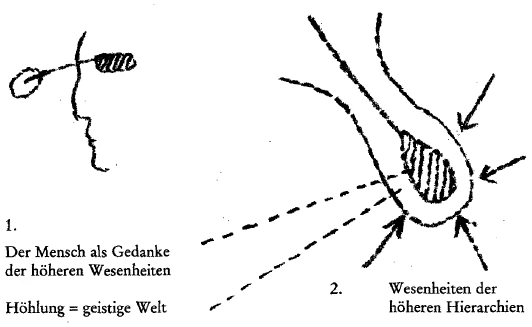
[ 15 ] The fundamental experience of the fifth post-Atlantean cultural epoch—our own epoch—is different. What is particularly characteristic of our epoch is that the etheric body is not puffed up or expanded, but rather contracted; that it is not too large, but rather too small, and this will become stronger and stronger as evolution progresses. If we can say: The normal form of the human being in Greek times is such that the etheric body is too large—then we can say: In modern humans, the etheric body constricts, contracts, and becomes too small. —The further humanity progresses in its materialistic contempt for the spiritual, the more this etheric body will contract and dry up. But since the organization of the physical body depends on the etheric body permeating it quite correctly, there will always be a tendency for the physical body, when the etheric body is too constricted, to begin to dry up as well. And if it were to dry up particularly severely, it would develop horn-like feet instead of natural human feet. The human being will not actually develop them, but the tendency toward this lies within him, and it is rooted in this tendency of the etheric body to dry out, to develop too little etheric force. Into this dried-up etheric body, Ahriman in particular can now take up residence, just as Lucifer does in the expanded etheric body. Ahriman will assume the form that indicates a poverty of the etheric body. He will develop too little etheric force to have properly organized feet, and will form the aforementioned horn-like feet—goat’s feet.
[ 16 ] Mephistopheles is, after all, Ahriman; he does not have goat’s feet for no reason; he has them for the reason I have indicated. Myths and legends are indeed very significant; that is why Mephistopheles very often appears with horse’s hooves, where the feet have withered into hooves. If Goethe had already fully grasped the problem of Mephisto, he would not have had his Mephisto appear as a modern gentleman, for it is part of the very nature of Ahriman-Mephisto not to possess enough etheric power to completely permeate the human physical form.
[ 17 ] But this also gives rise to another peculiarity: the etheric body is, as it were, contracted and is poorer in etheric forces than is normally the case. This peculiarity becomes clearest to us when we take a look at human nature as a whole. In a certain sense, we are already physically a duality. Just think: when you stand there like that, you are simply the physical human being. But part of being the physical human being is that the air you breathe is constantly within you. This breath, however, is expelled outward again with the next exhalation, so that the breath-human that permeates you is constantly changing. You are not merely what consists of muscles and bones—the flesh-and-bone human—but you are also the breathing human. Yet this one is constantly changing, moving back and forth, out and in. And it is the breathing human who is connected to the ever-circulating blood.
[ 18 ] Separate from this entire respiratory human lies within you the nervous human, the other pole in which the nervous fluid circulates, and there is only a kind of external contact, an external coming together between the nervous human and the blood human. Just as only those etheric forces that tend toward the Luciferic can easily approach the blood system through breathing, so the etheric forces that tend toward the Mephistophelean or Ahrimanic can only approach the nervous system, but not the blood system. Ahriman is denied entry into the blood; he can live continuously in the nerves, living on until he withers away, until he becomes dry and austere, because he cannot reach the warmth of the blood. But if he wishes to develop a relationship with human nature, then he will have to yearn for a single drop of blood, because it is so difficult for him to reach the blood. An abyss lies between Mephistopheles and the blood. If he wishes to approach the human being, to that which lives within the human being, if he wishes to enter into connection with the human being, then he becomes aware that the human element lives in the blood. He must seek out the blood.
[ 19 ] You see, this is connected to the wisdom of the Mephistopheles legend, which states that the pact is made with blood. Faust must pledge himself to Mephisto through blood, because Mephisto must crave blood, since he is cut off from it. Just as the Greek man faced the Sphinx, who lives in the respiratory system, so does the human being of the fifth post-Atlantean cultural epoch face Mephistopheles, who lives in the nervous processes, who is cold and sober because he suffers from a lack of blood, because he lacks the warmth of the blood. And through this he becomes a mocker, the sober companion of humanity.
[ 20 ] Just as Oedipus faced the Sphinx, so must the human being of the fifth post-Atlantean cultural epoch come to terms with Mephistopheles. He faces this Mephistopheles as if he were a second being. The Greek faced the Sphinx through the process of blood and respiration that had become more energetic; he faced what entered his nature through this more energetic respiration. Modern humanity faces, with everything that surges forth from its intellect and sobriety, that which is bound to the nervous process. This confrontation of the human being with the Mephistophelean could be prophetically, I would say poetically, foreseen. But it will increasingly emerge as a fundamental experience the further we advance in the evolution of the fifth post-Atlantean epoch. And what I have described as occurring in childhood experience will be this Mephistophelean experience.
[ 21 ] While the ancient Greek was tormented by an abundance of questions, modern man faces not so much the torment of questions as the torment of being enchanted by his own prejudices, of having a second body beside him that contains those prejudices. And how does this come about?
[ 22 ] Consider evolution with an open mind. How much has ceased to approach humanity in a warm, immediate way over the course of the fifth post-Atlantean cultural epoch? Consider the countless questions that truly confront us when we delve into Spiritual Science. They are all absent for the modern, materialistically minded person. He does not sense the riddle of the Sphinx; the Greeks still sensed it in a living way. But modern man will have to sense something else. He actually thinks he knows everything so well, observes the sensory world, combines it with his intellect, and then all the riddles are solved for him. He has no inkling of how deeply he is groping about in the phantasmagoria of the external world. But this increasingly densifies his etheric body, increasingly dries it out, and ultimately leads to the Mephistophelean element clinging to the being of the modern human being—like a second nature—into the future. Everything that develops in terms of materialistic prejudices and materialistic narrow-mindedness will strengthen the Mephistophelean nature, and we can already say: We are looking into a future where everyone is born with a second self who will say, “Those who speak of the spiritual world are fools. I know everything; I rely on my senses.” — Certainly, humanity will reject the Mephistopheles riddle just as it did the Sphinx’s riddle, but it will have a second being attached to its heels. This being will accompany it in such a way that it will feel compelled to think materialistically—not of its own accord, but through a second being that is its companion.
[ 23 ] The materialistic mindset will cause the etheric body to wither away, and Mephistopheles will dwell within that withered etheric body. We will have to understand this, and in the future, humanity will have to provide children with enough education—whether through eurythmy or through a perspective based on Spiritual Science—to enliven the etheric body, so that human beings can take their rightful place and recognize the significance of their companion. Otherwise, he will not understand this companion; otherwise, he will feel toward him as if he were enchanted, spellbound. Just as the Greeks had to cope with the Sphinx, so must modern man cope with Mephistopheles, with the satyr-like, faun-like figure that has goat’s or horse’s feet.
[ 24 ] One might well say: Every age knows how to distill its defining characteristic into a fundamental cause or origin. — Such fundamental causes are the Oedipus myth in Greece and the Mephistopheles myth in more recent times. But these things must be truly understood, as far as possible, from their very foundations.
[ 25 ] You see, what otherwise appears merely as fiction—the exchanges between Faust and Mephisto—becomes, one might say, the foundation for the pedagogy of the future. The prelude to this is that the people or the poet have sensed the presence of this companion. But the aftermath will be that every human being will have this companion, who must not remain incomprehensible to them, and that this companion will appear most vividly and most powerfully in a person’s childhood. And if adult educators do not take the right stance toward what the child expresses, then human nature will be corrupted by the enchantments of Mephistopheles through this misunderstood confrontation.
[ 26 ] It is very curious that, if one examines the literature of legends and fairy tales, one can find these traits everywhere. Legends and fairy tales, which are viewed so foolishly by the scholars of our time, point in their structure either toward the Mephistophelean, the Ahrimanic, or toward the Sphinx-like, the Luciferic. All legends and fairy tales stem from the fact that their content was originally experienced either through the relationship that humans have with the Sphinx or through the relationship that humans have with Mephisto. In legends and fairy tales we find, more or less hidden, either the motif of the riddle—that is, the Sphinx motif, the motif that something must be solved, that a question must be answered—or the motif of enchantment, of being spellbound by something: that is the Mephistophelean, the Ahrimanic motif. For what exactly does the Ahrimanic motif consist of? It consists in the fact that, when we have Ahriman beside us, we are constantly in danger of succumbing to him, of passing into his nature, of no longer being able to tear ourselves away from him. And one might say: Faced with the Sphinx, a person feels something that penetrates them and, as it were, tears them apart; faced with the Mephistophelean, a person feels something like: they must submerge themselves in this Mephistophelean, they must devote themselves to it, they must succumb to it.
[ 27 ] The Greeks had no theology in our modern sense, but when it came to all matters of wisdom, they were still closer to nature and its phenomena than modern humans. Without theology, they approached the wisdom of nature, and this gave rise to their intellectual curiosity.
[ 28 ] Human beings are closer to nature in their breathing process than in their nervous processes. This is why the Greeks felt this encounter with wisdom particularly vividly in their relationship with the Sphinx. Things have changed for people in modern times. Theology emerges. It is not through direct communion with nature that human beings believe themselves to be close to divine world-wisdom, but rather they seek to study it; they wish to approach it not through the processes of breathing and blood circulation, but through the nervous process. The search for wisdom, theology, becomes a nervous process. But in doing so, humanity binds its wisdom within the nervous process, drawing closer to Mephistopheles. And as the fifth post-Atlantean epoch dawned, it was precisely from this binding of the transformation of wisdom within the nervous process that the inkling arose that one is chaining Mephisto to one’s heels, that one is placing him beside oneself.
[ 29 ] If we strip the Faust legend of all the tangled elements that entwine it, we are still left with the fact that a young theologian strives for wisdom, is plagued by doubts, and therefore pledges himself to the devil, Mephisto, and is thus drawn into his sphere of influence. But just as the Greeks had to cope with the Sphinx by fully developing the ego-nature of the human being, just as one had to cope with the Sphinx through the development of the ego-nature, so in our time one must cope with Mephistopheles through the expansion and fulfillment of the ego with that wisdom which can come solely from the exploration of the spiritual world, through the knowledge of the spiritual world, through Spiritual Science.
[ 30 ] Oedipus was to be the mightiest of these conquerors of the Sphinx. Every Greek who took his humanity seriously was, in a small way, more or less a conqueror of the Sphinx. Oedipus was merely to embody, in a particularly typical form, what every Greek had to experience. So what happens? Oedipus was to conquer that which lives in the processes of breathing and blood. He was to set the human being who lives in this realm against the nervous human being who lives, as it were, with impoverished etheric forces. How does he come to do this? By taking into his own nature the forces related to the nervous process—that is, the Mephistophelean forces—but taking them in a healthy way, so that they do not merely accompany him but are within him, enabling him to confront the nature of the Sphinx through these forces.
[ 31 ] Here we see how, in essence, Lucifer and Ahriman exert a beneficial influence in their proper place—the place to which they have, as it were, first been transferred—and how they exert a harmful influence where they are not meant to be. For the Greeks, the nature of the Sphinx was something they were meant to cope with, something they were meant to cast out of themselves. If they could cast it into the abyss—that is, bring the expanded etheric body into the physical body—then they had overcome the Sphinx. The abyss is not out there; the abyss is one’s own physical body, into which the sphinx must be submerged in a healthy way. But there the other pole—the nervous process, the opposite process—must become stronger, emanating from the ego—not what is outside, but what must be inside. The Ahrimanic is taken up within the human being and thereby placed in the right place.
[ 32 ] Oedipus is the son of Laius. It had been prophesied to Laius that if he were to have a child, that child would bring misfortune upon his entire family. Therefore, he abandoned the baby boy who was born to him. He pierced the child’s feet, and thus the child was given the name Oedipus, meaning “clubfoot.” Therein lie the Mephistophelean forces in the Oedipus drama.
[ 33 ] I have said that if these forces cause the etheric force to diminish, the feet can no longer develop; they must wither and shrivel. In the case of Oedipus, this was brought about artificially. As is well known, he was found hanging from a tree by the shepherd who raised him, whereas he should have perished. He now carries his clubfeet through the world. He is, in a sense, Mephistopheles translated into the sacred. There he is in the right place; there he can powerfully pulse through the ego where the task of the fourth post-Atlantean epoch must be solved. Everything that made the Greek great, everything that truly made him a Greek—the harmonious balance between the etheric body and the physical body, which we still admire so vividly in the Greek figures in their well-formed beauty—all of that is lacking in Oedipus, so that he can become a “personality,” so that he can become precisely the representative of the human being in whom the ego grows strong. The ego, as it ascends toward the head, grows strong as the feet wither away.
[ 34 ] This must be countered by the human being of the fifth post-Atlantean cultural epoch. Just as Oedipus, in order to face the Sphinx and defeat her, had to take in Ahriman, so must the human being of the fifth post-Atlantean cultural epoch, who faces Ahriman-Mephistopheles, take in Lucifer—that is, he must undergo the reverse process of Oedipus. He had to push down from the head into the rest of his human nature what had been accumulated by the ego in the head. There has accumulated in the ego—insofar as this ego lives in the nervous process—philosophy, jurisprudence, medicine, and, unfortunately, theology as well—all nervous processes! Hence arises the urge to rid the head of everything and to penetrate the whole world through sensibility.
[ 35 ] Now take Faust as he stands, with everything the “I” has achieved, and how he wants to cast all of that out of his mind, as it were—what Goethe sums up in the words: “I have now, alas! Philosophy, law, and medicine, and, alas, theology as well, thoroughly studied with fervent effort.” He now sought to rid his mind of all that. He does so by surrendering himself to life, which is not bound to the mind. He is the reverse Oedipus, who allows the Luciferic nature to enter within him.
[ 36 ] And now observe everything Faust does to bring Lucifer into himself, so that he can fight Ahriman, Mephisto, at his side. All of this shows us to what extent Faust truly is the inverted Oedipus. While everything that happens in Oedipus through the inverted Ahriman nature is connected to Lucifer, everything that happens in Faust through the inverted Lucifer nature is connected to Ahriman-Mephisto. Just as Ahriman-Mephisto lives more in the outer world, so does Lucifer live more in the inner world. All the misfortune that befalls Oedipus because he must become imbued with the Ahrimanic nature consists of external events. Calamity befalls his family, not merely himself. And even the calamity that befalls him personally is indicated externally. That he gouges out his eyes and blinds himself—these are also external events. That the plague comes upon his hometown is something external. Everything that occurs in Faust consists of inner soul experiences, is a tragedy within the human being, so that Faust also presents himself here as the reverse of Oedipus.
[ 37 ] When we picture these two figures—or rather, these two dual figures: Oedipus and the Sphinx, Faust and Mephisto—before our eyes, we have before us, in a typical way, the evolution of the fourth and fifth post-Atlantean epochs. When the time comes when history is less about depicting the external phantasmagoria—that which has occurred as a reflection of the external—and more about depicting what people actually experience, only then will we see how meaningful and important these fundamental human experiences are. Only then will one realize what truly lives in the ongoing evolutionary process, how history—the external phantasmagoria—transcends the depiction usually presented as history, into that of which external events, however significant they may appear, are fundamentally only the external phantasmagorical imprint.
[ 38 ] Just as the ego had to strengthen itself, on the one hand, through Ahriman-Mephistopheles entering into Oedipus—that is, into the Greeks—so, on the other hand, this ego has become too strong in modern human beings. And modern human beings must free themselves from this ego by immersing themselves in spiritual events, immersing themselves in that which is connected with the world to which the ego belongs, when this ego becomes aware that it does not merely live within the human body, but is a citizen of the spiritual world. And this is the age in which we live. Whereas in the fourth post-Atlantean epoch humanity had to strive with all its might to become conscious of the ego within the physical body, so must humanity of our fifth post-Atlantean epoch work toward becoming conscious that the ego belongs to the spiritual world. And the expansion of ego-consciousness into the spiritual world—that is Spiritual Science. Therefore, this Spiritual Science is also deeply connected with the highest demands of human evolution in our fifth post-Atlantean epoch.