

The Connection Between Man
and the Elemental World
GA 158
15 November 1914, Dornach
Translated by Steiner Online Library
Third Lecture
[ 1 ] We touched on the extent to which the Earth itself serves as a source of inspiration for the people who live on it, at least in a few hints, because, of course, only hints can be offered in a field that is as vast as can be.
[ 2 ] It is particularly important and significant in our time to become aware that such connections exist as those we have spoken of, for humanity, within the course of Earth’s evolution, is currently at the point of, so to speak, emancipating itself once more from this earthly influence, and, in a sense, allowing itself to be permeated once again by those influences that come not from the earthly world, but from the spiritual world surrounding the Earth.
[ 3 ] This endeavor to penetrate, as it were, into human faculties, into human thought and feeling, that which is not merely earthly, lies at the foundation of our Spiritual Science endeavor. All trends in modern education are indeed moving toward this endeavor in Spiritual Science, and it is fair to say that there are two things that must increasingly come to the consciousness of people today.
[ 4 ] The first is that, in terms of his own spiritual nature, a human being belongs to a world that is not revealed to the external senses, but lies beyond the external sensory world; that human beings belong to such a world with their innermost soul being, a world that can be reached neither through sensory observation nor through conclusions and logic based on sensory observation. It will be the task of our time to gain clarity on this point: that all knowledge conveyed by the external senses, and the philosophy based solely on external sensory knowledge, cannot approach what the human soul actually is.
[ 5 ] The second is a truth that is familiar to you from your life in Spiritual Science, but which you know is still far removed from the general consciousness of the present day. It is the important truth of repeated earthly lives, that the human soul is not confined to the body in which it lives between birth and death, to all that is connected with this body, but that it passes from life to life.
[ 6 ] Because these two truths—that the soul belongs to a world that lies beyond the sensory world, and that it passes from life to life—are among the most important for our time and must be understood first and foremost, I have therefore included a chapter in the second volume of my Riddles of Philosophy in which the very course of human development points intensely toward these two truths, for it is an urgent necessity of our time that more and more people learn to grasp precisely these two truths.
[ 7 ] Since this book, The Riddles of Philosophy, is not intended specifically for anthroposophists but for all people who can read and understand what they read, an attempt had to be made to point out these two truths briefly but as clearly as possible. One might say that it lies in the deeper consciousness of people in modern times to direct their thoughts toward these truths. For now, I will simply say: to direct their thoughts. We can observe such tendencies—to direct thoughts toward these truths—everywhere. I have sometimes attempted to cite figures from recent intellectual history who tend toward such truths. Today I would like to cite one more example.
[ 8 ] One of the greatest minds of the 19th century is undoubtedly Emerson, who wrote with such profound forcefulness—not in pedantic philosophical language, but in a language that is nonetheless compelling. Emerson points out everywhere—whether he is speaking of nature or of the human race—that the external structure of the world, which man surveys with his senses and comprehends with his intellect, is merely the shell, the phantasmagoria, and that one arrives at the truth only by attempting to penetrate beyond the phantasmagoria.
[ 9 ] But thinkers like Emerson go even further. And I would like to give an example of this. Among his many significant works, Emerson also wrote a book titled The Representatives of the Human Race. In this book, he discusses Plato as the representative of all philosophical human endeavors; Swedenborg as the representative of humanity’s mystical aspirations; Montaigne, a significant thinker of the 16th century, as the representative of skepticism; Shakespeare as the representative of poetic talent; Goethe as the representative of literary talent; and Napoleon as the man of action, as the representative of the man of deeds.
[ 10 ] This book, however, has achieved something significant. It highlights the archetypes of humanity in relation to the life of the soul. It would be an interesting exercise to examine how the representative aspects of philosophical striving in Plato and the representative aspects of skeptical striving in Montaigne are indeed captured. This book represents one of the greatest achievements of humanity’s intellectual striving. Now, curiously enough, Emerson devotes to Montaigne—I would say—a particularly affectionate portrayal, although it is precisely this affectionate portrayal that only becomes apparent once one engages deeply enough with this chapter on Montaigne. This, too, is highly significant for Emerson’s underlying orientation toward Spiritual Science. Anyone who seriously engages with this worldview will realize how truly every thing has two sides, how, when one attempts to express a truth, one can only say something one-sided, and the second side must, as it were, lurk in the background.
[ 11 ] The skeptic, who has a keen sense that one is, in a sense, already doing wrong by strictly formulating a truth, is deeply moved by the spiritual and spiritual aura that is always present in the human soul and that prevents one, as soon as one is even slightly touched by the spiritual world, from presenting a sharply defined truth with too much aplomb without pointing out that, in a certain sense, the opposite of it also has its justification.
[ 12 ] This sense of being moved by a feeling that springs from the spirit is what makes Montaigne a significant figure. But that is not what I wanted to point out. I wanted to point out how Emerson recounts how he came to discover Montaigne. He says there: Even as a boy, I found a volume of Montaigne in my father’s library, but I did not understand it. — After he had graduated from college, he looked at the book again, and then he felt a strange urge to get to know, sentence by sentence, what Montaigne had written. And he did so, following this urge. Now, in the chapter on Montaigne that Emerson wrote, we see that he was searching for a way to express why he was suddenly, back then, as if possessed by Montaigne and suddenly began to absorb him completely. He finds no better way to express this than by saying: “It was as if I had written these books by Montaigne myself in a previous life.” — From this you can see how a spirit who is modern in the most eminent sense, one who addresses the demands of the present, is compelled, when he wishes to express the most intimate depths of his soul, to formulate an expression that tends entirely toward the truth of Spiritual Science regarding reincarnation. He finds no better expression and must therefore resort to the idea of repeated earthly lives.
[ 13 ] Something like this is extraordinarily characteristic, is immensely significant, and this now leads us to pick up on the idea that was discussed yesterday. If we look specifically at the most distinguished minds of our time—and one of the most distinguished is Emerson—then, on the one hand, if they are minds as significant as Emerson’s, they possess the earthly knowledge they have acquired, insofar as they are situated within the Earth’s evolutionary process. They know what one takes in as a human being today. They know that when one is placed at a certain point on Earth, speaks a certain language, and so on, it is customary, in the place where one is situated, to pass these things on to the child, to the young person, and thus to impart to the human being what is called education. This knowledge, which is passed on to a people in this way, is knowledge of a broad scope. One can certainly say that this is knowledge of a broad scope; one can say that when one sees how Emerson actually proceeds.
[ 14 ] We know that when he was to give a lecture, it seemed as though what he said sprang directly from his mind as he spoke. Everything seemed so improvised. If he received visitors on a day when he was scheduled to give a lecture, the visitors could see that all sorts of notes were scattered throughout the room, from which he had gathered what he had to say, so to speak, about the external aspects of his subject matter. But behind what he thus handed down to humanity lay intimacies, and this is precisely an intimacy—what I have expressed—that the idea of repeated earthly lives shimmers quite chastely in one place.
[ 15 ] One can see how even the greatest minds of our time, while deeply feeling, experiencing, and expressing such truths within their souls, remain chaste within themselves and do not yet wish to bring these truths into the realm from which external knowledge springs.
[ 16 ] If we now approach the matter from a perspective of Spiritual Science, we must examine it from a different angle, for our age is the one whose mission is to bring to light—to bring to true understanding—that which has hitherto been held back in the soul and only occasionally hinted at, to shape it into forms of knowledge, so that our age truly has the task of transforming much of what, up to this time, has been pushing its way out of the souls of the best among us into full clarity, into a truth that is self-evident to human beings. And here we can describe quite precisely how it was when Emerson, in his rich lectures, would soon utter a sentence expressing an insight into the industrial life of his surroundings, and then a few lines later bring up something concerning ancient India, and then again something concerning Shakespeare. In this way, he gathers together, so to speak, the knowledge of the world, and then a remark often slips out right in the middle of it all, one that comes from the depths of his soul.
[ 17 ] Where does the meaning behind such a remark come from? One can only answer this by considering all aspects of human nature. During their time on earth, human beings perceive only the very least, only a fragment of their life that unfolds from waking until falling asleep. The other part of life is spent in sleep, and this part of human life is truly, truly manifold.
[ 18 ] It is certainly true that for many, many people, life during sleep unfolds in such a way that they come into contact with elemental beings associated with lower expressions of human nature than those experienced during the day. One might say that from the moment they fall asleep until they wake up—that is, in the realm of elemental life, of nocturnal life—people get up to all sorts of mischief, things they are above when they are in their waking life. Who does not know that they often have to be ashamed of their dreams? This is a common experience that everyone can have. So during sleep, people engage in all sorts of mischief, in a society that is by no means a good one, but rather one that appeals to their passions and instincts—a society far worse than the one in which they are raised during their waking life.
[ 19 ] Only by understanding this can one better comprehend certain events that have occurred throughout history. In order to avoid indulging in too much frivolity even in physical life, people today must be endowed with the ability not to place too much importance on dreams. They therefore forget their dreams very easily, forget the flights of fancy from their dreams, and that is good for them, for they are to be prepared to enter the spiritual world in waking consciousness, whereas in earlier times, people were allowed to enter this spiritual world while asleep until they awoke.
[ 20 ] In fact, a deeper awareness of this world is not as far behind us as is commonly believed. I would like to give you an example of this as well. There is a picture by Albrecht Dürer that has posed many puzzles for many people, but especially for scholars. The etching depicts, roughly speaking, a satyr-like, faun-like figure who is, as it were, embracing a female figure. From the background appears another female figure who approaches this pair as if to punish them. And a Hercules-like male figure stands nearby, holding a club in his hand, which holds back the punishing female figure from the group of the woman and the satyr, so that she cannot approach. It is, one might say, quite strange, extremely strange, how the scholars have struggled to understand this image. It is usually called “Hercules.” But what is expressed here does not exist in the ordinary Hercules legend. One therefore wonders: How did Albrecht Dürer arrive at this scene? And the most curious ideas have been put forward. One can see, for example, in Herman Grimm, how helpless he is in the face of this image. He doesn’t know what to make of it. He puts forward the most curious ideas. And why does this happen? Why don’t people know what to make of it? Because he and the scholars do not know—what Albrecht Dürer still knew—that people can still enter a spiritual world while asleep. Today this awareness has been lost. Dürer, however, still knew that there are, for example, men who, during sleep, engage in all sorts of nonsense in communion with the elemental world—men who are quite well-behaved during waking hours but who, during sleep, revert to the world of instincts and engage in all sorts of useless things, all sorts of nonsense.
[ 21 ] In Albrecht Dürer’s painting, we see the satyr and Hercules with his club. Good old Hercules, standing there, would love to be that satyr himself. But he lives in the physical world—in a moral world on the physical plane—and his wife won’t let him. She comes over and wants to drive him away. But he actually likes it, and he holds her back.
[ 22 ] We see here an inner psychological process and know that Albrecht Dürer was still aware of some of these things. Thus, much in the art of centuries not so long ago can be explained, because at that time there was still an awareness of the connection between human beings and the spiritual-elemental world that lies immediately adjacent to the physical world.
[ 23 ] But when we turn our gaze to such noble spirits as Emerson was, we must say that during their sleep-life they do not engage in frivolous pursuits, but rather in noble ones. When they are in the spiritual world with their ego and astral body, they come into contact with the truths that are meant to be true anthroposophy for humanity. Then what is to become future physical knowledge pushes its way into their consciousness. One might say that Emerson receives such things in his sleep. Hence, it enters so chaste and intimately into what he has to say about physical life through his physical senses and intellect, surveying the vast earthly existence.
[ 24 ] Now, it would not be in keeping with the evolution of humanity for things to simply remain as they are, with people only grasping—I might say, in their dream life—what lies beyond the illusion of the senses, beyond the phantasmagoria of the senses. For this, again, is the point of evolution: that the dream life should lose more and more of its significance in the process of gaining knowledge. One must indeed be a great mind like Emerson to wish to grasp, out of the realm of sleep, something like the idea of repeated earthly lives. But what is spiritual must enter into humanity, must take hold in humanity. Just as these truths are connected to the innermost life of the human soul, just as they reveal themselves there, as it were, in a kind of dawn, particularly in spirits like Emerson, so on the other hand there must be an earthly predisposition to understand such truths in clear waking consciousness. There must be an earthly predisposition to perceive oneself in such a way that one finds it natural to acknowledge these truths. You understand that this is not yet natural in the present, for we are still such a small group as people engaged in Spiritual Science, and all those who stand outside of Spiritual Science regard us as fools or something similar.
[ 25 ] Modern education does not readily acknowledge these truths. Human nature resists this. The logical arguments people advance against Spiritual Science are generally of extremely low quality, for people do not resist for logical reasons; they resist because, by their very nature—as beings shaped by the forces of the earth—they are generally not predisposed to accept such truths today.
[ 26 ] But a time must come when human nature will be constituted in such a way that people can grasp these truths directly, just as they can grasp mathematical truths today. Human beings must be naturally organized in such a way that they can grasp these truths. For this to happen, it is necessary that, during the time between birth and death, they be physically constituted in such a way that their brains are sufficiently developed to enable them to grasp these truths.
[ 27 ] In the context of yesterday’s discussion, a relationship must be established between the spirits active in the earth and human beings such that human beings are constituted in a way that allows them to receive these truths; and this occurs in such a way that a landmass, as I demonstrated and described yesterday, slopes from east to west toward the three bays of which I spoke yesterday. Outwardly, this landmass is merely a phantasmagoria. In reality, this landmass is composed of the spirits of the Earth. In reality, the spirits of this landmass act upon human beings and physically shape them in such a way that they come to understand the truths regarding the spiritual-soul constitution of the human being and repeated earthly lives. What, I might say, more Western spirits must first conquer as if emerging from sleep will, upon awakening, become a more self-evident truth for those who, from the East, incline toward the evolution of humanity. One might say that the Earth is preparing their bodies for what they need for evolution. This Earth is precisely what I explained yesterday: a vast, all-encompassing organism that is animated and that, from its soul life, sends out the Earth spirits from time to time, who organize the bodies in such a way that they can intervene in evolution accordingly.
[ 28 ] You see, these things are extraordinarily profound and significant, and one really has to engage with them if one wants to understand what is at stake here. However, if one compares the Earth as an animated and spiritualized organism with what the human being is as an animated and spiritualized organism, there is a great difference. Through the outer shell of his physical body—in which he does not actually live, but in which he is simply contained—the human being stands in relation to the actual spirits of the Earth. Through the etheric body, he is related to the spirits of water; through the astral body, to the spirits of air; and through his connection with the ego, he is related to the spirits of fire.
[ 29 ] When a person leaves the physical and etheric bodies during sleep, they exist—along with their I and astral body—only in relation to the warmth that permeates the Earth and the air that flows through and breathes life into it. They are torn away from everything that Earth and water constitute within the physical body. When sleeping, the human being is truly torn away from all that, I might say, makes the physical and etheric bodies earthly beings. Of course, the air and the warmth also belong to the Earth, but only to the Earth, not to the parts of the Earth. Now, for the human being as an animated, spiritualized being, warmth is, so to speak, that in which he dwells as in his own element. In higher animals, a preparation for this is already present. They have their own warmth, not merely the warmth of their surroundings. They live in their soul life, in their own warmth. Human beings have developed this to such an extent that they live in their own warmth, that they have their own temperature. This is something that separates them from the manifold diversity of the external world. Warmth is, as it were, something of which every human being carries a certain measure within themselves and carries it with them. There, in their true self, they are at home in the warmth.
[ 30 ] In the air, he is less generally present. I would say that the very nature of the earth exerts a certain influence on him. Whether he lives in the air of the heights, the air of the water, or the air of the land, that makes a certain difference. There, the human being comes into relationship with what acts upon him from the outside. Such is the case with the human being as a soul- and spirit-filled organism.
[ 31 ] The opposite is true of the Earth as an organism imbued with soul and spirit. What warmth is to human beings, the Earth is to the Earth itself—the solid, earthly substance—and warmth is for it the outermost element, which relates to the animated Earth just as the Earth relates to us. The Earth is Earth through and through, just as we are warmth through and through. The Earth is differentiated outwardly in relation to warmth. Depending on whether it extends its limbs into the icy regions or into the sweltering regions of the tropics, it opens its soul to the outside world in accordance with the warmth, just as we, in relation to our physical bodies, tend toward the region where we currently live. With the Earth, it is precisely the opposite of what it is with human beings, and upon this is based the interaction of the Earth as an animated and spiritual organism with the human being as an animated and spiritual organism. Through this interaction, what comes into being in the physical human body is brought about, so that this physical human body may enter correctly into the evolution of the entire earthly existence in the succession of nations and peoples. It is precisely in the peoples who moved as masses from East to West that we find an intense relationship between the earthly and the human. And one could describe this intense relationship as if one were to see within the Earth itself a mighty being, and this mighty being were to resolve to intervene in the evolution in a corresponding way, let us say from the 20th century onward. Then it must say to itself: I must guide certain spiritual beings up to my surface; I must allow them to be active in such a way that they prepare physical bodies, so that the physical bodies can, through the brain, take in the truths that are appropriate in this time of human evolution.
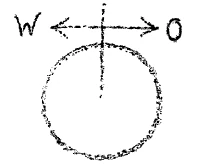
[ 32 ] What I have just said is like a thought that the Earth has. One grasps this thought only if one grasps it with the proper piety and reverence, if one does not treat it like the thoughts of external science, but rather regards it as something sacred, as something that cannot be spoken of without reverence, because one is reminded of the connection between humanity and the spiritual world, because one stands directly within the communion of the human with the divine where such things are spoken. Therefore, care should be taken everywhere to ensure that the necessary atmosphere of feeling and sensibility is present where such things are spoken. This is immensely important in such matters. One might say: In a certain sense, such things must not be spoken of in any other way than with the feeling, the mood of prayer, as their foundation. A gaze toward the spiritual worlds must pulse through what we are thinking through as we approach such thoughts. — And so that this can happen in a natural way, already through the external environment, our building is being constructed, and everything that is to come to light within it is being created.
[ 33 ] Thus, in what I have just described, we see a kind of example of how the Earth, as Earth, exerts a spiritual influence through what is contained in its solid elements, and how it creates and brings into being that which lives on it in the course of evolution.
[ 34 ] If, on the other hand, we move further westward, we find different conditions. Yesterday I explained to you a relationship in which the West interacts with the East, where the fluid element leans toward the East like a mighty being, and the threefold nature of the soul expresses itself by leaning toward the three great bays, which the spiritually inclined peoples of ancient Finland—such as Wäinämöinen, Ilmarinen, and Lemminkäinen, and which are today so prosaically referred to as the Gulf of Finland, the Gulf of Bothnia, and the Gulf of Riga. There, within the ancient Finnish people, that which comes from the liquid element and that which comes from the solid element worked together. In the Finnish people, the element that constitutes the more ethereal human being and refines the physical human being—the liquid—was united with the element of the earth, that which emerges from the earth and constitutes the physical human being.
[ 35 ] One might ask what significance a people such as the great Finnish people has, a people that has fulfilled such an eminent mission in the course of Earth’s evolution and yet remains for the future. It is all significant in the overall progress of evolution that such a people remains, that it does not disappear from the Earth once it has fulfilled its mission. Just as human beings themselves retain in living memory the thoughts they formed at a certain stage of life for a later stage of life, so too must earlier peoples remain as a conscience, as a living, ongoing memory in relation to what happens in later times: like a conscience.
[ 36 ] And now one might say: The conscience of Eastern Europe will be that which the Finnish people have preserved. — A time must come when an understanding of the tasks of evolution takes hold of people’s hearts, when, right from the heart of the Finnish people, the ideas of the Kalevala will blossom anew, when this wonderful epic of the Kalevala will be imbued with and interwoven with modern ideas of Spiritual Science, and when, in its depth, it will once again be brought to the consciousness of all of Europe.
[ 37 ] The European peoples revered the Homeric epics. The Kalevala, however, sprang from even deeper sources of the soul’s life. It is simply not yet possible to grasp this today. But it will become clear when the teachings of Spiritual Science are applied appropriately to explain the spiritual phenomena of Earth’s evolution. An epic such as the Kalevala cannot be preserved unless it is preserved in living existence, without the souls that dwell within the body, which are kindred to the creative forces of the Kalevala. It remains as a living consciousness. Through this it can continue to work, not through the words, but through what has lived within it, so that a center exists from which it can radiate. What matters is that this center exists, just as the thoughts we once had remain with us in later life.
[ 38 ] In the West, it is more that which forms and shapes the etheric body. These are difficult truths, and you must get used to them, because I do not have the opportunity—which, hopefully, will one day be available in the evolution of the Earth—to spend an entire year explaining the things I must cover in an hour. You must be willing to supplement much of this with your own thoughts and to meditate deeply on what has been said. Then it will become fully familiar to you. In particular, do not try to approach these matters with this or that hasty emotional nuance.
[ 39 ] In the West, there is a greater influence on the etheric body, which must be shaped and formed there in the same way, but at an earlier stage, than must happen with the physical body in the East.
[ 40 ] You see, it is very easy to fall into misunderstandings in such matters, for the differences are subtle, very subtle. For example, when one observes in the West that it is significant for the peoples there that the etheric body has been formed more by the spirits of water, it follows naturally—since the physical body is an imprint of the etheric body—that the physical body, as an imprint of the etheric body, has likewise been formed from the forces of water. But the point is that in the East, the forces act more directly into the physical body. One must therefore focus one’s attention on what really matters. External physical science cannot make this subtle distinction. It sees that the Eastern physical body is configured in one way and the Western physical body in another. It sees nothing more. Only Spiritual Science can go into such differences in greater detail. Moreover, language is so clumsy and ill-suited to expressing such differences. When one says something quite different, one often has the impression that one is actually saying the same thing. Yesterday, for example, I had to say that for Asian peoples, what matters is that the forces that build up the physical body lie within their own etheric body. Today I must say that for the peoples of the West, it is essential that the etheric body be formed from the forces of water. If you take the whole picture into account, you will understand that in ancient times it was the case that among the eastern peoples of Europe the etheric body had to be formed, but it is now, now, the time has come when the physical body must be formed, whereas for the Western peoples, their etheric body is formed after their physical body has already received its imprint more from the outside, so that their etheric body is directly exposed to the genii of the sea, the genii of water.
[ 41 ] For the peoples of the West, what they are is brought about by the fact that the impulses enter the etheric body. Where the impulses enter the etheric body to a greater extent, what matters is not so much the spatial aspect as the temporal aspect. What matters more is how the impulses work in the succession of time.
[ 42 ] When we look toward the East, we see, as it were, thoughts welling up from the earth to prepare humanity for future evolution. When we look toward the West, we see thoughts and forces welling up from the fluid, forces that shape the etheric bodies in the flow of time.
[ 43 ] And there we see how, even in ancient times in the West and far into Central Europe, the human etheric body was formed in such a way that this etheric body lives out its immediate life in a tangible, living, and outward manner.
[ 44 ] What does this mean? It means, my dear friends, that in ancient times there lived people in Western Europe who expressed their way of life through their etheric body just as—now that the etheric body has already acted through these ancient impulses—human beings act through their physical body. There lived people who still had a living connection with the spiritual world, particularly with the elemental world. This belongs to ancient times. Those times are, in a sense, already past, when the genii of the liquid element spoke in the most vivid way to the etheric body of human beings in the West. But when this etheric body is addressed, it is different from our time, in which the human physical body is primarily addressed. The human physical body is addressed in such a way that impressions are made upon its senses, so that the person acquires knowledge and adopts certain habits of life connected with the impressions of the senses.
[ 45 ] These ancient peoples of the West were such that, in their way of life and in what lived within them, they were even more closely connected to the elemental world. Among the Celts there were people who knew about the elemental world just as we know about the physical world today; people to whom the elemental world was not closed off, who could speak of nature spirits, water spirits, and earth spirits just as we speak of trees, plants, mountains, and clouds, and who had direct contact with these nature spirits. And the distinctive character of life in Europe is based on the fact that this was indeed the case in ancient times, because back then, just as we today act upon the physical body through the senses, so too was the etheric body of the human being acted upon.
[ 46 ] Then the process continued, but now it focused specifically on the human etheric body; however, this etheric body is formed and shaped in such a way that the relationship between the spirits of the liquid element and it takes place more in the subconscious, so that conscious interaction with the nature spirits recedes into the background.
[ 47 ] How did this come about? In the case of France, for example, it came about because the wave of Romanic development swept over the wave of Celtic development, so that the Celtic element was permeated by the Romanic one. In the confluence of the Celtic and the Romanic, we have two impulses. An ancient impulse that directly mediates the connection between the elemental world and the etheric body, and in the new impulse, in the influence of the Romanic, we have that which also enters the etheric body, but enters in such a way that it is like a historical wave, so that what I have already said in earlier lectures could come to pass: that within the French element, a revival of the ancient Greek element could take place.
[ 48 ] If one wishes to understand this Western type of human being correctly, one must assess these various impulses—which also flow into the etheric body—in the proper way. And so far we have, so to speak, spoken of characteristic phenomena in relation to the influences on the physical body and in relation to the influences on the etheric body. The situation is different when we consider the middle region. There, things are somewhat different. There we are dealing with something, I would say, much more inarticulate, with something that is less clearly definable. There we are dealing with the fact that both spirits of the earth and spirits of the liquid element act directly upon the physical body.
[ 49 ] You see, it is a transition. Here in the West, spirits of the liquid element act directly upon the etheric body. The spirits of the liquid element diminish in Central Europe, and certain spirits of the earth element join them. They act directly upon the physical body; less strongly on the etheric body. The spirits of the earth element refine the physical body as you move further east. Therefore, we have, in a way connected to Central Europe, all that which has long supplied Europe with physical bodies that are receptive to the liquid and solid elements, and thus we see how complex the factors flowing into human evolution must become. We see how, from this fund, this reservoir, the Frankish people—as I have described—are prepared by the genii of the liquid and the solid to reinsert themselves into the Celtic-Romanic folk element; and only then does that which has confronted us as the active force in human evolution come into being.
[ 50 ] The Franks who remain behind thus retain the peculiarity, the characteristic, of absorbing—primarily into the physical body—that which emanates from the fluid and earthly spirits; the Saxons are akin to them in this respect. The Franks who migrated westward united their essence with that essence which arises from the direct influence of the genies of the sea, a fact made all the more significant by the fact that it incorporates the historical aspect of the Romanic element.
[ 51 ] Thus the impulses intertwine, and this is how we can understand that, especially when we seek to characterize Western Europe, we cannot arrive at an understanding unless we take into account everything that influences the etheric body.
[ 52 ] If we wish to characterize Central Europe, we must say that what matters there is the physical body; what matters is what is configured within the physical body. Now we see how such impulses, such as those just described, concentrate, as it were, in certain centers, and how they emerge characteristically in certain centers. Two such centers, which really stand in a characteristic relationship to one another, are found in Central Europe on the one hand and in the British Isles on the other. In Central Europe, where this finds its strongest expression, we have what I have called the solid element, and where what comes from the genii of the liquid and the genii of the solid flows into the physical body, where these thus mix, and in the British Isles, where—in a certain sense more strongly than is the case in France, for example—what comes from the genii of the liquid element acts preferentially into the etheric bodies. This has resulted in people living in these two regions who, fundamentally speaking, carry the same impulses within them; only that some carry them in the physical body and are suited to everything connected with the activity of these genies in the physical body; the others, in the British Isles, carry them in the etheric body and are thereby called upon to bring about everything connected with the impulses of the etheric body. If I may put it in a somewhat grotesque way, I could say that when you place a German and an Englishman side by side, you notice the difference when you consider them as physical bodies. One only notices the similarity when one compares the physical body of the German with the etheric body of the Englishman. Only then does that which shows us that the same impulses are at work—indeed, the very same impulses—come to the fore.
[ 53 ] You see what emerges, I might say, in a caricatured form in the external perception that remains confined to the external phantasmagoria. Do not misunderstand the word. This only presents itself in its true form when one takes in what becomes the foundation of life, what is the truth. But because the beings in the world must interact—because it cannot be otherwise than that the beings interact, for the world is a whole—it must be the case that, on the one hand, certain impulses act through the physical body, and on the other hand, through the etheric body. I would say that this is how it ought to be. This gives rise to the corresponding real interaction.
[ 54 ] This, you see, has given rise to what appears in the spiritual world as a very special relationship between the German world and the British world. I explained this very special relationship between East and West in a previous lecture by showing you how a certain struggle takes place in the spiritual world between East and West, brought about by the difference between souls coming from an Eastern body and those coming from a Western body.
[ 55 ] What is brought about by the circumstances just described is something else entirely. I ask you not to take what I have to say today as something that can be understood through reason or speculation. One must observe this in the spiritual world; otherwise, one will not be able to arrive at the truth. Little by little, a resonance is developing between the forces emanating from Central Europe and the British Isles—a harmony, a true spiritual alliance—which has gradually grown so strong that one can say, in spiritual terms, that no earthly souls love one another more today than the earthly souls of Central Europe and the earthly souls of the British Isles. There exists the strongest love, spiritually speaking, and this is expressed outwardly in what we now see before us. That is how complex things are.
[ 56 ] One would truly not utter such things if they were based merely on a superficial understanding, if they had not been gained through the most painful of experiences. Do not think you can generalize by assuming that every alliance in the physical world is a war in the spiritual world, and every war in the physical world is an alliance in the spiritual world. Things are as I have described them to you. And the fact that this is expressed as a struggle is, in today’s materialistic culture, an expression of the difficulty of truly living out the matter in the spiritual realm.
[ 57 ] Our age resists acknowledging what exists in the spiritual world, not only in words but also in deeds. It attempts to present the opposite of what exists in the spiritual world, because the materialistic age resists the recognition of the spiritual even in its actions. And so what the spiritual world tends toward—namely, the harmony between what has been achieved in the physical realm in Central Europe and what has been achieved in the etheric realm in the British Isles—is drowned out in maya by what we see today as strife and mutual hatred.
[ 58 ] You see, even for those who are not Spiritual Scientists, it is understandable to regard us as fools, since the insights that emerge from the spiritual world are in stark contrast to what can be observed in the physical world. But we can be assured that the further development of humanity depends on spiritual truths truly taking hold, on people truly learning to see beyond the sensory world. For this, certain events are necessary, which I have spoken of more or less clearly in recent days.
[ 59 ] We should be glad that karma has brought us together here in a neutral setting where we can speak so freely about these matters, for it is not entirely easy to discuss them, especially today. But it is good for spiritual scientists to familiarize themselves with these matters, because they may regard what happens in the outer world precisely as an incentive to look behind the veil. Much would remain completely incomprehensible if one could not look behind this veil. Things only acquire their full meaning when one looks behind this veil.