

The Mystery of Death
The Nature and Significance of Central Europe
and the European National Spirits
GA 159
19 June 1915, Düsseldorf
Translated by Steiner Online Library
15. Overcoming Death through Insight: Pre- and Post-Mortem Experiences of the Soul and Our Connection with the Dead
[ 1 ] The day before yesterday, in our Düsseldorf lecture, we took a brief look at what is referred to in the context of life as the human being’s passage through the gate of death. That is precisely what matters: that Western spiritual development gradually be permeated by an insight that, in a sense, overcomes death through knowledge—overcomes it by recognizing it as a transformation of life itself.
[ 2 ] It goes without saying that, especially in our age permeated by materialistic views, death must increasingly appear as a boundary of the world that human beings experience. We can easily form a mental image of what this was like in earlier times; it was quite different, of course, because, as we know, people in those earlier times still possessed a kind of remnant of an ancient, dreamlike clairvoyance. This dreamlike clairvoyance was connected with a presence in the spiritual world. And since in those times, when our souls were embodied in such bodies, a clairvoyant presence in the spiritual worlds was still possible, and our souls were connected to the spiritual world, death was not for them a significant, conclusive phenomenon as it is in our times. But this would become ever more pronounced if the insight to be gained through Spiritual Science were not gradually to enter our time. For one must certainly not believe that this Spiritual Science, which we are acquiring, does not already, as Spiritual Science itself, hold the greatest significance for the entire human experience.
[ 3 ] Certainly, many of us will say: On our journey through the Spiritual Science movement, we strive for two things. First: to penetrate, in a rational and intelligent way, what Spiritual Science offers us. Second: By applying the methods of Spiritual Science to our souls, as outlined for us, for example, in the book How Does One Attain Knowledge of the Higher Worlds?, we ourselves strive to enter into the perception of the spiritual world even during our physical incarnation. But some will say: Certainly only a few, only a very small number, are granted by their karma the ability to enter the spiritual world fully consciously in this incarnation. Admittedly, in a certain sense everyone would enter—and indeed everyone does enter—who merely applies these rules; but to realize that one is already within it, to be attentive to it, is more difficult than the entry itself. And this is what prevents many—even if they are already truly within the spiritual world—from applying that subtle, intimate attention to what they are now experiencing, so as to be truly conscious of how they stand within it. One might say that for anyone who applies the rules given in the book How to Attain Knowledge of the Higher Worlds, it happens after a relatively short time that they stand within the spiritual world with their own self, but—they do not notice it. It is precisely in the face of such a consideration that it must be emphasized again and again that a rational understanding of what is presented in Spiritual Science does not depend at all on whether one looks into the spiritual world oneself. We have often said: Presenting the facts of the spiritual world naturally requires a spiritual-scientific perspective. But when what has been discovered is presented, anyone can understand it, provided they apply their sound intellect in an unbiased manner, unclouded by the prejudices of the external materialistic world. We must be clear that it is not enough merely to resolve or convince ourselves that we are completely beyond the prejudices of the materialistic age. Certainly, according to our will and our longing, we will rise above these prejudices of the materialistic age if we seriously engage with the Spiritual Science movement. For, fundamentally speaking, no one will honestly and sincerely commit to this Spiritual Science movement unless they are, in their deepest inner being, imbued with the longing to rise above materialistic prejudices. But these materialistic prejudices are so deeply ingrained in our habits of thought, and particularly ingrained is that which is not directly a materialistic prejudice but is connected to it. It is connected to the materialistic prejudice, to the entire materialistic worldview, that human beings, in a certain sense, cannot develop a comprehensive capacity for thought. As much as our age is focused on reason and logic, a sharp intellect and a sharp logic are actually not the exclusive domain of those who perhaps wish to lead the scientific or other cultural endeavors of our time.
[ 4 ] In our time, people do not strive for complete clarity of thought at all; for if they did strive fully for clarity of thought, they would already be able to truly understand Spiritual Science in its entirety. Anyone who thinks with complete clarity finds nothing to object to in what Spiritual Science has to offer—on the whole, of course; for in the details, the spiritual scientist can indeed err, just as human beings can err in general. Countless examples could be cited to show us how little our time is inclined to apply clear, sharp thinking.
[ 5 ] I would like to give you just one example from our own time. It has often been cited as a very common statement by a truly great man, a very significant figure. This statement has been repeated, and one German journalist has made a particular point of bringing it up time and again. A great man once said, then, that war is the continuation of politics by other means. And to many a thinker who thinks precisely in the spirit of our times, this seems so infinitely logical: War is a continuation of politics. Of course, nothing is to be said against the greatness of the man who uttered this statement. What he means is that nations conduct a certain kind of politics among themselves, thereby settling their affairs; when this politics has reached a point where it can, so to speak, go no further, then—well, what then?—then war simply continues politics. In this sense, the statement can be justified for everyone and immediately accepted. But if one thinks about it a little, one realizes how one-sided such a judgment usually is. For this judgment is, after all, entirely equivalent to saying, for example: There are two people who are friends or in some other relationship, who have always gotten along well, who may have loved each other infinitely, and who then begin to quarrel. Then one could also say: The quarrel is the continuation of love. Viewed from the outside, the quarrel is the continuation of love. But one will not have discerned anything specific about the nature of the quarrel if one merely knows that this quarrel is the continuation of love. So, of course, one has achieved nothing; one has not said the very least about war if one views it in such a way that one says: War is the continuation of politics. It is indeed the case that in our time, judgments can appear immensely significant that are actually quite one-sided judgments. Many judgments are highly valued today that reveal nothing special about the nature of the matter in question. Nevertheless, such a judgment need not always be fruitless. It can even have a very fruitful significance. But those who profess our worldview should penetrate the veil of maya a little, even with regard to external life. Of course, there is not the slightest objection to be raised against the judgment that now appears in every third newspaper column, for it is a fruitful judgment; yet, regarding the correctness of this judgment, one would have strange inner experiences if one were to examine it with clear thinking. So it is also when almost every newspaper column today proclaims: We will triumph, because we must triumph! — As I said, nothing is to be objected to regarding the validity of this judgment, regarding the fruitfulness and value of this judgment; but if someone standing before a river and needing to cross it says: I will swim because I must swim—then the correctness of the judgment depends on the fact that he can swim. And in this case, one can certainly, with clear thinking, attest to the correctness of a non-swimmer’s judgment: I will swim across because I must swim. What value does such a judgment have? Oh, it has great value, for it gives strength, it gives courage and confidence, it permeates the will; it is a judgment that spurs the will on. It is not a judgment that recognizes something, but one through which the will is steeled. This is what makes the judgment significant and important. Do not misunderstand such things. They are cited to show that clear, penetrating thinking is, after all, something other than what is so often claimed to be it. In our time, materialistic habits of thought are exceptionally widespread and strong.
[ 6 ] But our judgment is clouded most of all when we try to evaluate in our own minds what the person who studies Spiritual Science says. The fact is that everything the Spiritual Science scientist says can be understood—even if one has never cast a glance into the spiritual world—provided one applies truly sound, correct thinking. There is no person who, even without being clairvoyant, would have to be an opponent of Spiritual Science if they only possess sound judgment. There are, in fact, entirely different reasons for being an opponent of Spiritual Science, rooted in the nature of the human being, in the human soul. One of these reasons is, above all, the following.
[ 7 ] When a human being stands in the physical world with their perception, their perception in the physical world is always aided by the support of their physical body, their etheric body, and also their astral body. These—the physical body, the etheric body, the astral body—have long been present in the course of the world’s history, through the Saturn, Sun, and Moon eras, and have been built up for the human being from the forces of the divine hierarchies. They are today what they have become in the past. When a human being enters physical existence in the world, they are placed into that which has been prepared for them over long ages. All of this supports them as they stand within physical perception. For every time we perceive something or form a mental image, an imprint is made in our physical body. We are unaware of it, but this imprint in the physical body does occur. And the fact that it occurs is the reason why we have a memory during physical life. One must only picture this matter correctly. Let us ask the question: Why do we have a memory in physical life? — then we must say: Every time we form a mental image, an impression is made on the physical body. This impression is even more or less human-like. Every mental image we form does not merely, as the materialistic-fantastical thinker believes, make an impression here or there in the brain, but every mental image makes an impression on the whole human being. And with regard to a kind of re-forming of the head and even the upper part of the human chest, every mental image we form truly leaves an imprint. It is truly so: If I am speaking to you now—perhaps a hundred syllables in a minute—then during these minutes you have rapidly formed fifty human beings within yourself, yet you have just as rapidly dispelled fifty human images, one swiftly alternating with the other. Now, you can imagine how many such human images you have formed within yourself by the time the hour of contemplation is over. These human images are more or less alike in their outward form, yet at the same time unequal; none is completely alike to the other. Each is different from the other, even if only slightly so. It is a childish mental image to believe that if one has an impression of the external world now and remembers it tomorrow, that impression has remained within one in some form. It has not remained at all; rather, an image that is human-like has remained within the person. Truly, from every impression of the external world, an image remains that is human-like. And when you recall the impression again tomorrow, you place your soul into this human image that is within you. And the reason why you do not see this human image tomorrow, but rather recall the impression, is that you are reading within your astral body. It is a genuine act of reading, a subconscious act of reading; just as when you write something down and want to read it later, you do not describe the letters but what the letters mean—so it is tomorrow when you recall what you experienced today. You do not look at the image that has arisen within you, the human phantom that lives there, but you interpret it. You put yourself in the soul of this human phantom, and your soul experiences something quite different from this human phantom. It experiences once again what it experienced yesterday. One need not be all that surprised by this, for when you read Goethe’s “Faust” today—what do you have before you? Just so much paper and ink in some arbitrary form. That is, outwardly and materially, the whole of “Faust.” And you would never have Goethe’s “Faust” if you could not, in a soulful way, do something with what you have before you in the form of paper and ink. If you could not decipher it, it would simply be paper and ink. With regard to the external world, materialists constantly argue that what the Spiritual Science scholar says is there is, in fact, not there.
[ 8 ] But these materialists are as clever as a person who would say: What are you talking about with this Goethean Faust? It doesn’t even exist—there’s nothing but paper and ink! — This judgment about “Faust” is exactly the same as the judgment materialists pass on the world today. But it is the same with our memories. Tomorrow, nothing remains in our human beings of today’s impression except the phantom, the image, and everything else must be accomplished by the soul’s work on this phantom. And just as the entire fabric of Goethe’s Faust emerges in our soul from the paper and ink, so too does that which is a revival of today’s impression emerge from what has remained within us as a phantom when we recall it tomorrow. But this activity, which must be carried out so that we can remember, is performed for us by what has been prepared through the Saturn, Sun, and Moon periods; it is carried out by our so wonderfully formed physical body, then by our etheric body. They shape it, they do this for us. And what senses this, what feels this: the materialistically thinking human being. Now consider this: the spiritual truths that are gained are, after all, gained without this aid, in such a way that the aid of the outer physical body is not called upon. There, the forces that otherwise work in the outer body must come from within the soul; there, the work must be done from the soul itself. If one has a spiritual insight that has not been brought about by the external world, then, if we wish to recall it, we cannot place ourselves within an inner phantom that has remained; for that is, after all, in the body. There we must, through a much stronger power and without this support, work out the whole matter anew from within, work it out correctly. So that, too, is nothing particularly wondrous. For just think of the difference, how it reflects the matter I am now referring to on a small scale. Suppose someone reads a poem today, and this poem, which he has read today, he keeps in printed form until tomorrow. Then he can read it again tomorrow, and the day after tomorrow. But suppose they don’t keep it; then they must recite it from memory again. You see the difference: in one instance, we are, so to speak, doing something that has nothing to do with us; what we would otherwise have to do is carried over from one moment to the next by the external paper; we have a support in the paper. We have to exert ourselves more when we reconstruct the poem from the soul. Thus, the one who lives in the spiritual world must exert himself more inwardly with his will than the one who relies on the support of his body. But this is connected to the fact that everything that is achieved in Spiritual Science—indeed, everything that is merely to be understood—demands a great deal of mental effort in the first place. One can be much more sluggish and lazy as a materialist than as a person involved in Spiritual Science. And this is the reason why people are materialists, or at least one of the reasons. They are not materialists because they are compelled to it by logic, but they are materialists out of fear, and also out of laziness, because they want everything that takes place in the soul not to be brought about by the soul’s inner forces, but rather by what is inscribed in the body, by what is recorded there. These are things we must certainly take into account if we wish to understand the reasons why so many are opponents of Spiritual Science. Above all, however, it is difficult to come to terms with thinking when something is to be achieved that a human being must nevertheless achieve when he passes through the gate of death.
[ 9 ] I already hinted at this the day before yesterday: what is essential for passing through the gate of death is self-knowledge. Now, of course, this self-knowledge is by no means an easy thing. Some of you have already heard me speak about how, even with regard to outward appearance, people very often fall into the greatest error. There is a philosopher who is often mentioned these days, who lived in Vienna—Mach. I do not mean the Hamburg-based critic of theosophy, Maack, but Ernst Mach, the philosopher who should be taken seriously. He wrote an “Analysis of Sensations.” In it, he says the following with great naivety: I was walking down the street one day; suddenly I had to stop, because I encountered a person, and I thought: But this is a person with a very unsympathetic face, indeed, with an unbearable face. And lo and behold, I discovered that I had walked past a mirror, and the mirrors were hung in such a way that I had seen myself. Then I realized how little I was acquainted with my own appearance. — When he saw himself, he thus considered himself an unsympathetic person with an unbearable face. This is a professor of philosophy, a famous contemporary professor. And to further underscore what happened to him, he adds something else: When he had already been a professor for a long time, he was traveling by train one day, arrived very tired in a city, and boarded a bus there. There he saw a man getting on from the other side, and he thought: But there goes a run-down schoolteacher getting on! — But then he saw that there was a mirror hanging on the opposite side, and he realized that he had described himself as a down-and-out schoolteacher. He points out that, as he says, he knew the generic type better than its specific form.
[ 10 ] Now, if it is already so difficult to recognize oneself in terms of one’s outward appearance—perhaps it is easier for women, since they look in the mirror more often—it is quite a different matter when it comes to the soul. There is hardly any other way for our present age to gain self-knowledge than by sharpening our powers of insight through what we can absorb from Spiritual Science. The concepts and mental images we take in through Spiritual Science are, in the best sense, precisely suited to sharpening our self-knowledge. In fact, everything we take in through the book Outline of Esoteric Science is fundamentally geared toward self-knowledge in general. All the mental images we absorb through this book actually boil down to knowing ourselves, to knowing what the human being actually is. By studying how the human physical body, the etheric body, and the astral body have gradually come into being through Saturn, Sun, and Moon evolution, we come to know what is within us. And by coming to know in this general way what is within us, our powers of imagination are sharpened, enabling us to perceive specific details far better than would otherwise be possible.
[ 11 ] To what extent does this self-knowledge have significance for the moment of death? As long as we remain here in the physical body, self-knowledge is simply knowledge. But when we pass through the gate of death, everything we have acquired as self-knowledge is transformed into forces of the will. The better we know ourselves, the stronger a certain kind of willpower becomes precisely when we have shed the physical body. Let us suppose, for example, that we have realized here that we were, in regard to certain things, let us say, a violent person. Now, you know how difficult it is to completely transform ourselves in physical life—to truly shed that vehemence, even if we recognize it. But the moment we shed the physical body, the moment we simply know: “You were vehement”—that becomes will. And this will is directed toward eliminating that vehemence from our being. Every judgment of knowledge becomes, as we pass through the gate of death, a judgment of will; it becomes a force of will. And then something very significant occurs, which we can in a certain sense call the reversal of something experienced before the birth of the human being, but which is forgotten because the human being cannot look back on the times he lived through before his birth. But let us imagine that the human being could already now experience what he will develop in his Jupiter existence: When he gradually prepares himself from the spiritual world to come into incarnation once more, he would experience, in a most remarkable way, something like a glimpse of his future form, his future life. He would indeed also see something of his physical form. But there is one thing in particular that he would never be able to penetrate in this physical form, which would appear to him as two points. Let us imagine that, as we approach birth, we see our physical form fading before us, as it were, in a mist. We would see it as light, but within it we would see impenetrable, dark points, dark spheres, and many other things as well, but also these dark spheres. Long before a human being approaches physical birth, they see—as it were in time, not in space—before them: This is what you will become! And they already see, as it were, how their physical form is taking shape out of the essence of the spirits of form. This appears to them more or less as a figure of light, but within it, as if floating, two dark spheres. When a human being now lives toward physical life, they do so in part already within the mother’s womb; there they absorb certain forces from this environment, which the mother then shapes. They gradually feel connected to this luminous figure, and then they feel as if they were particularly immersed within these two spheres. Before, they seemed impenetrable to him; now he is inside them himself and feels the forces coming at him from all sides, flowing into him. Then he pierces through these two spheres, the space within the spheres; the space loses its impenetrability. And these are the places where the eyes will later be. When one approaches physical-earthly incarnation in this way, what one does not see at that moment, yet which enables us to see, are the eyes. They are like impenetrable spheres toward which we are moving. Then, in the final phase before entering the physical world, one penetrates them. If one were to experience this consciously, it would actually be a marvelous phenomenon. Imagine how, as you emerge from the spiritual world into the physical world, you say to yourself: Now you are going with your soul toward this physical form. There you will find two dark spheres. You cannot see through them with your present soul-vision; they are completely filled with spiritual substance! — Then one gains the power to make what was initially spiritually opaque transparent. And when one then, as they say, “sees the light of the world,” these spaces that were opaque are precisely the reason why one sees. One cannot see one’s own eyes; if one were to see them, one would not see the world.
[ 12 ] When one passes through the gate of death, the sight of death that follows is such a wondrous phenomenon in the spiritual life after death because something similar happens to the whole person as what happened here with the eyes. Only now is what happens to the whole human being experienced consciously. After death, one must gain the feeling in one’s inner experience: There you have stepped out of the world. Until now, one had the physical world before one’s eyes as a physical experience—that which the etheric body last reveals as a tableau. Now one passes through the gate of death with what one has acquired as self-knowledge, and this then becomes willpower. — Now imagine that the deceased is here. He leaves behind his physical experiences. He radiates his willpower—this willpower he has acquired through self-knowledge. This radiant willpower, acquired through self-knowledge, removes what prevents us from looking into the spiritual world. Just as, when entering birth, we remove the cloudiness of the eye, so to speak, so we remove what prevents us from looking into the spiritual world through this willpower. We make ourselves transparent after death. That is the significant event.
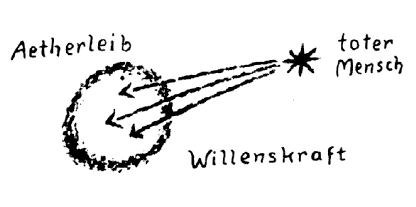
[ 13 ] When a person passes through the gate of death, as long as they still possess their etheric body, they look back on their entire life as if viewing a vast tableau. It lies before them. But now they also get the feeling: You see yourself! That is you, as you lived between birth and death; that is all of you! — Now all the power of self-knowledge they have acquired stirs within them and pierces through it, as it were, just as I have described; through this, the etheric body departs. Then it is as if a veil were falling, and what lies behind it comes into view for the first time, and that is the spiritual world. It is an immense experience to pass through the gate of death and, because the etheric body has been set free, to have one’s entire last life before oneself and to feel: This last life is a veil that conceals from you an immense world which you were unable to perceive during your life. Now the willpower arising from self-knowledge struggles against this veil, removing it. And as the veil tears apart, the spiritual world behind it appears.
[ 14 ] There is no need to be anxious, for example, simply because someone might say: In our present age, so many people have done absolutely nothing to achieve any self-knowledge. After all, according to many people’s judgment, one can hardly be any wiser or more intelligent than a contemporary university professor of philosophy; that is, after all, the ideal of intelligence in the present day. And one can hardly be any less inclined toward self-knowledge than such a famous man, or even a philosopher like Ernst Mach, who is truly a significant figure! One might therefore become disheartened and say: Things look rather bleak for self-knowledge. — Of course, if the situation were such that people were dependent on deriving from self-knowledge only that willpower which follows from present-day life, then things would be quite dire for humanity! People today are, after all, very proud of the tremendous advances in knowledge that have been achieved—and rightly so, from a certain perspective. Just think how a modern doctor, who knows everything that is currently fashionable in medicine, looks down with pride on those who were doctors not so long ago. They were all fools, he naturally thinks. With regard to external knowledge, people have gained and learned a great deal over the course of the last few centuries about the external world, how external phenomena are connected, and so on. Great progress has been made in this regard. But with regard to self-knowledge, the older times we experienced in past incarnations were far ahead of the present; so far ahead, in fact, that modern people, when they think materialistically, have no mental image of what to do with what comes from ancient times. For what people today regard as old prejudices was, in essence, self-knowledge, insofar as it was experienced by the souls of earlier times. And what has been recorded are merely the last remnants of that self-knowledge.
[ 15 ] Now, as far as earthly life is concerned, it is the case that, with ordinary external consciousness, a person knows nothing of their past incarnations. We do know, however, that among theosophists there are people who, after a relatively short time, begin to know an awful lot about their past incarnations. I once met a group in a European city where Seneca, Frederick the Great, Emperor Joseph, the Duke of Reichstadt, Madame Pompadour, Marie Antoinette, and a few others were sitting together at a coffee table. But apart from those who know so much about their past incarnations after having studied a little theosophy, people, as is well known, know very little or nothing at all about their past incarnations through ordinary external knowledge. For just as it is true that, through what the present cycle of humanity provides, a person knows nothing of their previous incarnation, so it is true that for the development of their will after death, they possess everything that has remained from their past lives. For things are different between death and a new birth. While here, between birth and death, people know nothing of their past incarnations, in the life between death and a new birth they possess within themselves all the powers of their past incarnations, as well as whatever has been experienced between death and a new birth. So when a person passes through the gate of “death,” they possess not only that willpower that comes from self-knowledge—which most people today lack—but all the forces of the will that do not stem from self-knowledge in this life; rather, they stem from the self-knowledge the person has undergone in earlier times. So that when a person passes through the gate of death, they do not lack the willpower that removes this fabric woven through their own life. But if humanity wishes to acquire new powers of will over the course of the next millennia, this self-knowledge from ancient times would also be increasingly valued in the present cycle of time. This is precisely why Spiritual Science must emerge for the further development of humanity. For the course of human history is such that, although human willpower is still sufficient today, the time is now beginning when, during the course of Earth’s development, this willpower can be strengthened by humanity becoming acquainted with the spiritual world.
[ 16 ] Humanity’s earthly evolution would be in danger if, from now on until the end of earthly evolution, people were to resist in every way the absorption of Spiritual Science. Then, indeed, human beings would find themselves increasingly unable to perceive much of the spiritual things and events in the spiritual world. They would be able to do so less and less. They would be able to penetrate the veil I spoke of less and less. So you see what significance self-knowledge, transformed into willpower, has. Here this insight is self-observation; over there it is self-will directed toward drawing back the veil from the spiritual world. It is precisely in those who pass through the gate of death that one perceives how important it is for them to strengthen themselves in the willpower as it has now been described—the willpower that arises from self-knowledge. It is therefore quite significant that, as a person passes through the gate of death, they engage through these various stages with what is within them, what is in their self, what they were during their earthly life. And when someone has a connection with a deceased person, it is of great, essential importance to make this connection particularly fruitful by helping the departed person to strengthen their self-awareness and to fulfill this self-awareness. This is what is meant in concrete terms: Let us suppose, for example, that someone who was with us here in physical life passes through the gate of death. Because we lived with him, we know what he was like, we know what he particularly enjoyed doing, and so on. Once they have passed through the gate of death, they have a necessity—an urgent necessity—to summon, as it were, everything they desire through strong inner forces. This must flow forth from their looking back. And we can come to their aid if we think of them as they appeared to us in life; if we engage in sending them the thoughts that characterize them. In addition to the various things that have already been said about our concern for the dead who have passed from us, we can also come to the aid of the dead by, as it were, presenting them with the image of their being. In this way, we relieve them of a certain effort in the unfolding of that will which must tear through the veil of the unrecognized. That is why the other thing I spoke to you about the day before yesterday has now occurred to me. It occurred to me, when I had to speak at the funeral of friends a short time ago, that I felt compelled to express, precisely at the funeral, that which lives in the friends as their essence. What was spoken did not come from memory, but was spoken from my own soul in such a way that this soul had completely placed itself within the other soul, after the latter had already passed through the gate of death.
[ 17 ] When dealing with a soul that has already passed through the gate of death, the task is to put oneself in that soul’s place. Here in the physical world, the object is present; one looks at it from the outside. In the spiritual realm, however, one is present within the spiritual-soul realm itself with one’s entire being. And in the specific case I spoke of the day before yesterday, it was precisely possible to put oneself in the soul of this personality who had passed through the gate of death and whom I thus characterized as a personality who, for many years before her death, had engaged deeply with our worldview, who lived entirely within it, so that she was now able to put into words her own inner content—that which she was as a being by virtue of having immersed herself in Spiritual Science and having absorbed certain forces—while she was still in her etheric body. I was able to receive this from the deceased who had passed through the gate of death, and I had to speak of this at the funeral.
[ 18 ] In other cases, things were different. When I was to speak at the funeral of our dear Fritz Mitscher—who must surely be particularly dear to the members of our branch here—I felt the need to fully put myself in the place of this soul who had passed through the gate of death. But now it became necessary to express in words what this soul had been in life for those who were friends with her and surrounded her, including as members of our anthroposophical movement, it became necessary to put this into words, so that, together with this soul after death, we might think through and collectively experience what serves as the inspiration and expansion of that will which arises from self-knowledge. Then the need arose, particularly at this funeral, to say things that resonate with what our dear friend Fritz Mitscher went through during his development after he had joined our Spiritual Science movement—what he had taken to heart, how his inner karma had driven him there. And the words I had to speak there are, as I said, not my own words; they sprang from the forces of his own soul, but were shaped in such a way that they expressed the essence of the years that preceded his death. I had to say that—not: I wanted to say what I had to say there. Of course, it is not something that was directly his own words; the soul in question would never have said this of himself in life. It is what the other soul felt, which is then connected to the soul of the departed, just as one can only feel with a soul that has already left the body. I would like to share with you these words that I had to speak at the funeral:
A hope that brings us joy:
Thus you entered the field,
Where the spirit’s blossoms of the earth,
Through the power of the soul’s being,
Wish to reveal themselves to the seeker.Beings who love truth above all else
Your yearning was akin to;
To create from the light of the spirit,
Was the serious goal of life,
Which you pursued tirelessly.You cultivated your beautiful gifts,
To walk the bright path of spiritual knowledge,
Unperturbed by the world’s contradictions
As a faithful servant of truth
To walk with sure steps.You trained your spiritual faculties,
So that they, brave and steadfast
On both sides of the path
Pushed error away from you
And created space for truth.To shape your self into a revelation
Of pure light,
So that the soul’s solar power
Might shine powerfully within you,
Was your life’s concern and joy.Other concerns, other joys,
Barely touched your soul,
Because knowledge, as light,
That gives meaning to existence,
Appeared as the true value of life.A hope that brings us joy:
Thus you entered the field,
Where the spirit-blossoms of the earth
Through the power of soul-being
Wish to reveal themselves to inquiry.A loss that pains us deeply,
Thus you vanish from the field,
Where the spirit’s earthly seeds
In the bosom of soul-being
Matured in your sphere of perception.Feel how we gaze lovingly
Toward the heights that now
Call us onward to other work.
Grant to the friends you have left behind
Your strength from the realms of the spirit.Hear the plea of our souls,
Sent to you in trust:
Here, for our earthly work, we need
Strong power from the lands of the spirit,
For which we thank our departed friends.A hope that brings us joy,
In a loss that pains us deeply:
Let us hope that You, far yet near,
Unlost to our lives, shine
As a soul-star in the spiritual realm.
[ 19 ] Even if these words should not be taken to mean that they were spoken by the soul itself, they were nevertheless spoken in such communion with the soul that, after a relatively short time, something was revealed from this soul—something that now came only from the soul; that is, not at all from my soul, but only from the soul that had passed through the gate of death. And that is how it sounded then, and ever since that time these words have echoed in my ears again and again:
To shape my self into a revelation
Of pure light,
So that the soul’s solar power
Might shine powerfully within me,
Was my life’s concern and joy.Other cares, other joys,
They scarcely touched my soul,
For knowledge appeared to me as light,
That gives meaning to existence,
As the true value of life.
[ 20 ] That is how the words echoed back. It was only later that I myself discovered that the two stanzas in the middle can be directly transformed from “you” to “I” and from “you” to “me.” I hadn’t known that before. For I had heard the stanzas just as I first read them to you. And now they came back from the essence of the dead man, spoken by him:
And when I first heard these words from that soul who had passed away—and it has happened often since then—it was only then that it occurred to me—for what was read aloud there is truly written word for word as it was heard in connection with the other soul—it was only then that it occurred to me that a dialogue could take place. At the cremation, it had been said:To shape my self into a revelation
Of pure light,
So that the soul’s solar power
Might shine powerfully within me,
Was my life’s concern and joy.Other cares, other joys,
They scarcely touched my soul,
For knowledge appeared to me as light,
That gives meaning to existence,
As the true value of life.
To reveal your true self,
To shape pure light...
[ 21 ] “You” and “your” appear in these verses. But I didn't write them myself. It wasn't until the words came back from the departed soul that I realized they were phrased in such a way that they could also be rendered in the first person:
To reveal my true self
and shape a light...
[ 22 ] You see there a dialogue that extends beyond the grave, a kind of understanding.
[ 23 ] Building on this, I would like to speak about something that is often mentioned in our Spiritual Science movement, but which cannot be discussed often enough. In the verses addressed to a soul that has passed through the gate of death, you will find an echo of what is most significantly expressed there, where it is said:
Hear the plea of our souls,
Sent to you in trust:
For our earthly work here,
We need the strong power from the realms of the spirit,
For which we thank our departed friends.
[ 24 ] Do not dismiss such a thing as mere words. It speaks to something that is profoundly and meaningfully connected to the very essence of our Spiritual Science movement.
[ 25 ] When a soul has strived as the one we are speaking of here has, so that it sought to permeate all the knowledge and experience it could acquire with the impulses of Spiritual Science, and it passes through the gate of death so early, then it is truly the case that such a soul can remain a faithful co-worker. So it was something like a plea when I called out these words to this soul, asking that it become a helper for what we must bring into the future of the Earth. For you can regard this as quite certain: the gulf between the living and the dead must truly be bridged in a living way through our Spiritual Science in the course of Earth’s evolution. We must learn, just as we are together with those living in physical bodies, to regard the dead not as dead, but as living among us, as living and working with us. Those who are the so-called dead then work with us using the forces at their disposal.
[ 26 ] We must strive to grasp—not as a theory but in a living way—the impulses that Spiritual Science is meant to create within us and translate into the living reality that we wish to integrate into cultural development from a spiritual perspective. And one must truly say: In the future, given the nature of our external culture, we will need the help of those who are in the spiritual worlds above. Those who truly bring the Spiritual Science movement to life here on earth will need the dead souls. That is why it was said that for our earthly work we need the power from the spiritual realms, for which we thank our departed friends. It is, as it were, a plea that these souls who continue to work—with the powers strengthened by what they absorbed here and imbued with what they absorbed in the spiritual realms—should work with us on Earth; that they may be imbued with that which is of the same nature as what we wish to achieve.
[ 27 ] Ah, it sometimes becomes symptomatically clear just what difficulties and obstacles are encountered by what we call our anthroposophical work on earth. Among the many things that can be observed time and again, let us highlight just one. A few years ago, an article appeared in a South German journal that caused a stir because word spread that it originated from a very prominent philosopher. The editor of the magazine is named Karl Muth. That same Karl Muth published a wide-ranging article at the time; when my Outline of Esoteric Science was published, he included this article, specifically in connection with that book, Esoteric Science. It might not have been all that difficult for me to at least weed out the worst parts of the article—the most foolish claims. For the truth about that great philosopher is as follows: many truly regard him as a great philosopher. But to some whom he has offended in life—he need not have offended them particularly, merely having sat across from them once—he appears as a sort of leech that latches on. And so he appeared to me, and I had to defend myself against him. But after he had written me postcard after postcard, letter after letter, he also sent me this article as a manuscript. I couldn’t bring myself to read the article because it started off so foolishly. For example, it said: Steiner calls what he wrote in his book “secret science.” But a secret science could not possibly exist, for the very essence of science is that it is not secret but public. — So, a secret science contradicts the very essence of science itself! That’s how it began. And wherever one turned the page, one came across such outrageous nonsense that it was fatal for me to continue reading the manuscript. It’s still lying around somewhere. This talk of “secret science” is sheer nonsense, for one need only know German to perceive this nonsense. It is just as if someone were to say: There is no such thing as natural science. But there is natural science! There is certainly no such thing as a “secret science,” but there is such a thing as “Geheimwissenschaft.” It was, therefore, utterly foolish, yet the editor of the journal considered it a particularly significant article. The article was widely read, and what was written about Spiritual Science—which had, after all, been thoroughly criticized—was regarded as something very clever.
[ 28 ] Now war has come. That philosopher is not German; on the contrary, he now counts himself among Germany’s worst enemies. And now he is writing a number of letters to the very same Karl Muth who, back then—forgive the trite expression—licked his fingers with glee at having received the article from the famous philosopher. Much venom and bile has already been poured out over Germany and the German people, but little has actually been written as poisonous, as ghastly as what this famous philosopher wrote in letters to Karl Muth. There one finds truly the most appalling judgments and criticisms of Germanness and the German character. The following can now even be regarded as a good sign. The philosopher in question, after spewing venom and bile, unfortunately did not write using “secret science,” because the censors did not prevent it from crossing the border at all, so that it even reached Munich, and Muth found the courage to reprint this venom and bile; but now not to reprint the “significant essay by a significant man,” but—years later, the same Karl Muth reprints this treatise on the Germans and writes: Of course, one must have a mental image of a man who writes like this as belonging in a madhouse! — You see, for Karl Muth, it took this treatise on the German character to realize that the man is a fool. A few years ago, however, he unleashed the same fool on our Spiritual Science. A reasonable person could have known that even back then, but fools are often regarded as famous philosophers; that is not the point! But you can see from this how things stand, what dangers Spiritual Science is actually exposed to. Had the war not come and had Karl Muth not been informed that this good man, Professor Wincenty Lutosławski, is actually a fool, he would have accepted another article from the pen of this “famous philosopher” that would have destroyed Spiritual Science.
[ 29 ] From this you can also see how, in our time, people are often not inclined to use their own judgment to determine what stance they should take toward Spiritual Science. I mention this only to illustrate—and one could cite many such examples—the obstacles our Spiritual Science movement faces; that even those who must later be regarded as fools are set upon it. Then perhaps the judgment is also justified that many other things said against the Spiritual Science are no more sensible. For where it could once be proven quite strikingly, there it has indeed been proven.
[ 30 ] We must realize that, in order to bring to life the impulses of Spiritual Science, we also need the very forces of those who have passed through the gate of death and who, before they crossed that threshold, absorbed what is contained in the light of Spiritual Science. The gulf between the living and the dead must first and foremost be bridged within the field of Spiritual Science itself. That is why something like a reminder must arise again and again: the awareness that we had souls close to us while they walked among us in their physical bodies—let us preserve that, just as it was before, only now directed toward the other form of life; let us preserve that, even when the souls in question have passed through the gate of death. For it will be among the most beautiful, the most significant things we can attain through Spiritual Science, when we can regard those who have passed through the gate of death as living among us, as meeting us; just as those who live in physical bodies meet us. And this will find substantial support in the fact that so many souls are now passing through the gate of death at an early physical age in the realms where new life is being prepared out of blood and death, and are handing over their unused etheric bodies to the spiritual world.
[ 31 ] The human etheric body is, in fact, constituted in such a way that it can supply the human being with life force well into old age. If a person passes through the gate of death while still young, the forces that could have been utilized here remain unspent—forces that would have been used had the person lived to a more advanced age. And we can now look up into the spiritual, the etheric world, where a person remains for some time after leaving the physical plane; there are, among those who have fallen in the fields of events and passed through the gate of death, many youthful etheric bodies that do not dissolve immediately, but remain, holding together and containing the forces that could have sustained life for a long time yet.
[ 32 ] But these etheric bodies will be there; they will be forces that can then come to the aid of human beings when they look up longingly, with the consciousness of Spiritual Science, toward where that which is contained in the unspent etheric bodies will be. Those forces from above will unite with those who consciously seek to connect with them out of a consciousness of Spiritual Science. Feeling and sensing this, we should turn to them. We should profess our belief in the spiritual world in a living way. We should be able to say to ourselves: There must be people, especially in the future, in the time that will follow this war, here on our Earth, who carry within them souls that can look up into the spiritual world in such a way that these unspent etheric bodies will be realities to them; that this will become a reality to them through the knowledge of the spiritual world. Then Spiritual Science will prove itself equal to what is not merely knowledge, but real life; real life also through the fateful events of our time. And then one will be able to say: Because there will be souls in the world who look up to the etheric bodies above, which are developing their powers undiminished, through this those human souls on Earth will be able to absorb these powers and thus work all the more strongly. And these untapped etheric body forces of those who have offered their sacrifices today on the fields of blood and death will be fruitful for the souls on Earth in the future.
[ 33 ] For this reason, let us once again today reflect on the spiritual interaction that can arise between souls who, inspired and enlightened by insights from Spiritual Science, look upward toward what remains of this war in the etheric bodies—what can emerge from this inner spiritual interaction. Let us once again inscribe in our souls those words that I now wish to speak at the end of our branch reflections, drawn from the entire context of current events:
From the courage of the fighters,
From the blood of the battles,
From the suffering of the forsaken,
From the sacrifices of the people
The fruit of the spirit grows
Souls, spiritually aware,
Send their meaning into the spirit realm.