

Paths to Spiritual Insight and
the Renewal of an Artistic Worldview
GA 161
30 January 1915, Dornach
Translated by Steiner Online Library
Third Lecture
[ 1 ] Essentially, the diverse reflections we have made here over time reveal that true, authentic art ultimately traces back to the mysteries of initiation. We have already discussed this, at least in passing, using various specific examples. Great artistic epochs—those in which artistic achievements that shine upon humanity come to pass—draw their artistic sources time and again from initiation. This points to how art brings spiritual life into physical life. Initiation opens up the possibility for human beings to progress from the physical plane into the spiritual worlds, and what can then be experienced in the spiritual worlds, more or less consciously, is carried down by true art into the physical forms through which art expresses itself.
[ 2 ] One can only truly grasp the full context referred to here, only truly grasp the full context of what is meant here if one takes into account that the last few centuries of human development have indeed concealed much, rendering it invisible and imperceptible to the vast majority of people—things that even five, six, or seven centuries ago were by no means as much of a mystery as they are today for those who call themselves cultured people.
[ 3 ] To highlight a significant fact, let us take the example of a work of art that truly shines through the ages: Dante’s Divine Comedy. Who, upon truly allowing the Divine Comedy to take hold of them, would not see the spiritual thread running through what Dante has expressed! Today, when it comes to explaining how Dante arrived at the magnificent images of his poem, people are often inclined to use the word “imagination” and content themselves with saying: Well, artistic imagination was simply at work in Dante. — Of course, it cannot be denied that artistic imagination was at work in Dante. But even historically, in a purely external sense, it would be incorrect to believe that Dante created his entire magnificent poem out of thin air, out of his imagination.
[ 4 ] Dante had a teacher and friend, Brunetto Latini, and I think it will become clear from what we are about to say that Brunetto Latini can truly be called an Initiate. So if we thus have the connection of an initiate—according to the standards of his time—with Dante, then we have precisely the connection that we must emphasize most thoroughly in relation to our own views.
[ 5 ] One thing was clear in those days: that one must walk the path through human rebirth if one wishes to uncover the mysteries of existence. And above all, it was still very much alive in those days that the path to knowledge of the world leads through self-knowledge. However, one must not view this self-knowledge as superficially as we often speak of self-knowledge today. Who does not believe they are capable of knowing something about themselves! I would like to begin by using a small example to make you aware of how difficult self-knowledge is even in the most elementary matters, and how little the human being is actually inclined to truly set out on what can be called self-knowledge.
[ 6 ] I have here a book by a very famous contemporary philosopher, a book by Dr. Ernst Mach, who has written a whole series of works that are quite characteristic of our time. Right on page 3 of his Analysis of Sensations, he makes a remark in which he discusses the connection between the physical and the psychological—a remark that is quite characteristic. He says: “As a young man, I once caught sight on the street of a face in profile that was highly unpleasant and repulsive to me. I was quite startled when I realized that it was my own, which I had perceived as I passed by a mirror arrangement consisting of two mirrors inclined toward one another.”
[ 7 ] So he walked on, and his karma led him past a set of mirrors where two mirrors were angled in such a way that he could see himself. And there he saw that face he found so unpleasant, which he then realized was his own. So even with regard to this most external aspect, it is not entirely easy to gain even the most basic self-knowledge,
[ 8 ] But the man in question makes yet another observation. He becomes a university professor and has formed a certain view of what a high school teacher looks like. “Not long ago, after a grueling overnight train ride, I boarded a bus, feeling very tired, just as a man was getting on from the other side. ‘What a shabby schoolteacher is getting on there,’ I thought. It was me, of course, because there was a large mirror hanging opposite me.” And now he adds by way of explanation: “The schoolteacher’s demeanor was thus much more familiar to me than my own professional demeanor.” He had formed a mental image of a schoolmaster, and he knew that the man who had just boarded looked like a shabby schoolmaster. Only afterward did he discover that it was himself.
[ 9 ] This is a fine example of the often rather lacking self-knowledge, even with regard to one’s outward appearance; but when it comes to spiritual self-knowledge, the situation is even more difficult. Nevertheless, this individual, personal self-knowledge is nothing other than the most elementary beginning, the beginning of that path which leads through the human being into the vast, universal mysteries of existence.
[ 10 ] When we look at the world from the outside, on the physical plane, we really have within this physical world only that which belongs to the very outermost nature of the human being—namely, the structure of the physical human body. We can say: When we take in the vast surroundings that we can survey on the physical horizon, we have there everything that is related to our outer physical human body. We must be clear that this is only a part of our total being, that the etheric body lies beyond it. But what in the human environment is similar to the etheric body, the human being does not initially sense; even less does he sense what is similar to his astral body, what is similar to his I.
[ 11 ] Because human beings are, for the time being, the only example here on Earth that brings them documents from the spiritual world, they must examine these documents of their own—they must examine themselves! All those who have experienced something of initiation have known this; Brunetto Latini knew it as well.
[ 12 ] Now, what is particularly characteristic of him—this teacher and friend of Dante—is that what is commonly called “initiation” is triggered, as is very often the case, by a specific event. Essentially, everyone who sets out on the path of Spiritual Science expects that, sooner or later, the gates to the spiritual worlds will open for them. And they will. It can, of course, happen—and often does—that entry into the spiritual world occurs gradually, that we slowly grow into the spiritual world; but very often it is also the case that the spiritual world is opened to us through a kind of sudden event, such as a life-shaking shock that befalls us. And so Brunetto Latini himself recounts how he had been sent as an envoy to the ruler of Castile, how he returned, how he learned on the way that his party, the Guelph party, had been driven out of Florence, that Florence had completely changed during his absence. This threw him into confusion. Such confusion of the outer state of mind, suited to the physical world, is often connected with what forms the starting point for entering the spiritual world.
[ 13 ] He goes on to describe how, in his confusion, he rode into a nearby forest instead of heading home, completely out of his mind, as he later recalled. When he came to his senses, it was quite peculiar: he did not see the usual world of the physical plane around him, but rather he saw something like a mighty mountain before him. He did not come to his senses in the consciousness that initially faces the physical world, but rather he came to consciousness facing a world entirely different from the one that physically surrounded him. A mighty mountain. But things were such that they came and went, arose and passed away again. And at the side of this mountain stood a woman, at whose command that which arose arose, and that which passed away passed away.
[ 14 ] Brunetto Latini perceived the regularity of natural phenomena in the form of an imagination. All the laws of nature and their regularity—creative, weaving, and living nature—appeared to him in his imagination in the form of a woman who gave orders as to how things should come into being and pass away.
[ 15 ] We see that we are living in the 13th and 14th centuries, a time when scientific thinking is gradually taking hold. What was later called, in abstract terms, the laws of nature—behind which people later refused to imagine there was anything essential—Brunetto Latini saw in the form of the mental image of a woman, from whose spirit, as if in words he himself imagined to govern nature, emerged what was later perceived in abstract form as the laws of nature. This woman then told him—so he recounts—that he should deepen his soul powers, and then he would penetrate ever deeper into himself. — And now it is interesting how she, as it were radiating her power over him, gives him the possibility of penetrating ever deeper into himself. It is the immersion into one’s own being. And the sequence he describes is, in certain circumstances, truly the correct sequence of initiation.
[ 16 ] The first thing, he says, that he came to know were the powers of the soul. So by delving deep within oneself, one truly comes to know what would otherwise remain unconscious: one’s own powers of the soul. And this recognition of one’s own soul forces is, of course, something that people—when they truly come into contact with them—easily flee from. For it is indeed often the case that when we perceive these soul forces, they strike us as unsympathetic, and we say to ourselves: What an unsympathetic soul that is! — And then one does not want that. Just as it was with the good professor when he saw his own form and found it quite unpleasant. One does not want to see it! For within this chorus of soul forces, one sees many things about oneself that one would never attribute to oneself in ordinary life. But one sees it in such a way that it works on the entirety of our being, on the elevation, but also on the diminution of our being, making us more or less valuable for the total existence of the universe.
[ 17 ] So we begin by delving into the soul forces. The next stage one then experiences is that of the four temperaments. It first becomes clear how we are woven together from the choleric, melancholic, sanguine, and phlegmatic temperaments, and how this interweaving lies deeper than the soul forces. And only after one has passed through the temperaments does one arrive at what, in the occult sense, can be called the five senses. For when people speak of these five senses, they are merely describing them as they know them from the outside. They know these five senses only from the outside. One can only come to know the senses from within if one has descended through the temperaments into deeper regions of one’s own self. Then one sees the eyes, the ears, and the other senses from within; that is to say, one experiences, for example, one’s own eyes and one’s own ears, filling them from within. You must, let us say, create a mental image of the following: Instead of entering here through this door into this hall and perceiving the objects and people already inside, when you undergo this descent into your own self, you enter the region, let us say, of your eyes or ears. Within this region, you perceive how the forces work from within to bring about seeing and hearing. You perceive a very complex world, a world of which a person who knows only the outer physical plane has no idea.
[ 18 ] Certainly, some will say: Well, yes, but this world of the eyes and ears does not impress me! The world of the physical plane that surrounds me is vast, but the world of the eyes and ears is small; there I am looking into a small world. — But that is a maya! What you perceive when you are inside your own ear, when you are inside your own eye, is much larger, much fuller than the outer physical world; there you have a much richer world around you.
[ 19 ] And only after passing through this region does one enter the region of the four elements. We have, of course, also spoken of all these characteristics of the individual elements. Only then does one feel oneself within the earth, the water, the air, and the heat.
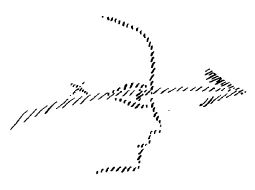
[ 20 ] Just as a person knows their senses from the outside, here they come to know them from the inside. So here they enter the eye with their consciousness from within, then break through the eye, and by breaking through the eye in this way, they enter the four elements. They can also break through via the ear or the sense of taste. Human beings are constantly surrounded by these elements, yet they do not know what they are like on the inside. One cannot see what they are like on the inside with the external sense organs; one must first step out of these sense organs, but from within, and then leave them again as if through gates, climbing out through one’s eyes and ears. Thus one slips through the eye, slips through the ear, and then enters the region of the elements. Through this one comes to know what lives as spiritual within this region of the elements itself: namely, the various kinds of nature spirits and those beings that belong to the hierarchies immediately adjacent to human beings.
[ 21 ] Then one moves on, entering the region of the seven planets. There, one is already further out, and begins to become acquainted with that which is creatively connected to us in the vast universe. And then, as it has always been called, one must cross Okeanos, the ocean.
Soul Powers
Four Temperaments
Five Senses
Four Elements
Seven Planets
Ocean
[ 22 ] This crossing of the ocean means the following: One can still reach the planets if, I might say, the last part of one’s soul being is still present in the physical realm. But when one passes through the gates of the senses in this way, through the elements and the planets, one must finally draw in even the last remnants of one’s soul being, so that one consciously enters the state in which one is otherwise only found in sleep. When one is with the planets in this way, one is still, as it were, with a part of one’s soul being within the body (see drawing). If one draws this out as well, then it seems as though one were swimming through the universal ocean of spiritual existence.
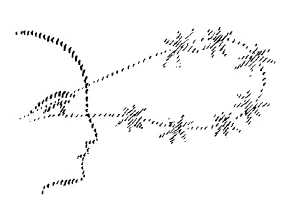
[ 23 ] Brunetto Latini now undertakes all of this; he recounts how he took each of these steps at the behest of the woman who appears to him in his imaginative vision. Then the woman urges him to go on. But this exhortation comes to him at a particular moment, and that is very characteristic.
[ 24 ] So consider this: The man rides into a forest because he is bewildered by what has happened in his hometown; he comes to a realization, but one that does not lead him back into the physical world, but rather through all these realms. Then the moment arrives for him when—not by chance, as one might say, but at the woman’s urging—he finds himself in the forest. So after he has gone through all of this, after he has ascended through the soul forces and the temperaments, passed through the senses into the elemental world, having already perceived a rich, spiritual life there, having perceived the seven planets, and through the seven planets the higher hierarchies as they closed circle upon circle, then having felt himself not as if on solid ground but as if swimming through the ocean, he awakens in the physical world.
[ 25 ] And this is the crucial point that we also recognize in all these initiation processes: that those involved go through a cycle, that they return to the physical world.
[ 26 ] After going through all of this, Brunetto Latini feels as though he is back in his forest. Now he is truly surrounded by his physical surroundings. Immediately afterward, the woman appears again, but in such a way that he is now surrounded by the physical forest, and she tells him to ride to the right. And there she instructs him on how to arrive at philosophy, the four human virtues, and the knowledge of the God of Love.
[ 27 ] Notice what lies behind this! People today will readily say: Philosophy? Well, I know all about that; I’ve studied the entire history of philosophy; I know what philosophy is and what it teaches. Four virtues: Plato called them wisdom, courage, temperance, and justice. Well, and the God of love—who doesn’t know him? —one need only read the four Gospels! In short, people today know all this. But this is the characteristic feature of spiritual knowledge: one begins to see that one does not know any of this, that one must first pass through an understanding of the spiritual world and then return to what the physical world offers, and only then can one understand the physical world.
[ 28 ] So if Brunetto Latini were to stand up now, and a very learned gentleman of the present day were to approach him—let us suppose a very famous professor of philosophy—and were to say, “I know all of philosophy,” then Brunetto Latini would reply: “Yes, of course you know it, but in truth you know nothing of it. You must first become acquainted with the nature of the supersensible worlds; you must know what the supersensible worlds are like. Then you will return to philosophy, and then it will be something entirely new to you; only then will you begin to have a glimpse of what you now believe you know so well.”
[ 29 ] One could also describe the same thing in a different way. Wouldn’t you agree? Who wouldn’t find it absurd if someone were to say: a very famous philosopher writes a philosophical book, but he doesn’t understand it. He must understand it, doesn’t he? If he writes a philosophical book, how could he not understand what he himself has written! Yes, but it is literally true that he may have written the book and yet need not understand anything of what he has written. It is not at all difficult to write books today: they write themselves. The things, don’t you think, that one has learned to repeat—one puts them together, but that does not mean one needs to penetrate the deeper meaning of the matter. That is the powerful thing that confronts us in Brunetto Latini: that through spiritual insight he seeks to know what others come to know through external study, and that only after he has passed through the spiritual world does he then encounter what others believe they possess from the physical world: the knowledge of philosophy, the knowledge of the four virtues, and the knowledge of the God of Love.
[ 30 ] I would very much like you to fully understand what I mean by these recent discussions, my dear friends! Certainly, a certain kind of knowledge of things can be attained even without spiritual insight; but things appear in a completely new light, appear as something entirely different, once one has first become acquainted with what lies behind the physical world. And so we see, precisely in the example of the connection between Brunetto Latini and Dante—which I have cited for this very reason—how external artistic creation is connected to initiation; we see how, in fact, Dante’s great work of art is connected to initiation. Dante could not have arrived at his unique way of relating to the spiritual world if he had not had Brunetto Latini as a friend and teacher, who drew him up into the spiritual world.
[ 31 ] Every age has its own particular way of seeking the spiritual world. Even in the centuries preceding Dante’s time, we find time and again, among the most diverse initiates, that woman of whom Brunetto Latini also speaks—that initiation into the spiritual world through this woman. Some—and this entire development dates back to the 7th and 8th centuries—some even call this woman “Natura,” living, creative nature. Ancient initiates described this woman, living, creative Nature, as the advisor to Nus, the intellect that creates the world, the wise reason that pervades the world as Nus, and they call this woman a relative of Urania. While Nus is advised by Urania out in the cosmos, he is advised in our regions, our earthly regions, by Natura. And when one sees through the whole matter, one is led back to the other way in which, in much earlier times, the initiates sought to approach certain mysteries of existence, and then we find this woman again in earlier times in Proserpina, in Persephone, who weaves the garment for her mother Demeter. Thus the imaginations change over the course of the centuries, but from all these imaginations we must conclude that what has worked in the continuous stream of humanity are precisely the mysteries of initiation.
[ 32 ] To truly grasp these things, however, one must be imbued with the living sense that in everything that happens in the world, it is not only those forces and essences that the external senses and the external intellect can perceive that are at work, but that the spiritual is at work everywhere. We must, however, reckon with the fact that what people today—and have done for a long time—call “spiritual development” is in fact nothing other than the development of those forces that are bound to the physical body. Today, spiritual development is often referred to as the development of the forces bound to the physical body. This has developed gradually. We know, of course, that in ancient times clairvoyance existed as the normal human state. This has gradually receded and faded, and what we call spiritual development today is something that is entirely bound to the physical human being.
[ 33 ] At the time of the Mystery of Golgotha, however, something entered human evolution through this Mystery of Golgotha that is so great, so immense, that it can only be fully understood little by little. What humanity had up to that point was a kind of tradition. With the last remnants of atavistic clairvoyant power, the Gospel writers recorded what had happened; but this, as I said, was a final effort. And now we are beginning, with newly awakened clairvoyant power, to grasp anew the first truths of the Mystery of Golgotha. We must realize that the times to come will penetrate deeper and deeper into these secrets of the Mystery of Golgotha. We are truly only at the beginning of this. Yet we are just beginning. The impulse of the Mystery of Golgotha, however, has been at work ever since that moment when the Christ life passed through the Earth. If people had had from Christianity—as I have often emphasized—only what they could grasp, then they would not have gained much from Christianity. If the Christ impulse could have worked only through what they were able to comprehend, then they would have gained very little indeed from the Christ in the centuries past.
[ 34 ] I have often cited two examples—I could cite many—from which we can see how the Christ works in the human soul, in that which runs through the historical development of humanity, yet of which people can know nothing. For truly, what Emperor Constantine knew of the Christ impulse when he himself converted to Christianity and made Christianity the state religion was certainly very little. But because Constantine, the son of Constantine Chlorus the Pale, won the victory over Maxentius, the impetus for the introduction of Christianity was given in Rome. The whole structure is such that special forces underlie it, so that this Christ impulse is at work everywhere. The Sibylline Books were consulted by Maxentius. They gave him the information—I mentioned this, for example, in the Leipzig cycle a year ago—on how he should act in the face of Constantine’s advancing army. But he also had a dream. Following this dream and the Sibylline Books, he marched out of the city with an army four times stronger than Constantine’s to meet Constantine, which was a mistake by all the rules of war.
[ 35 ] Constantine also dreamed that he would be victorious if he had the symbol of the Cross of Christ carried at the head of his army, which he did. It was not through all the human wisdom available at that time, but through dreams that everything was decided. But working through the dreams was something that could not be comprehended, yet which was none other than the living Christ impulse. Indeed, people could not understand what was at work within them—active, alive, and effective—and what drove the development of the world, what gave the European continent its character at that time.
[ 36 ] And once again we find a time in which we can see how people, using their reason, their intellect, and even their emotions, squabble over all sorts of dogmas—dogmas that seem quite strange to the enlightened today: whether it is right to receive Communion in one form or in two, and so on. We know with what vehemence these disputes raged, which later came to a head in Hussitism, with Wycliffe, and so on. But such disputes have always existed. They are proof of how little human intellect could grasp what the Christ impulse truly was.
[ 37 ] But where did the Christ impulse truly come to the fore at a crucial moment? I have also pointed this out on several occasions. In a shepherdess, in the Virgin of Orleans, it manifested itself in a kind of vision. And now we must be clear that this is a kind of assistance from the supersensible, spiritual forces that are working into people’s feelings at a time when they could not yet work into human concepts.
[ 38 ] In the case of Joan of Arc, the matter was particularly interesting. Her inner being was open; but it was not that part of her which is bound to the physical body that was open, but rather the perception of her etheric and astral beings. But it was so open that we can indeed find in her an analogue for initiation. In what sense?
[ 39 ] Well, let’s recall how we recently told the story of Olaf Åsteson here at just the right moment: how Olaf Åsteson slept through the days after Christmas and didn’t wake up again until Epiphany, on January 6. We made certain remarks about this: that during the season when the outer physical rays of the sun have the least power, the spiritual power enveloping the Earth is at its greatest. That is why Christmas is quite rightly placed in the time of year when physical darkness is at its deepest. In the darkness, spiritual enlightenment comes upon the human soul that is capable of enlightenment. That is why the legend of Olaf Åsteson is told to us: how, precisely during this time, he attunes his inner soul so that the forces—which enter the Earth’s aura as spiritual light forces from the sun at the time when the outer power of the sun is weakest—seize his soul, and he truly experiences, right up until January 6, what one might call: a stepping into the spiritual world.
[ 40 ] The Maid of Orleans is to be inspired for a great historical mission. The impulses that surge and swell through the world with the Christ impulse should be present in her soul. They should be present within her soul. How could they have entered? They could have entered if the Maid of Orleans had, at some point in her life, gone through something similar to what Olaf Åsteson experienced: if she had slept for the thirteen days following Christmas and awakened on January 6. She did not, however, do this as Olaf Åsteson did; but in a certain sense, she spent this time—which is conducive to initiation—in a state of sleep during the last thirteen days of her embryonic period. She was carried by her mother in such a way that she spent the Christmas season within her mother’s womb during the last thirteen days of her embryonic period, and that she was born on January 6: for that is the birthday of the Virgin of Orleans. This is a passing through precisely that time when spiritual forces are particularly strong in the Earth’s aura.
[ 41 ] It is therefore no surprise that even external documents note that the villagers were in a state of confusion on that 6th of January 1412, sensing that something had happened. What had actually happened on that January 6, however, was not known until later, when the Maid of Orleans had to carry out her mission. For those who grasp the spiritual connections, it is of immense significance that our birth calendar records that Joan of Arc was born on January 6.
[ 42 ] The connections in the world are indeed profound, and an enlightened person can certainly know—he need only look it up in an encyclopedia—when the Maid of Orleans was born. But of course, that tells him very little indeed. Only those who understand the significance of January 6 through Spiritual Science come to recognize the full meaning of this fact.
[ 43 ] Thus, even when faced with facts that are so clearly evident, we must, as it were, pass through an understanding of spiritual matters, and then return to earthly matters, only then can we understand them in the full sense of the word.
[ 44 ] I have made this observation, too, for the purpose of showing that what is commonly called “spiritual culture” today has indeed grown old, become barren and dry, and how anyone who understands anything of the deeper impulses running through the development of the world and humanity must realize that we are facing a renewal in which we ourselves must participate through our understanding, participate through our longing for the spiritual world. And the more intensely we create a mental image of a renewal that must take place, the better we will also find the opportunity to contribute to such a renewal.
[ 45 ] Merely making petty changes and reforms to the old ways will no longer serve the future; what is needed is a radical renewal of what might be called human spiritual life. For just as what we call Spiritual Science differs from what is taught today in the broadest circles about spiritual life, so too will the culture of the future differ from the culture of the present. And if people today are quick to dismiss what Spiritual Science pursues as fantasy, perhaps even folly, this means nothing less than that the people of the present call everything that will dominate the spiritual culture of the future both fantasy and folly.
[ 46 ] In such times, however, a rebirth of human spiritual life must take place. All branches of human life must immerse themselves in the impulse of this renewal, this rebirth. Everything artistic must also once again come close to initiation. And with this we have stated the reasons why an attempt had to be made to create, in our building in Dornach, a foundational work which, despite all its imperfections, is nevertheless connected in every detail with what the science of initiation has to say for our present time.
[ 47 ] Only when the findings of Spiritual Science come alive within our souls and are expressed as a living result in the outer form—only then does what is being created in our building have its true value, and will it serve as a starting point, not as something that is already complete. One would hope that the matter is viewed in this way and that, especially within our circle, there is a deep awareness: there is an intimate connection between what we have sought to acquire over the years as Spiritual Science and what is contained in every line, in every detail of our building. Then, when we ourselves are imbued with this insight, we will be able to convey to the world through our building what must necessarily be conveyed to the world. And then we will be able to look to the future with satisfaction, as from the elementary, primitive beginnings of this Dornach building, something ever more perfect—but in its own way—will be created.