

Paths to Spiritual Insight and
the Renewal of an Artistic Worldview
GA 161
2 February 1915, Dornach
Translated by Steiner Online Library
Fourth Lecture
[ 1 ] On numerous occasions during our discussions, we have had the opportunity to point out that anyone who truly wishes to understand life and existence must not simply rely on the assertion that life and existence are simple matters. Attention has had to be drawn time and again to the complexity and diversity of the harmony of the world in which human beings are woven, if only because one hears people say, time and again, that the truth—and by this they usually mean the truth about the highest things—must be simple. And people like it best when someone characterizes this truth about the highest things in such a way that one does not actually need to learn it, but rather possesses it simply, as if by oneself, without any learning.
[ 2 ] Every person—as I have often said—admits that they cannot understand a watch unless they have learned to grasp how the gears and other mechanisms interlock. Only when it comes to the great, magnificent, and mighty creation of the universe do people wish to be able to understand it without making any effort whatsoever. Now, fundamentally speaking, the entire field of Spiritual Science exists to grant us, slowly and gradually, an understanding of what the true meaning and significance of existence and life actually is.
[ 3 ] Today I would like to add a few words to the topics we have already discussed; in doing so, I would like to build on concepts and ideas that are familiar to us, on ideas that we have often taken to heart. I would like to start from the premise that, from the standpoint of Spiritual Science, we often have to use the words: The external existence in which we live is a maya, or the maya, the great illusion. — I have emphasized: This cannot be our view within the Western worldview, as if everything that surrounds us were an illusion in the sense that it were untrue. Not the world as such, which acts upon our senses, which we grasp with our intellect, is a maya; this world is true reality in its innermost essence. But the way in which human beings view it, the way it appears to them—that is what makes the world a maya, that is what makes it the great illusion. And when, through our inner spiritual work, we come to find the deeper foundations underlying what our senses show us and what our intellect tells us, then we will soon realize to what extent the outer world can be understood as an illusion. For then it appears to us in its true light, it appears to us in truth, when we know how to supplement it everywhere, to penetrate it with that which must be hidden from us in our first observation of the world.
[ 4 ] What gives human beings their very essence, their dignity, and their purpose is not that the cosmos, the universe, treats them like an immature child to whom the truth is simply handed on a silver platter, but rather that it is expected that they will earn the truth through their own labor—the labor of their entire lives. In a sense, the powers of the universe count on our cooperation in the pursuit of truth; they count on our freedom, on our dignity.
[ 5 ] Now, the whole of human life, as it initially unfolds between birth and death, is a maya, an illusion. This human life must be an illusion for the reason that, whenever we view the world solely in terms of its external physical things and events, we disregard the other side of the world and, as far as human existence is concerned, disregard what a person experiences between death and a new birth.
[ 6 ] Now one might certainly say: We understand human life between birth and death when we simply look at it; why, then, do we need the other side—life between death and a new birth? — But this is already a completely incorrect view, simply because life between birth and death is a reflection of life between death and a new birth. What we have experienced in the life that preceded our present physical life is reflected in the life we spend between birth and death.
[ 7 ] To understand this reflection, we must consider two further points. The first is that we look at certain stages, certain key points in our lives between birth and death, and examine precisely to what extent these points are reflected, or mirrored, in the life between death and a new birth. Then it is necessary to consider that the life between death and a new birth is connected to a much greater degree with the unknown worlds of which we speak through Spiritual Science: with those processes that took place before the formation of our Earth on what we call the ancient Saturn, the ancient Sun, and the ancient Moon. These processes on Saturn, the Sun, and the Moon are far more closely connected to the life we experience between death and a new birth than to the life we experience between birth and death.
[ 8 ] We can even say this: Life between death and birth is influenced from all sides and in every way by those past lives we know as the past planetary lives of Saturn, the Sun, and the Moon. What the Saturn, Sun, and Moon lives bring about in our hidden earthly life between death and a new birth is in turn reflected in the life between birth and death, so that the life between birth and death is a mirror image of what takes place between death and a new birth, and what takes place between death and a new birth is directly influenced by what occurred on the ancient Saturn, the ancient Sun, and the ancient Moon.
[ 9 ] We must consider certain key points and stages of our earthly life if we wish to better understand the process in detail.
[ 10 ] The first stage of earthly life is, of course, what we call conception in the physical existence of human beings, which is followed by the embryonic life of the human being. Only then does the birth of the human being take place—their entry into the physical plane.
[ 11 ] Now a very peculiar fact regarding human life is revealed to Spiritual Science. In fact, throughout our entire human life—insofar as we spend it in the physical body—there is only a single event that is entirely connected to earthly life, and which can therefore, in a sense, be explained purely from within earthly life: and that is conception. Nothing else in human life, apart from conception, has anything to do with earthly life—directly and exclusively. I ask you to pay particular attention to the word “exclusively.” What happens at conception has nothing to do with the lunar, solar, and Saturn lives; rather, the causes for what happens through conception are created within earthly life.
[ 12 ] Because external biology, the external physical science, is primarily concerned only with life on Earth, and from its perspective regards everything pertaining to life on the Moon, the Sun, and Saturn as folly, this external science can find truth in the physical sense of the word only through conception. That is why, when we read works such as those by Ernst Haeckel, we find that the most detailed treatment is given to what connects human beings with the processes in other organisms, and that the focus is always on whatever is in some way related to conception. Consider this, and compare it with what external science has to say, and you will find it to be true. When physical science examines the processes within the human being, it usually goes back as far as the simplest cellular organisms. Such cellular organisms, from whose form human beings also originate—after all, they too develop from the fertilized egg cell—such cellular organisms did not actually exist on the ancient Saturn, the ancient Sun, or the ancient Moon. These are found only on Earth, and on Earth such a union of cells takes place, to which external physical science attaches such great importance.
[ 13 ] This particular stage of our life is nothing other than a reflection of a real, actual process that takes place even before conception and is connected to human life. We are, of course, in the spiritual world during the final stages of our life between death and a new birth, but also at the time when we are physically conceived. Something is always happening to us in the spiritual life; and of what is happening there, conception is nothing other than a reflection, a maya. The actual process takes place in the spiritual world, and what takes place in the physical world is a reflection, a maya. But what happens in the spiritual world is a process that takes place between the Sun and the Earth, in such a way that the feminine element experiences the influence from the Sun, and the masculine element experiences the influence from the Earth. Thus, the process of conception is the reflection of an interaction between the Sun and the Earth.
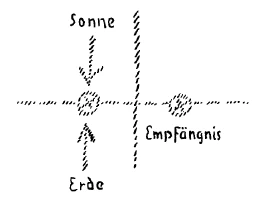
[ 14 ] However, this transforms the process—which people often reduce to a realm so degrading to humanity—into a significant mystery, into a reflection of a cosmic world process. It is also interesting to draw attention to a few details here. In the individual approaching the moment when he is to set foot on Earth again, the mental image of the parents through whom he enters the world takes shape in his soul. How he is drawn specifically to this particular pair of parents is a topic for another time; it is connected to the person’s karma. But what I wish to draw attention to today is that the one who is approaching birth receives an image of what is physically present on Earth, primarily of the mother at first. So the one who is about to be born looks down primarily upon the mother. From the father, he receives—and I ask you to bear this in mind, for it is a very significant phenomenon—an image through the fact that the mother carries an image of the father in her soul. The father is thus seen through the image that the mother carries of him in her soul.
[ 15 ] This is, of course, something I would say is expressed rather radically, but it is essentially correct. One can only speak of these supersensory processes by characterizing them in their essence. So that you do not form too fixed a mental image, I would like to add that, for example, when the spiritual-soul heritage from the father’s side is to play a special role—that is, when particular spiritual-soul qualities are to be transmitted from the father to the human being who is to be born—a direct image of the father can also come into being. But to the same extent that the image of the father comes directly into perception, the image of the mother fades.
[ 16 ] The next stage of physical life on Earth is the life spent between conception and birth. This life, too—which we call embryonic life—is essentially a reflection of another process that takes place in the spiritual world prior to the first-mentioned process. Thus, while birth in physical life naturally follows conception, that of which birth is a reflection precedes the solar-earth process of which conception is a reflection.
[ 17 ] This life that a human being spends between conception and birth cannot be explained at all by the conditions that otherwise prevail on Earth; and to attempt to explain it through the forces and laws of the Earth is simply nothing but utter nonsense. For it is precisely the reflection of a pre-birth process, and this pre-birth process is essentially influenced by what remains of the pre-earthly Moon and the pre-earthly Sun. It is a process that takes place between the Sun and the Moon, and is thus essentially a super-earthly process.
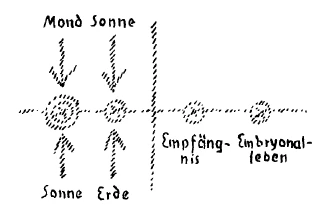
[ 18 ] The forces at work here are primarily those that interact between the sun and the moon. Conventional science has retained some awareness of this fact by counting embryonic life in lunar months and stating that it takes ten lunar months.
[ 19 ] Viewed in this way, we must take into account that in the life we spend between death and a new birth, we experience a real, tangible influence from the sun and the moon; yet in the life we later spend physically, between conception and birth, we reflect this process, which is a process of the sun and the moon.
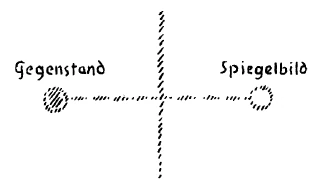
[ 20 ] Note that, of course, the word “reflect” is used here in a sense somewhat different from the spatial one. In spatial reflection, one has the object and the image at the same time, but here one has the actual process taking place before birth; what is reflected appears later in time. It is thus a maya of a supersensory, prenatal process.
[ 21 ] What we must then consider is, first of all, the period between birth and that often-mentioned, crucial point in human life when we begin to develop our sense of self, when we start to consciously say “I” to ourselves. We can call this the actual childhood. This time we spend there, early childhood—call it infancy, if you will—is again a reflection of a process that lies even further back in the spiritual realm. The actual process reflected in the time when we begin to babble, without relating speech to the sense of self, is a reflection of a pre-birth process that extends even further out into the cosmos. And here, we might say, the Sun and the entire planetary world belonging to the Sun—that is, the Sun and its planets surrounding it, with the exception of the Moon—work together. The forces at play between the Sun and its planets influence our lives between death and a new birth, and what arises there long before our birth is reflected in the life we spend in our very earliest childhood years.
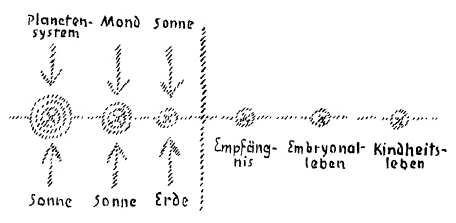
[ 22 ] You can see from this that the child must bring into its life a reflection of that which is even more detached from the earthly realm than the moon. This has an immense, deeply significant, practical consequence; it means that the human being must not be disturbed during this period of life with regard to receiving these forces, or with regard to utilizing the forces they have received. Just consider for a moment what is actually taking place here. Before our birth, forces from the cosmos—those that interact between the Sun and its planets—have acted upon us. These forces are present in the child who has passed through birth and entered earthly life. These forces want to emerge from the child. These forces are truly within the child. In this respect, when we look at the child’s innermost being, the child is a heavenly messenger, and the forces want to emerge. Basically, we can do nothing else but give these forces the greatest possible opportunity to emerge. This is essentially all we have to do in the early education of the human infant: we must not interfere with the forces that want to emerge.
[ 23 ] I would say that such an insight gives rise to a spirit of humility. While people usually believe that they can mean an enormous amount to a child, the most important thing is that they interfere as little as possible with what is trying to emerge. Not that the educator is nothing to the child. He is indeed something to the child. For what emerges—take note of this—is, after all, a reflection, and as educators we must give this reflection reality; we must give this reflection stability.
[ 24 ] What we do as educators can be compared to the following: If we have an object here, and it is reflected there, then we have the reflection here, and we must then imbue that reflection with something that makes it internally more solid than it is as an image. Human beings are indeed born as mirror images, and they must acquire the solidification, the becoming real of this reflection. That is precisely their development between birth and death. We must interfere as little as possible with what wants to emerge. What emerges are the mirror images of the processes we have already acquired from the cosmos before birth. But through our intervention, we must anchor what emerges as a mirror image into reality, and to the extent that we anchor it into a false reality—that is, to the extent that we wish to correct it—to that extent we can disturb it. But it is something otherworldly.
[ 25 ] Now you can see the immensely significant consequence that follows from this. Anyone who wishes to raise a child must ensure that they possess spiritual mental images and feelings within their own soul, which they live out alongside the child; for through everything we bring to the child in the way of purely material mental images and feelings tied solely to the material world, we disrupt the child’s development.
[ 26 ] People often ask: What is the best way to raise a child? As with so many things, it is not so much a matter of establishing a few principles that we carry around in our pocket or in our handbag so that we can follow them; it is a matter of starting with ourselves, of striving to carry within us a reservoir of supersensible mental images, of being imbued with a mindset and sensibility that reaches into the supersensible. For these have a far greater effect than what we can achieve through external intellectual principles and intellectual pedagogy. A loving heart, imbued with the spiritual world and thereby deepening all feelings, is thus also able to I would like to say—please do not misunderstand the word—to engage in a certain form of worship through the upbringing of the child, which consists in loving a being sent to us from the spiritual world, in a spiritualization of love for the child, in being permeated by the feeling: by reaching out our hands to the child, we can say to ourselves: You are giving the child something through your hand, but you must be a representative to them of those forces that are not to be found on earth, but in the supersensible.
[ 27 ] No matter how much we may devise regarding various educational principles, it will bear very little fruit as long as science follows a materialistic path. Only that which arises from Spiritual Science can be fruitful for the true education of the child. And the most important thing is what we make of ourselves. In the outer, material world, we may have a great impact through what we do; as educators, we have a far greater impact through what we are. I ask you to bear this in mind. We can regard the following principle as a motto, as a guiding principle of good pedagogy: In the outer, material world, you have an impact through what you do; as an educator, you have an impact through what you are.
[ 28 ] Then comes the period when we pass through boyhood or girlhood, the age in which we are still being educated, though in fact in a different way than during the time when we are infants. This is the next stage, the next level, that we wish to consider. It is intended to encompass everything from the point in time when a person begins to consciously say “I” to themselves, up to the point in time when we may release them from their actual upbringing, when they step freely out into life, the point in time when they must surrender themselves—as a well-bred or ill-bred person—to the maelstrom of life.
[ 29 ] This, too, is a reflection—outwardly quite clearly maya—and specifically a reflection of events that occurred earlier. The true realities now lie once again between death and a new birth. Specifically, the entire planetary system—from the Sun up to Saturn, or, if you prefer the terms of modern astronomy, up to Neptune—is at work here. Thus, the entire planetary system interacts here with the entire starry sky, and what takes place between the starry sky and the entire planetary system consists of forces that are active within us during the time we are being raised.
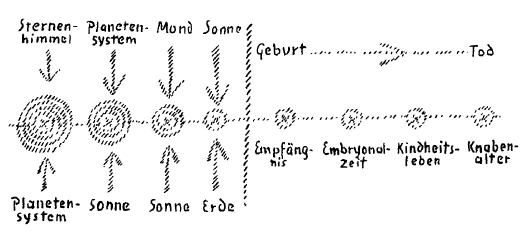
[ 30 ] One understands so little of the reality of the human being from mere earthly processes that one can only understand this human being in relation to the times in which he is being raised, if one is clear about the fact that forces are at work within him throughout his entire life that are not on Earth, that are not even within the planetary system, but lie outside the orbit of the planets and act in interaction with the entire starry sky.
[ 31 ] When we are faced with a child who already refers to himself as “I”—that is, whom we address, in a certain sense, as a human being—we must be clear about this: within him dwells something that is a reflection of a force active not only beyond our Earth, but beyond our solar system.
[ 32 ] Therefore, what has been said about early childhood education applies even more so—and to a much greater extent—to later education, namely the statement: Good pedagogy will only exist when pedagogy is drawn from Spiritual Science, when the teacher is imbued with the knowledge that there is a world beyond the planetary system that unfolds within the human being, and when he is imbued with this not only theoretically but also in his feelings and in his attitude, when he himself has lived through the truth of this extra-planetary world. The clumsiness of such a teacher can often be better than the sophisticated pedagogical principles of a materialistic teacher. For what we fumble, what our folly accomplishes, improves over the course of life. But what arises from us through what we are does not correct itself over the course of life.
[ 33 ] It would be desirable that among the many things that Spiritual Science is meant to metamorphose or transform, this too should be included: one should increasingly come to realize that those who wish to become teachers and educators—and, fundamentally speaking, all those who wish to become parents as well—must ensure that they become good educators by assimilating spiritual mental images that they accumulate within their own souls. The greatest work must be done on oneself if one wishes to become a good educator. And for a teacher, for example, it is more important that he live with his whole heart in the lesson material he intends to cover the next day at school before he enters the classroom, than that he have the best possible pedagogical principles for how to do this or that. Once he has grown to love the subject matter, having spiritually and inwardly given birth to it in love, he can even stumble through the lesson—though I do not recommend this—and he will perform better than the one who enters the school armed with all manner of principles, his brain constricted as if in Spanish boots, and who knows everything about how to do things most correctly.
[ 34 ] We know that, for the time being, the world still operates in the opposite way. Those who are to be educators today are, above all, assessed on the basis of what they know—the factual knowledge they have acquired. One is almost tempted to say: they are tested on what they can find in books—information for which it would be better if they simply built up a library of their own. They are tested most of all on what can be looked up in the library at any time, provided one has learned how to look things up. Especially in the case of the teacher certification exam, the main focus should not be on what the candidate can easily find when they need it; less emphasis should be placed on knowledge. Instead, every teacher should be assessed based on how their mindset and sensibility can connect with what people can acquire as insight and as a sense of the development of the entire universe. A person’s suitability as a teacher should be measured by the feeling they have toward the development of humanity and the world. Then, indeed, those who merely know the most would fail their exams, and those who are good people in a spiritual sense would pass the exams best.
[ 35 ] That is where we will ultimately end up. That is the direction we must ultimately take: A person who is not a good person, whose soul is not inclined toward spiritual life, would fail the teacher certification exam in the future, no matter how much they know, no matter how thoroughly they have mastered everything one needs to know today.
[ 36 ] It is precisely here that a new field will open up, one in which less emphasis is placed on intellectual knowledge and much more on the full development of the soul. Let it be emphasized once more: what matters is not that we are valuable because of what we accomplish in the external material realm, because of what we do; as educators, we are valuable above all because of who we are.
[ 37 ] The point is that we must take into account everything that relates to that real process which is reflected in conception. All of this belongs to the Earth. But insofar as it lies before birth, it belongs to the interaction of the Sun and the Earth; it takes place in the Earth’s aura. In the Earth’s aura, a significant spiritual process takes place before human conception, which is then reflected in conception itself. That which then takes place between the point in time reflected in birth and the point just mentioned is, in reality, a cooperation of the Sun and Moon prior to birth, and this is essentially a repetition of the processes that took place earlier during the Earth’s ancient Moon era.
[ 38 ] Thus, during embryonic life, a reflection of a real process takes place, and the real process occurs before birth; this is like a repetition of the processes that took place on the ancient moon. Likewise, what takes place in the process reflected by the period between the end of childhood—the point at which the human being arrives at the conscious “I”—and the moment of birth is a repetition of the ancient solar influence. What takes place even earlier, what is reflected in the formative years, is a repetition of the ancient Saturn processes of the Earth.
[ 39 ] And now, when we—whether well-behaved or ill-behaved—are released from our upbringing and sent out into the world as free individuals, what processes are then reflected? Then processes are reflected that lie even before the Saturn era; then processes are reflected within us that do not belong to the visible world at all, not even in such a way that they have a correlate in the outer visible stars. One could say that the correlation of what we experience up to the end of our education is still visible. The outermost stars that are still visible still have a connection to it. But what we then experience, what can still be formed within us, belongs entirely to the invisible world. We are released from the entire visible world when we have truly completed our education.
[ 40 ] And of course, this means that we enrich our soul—or have already enriched it—through the truths of the supersensible worlds. For only in this way do we truly find our way through life; otherwise, we are a puppet, a phantom, guided by forces to which we are not actually meant to be guided. The human being who, after the Saturn phase of his development, is set free into the world and who has no mental image in his soul of a supersensible world is not in the element to which he is actually called, but is carried along by invisible forces, just as the harlequin or the marionette is carried along by the forces present in the strings by which they are pulled.
[ 41 ] To take in what Spiritual Science has to offer means to become human; it means not remaining a mere figurehead, a puppet, or a doll of the sensory world, but rather attaining the freedom that is, so to speak, the element in which a human being acts and lives throughout their life. Freedom can only be understood at all through concepts that do not originate in the sensory world. For with everything we have from the sensory world, we cannot become free. This was what I had in mind when I wrote my Philosophy of Freedom, where I emphasized—as it can happen, so to speak, without the mental images of Spiritual Science—that the foundations of ethics, of moral teaching, must be designated as moral imagination; that is to say, they must be found on the basis of moral imagination, although one must not, of course, regard what is moral merely as an image of the imagination, but they must be found through moral imagination, through that which cannot be derived from the sensory world. The entire chapter written on “moral imagination” is an affirmation of the fact that throughout his life, insofar as he is to live it in freedom, must know himself to be connected with that which is not an image taken from the sensory world, but which must rise freely within him, which he carries within himself, which is itself exalted above the visible stars, which he cannot draw from the sensory world, which he can create only through an inner, creative process. This is what was meant by the chapter on moral imagination.
[ 42 ] This was yet another reflection intended to show how manifold are the relationships into which we are placed in life. Just as life before birth prepares us for its reflection, so too does the reflection between birth and death prepare us for the spiritual life that follows between death and a new birth. The more we can carry over from this life into the life between death and a new birth, the richer the unfolding in that life can be. For even the concepts we must acquire for that life—for the truths between death and a new birth—must be very different from those we must acquire for earthly maya, if we are to understand it. You will find some of the concepts we must acquire in the 1914 Vienna lecture series “The Inner Being of the Human Being and Life Between Death and a New Birth.” There you will find how one must acquire new concepts to understand what, as the other side of human life, flows between death and a new birth. It is sometimes quite difficult to gradually work out the concepts and ideas needed for this different kind of life. And you will notice, especially in such a lecture series when you read through it, how the speaker struggles to find expressions that somewhat reflect these entirely different conditions.
[ 43 ] At this particular time, when the deaths of dear members are affecting our anthroposophical life, I would like to draw attention to one thing. The moment of death plays a different role in the life between death and a new birth than the moment of birth does in our present life between birth and death. The moment of birth is the moment that, under ordinary circumstances of earthly life, a person does not remember. A person does not remember their birth in ordinary life. The moment of death, however, is the one that leaves the deepest impression on the entire life between death and a new birth; it is the one most vividly remembered, the one that always stands there, so to speak, but in a different form than it is viewed from this side of life. From this side of life, death appears as a dissolution, as something that easily fills a person with fear and dread. From the other side, death appears as the most luminous beginning of spiritual experience, as that which spreads something sun-like over the entire subsequent life between death and a new birth, that which most joyfully warms the soul in the life between death and a new birth, that which is looked back upon again and again with deep sympathy. That is the moment of death. If we wish to describe it in earthly terms: the most joyful, the most enchanting thing in life between death and a new birth is, viewed from the other side, the moment of death.
[ 44 ] If we have formed the mental image—based, for example, on a materialistic worldview—that human beings lose consciousness upon death, if we cannot gain a proper understanding of this continuation of consciousness—I am emphasizing this point today in particular, because the cause, the reason for this, is our coexistence with our beloved dead who have recently passed away—if we find it so difficult to create a mental image of consciousness that exists beyond death, if one believes that consciousness darkens—it also seems that consciousness darkens after death—then we must be clear: It is not true, for consciousness is exceedingly bright, and only because human beings are still unaccustomed to living in this exceedingly clear consciousness in the very first moments after death does something like a state of sleep set in immediately after death.
[ 45 ] This state of sleep, however, is the opposite of the state of sleep we experience in ordinary life. In ordinary life, we sleep because our consciousness is subdued. After death, we are, in a certain sense, unconscious because consciousness is too strong, too powerful; because we live entirely in consciousness, and what we need in the first few days is to settle into this state of heightened consciousness. We must first learn to orient ourselves within this state of heightened consciousness. When we then succeed in orienting ourselves within it to such an extent that we feel ourselves rising up, as it were, out of the abundance of worldly thoughts: “That was you!”—at the very moment when we begin to distinguish our past earthly life from the abundance of worldly thoughts, we experience within this abundance of consciousness the moment of which we can say: “We are waking up.” We may be awakened by an event that has intervened in our earthly life in a particularly significant way, an event that also intervenes in the events following our earthly life.
[ 46 ] So it is a matter of becoming accustomed to the supersensory consciousness, to the consciousness that is not built upon the foundation and support of the physical world, but which acts within itself. This is what we call “awakening” after death. One might say that this awakening consists in a feeling-out of the will, which, as you know and as you can see from the lecture series cited, can develop particularly after death. I spoke there of the emotional will, of the volitional feeling. When this volitional emotional life feels its way into the supersensible world, when it takes its first tentative steps, then awakening has occurred.
[ 47 ] These are the things we would like to discuss further, if circumstances permit.