

Paths to Spiritual Insight and
the Renewal of an Artistic Worldview
GA 161
1 May 1915, Dornach
Translated by Steiner Online Library
Twelfth Lecture
[ 1 ] A fundamental theme ran through all the discussions that have taken place here recently. This theme expressed the fact that, in our present time, we can indeed observe within the entire cultural development of humanity the need for a new impulse—namely, a spiritual impulse, an impulse of spiritual insight.
[ 2 ] The aim of these lectures is to demonstrate, from a wide variety of perspectives, that an era with a very specific character has, so to speak, come to an end, and that a new era must begin. The era that has come to an end is, in a sense, the era of the most intense materialistic mode of thinking and feeling, the era in which materialistic thinking and feeling have increasingly taken hold in the inner life of the human soul over the course of centuries. But just as the pendulum, having swung to one side, must swing back to the other side, in the opposite direction, so we are facing a time in which the human soul must once again be seized by the feeling that in all that is sensory, in all that is material, spiritual impulses are hidden, spiritual forces are hidden, and Spiritual Science is essentially meant to convey the knowledge and experience of these spiritual forces behind sensory and material phenomena and experiences—the spiritual forces to which humanity has been able to devote less attention and less interest over the centuries.
[ 3 ] We all know how, in our time, even the mere assertion that it is possible for the human soul to enter spiritual worlds is denigrated and condemned. We know how the most diverse factors of life, consciously or unconsciously, turn against the emergence of a worldview such as that of Spiritual Science. One might think that what Spiritual Science has to offer for the regulation of life and its facts would appear utterly absurd, foolish, and fantastical in our present age; but if one considers what, after all—I would say—even now more discerning people assert, based on somewhat deeper life impulses, then what has just been described takes on a different appearance.
[ 4 ] I would like to begin today by pointing out that, among the more discerning people of our time, there is not everywhere such a closed-mindedness toward what Spiritual Science seeks to assert; although there is indeed a closed-mindedness toward Spiritual Science itself, it is not so much a closed-mindedness toward what Spiritual Science actually asserts. Many, many examples along these lines could be cited. I would like to highlight one characteristic example today, which relates to a philosopher of recent times who was, after all, quite significant: Otto Liebmann, who passed away not long ago.
[ 5 ] Most of you will not be familiar with the name Otto Liebmann, and that is all right. But I would like to say that Otto Liebmann was one of the most astute analysts of human thought in modern times, that he thoroughly explored what might be called the theory of knowledge from every angle, and that he constantly asked himself the question: What can human thought grasp of reality?
[ 6 ] I would like to read you a short passage from Otto Liebmann’s philosophical writings, because it is characteristic of a man who, throughout his entire life, strove to fathom what human thought is and what our present age can say about it when it draws upon all the scientific findings of our time. Otto Liebmann says: One might be led to think that a chicken egg contains not only egg white and yolk, but also an invisible specter within; this specter materializes, and once it has finished materializing, it breaks the eggshell with its sharp beak, runs toward the grains, and pecks them up.
[ 7 ] At first, he says, one might think that there is a ghost inside the egg, and that once the shell is pecked open, the ghost would come out and be able to peck at the grains. How will those who take the position of constructing a worldview based on contemporary science respond? They will do so as follows: If someone says there is a ghost inside a chicken egg, then he is simply a fool. — That is how the intelligent people of the present day will speak. But this applies only to those who call themselves Theosophists or Anthroposophists! But what does the philosopher say, who has taken such pains to analyze human thought in the present day? He says: The only objection to this claim is that the preposition “in” is nonsense when used in the physical sense; in the metaphysical sense, it is entirely correct. It is quite correct that one cannot make sense of the mental image that the ghost is physically situated inside; but if one understands it metaphysically, there is nothing to object to. The preposition is simply not to be used in the ordinary sense.
[ 8 ] So the fact remains that a philosopher who wrote a brilliant book, Analysis of Reality, and a book, Thoughts and Facts — in the second issue of “Naturerkenntnis” from 1899, this is mentioned regarding the invisible specter —, admits that one can, in essence, stand at the very pinnacle of contemporary philosophy and yet cannot help but admit that there really is an invisible specter inside a chicken egg.
[ 9 ] Of course, Otto Liebmann would never stoop to seeing anything sensible in Spiritual Science. One might ask: Why doesn’t he do that? Why wouldn’t he—or anyone who thinks like him—take a look at this Spiritual Science to arrive at the conclusion: Yes, this Spiritual Science basically wants nothing more than to state as fact that this invisible specter is really inside the chicken egg! — The name doesn’t matter; we would simply call it the etheric body, which in turn is permeated by the astral body. The spiritual scientist simply describes what is inside as an invisible specter; the spiritual scientist therefore says nothing other than what the others say. Nevertheless, people will not turn to Spiritual Science so easily. They will denounce it as “nonsense, a fantasy,” even though it is vigorously demanded by science and by the intellectual work of the present day.
[ 10 ] How far is it, then, from the claim that there is an invisible spirit within a chicken egg to the claim that there is also something invisible within the human physical body—since anatomy and physiology examine only the physical? And if one were to set aside the use of the preposition “in”—which is what matters to the philosopher—then one would already be pointing to something that Spiritual Science says consists of the etheric body, the astral body, and the I. Spiritual Science, therefore, does nothing that cannot be strictly demonstrated to be truly demanded by the entire thought and cultural processes of the present. Of course, Spiritual Science must go a step further, for it cannot remain at the level of intuition: there is an invisible spirit within the chicken egg—especially when one moves on to the human being. It must be clear that what lies invisibly within the human being possesses certain qualities, certain inner factors of reality. While one can, I might almost say, create a mental image of the chicken egg in a ghostly way—that there is an unknown ghost inside it—when one moves on to human beings, one must be clear that the human being, when dwelling in the physical body, develops consciousness, and does so precisely because the physical body is such a complex apparatus. This leads one to suspect that what has been called an invisible ghost here must nevertheless be regarded as something that underlies the visible. If the outer aspect already possesses consciousness, then one must naturally assume that the inner aspect also possesses consciousness, that one cannot believe it to be “unconscious.”
[ 11 ] Science will lead us to recognize something akin to what Spiritual Science posits: that within the physical body there exists a spiritual human being. And it is the nature of this spiritual human being’s consciousness that Spiritual Science points out to us.
[ 12 ] We have known for quite some time now how to answer the question regarding the exact nature of this invisible specter that underlies human beings. If we first consider the philosophical views of our time, we must admit that an invisible specter also underlies human beings. We now ask ourselves: Can we know anything about this invisible spirit? — Indeed; just as human beings acquire knowledge of the external world through sensory perceptions and through the thoughts bound to the brain, so too does this knowledge expand: for within the spirit live the imaginations, lives that which we have described as imaginative knowledge. We would be able to see: not only does an invisible spirit underlie the chicken egg, but within the human being lies the etheric body, which—if given the opportunity—as has already been stated in our writings—frees itself from the physical body and develops an imaginative cognition, a cognition that works in the world through imaginations, which stand before the soul as moving imaginations.
[ 13 ] The question must be asked: Why is it that Spiritual Science faces so much opposition today, even though people who do not understand themselves ultimately arrive at and point to what Spiritual Science says?
[ 14 ] My dear friends, there is something that must be said here which, I would say, is dangerous to utter—or at least not without risk. Why would Otto Liebmann, no doubt, if he were to pick up a book on Spiritual Science, say: “That is too foolish, too silly for me”—even though he himself stands, so to speak, at the very threshold of the spiritual world? Why does he live in this strange self-deception, believing that although he stands at the threshold, if someone were to come and try to open the gate for him, he would say: “No, I will not go in.”—Why? That is not particularly reasonable!
[ 15 ] Sometimes comparisons can be helpful, and so I would like to use one to answer the question: Why are there people among today’s best and brightest who shy away from Spiritual Science?
[ 16 ] I would also like to draw attention to something we have already discussed: what I have already said about sleep and fatigue. People talk a lot these days about why people need to sleep, and they say: because they are tired. So that fatigue is essentially regarded as the cause of sleep. That is how people often speak today. Now, everyone knows from the most ordinary experience of life that a certain person who, let’s say, attends a fine lecture out of courtesy, often falls asleep immediately after the lecture has begun, even if he is not tired, from which anyone could conclude that fatigue is by no means the cause of sleep. On the contrary, the matter would be more accurately expressed if we did not say: We sleep because we are tired—but rather said: We feel tired because we want to sleep. — That would be the more accurate expression.
[ 17 ] Sleeping essentially consists in the fact that, by stepping out of the physical body and the etheric body with one’s I and astral body, a person experiences his physical body and etheric body from the outside, one might even say, not only enjoys but digests them; whereas, when he is within the physical body and the etheric body, he lives with his consciousness in the outer world. Do take note of what is actually being said here. When we are outside our physical body and etheric body with our ego and our astral body, we direct all our will and all our desire toward the physical body and the etheric body; we enjoy and digest the physical body and the etheric body from the outside; whereas the external world makes an impression on us when we are inside the etheric body and the physical body.
[ 18 ] Now, everything in the world is based on periodicity, just as it is with a pendulum. When the pendulum has swung to one side up to a certain point, it swings back down and up to the same height on the other side, by virtue of the force it has gained during its descent. Just as the pendulum cannot simply go this far but must then return and rise to the point it had reached before it went down, so too are sleeping and waking opposites. In the broadest sense, this is how it can be put.
[ 19 ] Let’s assume that from the moment we wake up until we fall asleep, we have been interested in the external world and its goings-on. This absorption of the external world was like a pendulum swinging to one side. Once we have absorbed enough of what the external world is, then, through oversaturation—through having had our fill of the external world—the normal need arises to enjoy ourselves again, to derive from ourselves the pleasure we otherwise find in the external world: we fall asleep. And once we have squeezed enough of this pleasure out of ourselves, then we can wake up again. It is a back-and-forth swing, a periodicity that, like the mechanisms outside, will run its course regularly. But Lucifer and Ahriman can truly lift human beings out of the entire course of nature. Thus, if a person has gone to a lecture or a concert out of courtesy, not because they want to listen, they can walk out and divert their interest. They walk out and enjoy themselves, because they find themselves more interesting than what is happening externally around them.
[ 20 ] Thus we can see: The person who falls asleep in an abnormal way simply has no interest in the environment or in what is happening in the environment. But this is precisely the case with the kind of people I have been speaking of—those who are actually being directed toward what Spiritual Science has to offer. In the realm of Spiritual Science, Otto Liebmann is a man like someone who attends a concert or a lecture out of courtesy and immediately falls asleep. He goes there, but in reality he has no desire to take in what is being presented there.
[ 21 ] In a more elevated sense, the same can be said of people like Otto Liebmann. They come to philosophy, to the realm of the mind, through connections that exist in our world. One writes a dissertation, a book, and is then sent to teach at a high school; one proves oneself to be a good thinker and is then sent to the university. Philosophy is worldliness in disguise. One need not have an inner calling to the realm of the spirit; that is what worldliness is. One walks up to the gate, enters, and falls asleep; one does not fall asleep immediately — like a filthy rich gentleman of private means led to a concert, who sleeps even when he is not at all tired — but one falls asleep as if due to a lack of interest in objective consciousness; yet one cannot awaken to imaginative consciousness. If it is impossible for one to awaken to imaginative consciousness, one immediately falls asleep the moment something is told about the spiritual world. In other words: it is too difficult for people to take anything in from Spiritual Science. And it is therefore not entirely without risk to state this, because people now say: So you are the ones who do what is so arduous for other people, for important people! — But since we are aware of the difficulty, we will not become arrogant. Yet we will also know that what we must face is opposed by the world precisely because people do not want to engage with such difficult matters, simply because they are too difficult for them.
[ 22 ] Now let us take a closer look at the difficulties that exist here. Let us point them out by asking: What does people’s ordinary thinking consist of, from the moment they wake up until ‘falling asleep’? What does it consist of? Well, the crude materialist thinks: it consists in the fact that a person has a brain with an extraordinarily fine structure, that processes take place within this brain, and that, because these processes take place, thinking occurs. Thinking is a consequence of these brain processes—so he argues.
[ 23 ] I have already pointed out to you that this is like someone saying: I am walking across the street; there are footprints and tire tracks. Where did these tire tracks come from? The earth below must have made them; the earth itself has produced the footprints and wheel tracks. — Logically, the person who thinks that the brain creates such impressions on its own is on exactly the same level. It is exactly the same when someone walks down the street, sees all kinds of tracks on the street, and then says: “Aha, there is this earth here, which is finely interwoven internally with all kinds of forces, with forces that make such tracks.” — It is exactly the same when the physiologist comes and looks at the human brain and observes all kinds of processes within it and says: “The brain does all of this.” — Just as these tracks on the ground are not caused by the ground itself, but by the people and carriages moving along the path, so too is what the anatomist and the physiologist discover not caused by the brain, but rather by the forces moving within the etheric body.
[ 24 ] This will help you understand what the deception of materialism consists of. There is nothing in everyday life that does not leave an impression on the brain. Just as every step leaves an impression on the ground, and just as you can prove that each of your steps has left an impression, so you can prove that what is willed and thought exerts an impression, an effect, on the brain. But that is only the trace of it; it is only what is left behind by thinking. For thinking actually takes place in the etheric body, and in truth, everything you perceive as thinking is nothing but the inner activity of the etheric body. As long as we are in the physical body, we need the physical body for thinking. It is also very easy to see why the materialist does not arrive at the truth. The materialist says: For heaven’s sake, you can see that you must have a brain, otherwise you couldn’t think! So you can also see that your brain is actually doing the thinking. — This conclusion is just as clever as if someone were to say: I can prove to you that this footprint on the path was made by the ground itself. I will remove a piece of the ground, and you will see that you cannot walk without it. The ground is necessary; so too is it necessary that we have a brain so that we can think in the physical body.
[ 25 ] It is necessary to make these things clear to oneself, for only then can one begin to recognize the immense errors afflicting contemporary thought, the multitude of errors with which this contemporary thought deceives itself, and how a recovery must take place through that more difficult knowledge, which does not, by any means, disregard the physical body: when we walk with the physical body, we must have the ground beneath our feet; when we think in the physical world, we must have a foundation as the ground for our thinking: the nervous system. But when we shift our thinking back into our astral body, then the etheric body becomes for us what the physical body is when we think in the etheric body.
[ 26 ] When we proceed to imaginative thinking, we think in the astral body, and the etheric body then retains the traces, just as the physical body retains the traces when we think in the etheric body. And when, after death, we are outside the physical body and have also shed the etheric body—as has often been described—then our vehicle is the outer life-ether, and we inscribe into the entire world-ether that which the astral body and later the I develop.
[ 27 ] This, then, is the process we undergo in what is called the first stage of initiation. This process consists in transferring our thinking—it is not thinking itself, but merely the activity of thinking—from the etheric body to the astral body, and in entrusting the preservation of the traces, which previously fell to the physical body, to the more ephemeral etheric body. This is the essence of the first step of initiation: the transfer of this activity, which was previously carried out by the etheric body, to the astral body.
[ 28 ] Thus we see that, while we live in imaginative insights, we withdraw, as it were, from the physical body into the etheric body, and then leave no further traces in the physical body. Consequently, for the one undergoing these first steps of initiation, the physical body from which he withdraws becomes objective; he now has it outside his astral body and ego. Previously, he was inside it; now he is outside. He thinks, feels, and wills in the astral body. He influences the etheric body, leaving traces in it; but he no longer influences the physical body, which he now sees as something external.
[ 29 ] This is, in a sense, the normal course of events regarding the first steps in initiation. It manifests itself in a very specific way in subjective experience.
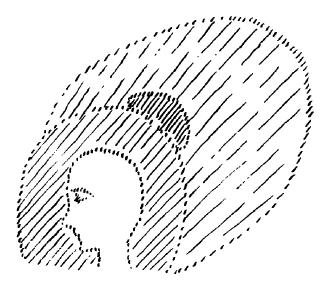
[ 30 ] Now I would like to begin by using a kind of schematic drawing to explain what these first steps of initiation consist of. Let us assume that this is the human physical head, and that the etheric body surrounds this human physical head. When the human being begins to develop what I have spoken of—when he begins to develop imaginative insights—the etheric body expands in this way, and the peculiar thing about this is that, naturally, the phenomena we have described as the formation of the lotus flowers occur in parallel. The human being grows, as it were, out of themselves in an etheric sense, and the peculiar thing is that, as the human being grows out of themselves in this etheric way, they develop something similar outside their body, I would say, like a kind of etheric heart.
[ 31 ] As physical human beings, we have our physical hearts, and we all appreciate the difference between a cold, abstract person who develops his thoughts like a machine and a person who is present with his heart in everything he experiences—that is, who is present with his physical heart. We all appreciate this difference. We do not expect much from the dry, calculating person who is not present with his heart in what he experiences in his soul, in terms of true knowledge of the world on the physical plane. A kind of spiritual heart, which is outside our physical body, forms in parallel with all the phenomena I have described in “How Does One Attain Knowledge of the Higher Worlds?”, just as the network of blood vessels forms and has its center in the heart. This network extends beyond the body, and we then feel, outside the body, a heartfelt connection to what we recognize through Spiritual Science. However, one must not expect that a person participates in Spiritual Science, so to speak, with the heart they have within their body, but rather with the heart that becomes theirs outside the body; with that heart, they are deeply engaged in what they perceive through Spiritual Science.
[ 32 ] One could certainly say, when reading through what has been written in the field of Spiritual Science: This is, once again, scientifically dry; this is science. So now we have to learn all over again! One has to learn enough in life as it is, and now one is supposed to learn what Spiritual Science says as well! There’s no heart in that. — One will discover the heart in it if one only delves deeply enough into things.
[ 33 ] Certainly, many people say: “Oh, theosophy must consist in man, above all else, becoming one with the whole world in his inner self.” — This “becoming one,” this “development of the God-man within the human being,” this “discovery of the divine self,” and so on are favorite phrases of those who want to be theosophists without knowing theosophy. All of this stems solely from a refusal to engage in the development of warmth of heart, even when one is no longer supported by the life-giving warmth of the physical heart. Just as Lichtenberg said: “When a head and a book collide, and it sounds hollow, the book is not necessarily to blame,” one could say: When a person encounters Spiritual Science and does not find warmth of heart in it, Spiritual Science is not necessarily to blame. — Everything I have now described as the normal path to clairvoyance consists in the human being lifting his etheric body, indeed even the higher members of his organism, out of the physical body, so that he incorporates a heart outside the scope of the physical body.
[ 34 ] On what, then, are ordinary thoughts based? You see, such a thought is actually formed only in the etheric body; but then it comes into contact with the physical body, leaving impressions throughout the brain. If one brings to mind the essential point that matters in everyday thinking, one can say: It is based on the fact that one thinks in the etheric body, and that what is thought falls upon the nervous system of the brain; it makes impressions there, but these impressions do not go deep; rather, they bounce back. And through this, thinking is reflected; through this, it comes to our consciousness. So a thought consists, first of all, in our having it in the soul, extending to the etheric body; then it makes an impression on the physical brain, but it cannot penetrate it and must therefore bounce back. We perceive these rebounded thoughts. And this is where physiology comes in, revealing the traces that have been created within the physical brain.
[ 35 ] What if the thought did not bounce back, but instead entered the brain and merely triggered processes there? If it did not bounce back, we could not perceive it; it would simply enter the brain and trigger processes there. It is conceivable that, instead of being reflected back, the thought might enter the brain. In that case, we would have no consciousness, for consciousness arises only when the thought is reflected.
[ 36 ] There is, however, one activity of the soul that enters into the body: this is the will. Will differs from thought in that thought rebounds off the physical organism and is perceived as a mirror image, whereas will does not. In the case of will, it enters into the physical organism, and a physical bodily process is then set in motion. This causes us to walk or move our hands, and so on. Actual will arises in a completely different way than thought. Thought arises through this reflection. Willing, however, enters into the physical organism; it is not reflected back, but rather brings about specific processes within the physical organism.
[ 37 ] However, there is still a part of our physical constitution where something that sinks into the background can bounce back again. Please follow closely what I am about to say. In our brain-based thinking, the process works as follows: mental activity develops in the etheric brain, rebounds off the physical nervous system, and thereby brings our thoughts into consciousness. In clairvoyance, we push the brain back, as it were. We think with the astral body, and our thinking is already reflected back to us through the etheric body.
[ 38 ] Here (see Figure I) is the external world; here is the physical body (during cerebral thinking); here, in clairvoyance, is the external world—that which we process with the astral body (see Figure II); we have the etheric body reflect this back, and we leave the physical body completely switched off.
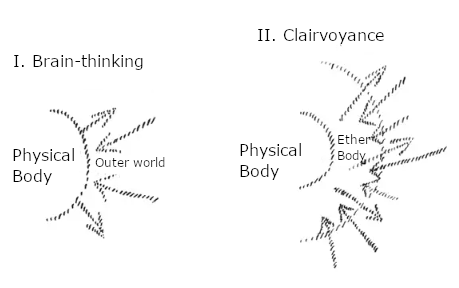
[ 39 ] Here (see Figure I), if you will, the soul’s activity penetrates into the physical body. Therefore, when we walk or move our hand, it is the soul that does so. But its activity must bring about internal, organic, material processes, and it is through these that the soul’s activity is realized. I would like to say: the will consists in the fact that the soul’s activity dies away in the material activity within the body.
[ 40 ] Now ask yourself: How do we actually live when we live in our thoughts? I would say that in our thoughts, we live right on the threshold of eternity. The moment we shut down the physical body and allow our thoughts to radiate back from the etheric body, we live in what we carry through the gate of death. As long as we allow our thoughts to radiate back from the physical body, we live in what exists between birth and death. But when we will, our volition belongs solely to our physical body. Our physical body is there so that it may develop activity. While thinking stands, so to speak, already at the gate of eternity, volition is intended for the physical body.
[ 41 ] Do you remember that I said in one of the lectures: Will is the baby, and as it grows older, it becomes thought. This corresponds to what we can develop today from a different perspective. Will is bound within temporality, and only through the fact that the human being develops, that he becomes wiser and wiser, and increasingly permeates his will with thought, does he lift what is born in the will out of temporality and up into the sphere of eternity; he liberates his will from his body.
[ 42 ] But in one part of the body, something is already active: the lower nervous system, the ganglionic system, the abdominal nervous system; the solar plexus is often also referred to as part of it. As it currently develops in humans, this nervous system is an imperfect organ; it is present only in its very earliest stages. It will continue to develop later. But just as we know that a child can still develop the characteristics that an adult develops, so we can know that this nervous system, which today serves to supply organic activities, will still develop. This nervous system, which runs alongside the actual brain and spinal cord system and alongside the nerves branching out into the limbs—this abdominal nervous system—is not yet developed enough today to do what it will do once humanity is on Jupiter. There, the brain and spinal cord will have regressed, and the abdominal nervous system will have a completely different structure than it does today. Then it will be located on the surface of the human being. For everything that is initially inside the human being is later deposited on the surface of the human being.
[ 43 ] However, in our ordinary life between birth and death, we do not use this nervous system directly; we leave it in the subconscious. However, under abnormal conditions, it can happen that what lies within the human will and capacity for desire enters the human organism, and that, due to abnormal conditions—which we will discuss later—it is reflected back by the abdominal nervous system, just as thought is otherwise reflected back by the brain. The will enters the ganglionic system, but instead of becoming active, it is reflected back by the ganglionic system, and something arises in the human being that otherwise arises in the brain. A process arises in the human being that can also be characterized as follows: If you consider the transition from the ordinary waking state to clairvoyance, you can see how our thinking, feeling, and willing are reflected within us in the ordinary nervous system—feeling and willing insofar as they are thoughts—but that which is willing, we allow to sink into the organism.
[ 44 ] In clairvoyance, we form—outside the physical body, so to speak—an organ that is higher than the brain. Just as our ordinary brain is connected to our physical heart, so too is that which develops as thought outside, in the astral body, connected to this etheric heart. This is higher clairvoyance: head clairvoyance.
[ 45 ] But a person can also take the opposite path. They can enter into the organization with the will that lies within the “baby” in such a way that the will becomes thought, whereas otherwise they have turned thought into will. This is the deeper rationale behind what I mentioned here some time ago as the difference between head clairvoyance and abdominal clairvoyance. In head clairvoyance, a new etheric organ is formed in which one becomes independent of the physical body. In abdominal clairvoyance, one appeals to the ganglion system, to that which is otherwise disregarded. Therefore, the results of abdominal clairvoyance are more fleeting than ordinary waking experiences; they have no significance for the souls when they pass through the gate of death. Everything gained through head clairvoyance has a spiritual, lasting significance even for the souls that have passed through the gate of death; it has greater significance than waking daytime experience. What is gained through abdominal clairvoyance has even less significance for life after death than everyday waking knowledge. All somnambulic clairvoyance is subordinate to waking daytime consciousness, not superior to it. This is not contradicted by the fact that all manner of poetic and other qualities can be developed through abdominal clairvoyance; for at the very moment this abdominal clairvoyance occurs, it is truly the ganglia that constantly impart volition into the physical body. As a result, the activity of the etheric body is held back in the ganglia and radiates back, and through this one then perceives that which one cannot perceive through the brain. One can thereby perceive thoughts that one would otherwise not perceive through the brain; but it remains, nevertheless, a subordinate activity. You see that one can make a sharp distinction between what is called head clairvoyance and what is called abdominal clairvoyance. Now you may ask: How do I distinguish whether I am developing head clairvoyance or abdominal clairvoyance? — One can only say: Head clairvoyance will always develop when, in our current epoch of human history, one truly seeks this clairvoyance in the manner described—through meditation and concentration—and when one cultivates everything that arises through the path of meditation and concentration. Intuition is something that does not arise through the path of meditation and concentration. Intuition is based on the perception of the ganglion system, and this can occur through the most varied abnormal circumstances of life. It is easier to be an intuitive person because, in a certain sense, it comes naturally, whereas mental clairvoyance must be acquired in the strictest sense of the word. That is why it is best not to tell oneself, when clairvoyance occurs spontaneously, that one is a divinely gifted person to whom something is given that one has not acquired; for in such cases it is best to be suspicious. One can demonstrate through individual examples how abdominal clairvoyance can arise. Mental clairvoyance will arise in no other way than by diligently and regularly bringing oneself to certain stages of initiatory development through meditation and concentration. With regard to abdominal clairvoyance, since it is not without danger to speak of these things—in a somewhat different sense than was the case earlier—I will cite one of the most harmless cases through which one can become an abdominal clairvoyant.
[ 46 ] Let us suppose that a person grows up under such conditions that a desire develops early in their soul to become, so to speak, as “high up” as possible in their external, physical life—such as a Privy Councilor, Court Councilor, or State Councilor, where such positions exist. So let us assume that this desire develops early on: one wants to become a Privy Councilor or a State Councilor and so on. To want to become such a thing means to be ambitious. This ambition lives in the nature of desire; it can burn, terribly, within the nature of desire. People do not realize: You want to become a Privy Councilor; but their desire burns within them, and they go through the world with this burning desire and grow up with it. That is why their desire does not always integrate properly into the physical organism. Something interferes. When someone becomes a Privy Councilor, he does not become a clairvoyant. But if he wants to become a Privy Councilor and does not succeed, and goes through the world with that burning ambition that gnaws at him and gnaws at him, then he can become one. But this desire must be very strong. Since there is no one among us who wants to become a Privy Councilor, I can say all this quite freely. If this desire gnaws and gnaws, then it gets stuck in the organism, and then the ganglion system gets used to reflecting the desire back, and it is possible to become a clairvoyant through these reflected desires. As a result, it is then possible that, for example, if he lives at Schönhauserallee 25 in Berlin, and another person who lives at Schönhauserallee 23 becomes a Court Councillor, he will perceive this event precisely through his specially developed clairvoyance. This stems from the fact that his ganglionic system has been made particularly receptive by his inherent desire to become a Privy Councillor. And if another person becomes something else, which is also roughly along these lines, he will be able to develop a subtle, intense clairvoyance specifically for such things.
[ 47 ] Such clairvoyance usually develops in a specific area. Since you know that there are other desires in life besides the harmless ones I have chosen, you will see which desires can awaken the various forms and areas of this clairvoyance. For these desires flow through the organism because they remain unsatisfied in physical life, even though they are present. You will thus see through which desires abdominal clairvoyance can be cultivated; it is always cultivated through desire, though one does not always recognize it. In the burning desire that is reflected back, the events that can then be perceived in the etheric body are also reflected. You have now been able to take a closer look at the deeper connection between head and abdominal clairvoyance. We need these things because they are connected to what I will develop tomorrow.