

Paths to Spiritual Insight and
the Renewal of an Artistic Worldview
GA 161
2 May 1915, Dornach
Translated by Steiner Online Library
Thirteenth Lecture
[ 1 ] Yesterday I drew attention to the way in which a human being can, on the one hand, leave their physical body through the higher aspects of their being—the etheric body, the astral body, and the I— and how, when he leaves his physical body, he takes the first steps toward initiation and comes to realize that what we call the spiritual activity of the human being is not something that only begins when the human being enters into initiation, but is, in fact, always already present in everyday life.
[ 2 ] We have had to emphasize in particular that the activity which comes to our consciousness through our thoughts actually takes place in the human etheric body, and that this activity taking place in the etheric body—that is, the activity underlying the thought-image—comes to our consciousness through its reflection in the physical body. But it is carried out in the soul-spiritual realm, so that when a human being stands within the physical world and merely thinks—but truly thinks—they are performing a spiritual activity. One might say that it simply does not come to his consciousness as a spiritual activity. Just as, when we stand before a mirror, it is not our face but its image reflected from the mirror that comes to our consciousness, so in everyday life it is not thinking itself but its reflection, as the content of thought, reflected back from the physical body-mirror, that comes to our consciousness. The situation is different with the will.
[ 2 ] We have had to emphasize in particular that the activity which comes to our consciousness through our thoughts actually takes place in the human etheric body, and that this activity taking place in the etheric body—that is, the activity underlying the thought-image—comes to our consciousness through its reflection in the physical body. But it is carried out in the soul-spiritual realm, so that when a human being stands within the physical world and merely thinks—but truly thinks—they are performing a spiritual activity. One might say that it simply does not come to his consciousness as a spiritual activity. Just as, when we stand before a mirror, it is not our face but its image reflected from the mirror that comes to our consciousness, so in everyday life it is not thinking itself but its reflection, as the content of thought, reflected back from the physical body-mirror, that comes to our consciousness. The situation is different with the will.
[ 3 ] Let us therefore bear in mind: What is expressed in thought is an activity that does not actually enter our physical organism at all, that takes place entirely outside our physical organism, and that is merely reflected back by our physical organism. Let us consider that, as human beings, we are actually always within our spiritual-soul being. If one were to represent this schematically, one could depict it as follows:
[ 4 ] If (a) represents the physical nature of human beings, then thinking actually takes place outside the physical nature of human beings, and what we perceive as thoughts is reflected back. Thus, with our thinking, we are always outside our physical body, and spiritual knowledge essentially consists only in this realization: that with our thinking, we are outside our physical body.
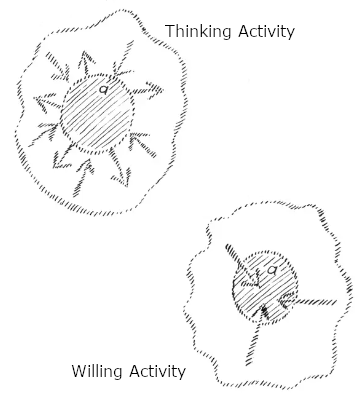
[ 5 ] The situation is different with what we call volitional activity. This truly enters the physical body (a). What we call volitional activity enters every part of our physical body and brings about processes and events within it. And the effect of these events is what is brought about in human beings as movement through the will.
[ 6 ] We can therefore say: as human beings living in the physical world, the fundamental force of the will radiates from the spiritual realm into our organism and performs certain activities within the organism enclosed by the skin. We are thus permeated by the forces of the will in the time between birth and death, whereas the content of thought does not take place within our organism, but outside of it. From this you can conclude that everything pertaining to the will is intimately connected with what the human being is in his physical existence between birth and death through his physical body. The will is indeed intimately connected with us, and all expressions of the will are closely linked to our physical organization, to our physical human being, as long as we stand between birth and death. This is why thinking truly has a certain character of detachment from the human being, a certain independent character in relation to the human being, which the will can never possess.
[ 7 ] Try to think deeply about the great difference that exists in human life between thinking and what belongs to the will. Spiritual Science is particularly well-suited to shedding the most intense light on certain of life’s mysteries from this perspective. Do we not all see that what we can come to know through Spiritual Science essentially stands before us in life as questions that we must answer?
[ 8 ] Just think about it: it does happen that someone goes to a lawyer with some kind of case. The lawyer listens to the story and handles the case for the client in question. The lawyer will dig up every possible clever argument, will be as clever as he possibly can to win the case for the client in question; he will muster all his intellect and reason to win the case.
[ 9 ] What would have happened—I’m sure life will provide you with the answer—if the opponent had succeeded, so to speak, in beating the other party to the punch, if the opponent had gone to the same lawyer a few hours earlier? What I’m hypothetically assuming here happens very often. The lawyer would have had the opponent’s case explained to him and, using all the acumen at his disposal, would have presented all the grounds for defending that very other client—grounds that are, so to speak, capable of deceiving the former. I do not believe anyone is inclined to deny that such a hypothesis could be reality. But what does this assumption prove to us?
[ 10 ] It shows us how little, in essence, a person is connected to what constitutes their intellect and reason, to what constitutes their power of thought, since in the same situation they can put it to the service of one as well as the other. Compare how different this is in all cases where the human will comes into play, where a person is engaged in a matter with their feelings and desires. Try to understand whether a person who advocates for a cause out of the nature of their will could do the same if they were to act in the same way. On the contrary, we would consider him mentally unstable if that were the case. The human being is intimately connected to the will, very intimately connected, because volition radiates into the physical organism and triggers processes in the human physical organism that are directly related to the personality.
[ 11 ] So we can say: it is precisely into these facts of life—which must appear so mysterious to our soul whenever we reflect on life at all—that what we gain through Spiritual Science sheds light. Spiritual Science will be able to enlighten humanity ever more deeply about what happens in everyday life, because everything that happens depends on supersensible causes. The most ordinary events are so dependent on the supersensible and can only be understood if we are able to look up to the supersensible causes.
[ 12 ] But let us now suppose the case in which a human being passes through the gate of death with his soul. We must then ask ourselves: What becomes of the power of thought, and what of the power of will? — Once death has occurred, the power of thought cannot be reflected back by an organism such as the one we otherwise carry within us between birth and death. For the significant point here is that this organism—everything that exists within us as lying beneath the surface of the skin—is cast off from us after death. Thus, the power of thought cannot be reflected back by an organism, nor can inner processes be triggered by an organism that, once one has passed through the gate of death, is no longer there. But what the power of thought is remains present; just as a person remains present when they pass in front of a mirror, at the moment when they can no longer see themselves in the mirror. At the moment when he passes before the mirror, his face is reflected back to him; had he passed by earlier, his reflection would have been reflected back to him earlier. The power of thought is reflected as long as we are in life, in the life of the organism; but it is also present when the human being has left the physical organism.
[ 13 ] What happens now? That which constitutes the power of thought cannot be perceived in and of itself. Just as the eye cannot see itself, the power of thought cannot perceive itself; it must be reflected back by something. But the physical organism is no longer there. From what, then, is the power of thought—or rather, that which the power of thought develops within itself as a process—reflected back when the human being has shed his physical organism? Here something occurs that is not entirely obvious to human physical understanding, but which must be grasped if we truly wish to comprehend life between death and a new birth. This can be understood through the teachings of initiation. In initiated knowledge, it is already the case during earthly life that the human being does not perceive in the reflection of his body, but outside of his body; that he steps out of the body and perceives without the body; that he thus turns off his bodily mirror. There, the one who develops such insights within himself sees how that which is the power of thought now comes to consciousness outside the body. It thus becomes clear that the reflection of the later is brought about by the earlier.
[ 14 ] So please note: when the initiated person leaves his body and is outside of it, he does not perceive through his body reflecting something back to him, but rather through the fact that his power of thought, which he now sends out, is reflected back to him by what he has thought in the past. You must therefore create a mental image: what has been thought previously reflects back the forces unfolded through thinking when this unfolding takes place outside the body.
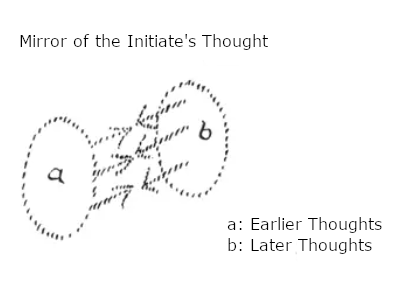
[ 15 ] Well, perhaps I can put it more precisely: Let’s assume that someone enters the state of initiation today. How is it that, in this state of initiation, they can perceive something through their power of thought? It is because the powers of thought they send out encounter what they thought, for example, yesterday. What they thought yesterday remains inscribed in the general world chronicle, which you know as the Akashic Records, and what their power of thought develops today is reflected in what was thought yesterday.
[ 16 ] From this you can see that the endeavor must be justified in making yesterday’s thoughts as strong as possible, so that they can truly reflect reality. And this is achieved through the strict concentration of thoughts and through various kinds of meditation, as we have described on occasion in lectures held on the knowledge of higher worlds. There, as it were, the thought, which otherwise remains fleeting, is condensed and intensified within the person to such an extent that the person can then reach a point where the power of thought is reflected in the previously intensified, condensed thoughts.
[ 17 ] And so it is with the consciousness that people develop after death. What a person has experienced between birth and death is, in a spiritual sense, inscribed in the great chronicle of time. And just as we cannot hear without ears here in the physical world, so too can we not perceive after death unless our life—with all that we have experienced between birth and death—is inscribed in the world. This is the apparatus of reflection.
[ 18 ] I have already drawn attention to this fact once before, in my last Vienna cycle. Our very life here, which we lead between birth and death, becomes a sensory organ for the higher worlds. You do not see your eye, you do not hear your ear, but you see through your eye and you hear through your ear. If you wish to perceive something about the eye, you must do so through the methods of external science. The same is true of the ear. The forces that a human being develops between death and a new birth are predisposed to radiate back forever to the earthly life we have lived, to be reflected through it, and then to spread out and be perceived again by the human being who is in the life between death and a new birth.
[ 19 ] From this you can see how absurd it is to speak of earthly life as if it were a punishment or something else superfluous in relation to the whole of human life. It is absolutely necessary in order to perceive—to have, so to speak, eyes and ears—between death and new birth. Human beings must adapt to this earthly life because it becomes their sensory organ in the spiritual world in the life after death.
[ 20 ] The difficulty in creating a mental image of this lies in the fact that when you think of a sense organ, you imagine something spatial. But space ceases to exist as soon as one passes through the gate of death or undergoes initiation. Space has meaning only for the sensory world. What we enter is time, and just as we use spatial ears and spatial eyes here, so we use temporal processes there. These are precisely the processes that take place between birth and death, through which are reflected those we develop after death. In the life between birth and death, everything lies perceptible to us in space. After death, everything unfolds in time, whereas otherwise everything lives perceptibly for us in space.
[ 21 ] The particular difficulty in speaking about the subjects of Spiritual Science lies in the fact that, as soon as we turn our gaze upward toward the spiritual worlds, we must truly unlearn the entire conception of spatial existence that we develop here; that we must completely abandon our spatial conception and realize that there is no space there, that everything unfolds in time, and that even the organs are temporal processes there. One must not only relearn if one wishes to find one’s way into the events of spiritual life, but one must also completely transform, reshape, and revitalize oneself in such a way as to acquire an entirely different mode of conception. And therein lies the difficulty that was pointed out yesterday and that many shy away from so much, even if they pursue a philosophy of the physical plane that is as astute as can be. People are simply attached to the mental image of space and cannot, in terms of their conceptions, find their way into a life that unfolds solely in time.
[ 22 ] I am well aware that there may be some souls who say to themselves: But when I try to create a mental image of myself in the spiritual world, I simply cannot conceive of that spiritual world as not being spatially extended. — Certainly, but what is necessary above all else is that we strive to transcend the modes of perception of the physical plane if we wish to enter the spiritual world. If we insist, time and again, on creating mental images of all the higher worlds solely according to the standards and patterns of the physical-spatial world, then we cannot gain true insights into the higher worlds, but at best only pictorial ideas.
[ 23 ] This is how it is with regard to thinking. After death, thinking proceeds in such a way that it reflects upon what we have experienced, upon what we were during our physical life on earth between birth and death. These experiences we have lived through are, in a sense, our eyes and ears after death. Try through meditation to grasp what this meaningful statement actually contains: Your life between birth and death will serve as your eyes and ears; it will provide you with the organs you will carry between death and a new birth.
[ 24 ] But what, then, of the forces of the will? The forces of the will bring about life processes within us that lie within the boundaries of our body. They bring about life processes within us. The body is no longer there once a person has passed through the gate of death, but the entire spiritual environment is present. Just as the will, with its powers, works into the physical organism, so too does this will, after death, seek to flow out of the person in every direction; it pours out into the entire environment, in the opposite direction to that in physical life, where the will works into the person. You can get a mental image of this pouring out of the will into the entire environment when you reflect on what you must already acquire through meditation in terms of inner willpower if you truly wish to make progress in the realm of spiritual knowledge.
[ 25 ] The person who is content to perceive the world merely through the senses sees, for example, a blue color, or a blue surface somewhere, or a yellow surface somewhere. That is enough for the person who wishes to remain within the physical world. We have also spoken before about how, even when viewing art, we must go beyond this purely sensory perception of the thing: how, for example, we must practice experiencing blue as if our will, our emotional power, were being allowed into the space, and as if something could radiate from us into the space toward what radiates toward us as blue—something like when we feel a sense of devotion, as if we could pour ourselves into the space. There, one’s own being flows into where there is blue; there it flows away. But where there is yellow, one’s own being—the being of the will—does not wish to enter; there it is repelled. There it feels that the will cannot pass through and is repelled within itself.
[ 26 ] Anyone who truly wishes to prepare themselves to develop the powers of their soul—the powers that lead them into the spiritual world—must be able to connect what I have just said with something real in their inner life. For example, they must make a real connection between the fact that they see a blue surface here and the realization that: “This one welcomes me warmly; it allows my soul, with its powers, to draw into indefinite distances. But this surface here, the yellow one, repels me; there the powers of my soul return, as it were, like pinpricks into my own soul.” — But this is how it is with everything one perceives through the senses. Everything has such nuances. Our spiritual will pours out into the world; it is either repelled or can pour out over the world. This can be developed by training one’s spiritual powers through colors or other impressions of the physical world. You will find a description of how to do this in the book How Does One Attain Knowledge of the Higher Worlds?
[ 27 ] But once one has developed this, once one knows what it is like when the forces of the soul continue to vibrate, turning blue—turning blue and moving forward are one and the same thing, that is: being received with sympathy; turning yellow is the same as being repelled, identical with antipathy—then one has these forces within oneself. Let us say one has experienced what such a nuance of the soul is like: to be received sympathetically, and one is now not facing a physical being at all, but it may be that one allows a spiritual being, to whom we are sympathetic, to flow into oneself through such developed soul forces. In this way we perceive the beings of the higher hierarchies and of the elemental world.
[ 28 ] I want to give you an example—one that is by no means meant to be suggestive, but rather to be understood as entirely objective. One need not limit oneself to developing powers through the sense of color; one can develop spiritual powers through everything. Imagine trying to feel, through self-knowledge, what it is like in one’s own soul when one is truly stupid or foolish. In everyday life, we overlook such feelings; we do not bring them to consciousness. But if one wants to develop the soul, one must have a sense of what it feels like inwardly when one does something truly foolish. And then one notices that when one does something foolish, such soul-will forces radiate out, and they can be repelled by something outside. But they are repelled in such a way that, as we feel this repulsion, we feel mocked and ridiculed. This is a peculiar experience. If one pays attention to what is happening spiritually around one when one is acting quite foolishly, one feels mocked, teased; and now one can develop the feeling of being teased from the spiritual world. If one then goes to a place where there are nature spirits known as gnomes, one has the power to perceive them. One acquires the power to perceive them only if one develops within oneself the feeling I have just described. The gnomes behave in such a way that they tease, make all sorts of gestures and faces, laugh at you, and so on. But you can only perceive this if you observe yourself while being foolish. The point is that through these exercises we acquire intimate powers, that we ourselves dive into the environment with our will. Then the whole environment is enlivened, truly enlivened.
[ 29 ] Thus, one might say: While our life between birth and death becomes an organ, a sensory organ, within our spiritual organism—which we carry between death and a new birth—our will becomes a participant in the entire spiritual environment in which we find ourselves. So we see how the will radiates back in the case of the Initiate, in gnome-seeing for example, and in the case of the dead. And when one sees gnomes, this is an example of this from the elemental world.
[ 30 ] Just imagine that there was a philosopher who made a great impression on many people in the second half of the 19th century: Schopenhauer. As you know, he also had a great influence on Nietzsche and Richard Wagner. Schopenhauer—just as others trace the world back to other causes—traced the world back to what he calls “mental image” and “will.” He said: “Mental image and will are what underlie the world.”
[ 31 ] Now, however, influenced by Kant’s way of thinking, he finds that mental images always remain mere figments of the imagination, that one can never penetrate reality through mental images. Only through the will can one penetrate reality; the will leads us into the reality of things. Now Schopenhauer philosophizes in an impressive way about mental images and the will. He is, if I may say so, not even on the wrong track. But he is also one of those whom I have compared to people who go as far as the gate but stop at the gate and do not want to go in. For if one takes him at his word—that the world is a mental image and the world is merely a dream image—then one can dispense with recognizing the world through mental images, and one can then proceed to recognize the mental images within oneself, to do something with the mental image in one’s own soul, that is: to meditate, to concentrate. Had Schopenhauer taken one step further, he would have come to say to himself: I must dispense with mental images! If the mental image is merely a product of my inner self, then I must use it internally. — Had Schopenhauer taken this step, he would have been driven to cultivate the mental image, to transform it into concentration and meditation.
[ 32 ] And when he says: “The world is will”—indeed, when he begins to describe it, as he does in his insightful treatise on “Will in Nature,” when he begins to describe will in nature, he does not take his own statement seriously. When one describes the will, one relies on mental images, and he has, after all, denied them any power of cognition. This then truly becomes a Münchhausen-esque tale, akin to grabbing oneself by the scruff of the neck to pull oneself out of the swamp. What should he have done if he had taken his own statement—“The world is will”—seriously? He would then have had to say to himself: So one must pour the will out into the world. One must use the will to crawl into things. One must immerse oneself in the world and send the will into the world, so that one does not take the color blue as a mental image, but tries to feel how the will immerses itself in it; that one does not take one’s own stupidity as a mental image, but takes what one can experience in the process of one’s own stupidity.
[ 33 ] You see, once again: one can arrive at a witty insight this way—an insight that simply needs to be taken seriously. If Schopenhauer had gone further, he would have had to say to himself: If the mental image is truly only the image we conceive, then one must process it within oneself; if the will is truly in things, then one must immerse oneself in things with the will, not merely describe how the will is in things.
[ 34 ] Here you see yet another example of how a prominent 19th-century philosopher leads people to the threshold of initiation, to Spiritual Science, and how this philosopher then does everything in his power to shut that door in their faces. Wherever one looks at life, it becomes clear that our time is ripe to reap the fruits of Spiritual Science. One must simply take things seriously, deeply seriously. Above all, one must understand how to take people at their word; for Spiritual Science is not at all dependent on defending its own cause. In fact, it is the others—its opponents—who do this most of all. But they do not know it; they have no idea.
[ 35 ] Take a certain type of people who were so common in the 19th century: the atomistic materialists, those people who had a mental image of all phenomena of life being based on the movements of atoms, so that they imagined that behind all this visible and audible world lies a world of atoms in motion, and through this motion arise the processes that we perceive as the appearance that is there. Nothing spiritual exists; the spiritual is merely a product of atomic motion. Atomic effects, then, are everywhere.
[ 36 ] Yes, how do these ideas about atomic vortices arise? Has anyone seen them? Has anyone discovered them through their own experiences? If that were the case, then they would not be what they are supposed to be: after all, they are supposed to lie beyond experience. If they were real, through what means would they have to be discovered? Let us assume that atomic movements exist. The mind cannot extract them from sensory perceptions. What would a person need to be able to speak of this atomic world? They would need to have clairvoyance. The entire atomic world would have to be a product of inner vision, of the power of clairvoyance. And one can only say to the people who presented themselves as 19th-century materialists: We do not need to prove that clairvoyants exist, for either you must remain silent about all your theories, or you must admit that you are clairvoyants in order to perceive these things, at least to the extent that you can perceive the atoms behind the sensory world. For it makes no sense to speak of the materialistic atomic world if there are no clairvoyant powers. If you find it necessary that there must be atomic motion, then you prove to us that there are clairvoyants.
[ 37 ] This is how one takes people seriously, even though they do not take themselves seriously when they say such things. If one takes Schopenhauer seriously, one concludes: If you say that the world is will, and that the mental images we have are merely images, then you would have to penetrate into the world with your will, and through meditation and concentration penetrate into thought. We take you seriously; but you do not take yourself seriously. — That is basically how it is with all the things that come into consideration in this regard.
[ 38 ] The profound significance of the Spiritual Science worldview lies in the fact that it takes seriously what others do not take seriously, what they gloss over superficially. The evidence can always be found in the opponents of Spiritual Science. But people do not realize at all that with their assertions, with what they think, they are in fact simultaneously destroying what they think. For the materialistic atomist, and Schopenhauer as well, destroy what they assert through their own assertions.
[ 39 ] Schopenhauer destroys his own system with the assertion: Everything is will and mental image. — But the moment he refuses to stop there, he must lead people toward Spiritual Science. It is not we who create the spiritual-scientific worldview. How does the spiritual-scientific worldview come into being in the world? It enters; it is present everywhere in the world. It enters life through unknown doors and windows, and even if others do not take it seriously, it will find its way into the cultural life of humanity.
[ 40 ] But something else can be recognized when such reflections truly make one aware of how little people delve into their own mental processes, how little people take themselves seriously in a deeper sense, even if they are profound, insightful philosophers. People weave, as it were, a fabric of imagination; but they shy away from using this fabric of imagination to truly accomplish an inner life’s work that leads them further in the experience of what the fundamental forces of the world are. Thus we see that the centuries to which reference was made again yesterday—in which external natural science celebrated its great triumphs—are at the same time those that have led people into superficial thinking. The more glorious the development of natural science, the more superficial the research penetrating into the sources of existence has become.
[ 41 ] One can learn about this matter, which has just been touched upon, from examples that provide truly compelling evidence. Let us suppose we observe a person who, after having paid no attention to the spiritual world for some time, undergoes a transformation such that he begins to take an interest in the spiritual world and develops a longing to learn about it. Let us suppose we observe this when we have entered into Spiritual Science. What will then be our need when we witness how a person who has not concerned themselves with the spiritual world, who has lived out their daily life and now finds themselves at a crossroads in life, now turns toward the spiritual world? We will be interested in what has been going on in the soul of such a person. We will try as often as possible to enter into the soul of such a person, and it will then be useful for us to know what has often been emphasized here: that the saying so frequently applied, “Nature does not make leaps,” is totally false. Nature takes leaps everywhere. When the green leaf transforms into a bright petal, nature takes a leap; and when it changes a person who has not cared about the spiritual in such a way that they become concerned with Spiritual Science, this is something akin to a leap, and we will seek to understand what has brought this about. We will gain some insight into the various spiritual sources, which we have already discussed here, and see how such a process can take place. .
[ 42 ] We will ask ourselves: How old was the person? — We know that every seven years, something new is born within the human being. From the age of seven, the etheric body; from the age of fourteen, the astral body; and so on. We will take everything we know about the etheric body and the astral body, and in particular we will take it inwardly rather than outwardly; then we will be able to gain some insight into what is going on within such a human soul.
[ 43 ] One can also take a different approach. One can arouse interest in the fact that people suddenly transition from an external life to a life concerned with spiritual truths and religious contemplation. A man may regard Spiritual Science as foolish fantasy, and if one investigates what is going on within his soul, one may discover what causes him to regard it as folly. But one can then do the following: one writes, say, one hundred and ninety-two or even more letters to people who have been said to have undergone such a transformation. One writes such letters across an entire continent and asks them to write back explaining what happened to them that brought about the transformation in their lives. One receives the most varied answers. One writes: When I was fourteen years old, my life led me to excesses; my father was annoyed by this and gave me a thorough beating; and that instilled in me a sense of what the spiritual world is. Others claim: I saw a person die. So suppose one had received one hundred and ninety-two letters and stacked them in piles. You make one stack of the letters in which the writers said they wrote such things out of fear of death or fear of hell; you make a second stack in which it is claimed that they saw good people or imitated them, a third stack, and so on. With such piles, one often has to summarize things briefly. Then one makes another pile: for other, egocentric motives. And now one gets the following: These one hundred and ninety-two letters have been sorted. One has counted how many letters are in each pile, and then, by a simple calculation, one can determine what percentage each of the individual piles accounts for. One can find out, for example, that fourteen percent have undergone such changes stemming from the fear of death or the fear of hell; six percent stemming from other egocentric motives; five percent because altruistic feelings have taken root in them through some means; seventeen percent strive for a moral ideal—presumably those associated with the Society for Ethical Culture—; sixteen percent due to pangs of conscience; ten percent through adherence to teachings regarding goodness; thirteen percent through imitation of other people deemed religious; nineteen percent through social pressure, coercion, and so on.
[ 44 ] So one can proceed by trying to lovingly immerse oneself in a soul that has revealed itself in this way; one can try to explore its innermost being; for this, one needs Spiritual Science. Or one can do it the way I just described. The person who did it this way is a certain Starbuck, and he subsequently wrote a sensational book about such things. That is the most extreme externalization of a matter; it is the opposite of what one must feel in Spiritual Science. Spiritual Science seeks everywhere to penetrate into the inner core of things. The tendency that has arisen from the materialistic character of our times has even taken hold of religious life to such an extent that it applies the popular, famous statistics to it. For this is indisputable research, as is clearly and unambiguously shown to us. It has a quality that is particularly loved by those who do not wish to enter the gates of Spiritual Science. Of it one can truly say: it is easy, very easy.
[ 45 ] We already emphasized yesterday why so many people are reluctant to engage with Spiritual Science: it is too difficult for them. As for these statistics, one can say: they are simple, truly quite simple. Well, experimental psychology is also practiced today. I would have to tell you a great deal about this experimental psychology if I were to give you an idea of it. It is called experimental psychology. Externally, much is expected of it. I just want to describe the beginning that has been made with experiments. Let’s suppose we sit ten children down in front of us, and now we write down, say, a sentence in front of these ten children: “Through e...ff...ort...one...achieves...much...” Now we take a stopwatch and say: “Hey, tell me how you read that.” The child doesn’t know yet; it thinks about it and finally figures it out: “Through effort one achieves much.” And now we quickly note how much time the child took to read the sentence. Of course, we need many sentences, because it’s difficult to read them. Gradually, this is then done in less time. Then we note how many seconds the first child, how many seconds the second, and so on, took to complete such a sentence. Then one calculates the percentages for the children and processes these further statistically. In this way, one tests their adaptability to the external environment and to various other factors. This method of experimental psychology bears a distinguished name; it is called the “intelligence test,” while the other method is called: “Testing the religious nature of human beings by experimental means.”
[ 46 ] You see, my dear friends, what I am presenting to you here in a few strokes is not something to be laughed at, for there are far more chairs of philosophy today where this is regarded as the future of the science of the soul than there are chairs of philosophy that take even the slightest bit seriously what—I will not say we are doing, but what was discovered in the past through inner observation of the soul. Today, one must experiment.
[ 47 ] These are examples of how people experiment today, and this approach has gained widespread popularity around the world. To this end, physics and chemistry laboratories are being set up; there is an endless amount of literature on the subject. Indeed, one can even experience what I wish to mention merely as an anecdote; one can experience that a friend of ours, the chairperson of one of our branches—one of our northern branches—was preparing to write a doctoral dissertation for a university. He naturally made an effort—just as one makes an effort to speak in a way that children can understand when speaking to them—he made an effort to leave out of the dissertation everything he had gained from Spiritual Science. All of that was left out. But now the thesis was being examined by a man who was an expert in these matters, who, so to speak, had all these methods down to a tee. He did not accept the thesis at all. This is a case that even the Storting has dealt with. The man, who is an experimental psychologist, is firmly convinced that his science of the soul stands on the scientific ground of the present, and that it will have the future.
[ 48 ] There is really nothing particularly negative to be said against this experimental psychology. After all, why shouldn’t it be interesting to explore these things? Certainly, all of this is quite interesting; one can certainly do all of these things. But what matters is how one integrates these things into life, and whether one uses them to trample underfoot what true Spiritual Science is, what true knowledge of the soul is. It must be emphasized again and again: it is not our intention to be the ones who reject what is being done by people who, according to their abilities, investigate the soul just as they investigate the sensory world and record their findings using the method of the one hundred and ninety-two answers. While this does correspond to people’s abilities, we must consider the world into which Spiritual Science is entering today. We must be clear about this.
[ 49 ] I am well aware that people may now come along and say: “He has once again launched a terrible tirade against experimental psychology; he doesn’t have a single good word to say about it!” — People may do that just as they do when they say: “You’ve been trashing Goethe’s Faust here around Easter and tearing Goethe to shreds!” — People who cannot grasp that characterizing is something different from criticism in the external sense will always misunderstand such things. By characterizing them, I wish to place them within the overall realm of human life. Spiritual Science is not suited to exercising criticism, and what has been said cannot be criticism either.
[ 50 ] However, what such people—who are not scientists—do should be Christian in nature, in contrast to what true Spiritual Science is.
[ 51 ] It is quite another matter to have a clear perspective. And so, when one looks at science, one comes to realize how it, I might say, externalizes the whole of human endeavor; how, even with regard to religious conversion, it does not look inward but views human beings from the outside.
[ 52 ] In real life, people aren’t really that superstitious. Insurance company statistics—as I’ve already mentioned—calculate roughly when a person will die. What I mean is, you can calculate for an eighteen-year-old when they will likely die, because they belong to a group of people among whom a certain number die in a given year. Based on that, insurance premiums are set, and they are distributed quite accurately. That works out quite well. But if people in everyday life wanted to prepare for death in the year for which the insurance company has calculated their probable death, they would be considered fools. The system decides nothing for life. Nor do statistics have anything to do with conversion.
[ 53 ] One must look deeply into all these things. In doing so, one struggles to arrive at a feeling that contains intuitive knowledge. It will, however, be particularly difficult to truly bring into today’s world culture that which, I might say, is the pinnacle of our Spiritual Science: the knowledge of Christ. Knowledge of Christ is that to which what we have in Spiritual Science leads us as the purest, holiest, and highest. In many lectures I have tried to make clear how, especially in our time, the Christ impulse that came into the world through the Mystery of Golgotha must be made accessible to the human soul through the instrument of Spiritual Science. In a variety of ways I have tried to make clear the manner in which the Christ impulse has worked. Just think of the lectures on Joan of Arc, Constantine, and so on. In a variety of ways, I have tried to make clear how the Christ impulse has been drawn more into the unconscious over the past centuries, but how we now live in a time when it must enter human life much more consciously, when a true understanding of the Mystery of Golgotha must come. One will not be able to come to know this Mystery of Golgotha unless one takes up such mental images as were touched upon during the Easter celebration—regarding Christ in connection with Lucifer and Ahriman—and penetrates them through Spiritual Science.
[ 54 ] We are living in an incredibly difficult time, a time of pain and suffering. As you know, I cannot speak about anything that characterizes this time, for the reason I have already mentioned. Nor do I wish to; I want to touch on something from a completely different angle that is related to today’s reflection.
[ 55 ] This time of pain and suffering has stirred many things within the human soul, and anyone who is living through this time, who is: concerned about what is happening, will notice that in our time, on the one hand, a great deepening of the human soul is taking place—of human souls who are deeply immersed in current events and who previously stood quite distant from all religious life, whose sensibilities and feelings were quite materialistic. One can find time and again today in their letters and other expressions how, through their painful involvement in current events, they have rediscovered their religious sensibilities.
[ 56 ] What is striking is that people who never before uttered such words are now beginning to speak of God and a divine order. Indeed, in this regard, one observes today an immense deepening of religious feeling among those who are at the very heart of these events.
[ 57 ] But one fact has rightly been emphasized; it is just as clear as what I have just said. Take the characteristic features of the letters written from the battlefields, in which one can find the deepening of feeling just described: there they say much about the way they rediscovered their God, but almost nothing—only a few have noticed this—almost nothing about Christ. One hears talk of God, but nothing of Christ.
[ 58 ] This is a very significant fact. In our time of great suffering and pain, a religious sentiment arises in some people through the abstract concept of God. One can hardly speak of a similar deepening of the sense of Christ. I say “hardly.” Of course, it occurs in isolated instances; but on the whole, the situation is as I have described it. From this, however, you can see how our age—even where it would be natural for human souls to seek a renewed connection with the spiritual world—struggles to be led to what we call the Christ impulse, the Mystery of Golgotha.
[ 59 ] To this end, it is necessary for the human soul to rise to a mental image of the entirety of humanity. To do this, it is necessary that we not merely cultivate fellowship with what lives with us for a time, but that we turn our spiritual gaze toward all times and beings, just as we, as souls, have passed through various earthly lives and various times. Then the overwhelming necessity gradually rises within our souls to recognize how a descending and an ascending development exist within humanity. One must feel at one with humanity in the course of historical development; one must look back to the very origins of the Earth, take in the descending and ascending development, at the center of which stands the Mystery of Golgotha, feel connected with all of humanity, and feel connected with the Mystery of Golgotha.
[ 60 ] Today, the human soul is closer to the spatial cosmos than to the temporal cosmos—that which has unfolded through the succession of stages of development. But we are led to this realization when, through Spiritual Science, we feel ourselves incorporated into the entire course of human development. For then we cannot help but see that there was a point in human development where something approached this development that could not have entered it through human power alone. It had to enter human development through an impulse from the spiritual world itself, which penetrated earthly development through a human body and was present at the beginning of the Christian era. It was a contact between heaven and earth.
[ 61 ] Here we are touching upon something that Spiritual Science will have to integrate into religious life. What is being touched upon here is how Spiritual Science will have to sink into people’s feelings so that these people may come into connection with the Mystery of Golgotha and find the Christ impulse in such a way that they can no longer lose it—not only in their vague feelings but also in their clear consciousness. Spiritual Science will work. We have recognized the necessity of this work and have often emphasized it, and in essence, you are all sitting here to demonstrate that you all wish to participate wholeheartedly in this Spiritual Science movement. And when difficult times once again befall humanity in the future, may Spiritual Science have already found the opportunity to ensure that a deepening of the human soul can be connected not merely with abstract awareness of God, but with concrete, historical Christ-consciousness.
[ 62 ] There is a time when serious feelings can be stirred within us. But we should not shy away from stirring such serious—I would even say sacred—feelings within ourselves. In this way, those who are part of our Spiritual Science movement should distinguish themselves from people who have not yet, through their karma, drawn closer to this Spiritual Science movement, in that the adherents of Spiritual Science take everything that happens in the world—the most external and the deepest—in a thoroughly serious manner.
[ 63 ] Consider how important it is, in everyday life, to realize that with our ordinary intellect—which is bound to the nervous system—and our reason, we are actually outside of what most interests us in ordinary physical experience, and that we are therefore, as things stand—as the lawyer hypothetically described above demonstrates—actually alien to our own thinking, alien to ourselves. But as we approach Spiritual Science, we gain an “extracorporeal” heart, as we explained yesterday; what we think through becomes once again imbued with intimacy and soulfulness. We can only use our intellect and reason—which are bound to the body—in various directions by not carrying out that through which we are most deeply connected to the spheres in which we stand with our thinking. Through Spiritual Science we will carry this out, and with what we think, with our intellect and our reason, we will become people of truth, truly people of truth. And life needs people of truth. That which we allow to be illuminated by the sun of Spiritual Science grows together with us, because we grow together with beings of the higher hierarchies. We must become people of truth through Spiritual Science! Then our thinking will not be of such a nature that we apply it like a lawyer who could defend both parties. We become people of truth by becoming one with spiritual truths. And by finding the way to understand our will as it has been characterized today, we will find the path into the innermost core of things. Not by speaking of the will in nature in the Schopenhauerian sense, but by living our way into things with our will and working within them.
[ 64 ] But this brings us to something that is so sorely lacking in our present age: the loving immersion in the essence of things. This is so sorely lacking in our present age. I would like to say: one must, time and again, experience in life the bitter reality of how this inclination—this will to immerse oneself in the essence of things—is lacking in human beings.
[ 65 ] If I present a seemingly insignificant fact to you here—a fact that appears to be a personal remark—you are truly missing the point if you believe that I am trying to make a personal remark. It is not meant to be a personal remark, but could, under certain circumstances, be significant for many of the ideas that are currently circulating, even within our own circles. Certainly, I am extremely reluctant to make such remarks; and if they were made merely to express that I myself find something superfluous, they would not be made. But gradually, more and more, a certain perspective, a sense of the serious must take hold—a serious impulse that, as the driving force of our movement, should permeate and govern every single one of our adherents. No one need therefore feel offended when I make such a remark; it is not made for personal reasons, but to point out once again something that, when one thinks it through, draws attention to the seriousness that one so much wishes to see associated with our movement. For precisely in this place, where it was possible to erect an outward sign with our building, one would so much like the right sentiment to prevail regarding what cannot be expressed in words at all, but which should be felt by every single person who belongs to the adherents of our movement.
[ 66 ] You see, it has come to this—I do not like to broach this subject here in this place—after I tried, in the first months of our difficult time, to bring this or that close to people’s hearts, that things have happened—I will put it this way—that make it absolutely necessary to no longer speak an objective word, appropriate to our movement, about the events of our time. That this is fundamentally painful, and that it is painful to feel such a multitude of misunderstandings pulsing through our movement, may be admitted sincerely and honestly.
[ 67 ] I am touching on these matters because they are directly connected to the very question that had to be touched upon today. The question touched upon was how alien we remain to our innermost being through our thinking, and why this is so. It is not enough for us merely to take into this thinking what may well up from the perspective of Spiritual Science. We must take in what wells up from the perspective of Spiritual Science in the sense that it enters into our will. But this will—I have said how intimately it is connected with what pulsates in our body—this will is more wayward than thought. A part of Spiritual Science that can be taken in through thought is sometimes taken in very little. But the part that should also enter into the will is misunderstood to a terrible degree. I, for one, have had to learn this the hard way: While out in the world there is talk of a belief in authority that is supposed to prevail among us, much has been misunderstood and misinterpreted here, where it would have mattered somewhat to recognize upon what carefully acquired insights that which was put forward is based.
[ 68 ] Well, I don’t know why I received a pamphlet yesterday written by a certain Church. But if it was sent to me from Arlesheim by one of our anthroposophical friends—and perhaps even with the intention that I should read it to see what someone might think about current events—then I would have to say—though this may not apply to this particular example, it certainly does to others: If this brochure had been sent to me for the purpose of my taking note of what someone thinks, in the form in which it appears in the brochure, I would have to emphasize that I find this mailing inappropriate and indecent. I say this without criticism. If it was sent to provide an example of how someone falsifies history—if the brochure was sent to me for that purpose—then that is, of course, a different matter. But not everything is done with that intention. Thus, I would like to address this brochure, in which someone passes judgment on current events based on nothing other than the most frivolous falsification of history.
[ 69 ] What we must overcome in our own country is the falsification of objective facts. Yet that is precisely what is being done on such a vast scale today. Anyone who knows nothing about the events that have preceded, who makes claims that can so easily be historically proven false—like that Mr. Church—should not be allowed to speak where serious matters are even being considered by serious people.
[ 70 ] When such a word is spoken, my dear friends, it should—I would say—be taken as an example, certainly not because of this detail, which in itself is highly insignificant. But this detail is a symptom, and we should reflect on such symptoms so that we may enter, ever deeper and deeper, into the very depths that our spiritual movement must penetrate. And this spiritual movement of ours will shine into our souls in a very special way when we become acquainted with what even those who, with moved hearts, stand right in the midst of the most difficult events of our time and seek the values of the spiritual world, cannot yet find. Spiritual Science must gradually build up for us the stages that lead upward to an unshakable understanding of the Mystery of Golgotha. This Mystery of Golgotha is the meaning of the Earth. And to understand the meaning of the Earth must be the highest aspiration of those who gradually find their way into Spiritual Science.