

The Value of Thinking for Satisfying Our Quest for Knowledge
The Relationship Between the Spiritual Science and the Natural SciencesGA 164
17 September 1915, Dornach
Translated by Steiner Online Library
First Lecture
[ 1 ] When it comes to exploring and reflecting on the physical world, it is, above all—one might say—a matter close to the human heart to find one’s way within the relationships between the physical world—in which one spends one’s existence between birth and death—and the higher worlds to which one actually belongs. We are, after all, quite aware that within every human being—even if their thoughts on the matter are still vague—there lives an eminently clear feeling, a distinct sense that they must, in some form, know at least something about these relationships. For no matter how vague a person’s thoughts about the higher worlds may be, no matter how much they may despair—for various reasons—of ever being able to know anything about them: it is simply natural and appropriate for human feeling and perception to relate to a higher world.
[ 2 ] Of course, one might object that, especially in our materialistic age, there are numerous people who either deny in some way that a spiritual world exists at all, or at least deny that human beings can know anything about it. But one can also say that one must first learn to adopt a sort of “negative” attitude toward the spiritual world; for it is not “natural” for human beings to deny a spiritual, a supersensible world. One must first arrive at this conclusion through all sorts of theories; one must first, one might say, be “misled” in order to deny a spiritual world with any degree of seriousness. So that when speaking of the natural human being, one can still say that it is in keeping with his sensibilities to turn his soul’s gaze upward in some way toward the spiritual worlds.
[ 3 ] But if there is even the slightest possibility that there are people who want nothing whatsoever to do with spiritual worlds, then there must be something in human nature that makes it difficult to define our relationship to the spiritual world. And this relationship does indeed seem difficult—difficult to comprehend. For we see that, throughout the history we can trace, a great many different philosophies and worldviews have emerged that appear to contradict one another. But I have often pointed out that this is only an illusion, for if it were easy for human beings to define their relationship to the supersensible world, the history of worldviews would not be filled with seemingly contradictory worldviews. This alone shows, then, that it is, in a sense, difficult to define one’s relationship to the spiritual world. And that is why the question may be raised as to where this difficulty comes from—what is actually present in the human soul that makes it so hard for a person to establish a relationship with the spiritual world.
[ 4 ] Now, if one examines all the attempts that are initially made outside the framework of a spiritual-scientific worldview—that is, let us say, in mere philosophy or in the external sciences—and asks oneself what these attempts are actually aiming at, what underlies them, then one must say: When one engages with these attempts, when one examines what kind of soul power people primarily employ to get to the bottom of the relationship between the physical and spiritual worlds, one finds that time and again—setting aside isolated attempts—people see, above all else, in thinking that soul capacity, that soul activity which, when properly applied, could lead to making a statement, to determining something about the relationships of human beings to the supersensible worlds. It is therefore, in a sense, necessary to consider thinking—the soul’s thinking activity—and to ask: What is the nature of thinking, of forming thoughts, in relation to the connection between human beings living in the physical world and the spiritual worlds? What, then, is the nature of this relationship between thinking and the spiritual worlds?
[ 5 ] So the question is: What is the value of thinking for knowledge that satisfies human beings? — I would like to begin by addressing this question today as a preliminary step, so that I can then go on to discuss other questions with you. I would like us to prepare, as it were, for a meaningful discussion by first considering the question of the value of thinking for knowledge.
[ 6 ] Well, we can, so to speak, get beyond thinking if we proceed in the following manner. We have already hinted in the course of the previous lectures that certain peculiarities of thought itself—or, to put it even better, of thoughts—must be taken into account. I have pointed out how there are many people who see it as a fundamental flaw in all scientific thought if this scientific thought is not merely a pale imitation, as it were, a mental photograph of an external reality. For these people say: If thinking is to have any relation at all to the real, to reality, then it must not contribute anything of its own to this reality; for the moment thinking adds something to reality, one is no longer dealing with an image, with a photograph of reality, but with a fantasy, with a figment of the imagination. And in order to ensure that one is not dealing with such a figment of the imagination, one must strictly ensure that no one includes in their thoughts anything that is not a mere photograph of external reality.
[ 7 ] Now, with a little thought, you will immediately come to the conclusion: Yes, for the external physical world—for what we call the physical plane—this seems quite correct at first glance. It seems to correspond to a perfectly correct intuition that one should not add anything to reality through thought, unless one wishes to have images of the imagination instead of a reflection of reality. For the physical plane, one can indeed say that it is absolutely correct to refrain from adding anything from one’s own thoughts to what one receives from the outside through perception.
[ 8 ] Now, in light of the view expressed above, I would like to draw your attention to two philosophers: Aristotle and Leibniz.
[ 9 ] Aristotle—in a sense, the synthesizer of the Greek worldview—is a philosopher who was no longer himself initiated in any way into the mysteries of the spiritual world, but who lived in the very earliest period following what I would call the “Age of Initiation.” Whereas previously all philosophers were still somehow touched by initiation when they expressed philosophically what they knew as initiates — Plato, for example, who was, to the highest degree, a kind of initiate but expressed himself philosophically —, in Aristotle’s case one must say that he no longer had even a trace of initiation, yet all manner of aftereffects of initiation were still present. He is, therefore, a philosopher who speaks solely in philosophical terms, without initiation, without any initiatory impulse, yet who conveys in his philosophy, in an intellectual manner, what the initiates who came before him had conveyed in a spiritual manner. Such is Aristotle.
[ 10 ] The statement we are now going to examine comes from Aristotle. [It was written on the board]:
There is nothing in the intellect that is not in the senses.
[ 11 ] So let us take note of this statement: There is nothing in — we might add — “human” intelligence that is not found in the senses.
[ 12 ] This statement by Aristotle must not be interpreted in any materialistic way, for Aristotle is far removed from any worldview that is even remotely materialistic in nature. In Aristotle’s work, this statement should be understood not in terms of worldview but in terms of epistemology. That is to say, Aristotle rejects the belief that one can gain knowledge of any world from within; rather, he asserts that knowledge can be obtained only by directing the senses toward the external world, receiving sensory impressions, and then forming concepts from these impressions through the intellect; but he does not, of course, deny that one receives spiritual elements along with these sensory impressions. He conceives of nature as permeated by the spirit; however, he believes that one cannot arrive at the spiritual unless one looks out into nature.
[ 13 ] Here you can see the difference from the materialist. The materialist concludes that only material things exist in the external world, and that we form concepts solely from the material. Aristotle conceives of all of nature as imbued with spirit, but he sees the path of the human soul toward the spirit as one in which one must start from sensory perception and process sensory impressions into concepts. Had Aristotle himself still been touched by an initiatory impulse, he would not have said this; for then he would have known that when one frees oneself from sensory perception in the way we have described, one attains knowledge of the spiritual world from within. Thus, he did not wish to deny the spiritual world, but only to show the path that human knowledge must take.
[ 14 ] This statement played a major role in the Middle Ages and was reinterpreted in materialistic terms during the materialist era. After all, in this statement by Aristotle—there is nothing in the world for the intellect that is not in the senses—one need only change a small thing, and we have immediately derived materialism from it. Isn’t that right? One need only make that which, in Aristotle’s sense, is the path of human knowledge the principle of a worldview, and then we have materialism.
[ 15 ] Leibniz put forward a similar proposition, and we will examine this one as well. After all, Leibniz is not that far behind us—he lived in the 17th century. Let us now also take this proposition of Leibniz to heart. So Leibniz says: There is nothing in—we can say again—“human” intelligence—I’m just adding “human” here—that is not in the senses, except for intelligence itself, except for the intellect itself.
[ 16 ] [It was written on the board]:
There is nothing in human intelligence that is not in the senses, except for intelligence itself, except for the intellect itself.
[ 17 ] So the intellect that a person possesses while working is not located in the senses. These two sentences in particular are textbook examples of how one can fully agree with the wording of a sentence, and yet how the sentence can still be incomplete.
[ 18 ] I do not wish to dwell here on the extent to which this statement by Leibniz is also philosophically incomplete. Let us simply note for now that Leibniz held the view that the intellect itself is not in any way already grounded in the senses, but that human beings must apply the work of the intellect to what the senses provide them. So that one can say: The intellect itself is an inner activity that has not yet passed through the senses.
[ 19 ] If you have been following the recent lectures, you know that this inner work is already free from the senses and takes place in the human etheric body. In our language, we can say: There is nothing in the intelligence working within the etheric body that is not in the senses, except for the intelligence working within the etheric body itself; what works there does not come in from the senses.
[ 20 ] Thinking as such, however, is in reality—if one considers it correctly in true self-knowledge—this activity within the etheric body, and this is what philosophers call the intellect. This thinking is therefore an activity; we can say it is a form of work. And because, from the perspective of our Spiritual Science, Leibniz—even if he is not absolutely correct—is nevertheless more correct than Aristotle, we can say: This thinking—or, to put it better, this thinking activity, this intellectual work within the human being, which is a function of the etheric body—does not exist in the outer reality of the physical plane. For the physical plane is, after all, limited to what it allows us to perceive through the senses. Thus, by placing ourselves as human beings within the physical plane, we bring the intellect into it; yet the intellect itself is not contained within the physical world.
[ 21 ] And here we come to the difficulty faced by those philosophers who seek to unravel the mystery of the world through the intellect. People must say to themselves: Yes, when I really think about it, the intellect does not belong to the sensory world; but I now find myself in a peculiar situation. I know of no other spiritual world besides the intellect; it is a spiritual world beyond the sensory realm. So what good is the intellect to me? It cannot receive anything—no content—unless it is informed by the external physical world through the senses. It stands alone. — But then the philosopher is faced with something that is actually quite peculiar. He must reflect: I have within me an activity, the activity of the intellect. Through this activity of the intellect, I wish to penetrate the mysteries of the sensory world. Yet I can only form thoughts about what is out there in the sensory world; but these thoughts arise through something that itself does not belong to the sensory world. So what do these thoughts have to do with the sensory world? Even if I know that the intellect is a spiritual entity, I must nevertheless despair of ever being able to approach anything that is reality through the spiritual entity that I possess.
[ 22 ] Now I will try to get to the heart of the matter by drawing a comparison. We have, after all, expressed the same idea in a different way in the previous lectures. We expressed it by leading ourselves to recognize that what we bring about through our thinking are reflections of reality, that these reflections are in fact additions to reality and are not realities in and of themselves.
[ 23 ] You see, this is the same truth, only expressed here in a different philosophical way. We had to say: the intellect forms mirror images. These mirror images, as representations of the reality being reflected, are irrelevant to reality, for the reality being reflected has no need for these mirror images. So one might be led to doubt the entire reality—the entire reality value—of thought and intelligence, and to ask oneself: Does thought have any real significance? Does it not, simply by virtue of what it is, already add something to external reality? Does any single thought have any real value if, in relation to reality, it is nothing more than a mirror image?
[ 24 ] But let us now endeavor to properly explore the reality of thought. In other words, let us answer the question: Is thought really just something imagined, having no real value at all? Or, we can approach the question from another angle: Where does thought have a reality? — Well, as I said, I’ll try to illustrate this with an analogy. Here is a watch; I pick up the watch and now hold it in my hand. Everything that constitutes the watch lies outside the muscles and nerves of my hand. My hand and the watch are two distinct things. But let’s now suppose it were dark here, that I had never seen the watch and could perceive it only through touch; in that case, I would perceive something of the watch by extending my hand and grasping it. If you focus your attention on the watch, you will say to yourself: I can learn something about the reality of the watch by holding it in my hand, by grasping it. But let’s first assume hypothetically for a moment that I had only one hand and not two; then I would not be able to grasp the first hand with the second, as I can actually do now. With my one hand, I could probably grasp the watch, but I would not be able to touch the hand itself with another hand—at most, I could touch it with my nose, but let’s leave that aside for now, shall we? Nevertheless, the hand is just as real as the watch. How do I convince myself of the reality of the watch? By taking it in my hand, by touching it. How do I convince myself of the reality of the hand? I could not convince myself by touching it if I did not have a second hand; but I know with inner certainty that I have a hand, that what I possess within myself to grasp the watch is just as real as I can verify the watch’s reality by touching it. Do you notice the difference between the real hand and the real watch? I must experience the reality of the hand in a different way than the reality of the watch.
[ 25 ] You can apply this analogy entirely to human thought, to the intellect. You can never grasp what the intellect comprehends through the intellect itself in such a direct way; just as you cannot touch your own hand with one hand. The intellect cannot perceive itself in the same way it perceives other things; yet it is convinced of its own reality through inner certainty. It is an inner certainty through which the intellect is convinced of its own reality. But one must then understand this intellect, this workings of the intellect, precisely as an activity of the human subject; one must be clear that, spiritually speaking, the intellect is, as it were, merely a hand that is extended to grasp something. All of this is figurative, but these are very real images. And just as, on the one hand, my hand is capable of convincing me of the reality of the watch—namely, by the fact that I am, for example, able to feel with my hand the weight of the watch and its smoothness, and am thus able, through the nature of my hand, to experience everything that is real about the watch—so, on the other hand, through the reality of the intellect, I am able to experience things in a way that differs from what the senses experience. The intellect is thus an organ of grasping in a spiritual sense, which we must perceive in #»s, not in the external world.
[ 26 ] And you see, this is where the difficulty lies for philosophers. They believe that when they have thoughts about the world, those thoughts must come to them from the outside; but then they realize that they do not come from the outside at all, but rather that the intellect creates these thoughts. And since they regard the intellect as foreign to external reality, they must actually regard all thoughts as figments of the imagination. But one must attribute a subjective reality to the intellect—a reality that is experienced internally. Then one has the realm of reality in which the intellect is perceived. Thus, by examining the true nature of the intellect, we arrive at the point where we can say to ourselves: Indeed, everything that the intellect produces may or need only be a reflection of external reality, but this reflection has come into being through the work of the real intellect. This is a human activity. Its reality consists in the fact that the human being works by gaining knowledge of the reality of the intellect through the intellect itself. So that we can say: the intellectual activity of the human being, which operates within the human being, operates in such a way at first that it is entirely justified to say: What this intellect produces has no significance for the world in which it operates—just as the hand has no significance for the clock; for the clock, it is utterly irrelevant whether it is grasped by the hand or not— it is something that exists for the human being and within the human being, enabling him to form certain images of things through the intellect. With regard to things on the physical plane, however, everything that this intellect produces is unreal, a reflection, dead, nothing living. We can say that the images of the physical world produced in the intellect are lifeless, dead images.
[ 27 ] [It was written on the board]:
Intellectual Activity — Dead Images.
[ 28 ] Thus, the images that humans form of the physical world are also lifeless images. One fails to recognize the true nature of this content of the intellect if one attributes to it anything other than that it can be a mere reflection of the physical world.
[ 29 ] But the situation changes completely as soon as a person begins to live with the experiences of their existence in time. When we face the things of the external world and form images of them through our intellect, we end up with lifeless concepts; but when we allow these concepts to remain present in our soul, then after some time—even when the experience we formed an image of has long since passed—we can, as we say, bring the image of that experience to mind through memory. We can say: Yes, right now I know nothing of the experience; but when I remember, it comes to mind. It was not in my consciousness before I remembered it, but it is there, somewhere deep within my soul—that is, in the unconscious—I just have to bring it up from the unconscious first.
[ 30 ] So the image of a past experience that I saw in the past is down there in the unconscious. Fine, it’s down there; I’ll bring it up. But down there, it’s not so meaningless. You need only consider the very ordinary difference between a mental image of an experience that we received in such a way that it gave us joy and uplifted us, and a mental image of any experience that did not give us joy. We can now repress a mental image that gave us joy into the unconscious, and we can repress a mental image that did not give us joy into the unconscious. Very few people give any thought to what can be said about the difference between such a joy-inducing mental image and one that causes sorrow or pain. But it is a tremendous difference. And this difference becomes particularly apparent when one tries to get to the bottom of the reality of such mental images, which have actually already faded from normal memory.
[ 31 ] Let us therefore consider a mental image that a person may well have enjoyed, but which gave him no reason to recall it later in life, or a mental image that caused him pain and which he likewise had little reason to recall. They do not rise to the surface of their consciousness, but they play a role in the unconscious life of the soul. If only people were willing to recognize, through Spiritual Science, what the mental images stored in the soul mean—even when they are completely forgotten. We are, in fact, always the result of our experiences. The expression we carry within us—especially in our more intimate gestures—is truly a reflection of what we have experienced in this present incarnation. You can tell from the faces of people who experienced a great deal of sadness in their childhood. In other words, what is going on down there is involved in the course of a person’s life. The inhibiting, sad mental images that are pushed down into oblivion, into the unconscious, wear us down; they sap our life force. The joyful and uplifting experiences we have had, on the other hand, enliven us. And when one studies the fate of our imaginative life in the unconscious, one discovers how immensely a person’s current mood and entire state of being depend on what lies dormant in their subconscious.
[ 32 ] Now compare the memories—the mental images that have already entered the unconscious life of the soul—with the mental images we currently have in our consciousness. Then you will say to yourself: The mental images we currently have in our consciousness are dead. Dead mental images do not participate in our life process. Only when they sink into the unconscious do they begin to participate in the life process and then become mental images that either promote or inhibit life. Thus, it is precisely by being pushed down into the deeper recesses of the soul that these mental images truly begin to live. I have always drawn attention to this in the lectures I have given in various places on the hidden foundations of the life of the soul. Thus, the mental images that are initially dead mental images begin to live when they are implanted in our soul life; but the more unconscious they become to us, the more they live.
[ 33 ] When one follows the process using insights from Spiritual Science, something very peculiar happens—something I can really only describe as follows [begins to draw]:
[ 34 ] Suppose this is the boundary between the conscious and the unconscious; let this line, this dash, be the boundary between “conscious”—which is above—and “unconscious”—which is below. And now we have formed all sorts of mental images in our consciousness. I will represent them schematically using various figures. We have formed these mental images; let us assume that these mental images descend into the unconscious. They descend there [arrows were drawn].
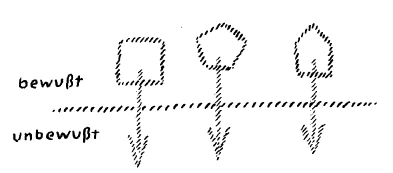
[ 35 ] Yes, you see, when these mental images that descend are explored using insights from the Spiritual Science, they are transformed. Externally, we have recognized that they either promote or inhibit life; internally, Spiritual Science insight reveals that, as they slip beneath the surface, so to speak, they become imaginations. There, in the unconscious or subconscious, everything that descends becomes imagination; everything becomes an image. You may have the most abstract mental images in your ordinary daily consciousness: when you descend below the threshold of ordinary daily consciousness, everything becomes imagination. That is to say, there is a process within the human being—a sum of processes—that is constantly striving—through the dead mental images of earthly, ordinary, materialistic consciousness descending into the subconscious—to transform, in every human being, before they attain imaginative cognition, all their conscious mental images into images, into imaginations, within the unconscious.
[ 36 ] If we wish to describe what we have in the unconscious realm of our imaginative life, if we wish to get to know it, then we must actually say: all of this consists of unconscious imaginations, and all the mental images that we can in turn bring up from the unconscious into the conscious must be brought up through an activity that also remains unconscious to us. We must bring them back into consciousness, but strip them of their pictorial character, transforming them back into abstract, non-pictorial mental images. And when you find yourself thinking: “Oh, I experienced something there; what was it again?”—and you make an effort—you all know the process—to remember something, then it is the effort you must devote yourself to in order to strip the image that lies there beneath of its pictorial character and transform it back into the conceptual form of consciousness.
[ 37 ] From this, however, you will see that when we push our mental images down into the unconscious, they become more spiritual. We must therefore say: When we take what the intellect offers us and absorb it into the unconscious, we must characterize the world of ideas that exists within us—and which we have pushed down—as a higher, more spiritual world. We must therefore say: The world of potential recollection—please note carefully that I say the world of potential recollection; after all, not all mental images that descend there need to be recalled again, but they are all down there in the unconscious life of the soul—the world of potential recollection actually consists of imaginations, of unconscious imaginations.
[ 38 ] [It was written on the board]:
The World of Possibilities for Memory — Imaginations.
[ 39 ] Now, for the ordinary human consciousness, there is sometimes the possibility—and we may well be able to discuss other such possibilities in the coming days—of bringing these images, which would otherwise never pass from the realm of potential memory into the reality of memory, up into consciousness. Consider the experiences that people who are drowning sometimes have! And if you were to compare them to the experiences of those who have passed through the gate of death, you would find that even there, certain mental images—which cannot be brought back through ordinary physical effort—rise up of their own accord. But episodes and fragments also surface in the ordinary world of dreams. Even the dream, as it presents itself to us, is, after all, a complex reality, for what is actually experienced often lies far beyond the surface. But the mental images with which we cloak these experiences are drawn from memory. Thus, dreams—the experiences of those struggling with death, such as drowning victims and the like, and experiences had immediately after passing through the Gate of Death—reveal this world of imagination, which is a more spiritual world than the world of ordinary human intelligence on the physical plane.
[ 40 ] But if you take what I described earlier—that these mental images, which have passed into the realm of what can be remembered, work to either promote or inhibit life—then you will say to yourself: There is some life in there. While the mental images of the ordinary intellect are dead, some life enters there, though it is not a particularly strong life. But even here, ordinary experience can offer something that shows you that what happens with these mental images descending into the subconscious realm can indeed signify an even stronger life.
[ 41 ] I have already emphasized the very common fact that people who have to memorize something in order to recite it or recite it aloud learn it and then sleep on it, and that this process of sleeping on it is part of making the memory more effective. This, however, is only a faint hint at something that Spiritual Science demonstrates much more clearly—indeed, completely clearly—namely, that our entire world of imagination, as we develop it and push it down into the subconscious, becomes ever more alive in the subconscious, while it remains dead in consciousness.
[ 42 ] However, the mental images that resurface are not even the ones that play the greatest role in promoting or hindering life; rather, they are the mental images that are connected to us in an even more intimate way. Mental images that we often simply accept as accompanying life—without even paying them that much attention—are connected to our life-promoting or life-inhibiting forces to a much greater degree. Let us suppose, for example, that someone is engaged in Spiritual Science. At first, they accept this Spiritual Science as having been developed by the physical intellect. They must, after all, start from that premise. We must build upon what the physical intellect perceives through the senses. Otherwise, I could not speak about the spiritual world at all, because language is meant for the physical world. But there is a difference in how we—I would say—incorporate such a world of ideas into our lives.
[ 43 ] Suppose a person accepts the truths of Spiritual Science with seriousness and dignity, in such a way that he feels: there is seriousness, deep seriousness in this. Another person takes in the mental images of Spiritual Science in such a way that they really only listen to them theoretically and do not allow them to touch them very deeply. One person takes them in, as it were, in an atmosphere of superficiality; the other, in an atmosphere of seriousness. We don’t even need to be strongly aware of how we take them in; that has more to do with how one goes through life, without always thinking about it. Those who are predisposed to—or have become accustomed to—taking things that should be taken seriously actually seriously, rather than frivolously or cynically, do not always first have to think about how to interpret them; they behave seriously and naturally. Likewise, those who are only superficially inclined take them in superficially; they cannot do otherwise. In this way, we accompany our mental images with something we cannot bring to consciousness—something that truly exists alongside the conscious. But what exists alongside consciousness delves much deeper into the unconscious than what we think quite consciously. The way we form our mental images, then, goes much deeper into the unconscious than what we think consciously. And when a person sleeps and their astral body and ego have left the physical and etheric bodies, this way of forming mental images plays an infinitely great role in the astral body and the ego. One might say: Whoever absorbs any mental images with the necessary seriousness holds these mental images in their astral body and in their “I” in such a way that they are present there like life-giving solar energy for a plant. They are truly life-giving forces of the highest degree. And within these mental images, the person incorporates what is life-giving—life-giving and extending beyond the present incarnation—and creates the prerequisites for the next incarnation. Here it becomes evident, through the creative soul, that you possess something in the subconscious that is more spiritual than what can be brought up through dreams.
[ 44 ] Here we have a world of unconscious imagination, connected to the very core of the human being. This way of approaching life penetrates, as it were, into our spiritual life forces, and it is quite akin to unconscious inspiration.
[ 45 ] [It was written on the board]:
The World of the Unconscious Imagination — Inspirations.
[ 46 ] I will then explain to you—there is no longer time for that today—how even ordinary life shows that these unconscious inspirations do, in fact, work unconsciously within the human being even during the very incarnation in which they are formed, but precisely unconsciously. Then I will go on to show you that there is an even higher world for human beings. But you can see from what has been presented today that the human soul life has an inner movement, that what is experienced on the physical plane through physical intelligence is experienced at a lower level, and that it then ascends into more spiritual regions—ultimately into regions even more spiritual than what we experience on the physical plane. [Arrows were drawn.] So the life of the imagination is in inner motion, in an upward movement. And now recall what I outlined for you yesterday: how certain human processes were depicted as moving downward. So that you can say to yourselves: When I have a human being before me, there is a downward current and an upward current within that person, and they interact. How they interact will be discussed tomorrow.
[ 47 ] [Diagram on the board]:
The World of the Unconscious Imagination: Inspirations
The World of Potential Memories: Imaginations
Intellectual Activity: Dead Images