

The Value of Thinking for Satisfying Our Quest for Knowledge
The Relationship Between the Spiritual Science and the Natural SciencesGA 164
18 September 1915, Dornach
Translated by Steiner Online Library
Second Lecture
[ 1 ] Yesterday I spoke about a kind of upward movement that is rooted in human nature. And essentially, by examining this upward movement, we have rediscovered everything we already know—namely, at the lowest level, the knowledge that applies only to the facts of the physical plane, the physical knowledge referred to as “objective knowledge” in *How Does One Attain Knowledge of the Higher Worlds?*. So today I will call it physical knowledge. We then became acquainted with the next higher level of knowledge, the so-called imaginative knowledge; but we considered it as primal-conscious imaginative knowledge; conscious imaginative knowledge can, after all, only exist in a person who attempts to work their way up to it in the manner described in the book *How to Attain Knowledge of the Higher Worlds*. [The terms “physical knowledge,” “unconscious imaginative knowledge,” and “conscious imaginative knowledge” were written on the board; see diagram.]
[ 2 ] But the content of imaginative insight—that is, imaginations—is a fact present in every human being. Thus, in this respect, the development of the human soul is really nothing other than an expansion of consciousness into a realm that is always already present within the human soul. One can therefore say: The situation with this imaginative insight is no different from that of objects that are initially in a dark room. For in the depths of the human soul, all the imaginations that initially come to mind are just as present as the objects in a dark room. And just as no new objects are added when light is brought into the room—but rather all remain as they are, only now illuminated—so too, once consciousness has awakened to imaginative insight, there are no other contents in the soul than those that were already there; they are merely illuminated by the light of consciousness. Thus, in a sense, by striving upward toward the level of imaginative cognition, we experience nothing other than what has long been present in our soul as a sum of imaginations.
[ 3 ] If we look back once more at what became clear to us yesterday, we know that when the mental images we form about the objects around us through our physical perceptions sink down into the realm of possible memories—that is, are submerged into the unconscious—so that we find ourselves in a position where be unaware of them for some time—yet we have not lost them, but can bring them back up from the soul—then we must say that what we have in ordinary physical consciousness is what we submerge into the unconscious. Thus, the world of mental images that we gain through physical perception of the external world is constantly being absorbed by our spiritual nature, by the supersensible; it continually slips into the supersensible. At every moment, we gain mental images about the external world through physical perceptions, and these mental images are handed over to our supersensible nature. It will not be difficult for you to reflect on this after all that has been said over the years, because this is, in fact, the most superficial supersensible process conceivable—a process that takes place continuously: the transition of ordinary mental images into mental images that we can remember. It therefore stands to reason—and this is indeed true according to spiritual research—that everything that takes place as we perceive the external world is a process of the physical plane. Even when we form mental images of the external physical world, this is still a process of the physical plane. But the moment we allow these mental images to sink into the unconscious, we are already standing at the threshold of the supersensible world.
[ 4 ] This is, in fact, a very important point that must be taken into account by anyone who wishes to gain an understanding of the occult world not through all sorts of occultist drivel, but through serious human spiritual effort. For there is already a very essential truth hidden in the statement I just quoted: When we, as human beings, encounter the things of the external world and form mental images about them, this is a process of the physical plane. At the moment when the mental image sinks down into the unconscious and is stored there until it is brought back up again through a memory, a supersensible process takes place—a true supersensible process. So you can say to yourself: If one is able to follow this process—which consists of a thought that is up in consciousness sinking down into the subconscious and existing there as an image—in other words, if one can trace a mental image as it exists down in the unconscious, then one is actually already beginning to glide into the realm of the supersensible. Just think about it: When you go through the ordinary process of remembering, the mental image must first rise up into consciousness, and you perceive it up here in consciousness, never down there in the unconscious. You must distinguish ordinary remembering from tracing mental images all the way down into the unconscious. What takes place in recollection can be compared to a swimmer who sinks beneath the water and whom you can see until he is completely submerged. Now he is below the surface, and you can no longer see him. When he comes back up, you see him again! [A drawing was made.] It is the same with human mental images: you have them as long as they are on the physical plane; if they go down, you have forgotten them; when you remember them again, they come back up like the swimmer. But this process I am referring to now—which thus already points toward imaginative insight—could be compared to your diving down yourself and thereby being able to see the swimmer down in the water as well, so that he does not disappear from your sight when he submerges.
[ 5 ] But this implies nothing less than that the line I drew earlier—which represents, as it were, the level below which the mental image sinks into the unconscious, into the realm of memory—is the threshold of the spiritual world itself, the first threshold of the spiritual world. This follows from it with absolute necessity. It is the first threshold of the spiritual world! Just think for a moment how close human beings are to this threshold of the spiritual world. [The words “threshold of the spiritual world” were written next to the diagram.]
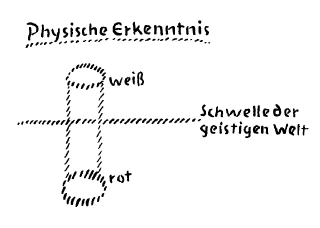
[ 6 ] And now let’s consider a process through which one can try to truly descend into the unconscious, to dive beneath the surface. The process would involve striving to follow mental images all the way down into the unconscious. This can really only be achieved through trial and error. It can be done, for example, by doing the following. You have formed a mental image of the external world; you try to artificially evoke the process of recollection independently of the external world. Consider how this is recommended in *How to Attain Knowledge of the Higher Worlds*, where the very ordinary rule of looking back on the events of the day is described. When one looks back on the day’s experiences, one practices, as it were, entering the paths that the mental image itself creates as it sinks below the threshold of consciousness and then rises again. Thus, the entire process of recollection is designed to trace the mental images that have sunk below the threshold of consciousness.
[ 7 ] But furthermore, in “How Does One Gain Knowledge of the Higher Worlds?” it is stated that one would do well to trace the mental images one has formed in reverse, that is, from the end back to the beginning; and if one wishes to survey the day, to follow the stream of events running backward from evening to morning. This requires a different kind of mental effort than that exerted in the course of ordinary recollection. And this different mental effort leads one, so to speak, to grasp—beneath the threshold of consciousness—what one had as an experiential image. And in the course of this experimentation, one comes to feel, to experience inwardly, how one is following these mental images, chasing them down beneath this threshold of consciousness. What is really at work here is a process of inner, experiential experimentation. However, the point is to undertake this process of looking back with genuine seriousness, not in a way that causes one’s commitment to the matter to wane after some time. But then, when one engages in this process of looking back for an extended period—or, more generally, in the process of bringing an experience to mind from memory, a world of mental images—so that one imagines the matter in reverse, that is, by applying more effort than is necessary when recalling events in their usual sequence, one then experiences that, from a certain point onward, one is no longer able to perceive the mental image in the same way as one did in ordinary life on the physical plane.
[ 8 ] On the physical plane, memory manifests itself in such a way—and it is best for memory on the physical plane when it manifests itself in this way—that when one brings to mind the mental image one wishes to or is supposed to remember, faithfully in accordance with the context of life, one brings it to mind exactly as it was formed on the physical plane. But if, through the trial-and-error process I’ve hinted at, one gradually becomes accustomed to, so to speak, chasing after these mental images beneath the threshold of consciousness, one does not discover them down there as they are in life. That is precisely the mistake people always make when they believe they will find in the spiritual world a mere copy of what exists in the physical world. They must assume that the mental images down there will look different. In reality, below the threshold of consciousness, they appear in such a way that they have shed everything that was characteristic of them on the physical plane. Down there, they become images in their entirety; and they become such that we sense life within them. We sense life within them. It is very important to take this very sentence to heart: we sense life within them. You can only be convinced that you have truly followed a mental image down below the threshold of consciousness when you have the feeling that the mental image is beginning to live, to stir. When I compared the ascent to imaginative insight to sticking one’s head into an anthill, I explained this from a different perspective. I said: everything begins to stir, everything becomes active.
[ 9 ] So suppose, for example, that during the day—I’ll take a completely ordinary experience—you were sitting at a table with a book in your hand. Now, at some point in the evening, you vividly create a mental image of what that was like: the table, the book, you sitting there, as if you were outside of yourself. And it’s always best to create a mental image of the whole thing from the outset in concrete terms, not as abstract thoughts, because abstraction—the ability to abstract—has no significance whatsoever for the world of the imagination. So you create a mental image of the scene: yourself sitting at a table, with a book in your hand. — By “table and book,” I simply mean: imagine as vividly as possible any scene from daily life. Then, when you truly let your soul’s gaze rest on this image, when you truly create a mental image of it while meditating intensely, from a certain point on you will feel differently than usual; indeed, I would say, by way of comparison, it’s similar to holding a living being in your hand.
[ 10 ] When you pick up an inanimate object, you get the feeling that the object is still—it doesn’t tingle or wriggle in your hand. Even if you’re holding a moving inanimate object, you’re reassured by the feeling that life is simply something that doesn’t emanate from the object itself, but is mechanically assigned to it. It’s a different matter entirely if you happen to be holding a living object—say, a mouse—in your hand. Let’s say, for example, you’ve reached into a closet, thinking you’re picking up some object, only to discover you’ve ended up holding a mouse. And then—don’t you agree?—you feel the mouse wriggling and tingling in your hand! There are people who start screaming at the top of their lungs when they suddenly feel a mouse in their hand. And the screaming doesn’t subside even before they see what’s scurrying and tingling in their hand. So there is a difference between holding a dead object and a living one. You have to get used to the living object first in order to tolerate it, in a way. After all, people are used to touching dogs and cats; but they have to get used to it first. But if, in the middle of the night—in the dark of night—you place a living creature in someone’s hand without them knowing it, they’ll be shocked, too.
[ 11 ] You must understand this difference that you feel between touching an inanimate object and a living one. When you touch an inanimate object, you have a different sensation than when you touch a living one. Now, if you have a mental image on the physical plane, you have a sensation that you can compare to touching an inanimate object. But as soon as you truly descend below the threshold of consciousness, that changes; so that you get the feeling: The thought has inner life, begins to stir. It is the same discovery you have—as a comparison for the spiritual feeling—as when you’ve caught a mouse, for my sake: the thought tingles and scurries.
[ 12 ] It is very important that we pay attention to this feeling if we are to gain an understanding of imaginative insight; for we are in the imaginative world at the very moment when the thoughts we draw up from the subconscious begin to tingle and wriggle, begin to behave in such a way that we have the feeling: down there, beneath the threshold, everything is actually swirling and churning. And while it is completely quiet up there in the attic and the thoughts can be controlled so nicely, just as machines can be controlled, down there one thought follows another; there they tingle and scuttle, there they swirl and churn—down there they suddenly become a very lively world. It is important to cultivate this feeling, for at that very moment, when one begins to sense the life of the world of thoughts, one is already within the imaginative or elemental world. One is already there! And it is so easy to enter it, if one only follows the very, very simplest rules set forth in *How to Attain Knowledge of the Higher Worlds* ; provided one does not attempt to enter through the various “practices” that have been alluded to in recent days. It really is that easy to enter. Just consider that one of the very first things clearly stated in the book *How to Attain Knowledge of the Higher Worlds?* clearly states that one should, for example, try to follow the life of a plant: how it gradually grows, how it gradually withers away. Yes, if you truly follow this, you must, in your thoughts, go through the entire life of the plant. First, you have the thought of the very small seed, and if you do not make that thought flexible, you will not be able to keep up with the plant as it grows. You must make the thought flexible. And then again, when you imagine the plant shedding its leaves, gradually dying off and withering, you must in turn imagine its shrinking and wrinkling. As soon as you begin to think about the living, you must make the thought itself flexible. The thought must begin to gain inner flexibility through your own power.
[ 13 ] There are two beautiful poems by Goethe. One is called “The Metamorphosis of Plants,” the other “The Metamorphosis of Animals.” You can read these two poems; you can find them beautiful, but you can also do the following. You can try to truly think the idea in these poems exactly as Goethe intended it, from the first line to the last, and then you will find: if you go through this process, the idea can move within you from beginning to end. And anyone who does not follow the idea of these poems in this way has not understood the metamorphosis. But whoever follows the thought in this way and then allows it to sink down into the unconscious, and who, after having done this repeatedly, recalls precisely this thought of metamorphosis—for this is no different from the way of thinking described in *How to Attain Knowledge of the Higher Worlds?* — whoever does this, whoever lets this thought sink down and then strives to do this fifty, sixty, a hundred times—and it may take a hundred and one times—will eventually bring it up. But then this thought, which he has practiced in this way, will be a living, moving one. You will experience that it does not come up like, say, a small machine, but—forgive me again for the example—like a little mouse; you will experience how it is itself an inwardly mobile, living element.
[ 14 ] I said that it is so easy to dive down into this elemental world if one just breaks away a little from the tendency all people have toward abstract thoughts. This tendency to have limited, abstract thoughts instead of thoughts that are inwardly dynamic—it is, after all, so terribly strong. Isn’t it true that people are so eager to define everything—what this or that is and what is meant by it—and are so satisfied when they can say, “This or that is what is meant,” because that gives them a thought that, like a machine, remains unmoving? And in everyday life, people become so terribly impatient when one tries by every means to convey to them living, dynamic thoughts rather than such abstract, boxed-in thoughts. For all external life on the physical plane and all life in external science consists of such dead, boxed-in thoughts—of thoughts that are boxed in. How often have I had to experience people asking me about this or that: “Well, how is it, then? What is that?”—They wanted a self-contained, rounded-off thought that they could write down so they could read it again and repeat it as often as they wanted, whereas the aim must be to have an inwardly dynamic thought, a thought that lives on—truly lives on.
[ 15 ] But you see, there’s also a very serious side to this whole mouse business. After all, why do some people scream when they realize they’ve reached into a closet and have a mouse in their hand? Because they’re afraid! And this feeling really does arise at the very moment when you realize—truly realize—that thought is alive! That’s when you start to be afraid, too! And that is precisely what good preparation for this matter consists of: weaning oneself off the fear of the living thought. Materialists do not want to come to such living thoughts; I have often emphasized this. Why? Because they are afraid. Yes, the master of materialism, Ahriman, appears once in the Mystery Drama with the term “fear.” There you have the passage in the Mysteries where it is hinted at how one feels when thoughts begin to become active. But now, all the instructions in *How Does One Attain Knowledge of the Higher Worlds?*, if followed, lead precisely to the point where one overcomes this fear of the active, of the living thought—truly overcomes it.
[ 16 ] So you see, one enters a completely different world—a world at whose threshold one must truly set aside the abstract thinking that dominates the entire physical plane. The tendency of people who wish to enter the occult world with a certain degree of ease is always to try to carry their ordinary thinking from the physical plane into it. That is not possible. One cannot bring ordinary physical thinking into the occult world. One must bring flexible thinking into it. One’s entire thinking must become active and flexible. If one does not sense this within oneself—and as I said, one is simply not doing it correctly if one does not sense it relatively soon—if one does not heed what I have just said, then one very easily fails to grasp the distinctive nature of the spiritual world. And one should grasp it if one wishes to engage with the spiritual world at all.
[ 17 ] You see, it is so difficult to grapple with human abstractness in this area; for once you have grasped this fluid nature of thought, you will also understand that a fluid thought cannot simply appear here and there at will. For example, you cannot find a land animal in the water; you cannot accustom a bird, which is adapted to the air, to living deep underwater. When you approach living things, you have no choice but to accept the mental image that they must not be taken out of their element. This must be kept in mind.
[ 18 ] I once attempted, in a very rigorous manner—initially in a narrow field; I always try to do it this way, but I’ll just cite it as an example here—to use a very important idea to illustrate, precisely through an example, how things must be when one takes this inner life of thought into account. I gave a short lecture series in Copenhagen on “The Spiritual Guidance of the Individual and of Humanity,” which is also available in print. At a certain point in this lecture series, I drew attention to the mystery of the two Jesus children. Now, take a look at how the matter is presented there. We have a lecture series that begins in a certain way. Attention is drawn to how a person can already gain certain insights by looking at the first years of a child’s development and reflecting on these things. The whole thing is structured. Then it continues. The role of the hierarchies in human progress is described—the book has been published, of course; it’s probably in everyone’s hands, so I’m speaking of something quite familiar—and then, in a certain context, at a very specific point, the two Jesus children are discussed. It is part of the discussion of the two Jesus children that this occurs at that specific point. And anyone who says: “Well, why shouldn’t one be able to take that out—this discussion of the two Jesus-children—and present it exoterically in isolation?”—is asking the same question as someone who asks: “Why does the hand have to be attached right here to the arm, to this part of the body?” They might even say: “Why isn’t the hand attached to the knee?” It could perhaps be there, too. — Anyone who believes the hand could be located elsewhere does not understand the entire organism as a living being, does he? The hand cannot be located anywhere other than on the arm! Similarly, in this context, the idea of the two Jesus-children cannot be placed elsewhere, because the aim is to structure the matter in such a way that the living idea is contained within the depiction.
[ 19 ] Now someone comes along and writes a treatise, taking this idea out of context in a crude and clumsy way and linking it to other ideas with which it has absolutely nothing to do! But that means nothing other than: he’s putting his hand on his knee! What does someone do when he puts his hand on his knee? Well, you can’t actually do that to a living organism, but you could draw it. Paper is patient; someone could simply sketch a human figure, truncated here, with the two knees arranged so that hands grow out of them. [This drawing has not been preserved.] Isn’t that right? One could draw that, but then one would have drawn an impossible organism; one would have proven that one understands nothing about real life! One could also use the following comparison: one has placed the eagle—the bird meant for the air—down into the depths of the sea, or something similar.
[ 20 ] What did someone like that try to do? Well, you see, what he tried to do can easily be done using only things that relate to knowledge of the physical plane. One professor can write a book starting with one thing, another can start with something else, and it doesn’t really matter: you can take things out and so on. But you’re not dealing with living beings here, but with thought machines. That is the essential point.
[ 21 ] Thus, a person who does something like this—by taking such a thing out of context and placing it into an impossible context—has proven that he is completely unfamiliar with the essence that has animated and inspired our entire movement in Spiritual Science from its very beginning, because he attempts to treat the spiritual realm according to the very ordinary materialistic schema. This is very essential. It is very important to take these things into account; otherwise, one cannot understand the essence of higher knowledge from within. One cannot say everything at just any point. And with regard to the exoteric—which touches upon the esoteric—Hegel has already stated that a thought belongs in its proper place within the context. I alluded to this recently when I tried to make a few remarks in this direction on Hegel’s birthday. In this way, one arrives at nothing less than immersing oneself in life through thought, whereas otherwise one always lives in the dead; one immerses oneself in life.
[ 22 ] But this also reveals something that one could not have recognized at all before and that cannot be verified at all on the physical plane, namely, coming into being and passing away. You can already see this in “How Does One Gain Insight into the Higher Worlds?” On the physical plane, after all, nothing can be observed other than what has come into being. The process of coming into being cannot be observed at all; only what has come into being can be observed on the physical plane. Nor can the process of passing away be observed, for when an object begins to pass away, it is no longer on the physical plane—or at least it departs from the physical plane.
[ 23 ] Thus, one cannot observe arising and passing away on the physical plane. The consequence of this is that we can say: When we discover the moving thought, we enter a completely new element of the world—namely, the world of life—and that is the world of arising and passing away.
[ 24 ] From an occult perspective, this could also be expressed as follows: During the ancient Lunar Age—though only in the state of dream consciousness—human beings were within the world of becoming and passing away. It was not the case that human beings first perceived what had come into being through their senses—for they had not yet developed their senses to the point of sensory perception—but rather they were still immersed within things themselves. Although they created mental images in a dreamlike way, the images they created in their dreams truly allowed them to follow the processes of coming into being and passing away. And this is what he must once again rise to by developing the capacity for active thought. Thus, the ascent to imaginative knowledge is at the same time a return—only a return on the level of consciousness. We return to something from which we have outgrown; we truly return.
[ 25 ] So we can say: This imaginative insight is a return to the world of arising and passing away. We discover arising and passing away when we return. And we cannot possibly learn anything about arising and passing away unless we arrive at imaginative insight. It is completely impossible to discern anything about arising and passing away without arriving at imaginative insight.
[ 26 ] That is why what Goethe wrote about the metamorphosis of plants and animals is so infinitely significant—because Goethe truly wrote it from the standpoint of imaginative insight. And that is why people could not understand what was actually meant when I wrote my commentaries on “Goethe’s Scientific Writings,” which repeatedly express, in a wide variety of ways, that it is not at all a matter of measuring Goethe’s insights against current scientific knowledge, but rather of delving into Goethe’s scientific insights themselves and seeing in them something immensely transcendent—something entirely different from current scientific knowledge. That is why I pointed to a sentence that Goethe expressed so beautifully and in which he hints at what matters most to him. Goethe undertook his Italian Journey, during which he pursued with interest not only art but also nature. When one reads *The Italian Journey*, one sees how, step by step, he immersed himself in everything that the mineral, plant, and other realms had to offer him. And then, when he arrived in Sicily, he said that, based on what he had observed there, he now wanted to take a journey to India—not to discover something new, but to view what had already been discovered by others in his own way. In other words: to view it with flexible concepts! That is what matters: to view what others have discovered through flexible concepts. This is what is so immensely significant—that Goethe introduced these flexible concepts into scientific life.
[ 27 ] Therefore, for those who understand the occult, the following is a fact that is otherwise overlooked. Ernst Haeckel and other materialist—or, as they are also called, monist—scholars have spoken very highly of Goethe’s *Metamorphosis of Plants and Animals*. But the fact that they were able to speak so highly of it is due to a very curious process, which I will also clarify for you by means of a comparison.
[ 28 ] Suppose you have a plant in a flowerpot in front of you—or, even better, out in the garden—and you want to enjoy it. You go out into the garden to enjoy it, to establish a connection with it. Now imagine there is a person who can’t relate to the plant at all. And when you ask yourself why, you discover: What actually bothers him is life itself! And so he meticulously crafts a cast of the plant, so that the plant is now just like the real one, but made of papier-mâché. He places it in his room, and now he takes pleasure in it. Life bothered him; only now does he find joy in it!
[ 29 ] I cannot tell you what torment I endured as a boy because of this comparison, which is also characteristic of people’s attitudes; as a boy, I often had to hear someone trying to emphasize the beauty of a rose by saying, “Truly, it looks just like wax!” — It’s enough to drive you out of your mind! But it does happen. It really does happen that someone highlights the excellence of a living thing by saying, in their turn of phrase, that it is like a dead thing. It really does happen. For someone who has a feel for such things, this is a terrible thing. But if one does not have such feelings, then one really cannot develop further in accordance with reality.
[ 30 ] Well then, here’s what happened with Ernst Haeckel. Goethe wrote *The Metamorphosis of Plants* and *The Metamorphosis of Animals*; Haeckel reads them, and Ahriman transforms the living reality that Goethe wrote about into mere facsimiles—into something that is essentially papier-mâché—and Haeckel understands this. He actually liked that. So what he praised was not at all what Goethe had really meant, but rather what Haeckel had first transformed into a mechanistic form. It is here that Ahriman steps in between Goethe and Haeckel, transforming the living into the dead.
[ 31 ] Now, as I have said, this conscious ascent toward imaginative knowledge is a return. I said at the beginning of this lecture: in fact, the imaginations are already within us; they have been within us since the Lunar Age, and the development of the Earth consists in our having superimposed the ordinary layers of consciousness upon them. Now, through what we have acquired in ordinary earthly consciousness, we are returning once more. It is a true return.
[ 32 ] And now one might ask: How can one describe this whole process? One could say: It is a descent and an ascent. Only now is there any justification for drawing this line at all [the words on the board are connected by a line; see diagram]; drawing it from the outset would make no sense. And only now can one say: At the level of ordinary physical cognition, one is at the bottom. Here is unconscious imaginative cognition, which now lies at the bottom of our nature and has to do with the forces of becoming and passing away; and on the other side, in the ascent, is conscious imaginative cognition. [Both were marked with a cross on the board.]
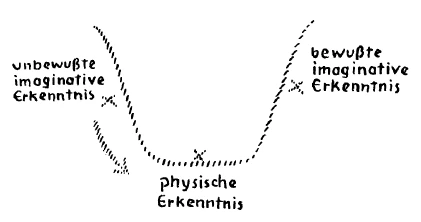
[ 33 ] If we take Goethe as an obvious example—I intend to regard him merely as an example—we can say that, in Goethe’s time, the point had been reached in the modern era where the external development of humanity had come to encompass imaginative cognition, where it was truly introduced into science.
[ 34 ] Now one might ask: Can we examine whether there are not some quite peculiar things associated with this? Yes, there are, because, fundamentally, Goethe’s entire way of thinking is quite different from that of other people. And Schiller, who was unable to develop this very way of thinking, could therefore understand Goethe only with the utmost effort, as you can see from the correspondence between Schiller and Goethe at the passage I have often cited, where Schiller writes to Goethe on August 23, 1794:
[ 35 ] “...For a long time now, though from a considerable distance, I have been observing the course of your mind and noting the path you have charted for yourself with ever-renewed admiration. You seek the essence of nature, but you seek it by the most arduous path, one that any weaker mind would surely avoid. You take nature as a whole in order to shed light on the individual; in the totality of its manifestations, you seek the basis for explaining the individual. From simple organization, you ascend, step by step, to the more complex, in order to finally construct the most complex of all—human beings—genetically from the materials of the entire edifice of nature. By recreating them, as it were, in the image of nature, you seek to penetrate their hidden workings. A grand and truly heroic idea, which amply demonstrates how deeply your mind “holds together” the rich whole of your mental images in a beautiful unity. You could never have hoped that your life would suffice for such a goal, but merely to set out on such a path is worth more than completing any other, and you have chosen, like Achilles in the *Iliad*, between Phthia and immortality. Had you been born a Greek—or even just an Italian—and had been surrounded from the cradle by an exquisite natural world and an idealizing art, your path would have been infinitely shortened, perhaps rendered entirely superfluous. Even in your very first perception of things, you would then have absorbed the form of the necessary, and with your earliest experiences, the grand style would have developed within you. Now, since you were born a German, since your Greek spirit was cast into this Nordic creation, you had no choice but either to become a Nordic artist yourself, or to replace in your imagination what reality withheld from it by the aid of your power of thought, and thus, as it were, to give birth to a Greece from within and by rational means. During that period of life when the soul forms its inner world from the external one, surrounded by flawed forms, you had already absorbed a wild and Nordic nature within yourself when your triumphant genius—superior to its material—discovered this deficiency from within, and was confirmed in this realization from without through your acquaintance with the Greek nature. Now you had to correct the old, inferior nature—which had already imposed itself on your imagination—according to the better model that your creative spirit had fashioned for itself, and this, of course, can only take place through guiding concepts. But this logical direction, which the spirit is compelled to take in reflection, does not sit well with the aesthetic direction, through which alone it creates. You therefore had one more task, for just as you had moved from intuition to abstraction, you now had to move in the opposite direction—transforming concepts back into intuitions and thoughts into feelings—because it is only through these that genius can bring forth...»
[ 36 ] He considers him a Greek transplanted into the Nordic world, and so on. Yes, there you see the full extent of Schiller’s difficulty in understanding Goethe! Some people could learn a thing or two from this—those who believe they can understand Goethe in the blink of an eye and thereby elevate themselves above Schiller, even though Schiller was by no means a fool when it came to those who believe they can understand Goethe so easily!
[ 37 ] But what is peculiar—and what one can discover—is that Goethe also holds a quite peculiar and divergent view in other areas as well, for example, regarding the ethical development of human beings, specifically in the way of thinking about what a person deserves or does not deserve as a reward or punishment.
[ 38 ] It is impossible to understand Goethe’s work from the very beginning unless one takes into account his—I would say—unique way of thinking about human beings in terms of reward and punishment, which diverged from that of his entire social circle. Read the poem “Prometheus,” in which he even rebels against the gods. Prometheus, of course, represents a rebellion against the way people think about reward and punishment. For Goethe, there is the possibility of forming very unique concepts regarding reward and punishment. And in his *Wilhelm Meister*, he truly attempted to portray this—I would say—by wonderfully delving into the mysteries of the world. One cannot understand *Wilhelm Meister* without taking this into account.
[ 39 ] Where does this come from? It comes from the fact that, in the realm of physical cognition, one cannot even begin to form a mental image of what punishment or reward should be assigned to any human action in relation to the world, for this can only be understood in the realm of the imagination. The occultists have therefore always said: When one ascends to imaginative knowledge, one experiences not only the elemental world, but also—as they put it—“the world of wrath and punishment.” So it is not only a return to the world of becoming and passing away, but at the same time an ascent to the world of wrath and punishment. |The phrases “return to the world of becoming and passing away” and “world of wrath and punishment” were written on the blackboard. ]
[ 40 ] That is why the unique connection between what a human being is worth and what they are not worth in relation to the universe can only be properly illuminated through Spiritual Science. All other forms of “justification” in the world serve as a preparation for this.
[ 41 ] This brings us to an important point, which I plan to continue discussing tomorrow.