

The Value of Thinking for Satisfying Our Quest for Knowledge
The Relationship Between the Spiritual Science and the Natural SciencesGA 164
19 September 1915, Dornach
Translated by Steiner Online Library
Third Lecture
[ 1 ] Yesterday we examined the characteristics of imaginative cognition from a certain perspective and made a point of emphasizing that human beings continually possess within themselves everything that they consciously bring to the forefront of their consciousness through imaginative cognition. I used the analogy of a dark room containing various objects—or, for my purposes, even people—that cannot be seen with the physical eyes in a dark room. Then one enters with a light, and everything inside is illuminated; there is nothing new there—everything was already there before. The only difference is that these things are seen and perceived afterward, whereas before they were not. So it is also with what imaginative insight presents to us. Everything that imaginative insight brings to consciousness is present within the human being, reigning and working there in the hidden depths of the soul; it belongs to what lives and weaves within the human being. And what is particularly important for human beings on the physical plane is this: their powers are continually increased or diminished in some way by what they take in during life, experience, and allow to sink down from their life of imagination into the depths of consciousness.
[ 2 ] I will have more to say about this matter at a later time; for the process is described very incompletely when one says: Here [it is depicted] is the threshold of consciousness; here is a mental image that sinks down into the subconscious and now exists down there like a living being. As I said, the process is described quite incompletely. But let us first ascend slowly and gradually to the true state of affairs in this area.
[ 3 ] What I want to say today is that we thus become aware of how these imaginative insights—as you can see from what has been discussed—are, of course, thoroughly and deeply connected to all the conditions of human life, including on the physical plane, from birth to death. But they belong to the unconscious or subconscious conditions of life. Thus, from what we have considered, we can also derive the important truth that human beings, as they live on Earth, are dependent on conditions that do not enter into the clear, waking consciousness we have from birth to death, except when we sleep. Thus, we are dependent on factors of life that cannot be known through ordinary, normal consciousness.
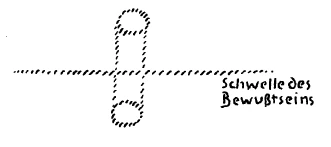
[ 4 ] But judging by the way I have described it, these life forces that are at work down there—and as we said yesterday, in the etheric body—are actually quite close to the human being, so close that, because they are kindred, they connect with what the human being continually allows to sink down from his world of imagination. For when a person transforms his thoughts into memories, he can, in a sense, himself transform his thoughts into the substance that exists down there in the subconscious. It is, after all, [substantively] exactly the same as what we think. When what we think is down there, it is precisely such a swirling, teeming mouse-like world as that which lives and weaves down there—and which is, in essence, a living thought life. But that is the etheric body; it has come from the cosmos into the etheric body. And because it is related to the life of thought we are conscious of, it is still very close to the human being. And just as it lives and weaves [within us today in the unconscious], so was it, in essence, fully present during the old Moon existence. That [Lunar thinking] was—if you imagine it as a dream, if you picture it as being completely immersed in dream life—essentially the same as when you dream, but perceive the living weaving of thought within the dream. That is the ancient Lunar mental image. The only difference for us during our Earth existence is that we must exert ourselves to have thoughts, to form thoughts through our own effort. The ancient lunar inhabitants did not form these thoughts through their own effort. They lived in dream images that were not as lifeless as our thoughts, but were, in fact, a weaving life, an image-weaving life.
[ 5 ] From what I have described to you, you can see that when we immerse ourselves in the imaginative world, we gain something and at the same time lose something. We lose that sense of calm, that earthly, peaceful experience of thoughts; we no longer have control over them, because thoughts themselves are living inner forces. In ordinary life, we feel ourselves to be the masters of our thoughts; we do not have that in the imaginative world; but in return, we also grasp a life that is truly life. The thoughts we have in physical life are dead; what we grasp there is alive and pulsating. And this was already the case for human beings during the old Lunar existence, only they experienced it as a dream and not consciously. This then ascends to the conscious level [in the course of Earth’s evolution]. And from the conscious recognition of what was dreamlike during the ancient Lunar existence, imaginative knowledge emerges as the first stage of that from which Spiritual Science knowledge must be derived. This imaginative knowledge is therefore still very closely related to the human being.
[ 6 ] Well, I said that one gains something and one loses something. People would be fine with the former—gaining something—but they don’t agree with losing. And this gives rise to countless errors; a great, great many errors arise from it. You see, it’s not all that easy if one doesn’t make the effort to imagine what this dreamlike, imaginative mental image was actually like during the Lunar Age. Since we live here on Earth, it’s inconvenient—given our current stage of physical development—to always have to form ideas and thoughts based solely on earthly facts. That is precisely what makes studying so inconvenient. One must truly weigh the facts, evaluate the facts, connect the facts, and one must slowly work one’s way through—by one’s own effort—the worlds of thought and imagination that one, as an earthly human being, masters with one’s earthly will. Some people therefore find it much more convenient when the living world of thought is simply given to them in such a way that all they need to do is wait for it: once they receive “enlightenment” from it, it enters their inner life, and then they no longer need to develop their own thoughts. That is how they think, but as a result, they do not progress any further than where they are. As an earthly human, one stands much higher than a lunar human; for one has developed further. Compared to the dreamlike imaginings of the lunar being, one stands—as an earthly human who combines facts and, through rational judgment, forms concepts from life experiences—far higher than the lunar being and than those who long for a return to this lunar existence, which is said to consist of insights not derived from thought.
[ 7 ] One can have peculiar experiences there. It is not that a person, when he sinks back into this moon-like state of awareness, has no thoughts at all. He has thoughts; but they arise of their own accord—he does not need to perform the work [of factual thinking]. That, in turn, seems quite comfortable. One can have a certain experience time and again—a very important, specific experience that must be taken into account if one is to understand these things correctly at all.
[ 8 ] There are people who attain a certain kind of visionary clairvoyance. This dreamlike imagination, this visionary clairvoyance, is, after all, always a regression to the nature of the Moon. For true clairvoyance—the kind that is desirable for the Earth—must be based on a higher level, on an even greater development through the world of thought than the perception of the physical plane. This regression is not an elevation, not an upward development of the human being, but a downward development, a becoming less intelligent than one is as a normal earthly human being. And this leads to this peculiar experience, which one can have again and again. There are people who possess a certain visionary clairvoyance, but who are actually not intelligent at all. Indeed, their clairvoyance is directly linked to the fact that they flee from intelligence—that they do not wish to develop the intelligence that one must cultivate as an earthly human being. It is precisely this dampening of ordinary earthly intelligence that is very often found in connection with a certain degree of visionary clairvoyance, which is of a lunar-atavistic nature. And this may lead to the following: Such people can then make records of their images. These records are not thoughtless, but interwoven with thoughts—the thoughts come with the images, and within them are woven witty, truly spirited images. And then a puzzle may arise: Yes, here is a person who describes, in images—in very beautiful images—Atlantis or other things that come to him in visions, and this is absolutely logically intelligent. But I have never perceived such intelligent logic in that person when he is asked to explain matters of the physical plane; then he lacks it. He has not become sufficiently of the Earth. Yet when he is allowed to slip back into lunar intelligence, that is when the intelligence emerges. But then it is not his own intelligence; he is merely a medium for the lunar intelligence, and the lunar intelligence works through him. One can receive wonderful descriptions of spiritual worlds from people who have slipped back a little into the lunar stage, and who, when they try to apply the intelligence they have developed on Earth, cannot even comprehend for themselves what they have actually produced—and in most cases do not even want to.
[ 9 ] I said: In the ascent toward imaginative knowledge, one must gain something and lose something, and that people usually do not want to lose anything. I also pointed out that people who possess spirit do not want to lose it. These are not the ones who love visionary clairvoyance; they, in fact, are quite willing to lose their ordinary intelligence and ordinary thinking. But there is another group that does not want to lose this intelligence. They wish to preserve this intelligence as it exists on the physical plane, but they do not want to develop it further. They do not want to continue working with this intelligence in such a way that a person comes to use concepts more freely than they are used in the processes of the physical plane. And then such people fall into allegorizing and symbolizing, which is, after all, merely an activity of the physical plane, because it does not further develop thinking but leaves it as it is, and then drapes it in external veils of thought drawn from all sorts of select occult matters. It is very important to take this into account as well.
[ 10 ] And you see, this was already present in the consciousness of those who had slowly and gradually worked their way up—or sought to work their way up—to the perspectives we must have today in Spiritual Science. Today, in Spiritual Science, we really must bring humanity something of clear thinking, combined with the possibility of knowing something about spiritual worlds—but through clear, completely clear thinking. It really took a long time for the possibility to arise—and hopefully it is here now—to see through these things in this way. And many people have worked their way toward this. People of such great clarity as Goethe, for example, have indeed come very close to complete clarity. But many have worked their way through to it. Just think of how Jakob Böhme struggled, starting from the turning point of the materialistic era, to work his way through the chaotically twisting, moving, swirling, and churning concepts—which he already possessed—in such a way that what emerged stands out in Jakob Böhme’s work as a profound illumination of many mysteries of the spiritual world.
[ 11 ] Yet another person uttered a wonderful sentence—I would say, one that wonderfully illuminates the horizon at the dawn of the modern era—from which one can see, or at least from what he has otherwise accomplished, that although he could not penetrate with a completely clear vision to what is today called Spiritual Science, he was nevertheless able to go far enough to reveal precisely its most vital nerve. For the man of whom I am now speaking realized in the 18th century: If one wishes to understand human beings, one must penetrate through the darkness, through the confusion of external, material knowledge. This is necessary even when you are standing at the first stage of imaginative knowledge. For we have seen that what weaves down there in the depths of the soul cannot be reached at all through physical knowledge. One must penetrate through the darkness. But that is not the only thing one must do. One must also penetrate through the confusion of ordinary concepts to reach knowledge; one must also dispel this confusion. Thus, one must also rise above ordinary thinking that operates on the physical plane.
[ 12 ] And this man coined a very beautiful phrase. The first part of this phrase is often followed, but the second part is almost never followed. Yet it is important to follow it. You see, most people today who are becoming or want to become mystics in some field or another admit that one must shed the sensory and the material, that one must shed the confusion of the material world in order to penetrate into the spiritual. But very few admit that one must also shed the forms of the spiritual that are attached to conceptual thinking; for they would like to take them along, to manage them just as they do on the physical plane, and to find the thought down there in the subconscious—as a possibility for recollection—in precisely the same form that it has up there.
[ 13 ] However, it would be a mistake to believe that when a clairvoyant looks into the human mind, he finds the thoughts exactly as the person thinking them has them in his mind. That is not true. Down there, they are transformed; they are living beings, an elemental world. The world of thoughts that a person has here on the physical plane cannot be found in the spiritual world. That is why that man coined a beautiful phrase, which I would like to write down for you, for it can truly be regarded as a kind of self-examination: How does one come to know anything about the worlds that lie beyond the earthly world? He said [it was written on the blackboard]:
Dispel your material darkness, and you will find Ühomme
[ 14 ] People who wish to be mystics agree with this part of the sentence: “To dispel the material darkness and confusion.” But people today still hardly understand the second part of the sentence. [It was written on the blackboard]:
Dispel your spiritual darkness, and you will find God
[ 15 ] where, for “Dieu”—since that term is still colored by religious mental images—we must understand it to encompass the entire scope of Spiritual Science. After all, he could not yet find the expression that we can find today.
[ 16 ] Now you can surely imagine that if someone today reads the sentence: “Dispel your material darkness and you will find man,” they would say: Yes, fine, that means I’ll just enter the spiritual world—I’d certainly like that. But when it comes to “Dispel your spiritual darkness and you will find God,” they say: “Well, what will I have left then? I’ll have nothing at all.”
[ 17 ] Yes, what remains? Precisely what constitutes the content of today’s Spiritual Science remains. This is necessary: the body of knowledge regarding the physical plane—which is usually believed to be the only correct one—must be dispelled just as material darkness must be dispelled. Now observe how this is taken into account in our Spiritual Science... [Gap in the postscript].
[ 18 ] This sentence is one of the so-called “philosophe inconnu,” Saint-Martin, who indeed regarded himself as a disciple of Jakob Böhme. Thus, we already find in Saint-Martin a deep longing for that which is to come to light in Spiritual Science. But he called himself the “philosophe inconnu,” the unknown philosopher, because what he carried within himself—even though, of course, the people who saw him saw his nose, saw his hands, and heard the words he spoke—remained foreign to them. The true philosopher, Saint-Martin, remained unknown to them, truly unknown.
[ 19 ] Thus, according to the discussions we had yesterday, the appropriation of imaginative knowledge is a return—a conscious return—to the way in which human beings related to the world during the Lunar Age. So we can say—you will recall that we have already described this from another perspective right here in these lectures: The events that actually are not normal events on Earth, but were normal events during the Lunar Age, still prevail in human beings today, albeit in a supersensible way, as spiritual-supersensible phenomena. Humanity has preserved these Lunar events; in a certain sense, it can revert to them. Then it produces insights in a completely different way than the Earth-dwelling human being can produce such insights. He can attain visionary clairvoyance, possess a subdued intellect, and present precisely the enigma I spoke of earlier—namely, that if he were prompted to work rationally and scientifically, or even to make rational judgments about the most ordinary, everyday events, he would be unable to do so; but when he writes down anything from his vision—even about the events that took place at the time of the Mystery of Golgotha—he may only be recording images and remain stuck in the lunar life, yet he writes with remarkable intelligence. And what he writes does not at all correspond to what one otherwise knows about this person. So, theoretically, he is incapable of anything, yet he writes very intelligently through mediumship, so that one cannot help but be astonished by the intelligence of his writing. But this is not a further development; it is a regression of the human being. Of course, this does not rule out the possibility that truths may come to light through such a person, because he is, after all, still grounded in earthly existence and connected to it, and in addition possesses this active lunar life within himself.
[ 20 ] I have tried to portray the various types of people in the Mystery Dramas, and also to depict a character who regresses to the lunar state—one who is unintelligent on the physical plane and yet can reveal true things, and who thus stands below the level of the normal earthly human being: that is Theodora. Theodora is a character who is specifically intended to represent a regression into lunar consciousness. That is, of course, very clear. I would like to say that this is very clearly indicated in the text, as it is stated at the point where Theodora appears: “Theodora, a seer. In her, the element of will has been transformed into naive clairvoyance.” Naive clairvoyance means, of course, lunar clairvoyance. It is a naive form of clairvoyance, and the character is portrayed accordingly. And this is also why, in the final Mystery Play, Theodora herself can no longer appear, but only her soul, because she is unable to participate in certain things. These Mystery Dramas, in particular, should be taken very, very seriously. Perhaps some of you will one day come to realize that hardly anything that has taken place here in recent days could not already be read in some form in the Mysteries. If one had read them as they were meant to be read, we would not have needed these confusions.
[ 21 ] So let us note: what is experienced as the imaginative world is still relatively very close to human beings. What can be experienced as the inspired world, on the other hand, is much less close to the human being. For when one first immerses oneself in the inspired world, it encompasses those events that did not take place during the Lunar Age, but already during the ancient Solar Age—and which the human being has also preserved within themselves. One thus penetrates even deeper into the human soul when working one’s way toward the inspired world. And the inspired world one first encounters has a [certain] peculiarity.
[ 22 ] You see, when a person works their way into the world of the imagination, they encounter events that took place during the old lunar existence. If you have a mental image of the ancient Moon in the phases when it was separated from the Sun of that time—you can read about this in *The Secret Science*—human beings lived on this Moon, separated from the Sun, at certain times. And what human beings experienced there is what one first encounters when returning with the old, dreamlike, imaginative clairvoyance. But when one enters the inspired world, one experiences upon returning not a being separated from the Sun, but a being directly within the Sun itself; that is, the realities that humanity experienced together with the Sun. One truly experiences genuine solar realities. And these solar realities, you see, are actually no longer related to the human being. For just as the human being is now, during earthly existence—if he does not look into the depths of his soul, does not look at what lies in the deeply hidden recesses of his soul—he is, in fact, through what he is on Earth, really more of a shell. He is not a true human being; he is more of a shell. He has, first of all, his physical form; this form, as it appears to us on the physical plane, came into being during his earthly existence. But within it are at work forces that cannot be seen, and which even modern science has not yet sought to investigate.
[ 23 ] A friend of ours has been encouraged to explore this line of inquiry using the biological material at his disposal. He is putting a great deal of effort into it and may, after some time—such matters require a great deal of study—be able to uncover a way to bridge the gap to these hidden aspects of human nature. But to do so, it is necessary to investigate precisely those biological facts that are not taken into account by current science—facts that today’s experimental researchers, as it were, leave aside. One must therefore examine the specimens for precisely what other researchers are not interested in at all, what they leave aside. Of course, much is still missing, and a great deal of new research must be conducted. It is quite possible that this will require many years of work before it can be completed. But it would be work of eminent importance, because it could show us what can still be attained through the means of physical science regarding what lives in human nature from the ancient Moon. A completely new embryology will emerge from this—a new branch, a new aspect of embryology. It is necessary that this be done at some point. But that is actually the extent of it; one cannot discover more by observing human beings from the outside. For what can be observed externally in human beings today is actually not older—not even as old as the earliest period of the ancient Moon existence. However, the research I have just described will allow us to draw conclusions about processes from the ancient Moon existence. These will correspond to what is described in *The Secret Science*. But, as I said, one does not go very far back when observing human beings as they are today; not even to the beginning of the ancient lunar existence, let alone to the ancient solar existence.
[ 24 ] If one wishes to return to the old solar existence, then one must simply take into account far, far less of the material aspect in human beings than can be taken into account in the science I have just spoken of. For what is at stake here is that something actually penetrates human nature which a person on Earth can indeed bring to light, but is not obliged to do so. They can, but they are not obliged to bring it to light. When, for example, true inspirations arise in an artist or a poet, then—if they are truly inspirations—they ultimately come from the spiritual world of the Sun-age. They truly come from the spiritual world of solar existence. But our age is so terribly spiritually impoverished that what comes from the inspirations of solar existence is rejected, and people actually always want to create only in a naturalistic way, adhering to the model—that is, to the earthly—while what can come from the model is, after all, merely the material for what one is actually meant to create. The arts that protect the individual artist from clinging to the model and falling into the material are architecture and music. Architecture, fundamentally speaking, cannot reproduce anything; indeed, it often does so quite clumsily. And music, too, cannot reproduce anything, for it is not true music to imitate birdsong or a cat’s meow, just as one imitates models in painting and so on. In music, one can only draw upon the very highest material of sound. But this is how it should be in every art. Just as much as the musician draws from music, just as much must the painter draw. What notes are to the musician, form and color must be to the painter. The model should provide him with nothing more than the material. Thus, artistic quality cannot be extracted from the model, but springs from inspiration that traces back to the ancient solar existence. Hence the alienness of truly great works of art to the earth. I said that a person can live without artistic inspiration; they can—they can certainly bring it in, but they do not need to bring it in. The Botokude, don’t they say: “A person can also live without art.”
[ 25 ] But now you can—and those who engage with these things on a deeper level will do so sooner or later—you can raise an important, fundamental question: Yes, if we have the Saturn existence, the Sun existence, the Moon existence, and the Earth existence—all with specific facts—and return to the Moon existence through imaginative knowledge, to the Sun existence through inspired knowledge, and from this it follows that we return to the Saturn existence through intuitive knowledge; yes, if it is indeed the case that we have no new facts but rather return to the old facts, why then does the human being need to develop further at all?
[ 26 ] So someone might ask this question: Why the further development? Why, in the first place, this whole earthly existence, which detaches us from the realities through which we have developed, so that our insights are pushed down into the unconscious, and we must first strive back up toward them through self-awareness? Why all of this?
[ 27 ] Yes, you see, because that is the only way we become true human beings; because that is the only way we can truly realize our true nature. And you can already see this outwardly when you truly study such personalities who had a grasp of the “movable concepts,” of this “concept mouse,” as I have cited for you, for example, in Goethe’s *The Metamorphosis of Plants* and *The Metamorphosis of Animals*. One must study such natures. And such personalities also demonstrate that, when they are entirely true within themselves, they stand in a very specific relationship to yet another world of the soul. This is particularly evident in Goethe. Study *Wilhelm Meister*, study all of Goethe’s poems, and you will find that a certain way of judging the world, of passing judgment on the world, emerged in him in a remarkable way. For if you engage with these things, you will find that to the same extent that the idea of metamorphosis develops in Goethe, a truly genuine, magnificent inner spiritual tolerance also develops within him. A wonderful tolerance develops within his soul—a remarkable way of relating to the world and to life, a spiritual tolerance! And this is connected to very profound realities.
[ 28 ] You see, when we look at the animal kingdom, we find that it takes on the most diverse forms. If, for example, we compare the hyena—whose face betrays its craving for carrion and whose entire posture reflects its nature—with the lion and the wolf, and if we in turn compare these animals with the eagle and the eagle with the vulture, and then compare these animals with turtles, snakes, worms, and various insects—when we consider all these different animal forms, we must ask ourselves: How does this relate to the spiritual world?
[ 29 ] This can only be studied by examining the ancient lunar existence. Why is that? You see, during the ancient lunar existence, human beings as we know them today did not yet exist. The corresponding forms that existed at the human level were the angels. Among the Angeloi—the angels—there were entirely different judgments, an entirely different way of thinking [than we have today]. The angels were at that time on the same level as humans are today, but they were not in a physical body such as humans have on Earth today. They were in a very soft, flexible body, for the spirits of form had not yet intervened to create a solid bodily form. Now, these Angeloi thought back then—that is, not now during the Earth period, but during the Lunar period—in concepts that were much more vivid compared to our earthly concepts. But these concepts had something else very distinctive besides their liveliness. They were deeply imbued with emotional impulses. Spurred on by the influence of the Archangels, the Archai, the Spirits of Form, the Spirits of Movement, and so on up through the higher realms, the angels conceived these concepts during the Lunar Age. But these are living, impulsive concepts—far more impulsive than the concepts we find in people today, who alternately become either “ecstatic fools” or “venomous fools,” don’t they, when they pour their emotions into how they judge life. There are indeed such people—and they may be the very best of people—but they will alternately be enraptured, inclined toward rapture over a matter, “rapture-seekers,” or, conversely, outright “venom-spitters,” so that their entire soul is poured into what they say, and the whole of it comes out in their concepts, doesn’t it? Well, this was present to a much greater degree—in a directly creative, artistic way—in these angels on the Moon.
[ 30 ] Let’s imagine a lunar inhabitant who thinks this way! He says to himself: Yes, I must now form a concept. Inspiration suggests to me: A wretched creature whose back slopes upward from back to front, whose face is repulsive with a longing for carrion! — And so this being comes into being, condemned to be a hyena. The creative concept is there. The forms of the animal kingdom are intimately connected with this creative thinking, which creates according to the principle of good and evil. And the entire animal kingdom, in its various forms, is thus an embodiment of good and evil.
[ 31 ] The people [of Earth] should not learn this. Someone who could not let go of the lunar culture led people astray, causing them to perceive good and evil in the way he had experienced it during the lunar era. He... [gap in the postscript] judged thus; but human beings were to learn to judge differently. This intense interweaving of emotions into concepts was not meant to penetrate into the deeper recesses of the soul. It had to be cast aside; it had to give way to a more objective, a more serene form. That is why human beings had to progress from the Lunar to the Earthly stage of development. And as humanity now progresses further, it will become even more tolerant. A Lunar Angel, yes, hated the hyena in an incredible way, because to him it was evil; he hated the snake, hated what was ugly, and loved what was beautiful. Good and evil belonged to the realm of creative life. Humanity had to wean itself from this. Humanity could not develop an earthly science if, for example, it were to classify animals—as the lunar angels did—into beautiful and ugly ones—wouldn’t you agree, we classify differently, according to objective criteria—into decent and indecent animals, into mischievous ones, into cunning animals, and so on. The Moon Angels had all of that. But it would not be scientific today, for example, if a scholarly book were to state: “The weasel—characteristic: cunning.” That might be the case in a satirical poem, but in science today, such things must be set aside; it cannot be that way today.
[ 32 ] Thus, in order to make progress in this field, one must be able to rise to a level at which one can view that which evokes the most intense emotions in human beings during earthly life with the same scientific detachment with which the animal kingdom is viewed today—without emotion. And we can see this in the unique nature of Goethe’s spirit. For him, human life is, to a much greater degree, a calm stream that he observes just as he observes natural phenomena. This is precisely the wonderful inner serenity of Goethe’s view of life: that for him, a part of human life also flows into the stream of natural facts. This is what enabled him to become so objective.
[ 33 ] Well, at this point we’ll have to pick up where we left off and continue our discussion tomorrow.