

The Value of Thinking for Satisfying Our Quest for Knowledge
The Relationship Between the Spiritual Science and the Natural SciencesGA 164
19 September 1915, Dornach
Translate the original German text into any language:
Versions Available:
The Value of Thinking for Satisfying Our Quest for Knowledge, tr. SOL
Dritter Vortrag
Third Lecture
[ 1 ] Gestern haben wir die Betrachtungen von einem gewissen Gesichtspunkte aus zu der Charakteristik der imaginativen Erkenntnis geführt und Wert darauf gelegt, zu betonen, daß der Mensch alles dasjenige, was er bewußt durch die imaginative Erkenntnis in seinem Bewußtsein gegenwärtig macht, ja fortwährend in sich hat. Ich habe den Vergleich gebraucht, daß in einem Zimmer, das finster ist, verschiedene Gegenstände, meinetwillen auch Menschen seien, die man mit physischen Augen in einem finsteren Zimmer nicht sieht. Dann kommt man hinein mit einem Licht, und alles das, was drinnen ist, wird beleuchtet; es ist nichts Neues darin, alles war schon vorher da. Der Unterschied ist nur der, daß die Dinge nachher gesehen, wahrgenommen werden und vorher nicht. So ist es auch mit dem, was uns die imaginative Erkenntnis darbietet. All das, was die imaginative Erkenntnis zum Bewußtsein bringt, ist im Menschen vorhanden, waltet und wirkt im Menschen da unten in den verborgenen Seelentiefen; es gehört zu dem, was im Menschen lebt und webt. Und was das besonders Wichtige für den Menschen auf dem physischen Plan ist: er wird fortwährend in irgendeiner Weise vermehrt oder vermindert in seinen Kräften durch das, was er im Leben aufnimmt, erfährt und hinuntersinken läßt von seinem Vorstellungsleben in die Tiefen des Bewußtseins.
[ 1 ] Yesterday we examined the characteristics of imaginative cognition from a certain perspective and made a point of emphasizing that human beings continually possess within themselves everything that they consciously bring to the forefront of their consciousness through imaginative cognition. I used the analogy of a dark room containing various objects—or, for my purposes, even people—that cannot be seen with the physical eyes in a dark room. Then one enters with a light, and everything inside is illuminated; there is nothing new there—everything was already there before. The only difference is that these things are seen and perceived afterward, whereas before they were not. So it is also with what imaginative insight presents to us. Everything that imaginative insight brings to consciousness is present within the human being, reigning and working there in the hidden depths of the soul; it belongs to what lives and weaves within the human being. And what is particularly important for human beings on the physical plane is this: their powers are continually increased or diminished in some way by what they take in during life, experience, and allow to sink down from their life of imagination into the depths of consciousness.
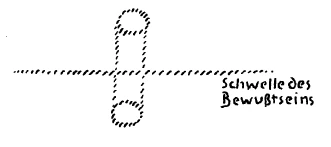
[ 2 ] Ich werde bei einer späteren Gelegenheit Ihnen über diese Sache noch etwas Genaueres zu sagen haben; denn der Vorgang ist sehr unvollständig charakterisiert, wenn man sagt: Hier [es wird gezeichnet] sei die Schwelle des Bewußtseins; hier sei eine Vorstellung, die sinke hinunter in das Unterbewußte und wäre jetzt drunten wie ein lebendiges Wesen. Wie gesagt, der Vorgang ist recht unvollständig beschrieben. Allein wir wollen erst langsam und allmählich zu dem wahren Tatbestand auf diesem Gebiet aufsteigen.
[ 2 ] I will have more to say about this matter at a later time; for the process is described very incompletely when one says: Here [it is depicted] is the threshold of consciousness; here is a mental image that sinks down into the subconscious and now exists down there like a living being. As I said, the process is described quite incompletely. But let us first ascend slowly and gradually to the true state of affairs in this area.
[ 3 ] Was ich heute sagen will, ist, daß wir also gewahr werden, wie diese imaginativen Erkenntnistatsachen ja selbstverständlich — wie Sie aus dem Erörterten ersehen können — gründlich und tief zusammenhängen mit allen Lebensbedingungen des Menschen auch auf dem physischen Plan von der Geburt bis zum Tode. Aber sie gehören zu den unbewußten oder unterbewußten Lebensbedingungen. So daß man auch aus dem, was wir betrachtet haben, die wichtige Wahrheit gewinnen kann, daß der Mensch so, wie er auf der Erde lebt, abhängig ist von Bedingungen, die nicht in das helle Tagesbewußtsein hineingehen, das wir von der Geburt bis zum Tode haben, außer wenn wir schlafen. Also wir sind von Lebensfaktoren abhängig, die man mit dem gewöhnlichen normalen Bewußtsein nicht kennen kann.
[ 3 ] What I want to say today is that we thus become aware of how these imaginative insights—as you can see from what has been discussed—are, of course, thoroughly and deeply connected to all the conditions of human life, including on the physical plane, from birth to death. But they belong to the unconscious or subconscious conditions of life. Thus, from what we have considered, we can also derive the important truth that human beings, as they live on Earth, are dependent on conditions that do not enter into the clear, waking consciousness we have from birth to death, except when we sleep. Thus, we are dependent on factors of life that cannot be known through ordinary, normal consciousness.
[ 4 ] Aber nach der ganzen Art, wie ich es dargestellt habe, sind diese Lebensfaktoren, die da unten — und wir haben gestern gesagt, im ätherischen Leib — walten, dem Menschen doch noch recht naheliegend, so naheliegend, daß sie, weil sie verwandt sind, sich verbinden mit dem, was der Mensch fortwährend hinuntersinken läßt von seiner Vorstellungswelt. Denn der Mensch kann gewissermaßen, wenn er seine Gedanken umwandelt in Erinnerungsvorstellungen, selber seine Gedanken zu der Substanz umformen, die da unten im Unterbewußten ist. Es ist ja [substantiell] ganz dasselbe, wie das, was wir denken. Wenn das, was wir denken, unten ist, ist es gerade so eine quirlende, wurlende Mauswelt, wie das, was da unten lebt und webt und was im Grunde genommen lebendiges Gedankenleben ist. Das ist aber der ätherische Leib, das ist aus dem Kosmos in den ätherischen Leib hereingekommen. Und weil es mit dem uns bewußten Gedankenleben verwandt ist, steht es dem Menschen noch sehr nahe. Und so, wie es [heute in uns im Unbewußten] lebt und webt, so war es im Grunde genommen während des alten Mondendaseins voll vorhanden. Das [Mondendenken] war — wenn Sie sich es traumhaft vorstellen, wenn Sie sich denken, daß es ganz eingetaucht ist in Traumleben — überhaupt so verlaufend, wie wenn Sie träumen, aber im Traum das lebendige Weben des Gedankens wahrnehmen. Damit haben Sie das alte Mondenvorstellen. Es kommt nur bei uns während des Erdendaseins noch dazu, daß wir uns anstrengen müssen, Gedanken zu haben, Gedanken zu bilden durch eigene Anstrengung. Diese Gedanken dutch eigene Anstrengung bildete sich der alte Mondenbewohner nicht. Er lebte in den Traumesbildern, die nur nicht so tot waren wie unsere Gedanken, sondern eben webendes Leben, bildwebendes Leben waren.
[ 4 ] But judging by the way I have described it, these life forces that are at work down there—and as we said yesterday, in the etheric body—are actually quite close to the human being, so close that, because they are kindred, they connect with what the human being continually allows to sink down from his world of imagination. For when a person transforms his thoughts into memories, he can, in a sense, himself transform his thoughts into the substance that exists down there in the subconscious. It is, after all, [substantively] exactly the same as what we think. When what we think is down there, it is precisely such a swirling, teeming mouse-like world as that which lives and weaves down there—and which is, in essence, a living thought life. But that is the etheric body; it has come from the cosmos into the etheric body. And because it is related to the life of thought we are conscious of, it is still very close to the human being. And just as it lives and weaves [within us today in the unconscious], so was it, in essence, fully present during the old Moon existence. That [Lunar thinking] was—if you imagine it as a dream, if you picture it as being completely immersed in dream life—essentially the same as when you dream, but perceive the living weaving of thought within the dream. That is the ancient Lunar mental image. The only difference for us during our Earth existence is that we must exert ourselves to have thoughts, to form thoughts through our own effort. The ancient lunar inhabitants did not form these thoughts through their own effort. They lived in dream images that were not as lifeless as our thoughts, but were, in fact, a weaving life, an image-weaving life.
[ 5 ] Sie können aus dem, was ich Ihnen dargestellt habe, ersehen, daß wit, wenn wit uns hineinleben in die imaginative Welt, etwas gewinnen und zugleich etwas verlieren. Die Beruhigung, das irdische geruhsame Erleben der Gedanken, das verlieren wir; das haben wir nicht mehr in der Gewalt, weil die Gedanken selber lebende innere Gewalten sind. Im gewöhnlichen Leben fühlen wir uns als Herrscher unserer Gedanken; so haben wir sie nicht da in der imaginativen Welt; aber dafür ergreifen wir auch ein Leben, das eben Leben ist. Die Gedanken, die wir im physischen Leben haben, sind tot; das, was wit da ergreifen, das lebt und webt. Und so war es schon während des alten Mondendaseins für die Menschen, nur hatten sie es traumhaft, und nicht bewußt. Zu dem Bewußten wird dann [in der Erdenentwickelung] aufgestiegen. Und aus dem bewußten Erkennen desjenigen, was während des alten Mondendaseins traumhaft war, geht die imaginative Erkenntnis als die erste Stufe desjenigen hervor, aus dem die geisteswissenschaftliche Erkenntnis genommen werden muß. Verwandt ist also diese imaginative Erkenntnis noch recht sehr mit dem Menschen.
[ 5 ] From what I have described to you, you can see that when we immerse ourselves in the imaginative world, we gain something and at the same time lose something. We lose that sense of calm, that earthly, peaceful experience of thoughts; we no longer have control over them, because thoughts themselves are living inner forces. In ordinary life, we feel ourselves to be the masters of our thoughts; we do not have that in the imaginative world; but in return, we also grasp a life that is truly life. The thoughts we have in physical life are dead; what we grasp there is alive and pulsating. And this was already the case for human beings during the old Lunar existence, only they experienced it as a dream and not consciously. This then ascends to the conscious level [in the course of Earth’s evolution]. And from the conscious recognition of what was dreamlike during the ancient Lunar existence, imaginative knowledge emerges as the first stage of that from which Spiritual Science knowledge must be derived. This imaginative knowledge is therefore still very closely related to the human being.
[ 6 ] Nun, ich sagte, man gewinnt etwas und man verliert etwas. Mit dem ersteren, dem Gewinnen von etwas, wären die Menschen schon einverstanden; aber mit dem Verlieren, da sind sie nicht einverstanden. Und daraus gehen unzählige Irrtümer hervor; sehr, sehr viele Irrtümer gehen daraus hervor. Sehen Sie, es ist nicht so ganz leicht, wenn man sich nicht Mühe gibt, sich vorzustellen, wie eigentlich dies traumhafte imaginative Vorstellen während der Mondenzeit war. Wenn wir hier auf der Erde leben, ist es ja wegen der physischen Entwickelungsepoche unbequem, immer erst auf Grundlage der irdischen Tatsachen sich Vorstellungen und Gedanken bilden zu sollen. Das ist ja eben gerade das Unbequeme des Studierens. Man muß die Tatsachen wirklich erwägen, die Tatsachen beurteilen, die Tatsachen in Verbindung bringen, und man muß langsam durch eigene Anstrengung sich durcharbeiten in den Gedanken- und Vorstellungswelten, die man eben als irdischer Mensch mit dem irdischen Willen beherrscht. Da empfinden manche es dann als etwas viel Bequemeres, wenn ihnen die lebendige Gedankenwelt einfach so gegeben wird, daß sie darauf nur zu warten brauchen: bekommen sie die «Erleuchtung» davon, dann geht es in ihr Seelenleben hinein, dann brauchen sie nicht mehr Gedanken zu entwickeln. So denken sie, kommen aber dadurch nicht weiter als sie sind. Man steht viel höher als Erdenmensch denn als Mondenmensch; denn man hat sich weiterentwickelt. Gegenüber dem traumhaften Mondenimaginieren steht man als Erdenmensch, der die Tatsachen kombiniert und der mit seinem vernünftigen Urteil sich Begriffe bildet aus den Lebenserfahrungen, viel höher als der Mondenmensch und als derjenige, der zurückersehnt dies Mondenmenschendasein, das in nicht von Gedanken erarbeiteten Erleuchtungen bestehen soll.
[ 6 ] Well, I said that one gains something and one loses something. People would be fine with the former—gaining something—but they don’t agree with losing. And this gives rise to countless errors; a great, great many errors arise from it. You see, it’s not all that easy if one doesn’t make the effort to imagine what this dreamlike, imaginative mental image was actually like during the Lunar Age. Since we live here on Earth, it’s inconvenient—given our current stage of physical development—to always have to form ideas and thoughts based solely on earthly facts. That is precisely what makes studying so inconvenient. One must truly weigh the facts, evaluate the facts, connect the facts, and one must slowly work one’s way through—by one’s own effort—the worlds of thought and imagination that one, as an earthly human being, masters with one’s earthly will. Some people therefore find it much more convenient when the living world of thought is simply given to them in such a way that all they need to do is wait for it: once they receive “enlightenment” from it, it enters their inner life, and then they no longer need to develop their own thoughts. That is how they think, but as a result, they do not progress any further than where they are. As an earthly human, one stands much higher than a lunar human; for one has developed further. Compared to the dreamlike imaginings of the lunar being, one stands—as an earthly human who combines facts and, through rational judgment, forms concepts from life experiences—far higher than the lunar being and than those who long for a return to this lunar existence, which is said to consist of insights not derived from thought.
[ 7 ] Man kann da eigentümliche Erfahrungen machen. Nicht daß der Mensch, wenn er zu diesem mondhaften Erkennen zurücksinkt, da etwa keine Gedanken hätte. Er hat Gedanken; aber die kommen von selbst, er braucht die Arbeit [des Tatsachendenkens] nicht zu verrichten. Das erscheint ja auch wiederum recht bequem. Man kann immer wieder eine bestimmte Erfahrung machen, eine ganz wichtige, bestimmte Erfahrung, die ins Auge gefaßt werden muß, wenn man diese Dinge überhaupt richtig verstehen will.
[ 7 ] One can have peculiar experiences there. It is not that a person, when he sinks back into this moon-like state of awareness, has no thoughts at all. He has thoughts; but they arise of their own accord—he does not need to perform the work [of factual thinking]. That, in turn, seems quite comfortable. One can have a certain experience time and again—a very important, specific experience that must be taken into account if one is to understand these things correctly at all.
[ 8 ] Es gibt Menschen, die kommen zu einem gewissen visionären Hellsehen. Dieses traumhafte Imaginieren, dieses visionäre Hellsehen ist ja immer ein Zurückfallen in die Mondennatur. Denn wirkliches, für die Erde erwünschbares Hellsehen muß auf einer höheren Stufe, auf einer noch größeren Erarbeitung durch die Gedankenwelt beruhen als das Erkennen des physischen Planes. Das Zurücksinken ist nicht eine Erhöhung, nicht ein Hinaufentwickeln des Menschen, sondern ein Sich-Hinunter-Entwickeln, ein Weniger-intelligentWerden als man als normaler Erdenmensch ist. Und da kommt es zu diesem eigentümlichen Erlebnis, das man immer wieder haben kann. Es gibt Menschen, die haben ein gewisses visionäres Hellsehen, sind aber eigentlich gar nicht intelligent. Ja, es hängt geradezu ihr Hellsehen damit zusammen, daß sie die Intelligenz fliehen, daß sie die Intelligenz, die man als Erdenmensch zu entwickeln hat, gar nicht entwickeln mögen. Gerade das Heruntergedämpftsein der gewöhnlichen irdischen Intelligenz findet man sehr häufig verbunden mit einem gewissen Grade visionären Hellsehens, das ein mondenhaftatavistisches ist. Und da stellt sich vielleicht folgendes ein: Solche Menschen können dann von ihren Bildern Aufzeichnungen machen. Diese Aufzeichnungen sind nicht etwa gedankenlos, sondern mit Gedanken verwoben — die Gedanken kommen mit den Bildern und darinnen sind geistreiche, ganz geistvolle Bilder verwoben. Und dann kann das Rätsel entstehen: Ja, da ist ein Mensch, der beschreibt in Bildern, in sehr schönen Bildern, Atlantis oder auch anderes, das ihm visionär kommt und das ist absolut logisch intelligent. Aber ich habe nie solche intelligente Logik wahrgenommen bei jenem Menschen, wenn er über die Dinge des physischen Planes etwas erklären soll; dann hat er sie nicht. Er ist nicht genug Erdenmensch geworden. Doch wenn er in die Mondenintelligenz zurückfallen darf, dann kommt die Intelligenz. Aber dann ist es nicht seine Intelligenz, dann ist er bloß Medium für die Mondenintelligenz, dann wirkt die Mondenintelligenz in ihn herein. Man kann wunderschöne Beschreibungen von geistigen Welten von Menschen erhalten, die so ein wenig zurückgesunken sind in die Mondenstufe, und die, wenn sie ihre irdisch erarbeitete Intelligenz anwenden wollen, selber gar nicht begreifen können, was sie da eigentlich hervorgebracht haben, dies auch meistens gar nicht wollen.
[ 8 ] There are people who attain a certain kind of visionary clairvoyance. This dreamlike imagination, this visionary clairvoyance, is, after all, always a regression to the nature of the Moon. For true clairvoyance—the kind that is desirable for the Earth—must be based on a higher level, on an even greater development through the world of thought than the perception of the physical plane. This regression is not an elevation, not an upward development of the human being, but a downward development, a becoming less intelligent than one is as a normal earthly human being. And this leads to this peculiar experience, which one can have again and again. There are people who possess a certain visionary clairvoyance, but who are actually not intelligent at all. Indeed, their clairvoyance is directly linked to the fact that they flee from intelligence—that they do not wish to develop the intelligence that one must cultivate as an earthly human being. It is precisely this dampening of ordinary earthly intelligence that is very often found in connection with a certain degree of visionary clairvoyance, which is of a lunar-atavistic nature. And this may lead to the following: Such people can then make records of their images. These records are not thoughtless, but interwoven with thoughts—the thoughts come with the images, and within them are woven witty, truly spirited images. And then a puzzle may arise: Yes, here is a person who describes, in images—in very beautiful images—Atlantis or other things that come to him in visions, and this is absolutely logically intelligent. But I have never perceived such intelligent logic in that person when he is asked to explain matters of the physical plane; then he lacks it. He has not become sufficiently of the Earth. Yet when he is allowed to slip back into lunar intelligence, that is when the intelligence emerges. But then it is not his own intelligence; he is merely a medium for the lunar intelligence, and the lunar intelligence works through him. One can receive wonderful descriptions of spiritual worlds from people who have slipped back a little into the lunar stage, and who, when they try to apply the intelligence they have developed on Earth, cannot even comprehend for themselves what they have actually produced—and in most cases do not even want to.
[ 9 ] Ich sagte: Beim Aufsteigen zur imaginativen Erkenntnis muß man etwas gewinnen und etwas verlieren, und daß die Menschen meistens nichts verlieren wollen. Ich wies auch darauf hin, daß Menschen, die Geist haben, diesen nicht verlieren wollen. Das sind jetzt nicht diejenigen, die das visionäre Hellsehen lieben, die wollen nämlich ganz gern die gewöhnliche Intelligenz, das gewöhnliche Denken verlieren. Aber es gibt eine andere Gruppe, welche diese Intelligenz nicht verlieren will. Sie möchte diese Intelligenz, so wie sie auf dem physischen Plane ist, erhalten, nur will sie sie nicht weiterbilden. Sie will in bezug auf diese Intelligenz nicht weiterarbeiten, so daß der Mensch dazu kommt, die Begriffe freier zu gebrauchen, als sie unter den Vorgängen des physischen Planes gebraucht werden. Und dann kommen solche Menschen in ein Allegorisieren, in ein Symbolisieren hinein, das doch wieder nur eine Tätigkeit des physischen Planes ist, weil es das Denken nicht fortbildet, sondern es stehen läßt, und ihm dann äußere Gedankenmäntelchen umhängt von allerlei erlesenen okkulten Sachen. Das ist sehr wichtig, daß man das auch berücksichtigt.
[ 9 ] I said: In the ascent toward imaginative knowledge, one must gain something and lose something, and that people usually do not want to lose anything. I also pointed out that people who possess spirit do not want to lose it. These are not the ones who love visionary clairvoyance; they, in fact, are quite willing to lose their ordinary intelligence and ordinary thinking. But there is another group that does not want to lose this intelligence. They wish to preserve this intelligence as it exists on the physical plane, but they do not want to develop it further. They do not want to continue working with this intelligence in such a way that a person comes to use concepts more freely than they are used in the processes of the physical plane. And then such people fall into allegorizing and symbolizing, which is, after all, merely an activity of the physical plane, because it does not further develop thinking but leaves it as it is, and then drapes it in external veils of thought drawn from all sorts of select occult matters. It is very important to take this into account as well.
[ 10 ] Und sehen Sie, das war schon im Bewußtsein derjenigen, die sich langsam und allmählich heraufgearbeitet haben oder heraufarbeiten wollten zu den Gesichtspunkten, die wir heute in der Geisteswissenschaft haben müssen. Heute müssen wir in der Geisteswissenschaft wirklich der Menschheit etwas vom klaren Denken bringen, verbunden mit der Möglichkeit, etwas von geistigen Welten zu wissen, aber in klarem, in vollständig klarem Denken. Es hat wirklich lange gedauert, bis die Möglichkeit gekommen ist — und hoffentlich ist sie jetzt da —, diese Sachen so zu durchschauen. Und viele Menschen haben sich dazu durchgearbeitet. Menschen von einer so großen Klarheit wie zum Beispiel Goethe sind ja der vollständigen Klarheit sehr nahe gekommen. Aber es haben sich viele durchgearbeitet. Denken Sie doch nur, wie Jakob Böhme von dem Übergangspunkte der materialistischen Zeit an gerungen hat, aus den chaotisch sich windenden, bewegenden und quirlenden und wurlenden Begriffen heraus — die hat er schon gehabt — sich wirklich so durchzuarbeiten, daß dasjenige herausgekommen ist, was eben bei Jakob Böhme doch als eine tiefsinnige Beleuchtung mancher Geheimnisse der geistigen Welt dasteht.
[ 10 ] And you see, this was already present in the consciousness of those who had slowly and gradually worked their way up—or sought to work their way up—to the perspectives we must have today in Spiritual Science. Today, in Spiritual Science, we really must bring humanity something of clear thinking, combined with the possibility of knowing something about spiritual worlds—but through clear, completely clear thinking. It really took a long time for the possibility to arise—and hopefully it is here now—to see through these things in this way. And many people have worked their way toward this. People of such great clarity as Goethe, for example, have indeed come very close to complete clarity. But many have worked their way through to it. Just think of how Jakob Böhme struggled, starting from the turning point of the materialistic era, to work his way through the chaotically twisting, moving, swirling, and churning concepts—which he already possessed—in such a way that what emerged stands out in Jakob Böhme’s work as a profound illumination of many mysteries of the spiritual world.
[ 11 ] Wieder ein anderer hat einen wunderschönen Satz ausgesprochen — ich möchte sagen, wie in der Morgenröte der neueren Zeit das Blickfeld wunderbar beleuchtend —, aus dem man sieht, oder wenigstens aus dem, was er sonst geleistet hat, kann man es sehen, wie er zwar nicht mit völlig klarem Blick durchdringen konnte zu dem, was heute Geisteswissenschaft sein soll, aber doch so weit kommen konnte, gerade den wichtigsten Nerv darzustellen. Es hat nämlich der Mann, von dem ich jetzt rede, im 18. Jahrhundert eingesehen: Will man den Menschen erkennen, so muß man durch die Finsternisse, durch die Wirrnisse der äußeren materiellen Erkenntnis durchdringen. Schon wenn Sie auf der ersten Stufe der imaginativen Erkenntnis stehen, ist das notwendig. Denn wir haben gesehen, was da unten in den Tiefen der Seele webt, das kann man mit der physischen Erkenntnis gar nicht erreichen. Da muß man dutch die Finsternis durchdringen. Aber das ist nicht das einzige, was man tun muß. Man muß auch durch die Wirrnisse der gewöhnlichen Begriffe zur Erkenntnis durchdringen, man muß auch diese Wirrnisse zerstreuen. Also man muß auch hinauskommen über das gewöhnliche, auf dem physischen Plan wirkende Denken.
[ 11 ] Yet another person uttered a wonderful sentence—I would say, one that wonderfully illuminates the horizon at the dawn of the modern era—from which one can see, or at least from what he has otherwise accomplished, that although he could not penetrate with a completely clear vision to what is today called Spiritual Science, he was nevertheless able to go far enough to reveal precisely its most vital nerve. For the man of whom I am now speaking realized in the 18th century: If one wishes to understand human beings, one must penetrate through the darkness, through the confusion of external, material knowledge. This is necessary even when you are standing at the first stage of imaginative knowledge. For we have seen that what weaves down there in the depths of the soul cannot be reached at all through physical knowledge. One must penetrate through the darkness. But that is not the only thing one must do. One must also penetrate through the confusion of ordinary concepts to reach knowledge; one must also dispel this confusion. Thus, one must also rise above ordinary thinking that operates on the physical plane.
[ 12 ] Und da hat denn dieser Mann einen sehr schönen Satz geprägt. Der erste Teil dieses Satzes wird gern befolgt, der zweite Teil wird fast gar nicht befolgt. Aber es ist wichtig, ihn zu befolgen. Sehen Sie, das geben heute die meisten zu, die irgendwie auf irgendeinem Gebiet Mystiker werden oder sein wollen, daß man das Sinnliche, das Materielle abstreifen muß, daß man die Wirrnisse des Materiellen abstreifen muß, um ins Geistige einzudringen. Daß man aber auch abstreifen muß die Formen des Geistigen, die dem begrifflichen Denken anhaften, das geben die wenigsten zu; denn sie möchten sie mitnehmen, möchten damit ebenso wirtschaften wie auf dem physischen Plane, möchten da unten im Unterbewußten den Gedanken als Erinnerungsmöglichkeit gerade in derselben Form finden, die er da oben hat.
[ 12 ] And this man coined a very beautiful phrase. The first part of this phrase is often followed, but the second part is almost never followed. Yet it is important to follow it. You see, most people today who are becoming or want to become mystics in some field or another admit that one must shed the sensory and the material, that one must shed the confusion of the material world in order to penetrate into the spiritual. But very few admit that one must also shed the forms of the spiritual that are attached to conceptual thinking; for they would like to take them along, to manage them just as they do on the physical plane, and to find the thought down there in the subconscious—as a possibility for recollection—in precisely the same form that it has up there.
[ 13 ] Es wäre aber ein Irrtum, wenn Sie glauben wollten, daß der Hellseher, wenn er hineinschaut in das menschliche Gemüt, die Gedanken da geradeso wiederfindet, wie der sie denkt, der sie im Kopfe hat. Das ist nicht wahr. Da unten sind sie verwandelt, sind sie lebendige Wesen, eine elementarische Welt. Die Welt der Gedanken, die der Mensch hier auf dem physischen Plane hat, die findet man nicht in der geistigen Welt. Deshalb hat jener Mann einen schönen Satz geprägt, den ich Ihnen aufschreiben will, denn er kann wirklich angesehen werden als eine Art Probieren im eigenen Gemüte: Wie kommt man nur dahin, über die Welten, die außerhalb der irdischen Welt liegen, etwas zu wissen? Da sagte er [es wurde an die Tafel geschrieben]:
[ 13 ] However, it would be a mistake to believe that when a clairvoyant looks into the human mind, he finds the thoughts exactly as the person thinking them has them in his mind. That is not true. Down there, they are transformed; they are living beings, an elemental world. The world of thoughts that a person has here on the physical plane cannot be found in the spiritual world. That is why that man coined a beautiful phrase, which I would like to write down for you, for it can truly be regarded as a kind of self-examination: How does one come to know anything about the worlds that lie beyond the earthly world? He said [it was written on the blackboard]:
Dissipez vos ténèbres matérielles ei vous trouverez Ühomme
Dispel your material darkness, and you will find Ühomme
[ 14 ] Mit diesem Teil des Satzes: Die materiellen Finsternisse und Wirrnisse zu zerstreuen — sind die Menschen, die Mystiker sein wollen, einverstanden. Den zweiten Teil des Satzes aber begreifen die Menschen heute noch kaum. [Es wurde an die Tafel geschrieben]:
[ 14 ] People who wish to be mystics agree with this part of the sentence: “To dispel the material darkness and confusion.” But people today still hardly understand the second part of the sentence. [It was written on the blackboard]:
Dissipez vos ténèbres spirituelles et vous trouverez Dieu
Dispel your spiritual darkness, and you will find God
[ 15 ] wobei wir für «Dieu», weil das noch gefärbt ist von religiösen Vorstellungen, den ganzen Inhalt der Geisteswissenschaft uns vorzustellen haben. Nicht wahr, er konnte noch nicht den Ausdruck finden, den man heute finden kann.
[ 15 ] where, for “Dieu”—since that term is still colored by religious mental images—we must understand it to encompass the entire scope of Spiritual Science. After all, he could not yet find the expression that we can find today.
[ 16 ] Nun können Sie sich sicher denken, wenn heute jemand den Satz liest: «Dissipez vos ténèbres matétrielles et vous trouverez l’homme», daß er sagt: Ja, schön, da komme ich eben in die geistige Welt hinein, das will ich schon. Aber bei «Dissipez vos ténèbres spirituelles et vous trouverez Dieu» sagt er: Ja, was bleibt mir dann noch, da habe ich ja dann nichts mehr?
[ 16 ] Now you can surely imagine that if someone today reads the sentence: “Dispel your material darkness and you will find man,” they would say: Yes, fine, that means I’ll just enter the spiritual world—I’d certainly like that. But when it comes to “Dispel your spiritual darkness and you will find God,” they say: “Well, what will I have left then? I’ll have nothing at all.”
[ 17 ] Ja, was bleibt da? Gerade das bleibt, was der Inhalt der heutigen Geisteswissenschaft ist. Das ist notwendig: der gewöhnlich als einzig richtig geglaubte Erkenntnisinhalt des physischen Planes muß ebenso zerstreut werden, wie die materielle Finsternis. Bemerken Sie nun, wie in unserer Geisteswissenschaft dieses beachtet ist... [Lücke in der Nachschrift].
[ 17 ] Yes, what remains? Precisely what constitutes the content of today’s Spiritual Science remains. This is necessary: the body of knowledge regarding the physical plane—which is usually believed to be the only correct one—must be dispelled just as material darkness must be dispelled. Now observe how this is taken into account in our Spiritual Science... [Gap in the postscript].
[ 18 ] Dieser Satz ist ein Satz des sogenannten «philosophe inconnu», des Saint-Martin, der sich ja als ein Schüler Jakob Böhmes auffaßte. So finden wir schon bei Saint-Martin eine tiefe Sehnsucht nach demjenigen, was in der Geisteswissenschaft zutage treten soll. Aber er nennt sich «philosophe inconnu», unbekannter Philosoph, weil dasjenige, was er in seinem Inneren trug — trotzdem natürlich die Leute, die ihn sahen, seine Nase sahen, seine Hände sahen, die Worte hörten, die er sprach —, ihnen doch fremd blieb. Der eigentliche Philosoph Saint-Martin blieb ihnen doch unbekannt, recht unbekannt.
[ 18 ] This sentence is one of the so-called “philosophe inconnu,” Saint-Martin, who indeed regarded himself as a disciple of Jakob Böhme. Thus, we already find in Saint-Martin a deep longing for that which is to come to light in Spiritual Science. But he called himself the “philosophe inconnu,” the unknown philosopher, because what he carried within himself—even though, of course, the people who saw him saw his nose, saw his hands, and heard the words he spoke—remained foreign to them. The true philosopher, Saint-Martin, remained unknown to them, truly unknown.
[ 19 ] Es ist also das Sichaneignen der imaginativen Erkenntnis nach den Auseinandersetzungen, die wir gestern gepflogen haben, eine Rückkehr, eine bewußte Rückkehr zu der Art und Weise, wie der Mensch sein Verhältnis zur Welt während der Mondenzeit hatte. So daß wir sagen können — Sie erinnern sich, wir haben das schon von einer anderen Seite gerade hier in Vorträgen dargestellt: In dem Menschen walten heute noch, aber übersinnlich, als Geistig-Übersinnliches, die Geschehnisse, die auf Erden eigentlich nicht normale Geschehnisse sind, sondern während der Mondenzeit normale Geschehnisse waren. Er hat sich diese Mondengeschehnisse bewahrt; er kann in gewissem Sinne zurückfallen. Dann bringt er auf ganz andere Art Erkenntnisse hervor, als der Erdenmensch solche Erkenntnisse hervorbringen kann. Er kann zu visionärem Hellsehen kommen, abgedämpfte Intelligenz haben und gerade einem das Rätsel aufgeben, von dem ich vorhin gesprochen habe, nämlich daß er, wenn man ihn veranlassen würde, vernünftig wissenschaftlich zu arbeiten, oder auch nur für die gewöhnlichsten alltäglichsten Ereignisse vernünftige Entschlüsse zu fassen, es nicht kann, daß es ihm nicht gelingt; aber wenn er irgend etwas aus der Vision heraus schreibt, selbst über die Vorgänge, die sich zur Zeit des Mysteriums von Golgatha abgespielt haben, er zwar nur Bilder aufschreibt, im Mondenleben stehenbleibt, aber doch furchtbar gescheit schreibt. Und es stimmt das, was er schreibt, mit dem, was man an dem Menschen sonst kennt, gar nicht zusammen. Also, er kann theoretisch nichts, aber er schreibt medial sehr Gescheites, so daß man erstaunt sein kann über das Gescheite. Das ist aber keine Weiterentwickelung, das ist eine Zurückentwickelung des Menschen. Das schließt natürlich nicht aus, daß durch einen solchen Menschen Wahrheiten zutage treten können, weil er doch wiederum im irdischen Sein steht und mit dem irdischen Sein verknüpft ist und dazu dies noch rege Mondenleben in sich hat.
[ 19 ] Thus, according to the discussions we had yesterday, the appropriation of imaginative knowledge is a return—a conscious return—to the way in which human beings related to the world during the Lunar Age. So we can say—you will recall that we have already described this from another perspective right here in these lectures: The events that actually are not normal events on Earth, but were normal events during the Lunar Age, still prevail in human beings today, albeit in a supersensible way, as spiritual-supersensible phenomena. Humanity has preserved these Lunar events; in a certain sense, it can revert to them. Then it produces insights in a completely different way than the Earth-dwelling human being can produce such insights. He can attain visionary clairvoyance, possess a subdued intellect, and present precisely the enigma I spoke of earlier—namely, that if he were prompted to work rationally and scientifically, or even to make rational judgments about the most ordinary, everyday events, he would be unable to do so; but when he writes down anything from his vision—even about the events that took place at the time of the Mystery of Golgotha—he may only be recording images and remain stuck in the lunar life, yet he writes with remarkable intelligence. And what he writes does not at all correspond to what one otherwise knows about this person. So, theoretically, he is incapable of anything, yet he writes very intelligently through mediumship, so that one cannot help but be astonished by the intelligence of his writing. But this is not a further development; it is a regression of the human being. Of course, this does not rule out the possibility that truths may come to light through such a person, because he is, after all, still grounded in earthly existence and connected to it, and in addition possesses this active lunar life within himself.
[ 20 ] Ich habe versucht, die verschiedenen Typen der Menschen in den Mysteriendramen darzustellen, und auch eine solche Gestalt zu zeichnen, die in das Mondenhafte zurückfällt, die also auf dem physischen Plan unintelligent ist und doch richtige Dinge offenbaren kann, die also unter dem Niveau des normalen irdischen Menschen steht: das ist die Theodora. Die Theodora ist eine Gestalt, bei der gerade gemeint ist, daß sie ein Rückfall in das Mondenbewußtsein ist. Das ist ja sehr klar. Ich möchte sagen, es ist sehr klar dort darauf hingewiesen, wie das ist, indem gesagt ist an der einen Stelle, wo die Theodora auftritt: «Theodora, eine Seherin. Bei ihr ist das Willenselement in naives Sehertum umgewandelt.» Naives Sehertum heißt eben Mondensehertum, selbstverständlich. Es ist ein naives Sehertum, und so ist der Charakter auch durchgeführt. Und aus diesem Grund ist es auch, daß im letzten Mysterium ja nicht mehr die Theodora selbst auftreten kann, sondern nur ihre Seele, weil sie gewisse Dinge nicht mitmachen kann. Gerade diese Mysteriendramen sollten sehr, sehr genau genommen werden. Vielleicht wird mancher von Ihnen einmal dahinterkommen können, daß kaum irgend etwas in den letzten Tagen sich hier abgespielt hat, was man nicht schon in den Mysterien in irgendeiner Form lesen konnte. Hätte man es gelesen, so wie die Dinge gelesen werden sollten, so würden wir diese Konfusionen nicht nötig gehabt haben.
[ 20 ] I have tried to portray the various types of people in the Mystery Dramas, and also to depict a character who regresses to the lunar state—one who is unintelligent on the physical plane and yet can reveal true things, and who thus stands below the level of the normal earthly human being: that is Theodora. Theodora is a character who is specifically intended to represent a regression into lunar consciousness. That is, of course, very clear. I would like to say that this is very clearly indicated in the text, as it is stated at the point where Theodora appears: “Theodora, a seer. In her, the element of will has been transformed into naive clairvoyance.” Naive clairvoyance means, of course, lunar clairvoyance. It is a naive form of clairvoyance, and the character is portrayed accordingly. And this is also why, in the final Mystery Play, Theodora herself can no longer appear, but only her soul, because she is unable to participate in certain things. These Mystery Dramas, in particular, should be taken very, very seriously. Perhaps some of you will one day come to realize that hardly anything that has taken place here in recent days could not already be read in some form in the Mysteries. If one had read them as they were meant to be read, we would not have needed these confusions.
[ 21 ] Also halten wir fest: das, was als imaginative Welt erlebt wird, das steht dem Menschen verhältnismäßig noch sehr nahe. Viel weniger nahe dagegen steht ihm dasjenige, was als inspirierte Welt erlebt werden kann. Denn wenn man zunächst sich in die inspirierte Welt hineinlebt, umfaßt sie diejenigen Tatsachen, die sich nicht während des Mondendaseins, sondern schon während des alten Sonnendaseins abgespielt haben und die der Mensch sich auch bewahrt hat. Man dringt also in noch größere Tiefen der Menschenseele ein, wenn man sich zur inspirierten Welt durcharbeitet. Und die inspirierte Welt, auf die man zunächst trifft, die hat nun eine [bestimmte] Eigentümlichkeit.
[ 21 ] So let us note: what is experienced as the imaginative world is still relatively very close to human beings. What can be experienced as the inspired world, on the other hand, is much less close to the human being. For when one first immerses oneself in the inspired world, it encompasses those events that did not take place during the Lunar Age, but already during the ancient Solar Age—and which the human being has also preserved within themselves. One thus penetrates even deeper into the human soul when working one’s way toward the inspired world. And the inspired world one first encounters has a [certain] peculiarity.
[ 22 ] Sehen Sie, wenn der Mensch sich zur imaginativen Welt durcharbeitet, so stößt er auf Tatsachen, die sich während des alten Mondendaseins abgespielt haben. Wenn Sie sich den alten Mond vorstellen in den Phasen, wo er von der damaligen Sonne abgespalten war Sie können das in der «Geheimwissenschaft» nachlesen —, so lebte der Mensch zu gewissen Zeiten auf diesem von der Sonne abgespaltenen Mond. Und was der Mensch da erlebte, auf das stößt man zunächst, wenn man zurückkehrt mit dem alten, traumhaften, imaginativen Hellsehen. Wenn man aber in die inspirierte Welt hineinkommt, dann erlebt man in der Rückkehr nicht ein von der Sonne abgespaltenes, sondern ein Sein, direkt in der Sonne drinnen; also die Tatsachen, die der Mensch zusammen mit der Sonne erlebt hat. Man erlebt wirklich richtige Sonnentatsachen. Und diese Sonnentatsachen, sehen Sie, die sind nun mit dem Menschen eigentlich nicht mehr verwandt. Denn so wie der Mensch jetzt, während des irdischen Daseins, ist — wenn er nicht in die Tiefen seiner Seele sieht, nicht auf das sieht, was in den tief verborgenen Gründen seiner Seele ist —, ist er eigentlich durch das, was er auf der Erde ist, wirklich mehr eine Hülle. Et ist nicht eine richtige Menschenwesenheit, er ist mehr eine Hülle. Er hat zunächst seine physische Form an sich; die ist ja so, wie sie uns auf dem physischen Plan vor Augen tritt, während des Erdendaseins entstanden. Aber darinnen wirken Kräfte, die man nicht sehen kann, und die sogar von der jetzigen Wissenschaft noch nicht gesucht werden.
[ 22 ] You see, when a person works their way into the world of the imagination, they encounter events that took place during the old lunar existence. If you have a mental image of the ancient Moon in the phases when it was separated from the Sun of that time—you can read about this in *The Secret Science*—human beings lived on this Moon, separated from the Sun, at certain times. And what human beings experienced there is what one first encounters when returning with the old, dreamlike, imaginative clairvoyance. But when one enters the inspired world, one experiences upon returning not a being separated from the Sun, but a being directly within the Sun itself; that is, the realities that humanity experienced together with the Sun. One truly experiences genuine solar realities. And these solar realities, you see, are actually no longer related to the human being. For just as the human being is now, during earthly existence—if he does not look into the depths of his soul, does not look at what lies in the deeply hidden recesses of his soul—he is, in fact, through what he is on Earth, really more of a shell. He is not a true human being; he is more of a shell. He has, first of all, his physical form; this form, as it appears to us on the physical plane, came into being during his earthly existence. But within it are at work forces that cannot be seen, and which even modern science has not yet sought to investigate.
[ 23 ] Es ist einem Freunde von uns die Anregung gegeben worden, mit dem ihm zu Gebote stehenden biologischen Material nach dieser Richtung zu suchen. Der Freund gibt sich viel Mühe und wird vielleicht nach einiger Zeit — solche Dinge kosten sehr viel Studium eine Möglichkeit herausbringen können, um die Brücke hinüberzuschlagen zu diesen verborgenen Teilen der Menschennatur. Aber es ist dazu notwendig, daß man eben gerade die biologischen Tatsachen durchforscht, welche von der gegenwärtigen Wissenschaft nicht berücksichtigt werden, welche der gegenwärtige Forscher, der experimentiert, gleichsam liegen läßt. Man muß also die Präparate auf das hin durchforschen, was die anderen Forscher gar nicht interessiert, was sie liegen lassen. Da fehlt natürlich noch viel, und man muß viele neue Forschungen machen. Es ist leicht möglich, daß das eine vieljährige Arbeit werden wird, bis sie fertig sein kann. Aber es wäre eine im eminenten Sinne wichtige Arbeit, weil es uns zeigen könnte, was noch mit den Mitteln der physischen Wissenschaft von dem erreichbar ist, was vom alten Mond in der Menschennatur lebt. Es wird sich da eine ganz neue Embryologie, ein neuer Teil, eine neue Seite der Embryologie ergeben. Es ist notwendig, daß das einmal gemacht wird. Aber damit ist es eigentlich aus; mehr kann man nicht finden, wenn man sich den Menschen von außen ansieht. Denn das, was heute am Menschen so von außen gefunden werden kann, ist eigentlich nicht älter, nicht einmal so alt wie die älteste Zeit des alten Mondendaseins. Aber es werden aus solchen Forschungen, von denen ich eben gesprochen habe, Rückschlüsse gemacht werden können auf Vorgänge des alten Mondendaseins. Die werden übereinstimmen mit dem, was in der «Geheimwissenschaft» geschildert ist. Aber, wie gesagt, man kommt nicht sehr weit zurück, wenn man den Menschen so betrachtet, wie er heute ist; nicht einmal an den Anfang des alten Mondendaseins, geschweige denn zu dem alten Sonnendasein.
[ 23 ] A friend of ours has been encouraged to explore this line of inquiry using the biological material at his disposal. He is putting a great deal of effort into it and may, after some time—such matters require a great deal of study—be able to uncover a way to bridge the gap to these hidden aspects of human nature. But to do so, it is necessary to investigate precisely those biological facts that are not taken into account by current science—facts that today’s experimental researchers, as it were, leave aside. One must therefore examine the specimens for precisely what other researchers are not interested in at all, what they leave aside. Of course, much is still missing, and a great deal of new research must be conducted. It is quite possible that this will require many years of work before it can be completed. But it would be work of eminent importance, because it could show us what can still be attained through the means of physical science regarding what lives in human nature from the ancient Moon. A completely new embryology will emerge from this—a new branch, a new aspect of embryology. It is necessary that this be done at some point. But that is actually the extent of it; one cannot discover more by observing human beings from the outside. For what can be observed externally in human beings today is actually not older—not even as old as the earliest period of the ancient Moon existence. However, the research I have just described will allow us to draw conclusions about processes from the ancient Moon existence. These will correspond to what is described in *The Secret Science*. But, as I said, one does not go very far back when observing human beings as they are today; not even to the beginning of the ancient lunar existence, let alone to the ancient solar existence.
[ 24 ] Wenn man zum alten Sonnendasein zurückkommen will, dann muß man eben schon viel, viel weniger Materielles im Menschen nehmen, als in der Wissenschaft genommen werden kann, von der ich eben gesprochen habe. Denn worum es sich dabei handelt, das ist, daß eigentlich in die Menschennatur etwas hereindringt, was der Mensch auf Erden zwar zur Offenbarung bringen kann, aber nicht zur Offenbarung bringen muß. Er kann, aber er muß es nicht zur Offenbarung bringen. Wenn zum Beispiel wirklich Inspirationen beim Künstler, beim Dichter eintreten, dann kommen sie zuletzt wenn sie wirklich Inspirationen sind — aus der geistigen Welt des Sonnendaseins. Sie kommen wirklich aus der geistigen Welt des Sonnendaseins. Nur ist unsere Zeit so entsetzlich geistarm, daß das abgelehnt wird, was aus den Inspirationen des Sonnendaseins kommt, und man eigentlich immer nur naturalistisch bilden, sich an das Modell, das heißt ans Irdische halten will, während dasjenige, was vom Modell kommen kann, ja nur das Material ist zu dem, was man eigentlich schaffen soll. Die Künste, die den einzelnen Künstler davor schützen, am Modell zu hängen, ins Materielle zu verfallen, das sind die Architektur und die Musik. Die Architektur kann im Grunde genommen nichts nachbilden; macht es oftmals auch recht ungeschickt. Und die Musik kann auch nichts nachbilden, denn das ist doch keine rechte Musik, wenn man Vogelflöten und Katzenmiauen nachbildet, wie man in der Malerei Modelle nachbildet und so weiter. In der Musik kann man nur das ganz hohe Material des Tones nehmen. Aber so müßte es in jeder Kunst sein. Geradesoviel wie der Musiker aus der Musik nimmt, geradesoviel muß auch der Maler nehmen. Was für den Musiker die Töne sind, muß für den Maler die Form, die Farbe sein. Das Modell müßte ihm nicht mehr geben als das Material. Also Künstlerisches kann nicht aus dem Modell heraus genommen werden, sondern entspringt der Inspiration, die auf das alte Sonnendasein zurückführt. Daher das für die Erde Fremde der wirklich großen Kunstwerke. Ich sagte, der Mensch kann ohne die künstlerischen Inspirationen leben, er kann, er kann sie zwar hereinbringen, aber er braucht sie nicht hereinzubringen. Der Botokude, nicht wahr, der sagt ja: Der Mensch kann auch ohne die Kunst leben.
[ 24 ] If one wishes to return to the old solar existence, then one must simply take into account far, far less of the material aspect in human beings than can be taken into account in the science I have just spoken of. For what is at stake here is that something actually penetrates human nature which a person on Earth can indeed bring to light, but is not obliged to do so. They can, but they are not obliged to bring it to light. When, for example, true inspirations arise in an artist or a poet, then—if they are truly inspirations—they ultimately come from the spiritual world of the Sun-age. They truly come from the spiritual world of solar existence. But our age is so terribly spiritually impoverished that what comes from the inspirations of solar existence is rejected, and people actually always want to create only in a naturalistic way, adhering to the model—that is, to the earthly—while what can come from the model is, after all, merely the material for what one is actually meant to create. The arts that protect the individual artist from clinging to the model and falling into the material are architecture and music. Architecture, fundamentally speaking, cannot reproduce anything; indeed, it often does so quite clumsily. And music, too, cannot reproduce anything, for it is not true music to imitate birdsong or a cat’s meow, just as one imitates models in painting and so on. In music, one can only draw upon the very highest material of sound. But this is how it should be in every art. Just as much as the musician draws from music, just as much must the painter draw. What notes are to the musician, form and color must be to the painter. The model should provide him with nothing more than the material. Thus, artistic quality cannot be extracted from the model, but springs from inspiration that traces back to the ancient solar existence. Hence the alienness of truly great works of art to the earth. I said that a person can live without artistic inspiration; they can—they can certainly bring it in, but they do not need to bring it in. The Botokude, don’t they say: “A person can also live without art.”
[ 25 ] Nun aber können Sie — und diejenigen, die die Dinge im tieferen Sinne mitmachen, werden das über kurz oder lang tun —, Sie können eine wichtige, urwichtige Frage aufwerfen, die Frage: Ja, wenn wir das Saturndasein, das Sonnendasein, das Mondendasein, das Erdendasein haben, alle mit bestimmten Tatsachen, und zum Mondendasein zurückkehren in der imaginativen Erkenntnis, zum Sonnendasein in der inspirierten Erkenntnis und daraus ergibt sich ja, daß wir in der intuitiven Erkenntnis zum Saturndasein zurückkehren; ja, wenn das also so ist, daß wir keine neuen Tatsachen haben, sondern zu den alten Tatsachen zurückkehren, warum braucht denn der Mensch dann überhaupt sich weiterzuentwickeln?
[ 25 ] But now you can—and those who engage with these things on a deeper level will do so sooner or later—you can raise an important, fundamental question: Yes, if we have the Saturn existence, the Sun existence, the Moon existence, and the Earth existence—all with specific facts—and return to the Moon existence through imaginative knowledge, to the Sun existence through inspired knowledge, and from this it follows that we return to the Saturn existence through intuitive knowledge; yes, if it is indeed the case that we have no new facts but rather return to the old facts, why then does the human being need to develop further at all?
[ 26 ] Also diese Frage könnte jemand aufwerfen: Warum denn die Weiterentwickelung? Warum denn überhaupt das ganze Erdendasein, das uns loslöst von den Tatsachen, durch die wir uns entwickelt haben, so daß die Erkenntnisse hinuntergerückt werden ins Unbewußte, und wir uns erkennend erst wieder zu ihnen hinaufranken müssen? Warum denn das Ganze?
[ 26 ] So someone might ask this question: Why the further development? Why, in the first place, this whole earthly existence, which detaches us from the realities through which we have developed, so that our insights are pushed down into the unconscious, and we must first strive back up toward them through self-awareness? Why all of this?
[ 27 ] Ja, sehen Sie, weil wir nur dadurch wahre Menschen werden, weil wir nur dadurch unsere wahre Natur wirklich vollenden können. Und das kann man auch schon äußerlich sehen, wenn man wirklich solche Persönlichkeiten studiert, die etwas von den beweglichen Begriffen, von dieser Begriffsmaus hatten, wie ich sie Ihnen angeführt habe zum Beispiel in der «Metamorphose der Pflanzen» und der «Metamorphose der Tiere» von Goethe. Solche Naturen muß man studieren. Und solche Naturen zeigen zugleich, daß sie, wenn sie nun innerlich ganz wahr sind, in einem ganz bestimmten Verhältnisse stehen zu einer noch anderen Welt der Seele. Gerade bei Goethe zeigt sich das. Studieren Sie den «Wilhelm Meister», studieren Sie alle Gedichte von Goethe, dann werden Sie finden, daß bei ihm in einer merkwürdigen Weise eine bestimmte Art auftrat, über die Welt zu richten, über die Welt zu urteilen. Sie werden nämlich, wenn Sie sich auf diese Dinge einlassen, finden, daß in demselben Maße, in dem bei Goethe sich die Metamorphosenidee entwickelt, sich bei ihm auch eine wirklich echte, großartige innere seelische Toleranz entwickelt. Eine wunderbare Toleranz in der Seele entwickelt sich bei ihm, eine merkwürdige Art, zu der Welt und zum Leben zu stehen, eine seelische Toleranz! Und das hängt mit ganz tiefen Tatsachen zusammen.
[ 27 ] Yes, you see, because that is the only way we become true human beings; because that is the only way we can truly realize our true nature. And you can already see this outwardly when you truly study such personalities who had a grasp of the “movable concepts,” of this “concept mouse,” as I have cited for you, for example, in Goethe’s *The Metamorphosis of Plants* and *The Metamorphosis of Animals*. One must study such natures. And such personalities also demonstrate that, when they are entirely true within themselves, they stand in a very specific relationship to yet another world of the soul. This is particularly evident in Goethe. Study *Wilhelm Meister*, study all of Goethe’s poems, and you will find that a certain way of judging the world, of passing judgment on the world, emerged in him in a remarkable way. For if you engage with these things, you will find that to the same extent that the idea of metamorphosis develops in Goethe, a truly genuine, magnificent inner spiritual tolerance also develops within him. A wonderful tolerance develops within his soul—a remarkable way of relating to the world and to life, a spiritual tolerance! And this is connected to very profound realities.
[ 28 ] Sehen Sie, wenn wir die Tierwelt überblicken, so hat diese Tierwelt ja die verschiedensten Formen. Wenn wir zum Beispiel die Hyäne, die ihre Aas-Sehnsucht im Gesicht trägt, die ihre Art in der ganzen Körperhaltung trägt, vergleichen mit dem Löwen, mit dem Wolf, und wenn wir wiederum diese Tiere vergleichen mit dem Adler und den Adler mit dem Geier, dann diese Tiere in Vergleich ziehen mit Schildkröten, Schlangen, Würmern, den verschiedenen Insekten, wenn wir alle diese verschiedenen Tierformen nehmen, so müssen wir uns doch fragen: Wie hängt das mit der geistigen Welt zusammen?
[ 28 ] You see, when we look at the animal kingdom, we find that it takes on the most diverse forms. If, for example, we compare the hyena—whose face betrays its craving for carrion and whose entire posture reflects its nature—with the lion and the wolf, and if we in turn compare these animals with the eagle and the eagle with the vulture, and then compare these animals with turtles, snakes, worms, and various insects—when we consider all these different animal forms, we must ask ourselves: How does this relate to the spiritual world?
[ 29 ] Das kann man nun nur studieren, wenn man das alte Mondendasein studiert. Denn warum? Sehen Sie, während des alten Mondendaseins war ja der Mensch in seiner heutigen Form noch nicht vorhanden. Die entsprechenden Formen, die auf der Menschenstufe vorhanden waren, waren die Engel. Bei den Angeloi, den Engeln, waren ganz andere Urteile, eine ganz andere Art des Denkens da [als wir sie heute haben]. Die Engel waren dazumal auf derselben Stufe, auf der die Menschen heute sind, aber sie waren ja nicht in einem solchen physischen Körper, wie die Menschen heute auf Erden es sind. Sie waren in einem ganz weichen, beweglichen Körper, denn die Geister der Form hatten noch nicht mitgewirkt, um eine feste Form der Körper zu bilden. Nun, diese Angeloi, die dachten dazumal — also nicht jetzt während der Erdenzeit, sondern während der Mondenzeit — in Begriffen, welche, verglichen mit unseren Erdenbegriffen, viel lebendiger waren. Diese Begriffe haben aber außer der Lebendigkeit noch etwas sehr Eigentümliches. Sie waren in hohem Maße durchtränkt von Gemütsimpulsen. Angeeifert unter dem Einflusse der Archangeloi, der Archai, der Geister der Form, der Geister der Bewegung und so weiter hinauf, faßten die Engel während der Mondenzeit die Begriffe. Aber es sind lebendige, impulsive Begriffe; viel impulsiver, als wir die Begriffe bei den heutigen Menschen finden, die abwechselnd entweder «Entzückensnickel» oder «Giftnickel» werden, nicht wahr, wenn sie ihre Emotionen hineinlegen in das, wie sie das Leben beurteilen. Es gibt ja solche und es können die besten Menschen sein, aber sie werden abwechselnd entzückt sein, zum Entzücken neigen über eine Sache, «Entzückensnickel» sein oder aber ganz ausgesprochene «Giftnickel», so daß in dem, was sie aussprechen, die ganze Seele drinnenliegt und das Ganze herausgeht in den Begriffen, nicht wahr. Nun, das war in viel höherem Grade — direkt schöpferisch, kreativ — bei diesen Engeln im Monde vorhanden.
[ 29 ] This can only be studied by examining the ancient lunar existence. Why is that? You see, during the ancient lunar existence, human beings as we know them today did not yet exist. The corresponding forms that existed at the human level were the angels. Among the Angeloi—the angels—there were entirely different judgments, an entirely different way of thinking [than we have today]. The angels were at that time on the same level as humans are today, but they were not in a physical body such as humans have on Earth today. They were in a very soft, flexible body, for the spirits of form had not yet intervened to create a solid bodily form. Now, these Angeloi thought back then—that is, not now during the Earth period, but during the Lunar period—in concepts that were much more vivid compared to our earthly concepts. But these concepts had something else very distinctive besides their liveliness. They were deeply imbued with emotional impulses. Spurred on by the influence of the Archangels, the Archai, the Spirits of Form, the Spirits of Movement, and so on up through the higher realms, the angels conceived these concepts during the Lunar Age. But these are living, impulsive concepts—far more impulsive than the concepts we find in people today, who alternately become either “ecstatic fools” or “venomous fools,” don’t they, when they pour their emotions into how they judge life. There are indeed such people—and they may be the very best of people—but they will alternately be enraptured, inclined toward rapture over a matter, “rapture-seekers,” or, conversely, outright “venom-spitters,” so that their entire soul is poured into what they say, and the whole of it comes out in their concepts, doesn’t it? Well, this was present to a much greater degree—in a directly creative, artistic way—in these angels on the Moon.
[ 30 ] Stellen wir uns einen solcherart denkenden Mondenbewohner vor! Der sagt sich: Ja, ich muß jetzt einen Begriff fassen. Die Inspiration gibt mir ein: Elender Wicht, der den Rücken von hinten nach vorn ansteigend trägt, der ein abstoßendes Gesicht macht aus Sehnsucht nach Aas! — Da entsteht dieses Wesen, wird dazu verurteilt, Hyäne zu sein. Der kreative Begriff ist da. Die Formen des Tierreiches stehen in innigem Zusammenhange mit diesem schöpferischen Denken, das nach dem Prinzip des Guten und des Bösen schafft. Und das ganze Tierreich in seinen verschiedenen Formen ist so eine Ausgestaltung des Guten und des Bösen.
[ 30 ] Let’s imagine a lunar inhabitant who thinks this way! He says to himself: Yes, I must now form a concept. Inspiration suggests to me: A wretched creature whose back slopes upward from back to front, whose face is repulsive with a longing for carrion! — And so this being comes into being, condemned to be a hyena. The creative concept is there. The forms of the animal kingdom are intimately connected with this creative thinking, which creates according to the principle of good and evil. And the entire animal kingdom, in its various forms, is thus an embodiment of good and evil.
[ 31 ] Die Menschen [der Erde] sollten das nicht lernen. Einer, der nicht von der Mondenkultur lassen wollte, der verführte die Menschen dazu, daß sie erkennen sollten das Gute und das Böse in der Form, wie er es während der Mondenzeit erlebt hat. Der... [Lücke in der Nachschrift] urteilte so; aber die Menschen, die sollten anders urteilen lernen. Da sollte nicht in tiefere Seelenuntergründe hinuntergehen dieses so starke Hineinlegen der Emotionen in die Begriffe. Das mußte abgelegt werden, das mußte einer objektiveren, einer gelasseneren Form weichen. Deshalb mußte der Mensch von der Monden- zur Erdenentwickelung vorschreiten. Und wenn er jetzt weiter vorschreitet, so wird er noch toleranter werden. So ein Mondenengel, ja, der haßte die Hyäne in einer unglaublichen Weise, weil sie für ihn das Böse war, er haßte die Schlange, haßte, was häßlich war, und liebte das, was schön war. Das Gute und das Böse gehörte zum Bereich des kreativen Lebens. Dies mußte sich der Mensch abgewöhnen. Der Mensch könnte keine Erdenwissenschaft entwickeln, wenn er etwa die Tiere einteilen würde, wie es die Mondenengel gemacht haben, in schöne und häßliche — nicht wahr, wir teilen anders ein, nach objektiven Begriffen —, in anständige und unanständig Tiere, in neckische, in raffinierte Tiere und so weiter. Das alles haben die Mondenengel gehabt. Aber wissenschaftlich wäre es zum Beispiel heute nicht, wenn in einem gelehrten Buche stehen würde: Das Wiesel — Eigenschaft: raffiniert. — Das kann in einem satirischen Gedicht der Fall sein, aber in der Wissenschaft muß das heute zurückgedrängt sein; da kann es heute nicht so sein.
[ 31 ] The people [of Earth] should not learn this. Someone who could not let go of the lunar culture led people astray, causing them to perceive good and evil in the way he had experienced it during the lunar era. He... [gap in the postscript] judged thus; but human beings were to learn to judge differently. This intense interweaving of emotions into concepts was not meant to penetrate into the deeper recesses of the soul. It had to be cast aside; it had to give way to a more objective, a more serene form. That is why human beings had to progress from the Lunar to the Earthly stage of development. And as humanity now progresses further, it will become even more tolerant. A Lunar Angel, yes, hated the hyena in an incredible way, because to him it was evil; he hated the snake, hated what was ugly, and loved what was beautiful. Good and evil belonged to the realm of creative life. Humanity had to wean itself from this. Humanity could not develop an earthly science if, for example, it were to classify animals—as the lunar angels did—into beautiful and ugly ones—wouldn’t you agree, we classify differently, according to objective criteria—into decent and indecent animals, into mischievous ones, into cunning animals, and so on. The Moon Angels had all of that. But it would not be scientific today, for example, if a scholarly book were to state: “The weasel—characteristic: cunning.” That might be the case in a satirical poem, but in science today, such things must be set aside; it cannot be that way today.
[ 32 ] So muß man, um auf diesem Gebiete weiterzukommen, sich zu einer Stufe erheben können, auf welcher man dasjenige, wogegen der Mensch im irdischen Leben die heftigsten Emotionen hat, so naturwissenschaftlich betrachtet, wie heute das Tierreich ohne Emotionen naturwissenschaftlich betrachtet wird. Und dieses können wir in dieser eigentümlichen Artung von Goethes Geist sehen. Für ihn ist das Menschenleben in einem viel höheren Maße ein ruhiger Strom, den er wie die Naturerscheinungen betrachtet. Das ist gerade das wunderbare innere Gelassene der Lebensanschauung Goethes, daß für ihn ein Teil des Menschenlebens auch hineingeht in den Strom der Naturtatsachen. Dadurch konnte er so objektiv werden.
[ 32 ] Thus, in order to make progress in this field, one must be able to rise to a level at which one can view that which evokes the most intense emotions in human beings during earthly life with the same scientific detachment with which the animal kingdom is viewed today—without emotion. And we can see this in the unique nature of Goethe’s spirit. For him, human life is, to a much greater degree, a calm stream that he observes just as he observes natural phenomena. This is precisely the wonderful inner serenity of Goethe’s view of life: that for him, a part of human life also flows into the stream of natural facts. This is what enabled him to become so objective.
[ 33 ] Nun, von diesem Punkt an müssen wir die Sache dann doch wieder aufnehmen und die Betrachtungen morgen fortsetzen.
[ 33 ] Well, at this point we’ll have to pick up where we left off and continue our discussion tomorrow.