

The Value of Thinking for Satisfying Our Quest for Knowledge
The Relationship Between the Spiritual Science and the Natural SciencesGA 164
18 September 1915, Dornach
Translate the original German text into any language:
Versions Available:
The Value of Thinking for Satisfying Our Quest for Knowledge, tr. SOL
Zweiter Vortrag
Second Lecture
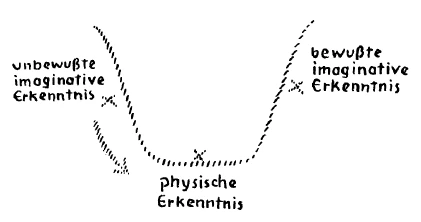
[ 1 ] Ich habe gestern über eine Art aufsteigender Bewegung, die in der Menschennatur begründet ist, gesprochen. Und im Grunde haben wir durch die Betrachtung dieser aufsteigenden Bewegung alles dasjenige wiedergefunden, was wir schon kennen, nämlich auf der untersten Stufe die Erkenntnis, die nur für die Tatsachen des physischen Planes anwendbar ist, die physische Erkenntnis, die in «Wie erlangt man Erkenntnisse der höheren Welten?» die gegenständliche Erkenntnis genannt ist. Also Physische Erkenntnis will ich sie heute nennen. Wir haben dann die nächsthöhere Stufe der Erkenntnis kennengelernt, die sogenannte imaginative Erkenntnis; aber wir haben sie betrachtet als urbewußte imaginative Erkenntnis; bewußte imaginative Erkenntnis kann ja nur vorhanden sein bei dem Menschen, der versucht, sich zu ihr durchzuringen auf die in dem Buche «Wie erlangt man Erkenntnisse der höheren Welten?» angegebene Weise. [Die Worte «physische Erkenntnis», «unbewußte imaginative Erkenntnis», «bewußte imaginative Erkenntnis» wurden an die Tafel geschrieben, siehe Schema.]
[ 1 ] Yesterday I spoke about a kind of upward movement that is rooted in human nature. And essentially, by examining this upward movement, we have rediscovered everything we already know—namely, at the lowest level, the knowledge that applies only to the facts of the physical plane, the physical knowledge referred to as “objective knowledge” in *How Does One Attain Knowledge of the Higher Worlds?*. So today I will call it physical knowledge. We then became acquainted with the next higher level of knowledge, the so-called imaginative knowledge; but we considered it as primal-conscious imaginative knowledge; conscious imaginative knowledge can, after all, only exist in a person who attempts to work their way up to it in the manner described in the book *How to Attain Knowledge of the Higher Worlds*. [The terms “physical knowledge,” “unconscious imaginative knowledge,” and “conscious imaginative knowledge” were written on the board; see diagram.]
[ 2 ] Aber als Tatsache ist der Inhalt der imaginativen Erkenntnis, das heißt, sind Imaginationen in jedem Menschen. So daß eigentlich die Entwickelung der Menschenseele in dieser Beziehung nichts anderes ist als ein Ausdehnen des Bewußtseins auf ein Gebiet, das immer in der Menschenseele drinnen ist. Man kann also sagen: Mit dieser imaginativen Erkenntnis verhält es sich nicht anders, als es sich etwa verhalten würde mit Gegenständen, welche in einem zunächst finsteren Zimmer sind. Denn in den Tiefen der Menschenseele sind alle Imaginationen, die für den Menschen zunächst in Betracht kommen, genauso vorhanden, wie die Gegenstände eines finsteren Zimmers. Und wie diese um keinen einzigen vermehrt werden, wenn man Licht in das Zimmer hineinbringt, sondern wie alle bleiben, wie sie sind, nur daß sie beleuchtet sind, ebenso sind, nachdem das Bewußtsein für die imaginative Erkenntnis erwacht ist, in der Seele keine anderen Inhalte da, als schon vorher da waren; sie werden nur von dem Licht des Bewußtseins erleuchtet. Also wir erfahren gewissermaßen durch das Sich-Hinaufringen zur imaginativen Erkenntnisstufe nichts anderes, als was längst vorher in unserer Seele als eine Summe von Imaginationen vorhanden ist.
[ 2 ] But the content of imaginative insight—that is, imaginations—is a fact present in every human being. Thus, in this respect, the development of the human soul is really nothing other than an expansion of consciousness into a realm that is always already present within the human soul. One can therefore say: The situation with this imaginative insight is no different from that of objects that are initially in a dark room. For in the depths of the human soul, all the imaginations that initially come to mind are just as present as the objects in a dark room. And just as no new objects are added when light is brought into the room—but rather all remain as they are, only now illuminated—so too, once consciousness has awakened to imaginative insight, there are no other contents in the soul than those that were already there; they are merely illuminated by the light of consciousness. Thus, in a sense, by striving upward toward the level of imaginative cognition, we experience nothing other than what has long been present in our soul as a sum of imaginations.
[ 3 ] Blicken wir noch einmal zurück auf dasjenige, was uns gestern hat klar werden können, so wissen wir ja: Wenn unsere Vorstellungen, die wir an den Gegenständen ringsherum durch unsere physischen Wahrnehmungen gewinnen, hinuntertauchen in das Gebiet der Erinnerungsmöglichkeiten, also ins Unbewußte hinunterversenkt werden, so daß wir in die Lage kommen, einige Zeit nichts von ihnen zu wissen, aber sie doch nicht verloren haben, sondern sie wieder heraufbringen können aus der Seele, dann müssen wir sagen, daß wir in das Unbewußte hinunterversenken dasjenige, was wir im gewöhnlichen physischen Bewußtsein haben. Es wird also die Welt der Vorstellungen, die wir durch die physische Erkenntnis an der Außenwelt gewinnen, ja immerfort von unserem Geistigen, von dem Übersinnlichen aufgenommen; sie schlüpft fortwährend in das Übersinnliche hinein. In jedem Moment ist es so, daß wir an der Außenwelt durch die physischen Wahrnehmungen Vorstellungen gewinnen, und diese Vorstellungen unserer übersinnlichen Natur übergeben werden. Es wird Ihnen nicht schwierig sein, dieses zu überdenken nach alle dem, was im Laufe der Jahre gesprochen worden ist, weil das ja gerade der alleroberflächlichste übersinnliche Prozeß ist, der nur denkbar ist, ein Prozeß, der sich fortwährend abspielt: der Übergang der gewöhnlichen Vorstellungen in Vorstellungen, an die wir uns erinnern können. So liegt es nahe, zu denken, was auch wahr ist gemäß der Geistesforschung, daß alles dasjenige, was sich abspielt, indem wir die äußere Welt wahrnehmen, ein Vorgang des physischen Planes ist. Auch dann, wenn wit an der physischen Außenwelt uns Vorstellungen bilden, ist das noch ein Vorgang des physischen Planes. In dem Augenblicke aber, wo wir die Vorstellungen hinuntersinken lassen ins Unbewußte, da stehen wir bereits beim Eingange in die übersinnliche Welt.
[ 3 ] If we look back once more at what became clear to us yesterday, we know that when the mental images we form about the objects around us through our physical perceptions sink down into the realm of possible memories—that is, are submerged into the unconscious—so that we find ourselves in a position where be unaware of them for some time—yet we have not lost them, but can bring them back up from the soul—then we must say that what we have in ordinary physical consciousness is what we submerge into the unconscious. Thus, the world of mental images that we gain through physical perception of the external world is constantly being absorbed by our spiritual nature, by the supersensible; it continually slips into the supersensible. At every moment, we gain mental images about the external world through physical perceptions, and these mental images are handed over to our supersensible nature. It will not be difficult for you to reflect on this after all that has been said over the years, because this is, in fact, the most superficial supersensible process conceivable—a process that takes place continuously: the transition of ordinary mental images into mental images that we can remember. It therefore stands to reason—and this is indeed true according to spiritual research—that everything that takes place as we perceive the external world is a process of the physical plane. Even when we form mental images of the external physical world, this is still a process of the physical plane. But the moment we allow these mental images to sink into the unconscious, we are already standing at the threshold of the supersensible world.
[ 4 ] Das ist sogar ein sehr wichtiger Punkt, der berücksichtigt werden muß von dem, welcher nicht durch allerlei okkultistisches Geschwätz, sondern durch ernstliche menschliche Seelenanstrengung ein Verständnis der okkulten Welt erlangen will. Denn es liegt schon eine ganz wesentliche Tatsache verborgen in dem Ausspruch, den ich eben angewendet habe: Wenn wir als Menschen den Dingen der Außenwelt gegenüberstehen und uns Vorstellungen bilden, so ist das ein Vorgang des physischen Planes. In dem Augenblick, wo die Vorstellung hinuntersinkt ins Unbewußte und dort aufbewahrt wird, bis sie wieder einmal heraufgeholt wird durch eine Erinnerung, vollzieht sich ein übersinnlicher Vorgang, ein richtiger übersinnlicher Vorgang. So daß Sie sich sagen können: Ist man imstande, diesen Vorgang zu verfolgen, der darinnen besteht, daß ein Gedanke, der oben im Bewußtsein ist, hinuntersinkt ins Unterbewußte und da unten als ein Bild vorhanden ist, kann man, mit anderen Worten, eine Vorstellung verfolgen, wie sie unten im Unbewußten ist, dann beginnt man eigentlich schon in das Gebiet des Übersinnlichen hineinzugleiten. Denn denken Sie doch nur einmal: Wenn Sie den gewöhnlichen Prozeß der Erinnerung vollziehen, so muß ja erst die Vorstellung in das Bewußtsein heraufkommen, und Sie gewahren sie dann heroben im Bewußtsein, niemals unten im Unbewußten. Sie müssen das gewöhnliche Erinnern unterscheiden von dem Verfolgen der Vorstellungen bis hinunter ins Unbewußte. Das, was im Erinnern stattfindet, können Sie vergleichen mit einem Schwimmer, der unter das Wasser sinkt und den Sie so lange sehen, bis er ganz untergetaucht ist. Jetzt ist er unten, und Sie sehen ihn nicht mehr. Wenn er wieder heraufkommit, sehen Sie ihn wieder! [Es wurde gezeichnet.] Ebenso ist es mit den menschlichen Vorstellungen: Sie haben sie, solange sie auf dem physischen Plan sind; gehen sie hinunter, so haben Sie sie vergessen; erinnern Sie sich wieder, dann kommen sie wieder wie der Schwimmer herauf. Aber dieser Prozeß, den ich jetzt meine, der also schon in die imaginative Erkenntnis hineinweist, der würde damit zu vergleichen sein, daß Sie selber untertauchen und dadurch den Schwimmer auch unten im Wasser sehen können, so daß er Ihnen nicht entschwindet, wenn er untertaucht.
[ 4 ] This is, in fact, a very important point that must be taken into account by anyone who wishes to gain an understanding of the occult world not through all sorts of occultist drivel, but through serious human spiritual effort. For there is already a very essential truth hidden in the statement I just quoted: When we, as human beings, encounter the things of the external world and form mental images about them, this is a process of the physical plane. At the moment when the mental image sinks down into the unconscious and is stored there until it is brought back up again through a memory, a supersensible process takes place—a true supersensible process. So you can say to yourself: If one is able to follow this process—which consists of a thought that is up in consciousness sinking down into the subconscious and existing there as an image—in other words, if one can trace a mental image as it exists down in the unconscious, then one is actually already beginning to glide into the realm of the supersensible. Just think about it: When you go through the ordinary process of remembering, the mental image must first rise up into consciousness, and you perceive it up here in consciousness, never down there in the unconscious. You must distinguish ordinary remembering from tracing mental images all the way down into the unconscious. What takes place in recollection can be compared to a swimmer who sinks beneath the water and whom you can see until he is completely submerged. Now he is below the surface, and you can no longer see him. When he comes back up, you see him again! [A drawing was made.] It is the same with human mental images: you have them as long as they are on the physical plane; if they go down, you have forgotten them; when you remember them again, they come back up like the swimmer. But this process I am referring to now—which thus already points toward imaginative insight—could be compared to your diving down yourself and thereby being able to see the swimmer down in the water as well, so that he does not disappear from your sight when he submerges.
[ 5 ] Daraus aber folgt nichts Geringeres, als daß die Linie, die ich vorhin gezeichnet habe, gleichsam die Niveaufläche — unter welche hinuntersinkt die Vorstellung ins Unbewußte, in die Erinnerungsmöglichkeit —, die Schwelle der geistigen Welt selber ist, die erste Schwelle der geistigen Welt. Das folgt daraus mit absoluter Notwendigkeit. Es ist die erste Schwelle der geistigen Welt! Denken Sie nur einmal, wie nahe der Mensch dieser Schwelle der geistigen Welt steht. [Die Worte «Schwelle der geistigen Welt» wurden neben das Schema geschrieben.]
[ 5 ] But this implies nothing less than that the line I drew earlier—which represents, as it were, the level below which the mental image sinks into the unconscious, into the realm of memory—is the threshold of the spiritual world itself, the first threshold of the spiritual world. This follows from it with absolute necessity. It is the first threshold of the spiritual world! Just think for a moment how close human beings are to this threshold of the spiritual world. [The words “threshold of the spiritual world” were written next to the diagram.]
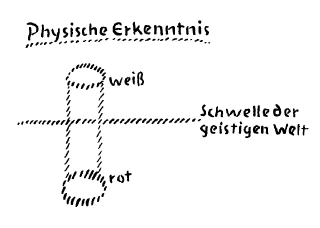
[ 6 ] Und nun nehmen Sie einmal einen Vorgang, durch den man versuchen kann, richtig da hinunterzukommen, unterzutauchen. Der Vorgang würde der sein, daß Sie sich bemühen, Vorstellungen zu verfolgen bis hinunter ins Unbewußte. Das kann eigentlich nur durch Probieren geschehen. Es kann dadurch geschehen, daß man etwa folgendes macht. Man hat sich eine Vorstellung an der Außenwelt gebildet; man versucht unabhängig von der Außenwelt künstlich den Prozeß der Erinnerung hervorzurufen. Denken Sie, wie das empfohlen wird in «Wie erlangt man Erkenntnisse der höheren Welten?», indem die ganz gewöhnliche Regel des Rückschauens auf die Tagesereignisse angegeben wird. Wenn man rückschaut auf die Tageserlebnisse, dann übt man sich darin, gleichsam in die Wege hineinzukommen, welche die Vorstellung selber macht, indem sie untergetaucht ist und wiederum aufsteigt. Also der ganze Prozeß der Rückerinnerung ist darauf angelegt, nachzugehen den Vorstellungen, die unter die Schwelle des Bewußtseins hinuntergesunken sind.
[ 6 ] And now let’s consider a process through which one can try to truly descend into the unconscious, to dive beneath the surface. The process would involve striving to follow mental images all the way down into the unconscious. This can really only be achieved through trial and error. It can be done, for example, by doing the following. You have formed a mental image of the external world; you try to artificially evoke the process of recollection independently of the external world. Consider how this is recommended in *How to Attain Knowledge of the Higher Worlds*, where the very ordinary rule of looking back on the events of the day is described. When one looks back on the day’s experiences, one practices, as it were, entering the paths that the mental image itself creates as it sinks below the threshold of consciousness and then rises again. Thus, the entire process of recollection is designed to trace the mental images that have sunk below the threshold of consciousness.
[ 7 ] Aber außerdem wird dort in «Wie erlangt man Erkenntnisse der höheren Welten?» gesagt, daß man gut tut, die Vorstellungen, die man sich gebildet hat, umgekehrt, also von dem Ende nach dem Anfang zurückzuverfolgen; und wenn man den Tag überschauen will, den Strom der Ereignisse vom Abend zum Morgen hin rückwärts verlaufend zu verfolgen. Dadurch muß man eine andere Kraftanstrengung machen, als sie gemacht wird auf dem Wege der gewöhnlichen Erinnerungen. Und diese andere Kraftanstrengung bringt einen dahin, gewissermaßen unter der Schwelle des Bewußtseins das zu erfassen, was man als Erlebnisvorstellung gehabt hat. Und im Laufe des Probierens kommt man darauf, zu empfinden, innerlich zu erleben, wie man da den Vorstellungen nachläuft, ihnen unter diese Schwelle des Bewußtseins hinunter nachläuft. Es ist wirklich hier ein Vorgang des inneren erlebnismäßigen Probierens, der in Betracht kommt. Doch handelt es sich darum, daß man diese Rückschau wirklich ernsthaftig macht, nicht so macht, daß man nach einiger Zeit in bezug auf den Ernst der Sache erlahmt. Dann aber, wenn man diesen Prozeß des Rückschauens längere Zeit macht, oder überhaupt den Prozeß des Heraufholens eines Erlebnisses aus der Erinnerung, einer erlebten Vorstellungswelt macht, so daß man die Sache umgekehrt vorstellt, also eine größere Kraft anwendet, als man anwenden muß, wenn man sich in der gewöhnlichen Folge erinnert, dann erlebt man nun auch, daß man nicht mehr in der Lage ist, die Vorstellung von einem gewissen Punkte an so aufzufassen, wie man sie im gewöhnlichen Leben eben auf dem physischen Plan aufgefaßt hat.
[ 7 ] But furthermore, in “How Does One Gain Knowledge of the Higher Worlds?” it is stated that one would do well to trace the mental images one has formed in reverse, that is, from the end back to the beginning; and if one wishes to survey the day, to follow the stream of events running backward from evening to morning. This requires a different kind of mental effort than that exerted in the course of ordinary recollection. And this different mental effort leads one, so to speak, to grasp—beneath the threshold of consciousness—what one had as an experiential image. And in the course of this experimentation, one comes to feel, to experience inwardly, how one is following these mental images, chasing them down beneath this threshold of consciousness. What is really at work here is a process of inner, experiential experimentation. However, the point is to undertake this process of looking back with genuine seriousness, not in a way that causes one’s commitment to the matter to wane after some time. But then, when one engages in this process of looking back for an extended period—or, more generally, in the process of bringing an experience to mind from memory, a world of mental images—so that one imagines the matter in reverse, that is, by applying more effort than is necessary when recalling events in their usual sequence, one then experiences that, from a certain point onward, one is no longer able to perceive the mental image in the same way as one did in ordinary life on the physical plane.
[ 8 ] Auf dem physischen Plan lebt sich ja die Erinnerung so aus — und es ist für die Erinnerung auf dem physischen Plan das Beste, wenn sie sich so auslebt —, daß, wenn man die Vorstellung, die man erinnern will oder erinnern soll, dem Lebenszusammenhang nach treu heraufbekommt, man sie so heraufbekommt, wie man sie eben auf dem physischen Plan sich gebildet hat. Wenn man aber allmählich durch das angedeutete Probieren sich daran gewöhnt, den Vorstellungen gleichsam nachzulaufen unter die Schwelle des Bewußtseins, so entdeckt man sie da unten nicht so, wie sie im Leben sind. Das ist ja der Fehler, den die Menschen immer machen, wenn sie glauben, sie finden in der geistigen Welt einen Abklatsch dessen, was in der physischen Welt ist. Sie müssen voraussetzen, daß die Vorstellungen da unten anders aussehen werden. In Wirklichkeit sehen sie unter der Schwelle des Bewußtseins so aus, daß sie alles dasjenige, was sie gerade als Charakteristisches auf dem physischen Plane haben, abgestreift haben. Da unten werden sie ganz und gar zu Bildern; und sie werden ganz und gar so, daß wir in ihnen Leben spüren. Leben spüren wir in ihnen. Das ist sehr wesentlich, gerade diesen Satz ins Auge zu fassen: Leben spüren wir in ihnen. Sie können sich erst dann überzeugt haben, daß Sie einer Vorstellung da unter der Schwelle des Bewußtseins wirklich nachgelaufen sind, wenn Sie das Gefühl haben: die Vorstellung beginnt zu leben, sich zu regen. Ich habe ja, als ich das Hinaufsteigen zur imaginativen Erkenntnis mit dem Hineinstecken des Kopfes in einen Ameisenhaufen verglichen habe, von einem anderen Gesichtspunkte aus das erklärt. Ich habe gesagt: es beginnt sich alles zu regen, alles regsam zu werden.
[ 8 ] On the physical plane, memory manifests itself in such a way—and it is best for memory on the physical plane when it manifests itself in this way—that when one brings to mind the mental image one wishes to or is supposed to remember, faithfully in accordance with the context of life, one brings it to mind exactly as it was formed on the physical plane. But if, through the trial-and-error process I’ve hinted at, one gradually becomes accustomed to, so to speak, chasing after these mental images beneath the threshold of consciousness, one does not discover them down there as they are in life. That is precisely the mistake people always make when they believe they will find in the spiritual world a mere copy of what exists in the physical world. They must assume that the mental images down there will look different. In reality, below the threshold of consciousness, they appear in such a way that they have shed everything that was characteristic of them on the physical plane. Down there, they become images in their entirety; and they become such that we sense life within them. We sense life within them. It is very important to take this very sentence to heart: we sense life within them. You can only be convinced that you have truly followed a mental image down below the threshold of consciousness when you have the feeling that the mental image is beginning to live, to stir. When I compared the ascent to imaginative insight to sticking one’s head into an anthill, I explained this from a different perspective. I said: everything begins to stir, everything becomes active.
[ 9 ] Nehmen Sie also zum Beispiel an, Sie haben während des Tages ich will ein ganz gewöhnliches Erlebnis nehmen — an einem Tische gesessen und ein Buch in der Hand gehabt. Jetzt, zu irgendeiner Zeit am Abend, da stellen Sie sich lebhaft vor, wie das war: den Tisch, das Buch, Sie dabeisitzend, wie wenn Sie außerhalb Ihrer wären. Und es ist dabei immer gut, sich die ganze Sache von vornherein bildhaft, nicht in abstrakten Gedanken vorzustellen, weil die Abstraktion, das Abstraktionsvermögen gar keine Bedeutung hat für die imaginative Welt. Also Sie stellen sich dieses Bild vor: sich sitzend an einem Tisch, mit einem Buch in der Hand. — Mit Tisch und Buch will ich einfach sagen, stellen Sie sich so lebhaft als nur möglich, irgendeinen Ausschnitt aus dem täglichen Leben vor. Dann, wenn Sie wirklich den Seelenblick auf diesem Bild ruhen lassen, wenn Sie wirklich intensiv meditierend das vorstellen, dann werden Sie von einem gewissen Moment ab anders als sonst fühlen; ja, ich will vergleichsweise sagen, so ähnlich, wie wenn Sie ein lebendiges Wesen in die Hand nehmen würden.
[ 9 ] So suppose, for example, that during the day—I’ll take a completely ordinary experience—you were sitting at a table with a book in your hand. Now, at some point in the evening, you vividly create a mental image of what that was like: the table, the book, you sitting there, as if you were outside of yourself. And it’s always best to create a mental image of the whole thing from the outset in concrete terms, not as abstract thoughts, because abstraction—the ability to abstract—has no significance whatsoever for the world of the imagination. So you create a mental image of the scene: yourself sitting at a table, with a book in your hand. — By “table and book,” I simply mean: imagine as vividly as possible any scene from daily life. Then, when you truly let your soul’s gaze rest on this image, when you truly create a mental image of it while meditating intensely, from a certain point on you will feel differently than usual; indeed, I would say, by way of comparison, it’s similar to holding a living being in your hand.
[ 10 ] Wenn Sie einen toten Gegenstand in die Hand nehmen, dann haben Sie das Gefühl: der Gegenstand ist ruhig, der kribbelt und krabbelt nicht in Ihrer Hand. Selbst wenn Sie einen bewegten toten Gegenstand in der Hand haben, so beruhigen Sie sich durch das Gefühl, daß das Leben eben ein solches ist, das nicht von dem Gegenstand ausgeht, sondern ihm mechanisch zugeteilt ist. Etwas anderes ist es, wenn Sie einen lebendigen Gegenstand, sagen wir eine Maus, zufällig in der Hand haben. Nehmen wir zum Beispiel an, Sie haben in einen Schrank hineingegriffen und glauben, irgendeinen Gegenstand in die Hand zu nehmen und entdecken, Sie haben eine Maus in die Hand bekommen. Und dann, nicht wahr, dann fühlen Sie das Krabbeln und Kribbeln der Maus in Ihrer Hand! Es gibt Leute, die fangen ein ganz riesiges Geschrei an, wenn sie plötzlich eine Maus in ihrer Hand fühlen. Und das Geschrei ist nicht kleiner, wenn sie noch nicht sehen, was da krabbelt und kribbelt in der Hand. Es ist also ein Unterschied, ob man einen toten oder einen lebendigen Gegenstand in der Hand hat. Man muß sich erst an den lebendigen Gegenstand gewöhnen, um ihn in gewisser Weise zu ertragen. Nicht wahr, die Menschen sind gewöhnt, Hunde und Katzen zu berühren; aber sie müssen sich erst daran gewöhnen. Wenn man aber in der Nacht, in finsterer Nacht, jemandem ein lebendiges Wesen in die Hand gibt, ohne daß er es weiß, so findet er sich auch schockiert.
[ 10 ] When you pick up an inanimate object, you get the feeling that the object is still—it doesn’t tingle or wriggle in your hand. Even if you’re holding a moving inanimate object, you’re reassured by the feeling that life is simply something that doesn’t emanate from the object itself, but is mechanically assigned to it. It’s a different matter entirely if you happen to be holding a living object—say, a mouse—in your hand. Let’s say, for example, you’ve reached into a closet, thinking you’re picking up some object, only to discover you’ve ended up holding a mouse. And then—don’t you agree?—you feel the mouse wriggling and tingling in your hand! There are people who start screaming at the top of their lungs when they suddenly feel a mouse in their hand. And the screaming doesn’t subside even before they see what’s scurrying and tingling in their hand. So there is a difference between holding a dead object and a living one. You have to get used to the living object first in order to tolerate it, in a way. After all, people are used to touching dogs and cats; but they have to get used to it first. But if, in the middle of the night—in the dark of night—you place a living creature in someone’s hand without them knowing it, they’ll be shocked, too.
[ 11 ] Diesen Unterschied, den Sie fühlen zwischen dem Berühren eines toten und eines lebendigen Gegenstandes, den müssen Sie sich klarmachen. Wenn Sie einen toten Gegenstand anfassen, haben Sie ein anderes Gefühl, als wenn Sie einen lebendigen anfassen. Wenn Sie nun eine Vorstellung haben auf dem physischen Plan, so haben Sie ein Gefühl, das Sie vergleichen können mit dem Anfassen eines toten Gegenstandes. Aber sobald Sie wirklich hinunterkommen unter die Schwelle des Bewußtseins, ändert sich das; so daß Sie das Gefühl bekommen: Der Gedanke hat innerlich Leben, beginnt sich zu regen. Es ist die gleiche Entdeckung, die Sie haben — als Vergleich für das seelische Gefühl —, wie wenn Sie meinetwillen eine Maus erfaßt haben: es kribbelt und krabbelt der Gedanke.
[ 11 ] You must understand this difference that you feel between touching an inanimate object and a living one. When you touch an inanimate object, you have a different sensation than when you touch a living one. Now, if you have a mental image on the physical plane, you have a sensation that you can compare to touching an inanimate object. But as soon as you truly descend below the threshold of consciousness, that changes; so that you get the feeling: The thought has inner life, begins to stir. It is the same discovery you have—as a comparison for the spiritual feeling—as when you’ve caught a mouse, for my sake: the thought tingles and scurries.
[ 12 ] Es ist sehr wichtig, daß wir auf dieses Gefühl achtgeben, wenn wit einen Begriff von der imaginativen Erkenntnis bekommen sollen; denn wir sind in der imaginativen Welt in dem Augenblicke, wo die Gedanken, die wir heraufholen aus dem Unterbewußten, anfangen zu kribbeln und zu krabbeln, anfangen so sich zu benehmen, daß wir das Gefühl haben: da unten, unter der Schwelle, da quirlt und wurlt ja eigentlich alles. Und während es da oben im Oberstübchen ganz ruhig ist und die Gedanken sich so hübsch beherrschen lassen, so wie Maschinen sich behertschen lassen, läuft da unten ein Gedanke dem anderen nach, da kribbeln und krabbeln, da quirlen und wurlen die Gedanken, da unten werden sie plötzlich eine ganz regsame Welt. Es ist wichtig, daß man sich dieses Gefühl aneignet, denn in diesem Augenblick, wenn man das Leben der Gedankenwelt zu fühlen anfängt, ist man in der imaginativen oder elementarischen Welt drinnen. Da ist man drinnen! Und man kann so leicht hineinkommen, wenn man nur die aller-, allereinfachsten Regeln befolgt, welche in «Wie erlangt man Erkenntnisse der höheren Welten?» gegeben sind; wenn man nur nicht versucht, auf dem Wege von allerlei in den letzten Tagen ja angedeuteten «Praktiken» hineinzukommen. Man kann wirklich so leicht hineinkommen. Denken Sie sich doch nur, daß als etwas vom allerersten in dem Buch «Wie erlangt man Erkenntnisse der höheren Welten?» klar angegeben ist, man solle zum Beispiel versuchen, das Leben einer Pflanze zu verfolgen: wie sie nach und nach wächst, wie sie nach und nach wiederum vergeht. Ja, wenn Sie das wirklich verfolgen, so müssen Sie ja in Gedanken dieses Leben der Pflanze durchmachen. Da haben Sie zuerst den Gedanken des ganz kleinen Samenkorns und wenn Sie den Gedanken nicht beweglich machen, so kommen Sie ja der Pflanze nicht nach in ihrem Wachsen. Sie müssen den Gedanken beweglich machen. Und dann wiederum, wenn Sie die Pflanze sich entblättern, allmählich absterbend, abwelkend denken, dann müssen Sie sich wiederum das Zusammenschrumpfen, das Zusammenrunzeln denken. Sobald Sie anfangen, das Lebendige zu denken, müssen Sie den Gedanken selber beweglich machen. Der Gedanke muß durch Ihre eigene Kraft anfangen, innere Beweglichkeit zu bekommen.
[ 12 ] It is very important that we pay attention to this feeling if we are to gain an understanding of imaginative insight; for we are in the imaginative world at the very moment when the thoughts we draw up from the subconscious begin to tingle and wriggle, begin to behave in such a way that we have the feeling: down there, beneath the threshold, everything is actually swirling and churning. And while it is completely quiet up there in the attic and the thoughts can be controlled so nicely, just as machines can be controlled, down there one thought follows another; there they tingle and scuttle, there they swirl and churn—down there they suddenly become a very lively world. It is important to cultivate this feeling, for at that very moment, when one begins to sense the life of the world of thoughts, one is already within the imaginative or elemental world. One is already there! And it is so easy to enter it, if one only follows the very, very simplest rules set forth in *How to Attain Knowledge of the Higher Worlds* ; provided one does not attempt to enter through the various “practices” that have been alluded to in recent days. It really is that easy to enter. Just consider that one of the very first things clearly stated in the book *How to Attain Knowledge of the Higher Worlds?* clearly states that one should, for example, try to follow the life of a plant: how it gradually grows, how it gradually withers away. Yes, if you truly follow this, you must, in your thoughts, go through the entire life of the plant. First, you have the thought of the very small seed, and if you do not make that thought flexible, you will not be able to keep up with the plant as it grows. You must make the thought flexible. And then again, when you imagine the plant shedding its leaves, gradually dying off and withering, you must in turn imagine its shrinking and wrinkling. As soon as you begin to think about the living, you must make the thought itself flexible. The thought must begin to gain inner flexibility through your own power.
[ 13 ] Es gibt zwei schöne Gedichte von Goethe. Das eine heißt «Die Metamorphose der Pflanzen», das andere «Die Metamorphose der Tiere». Diese zwei Gedichte kann man lesen, man kann sie schön finden, aber man kann auch folgendes machen. Man kann versuchen, den Gedanken in diesen Gedichten wirklich so zu denken, wie ihn Goethe gedacht hat, von der ersten Zeile bis zur letzten und dann wird man finden: wenn man das durchmacht, kann sich der Gedanke innerlich bewegen vom Anfang bis zum Ende. Und wer den Gedanken dieser Gedichte nicht so verfolgt, hat die Metamorphose nicht verstanden. Wer aber den Gedanken so verfolgt und ihn dann hinuntersinken läßt ins Unbewußte, und sich wiederum, nachdem er das öfters gemacht hat, erinnert gerade an diesen Gedanken der Metamorphose — denn es ist dies kein anderes Denken, als wie Sie es in «Wie erlangt man Erkenntnisse der höheren Welten?» verfolgen sollen —, wer also das ausführt, wer diesen Gedanken hinuntersenkt und dann sich bemüht, dies fünfzig-, sechzig-, hundertmal zu machen, und hundertundeinmal wird es vielleicht brauchen, der wird ihn einmal heraufkriegen. Dann aber wird dieser Gedanke, den er so praktiziert hat, ein beweglicher sein. Man wird erleben, daß er nicht so heraufkommt, wie etwa eine kleine Maschine, sondern verzeihen Sie nochmals das Beispiel — wie eine kleine Maus; man wird erleben, wie er selber ein innerlich bewegliches, lebendiges Element ist.
[ 13 ] There are two beautiful poems by Goethe. One is called “The Metamorphosis of Plants,” the other “The Metamorphosis of Animals.” You can read these two poems; you can find them beautiful, but you can also do the following. You can try to truly think the idea in these poems exactly as Goethe intended it, from the first line to the last, and then you will find: if you go through this process, the idea can move within you from beginning to end. And anyone who does not follow the idea of these poems in this way has not understood the metamorphosis. But whoever follows the thought in this way and then allows it to sink down into the unconscious, and who, after having done this repeatedly, recalls precisely this thought of metamorphosis—for this is no different from the way of thinking described in *How to Attain Knowledge of the Higher Worlds?* — whoever does this, whoever lets this thought sink down and then strives to do this fifty, sixty, a hundred times—and it may take a hundred and one times—will eventually bring it up. But then this thought, which he has practiced in this way, will be a living, moving one. You will experience that it does not come up like, say, a small machine, but—forgive me again for the example—like a little mouse; you will experience how it is itself an inwardly mobile, living element.
[ 14 ] Ich sagte, man kann so leicht hinuntertauchen in diese elementatische Welt, wenn man sich nur ein wenig losreißt von dem Hang aller Menschen nach abstrakten Gedanken. Dieser Hang, begrenzte, abstrakte Gedanken zu haben statt innerlich bewegliche Gedanken, der ist ja so furchtbar groß. Nicht wahr, die Menschen gehen so darauf aus, bei allem zu sagen, was das oder jenes ist und was damit gemeint ist, und sind so zufrieden, wenn sie sagen können, das oder jenes ist damit gemeint, weil ihnen das einen Gedanken gibt, der wie eine Maschine sich nicht regt. Und die Menschen werden im gewöhnlichen Leben so furchtbar ungeduldig, wenn man mit allen Mitteln versucht, ihnen bewegliche und nicht solche abstrakte Schachtelgedanken zu übermitteln. Denn alles äußere Leben des physischen Planes und alles Leben der äußeren Wissenschaft besteht aus solchen toten Schachtelgedanken, aus eingeschachtelten Gedanken. Wie oft habe ich es erleben müssen, daß Menschen mich bei dem oder jenem fragten: Ja, wie ist es denn? Was ist das? — Sie wollten einen abgeschlossenen, abgerundeten Gedanken, den sie sich aufschreiben können, um ihn dann wieder ablesen, ihn wiederholen zu können, so oft sie wollen, während das Bestreben sein muß, einen innerlich beweglichen Gedanken zu haben, einen Gedanken, der fortlebt, richtig fortlebt.
[ 14 ] I said that it is so easy to dive down into this elemental world if one just breaks away a little from the tendency all people have toward abstract thoughts. This tendency to have limited, abstract thoughts instead of thoughts that are inwardly dynamic—it is, after all, so terribly strong. Isn’t it true that people are so eager to define everything—what this or that is and what is meant by it—and are so satisfied when they can say, “This or that is what is meant,” because that gives them a thought that, like a machine, remains unmoving? And in everyday life, people become so terribly impatient when one tries by every means to convey to them living, dynamic thoughts rather than such abstract, boxed-in thoughts. For all external life on the physical plane and all life in external science consists of such dead, boxed-in thoughts—of thoughts that are boxed in. How often have I had to experience people asking me about this or that: “Well, how is it, then? What is that?”—They wanted a self-contained, rounded-off thought that they could write down so they could read it again and repeat it as often as they wanted, whereas the aim must be to have an inwardly dynamic thought, a thought that lives on—truly lives on.
[ 15 ] Aber sehen Sie, die Sache mit der Maus hat doch auch ihre ganz ernste Seite. Denn warum schreien manche Menschen, wenn sie entdecken, sie haben in einen Schrank hineingegriffen und eine Maus in der Hand? Weil sie sich fürchten! Und dieses Gefühl tritt wirklich auch auf in dem Moment, wo man merkt, richtig merkt: der Gedanke lebt! Da fängt man auch an, sich zu fürchten! Und darin besteht eben die gute Vorbereitung für die Sache, daß man sich die Furcht vor dem lebendigen Gedanken abgewöhnt. Die Materialisten wollen zu solch lebendigen Gedanken nicht kommen, ich habe das oft betont. Warum? Weil sie Furcht haben. Ja, der Meister des Materialismus, Ahriman, erscheint einmal im Mysteriendrama mit dem Ausdruck «Furcht». Da haben Sie die Stelle in den Mysterien, wo das angedeutet ist, wie man empfindet, wenn die Gedanken beginnen, beweglich zu werden. Nun aber sind ja alle Angaben in «Wie erlangt man Erkenntnisse der höheren Welten?», wenn sie befolgt werden, eben dahin bringend, daß man sich diese Furcht vor dem beweglichen, vor dem lebendigen Gedanken abgewöhnt, richtig abgewöhnt.
[ 15 ] But you see, there’s also a very serious side to this whole mouse business. After all, why do some people scream when they realize they’ve reached into a closet and have a mouse in their hand? Because they’re afraid! And this feeling really does arise at the very moment when you realize—truly realize—that thought is alive! That’s when you start to be afraid, too! And that is precisely what good preparation for this matter consists of: weaning oneself off the fear of the living thought. Materialists do not want to come to such living thoughts; I have often emphasized this. Why? Because they are afraid. Yes, the master of materialism, Ahriman, appears once in the Mystery Drama with the term “fear.” There you have the passage in the Mysteries where it is hinted at how one feels when thoughts begin to become active. But now, all the instructions in *How Does One Attain Knowledge of the Higher Worlds?*, if followed, lead precisely to the point where one overcomes this fear of the active, of the living thought—truly overcomes it.
[ 16 ] Sie sehen also, man kommt in eine ganz andere Welt hinein, in eine Welt, an deren Schwelle man das abstrakte Denken, das den ganzen physischen Plan beherrscht, richtig ablegen muß. Das Bestreben der Menschen, die mit einer gewissen Bequemlichkeit in die okkulte Welt hineinkommen wollen, besteht immer darin, daß sie das gewöhnliche Denken des physischen Planes da hinein mitnehmen wollen. Das kann man nicht. Man kann nicht in die okkulte Welt das gewöhnliche physische Denken hineinnehmen. Man muß das bewegliche Denken hineinnehmen. Das ganze Denken muß regsam, beweglich werden. Wenn man dies nicht spürt in sich — und wie gesagt, man macht es nur nicht richtig, wenn man es nicht verhältnismäßig bald spürt —, wenn man das nicht beachtet, was ich jetzt gesagt habe, dann kommt man sehr leicht dazu, eben nicht die Eigentümlichkeit der geistigen Welt zu erfassen. Und man sollte sie erfassen, wenn man sich überhaupt mit der geistigen Welt beschäftigen will.
[ 16 ] So you see, one enters a completely different world—a world at whose threshold one must truly set aside the abstract thinking that dominates the entire physical plane. The tendency of people who wish to enter the occult world with a certain degree of ease is always to try to carry their ordinary thinking from the physical plane into it. That is not possible. One cannot bring ordinary physical thinking into the occult world. One must bring flexible thinking into it. One’s entire thinking must become active and flexible. If one does not sense this within oneself—and as I said, one is simply not doing it correctly if one does not sense it relatively soon—if one does not heed what I have just said, then one very easily fails to grasp the distinctive nature of the spiritual world. And one should grasp it if one wishes to engage with the spiritual world at all.
[ 17 ] Sehen Sie, es ist so schwierig, auf diesem Gebiet zu kämpfen mit der menschlichen Abstraktheit; denn wenn Sie dies Bewegliche des Gedankens erfaßt haben, dann werden Sie auch begreifen, daß ein beweglicher Gedanke nicht in beliebiger Weise da und dort auftreten kann. Sie können zum Beispiel ein Landtier nicht im Wasser finden; Sie können dem Vogel, der für die Luft geeignet ist, nicht angewöhnen, tief unten im Wasser zu leben. Sie können, wenn Sie auf das Lebendige gehen, nicht anders, als zu der Vorstellung sich bequemen, daß man es aus seinem Element nicht herausnehmen darf. Das muß man beachten.
[ 17 ] You see, it is so difficult to grapple with human abstractness in this area; for once you have grasped this fluid nature of thought, you will also understand that a fluid thought cannot simply appear here and there at will. For example, you cannot find a land animal in the water; you cannot accustom a bird, which is adapted to the air, to living deep underwater. When you approach living things, you have no choice but to accept the mental image that they must not be taken out of their element. This must be kept in mind.
[ 18 ] Ich habe einmal in einer ganz strikten Weise, zunächst auf einem kleinen Gebiet — ich versuche es immer so zu machen, aber ich will es jetzt nur als Beispiel anführen — mit einem sehr wichtigen Gedanken versucht, gerade an einem Beispiel anschaulich zu zeigen, wie die Dinge sein müssen, wenn man mit diesem innerlichen Leben des Gedankens rechnet. Ich habe in Kopenhagen einen kleinen Vortragszyklus gehalten über «Die geistige Führung des Menschen und der Menschheit», der auch gedruckt vorliegt. An einer bestimmten Stelle dieses Vortragszyklus habe ich aufmerksam gemacht auf das Geheimnis von den zwei Jesusknaben. Nun nehmen Sie es einmal, wie die Sache dort dargestellt ist. Wir haben einen Vortragszyklus, der in einer gewissen Weise beginnt. Es wird da aufmerksam gemacht, wie der Mensch sich schon gewisse Erkenntnisse aneignen kann, wenn er hinzublicken versucht auf die ersten Entwickelungsjahre des Kindes, zurückzublicken versucht auf diese Dinge. Das Ganze ist gestaltet. Dann geht es weiter. Es wird der Anteil der Hierarchien an dem Menschheitsfortschritt dargestellt — das Buch ist ja gedruckt, es ist wahrscheinlich in aller Hände, ich spreche also von etwas ganz Bekanntem —, dann wird in einem gewissen Zusammenhange, an einer ganz bestimmten Stelle, von den zwei Jesusknaben gesprochen. Das gehört zu der Besprechung der zwei Jesusknaben, daß es an der bestimmten Stelle geschieht. Und wer sagt: Ja, warum soll man denn nicht das herausnehmen können, diese Besprechung der zwei Jesusknaben, und sie auch so herausgerissen exoterisch vortragen? — der tut dieselbe Frage, wie einer, der frägt: Warum muß denn die Hand just hier am Arm sitzen, an diesem Teil des Körpers? Er könnte ja sogar sagen: Warum sitzt die Hand nicht am Knie? Da könnte sie ja vielleicht auch sein. — Der versteht den ganzen Organismus nicht als Lebewesen, der glaubt, die Hand könnte auch woanders sitzen, nicht wahr? Die Hand kann nirgends anders als am Arm sitzen! So kann in diesem Zusammenhang der Gedanke von den zwei Jesusknaben nicht an einer anderen Stelle sein, weil versucht ist, die Sache so auszubilden, daß der lebendige Gedanke in der Darstellung drinnen liegt.
[ 18 ] I once attempted, in a very rigorous manner—initially in a narrow field; I always try to do it this way, but I’ll just cite it as an example here—to use a very important idea to illustrate, precisely through an example, how things must be when one takes this inner life of thought into account. I gave a short lecture series in Copenhagen on “The Spiritual Guidance of the Individual and of Humanity,” which is also available in print. At a certain point in this lecture series, I drew attention to the mystery of the two Jesus children. Now, take a look at how the matter is presented there. We have a lecture series that begins in a certain way. Attention is drawn to how a person can already gain certain insights by looking at the first years of a child’s development and reflecting on these things. The whole thing is structured. Then it continues. The role of the hierarchies in human progress is described—the book has been published, of course; it’s probably in everyone’s hands, so I’m speaking of something quite familiar—and then, in a certain context, at a very specific point, the two Jesus children are discussed. It is part of the discussion of the two Jesus children that this occurs at that specific point. And anyone who says: “Well, why shouldn’t one be able to take that out—this discussion of the two Jesus-children—and present it exoterically in isolation?”—is asking the same question as someone who asks: “Why does the hand have to be attached right here to the arm, to this part of the body?” They might even say: “Why isn’t the hand attached to the knee?” It could perhaps be there, too. — Anyone who believes the hand could be located elsewhere does not understand the entire organism as a living being, does he? The hand cannot be located anywhere other than on the arm! Similarly, in this context, the idea of the two Jesus-children cannot be placed elsewhere, because the aim is to structure the matter in such a way that the living idea is contained within the depiction.
[ 19 ] Nun kommt einer und schreibt eine Schrift und nimmt diesen Gedanken grobklotzig heraus und setzt ihn mit anderen Gedanken in Zusammenhang, mit denen er gar nichts zu tun hat! Das heißt aber nichts anderes als: er setzt die Hand ans Knie! Was tut einer, der die Hand ans Knie setzt? Ja, an einem Organismus wird man es nicht machen können, aber man könnte es ja zeichnen. Das Papier ist geduldig, es könnte einer einfach eine menschliche Figur aufzeichnen, hier abgestutzt, und die beiden Knie so, daß Hände daraus herauswachsen. [Diese Zeichnung ist nicht überliefert.] Nicht wahr, das könnte einer zeichnen, dann hätte er aber einen unmöglichen Organismus gezeichnet; er hätte bewiesen, daß er vom wirklichen Leben nichts versteht! Man könnte ja auch den Vergleich gebrauchen: er hat den Adler, den Vogel, der für die Luft bestimmt ist, in die Tiefe des Meeres hinunterversetzt oder dergleichen.
[ 19 ] Now someone comes along and writes a treatise, taking this idea out of context in a crude and clumsy way and linking it to other ideas with which it has absolutely nothing to do! But that means nothing other than: he’s putting his hand on his knee! What does someone do when he puts his hand on his knee? Well, you can’t actually do that to a living organism, but you could draw it. Paper is patient; someone could simply sketch a human figure, truncated here, with the two knees arranged so that hands grow out of them. [This drawing has not been preserved.] Isn’t that right? One could draw that, but then one would have drawn an impossible organism; one would have proven that one understands nothing about real life! One could also use the following comparison: one has placed the eagle—the bird meant for the air—down into the depths of the sea, or something similar.
[ 20 ] Was hat ein solcher denn versucht? Ja, sehen Sie, dasjenige, was er versucht hat, kann man mit allen Dingen, die sich nur auf Erkenntnisse des physischen Planes beziehen, ruhig tun. Da kann der eine Professor ein Buch schreiben, indem er mit dem einen anfängt, der andere kann mit dem anderen anfangen, und da kommt es nicht so darauf an: da kann man die Dinge herausnehmen und so weiter. Aber da hat man es nicht mit lebendigen Wesen zu tun, sondern mit Gedankenmaschinen. Das ist das Wesentliche.
[ 20 ] What did someone like that try to do? Well, you see, what he tried to do can easily be done using only things that relate to knowledge of the physical plane. One professor can write a book starting with one thing, another can start with something else, and it doesn’t really matter: you can take things out and so on. But you’re not dealing with living beings here, but with thought machines. That is the essential point.
[ 21 ] Es hat also ein Mensch, der so etwas macht, indem er eine solche Sache aus dem Zusammenhang herausreißt und in einen unmöglichen Zusammenhang hineinversetzt, bewiesen, daß er ganz und gar nicht bekannt ist mit dem Wesen, das unsere ganze geisteswissenschaftliche Strömung seit ihrem Anbeginne durchfeuert und durchglüht, weil er versucht, nach dem ganz gewöhnlichen materialistischen Schema auch das Geistige zu behandeln. Das ist sehr wesentlich. Es ist sehr wichtig, daß man diese Dinge ins Auge faßt, sonst versteht man nicht von innen her den Nerv der höheren Erkenntnisse. Man kann nicht an jeder beliebigen Stelle alles sagen. Und es ist wirklich in bezug auf das Exoterische, das etwas an das Esoterische anstößt, von Hegel schon ausgesprochen worden, daß ein Gedanke an seine Stelle gehört im Zusammenhang. Ich habe das neulich einmal angedeutet, als ich am Geburtstag Hegels einige Andeutungen nach dieser Richtung hin zu machen versuchte. Man kommt also zu nichts Geringerem auf diese Weise, als daß man mit dem Denken ins Leben untertaucht, während man sonst immer im Toten lebt; man taucht ins Leben unter.
[ 21 ] Thus, a person who does something like this—by taking such a thing out of context and placing it into an impossible context—has proven that he is completely unfamiliar with the essence that has animated and inspired our entire movement in Spiritual Science from its very beginning, because he attempts to treat the spiritual realm according to the very ordinary materialistic schema. This is very essential. It is very important to take these things into account; otherwise, one cannot understand the essence of higher knowledge from within. One cannot say everything at just any point. And with regard to the exoteric—which touches upon the esoteric—Hegel has already stated that a thought belongs in its proper place within the context. I alluded to this recently when I tried to make a few remarks in this direction on Hegel’s birthday. In this way, one arrives at nothing less than immersing oneself in life through thought, whereas otherwise one always lives in the dead; one immerses oneself in life.
[ 22 ] Dadurch aber enthüllt sich einem auch etwas, was man vorher überhaupt nicht hat erkennen können und was auf dem physischen Plane gar nicht zu prüfen ist, nämlich das Entstehen und Vergehen. Auch das können Sie schon aus «Wie erlangt man Erkenntnisse der höheren Welten?» ersehen. Auf dem physischen Plane ist ja nichts anderes zu beobachten als das, was entstanden ist. Das Entstehen kann gar nicht beobachtet werden, nur was entstanden ist, kann auf dem physischen Plan beobachtet werden. Auch das Vergehen kann nicht beobachtet werden, denn wenn der Gegenstand ins Vergehen übergeht, ist er nicht mehr auf dem physischen Plan, oder er geht wenigstens weg vom physischen Plan.
[ 22 ] But this also reveals something that one could not have recognized at all before and that cannot be verified at all on the physical plane, namely, coming into being and passing away. You can already see this in “How Does One Gain Insight into the Higher Worlds?” On the physical plane, after all, nothing can be observed other than what has come into being. The process of coming into being cannot be observed at all; only what has come into being can be observed on the physical plane. Nor can the process of passing away be observed, for when an object begins to pass away, it is no longer on the physical plane—or at least it departs from the physical plane.
[ 23 ] Man kann also das Entstehen und Vergehen auf dem physischen Plan nicht beobachten. Die Folge davon ist, daß wir sagen können: Wir treten in ein ganz neues Weltenelement ein, wenn wir den beweglichen Gedanken entdecken, nämlich in die Welt des Lebens und das ist die Welt des Entstehens und Vergehens.
[ 23 ] Thus, one cannot observe arising and passing away on the physical plane. The consequence of this is that we can say: When we discover the moving thought, we enter a completely new element of the world—namely, the world of life—and that is the world of arising and passing away.
[ 24 ] Okkultistisch gesprochen würde das auch in der folgenden Weise ausgedrückt werden können: Der Mensch war während der alten Mondenzeit — allerdings nur im Traumbewufßtsein — in der Welt des Entstehens und Vergehens darinnen. Da war es nicht so, daß der Mensch erst das Entstandene mit den Sinnen gesehen hat, denn er hat ja die Sinne noch nicht zur Sinnenanschauung ausgebildet gehabt, sondern steckte noch in den Dingen drinnen. Er stellte zwar traumhaft vor, aber die Bilder, welche er traumhaft vorstellte, die ließen ihn wirklich das Entstehen und Vergehen verfolgen. Und das ist es, wozu er sich erst wiederum aufschwingen muß, indem er zu beweglichen Gedanken kommt. So ist das Aufsteigen zur imaginativen Erkenntnis zugleich eine Rückkehr, nur eine Rückkehr auf der Stufe des Bewußtseins. Wir kehren zurück zu etwas, aus dem wir herausgewachsen sind; wir kehren richtig zurück.
[ 24 ] From an occult perspective, this could also be expressed as follows: During the ancient Lunar Age—though only in the state of dream consciousness—human beings were within the world of becoming and passing away. It was not the case that human beings first perceived what had come into being through their senses—for they had not yet developed their senses to the point of sensory perception—but rather they were still immersed within things themselves. Although they created mental images in a dreamlike way, the images they created in their dreams truly allowed them to follow the processes of coming into being and passing away. And this is what he must once again rise to by developing the capacity for active thought. Thus, the ascent to imaginative knowledge is at the same time a return—only a return on the level of consciousness. We return to something from which we have outgrown; we truly return.
[ 25 ] So daß wir sagen können: Diese imaginative Erkenntnis ist die Rückkehr in die Welt des Entstehens und Vergehens. Entstehen und Vergehen entdecken wir, wenn wir also zurückkehren. Und wir können gar nicht etwas erfahren über Entstehen und Vergehen, wenn wir nicht zur imaginativen Erkenntnis kommen. Es ist ganz unmöglich, etwas über Entstehen und Vergehen auszumachen, ohne zur imaginativen Erkenntnis zu kommen.
[ 25 ] So we can say: This imaginative insight is a return to the world of arising and passing away. We discover arising and passing away when we return. And we cannot possibly learn anything about arising and passing away unless we arrive at imaginative insight. It is completely impossible to discern anything about arising and passing away without arriving at imaginative insight.
[ 26 ] Daher ist ja das, was Goethe über die Metamorphose der Pflanzen und der Tiere geschrieben hat, so unendlich bedeutungsvoll, weil Goethe das wirklich vom Standpunkte der imaginativen Erkenntnis aus geschrieben hat. Und deshalb konnten die Leute nicht verstehen, was eigentlich gemeint war, als ich meine Kommentare schrieb zu «Goethes Naturwissenschaftlichen Schriften», die in den verschiedensten Wendungen immer wieder ausdrücken, daß es gar nicht darauf ankomme, an den gegenwärtigen naturwissenschaftlichen Erkenntnissen diejenigen Goethes zu bemessen, sondern sich in diese naturwissenschaftlichen Erkenntnisse Goethes selbst zu vertiefen und in ihnen etwas ungeheuer Überragendes zu sehen, etwas ganz anderes als die gegenwärtigen Naturwissenschaftserkenntnisse zu sehen. Deshalb habe ich hingewiesen auf einen Satz, den Goethe so wunderschön ausgesprochen hat und in dem er andeutet, worauf es bei ihm ankommt. Goethe machte die Italienische Reise und verfolgte dabei mit Interesse nicht nur die Kunst, sondern auch die Natur. Man sieht, wenn man die «Italienische Reise» liest, wie er Schritt für Schritt sich in alles das, was ihm Mineralisches, Pflanzliches und so weiter bieten konnte, vertiefte. Und dann, als er in Sizilien angekommen war, da sagte er, nach dem, was er da beobachtet hatte, nun möchte er eine Reise nach Indien machen, nicht um Neues zu entdecken, sondern um das Entdeckte, das schon von anderen Entdeckte, in seiner Art anzuschauen. Das heißt mit anderen Worten: mit beweglichen Begriffen anzuschauen! Das ist es, worauf es ankommt: Das, was andere entdeckt haben, mit beweglichen Begriffen anzuschauen. Das ist das so ungeheuer Bedeutungsvolle, daß Goethe diese beweglichen Begriffe eingeführt hat in das wissenschaftliche Leben.
[ 26 ] That is why what Goethe wrote about the metamorphosis of plants and animals is so infinitely significant—because Goethe truly wrote it from the standpoint of imaginative insight. And that is why people could not understand what was actually meant when I wrote my commentaries on “Goethe’s Scientific Writings,” which repeatedly express, in a wide variety of ways, that it is not at all a matter of measuring Goethe’s insights against current scientific knowledge, but rather of delving into Goethe’s scientific insights themselves and seeing in them something immensely transcendent—something entirely different from current scientific knowledge. That is why I pointed to a sentence that Goethe expressed so beautifully and in which he hints at what matters most to him. Goethe undertook his Italian Journey, during which he pursued with interest not only art but also nature. When one reads *The Italian Journey*, one sees how, step by step, he immersed himself in everything that the mineral, plant, and other realms had to offer him. And then, when he arrived in Sicily, he said that, based on what he had observed there, he now wanted to take a journey to India—not to discover something new, but to view what had already been discovered by others in his own way. In other words: to view it with flexible concepts! That is what matters: to view what others have discovered through flexible concepts. This is what is so immensely significant—that Goethe introduced these flexible concepts into scientific life.
[ 27 ] Daher ist für den, der okkultistisch begreift, das Folgende ein Faktum, das sonst verkannt wird. Ernst Haeckel und andere materialistische, oder wie man auch sagt, monistische Gelehrte, haben sich sehr anerkennend über Goethes Metamorphose der Pflanzen und der Tiere ausgesprochen. Aber daß sie sich anerkennend aussprechen konnten, das beruht auf einem sehr merkwürdigen Prozesse, den ich Ihnen auch durch einen Vergleich klarmachen will.
[ 27 ] Therefore, for those who understand the occult, the following is a fact that is otherwise overlooked. Ernst Haeckel and other materialist—or, as they are also called, monist—scholars have spoken very highly of Goethe’s *Metamorphosis of Plants and Animals*. But the fact that they were able to speak so highly of it is due to a very curious process, which I will also clarify for you by means of a comparison.
[ 28 ] Nehmen Sie an, Sie haben eine Pflanze in einem Blumentopf vor sich, oder gar, was noch besser ist, draußen im Garten, und Sie wollen diese Pflanze genießen. Sie gehen hinaus in den Garten, um sie zu genießen, um sich in ein Verhältnis zu ihr zu bringen. Und nun denken Sie sich, es gäbe einen Menschen, der mit der Pflanze gar nichts anfangen kann. Und wenn man sich fragt, warum, dann entdeckt man: Den stört ja eigentlich das Leben! Und darum macht er einen Abguß der Pflanze ganz fein nach, so daß die Pflanze jetzt so ist wie die wirkliche, aber in Papiermaché. Das stellt er sich ins Zimmer und jetzt hat er seine Freude daran. Das Leben hat ihn gestört; er hat erst jetzt seine Freude daran!
[ 28 ] Suppose you have a plant in a flowerpot in front of you—or, even better, out in the garden—and you want to enjoy it. You go out into the garden to enjoy it, to establish a connection with it. Now imagine there is a person who can’t relate to the plant at all. And when you ask yourself why, you discover: What actually bothers him is life itself! And so he meticulously crafts a cast of the plant, so that the plant is now just like the real one, but made of papier-mâché. He places it in his room, and now he takes pleasure in it. Life bothered him; only now does he find joy in it!
[ 29 ] Ich kann Ihnen nicht sagen, welche Qualen ich als Bub ausgestanden habe bei dem Vergleich, der auch charakterisierend ist für die Gesinnung der Menschen, ich habe oftmals hören müssen als Knabe, daß jemand das Schöne einer Rose dadurch besonders hervorheben wollte, daß er sagte: Wahrhaftig, wie aus Wachs! — Es ist zum Aus-der-Haut-Fahren! Aber es gibt das. Es gibt das wirklich, daß jemand das Vorzügliche eines Lebendigen dadurch hervorhebt, indem er in seiner Redewendung sagt, es wäre wie ein Totes. Das gibt es wirklich. Für den, der eine Empfindung für die Sache hat, ist das etwas Furchtbares. Aber wenn man nicht solche Empfindungen hat, so kann man sich wirklich nicht der Realität gemäß weiter entwickeln.
[ 29 ] I cannot tell you what torment I endured as a boy because of this comparison, which is also characteristic of people’s attitudes; as a boy, I often had to hear someone trying to emphasize the beauty of a rose by saying, “Truly, it looks just like wax!” — It’s enough to drive you out of your mind! But it does happen. It really does happen that someone highlights the excellence of a living thing by saying, in their turn of phrase, that it is like a dead thing. It really does happen. For someone who has a feel for such things, this is a terrible thing. But if one does not have such feelings, then one really cannot develop further in accordance with reality.
[ 30 ] Nun also, bei Ernst Haeckel ist folgendes passiert. Goethe hat «Die Metamorphose der Pflanzen» und «Die Metamorphose der Tiere» geschrieben, Haeckel liest sie und Ahriman verwandelt ihm das Lebendige, das Goethe geschrieben hat, in Attrappen, in etwas, was aus Papiermaché eigentlich ist, und das begreift er. Das gefällt ihm eigentlich. So daß man in dem, was er lobt, gar nicht das gelobt hat, was Goethe wirklich gemeint hat, sondern Haeckel hat es erst ins Mechanistische umgesetzt. Da tritt eben zwischen Goethe und Haeckel der Ahriman, der das Lebendige in ein Totes verwandelt.
[ 30 ] Well then, here’s what happened with Ernst Haeckel. Goethe wrote *The Metamorphosis of Plants* and *The Metamorphosis of Animals*; Haeckel reads them, and Ahriman transforms the living reality that Goethe wrote about into mere facsimiles—into something that is essentially papier-mâché—and Haeckel understands this. He actually liked that. So what he praised was not at all what Goethe had really meant, but rather what Haeckel had first transformed into a mechanistic form. It is here that Ahriman steps in between Goethe and Haeckel, transforming the living into the dead.
[ 31 ] Nun ist, wie ich gesagt habe, dieses sich zur imaginativen Erkenntnis bewußt Hinaufschwingen ein Rückkehren. Ich habe schon im Anfang des Vortrages gesagt: eigentlich sind die Imaginationen schon in uns, sie sind in uns seit der Mondenzeit, und die Erdenentwickelung besteht darinnen, daß wir die gewöhnlichen Bewußtseinsschichten darübergelegt haben. Jetzt kehren wir durch das, was wir uns im gewöhnlichen Erdenbewußtsein angeeignet haben, wiederum zurück. Es ist eine wirkliche Rückkehr.
[ 31 ] Now, as I have said, this conscious ascent toward imaginative knowledge is a return. I said at the beginning of this lecture: in fact, the imaginations are already within us; they have been within us since the Lunar Age, and the development of the Earth consists in our having superimposed the ordinary layers of consciousness upon them. Now, through what we have acquired in ordinary earthly consciousness, we are returning once more. It is a true return.
[ 32 ] Und nun kann man sich fragen: Wie kann man denn das Ganze bezeichnen? Man kann jetzt sagen: Es ist ein Hinuntersteigen und ein Wiederaufsteigen. Jetzt hat man erst eine Berechtigung, überhaupt diese Linie hinzuzeichnen [die an der Tafel stehenden Worte werden durch eine Linie verbunden, siehe Schema]; sie von vornherein hinzuzeichnen hätte keinen Sinn. Und jetzt kann man erst sagen: Auf der Stufe des gewöhnlichen physischen Erkennens, da ist man unten, Hier ist das unbewußte imaginative Erkennen, das jetzt unten in unserer Natur sitzt, das zu tun hat mit den Kräften des Entstehens und Vergehens; und auf der anderen Seite, bei dem Hinaufstieg, ist das bewußte imaginative Erkennen. [Beides wurde an der Tafel angekreuzt.]
[ 32 ] And now one might ask: How can one describe this whole process? One could say: It is a descent and an ascent. Only now is there any justification for drawing this line at all [the words on the board are connected by a line; see diagram]; drawing it from the outset would make no sense. And only now can one say: At the level of ordinary physical cognition, one is at the bottom. Here is unconscious imaginative cognition, which now lies at the bottom of our nature and has to do with the forces of becoming and passing away; and on the other side, in the ascent, is conscious imaginative cognition. [Both were marked with a cross on the board.]
[ 33 ] Wenn man nun gerade Goethe als ein naheliegendes Beispiel nimmt — ich will ihn nur als ein Beispiel ansehen —, so kann man sagen: Bei Goethe ist in der neueren Epoche der Punkt gekommen, wo die äußere Entwickelung der Menschheit das imaginative Erkennen erfaßt, wo es wirklich in die Wissenschaft eingeführt wird.
[ 33 ] If we take Goethe as an obvious example—I intend to regard him merely as an example—we can say that, in Goethe’s time, the point had been reached in the modern era where the external development of humanity had come to encompass imaginative cognition, where it was truly introduced into science.
[ 34 ] Nun kann man sich fragen: Jetzt kann man studieren, ob nicht ganz merkwürdige Dinge damit verknüpft sind? Ja, sie sind damit verknüpft, denn im Grunde genommen ist die ganze Goethesche Denkweise eine durchaus andere als die anderer Menschen. Und Schiller, der eben diese Denkweise nicht entwickeln konnte, der konnte deshalb Goethe doch nur aus äußerster Anstrengung verstehen, wie Sie aus dem Briefwechsel zwischen Schiller und Goethe ersehen können an der Stelle, die ich öfters anführte, wo Schiller an Goethe schreibt am 23. August 1794:
[ 34 ] Now one might ask: Can we examine whether there are not some quite peculiar things associated with this? Yes, there are, because, fundamentally, Goethe’s entire way of thinking is quite different from that of other people. And Schiller, who was unable to develop this very way of thinking, could therefore understand Goethe only with the utmost effort, as you can see from the correspondence between Schiller and Goethe at the passage I have often cited, where Schiller writes to Goethe on August 23, 1794:
[ 35 ] «...Lange schon habe ich, obgleich aus ziemlicher Ferne, dem Gang Ihres Geistes zugesehen, und den Weg, den Sie sich vorgezeichnet haben, mit immer erneuter Bewunderung bemerkt. Sie suchen das Notwendige der Natur, aber Sie suchen es auf dem schwersten Wege, vor welchem jede schwächere Kraft sich wohl hüten wird. Sie nehmen die ganze Natur zusammen, um über das Einzelne Licht zu bekommen; in der Allheit ihrer Erscheinungsarten suchen Sie den Erklärungsgrund für das Individuum auf. Von der einfachen Organisation steigen Sie, Schritt vor Schritt, zu der mehr verwickelten hinauf, um endlich die verwickeltste von allen, den Menschen, genetisch aus den Materialien des ganzen Naturgebäudes zu erbauen. Dadurch, daß Sie ihn der Natur gleichsam nacherschaffen, suchen Sie in seine verborgene Technik einzudringen. Eine große und wahrhaft heldenmäßige Idee, die zur Genüge zeigt, wie sehr Ihr Geist das reiche Ganze seiner Vorstellungen in einer schönen Einheit “ zusammenhält. Sie können niemals gehofft haben, daß Ihr Leben zu einem solchen Ziele zureichen werde, aber einen solchen Weg auch nur einzuschlagen, ist mehr wert als jeden anderen zu endigen, und Sie haben gewählt, wie Achill in der Ilias zwischen Phthia und der Unsterblichkeit. Wären Sie als ein Grieche, ja nur als ein Italiener geboren worden und hätten schon von der Wiege an eine auserlesene Natur und eine idealisierende Kunst Sie umgeben, so wäre Ihr Weg unendlich verkürzt, vielleicht ganz überflüssig gemacht worden. Schon in die erste Anschauung der Dinge hätten Sie dann die Form des Notwendigen aufgenommen und mit Ihren ersten Erfahrungen hätte sich der große Stil in Ihnen entwickelt. Nun, da Sie ein Deutscher geboren sind, da Ihr griechischer Geist in diese nordische Schöpfung geworfen wurde, so blieb Ihnen keine andere Wahl, als entweder selbst zum nordischen Künstler zu werden, oder Ihrer Imagination das, was ihr die Wirklichkeit vorenthielt, durch Nachhilfe der Denkkraft zu ersetzen, und so gleichsam von innen heraus und auf einem rationalen Wege ein Griechenland zu gebären. In derjenigen Lebensepoche, wo die Seele sich aus der äußeren Welt ihre innere bildet, von mangelhaften Gestalten umringt, hatten Sie schon eine wilde und nordische Natur in sich aufgenommen, als Ihr siegendes, seinem Material überlegenes Genie diesen Mangel von innen entdeckte, und von außen her dutch die Bekanntschaft mit der griechischen Natur davon vergewissert wurde. Jetzt mußten Sie die alte, Ihrer Einbildungskraft schon aufgedrungene schlechtere Natur nach dem besseren Muster, das Ihr bildender Geist sich erschuf, korrigieren, und das kann nun freilich nicht anders als nach leitenden Begriffen vonstatten gehen. Aber diese logische Richtung, welche der Geist bei der Reflexion zu nehmen genötigt ist, verträgt sich nicht wohl mit der ästhetischen, durch welche allein er bildet. Sie hatten also eine Arbeit mehr, denn so wie Sie von der Anschauung zur Abstraktion übergingen, so mußten Sie nun rückwärts Begriffe wieder in Intuitionen umsetzen, und Gedanken in Gefühle verwandeln, weil nur durch diese das Genie hervorbringen kann...»
[ 35 ] “...For a long time now, though from a considerable distance, I have been observing the course of your mind and noting the path you have charted for yourself with ever-renewed admiration. You seek the essence of nature, but you seek it by the most arduous path, one that any weaker mind would surely avoid. You take nature as a whole in order to shed light on the individual; in the totality of its manifestations, you seek the basis for explaining the individual. From simple organization, you ascend, step by step, to the more complex, in order to finally construct the most complex of all—human beings—genetically from the materials of the entire edifice of nature. By recreating them, as it were, in the image of nature, you seek to penetrate their hidden workings. A grand and truly heroic idea, which amply demonstrates how deeply your mind “holds together” the rich whole of your mental images in a beautiful unity. You could never have hoped that your life would suffice for such a goal, but merely to set out on such a path is worth more than completing any other, and you have chosen, like Achilles in the *Iliad*, between Phthia and immortality. Had you been born a Greek—or even just an Italian—and had been surrounded from the cradle by an exquisite natural world and an idealizing art, your path would have been infinitely shortened, perhaps rendered entirely superfluous. Even in your very first perception of things, you would then have absorbed the form of the necessary, and with your earliest experiences, the grand style would have developed within you. Now, since you were born a German, since your Greek spirit was cast into this Nordic creation, you had no choice but either to become a Nordic artist yourself, or to replace in your imagination what reality withheld from it by the aid of your power of thought, and thus, as it were, to give birth to a Greece from within and by rational means. During that period of life when the soul forms its inner world from the external one, surrounded by flawed forms, you had already absorbed a wild and Nordic nature within yourself when your triumphant genius—superior to its material—discovered this deficiency from within, and was confirmed in this realization from without through your acquaintance with the Greek nature. Now you had to correct the old, inferior nature—which had already imposed itself on your imagination—according to the better model that your creative spirit had fashioned for itself, and this, of course, can only take place through guiding concepts. But this logical direction, which the spirit is compelled to take in reflection, does not sit well with the aesthetic direction, through which alone it creates. You therefore had one more task, for just as you had moved from intuition to abstraction, you now had to move in the opposite direction—transforming concepts back into intuitions and thoughts into feelings—because it is only through these that genius can bring forth...»
[ 36 ] Er hält ihn für einen in die nordische Welt versetzten Griechen, und so weiter. Ja, da sehen Sie die ganze Schwierigkeit Schillers, Goethe zu verstehen! Manche Leute könnten daraus etwas lernen, die glauben, im Handumdrehen Goethe verstehen zu können und sich dadurch über Schiller zu erheben, trotzdem Schiller auch nicht gerade ein Tor war gegenüber denjenigen Menschen, die da glauben, Goethe so ohne weiteres zu verstehen!
[ 36 ] He considers him a Greek transplanted into the Nordic world, and so on. Yes, there you see the full extent of Schiller’s difficulty in understanding Goethe! Some people could learn a thing or two from this—those who believe they can understand Goethe in the blink of an eye and thereby elevate themselves above Schiller, even though Schiller was by no means a fool when it came to those who believe they can understand Goethe so easily!
[ 37 ] Aber das Eigentümliche, das man entdecken kann, das ist das, daß Goethe auch in bezug auf andere Gebiete eine ganz eigentümlich abweichende Anschauung hat, zum Beispiel in bezug auf die ethische Entwickelung des Menschen, namentlich in der Art zu denken, was der Mensch als Belohnung oder Strafe verdient oder nicht.
[ 37 ] But what is peculiar—and what one can discover—is that Goethe also holds a quite peculiar and divergent view in other areas as well, for example, regarding the ethical development of human beings, specifically in the way of thinking about what a person deserves or does not deserve as a reward or punishment.
[ 38 ] Man kann Goethe schon von Anfang an in seinem Wirken nicht verstehen, wenn man nicht seine, ich möchte sagen, von seiner ganzen Umgebung abweichende Art, über den Menschen in bezug auf Belohnung und Strafe zu denken, ins Auge faßt. Lesen Sie das Gedicht «Prometheus», wo er sich sogar gegen die Götter auflehnt. Prometheus, das ist natürlich ein Auflehnen gegen die Denkweise der Menschen über Belohnen und Strafen. Für Goethe existiert die Möglichkeit, sich ganz besondere Begriffe zu machen über Belohnen und Strafen. Und in seinem «Wilhelm Meister» hat er das ja wirklich, ich möchte sagen, wunderbar schürfend in den Geheimnissen der Welt, darzustellen versucht. Man versteht den «Wilhelm Meister» nicht, wenn man das nicht ins Auge faßt.
[ 38 ] It is impossible to understand Goethe’s work from the very beginning unless one takes into account his—I would say—unique way of thinking about human beings in terms of reward and punishment, which diverged from that of his entire social circle. Read the poem “Prometheus,” in which he even rebels against the gods. Prometheus, of course, represents a rebellion against the way people think about reward and punishment. For Goethe, there is the possibility of forming very unique concepts regarding reward and punishment. And in his *Wilhelm Meister*, he truly attempted to portray this—I would say—by wonderfully delving into the mysteries of the world. One cannot understand *Wilhelm Meister* without taking this into account.
[ 39 ] Woher kommt denn das? Das kommt daher, weil man auf dem Gebiet des physischen Erkennens überhaupt nicht sich eine Vorstellung machen kann, welche Strafe oder welche Belohnung in bezug auf die Welt für irgend etwas Menschliches anzusetzen ist, denn das kann erst aufgehen auf dem Gebiet der Imagination. Die Okkultisten haben daher immer auch gesagt: Wenn man hinaufkommt in die imaginative Erkenntnis, erlebt man nicht nur die elementarische Welt, sondern auch — wie sie sich ausdrückten — «die Welt des Zornes und der Strafe». Also nicht nur ist es hier eine Rückkehr in die Welt des Entstehens und Vergehens, sondern zu gleicher Zeit ein Hinaufklettern zur Welt des Zornes und der Strafe. |Die Worte «Rückkehr in die Welt des Entstehens und Vergehens» und «Welt des Zornes und der Strafe» wurden an die Tafel geschrieben. ]
[ 39 ] Where does this come from? It comes from the fact that, in the realm of physical cognition, one cannot even begin to form a mental image of what punishment or reward should be assigned to any human action in relation to the world, for this can only be understood in the realm of the imagination. The occultists have therefore always said: When one ascends to imaginative knowledge, one experiences not only the elemental world, but also—as they put it—“the world of wrath and punishment.” So it is not only a return to the world of becoming and passing away, but at the same time an ascent to the world of wrath and punishment. |The phrases “return to the world of becoming and passing away” and “world of wrath and punishment” were written on the blackboard. ]
[ 40 ] Darum wird die eigentümliche Verkettungsmöglichkeit zwischen dem, was der Mensch wert ist und nicht wert ist mit Bezug auf das Universum erst eine richtige Beleuchtung durch die Geisteswissenschaft erfahren können. Alles andere «Justifizieren» in der Welt ist vorbereitend dazu.
[ 40 ] That is why the unique connection between what a human being is worth and what they are not worth in relation to the universe can only be properly illuminated through Spiritual Science. All other forms of “justification” in the world serve as a preparation for this.
[ 41 ] Hier stehen wir an einem wichtigen Punkt, wo ich dann morgen fortfahren will.
[ 41 ] This brings us to an important point, which I plan to continue discussing tomorrow.