

The Spiritual Unification of Humanity
through the Christ Impulse
GA 165
2 January 1916, Dornach
Translated by Steiner Online Library
New Year's Reflections III
[ 1 ] Let us imagine the human etheric body in relation to the human physical body and depict this in a sketch. Very schematically, let us regard this as the etheric body (it is drawn), and let us now depict the physical body—which, of course, permeates the entire human etheric body with the exception of its outermost parts—as if it were surrounded by a kind of rind of the etheric body. You know, of course, what the actual conditions are. So let this be the physical body and the etheric body, and of course the astral body and the I are also part of the entire human system. Now let us recall that the human etheric body naturally consists of the various types of ether we have learned about. And we have come to know the following types of ether: the warmth ether, the light ether, the chemical ether—which mediates the music of the spheres—and the life ether.
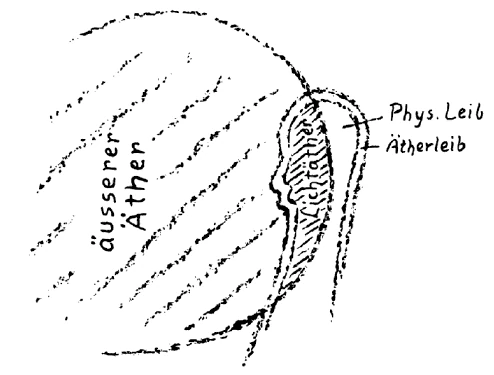
[ 2 ] Let us now turn our attention to the light ether. Certainly, the entire etheric body consists of an intimate union—an organized, intimate union—of these four types of ether. But today we want to highlight in particular that part of the etheric body which is the light ether. Let us now highlight the part of the etheric body that we refer to as the light ether. I have often emphasized that human beings actually gain consciousness of things by the fact that, with their “I” and their astral body, they are, in essence, within those things. Only during waking hours are the “I” and the astral body—one might say, insofar as the parts of them that are not within things are concerned—embedded within the physical body and the etheric body. If we consider this, we can say that the reason we have sensory perceptions is that the human “I” and also the astral body first receive a revelation from things that remains unconscious, and that this revelation is then reflected in the sense organs and their nerve extensions in the physical body. We have discussed these matters repeatedly.
[ 3 ] But today we ask ourselves: How does memory actually work? How is it that we have memories of various things—of objects and also of experiences we have gone through? Let’s take a closer look at this question. Today, we’ll approach it, so to speak, entirely empirically, based on observation.
[ 4 ] Let’s consider this scenario: Today we meet someone we saw for the first time five days ago. We remember that we saw him five days ago, that he told us his name at the time, and that we spoke with him. We say that we recognize this person. What happens within us when we recall a person and our encounter with them in this way after some time has passed?
[ 5 ] Well, the first thing to consider is this: While we were with that person five days ago, our etheric body performed certain movements. We will now focus specifically on the light aspect of the etheric body. Of course, the other aspects—the warmth aspect, the chemical aspect, and the life aspect—resonate as well, but today we will focus on the light aspect of our etheric body. I will therefore even call it the light body for the time being. Our etheric body performs certain movements. For the thoughts aroused by the person we encountered manifest themselves in our light body as inner movements of light. Apart from the fact that we see the person with our senses, we thus have something in the way of impressions that are not conveyed through the senses, insofar as our light body performs movements. The entire encounter with the person thus consisted in our light body performing all manner of movements. Imagine this quite vividly: while you were standing before the person, while you were speaking with them, your etheric light body was constantly in motion. What you say to them, what you feel about them, what you think of them—all of this is revealed in the movements of your light body.
[ 6 ] When we see this person again after several days, this renewed encounter stimulates our soul, and this stimulation causes the etheric body—purely out of its own inertia—to repeat the movements it performed five days ago, when we stood before the person and exchanged thoughts with them. So when you encounter the person again after five days, the etheric light body is stimulated to perform the same movements it performed five days ago. During waking consciousness, a part of one’s ego and astral body is always present in the outer light ether. Sleep occurs, after all, when that part of the astral body and the “I” that is present in the physical and etheric bodies during waking hours withdraws into the outer ether. Since one is, in essence, present in the outer ether with one’s “I” and astral body, and the inner etheric body—through its inertia—repeats the movements it performed at that time, one now feels the movements the etheric body performed back then. And that is remembering. Perceiving inner etheric movements from the outer ether, perceiving the movements of the inner light body from the outer light ether—that is what it means to remember.
[ 7 ] So, for example, imagine this: Two people stand facing each other in front of you. For the sake of argument, let’s say one can see only the other’s face. As one looks at the other’s face, his etheric body makes certain movements. Now he walks away. The etheric body retains the tendency to repeat these movements when stimulated to do so. Five days later, the two people meet again. They perceive each other—at first, the one whose etheric light body made the movements perceives the other. This stimulates his light body once more to make the same movements it made when he perceived the face. This is expressed in consciousness by the thought: “I have seen this face before.” That is to say, consciousness perceives, from the outer light ether, the inner light movements of the light ether within the human being. This is recollection; this is memory, purely as a process of observation. One might say: In the outer light, one sees the movements that the inner light body has undergone. But one does not see them as light movements. Why does one not see them as light movements in ordinary life? One does not see them as light movements because this light-etheric body is embedded within the physical body. As a result, the movements of the etheric body resonate throughout the physical body. And through this interaction, the light movements of the etheric body are transformed into memories. One does not see the movements of the etheric body, but rather the mental images produced by its interaction with the physical body. But these are the memories.
[ 8 ] When the physical body is gone—that is, when a person has passed through the gate of death—the “I” and the astral body are, of course, initially much more intensely present in the outer ether until they leave the outer ether after a few days. At that point, the inner body of light is no longer stimulated by contact with the physical body to form the kinds of mental images that are possible only in the physical body. Therefore, the deceased sees everything they have experienced and everything that the etheric body is now allowing to unfold and play out once they are free from the physical body, once they are no longer held back by it. The deceased sees all of this unfold in the few days following death, for the etheric body has a constant tendency to bring forth once more everything it has ever carried out as movements during the experiences of physical life. This entire life unfolds there, resonating out in the etheric body. And one sees it in this tableau—it projects itself into a powerful tableau; the entire reflection of etheric movements projects itself into a panoramic overview of the past earthly life.
[ 9 ] If one were to have the ability to master the physical body in such a way as to become independent of it and thereby also liberate the etheric body—this can be achieved through certain meditative processes, all of which are described in How Does One Attain Knowledge of the Higher Worlds? — one could already achieve this in one’s lifetime; indeed, many do achieve it—so that one is not disturbed by the physical body, and thus, when recalling, one does not perceive what arises from the etheric body’s contact with the physical body, but rather perceives the etheric body’s own vibration and movement. One is then in the outer light ether and observes the movements of one’s light body.
[ 10 ] Why can't this happen in everyday life? Why doesn’t it happen, for example, when Miss Scholl comes face to face with Countess Kalckreuth and recognizes her—assuming, for the sake of argument, that there is no clairvoyance involved—that under ordinary circumstances, Miss Scholl recalls her mental image of Countess Kalckreuth, that is, a mental picture of her, and does not perceive what she might otherwise perceive: the inner vibration of her etheric body, so that she would have the inner experience: “Ah, so this is how my etheric body has always vibrated when it has encountered Countess Kalckreuth?” — Light would then perceive light, namely the outer aspect, because Miss Scholl’s ego and astral body would perceive the movements—the ever-tending movements—of her own light body and would know how to interpret them correctly, so that she would also say: “These are the movements my light body has always performed whenever I stood before Countess Kalckreuth.” We would then have the phenomenon that, by dwelling in the ether—and we always do this, because a large part of our “I” and our astral body is outside our physical body—by weaving and surging in the light ether, we perceive our own portion of organized light ether with its movements: light from the light, the light that is within ourselves.
[ 11 ] Why doesn’t this happen in everyday life? Why do we only perceive the result of the etheric body’s movements impacting the physical body? — This is because Ahriman and Lucifer are linked to the earthly world, because Ahriman has chained the physical body so tightly to the whole being of the human being that the etheric body cannot easily break free; because Ahriman has bound the physical body so tightly together with the etheric body and the light body, and because Ahriman’s serving spirits are constantly present, causing the human being’s light body to be darkened by their vibrations whenever the human being is in the light, so that he cannot see it. Demons constantly keep the human being’s light body in darkness. This is due to the arrangement that Ahriman has established with the physical body and, incidentally, with the etheric body as well. We can therefore say—and I want to write this sentence on the board in particular, because it is an important one—: If it is possible for the human soul to observe the processes in its own light body from within the light, then that soul has freed itself from the Ahrimanic forces that otherwise obscure the processes in the light body.
[ 12 ] What, then, might a soul that wishes to achieve this implore or long for? Such a soul might say to certain powers that exist in the spiritual world—and which this soul acknowledges—: Oh, you powers in the spiritual world, let me, having left my physical body, be in the world of light with full awareness, be in the light, so that I may observe my own body of light; and do not let the power of the Ahrimanic forces be too strong over me, lest they make it impossible for me to see what is happening within my body of light! So, I will say once more what such a soul might implore in prayer, out of a longing for certain powers that might be recognized by this soul in the spiritual world. Such a soul might say: Oh, you powers, let me consciously look out from the light into the light at the processes taking place in my own light body, and dampen, take away the strength and power of the Ahrimanic forces that darken and obscure the processes in my own light body! Let me consciously behold my own light from within the light! Let me consciously behold the light from within the light, and take away the forces that prevent me from beholding the light from within the light!
[ 13 ] What I have just told you, my dear friends, is not merely a made-up prayer, but rather the way in which Christ—after passing through the Mystery of Golgotha—taught those who were still able to understand him to pray during the time he spent with his closest disciples after overcoming the Mystery of Golgotha.
[ 14 ] And that was part of the understanding—the Gnostic understanding—that these disciples were still able to offer to Christ at that time, and which disappeared, as I have indicated, around the time, around the centuries, of the Mystery of Golgotha.
[ 15 ] Thus, through the power that Christ Himself was to them, these souls, intimately connected to Christ, were able to look up to Christ and implore him for the opportunity to observe their own being-in-light from within the light, and to hold back the opposing forces of Ahrimanic nature, so that the gaze from within the light might not be dimmed or darkened, enabling them to behold these movements of light in the body of light. These intimate disciples of Christ Jesus learned at that time what I have hinted at here; that is what they learned. And they were well aware of the nature of all that we have spoken of today. They were well aware of it. They learned this during the time when Christ was with them after the Mystery of Golgotha.
[ 16 ] Among the fragments that have survived from the ancient Gnostic wisdom, I have also cited the Pistis Sophia text. I would like to read a passage from this Pistis Sophia text. This passage is titled:
[ 17 ] “I will praise you, O Light, for I long to come to you. I will praise you, O Light, for you are my Savior. Do not forsake me in Chaos”—when I am outside the physical body—“do not forsake me in Chaos; save me, O Light of the Heights, for it is you whom I have praised. You have sent me your light through yourself and saved me. You have led me to the upper realms of Chaos”—knowing beyond the physical body—. “May now the spawn of evil”—Ahriman; but Ahriman is not there—“who pursue me, sink down into the lower realms of Chaos. And do not let them come to the upper realms, lest they see me. And may great darkness cover them, and gloom fall upon them. And do not let them see me in the light of your power, which you have sent to me to save me, lest they gain power over me again. And do not let them succeed in the plan they have devised to take my power, nor in their words against me to take my light from me. Rather, take theirs instead of mine. And they have said they would take all my light, yet they have not been able to take it, for your light was with me. Because they have consulted without your command, O Light, therefore they have not been able to take my light. Because I have believed in the Light, I will not be afraid. And the Light is my Savior. And I will not be afraid.”
[ 18 ] When we feel fear, we think of Ahriman, as we see in one of the mystery plays.
[ 19 ] And now let us consider this passage from the Pistis Sophia text. Is it not as if it were preserved for this very purpose, so that one might say: Just look at this, you opponents of modern Spiritual Science! It is said in this modern Spiritual Science that the light movements of the body of light can be seen from within the light, provided the opposing Ahrimanic demons do not prevent this. But there was a time when this was already known. And there is even physical evidence of this time in the Pistis Sophia text. For, in essence, what I have read to you is nothing other than this process that I myself have constructed for you from the nature of the body of light and the soul’s abiding within the body of light itself. But there is no way to understand this passage from the Pistis Sophia text without first having understood what I explained earlier. Therefore, those who come across the Pistis Sophia text should tell themselves, when they read something like this: they do not understand it at all. But they are not humble enough to do so.
[ 20 ] But that is precisely what must come upon us—this great humility, which, in relation to this matter, can consist in saying to oneself—yes, there is a passage from the Pistis Sophia text that goes: “I will praise you, O Light, for I desire to come to you. I will praise you, O Light, for you are my Savior.” As I read it this way, I do not understand it. But one must possess this humility, this modesty of not wishing to understand until one has first created the conditions for understanding. Yet this modesty is nowhere to be found, especially in our time. And those who unearth such writings from the rubble and ruins are often the very ones who lack this modesty the most. Either they interpret these writings in the most trivial way, saying: “Well, the Light—that’s a nebulous mental image; it’s all meant allegorically.” — Or else they say: “Those who wrote this in ancient times were simply at a childlike stage of human development, and we—we have finally come so wonderfully far”—you recall Wagner’s words from yesterday! “We have finally come so wonderfully far that we realize these predecessors, with all their understanding, were simply at a childlike stage!”
[ 21 ] The issue in our time is not merely that a teaching cannot be understood by those who do not wish to understand it, but above all that a certain state of mind—which is absolutely necessary if true spiritual knowledge is to be attained—cannot be easily brought about. This state of mind is precisely the mood of the mysteries, which consists in developing within oneself the feeling that one cannot understand something until one has first prepared the soul to enter into that understanding. In our time, however, the prevailing mood of the soul is that the intelligent person—and, of course, in today’s view, every adult is intelligent—can judge everything for themselves. But the world is profound, and that which is connected with the mysteries of the world is profound. And because of this belief in one’s own cleverness—which every adult today holds about themselves—people simply pass by the deepest problems of the world, the deepest mysteries of the world. And when these mysteries of the world are discussed, they meet the speaker with nothing but scorn and derision at best, and cast the subject into the darkest corners, labeling it with their own labels: superstition, fanaticism, and fantasy—if not far worse labels.
[ 22 ] To clearly recognize this fact, my dear friends, is what matters. This is what is important: to see clearly how, in our time, those who have no will to understand pour scorn and derision upon that which can only be attained through intellectual modesty and humility, with a soul prepared in humility and modesty. For the time being, it is not only an understanding of the truths of Spiritual Science that is lacking, but rather the very mood of knowledge itself is absent in our time—that mood which gives rise to a genuine striving for knowledge.
[ 23 ] But the world depends on there being some people—and more and more of them—who clearly see through this and first take it to heart and pay attention to it, recognizing that this is where the lever of true progress must be applied. First, one must know what is to happen. And one must look clearly, without succumbing to illusion, at how those who, with scorn and derision, dismiss any genuine spirit of knowledge, seek to take control of everything that humanity is still to grasp in its spiritual culture. The aim is to integrate human beings into materialistic culture from childhood onward. Materialistic culture already lords over the tender soul of a child by imposing upon it the materialistic school, which renders the entire soul submissive to materialism—not so much through the content of what it teaches as through the very manner in which it must teach.
[ 24 ] And such rule is cloaked in the illusion of time by claiming that this is what is demanded in the age of liberalism and freedom! That which is the very opposite of all freedom is called freedom in the materialistic age. And things are arranged in such a way that people hardly notice that the opposite of freedom is called “freedom.” And those who suspect something of the matter would, at most, seek to combat this very lack of freedom with the same kind of lack of freedom, only coming from the other side. “This or that should be banned,” say some, while others, in turn, flirt with those powers that take control of everything that should grow freely like a little flower in the field.
[ 25 ] First, it is necessary for us to be imbued with that mindset—which can only be a truly free mindset—that arises from Spiritual Science. Above all, we must be clear that what is meant to be developed in the human soul during early childhood cannot be introduced into the course of the outer, materialistic world order. Not allowing ourselves to be deceived by words—that is what we must understand first and foremost. But for this, it is also necessary that we free ourselves from the entire aura of prejudices that confront us everywhere; that we truly experience, under all circumstances, that attitude—as something living within our souls—which can arise from the very essence of Spiritual Science; that we ask ourselves more often: What is in our soul that flows from the essence of Spiritual Science, and what is in our soul simply because we also adopt those thought forms that are swirling through the world today?
[ 26 ] Perhaps we cannot yet do anything in our own time to counter the thoroughly materialistic course of the materialistic, unfree spirit of the age. But we must at least learn to perceive it, for the time being, as a constraint. That is where it must begin. We must not succumb to illusions either. For if the world continues to develop as it strives to do in accordance with these materialistic impulses, then we will gradually enter a phase of development in which not only will those who are not certified be prohibited from from doing anything for human health, but in which every word spoken about anything pertaining to science will be prohibited—unless spoken by someone who has taken a kind of vow to say nothing other than what is patented in accordance with the materialistic world order. Today, many things are still prohibited, though people do not feel the coercion of these prohibitions. But we are heading toward times in which, just as any unpatented effort to heal people will be prohibited, so too will every word spoken—except at an institution guaranteed and patented by the materialistically developed powers.
[ 27 ] If one fails to grasp the entire course of these events, one will sail full steam ahead into the “freedom” of the future, which will consist of laws prohibiting anyone from teaching anything unless they do so within a licensed classroom; laws under which everything that even remotely resembles what is happening here will be banned. Because people do not see where this trend is headed, they do not keep this in mind today.
[ 28 ] Certainly, we will not—and this must be emphasized again and again—be able to do much in our time. But things must begin with thought; they must begin with a sense of the matter at hand; and whatever one can begin with, that is where one must start.
[ 29 ] However these words may be received, my dear friends, I felt compelled to address them to you at this turn of the year, because the New Year’s celebration is a kind of symbol of the passage of time in general, and because it is best if, during the New Year’s celebration, we truly take the time to reflect on what lies within the passage of time. One can never do enough to remind oneself again and again just how dependent people today are on opinions that are floating about—opinions that circulate precisely because they are recorded in filthy black ink on newspaper, and this filthy black ink is an infinitely potent magic potion for everything that people believe in the world. It is then interesting to observe when these gentlemen are not entirely in agreement among themselves, for then you see: there is that which floods every mind—that which has been conjured up with this filthy black ink onto the dirty paper—and which exerts such an immense spell over the entirety of present-day humanity. But of course there are always some who advocate believing whatever is written in that filthy black ink on the dirty paper labeled this or that, and others who, on paper labeled differently, want to pass off as irrefutable truth whatever is conjured up on it with that same black ink. They are at odds with one another. And then people can already see where the actual error and harm lie. Only the one on the right in the editorial office who sees this attributes it to the one who, of course, finds belief on the left in the editorial office! And so it is interesting to bring to mind a few words written, for example, by a certain Dr. Eduard Engel in the Türmer of 1911. They were titled: “On the Psychology of the Newspaper Reader.” I do not wish to say too much about these matters myself, so I will simply present to you what is sometimes said when people judge one another.
[ 30 ] Thus, in “On the Psychology of the Newspaper Reader” (Türmer, 1911), page 230, it is stated: “The newspaper reader is a very complex being. However, his countless less important characteristics all fade into the background behind two: He believes everything; he forgets everything. The entire secret of the daily press, in its current immense development, rests on these two main characteristics, which are present in every newspaper reader. He believes everything; he forgets everything. Printed newspaper is one of the essential hallmarks of the modern cultured person. The vast majority of readers read only one newspaper and believe in it. Their worldview in the evening is the one they have drawn from their newspaper that morning. If they encounter someone who reads a different newspaper and then expounds his—that is, his newspaper’s—worldview, that person seems to them either crazy or at least paradoxical. Newspaper editorial offices, which possess a particularly keen understanding of the newspaper reader’s psyche, treat their readers’ tender faith in printed newspaper with anxious caution. A newspaper never publishes a correction for the general public regarding what it has to report to its readers; even in the not infrequent cases where a mistaken report was the opposite of the truth and utter nonsense, they are careful not to shake their readers’ belief in the newspaper’s infallibility. Occasionally, however, they are forced to report the truth after a few days. Here, the second indispensable trait of the newspaper reader comes in handy: his forgetfulness...”
[ 31 ] When one considers the power that printed newspaper has gradually acquired throughout the 19th century and right up to the present day, and the role that faith in printed newspaper plays in the entire decadent aspect of our culture, it is indeed necessary to truly take stock of the whole sorry state of affairs.
[ 32 ] That is also what sometimes makes one feel uneasy—that there is such a strong demand to transform the form of communication we have chosen into the preservation offered by the printed word. And of course it cannot be any other way, for the “black art” is already here, and the “white art” must naturally take this black art—which finds expression in printed paper—into account. We must have books and cycles. But let us be truly aware that we must do our part to ensure that what is now entrusted to printed paper does not, under any circumstances, make its way through the world in the same way that, as is customary today, what—let me use the expression—“flutters out on the wings of printed newspaper to the minds of people” does.
[ 33 ] I wanted to create a mental image of the seriousness of the situation. That is why I took the liberty yesterday and today of inserting this contemporary reflection—also as a kind of New Year’s reflection—in the context of great mysteries, such as those of the earthly human year and the journey from light toward the human being’s own light, in the context of these great mysteries of existence.