

The Spiritual Unification of Humanity
through the Christ Impulse
GA 165
16 January 1916, Dornach
Translated by Steiner Online Library
The Conceptual World and Its Relationship to Reality II
[ 1 ] Yesterday we tried to put ourselves in the context of the development of understanding and idealization—the emergence of concepts about the world and of ideas—and we saw that a certain development can be observed there as well: that, in a sense, what emerged from a kind of clairvoyant experience of concepts was what the Platonic Ideas were, and that, little by little, that abstract way of thinking developed, which continues to this day; but that the time is now pressing for us, in a sense, to consciously restore living life to the concepts in order to enter into living spirituality as such, so that what was left behind as dreamlike clairvoyance in concepts may once again be attained in a conscious manner.
[ 2 ] The point now is that we must take a closer look at how all the highest matters of worldly existence could be grasped in an entirely different way at a time when there was still some echo of the old, clairvoyantly perceived concepts, and how the highest matters of humanity had to be grasped in a completely different way once conceptual thinking had already become intellectual, rational, and abstract. For the questions we spoke of again yesterday—questions that arose so significantly in medieval scholasticism—could, in fact, naturally develop only in an age when there was uncertainty about the relationship between the world of concepts and the world of true reality. In a time that preceded Greek philosophy, for example, one could not have even conceived of something like what we have regarded as the doctrine of universals in re, post rem, and ante rem, for the concept, when vividly grasped, leads directly into reality. One knows that one stands within reality through it, and one cannot then raise the questions we discussed yesterday. They do not arise as riddles at all.
[ 3 ] In the early days of Christian development, however, there was certainly something of an echo of the ancient clairvoyant conceptual world, and one can say: As the Mystery of Golgotha passed through the development of European and Near Eastern humanity, there were still many people who were truly capable of grasping—through the echoes of concepts perceived clairvoyantly—those things that can actually only be understood spiritually and that relate to the Mystery of Golgotha. Only in this way can we understand why so much of what was developed in the early days—in the first centuries of Christianity—in terms of concepts designed to grasp the Mystery of Golgotha must have been incomprehensible in later times. While the early Christian teachers still drew upon the echoes of ancient clairvoyant concepts to grasp the Mystery of Golgotha, these clairvoyant concepts naturally remained incomprehensible in their very essence to later centuries; and, fundamentally speaking, what is called gnosis is usually nothing other than the lingering echoes of ancient clairvoyant concepts. People tried to grasp the mystery of Golgotha using ancient clairvoyant concepts, but later on these concepts were no longer understood—only abstract concepts were. Consequently, people misunderstood what Gnosis actually intended. However, one would be taking a very one-sided view of the matter if one were simply to say: So there was a Gnosticism that still employed old clairvoyant concepts, which persisted into the 1st, 2nd, and 3rd centuries after the Mystery of Golgotha, and then came the uninformed people who were incapable of understanding the Gnostics. — That would be a very one-sided way of thinking. Working with clairvoyant concepts in a certain perfect sense belongs to a time much older than the era in which the Mystery of Golgotha took place—a much older time. And these concepts grasped through clairvoyance were already thoroughly infected by Lucifer; that is to say: the old clairvoyant-conceptual understanding was already permeated by Lucifer, and this Luciferic permeation of the old clairvoyant conceptual system—that is Gnosis. A kind of reaction against Gnosis was therefore bound to arise, because Gnosis was precisely the dying old world of clairvoyant concepts—the old world of clairvoyant concepts that had already been infected by Lucifer. One must also take this into account.
[ 4 ] Now I would like to begin with a man who, in the early centuries of Christianity, sought, so to speak, to stem the tide of influences emanating from Gnosticism—which had become Luciferic—and who, from this perspective, sought to grasp the Mystery of Golgotha. That man is Tertullian. He came from North Africa and was well-versed in matters of pagan wisdom. Toward the end of the 2nd century, following the Mystery of Golgotha, he converted to Christianity and became one of the most learned theologians of his time. Now it is particularly interesting to consider him a little, for the reason that, from his study of ancient pagan wisdom, he still retained something of an inner understanding of the ancient clairvoyant conceptual world, and on the other hand, because—as the story of his conversion shows—he was fully imbued with the Christian impulse and, in a sense, wanted to unite the two in such a way that Christianity could thereby fully endure. To do this, he had to set aside what he perceived as Luciferic-tinged Gnosticism in the teachings of Basilides, Marcion, and others. And now certain questions arose for him. These questions arose for Tertullian for a very specific reason. You see, as we begin our study of Spiritual Science today, we very often speak of the structure of human nature—of the way in which human beings first have their dense physical body, with eyes that can see and hands that can grasp; how there is then an etheric body, an astral body, a sentient soul, and so on. That is to say, we seek above all to understand the constitution of human nature. But if you trace the historical development of spiritual life over the centuries since the Mystery of Golgotha, you will find nowhere that the constitution of the human being was regarded in such a way—externally, as we do—right up to the present day. That was lost, and had already been lost when the Mystery of Golgotha took place. Those who were touched by the impulse of the Mystery of Golgotha knew nothing more of this structure of the human being. But this presented a very specific difficulty for them. To recognize this difficulty, my dear friends, try for a moment to connect with your own heart, with your own soul, and ask yourselves a question. You know that we have tried in various ways to make clear to us the manner in which Christ intervened in the development of the Earth through Jesus. But try to imagine what it would have been like for you to understand the whole matter—how Christ permeated the members within Jesus—if you had known nothing of the entire constitution, of the very nature of the human being! It was only because you already knew something about these bodies that it became possible to understand how the Christ, as a kind of cosmic “I,” permeates them. For anyone who will seek an understanding of the Christ in the future, knowledge of the human constitution will be the essential preparation.
[ 5 ] In ancient times, when dreamlike, clairvoyant concepts still existed, people knew something of this structure of the human being; and some of this knowledge had passed on to the Gnostics, albeit in a distorted form. Therefore, these Gnostics had attempted to interpret the coming of Christ into Jesus of Nazareth using the last remnants of these concepts regarding the constitution of humanity. But the others, to whom Christianity was now to come, and who were taught by their church teachers, knew nothing of this structure of the human being, nor did their church teachers. And so the great, far-reaching question arose: What is the nature of the interaction between the Christ-nature and the Jesus-nature? How is it possible that this Christ, as a divine being, takes up residence within Jesus, a human being? — And it is this question that preoccupies people like Tertullian. Because they lack the prerequisite for understanding the matter, the problem arises for them again, as it were, posthumously—but in the case of Christ Jesus, it leads them to ask: How, exactly, are the spiritual, physical, and soul aspects connected?—They did not know how these aspects are connected in human beings in general, but they had to figure out somehow how they were connected in Christ Jesus. Since the Gnosticism of that time was tinged with Luciferic influences, it naturally failed to arrive at the truth either. If you recall certain lectures I have given here recently, you will find that I have said: people tend toward materialism on the one hand, and toward one-sided spiritualism on the other. One-sided materialism is Ahrimanic; one-sided spiritualism is tinged with Luciferic influence. The materialists do not reach the spirit, and those who believe in the spirit in a Luciferic way do not reach matter.
[ 6 ] This was the case with the Gnostics: they did not arrive at physical existence, at material existence. And if one now considers a person such as Marcion, one sees that he has a clear—or at least more or less clear—concept of Christ, but he is utterly unable to grasp how this Christ was contained within Jesus. Consequently, the entire process became etherealized for him. He went so far as to conceive of Christ still as a spirit, as an ethereal being who had seemingly taken on a body. But he could not grasp the true nature of how Christ was present within Jesus. Marcion went so far as to say—and it was he, in particular, who came to say this—that although Christ did descend to earth, everything that Jesus experienced was only experienced in appearance; the physical events were only experienced in appearance; Christ did not actually participate, but was present only as an ethereal being who remained entirely separate. That is why Tertullian had to oppose Marcion, and others who thought similarly, such as Basilides. And for him, the great enigmatic question arose: How was the divine nature of Christ connected to the human nature of Jesus? What, in fact, was the God-man? What was the Son of God? What was the Son of Man? — Above all, he sought to clarify these concepts. And in doing so, he first developed a concept that was very important—and remains important to this day—one that must be understood if one is to grasp just how many possibilities for error exist for human beings.
[ 7 ] Tertullian, in particular, developed a certain way of thinking. He had to break away from the old clairvoyant traditions; he had to gain clarity regarding concepts and their relationships to realities—including higher, spiritual realities. I would like to insert an episode here from which you will see, not what Tertullian consciously realized, but what prevailed in his thinking. I will insert a purely intellectual episode, which I ask you, however, to take very much to heart. I will do the following. I write the number 1 and then its double, 2; 2—4; 3—6, and so on. And now imagine: I don’t stop at all; I keep writing on and on—that is, I would write on into infinity. How many such numbers would I have written by then? An infinite number, wouldn’t you agree! But how many have I written here? Have I written a number on the right for every number on the left? Without a doubt, I’ve written exactly as many digits on the right as I’ve written on the left, and if I were to continue into infinity, there would always be a number on the right for every number on the left. But now consider this: every number that appears on the right here also appears on the left there. But that means nothing other than this: I have as many numbers on the right as I have on the left, yet at the same time, I have only half as many numbers on the right as on the left. For it is quite obvious that between any two numbers that are double each other, there must always be one in between; I must have only half as many numbers on the right as on the left. One is always missing—that’s obvious—so I can only have half as many on the right as on the left. That’s easy to see. — But consider that one is always missing—that 1, 3, 5, 7, and so on are missing—so half the numbers are missing on the right! So I really do have only half as many on the right as on the left. Nevertheless, I have exactly as many numbers on the right as on the left. That means: As soon as I enter infinity, half is equal to the whole. That’s perfectly clear: As soon as I enter infinity, half is equal to the whole—there’s no escaping it. As soon as you move from the finite into the infinite with your concepts, something like this emerges on its own: that half is equal to the whole. You can write all the numbers on the left here and all the squares on the right: 1 — 1, 2 — 4, 3 — 9, 4 — 16, 5 — 25. Certainly, there is a square for every number, but just as there are many numbers missing here, it can only be a part of the whole. Think about it: after all, there are always only the squares.
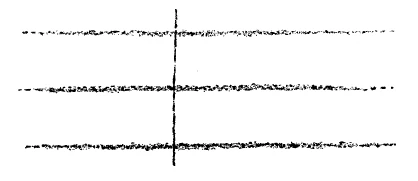
[ 8 ] You can illustrate this in another way: I’ll draw two parallel lines here—I’ve shown this many times before. How large is the space between these two parallel lines? Infinitely large, of course! As you know, in mathematics this is denoted by this symbol: 00. But if I now draw a perpendicular line to it, and then draw another parallel line at exactly the same distance, then the current space is exactly twice as large as the previous one, yet it is still infinite. That is to say, the new infinity is equal to twice the previous infinity. You can see this very clearly even here: using the simplest means of thought, you can see that thought applies only to the finite. It is groundless and fruitless as soon as it steps outside the finite. It cannot make any use of the laws it possesses when it moves from the finite into the infinite. But you must not merely conceive of this infinity in the very large or the very small; you must also conceive of the infinite within the world of qualities.
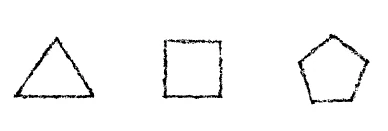
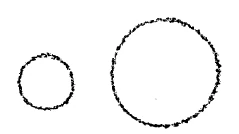
[ 9 ] This is a triangle, this is a quadrilateral, this is a pentagon (see drawing); I could draw a hexagon, a heptagon, an octagon, and so on, and if I keep going, it becomes more and more like a circle. If I then draw a circle, how many sides does it have? It actually has an infinite number of corners. But if I draw a circle that’s twice as large—it also has an infinite number of corners, but it has twice as many! So even within the finite, concepts of infinity are present everywhere, so that our thinking can fail everywhere—even where it encounters the finite—in the face of infinity, in the face of intense infinity. This means that thought must always be aware that it is at a loss and without a foothold when it seeks to move from the finite sphere initially given to it out into the infinite.
[ 10 ] One must draw a practical conclusion from this. One really must draw the practical conclusion that one must not simply think off the cuff, because one can go terribly wrong if one thinks off the cuff like that. And among the various negative contributions attributable to Kant, there is one positive one: that he once gave people a good scolding regarding this nonsense—of just thinking haphazardly about everything. If you think haphazardly, you can prove that space must have a boundary somewhere, that the world is finite; but just as easily: that it is infinite, because thought loses its footing as soon as you step outside a certain sphere. And so Kant formulated the so-called antinomies: how one can prove one thing just as easily as its opposite, because thought loses its footing and has merely relative value. One can think quite correctly with regard to one point; but if one is unable to extend that reasoning to another point—which may lie nearby—one goes astray if one simply thinks or even observes at random. In this field, one can truly see how little people are aware that one cannot proceed haphazardly, neither in thinking nor in observing, nor in perceiving much of what is out there.
[ 11 ] It seems I am now linking metaphysical and epistemological concepts to something very mundane. But it is exactly the same puzzle; it’s just a pity that we don’t have the time to discuss, from an epistemological perspective, to what extent it is the same puzzle. A few days ago, Mr. Bauer drew my attention to something very beautiful along these lines. You know that Pastor R., in his lecture with which he effectively killed our Spiritual Science, pointed out that if someone were to walk up to our building, amid all the incomprehensible things placed there for people to see, they might be reminded of the old Matthias Claudius. And Pastor R. meant to say that the good, dear old Claudius would have to stand there and say: “Up there, these anthroposophists reign and want to know that which can never be known! It is simply beyond human understanding.” — And then he quoted the words of Matthias Claudius:
[ 12 ] We proud children of man
Are nothing but poor sinners
And know very little;
We spin castles in the air
And pursue many arts
And drift further from our goal.
[ 13 ] So there we are, because old Matthias Claudius tells us that all people are poor sinners and should not turn their gaze toward what is incomprehensible and inscrutable. Well, and good old Matthias Claudius also sums it up by saying that Pastor R. is such a wise man that he knows people are poor sinners and know nothing of what cannot be seen by the physical eye. Mr. Bauer, however, not content to simply listen to these words from Pastor R., opened up Matthias Claudius and read the “Evening Hymn” by Matthias Claudius, which goes like this:
[ 14 ] The moon has risen,
The golden stars shine brightly
In the clear, bright sky;
The forest stands black and silent,
And from the meadows rises
The wondrous white mist.[ 15 ] How still the world is
And in the cloak of twilight
So peaceful and so lovely!
Like a quiet chamber,
Where the day’s sorrows
Are to be slept away and forgotten.[ 16 ] Do you see the moon up there? —
We can only see half of it,
And yet it is round and beautiful!
So it is with many things,
Which we laugh at without a care,
Because our eyes cannot see them.[ 17 ] We, proud children of humanity
are but poor sinners
And know very little;
We spin castles in the air
and pursue many arts
And drift further from our goal.
[ 18 ] Pastor R. is surely the poor sinner who is furthest from the goal! He simply forgot that the fourth stanza is intrinsically linked to the third!
[ 19 ] You see, what matters is that one tries, through one’s thinking, to be well-rounded. Of course, if the fourth stanza refers to Pastor R.—if Pastor R. identifies with all humble human beings—one can draw the exact opposite conclusion from it than one must draw when considering the third stanza as well. This latter, trivial example is not entirely unrelated to the more metaphysical-theoretical points I have cited. It is necessary for people to realize that when one looks at something like this and begins to think about what one sees, one may, under certain circumstances, arrive at the exact opposite of what is truly true. And this is what one encounters most particularly when attempting to make the transition from the finite to the infinite, or from the material to the spiritual, or the like.
[ 20 ] Well, a man like Marcion, speaking from his Lucifer-infected gnosis, said: The process of becoming human and so on, which takes place here on Earth—a God cannot go through that, because a God must be subject to different laws that belong to the spiritual world. He failed to see the connection between the spiritual and the material, the sensory. Now there was a debate—which no longer exists—about this—Marcion is recognizable, outwardly and physically, only through his opponents, such as Tertullian—that the entire external, physical history of Jesus of Nazareth was not at all appropriate to the divine world order; how God could be on Earth—all of that could be mere illusion, all of that could be meaningless. Christ would have to be understood in a purely spiritual sense. — Tertullian said: “You are right, Marcion”—this is now recorded in Tertullian’s writings—“you are right when you formulate your concepts the way you do; these are entirely understandable, transparent concepts, but you must then apply them only to the finite, to the things that take place in nature; you must not apply them to the divine. For the divine, one must have different concepts. And what is the rule, the law, for the workings of the divine may appear absurd to the finite mind.
[ 21 ] Tertullian thus found himself—I will not say consciously, but intuitively and unconsciously—confronted with the great enigmatic question of the extent to which thinking that is adapted to nature and natural phenomena is valid. And he countered Marcion by saying: If one applies only the kind of thinking that seems plausible to human beings, then one can assert what Marcion says. But with the mystery of Golgotha, something has entered the course of world history to which this kind of thinking does not apply—something that requires different concepts. — Hence he formulated the statement: “These higher concepts, which relate to the divine, compel us to believe what is absurd to the finite.” To do justice to Tertullian, one must not merely quote the sentence: “I believe what is absurd, what cannot be proven”—but one must cite this statement within the full context in which it stands, a context I have just attempted to make somewhat understandable. This was the central problem that now occupied Tertullian: How is the divine nature of Christ connected to the human nature of Jesus? — And he was clear about this: human concepts are inadequate for grasping what took place in the Mystery of Golgotha. Human concepts always lead to an inability to connect the spiritual aspect—what one has grasped of Christ—with what one must grasp as earthly history in relation to Jesus. But, as I said, Tertullian lacked the ability to grasp the problem from the constitution of the human being, as we are once again attempting to understand it today. As a result, he initially managed only—I would say—to find a surrogate for that concept we develop when we seek to clarify something at a particular point in our Spiritual Science understanding.
[ 22 ] Recall a passage from our Spiritual Science insights, which you can find, for example, in my Theosophy. There you will see: First there is the discussion of the physical body, the etheric body, and the astral body; then the soul of sensation, the soul of understanding or feeling, the soul of consciousness; and finally, the individual connections with the Spirit-Self. There are various discussions about how the Spirit-Self works its way into the soul of consciousness. But this is precisely the point one must focus on if one wishes to look into Christ’s indwelling in the human being Jesus, if one wishes to understand this. It is a prerequisite to know how, in humanity at large, the Spirit-Self enters the soul of consciousness; this is the prerequisite for understanding how the Christ-nature, as a special cosmic Spirit-Self, entered into the nature of the conscious soul of Jesus of Nazareth. Tertullian found only a surrogate for this, and one can understand the concept he developed in the same way as if one were to say today: There is no mingling—according to Tertullian—between the Christ, corresponding to the Spirit-Self, and the Jesus, corresponding to the consciousness-soul and all that belongs to the lower aspects of being; no mingling, but only a connection. And humanity will come to know such a connection only when the Spirit-Self is properly present. We are now living in the age of the consciousness soul. Every human being will have a much looser connection when the Spirit-Self is regularly developed in the sixth post-Atlantean epoch. Then people will also better understand how differently, for example, the Christ-nature was bound to the Jesus-nature than, say, the consciousness soul is bound to the intellectual soul. The consciousness soul is, of course, always inwardly blended with the intellectual soul. But the Spirit-Self is connected to the consciousness soul, not blended with it. And Tertullian truly developed this concept. He says: Christ is not blended with Jesus, but connected to him. Thus the one God-man, Christ Jesus, stood before him to illustrate once more—in an age when this ancient conceptual clairvoyance was no longer present—how the divine and the physical-soul aspects were united within human nature. Christ, as it were, stands before Tertullian as the representative of all humanity. Through Christ, he studied the constitution of the human being in order to understand Christ Jesus. Christ became the center of his entire thinking, which was no longer applicable to human nature alone. And because Tertullian had made it clear to himself that Christ is not mixed with Jesus, but connected—he could not say, as we would say, “like the Spirit-Self with the conscious soul”—but he said, “not mixed, but connected”—it became evident to him that he said to himself: Everything with which Christ has united himself also comes forth from the spirit of the world; that is the Father principle in the world. — For Tertullian, the Father principle became that which, so to speak, belonged to the earthly manifestation of Jesus. There lies the Father principle, the creative principle in nature, that which brings everything forth in nature. The Christ principle, the Son principle, united with this. This is how it became for Tertullian, and through the Father and the Son, through the purification of the external and the natural, through Christ, the Spirit—which he calls the Holy Spirit—now arises once more.
[ 23 ] Thus, what stands as the Christ Jesus during the time of the Mystery of Golgotha—that is, Jesus emerging from the Father Principle—is just as everything in the world emerges from the Father Principle. Thus, because he bore the Christ within himself, this Christ Jesus was the Son emerging from the Father principle—the One who had simply come later, the Bringer of the Spirit—the Spirit that then, in turn, comes from him. Thus Tertullian sought to find the path from the individual human being out into the cosmos: to the Father, Son, and Spirit principles.
[ 24 ] Jesus the Father
Christ the Son
Holy Spirit
[ 25 ] Now he faced the great difficulty of explaining how three could be one and one could be three. In ancient times, when clairvoyant concepts still existed, it was no great difficulty at all to create a mental image of this. But in an age when everything falls apart because of concepts and nothing can be properly connected anymore, the difficulty arose. Tertullian needed a nice analogy to explain how one can be three and three can be one. He said: Take the spring. From the spring comes the stream; from the stream comes the river. When we ask about the river, we say: It comes from the spring through the stream; from the spring through the stream. — Or take, he said, by way of comparison, the roots, the shoots, and the fruit: the fruit comes from the root through the shoot. — Tertullian needed a third analogy, saying: The little flame comes from the sun, carried through the cosmos. Thus, he said, one must create a mental image in which the Spirit comes from the Father through the Son. And just as this triad—spring, stream, river—does not contradict the unity that the river is in reality, so too does the fact that the Spirit comes from the Father through the Son not contradict the unified unfolding of the Father, the Son, and the Spirit.
[ 26 ] So he sought to understand how the three could be one: like roots, shoots, and fruit; like a spring, a stream, and a river. And he also tried to arrive at a certain formula. By considering the Father principle—that is, whatever it is from which the Spirit principle arises through the Son principle—he thought of the Father principle as the natural, the outwardly created, the outwardly manifest; in the Son principle, that which permeates what is outwardly revealed; and in the Spirit principle, that which is then brought about for the Earth’s development through both together—thereby a doctrine took shape for him, which, however, was essentially only a single symptomatic expression of was taking shape in those early centuries of Christianity among people who, on the one hand, still harbored some element of Gnosticism within themselves, yet at the same time were enduring all the pain and suffering caused by the inevitable loss of Gnosticism, and who were now seeking to come to terms with who Christ Jesus was and what he had to be for the purpose of the Mystery of Golgotha. Tertullian is merely a particularly brilliant representative—but he is indeed a representative—of what people thought in those early days of Christianity in order to truly penetrate spiritually what had happened.
[ 27 ] Christianity then gave rise to what you know as the Creed, the Apostles’ Creed, which became established in the 3rd and 4th centuries and was subsequently codified by the councils. If one studies this as it was at that time, one soon discovers: It is essentially a defense against Gnosticism, a rejection of Gnosticism, because people sensed the Luciferic factor within Gnosticism. Gnosticism leans toward Lucifer, that is, toward a one-sided spiritual conception. It therefore cannot at all arrive at the Father principle; it cannot properly honor it. The material world becomes something to be scorned, something it cannot use. In contrast to this, it must be stated: “I believe in God the Father, the almighty Father”—the first part of the Creed. This first part of the Creed is formulated against the contempt for the material world, formulated in such a way that even the external, which is seen with the eyes, is understood as something divine—and specifically as something divine that proceeds from the Father principle.
[ 28 ] The second point was to establish, in opposition to Gnosticism, that there was not merely an ethereal Christ at the time of the Mystery of Golgotha, but that this Christ was truly connected to the human being Jesus of Nazareth—not merged with him, but connected. It was therefore necessary, on the one hand, to establish that the Christ was connected to the spiritual realm, and on the other hand, that the Christ was connected to Jesus of Nazareth, to natural development on Earth, and that when the suffering, the death, the Resurrection, and all that is yet to come in connection with the Mystery of Golgotha took place, this was not something in which the Christ did not participate, but rather that he truly suffered in the body. The Gnostics had to deny that the Christ suffered in the body, since he was, after all, not connected to the body; for the Gnostics—or at least for certain Gnostics—it was merely an apparent suffering. — In contrast, it must be established that Christ was truly united with the body in such a way that He suffered in the body. Thus, all the events that took place on the outer physical plane were to be connected with Christ. Therefore: I believe in Jesus Christ, the only-begotten Son of God, born of the Holy Spirit and the Virgin Mary, who suffered under Pontius Pilate, died, rose again on the third day, ascended into heaven—that is, became spiritual once more—and who sits at the right hand of the Father, to judge the living and the dead.
[ 29 ] One might say: The Gnostics came closest to the Spirit, which must first be regarded as a purely spiritual entity. But it is spiritual insofar as, although it currently represents a spiritual reality, it must gradually come to fruition in human coexistence within the social structure that emerges during the Jupiter, Venus, and Vulcan eras—when the Holy Spirit incarnates, not in a single human being, but in all of humanity, in the configuration of society. But it is only just beginning. Yet the Gnostics were best able to understand that something has only a spiritual existence and does not intervene in the material world. Therefore, fundamentally speaking, the Holy Spirit was closest to the God of the Gnostics. But this Christianity, which sought to establish itself on earth, which did not want the Spirit to be “Luciferized”—that is, seen as merely something spiritual—this Christianity now also had to define faith in the Spirit as something connected to the material world: “I believe in the Holy Spirit, in the holy Church.” — This is now contained in the Apostles’ Creed, that is to say: the Church as the great physical body of the Holy Spirit. Nor could this Christianity regard life in the Spirit as something merely internal; rather, it had to realize the Spirit externally through the forgiveness of sins, in that the Church itself assumed the office of forgiving sins and, moreover, the doctrine of the resurrection of the flesh: I believe in the Holy Spirit, in the holy Church, in the forgiveness of sins, in the resurrection of the body.
[ 30 ] That is how the Creed was formulated in the 4th century, for example. So there were all these barriers against Gnosticism, and the way these three parts of the Apostolic Creed are formulated is closely connected, much like this: the river flows from the source through the stream, or: the fruit arises from the root through the shoot. — There was an immense striving during that time to grasp how the spiritual is connected to the material that spreads throughout the world, how one can conceive of the spiritual together with the material, and how one can conceive of the Trinity together with that which manifests outwardly in the material world. This is what was sought; it was sought with great intensity. But when one considers all that lives on in the Apostolic era—which has become completely incomprehensible today—one must say: the echoes of the old clairvoyant concepts still live on there, concepts that are only now fading away; and therefore the matter does not take on the old, living forms it could have taken if one had been able to grasp the Trinity and the Apostolic tradition through earlier clairvoyant concepts, but rather it is a beginning toward grasping the material and the spiritual simultaneously.
[ 31 ] There are many people today who say: Why bother with this old dogmatism? People were just musing about all sorts of fanciful concepts, but no one can gain any wisdom from that—it’s all just idle daydreaming. — If one looks more closely, however, one finds that behind this vain daydreaming lies a tremendous struggle to grasp what had just become relevant to the world—on the one hand, through the Mystery of Golgotha, and on the other, through the loss of the old clairvoyant knowledge, the gentle ebbing away of that ancient insight.
[ 32 ] Now the development continues, and something similar is happening to what occurred in earlier times, when art, religion, and science—which were still one and the same—emerged from the single root of the mysteries. Now, once again, that which lies within that common root—which the Apostolic era sought to grasp—is striving to branch out into the Trinity. I will now attempt to describe this further development as best as can be done today without causing too much offense. For if I were to simply state what needs to be said, it would surely make many people shy away from it.
[ 33 ] Within Western culture, what had originated from a single unity now developed into three distinct currents. That is to say, one current was particularly suited to grasping the Spirit, the Holy Spirit; another, the Son, Christ; and yet another, the Father. And the curious thing about this is that, as development proceeds along separate paths, the Holy Spirit current, the Christ current, and the Father current emerge more and more clearly—but in a one-sided manner. For, of course, one can only fully grasp it from all sides when all three are present together. If one develops what is to be understood as a Trinity in such a one-sided manner, difficulties arise in the development; then certain things are left out, and others degenerate. Now the following came to pass: The common development gradually split in such a way that a stream of development clearly continued which is oriented primarily toward the Holy Spirit—not as the first in time; the first in time is, of course, the coming together—and this is the one that is still essentially embodied today in the Russian Orthodox Church. As strange as it may seem, this is nevertheless the essence of the Russian Orthodox Church: that it focuses primarily on the Holy Spirit alone. And you will recognize from the way in which, for example, Solovyov speaks of Christ, that he is particularly adept at approaching Christianity from the perspective of the Holy Spirit. It does not matter whether he is consciously speaking about Christ or not, but rather what spirit reigns within him, what meaning he ascribes to things. What matters here is the inner dimension, especially the way in which he regards the external social order of the Church as inseparable from what is taught and from worship. This stems entirely from the nature of the Holy Spirit. The early Church, however, sought to avoid this mere knowledge derived from the Holy Spirit by establishing the Trinity in the Creed and adding Christ and the Father to the Holy Spirit. But these three must—as is also Soloviev’s ideal—come together again into a kind of synthesis.
[ 34 ] The second movement was the one that developed more with a focus on honoring Christ; although it taught all sorts of things about the Holy Spirit, it essentially honored Christ. It is the church that spread further in the West from Rome and tended to prioritize honoring Christ. Just consider this: in all the areas where this church was active, it essentially sought to honor Christ; wherever you look, it is Christ; wherever you look, this church is significant in its one-sided emphasis on the central article of faith in the Creed. Only in more recent times has this church attempted to incorporate the principle of the Father as well. But because one does not know the actual inner connection, one fails to grasp the proper relationship between Christ and the Father. And this failure to correctly recognize the relationship between Christ and the Father is precisely what causes all the discussions in modern Protestantism. It drives one from Christ toward the Father. This can be observed once again in our own time. The sad events of the present have also led to individual souls—indeed, numerous souls—being imbued with religious consciousness through these events; this can be demonstrated. But Christ plays a very minor role in this dawning of new religious consciousness; far more prominent is the Father principle, the general principle of God, by which the Father principle is meant. Anyone who can observe the world with some accuracy can notice this everywhere. I would like to describe just one small example to you. During our last stay in Berlin, a dear member passed away and was cremated there. I made it a condition—given the prevailing circumstances, it was necessary—that a pastor speak. He was a very kind man who was quite willing to let me say a few words afterward. But lo and behold, he actually gave a deeply moving speech, and as he spoke of God the Father, one had the feeling that he was speaking from the depths of his inner soul. And the whole time I listened to him, I realized: This is actually a confirmation of what Spiritual Science must generally show us: Christ was once cherished, but now people have gone astray; when one speaks of religious life, one now arrives only at the Father principle. — Many letters coming from the field, written by people who have delved deeply into religion, speak little of Christ, but everywhere of the principle that must be regarded as the Father principle. — Anyone who looks into this can see it. — And then, finally, because Christmas was just around the corner, the pastor mentioned Christ. It was so far-fetched, because, as a Christian, he felt it might be appropriate to speak of Christ. One could find no resonance or meaning in it at all. — And such phenomena are now multiplying by the minute.
[ 35 ] There is, in fact, a third movement in which the principle of the Father is upheld in a one-sided manner. And now you can imagine: The two pillars that were erected by the Apostolic period to counter the one-sided emphasis on the Father principle—Christ and the Holy Spirit—must be set aside if only the Father principle is emphasized one-sidedly. On the other hand, the Father principle was established in the Apostolic creed to indicate that the material world, too, is a divine one. The one-sided Father principle—entirely one-sided—is upheld in that spiritual current that draws on Darwin, Haeckel, and so on. This is the one-sided development of the Father principle. And no matter how much Haeckel may resist the idea that he was born out of religion, he was born out of religion through the one-sided development of the Father principle, just as other religious movements were born through the one-sided development of the Holy Spirit or Christ principle.
[ 36 ] And, when you get right down to it, it seems rather superficial when people say that the early councils merely wrangled over dogmatic concepts. These dogmatic concepts are not merely dogmatic concepts; rather, they are the outward symbol of profound oppositions that exist within European humanity—those oppositions that exist within those who are predisposed primarily as people of the Holy Spirit, as people of Christ, and as people of the Father. This differentiation is also deeply rooted in the ethnographic nature of the European world. And insofar as people throughout Europe looked to the early centuries of Christian proclamation, they established a creed that encompasses the Trinity. Certainly, every one-sidedness can bring the other side with it, but it need not. But humanity must pass through various trials, must pass through various one-sidednesses, in order to emerge from those one-sidednesses and find its way to totality, to wholeness. And one must then surely also have the good will to study things in their deeper meaning, in their deeper essence.
[ 37 ] If one studies the deeper essence of these three layers—three currents of European intellectual life—which can be characterized as I have just done, one will see: This differentiation has penetrated deep into the very fabric of the human soul, and one will come to understand much that, if left ununderstood, can only stand before us as a painful enigma. One might say: Just as unity in the Trinity presented itself to Tertullian, so too did three of humanity’s most fundamental European needs live within the way the One expressed itself symptomatically in the Three, insofar as they were oriented toward religious life; and something like the formation of the schism between the Western and Eastern Roman Churches—the Roman and Greek, or Orthodox, Churches—is merely the outward expression of the necessity inherent in the impulse that must branch out in different directions.
[ 38 ] In this sense, Spiritual Science will make many aspects of human life comprehensible. Because it seeks in this way to shed ever deeper light on human interrelationships—and on the interrelationships within the entire course of human development—it is, of course, largely misunderstood today. For an era is emerging more and more clearly in the outer world that wants nothing to do with Spiritual Science—an era in which a deeper understanding, even of history, is no longer sought at all; an era in which everyone pursues only what they, according to their subjective judgment and their personal sympathies or antipathies, wish to regard as true. Of course, Spiritual Science must be present precisely in such a time, for the pendulum of development must swing to the other side. But it is just as obvious that Spiritual Science will be widely misunderstood in such a time. And we really must be clear about how much of our time is characterized by people who do not seek objectivity, perspective, or a comprehensive view at all, but who instead make hasty judgments based on their inclinations. It is truly the case that, fundamentally speaking, on the one hand there is a profound necessity to convey an extraordinary amount from the spiritual world, yet on the other hand it is extraordinarily difficult to make oneself understood, especially in our immediate present. Never before have people lived so strongly, as it were, within a general aura of which they are completely unaware. I am deeply convinced, when I say that much must remain unsaid in our time, that there will be many who take it for granted that they are now suited—perhaps within a smaller circle—to hear what cannot otherwise be said. Yet this view is entirely mistaken. Certainly, many may long to hear now some of what it may only be possible to say to humanity years from now. But we must be clear that we live today in an age where judgment is not passed only when a word, with its meaning, reaches our soul, but where judgment has already been passed before the word reaches our soul. In our time, the way the word is received is, for the most part, already determined by the time the word reaches the ear and has not yet been taken in by the soul. We no longer have the time to ask about the meaning, so stirred up are people’s passions and emotions at present by the oppressive events into which we have been thrust, and many a word could only be tolerated because it was spoken in our presence.
[ 39 ] In our present time, we can do nothing else but make it clear to ourselves again and again that what matters is that a number of people be found who stand firmly on the ground of what we have already been able to attain through our Spiritual Science; who stand firmly and faithfully on this ground and who can cherish the hope that this firm and faithful standing on the ground of Spiritual Science may, in due course, become important and essential for the development of humanity. The time will certainly come when—since so many passions have already been stirred up—something like a great question will permeate the atmosphere in which our spiritual scientific movement lives. This question will not be heard clearly, but perhaps its effects will be evident. Nor will the answers be given clearly in words, but in relation to external events they may be very clear. Something like this, without being put into words, will whisper through the Spiritual Science movement: “Should I go along with it, or should I not?” — And the answer will reflect what has driven people—out of a sense of sensation, out of sympathy with the general sentiments arising from Spiritual Science. Arising from many secondary feelings will be what drives the response—a response that will not be clearly articulated, that will not simply be expressed by saying: “I used to like Spiritual Science, but now other feelings have crept in, and now I no longer like it”—but rather, people will put on a facade and seek all sorts of reasons, which they may expound upon from many angles. The essential point will be that one used to like Spiritual Science but no longer does, which has a great deal to do with enthusiasm, with sensation, with all sorts of sensual pleasures of the soul, and so on. In a certain sense, precisely out of the emotions of the present, something like this will increasingly emerge: “I’m going along with it”—and: “I’m not going along with it.”—But deep within, our Spiritual Science is invincible, utterly invincible. And what we must keep in mind is that there will at least be some in whose hearts it is firmly anchored—not out of sympathy or preference, out of pleasure or sensation, out of vanity or enthusiasm, but because the soul is connected to it as to its own truth, and because the soul does not shy away from the difficulties of entering into the core of truth in the world. Much will fall away entirely; but perhaps what remains afterward will be all the more significant and certain. This must be borne in mind when it is now necessary to emphasize again and again that, until more peaceful times dawn upon our civilized lands, we must do without a great many things that might be very useful for understanding our present age, but which, given the nature of our times, simply cannot be presented to humanity at this very moment.
[ 40 ] I would like to say these words to explain why some things were only hinted at in the most recent lectures. However, I would like to make one more point. Precisely because it is true—and it is indeed true—that we are living in a time when a word has already led to judgment before it has even reached the soul, many people can learn a great deal from current events using the tools that Spiritual Science already provides them. Much can be learned precisely from what is happening around us, if one looks at it more deeply, if one sees how, today, outer humanity has almost entirely lost the ability to judge with any objectivity, how judgments flow solely from emotions and permeate everything that the cultural world has to offer. And when one looks for the reason why this is so, when one sees this reason swirling in the human aura of the present and then realizes how a word is already a judgment before it enters the soul, then one can learn a great deal from current events precisely through the instrument of Spiritual Science. And we must learn if we are to become, in reality, an instrument—as a society—for the Spiritual Science. The example cited today—of how a person who wishes to criticize our society quotes a fourth stanza and omits the third—yes, my dear friends, if you seek the reasons for the opposition that arises against us: they are to be found everywhere. They must be sought everywhere in superficiality, in that utterly immense superficiality. Everywhere, so to speak, a fourth stanza is seen and a third stanza is overlooked, figuratively speaking. Only many among us still do not believe this. Many among us still believe that they are doing the right thing when they go to this or that person and tell them: “I have become so spiritually developed through our Spiritual Science that I even read aloud to my husband, who is fighting out in the field, and I know that it helps him.” — Then, of course, people come and use that against us. Or when you tell people what we’ve had to hear—what’s been spread around as the “Nathanael story” and so on. That such things happen at all—that these things are actually spread from within our own ranks—seems at first to stem from good will, but from a good will that is linked to a certain naivety—a naivety, however, that is boundlessly arrogant, because it does not recognize itself as naivety and does not want to recognize it, but takes itself so seriously as a person that it considers it absolutely essential to convert this or that person—about whom, if it were not so naive, it would know there is nothing to be done. This is so infinitely important that one can understand how, at times, naivety, in its boundless arrogance, feels endowed with a mission. And as a rule, no one resents you more than the naive person who believes they are doing the very best thing when, out of a certain enthusiasm, they do the absurd.
[ 41 ] And indeed, if you consider the matter, it is first and foremost necessary that we at least gain this insight from Spiritual Science: that we must be modest in our thinking. If thinking can really be so off the mark, as I tried to make clear today, why should we—whenever we’ve drilled this or that into our brains—why should we believe so absolutely that it is an irrefutable truth? And why should we then immediately go out into the world and trumpet it, as if driven by a mission? Why shouldn’t we resolve to first learn something real and to draw from the humanities a certain inner impulse of vitality—rather than just the one we get when we merely dabble in them? That is why we cannot appeal often enough to the seriousness—the deep seriousness—that must permeate us and that must always remind us: No matter how strongly you believe in your judgment in any given direction, you must examine it, for it could be wrong. — If we take all this into account, along with many other things—after all, not everything can always be said—then we will truly, little by little, become a group of people within whom lives that which is as impersonal as the most important impulses must be, even in the present, if they are to stand up against the merely personal impulses that are currently surging and sweeping through the world.
[ 42 ] I wanted to speak to your souls about such feelings and emotions, since we will not be meeting for a few weeks now. I also wanted to present you with a broader picture in these final hours before the weeks when we will not be able to speak with one another, by tracing a chapter in the original development of Christianity and its divergence into various movements. I am convinced that, no matter how much you study the development of Christianity over the centuries to date, what has been said today will serve as a guide that will clarify an infinite number of things for you regarding its outward manifestations. And conversely, if you truly contemplate these outward manifestations with seriousness, you will find confirmation everywhere of what I could only hint at today. So it would be good if we could use something like a subject for meditation that can present problems and riddles to our souls, the solutions to which we can each attempt, according to our own abilities. Of course, some will be able to do this only with more fleeting thoughts, moment by moment, while for others it will be more natural to familiarize themselves with something that can shed light on what has been alluded to here. But everyone can find inspiration when they attempt—I would say—to develop those rippling thoughts that stretch back through the centuries and yet play an essential role in what confronts us in the present, making it necessary for us to understand it. I know that, in reality, no one understands our troubled present who has not come to know all the contradictions that have arisen in a completely natural way in the course of European development. But when one compares what is being judged today about the state of the world with what is objectively true—and can only be recognized by knowing all the forces that have intervened in this development, which can only be revealed by a consideration of history, including its spiritual dimensions—when one compares today’s judgments with what leads to a true judgment, then one is filled with deep, deep feelings of sorrow. Not only painful feelings, my dear friends, about what is happening today, but also about the difficulties that arise in moving beyond what is happening today. And we must move beyond it! And the more you come to realize that a deep spiritual-scientific understanding of the forces of human evolution in all areas is necessary—without allowing our personal emotions to influence our judgment—the more such an understanding of the evolutionary impulses is sought through Spiritual Science, the more you will realize how important it is to recognize these impulses through Spiritual Science and to bring them to life in your soul; the better you will belong to those souls who can stand firm on the ground where one must stand today if what must actually happen—by virtue of an inner, necessary demand of the mysteries of human evolution—is to be achieved.
[ 43 ] I would like to speak about your sensations and your feelings, so that Spiritual Science may take root in these sensations and feelings and become firmly anchored within them, and so that there may be people as there ought to be and as there must be if we are to make progress in the evolution of humanity. We must think this in all humility, but we must act upon it in this humility, for it is not suited to fostering a sense of grandeur in us, but only to creating within us the need to devote as much strength and as much intensity as possible to truly penetrating that which seeks to realize itself spiritually in the history of human development.