

Necessity and Freedom
in World History and Human Action
GA 166
25 January 1916, Berlin
Translated by Steiner Online Library
First Lecture
[ 1 ] Now that we are able to be together again, my task will be to speak about important—though somewhat difficult—questions concerning human life and the life of the world—questions whose consideration, of course, cannot be concluded with this lecture, but on the contrary, can only be introduced. In the course of this reflection, it will become clear just how infinitely important these very questions are in relation to a spiritual connection with the great events that are so deeply moving humanity today. If I were to summarize in two abstract terms what I am to speak to you about during this time, I could do so with the following two phrases: “The necessity of world and human events” and “Human freedom within world and human events.”
[ 2 ] There is, in fact, hardly a person who is not, to a greater or lesser extent, grappling with precisely these questions, and there are perhaps hardly any events on the physical plane that suggest engaging with these questions as strongly as those that are now sweeping across the peoples of Europe and through the souls of the people of Europe. When we consider world events and our own actions, feelings, will, and thoughts within the context of world events—and view them first and foremost in connection with what we call the divine, wise world government—we tell ourselves that this wise world government reigns in all things. And when we look back at something that has happened—in which we ourselves may have been placed—we can then ask the question: Was what happened, in which we ourselves were placed, grounded within the entire wise world government in such a way that we can say it was necessary, that it could not have happened any other way, and that we ourselves could not have acted any differently within that event? Or, looking more toward the future, can we say: At this or that future time, this or that will unfold, and we believe we might be placed within it? Must we not assume, in light of the wise world government we presuppose, that what happens in the future is also necessary—or, as is often said, foreseen? But can our freedom still exist in this context? Can we resolve to intervene in some way through the ideas and skills we have acquired? Can the way we intervene change what we might wish would not occur in the manner it would have to occur if we did not intervene?
[ 3 ] When people look back more on the past, they are more strongly struck by the idea that everything was necessary—that it could not have happened any other way. When a person looks more toward the future, the idea that it must be possible for him—the person himself—to intervene with his will wherever he is permitted to do so makes a stronger impression on him. In short, a person will always find himself in a kind of conflict between the assumption of an unconditional necessity that pervades all things, and, on the other hand, the necessary prerequisite of freedom, without which they cannot truly maintain their worldview, because otherwise they would have to assume that they are woven into the great machinery of existence like a cog, determined by the forces governing this machinery in such a way that even the functions of their very existence as a cog are predetermined.
[ 4 ] You know, of course, that the dilemma of choosing one thing over another runs, so to speak, through all of humanity’s intellectual endeavors; that there have always been philosophers, known as determinists, who assumed that all events in which we are entangled through our actions and our will are strictly predetermined, and that there have been indeterminists who assumed the opposite: that human beings can intervene in the course of development through their will and their ideas. You also know that the ultimate extreme of determinism is fatalism, which clings so rigidly to a spiritual necessity pervading the world that it presupposes that nothing—absolutely nothing—could happen in any way other than as it is predetermined, and that human beings must merely submit passively to the fate that has been poured out upon the world precisely because everything is predetermined.
[ 5 ] Perhaps some of you also know that Kant drew up a table of antinomies, in which he always placed a certain proposition on one side and its opposite on the other; for example, on one side the proposition: “The world is infinite in space,” and on the other side the proposition: “The world is finite in space,” and that he then demonstrated that one can prove one statement just as well as the other using the concepts available to human beings. In the same sense, one can rigorously prove: The world is infinite in space or time—or: The world is finite in space, bounded, enclosed by boards, and in time it had a beginning.
[ 6 ] Among the questions Kant included in his Table of Antinomies is the one we have just touched upon. He was thus aware of—and drew people’s attention to—the fact that one can prove just as rigorously, strictly—in the only way one can prove strictly logically—that all events in the world, including human events, are subject to rigid necessity, just as one can prove, with exactly the same rigor, that human beings are free beings and that they somehow determine, through their will, the things in which they intervene with their will. Kant considered these questions to be undecidable for human cognitive faculties—questions that go beyond the limits of human cognitive faculties—because one can rigorously prove one position just as well as its opposite using human means.
[ 7 ] Now, in the discussions we have had over the years, you already have, so to speak, the foundations for getting to the bottom of this strange mystery that lies before us. For one really does want to say: The question of whether human beings are bound by necessity or whether they are free is indeed a mystery. This question is a mystery. But what is certainly even more mysterious is the fact that both positions can be rigorously proven. You will not find the foundations to rise above doubt in this area at all if you seek them outside of what we call Spiritual Science. Only within the framework of these foundations—which Spiritual Science can provide—can one gain insight into this mystery, into this enigma that actually underlies the questions mentioned.
[ 8 ] This time, we will proceed quite slowly in our reflections. To begin with, I would just like to say: How is it even possible that a person can prove both a proposition and its opposite? When we are confronted with such a situation—if we are confronted with it at all—we are made somewhat aware of a certain limitation of ordinary human conceptual capacity, of ordinary human logic. But we will be reminded of this limitation of human logic in connection with many other things as well. It always arises wherever a person attempts to approach the infinite with their concepts.
[ 9 ] I can show you this using a very simple example. As soon as a person tries to approach the infinite with their concepts, something occurs that can be described as a confusion of concepts. I want to make this clear to you using a very simple example. You just need to follow me patiently through a line of reasoning that may be unfamiliar to you. Imagine that I were to write the numbers 1, 2, 3, 4, 5, and so on, one after another, on the blackboard. I could, couldn’t I, write them on into infinity: 1, 2, 3, 4, 5, 6, and so on. Now I can write down a second series of numbers: to the right of each number I’ve written, its double, that is:
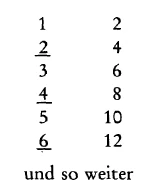
[ 10 ] Now I can write to infinity again. But you’ll have to admit: every number on the right side of the sequence is also present on the left side. I can underline 2, 4, 6, 8, and so on. Now take a look at the left-hand sequence of numbers: there are infinitely many possible numbers. Among these infinitely many numbers are exactly the numbers that appear on the right in the right-hand sequence: 2, 4, 6, and so on are included. I can keep underlining more and more. If you take the underlined numbers in the left-hand sequence, these underlined numbers are always exactly half of all the numbers. Every other one is underlined. But if I now write them on the right, I can continue writing: 2, 4, 6, 8, and so on to infinity. I have an infinity on the left and an infinity on the right, and you can’t say that I have fewer numbers on the right than on the left. There’s no question that I must have exactly as many numbers on the right as on the left. And yet: since all the numbers on the left can be created by crossing out, the infinity on the left is only half of the infinity on the right. It’s quite clear: I have exactly as many numbers on the right—namely, an infinite number—as on the left, because every number on the right corresponds to a number on the left—and yet the number of numbers on the right can only be half of the number on the left.
[ 11 ] There is no question that, as soon as one moves into infinity, one’s thinking becomes confused. The question that arises here cannot be resolved, for it is just as true that there are half as many numbers on the right as on the left as it is true that there are exactly as many numbers on the right as on the left. Here you have this in the simplest possible way.
[ 12 ] This leads a person, in a certain sense, to say to himself regarding his concepts: “So I really must not apply them to the infinite—to that which lies beyond the sensory world—and the infinite does lie beyond the sensory world—I must not apply them to the infinite.” Do you believe that you cannot apply them not only to the unbounded infinite, but also to the bounded infinite, for the same confusion arises in the bounded infinite.
[ 13 ] Imagine drawing a triangle, a quadrilateral, a pentagon, a hexagon, and so on. By the time you get to a hundred-sided polygon, you’ll be very close to a circle. You won’t be able to distinguish the small lines from one another very well anymore, especially if you step back. You can therefore say: A circle is a polygon with an infinite number of sides. If you have a small circle, there are an infinite number of sides inside it; if you have a circle twice as large, there are also an infinite number of sides inside it—and yet exactly twice as many! So you don’t need to go to the boundless infinite; rather, if you take a small circle that has an infinite number of sides and a circle twice as large that also has an infinite number of sides, you can already encounter something within the manageable infinite that completely confuses your concepts. What I have just said is extraordinarily important. For people do not realize at all that they have only a certain realm—namely, the realm of the physical plane—for the concepts that are applicable, and that this must be so for a certain reason.
[ 14 ] You see, in a place where people are now taking a rather hostile stance toward us—which is, after all, the case in many places these days, among many people—a pastor gave a sermon against our Spiritual Science, which he concluded, believing it might be particularly effective, with a quote from Matthias Claudius. This quote from Matthias Claudius essentially states that human beings are, in fact, poor sinners who cannot know very much, and that they should be quite content with what they know and not seek to discover what they cannot know, The man chose this stanza from a poem by Matthias Claudius because he thought he could pin on us the accusation that we wanted to go beyond the sensory world, but that Matthias Claudius himself had already said: man is, after all, a vain sinner who cannot go beyond this sensory world.
[ 15 ] Yes, “by chance,” as they say, a friend of ours looked up this poem in Matthias Claudius and also read the preceding stanza. The stanza immediately preceding it states that a person can go out into the field and, even though the moon is always a full disk, if it is not a full moon, he sees only a part of the moon, while the other part is still there; and so there are many things in the world that, if one looks at them at just the right moment, one can know are there. And since Matthias Claudius wanted to point out that one should not limit oneself to what is immediately apparent to the senses, but that one is a poor sinner who allows oneself to be deceived by what the senses immediately present, what the good man quoted from Matthias Claudius ended up applying to himself.
[ 16 ] The sensory world—unless, of course, we happen to be just like this pastor—sometimes draws our attention to the fact that, wherever we turn our gaze, we must also direct it toward the other side and correct one side through the other. With regard to that which lies beyond the sensory world, however, there is no immediate correction through the sensory world. One cannot immediately point to the other aspect, and so it happens that people then proceed to philosophize and, of course, must be convinced that this is true, because—it can be proven strictly logically. But the opposite can also be proven strictly logically. We can, in fact, ask ourselves this question today, and all the considerations we are now undertaking will then answer this question more precisely: Why is it that, when we go beyond the sensory world, our thinking becomes so confused? How is it, in the first place, that we can prove both one thing and its opposite? We will discover how this is connected to the fact that human life is situated, as it were, in the middle—in a state of equilibrium—between two opposing forces: the Ahrimanic and the Luciferic forces.
[ 17 ] Certainly, one can reflect on freedom and necessity, and one can believe that there is compelling evidence: There is only one necessity in the world. But it is Ahriman who has brought about the compelling nature of this evidence. On the one hand, when one proves one thing, it is always Ahriman who leads one astray; and when one proves the other, it is always Lucifer who leads one astray. One is, in fact, always exposed to these two forces, and if one does not take into account that one is placed between these two forces, one will never understand where such conflicts in human nature—such as the one that has been examined—come from.
[ 18 ] However, even the sense that, in the workings of the world as a whole, alongside the state of equilibrium there also exist the pendulum’s swings to the right and to the left—the Ahrimanic and the Luciferic swings—was lost in the 19th century. This sense has completely died out. Today, after all, you’re basically considered to be mentally unstable if you speak of Ahriman and Lucifer, aren’t you? Things actually didn’t get this bad until the mid-19th century, for a very insightful philosopher, Thrandorff, wrote a very fine treatise here in Berlin in the mid-19th century in which he attempted to refute the arguments of a clergyman. A clergyman had been spreading the idea here—I hope we can say this openly in our circles—that there is no devil and that speaking of a devil is actually a terrible superstition. We are speaking of Ahriman. The philosopher Thrandorff took up the cause against the clergyman in a treatise that is very interesting: “The Devil—No Dogmatic Pipe Dream.” As late as the mid-1850s, he attempted, so to speak, to prove the existence of Ahriman from a strictly philosophical standpoint.
[ 19 ] I hope that, in the course of the public lectures I will be giving here in the near future, I will be able to speak specifically about this faded tone in intellectual life—about theosophy, which disappeared entirely in the mid-19th century. People had already been speaking of these things—albeit under a different name—as far back as the mid-19th century. The very feeling for them has been lost, but this feeling was, in essence, present in a subtle way all the way back into the 14th and 15th centuries, until it naturally had to recede into the background for a time. We know, of course, that Spiritual Science—as I have often emphasized—in no way denies the great value and significance of the rise of the natural sciences. But the fact that this rise of the natural sciences could occur was due to the loss of the sense, the feeling for this contrast—Ahriman and Lucifer—which can be found only in the spiritual realm. Now they must once again emerge across the threshold of human consciousness. A subtle sense of this existed right up into the 15th century.
[ 20 ] I would like to use an example to show you how things unfolded with regard to Ahriman and Lucifer, when there was already only a sense that these were two forces at work. I would like to illustrate this with an example:
[ 21 ] In Prague, at the Old Town Hall, there is a very remarkable clock that was built in the 15th century. This clock is truly a marvel. At first glance, it looks like a kind of sundial, but its design is so complex that the sequence of hours is displayed in two ways: according to the old Bohemian system and according to the modern calendar. The sequence of hours in the old Bohemian system ran from 1 (or O) to 24, while the other, later system only went up to 12. At sunset, the shadow hand—there was a shadow—always pointed to 1. And the clock was designed so that the hand truly always pointed to 1 at sunset. So despite all the variations in sunset times, the hand always pointed to 1.
[ 22 ] This clock also indicated when a solar or lunar eclipse occurred. It showed the paths of the various planets through the zodiac signs; it had a planetary circle on it. It even indicated—it is truly marvelously constructed—the movable feasts. So it indicated when Easter fell in a given year. It served as a calendar as well. One could see the progression from January through December. The variable date of Easter was factored in. A specific hand indicated when Easter fell, even though it is a movable feast, as is Pentecost.
[ 23 ] The clock was, therefore, exceptionally well-designed for the 15th century. The history of how it was constructed has now been researched. But aside from this researched history—which is documented and which you can read about—there are, after all, many descriptions of it— there is a legend that attempts to explain the peculiarities surrounding this clock—first, the fact that it is such a marvelous piece of engineering, and second, that after it was constructed by the brilliant man who was able to build it, it was wound up continuously for as long as he lived. After his death, no one could wind it, and people were sought far and wide who could fix it so that it would run. As a rule, nothing was achieved except that those involved ruined it. Then, once again, one person or another would come along who claimed he could fix it. He would fix it, but the clock would repeatedly fall out of order again and again.
[ 24 ] All these facts came together to form a kind of folk legend, and this folk legend goes as follows: A simple man is said to have received, through a special gift from heaven, the ability to build this clock once. He alone knew how to care for this clock. The legend placed great emphasis on the fact that it was a simple man who, through a special grace—that is, genius—had received this gift from the spiritual world. But then the ruler wanted this clock for Prague alone, and he wanted to make it impossible for any other city to possess it. Therefore, he had the brilliant clockmaker who had crafted it blinded; he had his eyes gouged out. The man then withdrew from public life. Only before his death did he ask, just once more and for a single moment, for the grace to be able to repair the clock again; and he used that moment—so the legend goes—to throw the clock into disarray with a quick flick of his wrist, so that no one could ever set it right again.
[ 25 ] At first glance, this legend seems very unassuming. But the way it is constructed conveys a keen sense of the presence of Ahriman and Lucifer and the balance between them. Consider how subtly this legend is crafted. One could find the same subtle structure in countless such folk legends. For it is shaped with a keen sense of Lucifer and Ahriman. First of all, isn’t there a state of equilibrium: the person in question receives, through an act of grace from the spiritual world, the ability to create something so extraordinary. There is no selfishness involved here. For, after all, selfishness could overcome anyone. This is a gift of grace. He truly did not create it out of selfishness. But there is also no trace of mysticism here, for it is explicitly stated that he was a simple man. With this description—that is, by drawing attention to an act of grace (and thus nothing of selfishness) and to the fact that he was a simple man (and thus nothing of fanciful speculation)—the intention was to suggest that nothing of Ahriman or Lucifer dwelt in this man, in his soul, but rather that he was entirely under the influence of good, progressive divine powers.
[ 26 ] Lucifer dwelt within the ruler. Out of selfishness, he wanted the clock for his city alone, and so he blinded the man. Thus, Lucifer is set aside. But because Lucifer is there, he is always connected to his brother Ahriman. And because the man is blinded, the other gains the ability to intervene destructively from the outside through a skillful maneuver. This is the work of Ahriman.
[ 27 ] Here, then, the benevolent power is placed between Lucifer and Ahriman. You can find this subtle construct in many folk tales, even the simplest ones. But the sense that Ahriman and Lucifer intervene in the whole of life—that sense could have been lost in an age when an understanding of positive and negative electricity, positive and negative magnetism, and so on, as the fundamental forces of the material world, had to take hold more and more. The fact that scientific research was able to flourish was due to the fact that even this sense of spiritual insight into the world receded.
[ 28 ] We will see how Ahriman and Lucifer intervene in what human beings call “knowledge”—in what human beings call their very relationship to the world—in such a way that the very confusion we have spoken of arises. This confusion becomes particularly clear to us in the question we have raised. Let’s take a simple hypothetical example. I could just as easily have taken this example from major world events as from the most everyday occurrences. I will take a very simple example, but I could just as easily have taken it from major world events. Let’s suppose three or four people are getting ready to go on a trip. They want to take a trip through, say, a mountain pass. When you drive through this pass, there’s an overhanging rock at the top. The people have gotten ready for the trip and want to leave at a specific time. But the coachman has just ordered a small mug of beer, and it’s brought a little too late. He misses the departure time by five minutes. Then he sets off with the party. They drive through the mountain gorge. Just as they reach the spot where the overhanging rock is, the rock slips, crashes down onto the carriage, and crushes the entire party. They perish. Perhaps—only the party perishes; the coachman survives.
[ 29 ] So here we have such a case. You might ask: Is the coachman to blame, or is this a case of absolute necessity? Was it absolutely necessary for these people to be struck by this misfortune at that very moment? And was the coachman’s sluggishness merely a part of this necessity? Or might one entertain the idea that if the coachman had only been diligent, they would naturally not have been struck—since he would have long since driven through the area by the time the rock began to slide.
[ 30 ] There, in the midst of everyday life, you have this question of freedom and necessity, which is intimately connected with “guilty” or “innocent.” Of course, if everything is subject to absolute necessity, then one cannot speak of guilt in the higher sense in the case of this coachman; it was simply necessary that these people meet their deaths.
[ 31 ] This question confronts us at every turn in life. As I said, it is one of the most difficult questions—one of those questions into which Ahriman and Lucifer most easily interfere when we try to resolve them. First of all, Ahriman intervenes whenever an attempt is made to resolve this question. This will become clear to us as we proceed with our reflections.
[ 32 ] But now we must take a completely different approach than the one one might usually think of when trying to find a solution to this very question. You see, when a person sets out to solve such a question, when they first think: “Well, I can follow the event—the rock fell, that’s what happened”—when they follow something like that and ask themselves: “Is this based on necessity or freedom? Could it have been any different?”—then at first they look only at the external events. They see the events as they unfold on the physical plane. Well, people do this out of the same impulse that leads them, for example, when it comes to the human being—if they are purely materialistic in their outlook—to stop at the human physical body. Isn’t it true that a person who knows nothing of Spiritual Science will, today, initially stop at the human physical body? He says: What one sees and feels in a human being is simply there. He does not go beyond the physical body to the so-called etheric body. And if he is a true, stubborn materialist, then he laughs and scoffs when it is suggested that a finer etheric body underlies the dense physical body. Nevertheless, you know how well-founded this view is—that, alongside the other aspects of human nature, this etheric body underlies the physical body—and over the years we have become accustomed to knowing that we must not speak merely of the human physical body, but must also speak of the human etheric body and so on.
[ 33 ] Perhaps some of you have not yet asked yourselves this question: What about the other world that exists outside of human beings—the world in which ordinary worldly events take place? We have, of course, spoken at length about this as well. We have spoken of the fact that when human beings first perceive the external events of the physical plane through their physical senses, they have no idea that wherever we look, there are also elemental beings; that is to say, in a sense, wherever we look, the situation is exactly the same as it is with human beings themselves. In human beings, we have the etheric body, which we have often referred to in the past as the elemental body. Out in nature, and indeed in all external physical events, we have the succession of physical events, and then the world of elemental existence. This runs entirely parallel: human being—physical body, etheric body; the physical processes, and flowing into these physical processes everywhere are the events within the elemental world. Just as it is true—and yet highly one-sided—to say of a human being that he has only the physical body (we must say that he also has his etheric body), so we can assume that the same is true of external processes: what we initially perceive here with our physical senses and our physical intellect is one thing. Underlying this, however, is something analogous to the human etheric body. Every external physical event is in fact underpinned by something that is a higher, more subtle process.
[ 34 ] There are people who have a certain sensitivity to such things. This sensitivity can manifest itself in two ways. You may have already noticed the following, either in yourself or in others: a person has gone through something. But afterward, they come to you—or it might be you yourself—and say: “Yes, but I have the feeling that while this or that was happening to me on the outer level, something entirely different was happening to me; something entirely different was happening to my inner self.” — I mean, you see: deeper souls can have this feeling that events which do not take place on the physical plane at all can nevertheless be important for the course of their lives. That something has happened to them—that is one thing. Other people go even further: such things reveal themselves to them symbolically in dreams. Someone dreams that they are experiencing this or that. For example, someone dreams that they have been, let’s say, struck dead by a rock. They wake up. They can say to themselves: This is a symbolic, allegorical dream; something has taken place within my soul. One can often find confirmation in life that something has taken place in the soul that is much more than what has just occurred in the outer world to the person in question on the physical plane. The person may have advanced a step higher, whether in knowledge, in the improvement of their volitional nature, in the refinement of their feelings, and so on.
[ 35 ] In lectures recently given here, I pointed out that what a person knows through their “I” is actually only a part of what is happening within them, and that the astral body, down below, is far, far more knowledgeable. You will recall how I drew attention to this. The astral body, however, is aware of much of what happens to us in the supersensible realm—things that do not occur in the sensible realm. Now we are led from another angle to realize that something is constantly happening to us in the supersensible realm. Just as when I move a hand, the physical movement is only a part of the entire process and beneath it lies an etheric process—a process of my etheric body—so too is every physical process out there permeated by a finer elemental process, by something that runs parallel to it and takes place in the supersensible realm. Not only are beings permeated by the supersensible, but all existence is permeated by the supersensible.
[ 36 ] Now, recall something else I have repeatedly pointed out, which in some respects even seems paradoxical. I have pointed out how, in the spiritual realm, the opposite of what exists here in the physical realm often holds true—not always, but often—so that if something is true here in the physical realm, the truth in the spiritual realm can look quite different. I say: not always. But over the years I have cited many cases where one must conclude: in the spiritual realm, the exact opposite of what one would assume here in the physical realm turns out to be true.
[ 37 ] With regard to the supersensible events that run parallel to the sensible events, it is sometimes—indeed, very often—the case. And now we must ask: when we see that a group of people set out, got into a carriage, drove off, and then a rock fell and crushed the group—that is the physical event. Parallel to this physical event, within it—just as our etheric body is within us—there is a supersensible event. One must now recognize this: it can be the exact opposite of what is happening here in the physical realm. And very often, in fact, it is the exact opposite.
[ 38 ] This is also a source of many errors if one is not careful. For consider, for example, that the following could happen. If someone has developed atavistic clairvoyance and possesses a kind of “second sight,” the following could happen to them: Let’s assume a group has set out, but at the last moment, someone belonging to the group decides to stay behind. And this is precisely, let’s say, a person with “second sight.” This person does not go along; they withdraw. After some time, they have a vision. In this vision, a mental image of an event may now appear to them. Of course, they might just as easily form a mental image of the people in question being buried by a rockfall, but they might also form a mental image—depending on their disposition—for example, that something particularly joyful has happened to the group. The image of an event that is especially joyful for the group could arise. And the person in question might later hear that society had perished in the way I have assumed. This would happen if the somnambulist in question had not seen exactly what was taking place on the physical plane—which, of course, could also be the case—but if she had seen what was unfolding as a parallel event on the astral plane: that perhaps these individuals, at the very moment they departed from the physical plane, were called to something special in the spiritual world, and that this special calling also fills them with a special new life for the spiritual world. In short, the individual in question might have perceived the event in the supersensible worlds proceeding in a direction exactly opposite to that on the physical plane, and this exact opposite might indeed exist. It could indeed be the case that here on the physical plane misfortune is unfolding, and that this misfortune corresponds to great happiness in the supersensible world for the souls in question.
[ 39 ] Now, someone—and there are indeed such people—who considers himself smarter than the wise world government might say: If I were the Ruler of the Worlds, I wouldn’t go about it by calling souls to happiness in the spiritual world while bestowing misfortune upon them here on the physical plane. I would do it better! — Well, to such people one can only always say: It is understandable that here on the physical plane one can indeed be led astray by Ahriman. But cosmic wisdom still knows better. For what may be at work here is this: that for the task now arising for the souls in the spiritual world, this experience here on the physical plane is necessary—so that they may, as it were, always look back on their earthly life and this physical event, in order to draw the corresponding strength from that perspective. In other words, these two events—the physical event and the spiritual event—may necessarily belong together for the souls who have lived through them.
[ 40 ] Thus, we could hypothetically cite examples from every realm of how something takes place here on the physical plane and, as it were, an ethereal body of this event exists—an elemental, supersensible event that is associated with it. We must not merely stick to the general assertion of the pantheists, saying that a spiritual world underlies the physical world; rather, we must go into the specifics. We must truly be clear about this with regard to every single physical event: it is underlaid by a spiritual event—a genuine spiritual event—and only the physical and spiritual events together form the whole.
[ 41 ] But if one follows the events on the physical plane, one might say that one ends up weaving these events into one’s thoughts. And indeed, when one follows the events on the physical plane, one inevitably finds a cause for every effect. There is simply no other way. Everywhere you look, you find a cause for every effect. When something has happened—you will always find the cause. But that means you find the necessity. Using the simple example I’ve chosen, if you approach it with the necessary pedantry, you might say to yourself: Well, this group was together. They had certainly set a specific time for their departure. But if I now investigate why the coachman was slow, I will trace various chains of causality. First, won’t I, perhaps, look at the coachman himself—examine how he was raised, how he came to be slow? Then I will examine the various circumstances that caused him to receive his mug of beer too late. I’ll be able to find a mere chain of causes throughout all of this. I’ll have been able to show how one thing interlocks with another in such a way that the situation could not have unfolded any other way. I’ll gradually come to completely rule out the coachman’s free will, because if there’s a cause for every effect, then everything the person in question does also comes into play. Isn’t it true that the coachman wanted another mug only because he was perhaps not sufficiently disciplined in his youth? If he had been disciplined more—for which he is not to blame—it would not have turned out this way. So one can find the connection between cause and effect everywhere.
[ 42 ] This is because concepts only come into play on the physical plane. Just consider this: if you want to understand something, one thought must be able to follow from another—that is, you are dependent on being able to develop one link from the next. It is in the nature of a concept that one follows from the other. That is a necessity.
[ 43 ] But what can be comprehended, conceptualized, and logically connected on the physical plane changes as soon as one ascends to the next supersensible world. There, one is not dealing with causes and effects, but with beings. There, beings intervene. At every moment, a different spiritual being intervenes or carries out an action. There, one has nothing at all to do with what can be grasped through concepts in the ordinary sense. For if you were to try to follow what happens in the spiritual world using concepts, the following might happen. You might think: Well then, here I stand. Certainly, I am already able to perceive that something spiritual is taking place there. Sometimes a gnome-like being approaches, sometimes a sylph-like being approaches, sometimes another being approaches. Now I have the entire array of spiritual beings before me. Now I strive to fathom the effects that must result from this. Of course, on the physical plane this is sometimes easy: when someone strikes a billiard ball in a certain way, they know how the other one will fly; they can calculate it. But on the spiritual plane, the following can happen: Once you have observed your beings and now know: “Ah, that is a gnome-like being; it is behaving in such a way that it will do this; it is interacting with another—so this must happen.”—Now you have fathomed this. The very next moment, a being leaps forward and changes the whole situation, or a being you had included in your calculations leaves, disappears, and no longer participates. Everything there is based on the nature of the beings themselves. You simply cannot weave everything into your conceptual framework in the same way as on the physical plane. That is completely impossible. There is no explaining one thing after another based on concepts. A completely different kind of interaction takes place in this spiritual world, in this sequence or flow of spiritual events that runs parallel to physical events.
[ 44 ] We must come to terms with the fact that our world is based on a realm for which we must not only assume that it is a spiritual one in contrast to our own world, but for which we must also assume that there is an entirely different kind of connection between events: that the methods we are accustomed to using in our conceptual world—the methods with which we explain and prove things—are of no use whatsoever within the spiritual world, in the specific, concrete details of that spiritual world.
[ 45 ] Thus we see how two worlds interpenetrate: one world that can be woven into concepts, and the other world that cannot be woven into concepts but can only be contemplated. What I am implying here goes very far. But people are not aware of just how far it goes. Just think for a moment: if someone believes they can prove everything and that only what is provable is valid, they may well end up in the following situation. They might say: Well, everything must be proven, and what is not proven is not valid. So one must be able to prove everything in the course of world history. So I just have to strain my mind thoroughly, and then I’ll be able to prove, for example, whether or not there was a Mystery of Golgotha! And it’s so incredibly easy for people today to say: If you can’t prove that there was a Mystery of Golgotha, then it’s just nonsense; then there was no Mystery of Golgotha.
[ 46 ] But what do people make of these proofs? They believe that one starts from a certain concept and moves on to other concepts, and if that is possible, then the matter has been proven. But these proofs lead to no other world than the physical world. No other world follows from this line of reasoning at all. For if one could prove—prove with necessity—that a Mystery of Golgotha had to take place, and if that could follow from our concepts, then it would not be a free act! Then Christ would have had to come to Earth from the cosmos, because human concepts would simply prove it to him and thereby command it. But the Mystery of Golgotha must be an act of free will—that is, it must be an act that, by its very nature, cannot be proven. It is essential to see this through.
[ 47 ] The same is true, after all, when people want to prove that God once created the world—or that He did not create it. They spin this out in their concepts as well. But “creating the world” must at least be a free act of the divine essence! It follows, then, that one cannot prove it from the necessity of the sequence of concepts; one must perceive it if one wishes to arrive at that conclusion.
[ 48 ] So, what is being said here is something very significant: that in the next world—which permeates ours as a supersensible realm—the order that prevails is not at all the one we can grasp through concepts and their power of proof, but rather that a form of perception takes hold there in which a completely different order governs events.
[ 49 ] Today I would just like to say a few words about this. At Christmas, I pointed out how, especially in our time, such contradictory phenomena arise that confuse human thinking. Just consider that a book has now been published by Ernst Haeckel, who was such a great natural scientist: Thoughts on Eternity. I have already drawn attention to this. These “Thoughts on Eternity” contain exactly the opposite of what many other people are now arriving at out of a deep empathy with world events. Just consider that there are many people today—we will have to speak about this fact specifically in our current context, I only wanted to offer an introduction today—that there are many people who, precisely because of the fact that is now affecting our souls in such a terrible, such an overwhelming way, have, out of this world event, once again come to a deepening of their spiritual and religious sensibility; many people, because they say to themselves: If our physical world were not based on a supersensible order, how could we explain what is happening at present? Many have returned to a religious sensibility. I need not spell out this line of thought for you; it is so obvious, and it is evident in so many people today.
[ 50 ] Haeckel takes a different line of thought. He expresses this in his little book, which has just been published: People believe in the immortality of the soul. Current events clearly prove that such a belief in the immortality of the soul is impossible, for we see thousands perish every day by sheer chance. How, then, can any reasonable person still believe that, in the face of such events, there can be any question of the immortality of the soul? How can there be a higher order at work here? — For Haeckel, then, what is now happening in such a shattering way is proof of his dogma that one cannot speak of the immortality of the soul. Here again you have antinomies: a large part of humanity is deepening its religious commitment, but in the face of the very same events, Haeckel is becoming incredibly superficial in his religious views.
[ 51 ] All these things are connected to the fact that people today are unable to gain any clarity regarding the relationship between the world that presents itself to their senses and their intellect—which is bound to the brain—and the world that underlies it as a supersensible realm; that as soon as they approach these matters, their thinking becomes confused. Yet despite all the disappointments it offers, our time will, in a certain sense, bring about a deepening of the soul—a turning away from materialism. But it will be necessary that, out of the pure effort of the soul—which devotes itself to the unbiased exploration of the world—and from this perspective, a knowledge arise of how sensory events are complemented by supersensory events; and that there be at least a small group of people who are able to assume that all the sufferings, all the pain currently endured on the physical plane are, in the overall progress of humanity, one side of another—a supersensible side.
[ 52 ] We have already pointed out this supernatural aspect from a wide variety of perspectives. We will continue to do so from other perspectives. But time and again we will be confronted with the fact that, when Europe’s blood-fertilized soil once again knows peace, there must be a group of people capable of hearing—spiritually hearing, spiritually sensing—what will then be spoken from the spiritual worlds to humanity, which will once again be experiencing peace. For what we must now inscribe upon our souls—often, again and again, and time and again—will be true, deeply true, and will prove itself to be the truth.
From the courage of the fighters,
From the blood of the battles,
From the suffering of the forsaken,
From the sacrifices of the people
The fruit of the spirit grows
Guiding souls, spiritually aware,
Toward the realm of the spirit.