

The Riddle of Man
The Spiritual Background of Human History
GA 170
27 August 1916, Dornach
Translated by Steiner Online Library
Twelfth Lecture
[ 1 ] I would like to pick up on the remarks I made last time: that memory, as it appears in the present age—that is, in the Earth era—is a kind of metamorphosis of other soul activities that human beings once possessed during the ancient Moon era. I said: During that time of dreamlike, imaginative vision, human beings did not need the kind of memory they have now. They did not need it because, in a sense, they left behind—like a comet’s tail—an imprint in the objective world of what they had experienced in their dreamlike imaginings. This sense of the existence of what one had experienced in this way has been lost in the Earth era. Now there is something else that must also be taken into account for a complete understanding of this matter: that the experience of consciousness can be imprinted in this way upon the objective substance of the world only if it has, in a certain sense, already been experienced beforehand—not only when it is experienced by the being, in this case the human being, but when it has, in a certain sense, already been experienced beforehand. From this you can see that all the experiences of human lunar consciousness were still, in fact, merely re-experiences of what beings of higher hierarchies had conceived for human beings beforehand. The beings of the higher hierarchies, therefore, conceived in advance what the lunar human beings dreamed. Human beings think it through afterward—if we wish to call “thinking” what is actually meant as a dreamlike, imaginative experience of consciousness.
[ 2 ] A different state now begins for the earthly life. Human beings no longer live in such a way that they, so to speak, think once again what has already been thought before, and that it then remains visible to them. Rather, they think, and—as we heard yesterday—what is thought is preserved only within themselves through the resilience of their physical body. It is engraved into his own etheric substance and only after his death is it handed over to the general substance of the world. Then one can look back on it just as one can look back on everything previously experienced consciously—that is, experienced in consciousness; one can, after all, look back during the time one lives through between death and a new birth. Now, what a person thus experiences—what he first embeds in his etheric body, then, by “passing through death,” carries out into the general world substance—is destined to be gradually transformed as he passes through the entirety of earthly existence in repeated earthly lives. For just consider for a moment all that a person thinks! Wouldn’t it be the most terrifying thought you could conceive if you had to tell yourself that all human thoughts are objectively imprinted into the substance of the worlds and would thus remain there forever? But that is precisely what would happen if human beings, by undergoing repeated earthly lives, were not able to rectify those thoughts that are not meant to remain—either by correcting them or eradicating them entirely and replacing them with others, and so on. This is precisely what evolution achieves through the various earthly lives: that human beings become capable of truly improving what they imprint into the general substance of the world at each death, and that they can strive to ensure that, once they have passed through their final earthly incarnation, only that which can truly endure is transferred from them into the etheric substance of the world.
[ 3 ] So here you see a process different from the one that took place for the dreamlike, imaginative Lunar consciousness. For that consciousness, the thoughts were first conceived by beings of the higher hierarchies, and in part also by elemental beings; they were then further developed by people of the Lunar era. Through this process, they become so visible that they remain visible. That which is thought in this way now remains visible. During the normal course of Earth’s development, everything that a human being thinks—which now also includes what they feel and will while thinking—is first imprinted into their own etheric body, into their own etheric substance. And only then, once he has passed through the gate of death, does it become part of the world’s etheric substance, so that it would remain there unless he were to correct it in the course of subsequent incarnations, to the extent that it requires correction.
[ 4 ] This is certainly true of the normal spiritual life of earthly evolution—that is, the spiritual life we develop in the ordinary waking state between birth and death—but it does not apply to the consciousness we develop as part of this waking consciousness: between death and a new birth. But we have often spoken of what must now enter human consciousness as spiritual science, why it must enter, and to what extent it is a fundamental necessity. What must now enter as spiritual science—so that humanity can truly achieve its earthly goal—stems from sources other than ordinary waking consciousness. This spiritual science, as you know, must be born within earthly existence itself; for we have often emphasized that it could not be developed in the life between death and a new birth, that what is developed here during earthly life as spiritual knowledge can only be developed here and has an effect on the world in which the dead find themselves between death and a new birth.
[ 5 ] Spiritual science, then, is something that is not developed through ordinary everyday consciousness, nor can it be brought into this world as directly as it appears through birth; rather, it must be developed through a different way of looking at things. Yesterday and today we have characterized two kinds of consciousness life: the lunar consciousness life, which had the kind of memory we have described, and the earthly consciousness life—which we call objective consciousness—which has a memory as we have also described.
[ 6 ] The consciousness through which one originally receives the content of spiritual science is of a special kind. As I have often emphasized, one can always understand it using ordinary, sound common sense, and one can even live within it without looking into the spiritual world; but to bring it out, so to speak, requires a special kind of consciousness. Yet this special kind of consciousness, when one understands it, also makes it possible for human beings to shape their future earthly existence in the way it must be shaped if humanity is not to fall into decadence. An understanding must develop of the influx of spiritual-scientific truths from the spiritual world into our physical world, if humanity is not to fall into decadence, at the very gates of which it already stands clearly visible.
[ 7 ] One must develop certain feelings toward the truths of spiritual science if these truths are to fulfill their purpose in humanity’s future. And these feelings are naturally grounded in the path that these spiritual-scientific truths take from the spiritual world into the physical world. The kind of memory that functions naturally—which characterizes our ordinary daily consciousness—ceases, in a certain sense—as I have even explained in public lectures—when it comes to exploring the spiritual world. Memory, as you know, is something that is in a certain sense even transcended by the consciousness that must fathom the mysteries beyond the threshold. But something new must take its place. Of course, what has been lived through in consciousness must not simply pass away. And this new element comes into being—please take a good look at this now! —in that a statement, a content that characterizes the spiritual in the sense of spiritual science—that is, that has real spiritual content—does not remain merely in one’s own etheric body until death, but now enters directly from consciousness into the spiritual-etheric world. Thus, a true statement—I mean one that truly touches the spiritual—is inscribed into the etheric matter. In lunar consciousness, the content becomes visible because it had already been preconceived. It is only through the lunar human’s act of conceiving it that the content—which had previously been preconceived in a certain way—becomes visible. In ordinary waking earthly consciousness, the statement first imprints itself upon one’s own etheric body and remains connected to the human being until the person can correct it. Thus, what was poorly conceived improves in the course of karma. A sentence that touches upon something truly spiritual is inscribed into the general etheric substance. This must happen; this is how it must develop. For the evolutionary process of the world simply requires that which can now be inscribed into the world through the content of spiritual science.
[ 8 ] You might say—well, you might not say it, but someone might: “Yes, then I’d rather leave everything related to the humanities alone; that way I won’t have to fear that what I think will be so directly imprinted into the etheric substance!” — You could have said that, at most, during the era of Greco-Roman culture; you can no longer say that now. For what I pointed out earlier—that human beings can correct what is inscribed within them—is true, insofar as it concerns a certain content. But it ceases to be true for everything that I characterized for you yesterday as originating from Lucifer and Ahriman. And these will only be overcome in the future by establishing a balance between them, as I have also explained. Human beings produce of their own accord—even from our fifth post-Atlantean epoch onward—only that which can be corrected again. But under the influence of Lucifer and Ahriman—if they do not learn to be on guard against them—they nevertheless engrave into the general etheric substance of the world what they think and what they carry out under the influence of Lucifer and Ahriman in the sense often described. This is now inscribed just as the results of spiritual science are otherwise inscribed.
[ 9 ] So this is the finer distinction: what we, through our own efforts, bury only within ourselves; what is buried in the general substance of the world through the content of spiritual science; and what is buried in this general substance of the world through the actions of Lucifer as the seducer or tempter and Ahriman as the spirit of lies.
[ 10 ] What is often put forward in a clichéd manner—that one should be careful not to fall prey to Ahriman, not to fall prey to Lucifer—is, of course, completely meaningless. But the question must surely arise with all its vitality in our souls, especially when we understand, first, the necessity and, second, the task of spiritual science: What, then, do the contents of spiritual science mean for those who can see through what humanity needs? It is the knowledge that we are already crossing over into—and preparing for—that very epoch of the world in which, once again, not what has been preconceived for us, but what we ourselves think, will be inscribed into the general substance of the world. And when one takes this into account, a sense of responsibility for everything we accomplish within our world of thought—a sense of responsibility for what we think—will flow from this truth. It is, after all, so natural for human beings to believe—and, as I said, up until the present time this was essentially correct—that thoughts have no objective significance. In our time, it is already becoming increasingly the case that a real lie, a real untruth in the sense characterized yesterday, is taken up by Ahriman and embedded in the general substance of the world. From this, however, it becomes clear how people will gradually have to accustom themselves to engaging in thinking.
[ 11 ] If one cannot make sense of what has just been described, one might become anxious. But if one considers everything calmly, objectively, and with composure, there is no need to become anxious; one could even avoid becoming anxious simply by telling oneself: “Yes, I must have such a tremendous sense of responsibility toward everything I think.” — For the foreseeable future, for many millennia, it will be crucial that we, as human beings, develop a sense of responsibility for every thought we conceive. And one can understand the act of conceiving a thought roughly as follows: the thought is ready when we translate it into language and, if necessary, make it suitable for communication. As long as we have not yet formulated it in such a way as to make the thought suitable for communication, the thought has certainly not reached the stage where Ahriman can do much with it. But once we have developed the thought to the point where we consider it ready for communication—that is, once we are prepared, in due time, to share the thought—then, then Ahriman is on the lookout to seize the thought and insert it into the general substance of the world. This must go hand in hand with ensuring that we ultimately have correctly formulated thoughts for which we can take responsibility, and that we learn to treat thinking itself as a process of seeking. As human beings today—and this is the legacy of the fourth post-Atlantean epoch and the as-yet-undeveloped aspect of the fifth post-Atlantean epoch—we still have too strong a sense that we are free to formulate every thought immediately. Thinking is not given to us at all for the purpose of immediately completing thoughts! Rather, it is given to us for the purpose of seeking, so that we may investigate the facts, gather them together, and examine them from every angle. Isn’t it true that, as people are today, they prefer to quickly form a thought, which they then utter as quickly as possible or write down on paper or something like that? They want to get it out into the world as quickly as possible. But thinking is not given to us for the purpose of hastily forming thoughts, but rather to seek—to regard thinking as an operation, as something that may remain in this state of formation for a long time. And one should, so to speak, suspend the formulated thought until one can account to oneself that one has examined a fact from every angle, so that it is no longer a fact about which twenty-six people make false statements, as I characterized it, and only four make something approximately correct. For thirty people were sitting there!
[ 12 ] An enormous amount will depend on whether a number of people grasp precisely this essential fact that I have just described. For it is actually unimaginable today just how often people violate this maxim: to use thought for the sake of inquiry and to suspend the finished thought for as long as possible. And that is why webs of lies permeate our world; that is why lying is becoming more and more of a habit. But as the inclination toward lying, the tendency to lie, takes hold of humanity, humanity slips directly into decadence, and a constant oscillation between Ahriman and Lucifer takes place. On the one hand, untruths are spoken, whether directly out of malice or out of thoughtlessness; and in saying “malice, thoughtlessness,” we have already indicated that Lucifer is allied with the spirit of lying! Lucifer is allied with the spirit of lying, and this allows him to gain a particularly strong foothold, for lying, in turn, generates passion. And we lose the strength to maintain a balance between what we feel and want, and what we think. It will be absolutely essential for people to bring sufficiently to consciousness from the subconscious just how infinitely widespread the opposite tendency is today from what is called for here as a necessity for the future: the strict responsibility toward what one formulates as truth. We are seeing it disappear in an alarming way, especially in recent years. But the important thing is that we must be careful. For people are not aware, in their higher consciousness, of how strong the tendency is to speak untruths.
[ 13 ] Truly, something only becomes a truth once it has been examined from every angle, once it has been, so to speak, placed in every possible context and examined from various perspectives; once one has truly suspended judgment for as long as possible. No hastily expressed view, no hastily expressed opinion, no hastily expressed statement of fact can be the truth. It can have the effect of leading humanity further and further into decadence. One can practically conduct experiments in this regard. After all, people don’t usually lie outright like that. Certainly, some people do; but what is worst of all is the unconscious and subconscious lying stemming from a Luciferic temptation, so that one speaks a half-truth, or a quarter-truth, or an eighth-truth, or a sixteenth-truth—even a ninety-eighth-thousandth-truth—but through the dynamic force of the two-hundredths that remain, drives everything toward evil.
[ 14 ] Added to this is, in particular, the fact that there is now such an overwhelming tendency among people to constantly categorize everything, to think they know everything, to never reflect on anything, and to never use their thinking to explore, but instead to immediately put everything into words. And indeed, it is only natural that people notice that there is so much lying in the present; it does not take much talent to observe this, especially in the present. But one must also be clear about this when making the general judgment: “There is a lot of lying today”—in that case, one would have to follow a line of reasoning to examine this truth—that there is a lot of lying today—from every angle. Otherwise, a truth—by being grasped too quickly and not in a way that truly reflects reality—can actually become the exact opposite. For example, in the last few days I’ve read an article about the great lies being told today. It doesn’t take much talent to characterize all the lies currently floating around, but I find nothing more deceitful than this article! This article is nothing but a mass of lies; a mass of lies is spread throughout the article, even though what is said is, of course, true in a certain sense. This is not meant to be a criticism of such an article, but the point is that a certain awareness must truly arise in humanity: one must immerse oneself in things, one must examine them from all sides, and one must not jump to hasty conclusions.
[ 15 ] You see, what one needs for the spiritual world, based on what one experiences here in the physical world, is above all this way of relating to the truth. This is what is needed for the spiritual world, which demands a correct, true understanding of the impulses of spiritual science; but it is also needed for the world one experiences after passing through the gate of death. It is essential to bear in mind that one needs this attitude toward the truth, because otherwise one will not have the opportunity to develop an understanding of the environment during the time between death and a new birth. This sense of responsibility toward the truth is what one needs in order to find an understanding of what one is actually called upon to accomplish in the spiritual world.
[ 16 ] In a certain sense, humanity’s relationship to truth must change in the future development of humanity through spiritual science; and in many respects, what appears to us in the present time shows—in a truly alarming way—how the path we are on is a downward one, and that we must seek an upward path instead. For as we must pass through the remainder of the Earth period—through the Jupiter, Venus, and Vulcan periods—much of what is generated within us through our soul life must be engraved and transferred into the substance of the worlds. This is something I have to say about the metamorphosis of memory.
[ 17 ] I would also like to say a few words about the metamorphosis of habitual behavior. If we look back at how this developed—how, so to speak, what is now habitual existed in the Lunar Man—we can say: It was the case that human beings simply received impulses from spiritual beings of the higher hierarchies. They had not yet developed habit. It is a principle of the Earth era, a fact of the Earth era, that human beings have habits. Now, however, since we have already passed the midpoint of the Earth era, we must prepare what is necessary for further development. Through habit, we detach ourselves from the beings who send down their impulses from the spiritual world. And through habit, our freedom is established.
[ 18 ] But we must once again enter into a different relationship with the beings of the higher hierarchies. Subconsciously or unconsciously, we were dependent during the Lunar Era and even during the first Earth Era, without doing anything about it. The spiritual beings of the higher hierarchies—and even certain elemental beings within us—sent their impulses into our consciousness. Now we are freeing ourselves. Imitation remained, as it were, like a residue, a sort of remnant, from the earliest days of childhood. But we must develop beyond this life of habit—beyond what is not merely a habit for external actions but also for our moral conduct—I refer you only to the chapter in my Philosophy of Freedom on moral tact—that is, beyond everything we acquire as habit and through which we establish the foundation of our freedom. Let us truly recognize what we are developing here in the life of habits! The fact is that we carry within us a remnant of a relationship to the spiritual beings of the higher hierarchies, whom we do not fully comprehend in our ordinary waking consciousness on Earth. I would say: there is an unknown world. From this unknown world, we enter through the gateway of the senses into the world in which we live. But we originate from the world beyond the senses, from the world that lies behind the veil of the sensory world—a world we reveal to ourselves once more through spiritual science. Yet we carry within us a remnant of this world. It is simply not clear to us during ordinary earthly consciousness. We lived in the spiritual world over there until the end of the Lunar Age and even into the Earth Age alongside the beings of the higher hierarchies. We have stepped out through the gateway of the senses. But we have not lost everything that developed within our souls in terms of a sense of belonging with the beings of the higher hierarchies. We carry a subconscious remnant with us. Among many other things, this subconscious remnant is also the foundation of conscience. One can also view conscience from this perspective. Conscience is certainly still a legacy of the spiritual world. Only gradually—as we learn to understand the world anew, as we learn to grasp it spiritually once more—will a body of moral principles emerge for us that will shed light on what arises from our conscience as an instinctive morality. An ever-brighter morality will emerge—if humanity seeks it, of course!
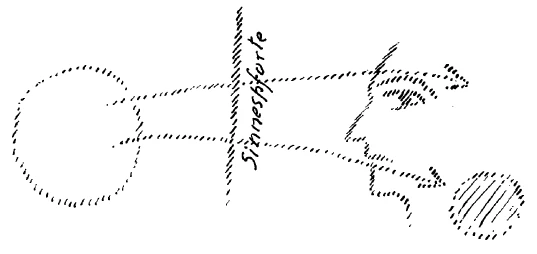
[ 19 ] That is why we still speak so often today of abstract ideals: of the great abstract ideals of truth, beauty, and goodness. But remember, as I explained here eight days ago, how what truth, beauty, and goodness are as abstract ideals here in the physical world correspond to beings in the spiritual world. It is toward these beings of the higher hierarchies—and not merely toward the abstract ideals of beauty, truth, and goodness—that the human soul will evolve once more, whereas now, through our actions and our human activities, we are, so to speak, pursuing abstract ideals. If we are to rise to idealism at all, we must develop to the point where we once again recognize our connection to a living spiritual world, from which the impulses for what happens here in the physical world must flow. Spiritual science will have to emerge in such a way that, through it, human beings receive impulses for what is to happen in the physical world. And I would like to say: Things are tangible—I mean this symbolically—but spiritually, of course, they are tangible!
[ 20 ] Consider what today’s materialistic culture of the fifth post-Atlantean epoch has to say about the future of humanity, about what human beings should do! Certainly, much of it is admirable. I have no intention whatsoever of reproaching or criticizing what is said there. But it is, after all, a search for abstractions! Moral ideals, economic ideals, all sorts of other ideals—they are abstractions. Compare the abstractions presented there—which are supposed to represent a human impulse in the future—with the living reality that human beings can know through spiritual science is destined to come to pass in the world! Take what one can understand by knowing that we will enter into this relationship with the hierarchy of the Angeloi, that this will enable us to fulfill this task, and that through this the world will take on this or that form, and so on. Try to piece together what you find in the various cycles regarding the way humanity will develop in the future—what it will do in a positive sense. Compare this with the abstract moral ideals that are otherwise put forward, and you will see the difference between what is living and what is merely dead and abstract. But this living reality is what we will need—the awareness that the world does not simply exist as a static entity: minerals, plants, animals, and human beings, with humans creating all sorts of ideals by which they govern themselves—mere abstractions according to which the world must be shaped. No, rather: minerals, plants, animals, human beings, angels, archangels, and so on—it ascends like a living chain! And from this living context flows, in turn, the vitality that is to flow into the development of humanity. Until we fully unfold, through spiritual science, to an understanding of this fact, there will always be only abstract ideals. Thoughts—as if thoughts had anything creative about them, unless these thoughts are the thoughts of the angels, archangels, and so on! This appropriation by consciousness of being in a living connection with a world meaning and a world purpose—that will come. Truth will become more moral, because people will feel a moral responsibility toward the truth. And morality will increasingly become a wisdom-filled insight, because people will know which beings they serve by performing this or that action.
[ 21 ] Essentially, what I have just said is also the correct understanding of the Christ principle for our time. What has been drawn from the Christ principle up to our time has not been able to prevent our age from declining—and continuing to decline—in many ways. But Christ, as I have often said, did not come by declaring: “I am here only for a moment; write down as quickly as possible whatever you know to say about me, and humanity is then to believe in this until the end of time!” — That this is the case is taught only by a short-sighted, narrow-minded theology of the present. What it teaches can often be put into words as if Christ had said: “I have done certain things; write them down quickly; then nothing must ever be added to them, and this must be taught until the end of the world.”
[ 22 ] This assertion is based on falsehood—a falsehood so great that one does not even want to utter it. I believe that those who continually act upon it do not even voice it. Falsehood—the utmost falsehood—underlies this impulse that drives one’s actions. For Christ said, “I will be with you always, even to the end of the age,” and that means: His revelation will always be available! In the early days of Christianity, it was the content of the Gospels; today, it is the content of spiritual science, which comes from the sources.
[ 23 ] Those who wrote down what could be written down at that time did not say: “We are writing, and there is nothing else to write down but what we are writing down”—but rather they said: “If one were to write down everything there is to say about the Christ, the world would not have enough books to contain it.”
[ 24 ] In a certain sense, it is precisely what pulsates through spiritual science that will lay bare a nerve of the understanding of Christ that cannot be laid bare by anything else in the present. It is truly necessary today to draw attention to the stance a person must adopt toward their own thoughts and toward the impulses that underlie their actions. So much—or at least it seems so much—has been written about this, but most of it lacks any foundation, because people today are determined to take the opposite path. They want to be done with thinking quickly and do not want to make thinking the path toward a goal that one believes one has attained only after walking for a long, long time. And then, once one has gained some understanding of the truth, there still comes a time when one realizes: even after examining a matter from every angle, a completely correct insight or formulation may emerge—yet one still need not stop looking at it from other perspectives, continuing to examine it.
[ 25 ] This, first and foremost, is what spiritual science is meant to instill in our souls as a very serious imperative. And this building, as far as it is now complete, actually stands there to foster an awareness of this task of spiritual science. And it is meant to stand there as a starting point—a small, fragile starting point—so that what has been said may enter into the hearts and souls of people. For this, of course, it is necessary that everything that can be done already be done, for there are many obstacles to this at present.