

The Riddle of Man
The Spiritual Background of Human History
GA 170
28 August 1916, Dornach
Translated by Steiner Online Library
Thirteenth Lecture
[ 1 ] In the lectures I have given, I have had to say many things that could be called paradoxical—things that may rightly sound paradoxical in the face of contemporary materialism. But that is indeed the case: insights from the realm beyond the threshold pertain to a different realm of the world—or perhaps we should say, to a different form of the world—than the one in which the sensory facts lie, which today are regarded in isolation by what calls itself science. Let us recall certain points that had to be addressed. Let us recall that we were able to explain the way in which the outward form of the human figure points to humanity’s connection to the world: How the human head, in its form and in its entire structure—that is, the head as it is—is, first of all, a formation that could not have been predisposed or come into being within earthly life, that is a result of the lunar forces, but which, in the way it is specifically and individually formed, is also, in every single human being, a result of their previous incarnation, and that, in turn, what constitutes the human body apart from the head is, so to speak, in the process of preparing to become a head in the next incarnation. Thus, in the form of the human head we have an indication of a previous incarnation; in what becomes of the human body, we have an indication of the human being’s next incarnation. The human form is indeed directly linked to the preceding and the subsequent incarnation. When one views the human being in this way, he thus points to a great cosmic context.
[ 2 ] You know that those rudiments that have survived from older, wiser times relate human beings, in terms of their physical form, to the twelve signs of the zodiac. Without, of course, wishing to comment here on the amateurish nature that astrological research often exhibits today, it is nevertheless worth pointing out that deep, significant mysteries lie behind this correspondence between the human form as a whole and the universe.
[ 3 ] You know that astrology assigns the head to Aries, the neck and larynx to Taurus, the area around the shoulder joints and everything expressed through the arms and hands to Gemini, the chest area to Cancer, everything related to the heart to Leo, what takes place in the lower abdomen to Virgo, the lumbar region to Libra, the genital region to Scorpio, the thighs to Sagittarius, the knees to Capricorn, the lower legs to Aquarius, and the feet to Pisces.
[ 4 ] Here we have the allocation of the entire human body, including the head, to the forces that govern the universe, which can be expressed in a certain way by symbolizing them through the fixed stars of the zodiac.
[ 5 ] Now, however, we have spoken of the fact that the head itself is actually a transformation of the entire body—namely, the body as it was in the previous incarnation—and that in the sense organs, which are, after all, represented in relation to one another within the head, we must again recognize a twelvefold structure, a true twelvefold structure. So we can draw a diagram something like this:
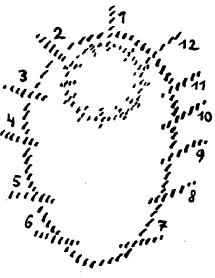
[ 6 ] Let us consider this schematically as the human body as a whole (see drawing), and if we were now to assign the head to Aries, the neck to Taurus, and so on, so that we assign the entire human being to the twelve constellations. Based on what we have now said about the interrelationship of the entire sensory organism, we must now take what is here assigned to just one constellation and in turn assign it to all twelve constellations. So we must repeat the same process here. And I would like to draw your attention to this peculiarity, which is repeated in virtually all the great laws of the universe. When one has something like a series of twelve, one element of the series always belongs to the whole and yet is, in turn, an independent element. That one element—the head—is assigned to one constellation and yet, at the same time—as something distinct and specific—is assigned to all twelve constellations. If what has been said is correct, one would have to assume that if this is the body in one incarnation that becomes the head in the next, then, in a sense, what is today the entire head would have to serve as a sense organ in the next incarnation. What is today the larynx—the organ of speech—along with everything in its vicinity, would have to serve, transformed and metamorphosed, a second sensory life in the next incarnation; that which expresses itself in the arms would serve a third sensory life, and so on. As we stand in the world, we might say: Transformed and metamorphosed, our entire body becomes a head in the next incarnation—and so regularly that the twelvefold structure present in our body today could reappear in the twelvefold structure of the head in the next incarnation.
[ 7 ] One might even ask: Is there any indication that this “twelveness” is actually contained within the head? — Well, most of you will know that twelve major nerve tracts originate from the human head. Once these are properly interpreted—not in such a pitifully confused manner as today’s brain physiologists do—one will recognize in these twelve nerve branches of the head what was assigned to the entire body in the previous incarnation. And there is no need to dwell on the paradox that, for example, what is now in the hands will one day appear as something on the head. One can perhaps even grasp such things quite easily, in broad terms. For isn’t what we have in our hands and arms—when we observe them properly from a physiognomic perspective—truly something that already shows us, as it were, the predisposition toward the speech organs? Do we not speak an eloquent language with our hands and arms? Why, then, should one not be able to believe that this will one day become something entirely different—something that, in essence, manifests itself on an entirely different level of existence as a sensory organ of the head? And to laugh at the idea that what is expressed today in our bodies through the knees might, as it spreads throughout the entire body, develop into the sense of touch—into a tactile organ—only someone who has absolutely no understanding of what the metamorphosis of existence actually is could laugh at that. This peculiarity of our human knees in particular—with the marvelous structure of the patella, which is so sensitive in a certain respect, yet in a different way than the tactile organ of the entire body—is precisely what is preparing to become the sense of touch in a future incarnation. Thus does that which is within us undergo metamorphosis, and through such things we glimpse into the deep mysteries of existence. However, in order to truly look into such deep mysteries of existence—and to look into them with reverence—it is essential that we not develop the attitude that prevails today in conventional science, an attitude that is, in fact, cynical in relation to what it ought to be. We need reverence toward existence if we wish to discern its mysteries. For quite some time now, modern humanity has carried its terrible arrogance and megalomania into all its worldviews. When this megalomania is particularly evident in individual characters, it comes as no surprise to those who see how, especially in the intellectual and scientific life of humanity, a megalomania and arrogance prevail that goes largely unnoticed today.
[ 8 ] In the humanities, I have often found it necessary to draw attention to this arrogance, which has been particularly rampant in the recent development of humanity. I have often spoken of how people write when they write about human achievements. One need only read what is written in schoolbooks or other works that speak of humanity’s inventive spirit regarding the invention of, say, paper—this very paper that makes one want to be so sad when one sees how much is printed on it in recent times. But what do people say about the human capacity that has brought about such things! I have pointed out that a wasp nest consists of the same material—real paper—and that millions of years ago, elemental beings underlying the construction of wasp nests had truly already made this invention before humans did. And one could say the same thing in a thousand different contexts. Take a look at a telescope that can rotate in two ways, so that it moves up and down and can also be swiveled. Schmick, who has made various efforts to draw attention to such things, has already pointed specifically to this telescope example. Look at what human beings have accomplished there! This dual movement of the telescope—back and forth and up and down—is achieved by a double mechanism for rotation: an upper mechanism, known in mechanics as a hinge joint, and a lower one, known in mechanics as a pivot joint. This allows the dual rotation to be produced correctly. Now, it would be foolish—as one can easily test with a telescope—to do the opposite: to place the pivot joint in the place of the hinge joint and the hinge joint beneath the pivot joint. That would be disadvantageous. One might now praise this as a profoundly significant human invention—that we have devised such a mechanism of movement. But in a far more ingenious way—if I use the word “ingenious” objectively, not subjectively—you all carry this mechanism right there at the back, where the head sits on your cervical vertebrae: a hinge joint at the top, a pivot joint at the bottom. And thanks to this, you are able to move your head up and down and turn it from side to side. You see, there we have exactly the same thing that is the subject of human thought today, right within the human organism.
[ 9 ] There is absolutely nothing that humans have invented or will ever invent that cannot be found in some form within the human organism. Everything that human beings have discovered and will yet discover in the realm of mechanical devices can be found in the human organism—everything that can truly contribute to human evolution. Only that which cannot contribute to human evolution is not found in human beings, or it is found in such a way that it is integrated quite differently than it is integrated by human beings into their own evolution. So we can say: If we look back to very, very early times, there must have been a time—this is inherent in the character and the entire spirit of evolution—when this peculiar joint mechanism and indeed many other things came into being. And now it exists. And in the course of human development—what is commonly called human development, namely the development in which human beings already possess the form they have today—we will be able to go back and go further back: we will never find that this structure was not there. And if it were to have arisen by purely mechanical means, how could that have happened? Just consider that this is a particularly functional mechanism—so functional that it can be put to good use in a telescope. Any other mechanism would be impractical. Now, according to a well-known principle of superficial Darwinism—superficial, I say—the functional is said to have evolved from the less functional. But what, for example, would the less functional consist of in this case? The less fit would make it impossible for humans, as they are now, to live at all. They would therefore not be able to live as they do now, and it is unthinkable that one could speak here of a transition from the less fit to the fit. Those who have developed the necessary counter-truths to the commonly accepted, superficially understood Darwinian truths have always drawn attention to such matters.
[ 10 ] How, then, will people in the future come to understand the relationship between humanity and the universe? I have already had to say something paradoxical about this as well. You will recall how I explained that the current belief that the heavens would reveal themselves is nothing more than a cliché, and that, in truth, the mysteries of the heavens—which will be explored and which Copernicanism treats as if the heavens could explain themselves—can shed light on what lives on Earth, and conversely, the mysteries of the Earth can shed light on the mysteries of the heavens.
[ 11 ] As paradoxical as it may sound today: In the future, people will study the development of the embryo—how it develops from a single cell and its environment, and so on, until it becomes a fully formed human being. What is observed there will be accepted as a revelation of the great cosmic, universal mysteries. And what we will observe in the heavens will have to be regarded as a principle of explanation for what takes place here on Earth in animals, plants, and human beings—especially in the embryonic stage. The heavens explain the Earth, and the Earth explains the heavens. I have already elaborated on this. It is still a paradox of our time—a genuine, serious principle of knowledge for the future that must be expanded.
[ 12 ] Today I would like to speak about something similar—I would say, a third paradox—that is connected to the reflections we have just been having on Ahriman and Lucifer in the wake of Goethe’s Faust. We are justified in seeking the manifestations, the revelations of Lucifer, in all that is expressed in human emotions, in human passions, feelings, and so on. We regard the Luciferic as acting more from within. When Eve set out to make herself beautiful in order to appear beautiful, to be the being who, as such, finds herself beautiful and can bring about temptation through her beauty—that is precisely when Lucifer had to intervene. When the other phase was to occur in the course of Earth’s evolution—namely, that the sons of the gods should find the daughters of men beautiful, that is, should find the object beautiful—Ahriman had to be at work. — To permeate Eve in such a way that she felt beautiful and could appear beautiful through her seduction: Lucifer. For the object to be found beautiful and to appear beautiful from the outside, Ahriman was necessary. The former falls within the Lemurian epoch, the latter within the Atlantean epoch.
[ 13 ] But we must come to know the Ahrimanic and the Luciferic in ever greater detail. Of course, I can only ever describe individual aspects of the Ahrimanic and the Luciferic. You must then piece together the Ahrimanic and Luciferic characters in their entirety from the individual characteristics I have given you.
[ 14 ] Perhaps some of you are familiar with what one might call a paradoxical occurrence that typically arises among those who move in circles where occultism, quasi-occultism, occultist fraud—well, and everything else related to these matters—is practiced. There, a certain experience can be had time and time again. So let’s assume there is a society calling itself occult, with a few prominent celebrities. After all, in such occult societies there are always celebrities who are believed in and sworn by. Now something emerges there that is propagated as a dogma. Well, let’s assume it emerges as a dogma that this or that personality is present, is the embodiment of a powerful, towering individuality, has accomplished something that ordinary people cannot, in some special way—let’s say, by writing great truths that are distributed in thousands upon thousands of copies throughout the world and regarded as something great, even though they may sometimes contain nothing but general platitudes; but that doesn’t matter. It happens time and again that precisely the most superficial things, when presented with the necessary sentimental embellishment, are accepted by thousands upon thousands of people as the “deepest of the deep.”
[ 15 ] When something like this happens, one often finds—and I don’t mean to single out any one specific case, but rather something typical—that there are various people who initially react with fierce opposition, saying: “We don’t want dogmatism; that’s nonsense; we don’t want anything like that; we’ll never believe in it.” — They launch a sort of campaign against it. Then some celebrity who advocates the cause comes along and meets one of these rebels. And you can observe that within a few hours—literally within a few hours—the rebel is converted and becomes the most ardent supporter. Sometimes it doesn’t even take hours—perhaps not even a full hour. These things can be witnessed time and again. And one can observe that people then come and ask: “Well, how is that possible?” That person—it really isn’t just “they,” but it’s actually often “he,” truly—was just a moment ago thinking quite clearly about this matter, and no sooner have they had a brief conversation with this occult celebrity than they are as if transformed; they now believe in everything.
[ 16 ] There are people sitting here who know that these things have happened. Has conviction truly been brought about in such a case? No, what we here in ordinary life call “conviction” in waking consciousness cannot even be considered in such a case. Rather, the matter must be understood quite differently. And to understand it, let us consider for a moment the character of Ahriman.
[ 17 ] You see, one of Ahriman’s main characteristics is that he is actually completely unfamiliar with that unbiased relationship to truth that human beings, as they live here on Earth, possess. Ahriman does not know this unprejudiced relationship to truth, in which one strives simply to have truth as the correspondence of a concept with an objective reality. Ahriman does not know this. That is why he is not at all concerned with it. Given the entire position that I have already described on several occasions—the position Ahriman holds in the cosmos—he is truly utterly indifferent, when forming a concept, as to whether it corresponds to reality. For him, Ahriman, in everything he forms for himself as truth—we would not call it truth in a human context—but what he develops for himself as truth, it is always about effects. Something is not said to correspond with something else, but to have an effect. This or that is said so that it produces this or that effect.
[ 18 ] So, it would be Ahrimanic if I were to say this or that to someone—let’s say in connection with the building—while being completely indifferent to whether it is true or not, if my sole intention were to cause the person in question to do this or that, knowing that if I say this to him, he will do this or that.
[ 19 ] I think you can imagine that this is possible—that one might come up with something, regardless of whether it corresponds to reality or not, but which is presented in such a way that it has a certain effect on the person hearing it. — On a smaller scale, there are all sorts of things like this among people. One could cite many examples, but just think for a moment about all the things those matchmakers say when they’re trying to earn a commission by setting two people up, claiming that the bride or the groom should do this or that! They really don’t care whether the facts are accurate, but rather that, under the influence of what they say, they earn their matchmaking fee. That is just a very small, illustrative example! Of course, Ahriman does not concern himself with such minor examples. But I mean, we naturally have an analogue for everything in human life.
[ 20 ] So, in the case of Ahriman, all his statements are effects. And he shapes his statements in such a way that he can assist when it comes to communicating such things. Now imagine that it would be advantageous for Ahriman to create a number of people on Earth who believe in something specific—namely, what I was just talking about. Now, if someone is so deeply initiated into the mysteries of evil occultism—and, due to the nature of their initiation, has no inclination to replace this occultism with the true one—then they can, if you’ll allow me this paradoxical turn of phrase, connect with Ahriman in such a way that they can impart to someone a truth that is Ahrimanic—that is, a truth that, in the human sense, is not a truth at all—but one that is meant to have an effect! And this always underlies what I have just described, where, in the space of a very short hour, someone who was quite rebellious is influenced through Ahrimanic arts. In alliance with Ahriman, one can indeed lead another person to believe that this or that transcendent individuality is incarnated in this or that human personality. One need only know the arts of introducing truths into any sphere of life—in this case, into humanity—in such a way that one calculates only their effect, not their correspondence with objectivity.
[ 21 ] Such practices are carried out in many communities that call themselves occult. In many such communities that call themselves occult, the aim is by no means merely to develop ideas that are in accordance with objectivity, but rather to say things that produce very specific effects—in one direction or another.
[ 22 ] Certainly, there may also be people who are so stupid and foolish that—without the Ahrimanic arts being directly practiced by a human being—they unconsciously absorb Ahrimanic impulses, as it were. But it is already a fact within humanity that Ahrimanic arts—that is, arts directly brought about in alliance with Ahriman—are actually practiced. And for our time, these things that arise from humanity’s alliance with Ahriman are of particularly great significance. For much of what has been happening within humanity for a long time occurs in a way that can only be understood if one knows the mysteries to which subtle allusions have been made here.
[ 23 ] For Ahriman, then, the point is that he never looks at whether an idea corresponds to objective reality, but rather at the effect—at what can be achieved.
[ 24 ] With Lucifer, it is a different matter. Lucifer has different characteristics. Well, we have already pointed these out. But now we also want to highlight a particular characteristic of Lucifer so that we can come to understand these things better and better. You see, even with Lucifer, it is not a matter of harmonizing any concept with objectivity—absolutely never—but rather of developing those concepts that bring about as much consciousness as possible in human beings. So please understand me clearly on this point: to bring about as much, as intense, and as widespread a consciousness as possible in human beings. This widespread consciousness, in which Lucifer is interested, is, when it is brought about, linked at the same time to a certain inner sensuality in human beings. And this sensuality, in turn, is Lucifer’s domain. You may recall that I pointed out, with regard to the Atlantean era, that up to a certain point in time, everything sexual took place unconsciously. Beautiful myths from various peoples point to this unconscious nature of the sexual process in earlier times. It was only brought into consciousness over the course of time. Lucifer plays a significant role in bringing the unconscious into the conscious and into an ever-increasing state of consciousness. His aim is to evoke consciousness in human beings outside the appointed time, outside the proper cycle of time—that is, to evoke consciousness prematurely, at a time when this level of consciousness would actually be properly developed at a different point in time. Lucifer does not want human beings to be directed toward something external just like that. He wants everything that acts upon consciousness to act from within; therefore, all visionary life that is, as it were, forced out from within has a Luciferic character. If one comes to know Lucifer—as one must, since he must, of course, always be placed in the proper context with regard to his effects, given that one is dealing with spiritual forces in the universe—it strikes one as particularly abhorrent that Lucifer has not the slightest understanding for humanity’s harmless delight in external things. This harmless delight in what comes from the outside—for that, Lucifer has not the slightest understanding. He does, however, have an understanding for what is stirred up by all manner of inner forces. Lucifer has a deep understanding of how someone stirs up a passion within themselves, indulges in it, and derives pleasure from it, so that what would otherwise remain subconscious is brought into consciousness as much as possible. But despite his wisdom—for Lucifer does, of course, possess great wisdom—he cannot understand a harmless joke that someone makes, prompted by some external event. That lies entirely outside Lucifer’s realm. And one can actually protect oneself against Luciferian assaults—which he undertakes very easily—by trying to live in what brings harmless delight, what entertains a person in a harmless way from the outside. Lucifer cannot stand that at all. If one takes pleasure in a good caricature, it annoys Lucifer terribly.
[ 25 ] Yes, such are the connections that reveal themselves when one moves from the material realm of the sensory world into the realm that lies beyond the threshold, when one enters that sphere where everything does not have the character of things as in the physical world, but rather the character of beings, of the living. Even when one enters the elemental world, everything has the character of the living. So you see that one can say, in a sense: For both Ahriman and Lucifer, the correspondence between the idea and objectivity is irrelevant. In the case of Ahriman, it is the effect of what he says; in the case of Lucifer, it is the expansion within human nature of that which, in a certain situation, should not actually become conscious—that which lies outside the proper cycle of time and is linked to a certain inner lust.
[ 26 ] For it is through these two approaches that one can achieve things that cannot be achieved by relying solely on the correspondence between one’s conception and objective reality. And just as in certain unscrupulous occult circles an alliance with Ahriman is sought for the reasons I described earlier, so too in these same unscrupulous occult circles an alliance with Lucifer is sought, in an attempt to influence human beings in such a way as to evoke in them a vision of a voluptuous nature—that is, a vision kindled from within.
[ 27 ] What is deliberately brought about in so-called occult circles—what is entered into as an alliance with Ahriman and Lucifer—is, of course, also brought about by the fact that Ahriman and Lucifer work into the unconscious of human beings. And much of what must be said critically about the character of the fifth post-Atlantean epoch in particular—as it is now unfolding in the wider world out there—must also be attributed in this way to Ahrimanic and Luciferic impulses. The fact that so much is said that is outright false or a lie, and that so much is said not because one first seeks justification to speak based on conformity with objectivity, but because one wants to say it—because it corresponds to emotion, passion—this is attributable to the fact that Ahrimanic and Luciferic currents have indeed taken hold of the world very strongly in a chaotic manner. For in the current development of humanity, we would not be able to make assertions out of passion without first examining their correspondence with objectivity if we were to entrust ourselves solely to the good powers. The Atlantean human being—and the post-Atlantean human being, at most up to the middle of the fourth post-Atlantean period—was still able to find truths from within, in accordance with the objectivity described. But that, as we know, has been lost. Our current cycle of time exists precisely so that humanity can learn to observe the external world, to examine the external world, and not to form assertions based on passions.
[ 28 ] So if, even today, truths are formed from within without seeking harmony with the external world, this is a Luciferic current that aligns itself with Ahrimanic currents, whereby the former does not produce true consciousness, and the latter produces falsehood or insincerity. — And what is described here is already very, very widespread in the present. For today, many souls have been deprived of true consciousness of what it actually means for a concept to correspond to objectivity. People do not seek in this direction at all. And when one attempts to find precisely this correspondence between the concept and objectivity, then people do not understand it at all; from many perspectives, they regard it as something that—well, it is actually—it is hard to find a word for it—something surprising, that it can be done this way. In these circles, one finds the least approval precisely when one attempts to provide such characteristics of reality that are based on what is actually there—that simply take the things of the world and reproduce them in the mind. This is sometimes very poorly understood. People do not understand at all that this is something different, something quite radically different from what someone does when they are driven by this or that passion—be it a personal passion or a national passion—and simply shape their assertions according to that passion. But therein lies the radical difference that people still fail to notice today. People often formulate assertions based on how they already think, on the direction of their thinking, and in doing so fail to see whether such assertions correspond to the facts. But what matters today is that our assertions correspond to the facts. For otherwise, we can never hope to enter an era in which the spiritual world can be viewed in the right way. If we do not cultivate an attitude toward factuality in the physical world, we will not be able to find it in the spiritual world. The ability to immerse oneself properly in the spiritual world must be acquired here in the physical world. That is why we have been placed in the physical world, where we are called upon to seek the correspondence between our ideas and objective reality, so that we may acquire this ability, so that it may become a habit, and so that we may carry it over into the spiritual world.
[ 29 ] But how many people today make claims—without caring in the least whether they are objective—based solely on emotion? This is moving in exactly the opposite direction from where the world must go if humanity is to move forward. And thinking in accordance with reality has been lost in such a terrible way in our materialistic age, under the influence described above; thinking in accordance with reality is so rare today. And when thinking in accordance with reality is honestly sought, it clashes with everything that constitutes unrealistic thinking today. You can see this in a terrible way in the fact that we must speak again and again of the clashes between our anthroposophical movement and unrealistic thinking, because the facts are there, and because one cannot remain silent if one is sincere about this movement.
[ 30 ] These clashes between the kind of thinking that is grounded in reality—which we strive for—and the kind of thinking that is hostile to reality—hostile in the sense in which it has been characterized—show what is at stake today for anyone who wishes to uphold the truth. Certainly, the struggle against opposing forces has had to be waged in every age; but one must also come to know it anew in each age in its particular form, in its particular metamorphosis. Pharisaism, too, has not died out; it is simply found today in a different form. And we will only be able to move forward with the clarity that is necessary if we truly understand this difference between thinking in accordance with reality and thinking hostile to reality.