The Riddle of Man
The Spiritual Background of Human History
GA 170
2 September 1916, Dornach
Translated by Steiner Online Library
Fourteenth Lecture
[ 1 ] The conclusion drawn from considerations in the humanities—which we have even cited repeatedly in recent times—regarding the relationship of the human head and the rest of the human body—with the head being integrated into the rest of the body—to the whole of the world, is indeed of the most far-reaching significance. You know, of course, how we have described it. We have said: What a human being carries as his head, along with everything that belongs to it, is a transformed form, a transformed shape, a metamorphosis; and that from which this head has been transformed and reshaped is the entire body of the previous incarnation. So when we look at the entire body of our present incarnation, we see how it carries within itself the forces that can transform it so that it becomes merely a head—a head with all that belongs to it, with twelve pairs of nerves springing from it, and so on. And this head, which develops from our entire body, we will carry with us into our next incarnation. In contrast, during the time between our death—after our present life—and our birth in the next incarnation, our body— that is, everything that belongs to our body, is prepared for the next incarnation.
[ 2 ] Such truths should not be taken in the same way as the truths of everyday life or ordinary science, but rather as truths that carry meaning within themselves, as truths that point to larger contexts. With regard to the truths of everyday life, we describe, in a sense, ourselves and our surroundings; with regard to truths such as those mentioned, we interpret our surroundings and ourselves within the context of the world. The truths of everyday life and ordinary science are really like describing the shapes of individual letters on a page, or at most explaining the grammatical rules governing how they combine to form words. But what is meant by truths such as those mentioned can be compared to reading without first devoting a special description to the shapes of the letters, without focusing on the grammar, and without considering how these letter shapes combine to form words. Just think how completely different the content of what we read is from what is actually written on the page for our eyes to see. Similarly, when we cite a truth such as the one just mentioned, we do not have only what we are now stating in mind, but rather we have in mind the entire far-reaching significance of such a matter for humanity’s place in the universe. In a sense, we thereby read deeply vibrant spiritual truths that have nothing to do with the forms of the head or the body—those studied by anatomy and physiology, or those we encounter in everyday life when we speak of the human form. One can only truly understand human beings not merely by describing them, as everyday life and science do, but by reading them.
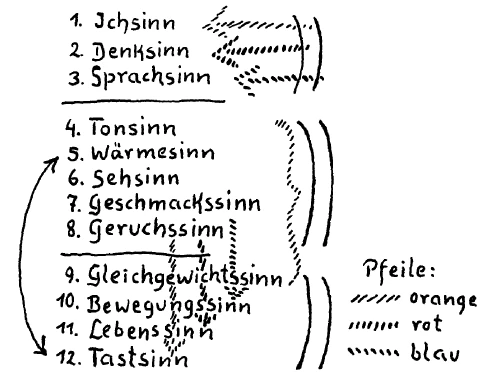
[ 3 ] Based on this premise and in keeping with it, let us once again turn our attention to what we have also discussed in the context of the past few weeks. Let us focus on the twelve senses of the human being. Let us review them once more, these twelve senses of the human being.
[ 4 ] Sense of Self: I ask you to consider once more what I have said regarding this sense of self. This sense of self does not refer to our ability to perceive our own self. With this sense of the “I,” we do not perceive our own “I”—the “I” that first came to us here on Earth—but rather, with this sense of the “I,” we perceive the “I”s of other people. In other words, we perceive with this sense of the “I” everything in the physical world that approaches us as endowed with an “I.”
[ 5 ] The second is the faculty of thought. The faculty of thought, in turn, has nothing to do with our own thought processes. When we think for ourselves, this thinking is not an activity of the faculty of thought, but something entirely different. We will discuss this further. The thinking sense refers to our ability to understand and perceive the thoughts of other people. So, at first, this thinking sense has nothing to do with our own thought processes.
[ 6 ] Sense of language: This, in turn, has nothing to do with the development of our own language, nor—at first—with the ability that underlies our own speech; rather, it is the sense of understanding what is spoken to us by another person.
[ 7 ] Sense of hearing or sense of sound: There’s no way that can be misunderstood.
[ 8 ] The sense of heat, the sense of sight, the sense of taste, the sense of smell, the sense of balance: I have, after all, explained these senses on several occasions before, and again in these reflections.
[ 9 ] Sense of movement, meaning of life, sense of touch.
[ 10 ] These are the twelve senses through which we perceive the external world here in the physical world. As you know, materialistic thinking recognizes only the sense of sound, the sense of heat—though it conflates this with the sense of touch—the sense of sight, the sense of taste, and the sense of smell, and consequently speaks of five senses. However, modern science—modern physiology, specifically sensory physiology—already adds the sense of balance, the sense of movement, and the sense of life, and also distinguishes between the sense of touch and the sense of heat. Conventional science and conventional physiology do not speak of a specific sense of language, a specific sense of thought—one might also say a “sense of thought”—or a specific sense of the self, because, given the nature of their thinking, they are still unable to speak of these today. After all, the materialistic way of thinking and viewing the world tends to limit itself to everything that is perceptible through the senses. Admittedly, there is a certain absurdity in saying “sensorily perceptible,” because one arbitrarily delimits what is sensorily perceptible—namely, what is perceptible through the five senses; but you all know what is meant when one says: The ordinary materialistic view accepts only what is perceptible through the senses, and therefore seeks organs of perception for the senses as well. Because it has absolutely nothing at its disposal other than an organ of perception for the sense of the self, the sense of thought, and the sense of language—because it has absolutely nothing for these that it could compare, for example, to the ear for the sense of sound or to the eye for the sense of sight—it does not speak of these senses: the sense of the self, the sense of thought, the sense of language. But this raises the question for us: Are there really no organs for the sense of the “I,” the sense of thought, and the sense of language? Today we would like to delve into a more detailed examination of these matters.
[ 11 ] By “sense of the self,” we mean our ability to perceive the selves of other people. A particularly inadequate and insufficient assertion of modern thought is that we do not actually perceive the self of another person at all, but rather always—to a greater or lesser extent—merely infer it. We see something approaching us—so this way of thinking assumes—that walks upright on two legs, always moving one leg past the other or placing one next to the other; supported by these legs, it has a torso from which two arms swing, performing various movements for various purposes; then, sitting atop this, is a head that emits sounds, speaks, and makes gestures. And when something like this, as I have just described it, approaches us, we conclude: This is the bearer of an “I.”—So says the materialistic view. This is utter nonsense, real, genuine nonsense; for the truth is that just as we see colors with our eyes and hear sounds with our ears, we also truly perceive the “I” of the other person. Without a doubt, we perceive it. And this perception is an independent one. Just as seeing is not based on an inference, just as hearing is not based on an inference, so too the perception of the other’s “I” is not based on an inference, but is an immediately real, independent truth that is gained independently of our seeing the other or hearing their sounds. Apart from the fact that we hear their speech, that we see their physical form, that we allow their gestures to affect us—apart from all of that, we perceive the other’s “I” directly. And just as the sense of sight has nothing to do with the sense of hearing, so too does the perception of the “I” have nothing to do with the sense of sight, or with the sense of hearing, or with any other sense. It is an independent perception of the “I.” Until this is understood, the science of the senses will not rest on solid foundations.
[ 12 ] This raises the question: What is the organ for perceiving the other self? What within us perceives the other self, just as we perceive colors or light and dark with our eyes, or sounds with our ears? What does the other’s “I” perceive? The perception of the “I” now has its own organ, just as visual perception or auditory perception does. However, the organ of “I”-perception is, so to speak, structured in such a way that its point of origin lies in the head, but the entire region of the rest of the body—insofar as it is dependent on the head—forms an organ for the “I”-perception of the other. Indeed, the whole human being, conceived as an organ of perception—insofar as he is here constituted in a sensory-physical way—is an organ of perception for the “I” of the other. In a sense, one could also say: the organ of perception for the “I” of the other is the head, insofar as it has the whole human being attached to it and its capacity for perception of the “I” radiates through the whole human being. The human being, insofar as he is calm, insofar as he is the calm human form with the head, so to speak, as its center, is an organ of perception for the “I” of another human being. Thus, the organ of perception for the “I” of another human being is the greatest organ of perception we possess, and we ourselves, as physical human beings, are the greatest organ of perception we possess.
[ 13 ] Now we come to the meaning of thought. What is the organ of perception for the thoughts of others? The organ of perception for the thoughts of others is everything that we are, insofar as we feel activity and life within ourselves. So if you consider that you possess life throughout your entire organism and that this life is a unity—not insofar as you are formed, but insofar as you carry life within you—then this life of the entire organism that you carry within you, insofar as it expresses itself physically, serves as the organ for the thoughts that come to us from the outside. If we were not constituted as we are, we could not perceive the “I” of another; if we were not animated as we are, we could not perceive the thoughts of another. That is not the meaning of life of which I am speaking here. The issue here is not that we perceive our overall state of being internally—that is part of the meaning of life—but rather that we carry life within us. And this living force within us, everything that constitutes our physical organism of life, serves as the organ of perception for the thoughts that others direct toward us.
[ 14 ] And insofar as we have the power to move—to carry out all the movements that originate within us—for example, when we move our hands, when we turn our head, or when we move it up and down—we are carrying out movements from within. So, insofar as we possess these forces to set the body in motion, this ability to move is grounded in a physical organism within us. This is not the physical organism of life; it is the physical organism of motor function. This is also, at the same time, the organ of perception for language, for the words that others send our way. We could not understand words if we did not have a physical motor system within us. Indeed, insofar as the nerves for our entire motor process originate in our central nervous system, the sensory apparatus for the words spoken to us is also located there. This is how the sensory organs specialize. The whole human being: a sensory organ for the “I”; the living force underlying the physical: a sensory organ for thinking; the human being capable of movement within itself: a sensory organ for words.
[ 15 ] The sense of sound is even more specialized. Although it encompasses more than what physiology usually considers part of the auditory system, the sense of sound is nonetheless more specialized. Well, I don’t need to discuss the sense of sound. If you pick up a standard textbook on sensory physiology, you will find the sense of sound and the organ of the sense of sound described there. It is still more difficult today to find a description of the organ for the sense of heat, because, as I said, it is conflated with the sense of touch. But the sense of warmth is actually a highly specialized sense. While the sense of touch is distributed throughout the entire organism, the sense of warmth is only seemingly distributed throughout the entire organism. Of course, our entire organism is receptive to thermal influences, but as a sense—as the perception of warmth—the sense of warmth is highly concentrated in the human torso, in the chest region. — The specialization of the organs for the senses of sight, taste, and smell is, of course, well known from ordinary observation or from what conventional science has to say.
[ 16 ] Now we can truly distinguish, in a certain sense, between the middle, lower, and upper aspects of our sensory life, and today we would like to make a special observation regarding this distinction. Let us begin with the sense of language and consider it. I said: To the extent that we possess an organic capacity for movement within us, we are able to perceive words. This, then, underlies the sense of language. But we can not only perceive and understand the words of others; we therefore do not merely have a sense of language, but we also have a capacity for language, a potential for language—we speak ourselves. And what is now interesting and important is the relationship between our ability to speak and our ability to understand language—that is, not merely to hear the sounds (please distinguish between the two), but to understand language. A precise distinction must be made here between a sense of sound and a sense of language. So we can not only understand the words of others, but we can also speak ourselves. How does one relate to the other—speaking to understanding language?
[ 17 ] When we examine human beings using the methods of spiritual science, we find that what underlies the understanding of words and what underlies speech are very closely related to one another. If we wish to examine what actually underlies speech, we can first go back to human soul life, in which—as is undeniable to anyone of sound mind—the origin of speech lies. Speech originates in the soul and is kindled by the will within the soul. Without our willing—that is, without developing a volitional impulse—no spoken word naturally comes into being. If we now observe a person from a spiritual scientific perspective while they are speaking, something similar takes place within them as when they understand what is being spoken. But what happens when a person speaks themselves involves a much smaller part of the organism, much less of the motor system. That is to say, the entire motor system comes into play as the sense of speech, as the sense of the word; the entire motor system is, at the same time, the sense of speech. A part is singled out and set in motion by the soul when we speak—a part of this motor system. And this singled-out part of the motor system has its main organ in the larynx, and speech is the stimulation of movements in the larynx through the impulses of the will. What takes place in the larynx when we speak happens in such a way that impulses of the will arise from the soul and set the motor system concentrated in the laryngeal system in motion, while our entire motor system serves as a sensory system for the perception of words. The difference is that, as we perceive words, we keep this motor system at rest. It is precisely because we keep it at rest that we perceive and understand words. In a certain sense, every person knows this instinctively; for every person occasionally does something instinctive that suggests they know in their subconscious what I have just explained. I will speak in very general terms. Imagine I make this movement (raising a hand in defense). The ability to make this movement—insofar as it arises from my entire motor system—for every tiny movement is not localized in just one part but arises from the whole motor system of the human being—brings about something very specific. By not making this movement, I do what I must do in order to understand something specific that is expressed in words by another person. I understand what the other person is saying by not performing this movement while they speak, but rather by suppressing it—that is, by stimulating my motor system only to a certain extent, down to the fingertips, but holding back the movement, thus pausing and restraining it. By restraining this very movement, I comprehend what is being said. If one does not want to hear something, one often makes this movement—intending to indicate that one wishes to suppress hearing. This is the instinctive knowledge of what this holding back of movement signifies.
[ 18 ] Now, human beings are originally endowed in such a way that the entire organism of movement—which is at the same time the organism of verbal meaning—is, so to speak, what is appropriate in the ongoing evolution of humankind. Just as we were once, in the Lemurian epoch, released from our connection with the totality of the world, we are predisposed to understand words. But at that time we were not yet predisposed to speak words. It may seem curious to you that we could have been predisposed to understand words but were not predisposed to speak them. But this is only seemingly curious; for our motor organism is not precisely predisposed to hear and understand the words of others—that is, to understand the words of fellow human beings—but rather to understand various other things. We were originally much more predisposed to understand the elemental language of nature, to perceive the workings of certain elemental beings in the external world. We have forgotten this; in exchange, we have gained the ability to speak ourselves. This came about because, during the Atlantean epoch, the Ahrimanic power brought about a transformation in our motor system, which had originally been bestowed upon us. It is to the Ahrimanic power that we owe our ability to speak, our gift of language. So we must say: As human beings, we were actually originally predisposed to perceive language differently than we do now. We were predisposed to perceive language in such a way that we would have actually faced the other person directly—and as strange as that may seem to us now, we naturally grow accustomed, especially over such a long period of time as has elapsed since the Atlantean era, to what has just happened— we were predisposed to perceive the other person more or less entirely through gestures and body language, through silent means of expression, and to imitate these ourselves with our own motor apparatus, thus communicating without physically audible speech. We were predisposed to communicate in a much more spiritual way. Ahriman intervened in this more spiritual mode of communication; he specialized our organism, adapting the laryngeal system to produce spoken words. And what remains of the laryngeal system—its ability to understand spoken words—is thus an Ahrimanic gift.
[ 19 ] Insofar as we are living organisms, we are capable of perceiving the thoughts of others. Moreover, we were once predisposed to perceive the thoughts of others in a much more spiritual way than we actually do now. In a sense, in a simple face-to-face encounter, we were once capable of intuitively sensing another’s thoughts and reliving them. The way we perceive the thoughts of others today—even only indirectly through language—is a crude physical reflection of that. And at best, if we train ourselves a little to observe the other person’s gestures, facial expressions, and physiognomy, we can still perceive a faint echo of what we were once predisposed to do. We were predisposed to perceive a person’s entire way of thinking simply by standing before them, to live it out, and to perceive the individual expressions of thought through their individual gestures and facial expressions. Once again, it is an Ahrimanic gift that has transformed this more spiritual mode of perceiving the world of thought, a mode that, even in the course of human evolution, has become increasingly concentrated on external language.
[ 20 ] We did not need to go back very far in human development—only as far as the Egyptian-Chaldean period, not to mention the Indian period, where this was still highly developed—we only needed to go back beyond the Greco-Latin period, where we still find a subtle understanding among humanity of the life of thought, insofar as it was expressed in unspoken words, in what came to expression through physiognomy, through gestures, even through postures, through the entire manner in which one person relates to another. Humanity has lost this understanding. Less and less of this has been preserved, and today there is already very little understanding of how to discern the inner secrets of a person’s thoughts from the way they approach us. We listen almost exclusively to what comes to us from their thoughts—in their thoughts, about their thoughts—through the audible words they communicate to us. But because this has happened, we have gained the ability to transform our life apparatus, our life organism itself, into a thinking apparatus. We would not have the gift of thinking if what I have described had not occurred, if that Ahrimanic influence I have spoken of had not come about. So you see that, in a certain sense, our present-day ability to speak is connected to our sense of words and language, but indirectly through Ahrimanic influences; and that our present-day ability to think is connected to our sense of thought, again indirectly through Ahrimanic influences.
[ 21 ] Then we were predisposed to sense the “I” of another human being in a subtle way—not merely to experience it, but to perceive it inwardly; for our entire being is an organ of the “I” sense. Ahriman is still working very intensely today to specialize this sense of the “I” as well, just as he has specialized and transformed the sense of language and the sense of thought. This is even in the process of becoming, and it is expressed in the fact that, in this regard, humanity is moving toward a remarkable tendency. One must say something quite paradoxical when speaking of what is actually meant here. Today it is expressed only in its very earliest stages, and actually more in a philosophical sense. There are already philosophers today who completely deny the ability to experience the “I” inwardly: for example, Mach and others; I spoke of this in the philosophical lecture I gave recently. These people would actually have to hold the view that one has no ability to perceive the “I” inwardly, but rather that one perceives the “I” by perceiving others. And the tendency is to think in the way I am now going to illustrate in a grotesque manner. People would end up saying to themselves: Here come others toward me, walking around on two legs, swaying back and forth as I described earlier, and from this I conclude that there is an “I” within them. And because I look just like them, I conclude in turn that I, too, have a self. — One would thus infer one’s own self from the selves of others. This is already inherent in the nature of many assertions made today, particularly when, from the perspective I just mentioned, it is described how the self actually develops during our individual evolution between birth and death. Look into contemporary psychology, and you will find descriptions of how this sense of “I” develops through our interaction with others. Because we do not possess it at first as children, but perceive it in others, we project what we see in others onto ourselves as well. The ability to infer from others to ourselves will, of course, become greater and greater. Just as the capacity for thought has gradually developed from the capacity of the sense of thought, and the capacity for language from the capacity of the sense of language, so too will the capacity to experience ourselves in relation to the whole world become increasingly developed, alongside the capacity to perceive other “I’s.” We are dealing here with finer distinctions, but one must grasp them. In a sense, the Ahrimanic forces are very much at work in this aspect of the human being—very, very much so.
[ 22 ] Let’s now look at the human being from the other side. There we have the sense of touch. I told you: the sense of touch is actually, at its core, an inner sense. For when you touch something—say, the table—it exerts pressure on you; but what you perceive is actually an inner experience. What is brought about within you by the contact—that is what the perceptual experience actually is. What you experience there remains entirely within you through the sense of touch. So the sense of touch is, after all, something that essentially extends only to the outermost periphery of the skin; and because the external world comes into contact with this periphery of the skin, and we have inner experiences following this contact or other interactions with the external world, we have the experiences of the sense of touch. The sense of touch is thus the most peripheral of the senses and yet, fundamentally, an internal sense. The apparatus for touch is most highly developed at the periphery and sends only its fine branches inward; these are not properly elucidated by external scientific physiology simply because the latter does not properly distinguish the sense of touch from the sense of heat.
[ 23 ] We also possess an organ of touch that is, so to speak, spread out like a network across our entire surface and sends fine branches inward. This network—if I may call it that—is a rough description—but what is it, really? What was its original purpose? It is, after all, a striking fact from the outset that this sense of touch—even though it is now used to perceive the external spatial world through touch—provides us with inner experiences in its own experiences. This is a fact that is just as undeniable as it is significant and remarkable. And it is connected to the fact—as spiritual science reveals—that this sense of touch was not originally intended to perceive the external world as it is today, nor was it intended to perceive the physical external world at all, but rather has undergone a metamorphosis. This sense of touch is actually intended to enable us to extend our “I”—conceived entirely in spiritual terms, the fourth member of our organism—spiritually throughout our entire body. And the organs that constitute the sense of touch originally provide us, in our inner experience, with our sense of “I,” our inner perception of the “I.”
[ 24 ] Now we come to the inner perception of the self. So please distinguish: The essence of the “I”—which is a real essence, a spiritually substantial essence—resides within us and extends within us all the way to the network of the sense of touch; and that which constitutes the network of the sense of touch—which is internally touched by the extending “I”—provides the perception of the “I.” If it had remained in its original state, the nature of which I have now outlined, then we would not have the kinds of perceptions through the sense of touch that we have now. We would certainly still encounter objects in the external world, but that would leave us utterly indifferent. We would not experience this encounter—or, if you will, this running of our fingertips over the objects—as touching. We would therefore experience such encounters with the external world in such a way that we would perceive our “I” in the process, experience our “I” in the process, but we would not speak of a perception of the external world. Since our evolution began in the Lemurian epoch, our organism has had to be transformed so that it could evolve from a stimulus for the inner “I” into a tactile organ capable of perceiving the external world through touch. And this is a Luciferic act; it is attributable to a Luciferic influence. As a result, our experience of the “I” has become so specialized that we experience the external world through touch, which has naturally also clouded our experience of the “I.” We would have a completely different sense of the “I” if we walked through the world without constantly having to pay attention to what bumps or presses against us, or whether something is rough or smooth, and so on.
[ 25 ] Thus, the Luciferic element—which shaped the sense of touch—intermingles with the experience of the “I.” Here, then, the innermost aspect is mingled with an outer aspect, just as in the sense of language, an outer aspect is mingled with an inner one. The sense of language was intended to perceive only words, which then need not be spoken aloud—that is, to perceive meaning. Speech as an inner process has become intertwined with this. Here, it was an inner process, and an outer element has been added: perception from the outside.
[ 26 ] The meaning of life: That which constitutes the organ of the sense of life—through which we perceive and experience our inner structures and our inner constitution—has now been transformed in a similar way by a Luciferic influence; for originally, in this regard, we were intended only to perceive our astral body inwardly, experiencing it within our life organism. Now, however, the ability to experience the inner physical condition, the inner state of the human being, as a feeling of well-being or discomfort has been introduced. This is a Luciferic impulse that has been introduced there. Just as the “I” is linked here with the sense of touch, so too is the astral body linked here with the feeling of well-being or discomfort regarding our life state.
[ 27 ] And again, our motor system was originally designed in such a way that we would experience only the interaction of our etheric body with our motor system. Added to this is the ability to perceive and experience our inner mobility—the very sense of movement itself. Yet another Luciferic impulse. We therefore owe the transformations of our entire human being to both Luciferic and Ahrimanic influences. The senses originally intended for the physical plane—the sense of the “I,” the sense of thought, and the sense of speech—have been transformed by Ahriman. And it is only through the Luciferic transformation of the sense of touch, the sense of life, and the sense of movement that we have become what we are as human beings on the physical plane. And there is only one intermediate realm that has, so to speak, remained preserved from these influences. This is the more precise, detailed description of our organism.
[ 28 ] I do not wish to go any further in this reflection today, but will continue it tomorrow, because it is already good enough to give this some thought. For tomorrow we will see how fruitful is what we have just discussed, in order to expand upon the great, significant truth—one that reveals so much—regarding the relationship of our head to our body from the previous incarnation, to the body of the present incarnation, and back to the head of the following incarnation, and what this implies for our entire relationship to the cosmos.
[ 29 ] We see here how it is already necessary to focus our attention on that state of balance—which is the essential, the significant—that must be established between the Ahrimanic and the Luciferic in the world. Consider that, in a sense, the human “I” is involved at the outermost ends: here, so to speak, the “I” from the outside, and in the sense of touch, the “I” from the inside. (See diagram, orange arrows.) Similarly, the astral body is involved in thinking, but is also involved in the life organism from the inside (red arrows). The etheric body is involved here when speech is not taking place, but is equally involved in the sense of movement from within (blue arrows). In the center, we have, so to speak, that which is less involved in “I feel—think—live—speak—move”—a kind of hypomochlion, like the center of a balance where it rests. The closer one gets to the center, the more the balance beam remains still. It swings out at the sides. Thus, we would have a kind of state of equilibrium in the center.
[ 30 ] Here, the human being is already revealed to us as being significantly influenced from two sides. And it is necessary to view the Ahrimanic and the Luciferic in the right way if one wishes to understand the human being in his constitution as well as in his present-day activities.