

The Riddle of Man
The Spiritual Background of Human History
GA 170
3 September 1916, Dornach
Translated by Steiner Online Library
Fifteenth Lecture
[ 1 ] If we take a step back and look at the things we discussed yesterday as a whole, we can arrive at an overall conclusion. Admittedly, it is somewhat complicated to follow the details that were discussed yesterday. But you have surely arrived at the conclusion that our twelve sensory realms, as we have come to know them, are to be understood in such a way that their formation involves not only the regularly progressing principle of evolution, but also the Ahrimanic and Luciferic principles. We can see from this that we must already adopt a more objective attitude toward these Ahrimanic and Luciferic principles than is very often the case, for the simple reason that the Ahrimanic and Luciferic principles are involved in the formation of humanity as a whole in such a profound way. Now, if we recall, however, that the Ahrimanic and Luciferic principles are harmful to human development only when they are misplaced—when they do not appear in the right place—then we can also imagine that the Ahrimanic principle, which we traced yesterday at the upper end of our sensory series, and the Luciferic principle, which we were able to trace at the lower end, have intervened, so to speak, in an erroneous way, in an illegitimate way—not as they have, so to speak, been permitted in evolution. And this gives rise to the various deviations in human beings. These deviations must be possible; otherwise, human beings could not walk their paths through the universe of their own free will. It must be possible both for that which we can possess, so to speak, only through Ahriman’s power to go astray, and for that which we can possess through Lucifer’s power to go astray; and it is precisely by constantly maintaining a balance against the Ahrimanic and the Luciferic, by mastering these powers, that we find the right path in our evolution.
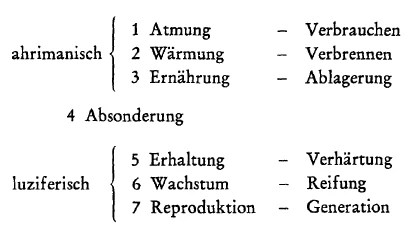
[ 2 ] Much could be explained if truths such as those outlined yesterday were elaborated upon further; for these truths truly hold the keys to an infinite number of life’s mysteries that confront humanity especially in the present. But it is simply not possible at present—even within our own circles—to speak of these consequences, consequences that, although they arise from entirely objective spiritual-scientific foundations, cannot be discussed today. We now wish to turn our attention to the life forces, to the life impulses, which we have shown to be, in a sense, like an inner planetary system. Just as we consider the twelve sensory regions, we can consider the life spheres: respiration, warmth, nutrition, excretion, maintenance, growth, and reproduction. These are the seven life impulses—the planetary system, so to speak, that exists within the human being—in contrast to the zodiacal system of the twelve sensory regions. But just as the zodiacal system of the twelve sensory spheres is subject to Ahrimanic and Luciferic influences—which have brought about something different from what lies in the regular course of evolution—so too is the case with these seven life impulses. Again, we can say: These three life impulses—the outer ones, which connect the human being more with the external world—can be influenced by Ahriman, and the life impulses that correspond more to the inner life process can be influenced by Lucifer. Only in the middle does the separation, so to speak, somewhat balance out what is already naturally in equilibrium by virtue of its very nature.
[ 3 ] In breathing, there is something that can be described as follows: We do not breathe merely as we would if only the regularly active divine-spiritual impulses were at work in our breathing—those impulses referred to at the beginning of the Old Testament, as if only the power of Yahweh were present in our breathing. We breathe in a way that corresponds to the transformation of our respiratory system by Ahrimanic forces, which have now also intervened in human life during the Atlantean epoch. For we do not merely breathe; rather, we wear down our organism through breathing. And in this wearing down, a certain sense of well-being manifests itself. In fact, throughout our lives between birth and death, we engage in the breathing process in a certain way that is more vigorous than what is naturally intended for us. The depletion of our life forces is very closely connected to this Ahrimanic influence. Roughly speaking, one could say: We would inhale less oxygen in the same amount of time if the Ahrimanic influence were not present, and the process of aging—that depletion of our organism expressed in aging, in growing older, in the sense that one can see the process of aging and that it is not merely the passage of years—would not take place as intensely as it does now. This is largely connected to this Ahrimanic influence on the respiratory process.
[ 4 ] Due to the Ahrimanic influence, this warming is associated with a more intense process of combustion in our organism than would occur under normal evolutionary conditions; consumption is equivalent to combustion. We are, in fact, burning ourselves.
[ 5 ] And due to the Ahrimanic influence, nutrition is associated with a process of deposition, so that what we take in as food is not merely processed, but is, in a sense, deposited in the organism almost as if it were a foreign substance. Fat formation, the accumulation of fat—that is the most common process that belongs here. This accumulation of fat is a process that must be explained here from its Ahrimanic aspect. It could, of course, also be explained from the Luciferic aspect, but that would lead to a different chapter. So, deposition—the ability to store nutrients so that they remain and, in a sense, become foreign substances—consumption, combustion, and deposition: these can be attributed to Ahrimanic influence in these three life impulses. — Excretion, in a certain sense, is excluded.
[ 6 ] The process of maintenance is subject to a Luciferic influence. All forces reshape our inner maintenance process, and what results is even similar to the formation of deposits. All the tendencies we possess for encapsulation, ossification, and sclerosis must be included in this context. One could call it a general hardening. We harden our organism over the course of our lives. This occurs through a Luciferic influence and is also associated with Luciferic effects. For we actually perceive these hardening processes—until they go beyond a certain point, until they then develop into sclerosis or other pathological conditions—as a certain persistent sense of well-being within the organism. Only when the process goes beyond a certain point do we no longer perceive it as a sense of well-being, but as an illness—be it sclerosis, cataracts, or the like.
[ 7 ] The process of growth, too, is subject to a Luciferic influence, which manifests itself in such a way that, without this Luciferic influence, human beings would grow without any particular discontinuity occurring in the course of their growth between birth and death. But because the Luciferic influence is present, it becomes particularly strong in the very first stages of growth—precisely in the earliest periods of growth—and transforms the mere process of growth into a process of maturation. Maturation, sexual maturity—these are Luciferic transformations of the mere process of growth. And everything associated with this shows that the original evolutionary pattern—which does not lead to this discontinuity of maturation—would propel human beings into a process of continuous growth. Maturation in both the female and male sexes, and everything associated with it—the transformation that takes place during the years of maturity, right up to the change in voice—all of this is connected to this Luciferic influence.
[ 8 ] The effect of the Luciferic influence on reproduction transforms reproduction into generation, into the external, physical possibility of procreation. Originally, through the advancing divine-spiritual forces, human beings are, after all, predisposed to reproduce only themselves—that is to say, they must always reproduce themselves, mustn’t they? In order for them to grow, new parts must constantly come into being: an inner reproduction. The fact that external reproduction is added to this—that reproduction becomes generation—is attributable to the Luciferic influence. As you know, the latter in particular—the Luciferic influence on reproduction and growth—is very clearly indicated in the Bible. One need only read the Bible to truly discern, from the powerful, titanic imagery found there, precisely what has now been explained to you. So you see, here too we have an interplay between the Luciferic and the Ahrimanic.
[ 9 ] If you now take stock of what we have said about the twelve sensory spheres and the seven life processes—in a sense, about the inner zodiac and the inner planetary system of the human being—you will come to admit that knowledge which reveals these things must be of a different nature than what is commonly called knowledge today. Today’s knowledge, today’s understanding, so to speak, merely skims the outer surface, the surface of things. But one must acquire concepts and ideas that lie on the threshold of the spiritual world. One need not stand within the spiritual world itself, but only seek to acquire, through spiritual science itself, concepts that lie on the threshold of the spiritual world; and one will feel that, as a result, this knowledge, this insight, becomes much more active, much more intensely inner, that it truly becomes capable of penetrating into what is at work within beings—that is, in our case here, what is at work within the human being himself. We must, so to speak, experience the universe firsthand, not merely stand by as spectators and let it affect us from its surface. One must experience what is active, alive, and weaving within beings. Through spiritual science, one truly acquires not just a different kind of knowledge, but a knowledge of a different nature. If you behave merely like a modern anatomist or physiologist, you cannot distinguish, within the breathing process, the part that is, so to speak, regular, from the part that is Ahrimanic—because this naturally occurs simultaneously; one must, so to speak, slip into the breathing process and experience it. Then one already experiences the interplay of the two forces, the two impulses. This immersion into the world is something that has been lost precisely in our present age, and in particular has been lost in many ways to contemporary science. People believe—as I have often emphasized—all too readily that this active, inwardly engaged knowledge, which immerses itself in things so that one reaches not merely the surfaces but the forces, was either never a form of knowledge at all or has long since been lost to humanity. That is not true. For it has not been lost to humanity nearly as much as one might think. One need only go back a little through the centuries, and then one certainly has the opportunity to study how this inwardly active knowledge existed in a time not so long ago. Take the life process. It is, first and foremost, a whole; it constitutes us, after all; it is what defines us, this life process. But there are seven interrelated impulses—truly an inner planetary system. I have drawn your attention to this—do you recall our reflections over the past few weeks?—that one will have to get used to many paradoxes if one wishes to attain true insight.
[ 10 ] I have said: What goes on within human beings, and what today’s materialistic Darwinism seeks to find in human beings, should not be regarded as an explanation of what goes on within human beings, but rather as an explanation of the macrocosm, of the universe. And conversely: In the great astronomical processes that take place out there, one will find the explanation for what is within human beings. But to do so, one must stand alive within the process of the world; one must truly immerse oneself in it. One must not merely observe the process of the world from the surface. To observe the Sun, Moon, Mars, Mercury, Jupiter, and so on merely from the outside as they traverse the sky is merely a superficial view; rather, one must experience firsthand what they do as they journey through the cosmos—that is what is necessary—and experience the forces they radiate, which radiate in a differentiated manner, that is, differently from each of these planets, so that there are differentiated forces out there. But if it is true that the universe explains what is within us, then the thought—which is entirely correct—is no longer far from you: If one truly knows the forces contained within the planets in a living way, then there must be something in this living understanding that makes human life comprehensible. Understanding human life through living knowledge drawn from the universe—that is what is intended by contemporary spiritual science, though it was also present in earlier times. It is not at all necessary to go too far back into the Middle Ages; there one finds remarkable statements—which were later put into print—that are generally not understood or are explained rather superficially today, but which indicate how, in centuries not so long ago, a living knowledge—albeit of an atavistic nature at that time—still existed:
O Sun, a king of this world
Luna sustains your lineage
Mercury swiftly unites you
Without Venus’s favor, you achieve nothing
Mars chooses you as a man
Jupiter’s grace is yours to keep
That Saturn, old and aged
Reveals himself in many colors.
[ 11 ] Here you have a saying that is meant to indicate which forces are, so to speak, localized not in the planets as they are seen externally—merely on the surface of things—but in the inner, living essences of the planets. The forces of the entire planetary system are expressed in this saying, but in such a way that, when one grasps it, it makes clear how these forces work within the human being. What, then, is expressed in such a saying? In such a saying is expressed—I will try to paraphrase roughly what is expressed—: Here we live in the physical body between birth and death; this is, by and large, connected with the forces the Earth receives from the Sun. But other forces are also needed for the human race to truly exist. So that the human race can not only exist as it is formed by the Sun, but can also reproduce, thereby preserving the race—for this, the forces must emanate from the Moon:
[ 12 ] Luna, your lineage continues.
[ 13 ] But the two forces—the solar impulse and the lunar impulse—are held together by the Mercury impulse:
[ 14 ] Mercury will quickly bring you together —
[ 15 ] As a result, the entire process is becoming increasingly spiritual. Our physical existence—the fact that we simply exist in human form—depends on the sun; therefore, the sun is the king of this world, understood as the physical sun. It is only because Christ descended and came from the sun to Earth that the sun is also spiritual. But just as the sun is first and foremost a physical body, so it makes it possible for us to live on Earth as physical human beings. |
[ 16 ] Luna, your lineage continues
[ 17 ] transcends into the spiritual realm. It goes even further: Mercury quickly unites you
[ 18 ] and goes even further into the spiritual realm: Without Venus’s favor, you will achieve nothing
[ 19 ] That is to say, there must be that which comes from the Venusian impulses and permeates the whole, warming it, as it were, and making it glow. From Mars emanates that which the Venusian impulse, in turn, needs in order to connect with it and find its counterpoint in it. And even more spiritual—though spiritual within the physical—is that which emanates from Jupiter: “Jupiter’s grace.” And it is only through this that the human being comes into being within the human race as he is: that which always acts as the Saturn force—the oldest force, now acting, so to speak, at the outermost periphery—acts from the spiritual-soul realm in such a way that the spiritual-soul realm can fully permeate the physical in the human being as well. For through the Sun alone, we could be nothing but flesh and blood. Through Saturn, we are not merely flesh and blood, but flesh and blood permeated and warmed by soul and spirit. The soul manifests itself in us through the Saturn force, which is the oldest, “old and ancient”:
That Saturn, old and aged,
Appears in many colors.
[ 20 ] For our physical form expresses the soul-spiritual in the physical realm: Indeed, all colors are present in our skin tone, in our physical form.
That Saturn, old and aged, Shows himself in many colors.
[ 21 ] There was, then, a body of knowledge preserved in such clumsy, awkward old sayings—an ancient body of knowledge that has been lost amid our modern superficiality and must be rediscovered. As the fourth post-Atlantean epoch draws to a close—beginning in the fifteenth and sixteenth centuries—this ancient, atavistic, clairvoyant knowledge also fades away, and purely physical knowledge takes its place—knowledge that clings to the surface and no longer delves into the depths of things. And through spiritual science, we must once again seek the knowledge that delves into the depths of things. That is how people spoke back then. Now we speak in the same way that we attempted yesterday and today to characterize our twelve sense realms, our seven life impulses, and life movements in terms of their place within the spiritual order of the world. Thus, a lost knowledge will emerge once more; but what must emerge is a lost knowledge of the human being, grasped in a different way—grasped with full consciousness—whereas what lay in these sayings was not fully conscious. Those people who knew these sayings knew them from ancient traditions. If one had asked the people who truly felt the power of such a saying within themselves where they had gotten it from, they would have said: “Yes, we know the saying: ‘O Sun, a king of this world, the Moon sustains your lineage...’ and so on, and if one understands what is contained therein, one understands the life process of humanity; but how one comes to understand such things, we cannot know.” — That is what they would have said.
[ 22 ] This was taught by spiritual beings in ancient times through a process in which what had descended from the spiritual world to Earth through divine inspiration was written in verse, without this being a fully conscious process. Ancient wisdom has been preserved in language; it lies in the concepts and ideas that language has developed. That is why, parallel to the process of materializing knowledge—the process of materializing insight—came a loss of understanding of the spiritual nature of language. If one were to go back even to the eighth, ninth, or tenth centuries today, one would find—if one were to look not at that “fable convenue” that is regarded as history today, but at real history—that people knew: language is something connected to processes of the spiritual world. They did not say it—especially not in Europe—in the way we say it now: that this human capacity for language is a process arising from the ongoing evolutionary process of the divine-spiritual and from the Luciferic or the Ahrimanic. They did not say it that way. But they had a subconscious sense of this, in that they knew that, just as language is used in ordinary life, it is something that does not quite belong to human beings. It must be ennobled by, so to speak, condensing the highest truths into sacred sayings that are also held sacred. That is why all the truths were formulated precisely in such sayings. I have chosen a clumsily phrased saying, one that can still be found, so to speak, even in the very latest times, when the fourth post-Atlantean epoch was already drawing to a close; yet despite this, the saying is such that it possesses a certain solemnity precisely in its clumsiness. Through this—which poured itself into such a saying—the Ahrimanic influence was to be, as it were, paralyzed. Through the sense of sacredness one felt in it, a feeling was to be set against the Ahrimanic that would paralyze it. Therein lies the balance. The Ahrimanic, which comes from without, is kept in balance by a feeling—a sacred feeling—from within. Hence that peculiar attitude toward language in earlier times, which has since been completely lost and has given way to an external relationship to language, to the spirit of language.
[ 23 ] Shortly after the dawn of the fifth post-Atlantean epoch, modern materialism began to emerge. In earlier times, language had been viewed as a kind of gesture that pointed to reality but was not itself a reality. I have often tried to explain what this actually means. When one says “dog,” “wolf,” or “lamb,” these are linguistic expressions. Today’s linguistic theorists cannot come to terms with them because, in their view, they actually mean nothing. For if there is one such four-legged creature, it is called a dog; if there is another four-legged creature of the same kind, it is also called a dog. The word designates both as “dog”; it designates the individual dog and yet all of them as “dog.” People today perceive this contradiction: that the word actually hovers in the air. Because they no longer see the spiritual in things—the spiritual is nothing to them—what the word signifies has also become nothing. I made this clear by saying: People think this is merely a noun, a word: lamb, wolf. But one can convince oneself that it is not merely a noun, merely a word, if one tries to confine a wolf and feed it nothing but lamb meat—that is, lamb matter—until its entire physical substance has been replaced. Then there is nothing left of the old wolf’s matter within it. Has the wolf therefore now become entirely a lamb? Certainly not! The “wolf” is still something other than its matter. Materialistic views are actually so foolish that they are very easy to refute. For through a line of reasoning such as the one just presented, materialism is, of course, immediately dispelled. But if one can no longer keep in mind what it is that makes a wolf a wolf and a lamb a lamb, then one cannot make sense of the words either.
[ 24 ] However, the primary task of this fifth post-Atlantean epoch was to become materialistic. Materialism had to be introduced, so to speak. Therefore, for this fifth post-Atlantean epoch, the inauguration—I would say the initiation—of the world into materialism, into materialistic feeling, thinking, and perception, had to be properly undertaken. This had to happen from two sides. First, people had to be made aware of how the salvation of humanity—which, of course, is merely the salvation for the materialistic current in the fifth post-Atlantean epoch, but which is always declared to be universally valid—lies in the purely material treatment of the world. In the times when such sayings still existed, the world was not treated merely in material terms; people still felt themselves to be immersed in a living reality that radiated from the entire life of the planetary system, as is indeed expressed in such a saying. And one can understand such a saying. But humanity had to be taught what it had not known before: to deal with the external, the mechanical, the materialistic, in order to find within them, first and foremost, what is most important—and next in importance—for the fifth post-Atlantean epoch. For spiritual science must enter this fifth post-Atlantean epoch starting from our time; but judging by the obstacles that stand in its way, you will be able to see that it will not assert itself quickly, and that it will not attain its full significance until the sixth post-Atlantean epoch. That is the point. For in the fifth post-Atlantean epoch, it will always have everything materialistic as a major adversary. That is one thing.
[ 25 ] And the other point is that language is misunderstood; that words which do not directly denote merely sensory qualities are not considered to have any character of reality. This had to be made clear to humanity at some point. Humanity had to be told once and for all: Your language forms words, but these words were regarded as designations for reality only by a bygone era that lived in prejudice and superstition. In truth, you must free yourselves from the content of words, for words are idols. Thus Bacon, Bacon of Verulam—acting also on behalf of the spiritual world—initiated the misinterpretation of language in our more recent post-Atlantean era, the expulsion from humanity of the sense that language contains something spiritual. He called all concepts of substance and commonality “idols,” and he classified these idols into different categories; for he carried this out very thoroughly.
[ 26 ] First, he said, people have certain words with which they believe they can designate something real—words that arise simply because people must live together: prejudices, idols of the tribe, of the people, Idola tribus. Then, as humans come to understand the world, they mistakenly attempt to introduce the spiritual into their way of seeing things. What arises in humans as knowledge arises as if in a cave; but by bringing the external world into this cave, they form words for what they wish to know. In these words, in turn, lies a reference to the unreal. These are the idols of the cave: Idola specus. Then idols arise—that is, designations for nothingness, for the unreal—because people are united not only in tribes and nations through blood ties, but also because they form communities of their own in which they administer this or that—they are, after all, administering more and more, and eventually everything will be administered; humanity will reach a point where it cannot walk through the world without a doctor on its left and a police officer on its right, so that it is completely “administered,” isn’t that so? According to Bacon, this also creates certain unrealities. These unrealities, which are created in this way and find their expression in words, are the idols of the marketplace, of coexistence in the marketplace: Idola fori. And then there are the idols that arise from science, which seeks mere names. These are, of course, a tremendous number of idols. For if you take all our systems—with what they denote of the spiritual—and present them to Bacon, then all the words for spiritual things are such idols. These idols, Bacon argues, are actually the most dangerous, because one believes one has special protection in them—namely, true knowledge: these are the Idola theatri. This is the inner theater that humans construct for themselves, a kind of spectacle of concepts, just as unreal as the figures on the stage. All idols that can be expressed in words belong to these four categories.
[ 27 ] And the salvation of humanity with regard to knowledge consists—as was, after all, inaugurated by Bacon of Verulam—in seeing through these idols, in seeing through their idolatrous nature, their ideological nature, and their nature of futility, so as to gradually focus one’s gaze solely on reality. But if one sets aside all these kinds of idols, then nothing remains but the five senses. Everyone can see this for themselves. And the people of the fifth post-Atlantean epoch should be made aware that, while these idols—which find expression in words—are indeed needed as a kind of currency of the tribe, of individual knowledge, of the marketplace of coexistence, or even of scientific observation and the inner theater, but that they are only recognized for what they truly are when one grasps their idol-like nature, their nature of futility, regards them as nothing, and considers as real only that which one can touch, that which one can see with one’s eyes, that which one can examine in the chemistry laboratory, in the physics laboratory, or at the clinic. The classic introductory text for this way of viewing the world is contained in the significant treatise on idols that Bacon of Verulam wrote for the fifth post-Atlantean epoch. And it is precisely in such a treatise that you see that even that which one must turn away from, from a certain standpoint, enters the world according to a proper world order. The fifth post-Atlantean epoch had to develop materialism; therefore, the program of materialism—emerging from the spiritual world—had to exist. And the first part of this materialist program is the doctrine of idols, the casting off of the old Aristotelian prejudice that words contain categories that have meaning for reality.
[ 28 ] Humanity has already come a very long way today on the path of regarding everything that is not perceptible to the senses as an idol. Bacon is the great founder of the science of idols. It must therefore be understandable that the very same mind—which was thus meant to point out to people the idolatrous nature of language—had to be used by the spiritual world to inaugurate, in a practical sense as well, that which appears, so to speak, as a materialistic paradise on earth. Of course, this had to be presented in such a way that it truly had a paradisiacal character—but a paradisiacal character for the materialistic mindset that was bound to emerge in the fifth post-Atlantean epoch. Therefore, the practical ideal had to stand as a counter-image. An age that thinks of language in this way must see its ideal in seeking the mechanical all the way out into the nearest attainable celestial spheres. Thus, the ideals of materialism for the fifth post-Atlantean epoch arise from the very same mind that produced the doctrine of the idols. An ideal that remains unfulfilled to this day can be found in Bacon: the artificial creation of weather. It will be achieved! This ideal from Bacon’s Nova Atlantis will also yet be fulfilled. In Bacon’s writings, we first encounter references to steerable airships; it is in his work that we first find the idea of the submarine. We have, after all, already come this far. It is Bacon, Bacon of Verulam, who is also the great inaugurator of practical materialism, extending all the way to these practical mechanisms that apply to the fifth post-Atlantean epoch.
[ 29 ] Whenever we need to describe the fundamental character of a particular era, we can point out how impulses surge into it from the depths of the world. Idol theories, the invention of controlling the weather, sailing through the air, and sailing beneath the sea—these all belong together. This is an idea and an ideal that belong together; it enters the fifth post-Atlantean epoch in this way. One must judge these things objectively; one must be clear that, if one does not misuse the word—if one does not regard it as an idol, nor turn it into one—then it can be applied differently. The evolution of humanity proceeds according to a plan. The individual impulses emerge step by step in evolution according to a plan. But with what is entering as an “idol theory” and as “Nova Atlantis,” the last remnants of the great atavistic spiritual theory, worldview, and feeling have been eradicated. And these must be reclaimed through a new spiritual science that is now emerging with full consciousness. In the fourth Atlantean epoch—ancient Atlantis—one individual grasped those ideas that arose at that time, through which the ancient Atlantean era descended into materialism. As you know, he is described in our writings. Just as, back then in the fourth period of the Atlantean era, the materialism of ancient Atlantis had to arise as an idea through a mind of that era, so too, in the fifth post-Atlantean period, “Nova Atlantis” had to come into being, intended to provide something similar for this fifth post-Atlantean period. One cannot come close to understanding these things unless one approaches them in the same way one approaches scientific matters. If one is able to look closely at the subtleties of world history, then one will indeed find these deeper connections. But today one must already take spiritual science as the foundation. And ordinary history is a “fable convenue”; it recounts only those things that individual nations, peoples, and citizens want to hear. True history must be drawn from the spiritual world.
[ 30 ] And for such figures who, in a sense, set the tone—such as Baco of Verulam, Lord Bacon—their biography is far less important than what reveals to us how they fit into the overall process of human development.