The Riddle of Man
The Spiritual Background of Human History
GA 170
2 September 1916, Dornach
Translate the original German text into any language:
Versions Available:
The Riddle of Man, tr. SOL
Vierzehnter Vortrag
Fourteenth Lecture
[ 1 ] Das Ergebnis aus geisteswissenschaftlichen Betrachtungen, das wir in der letzten Zeit sogar wiederholt angeführt haben, von der Beziehung des menschlichen Hauptes und des menschlichen übrigen Leibes — wobei dann das Haupt einbezogen ist in den übrigen Leib — zu dem Weltganzen, dieses Ergebnis ist in der Tat von weittragendster Bedeutung. Sie wissen ja, wie wir es angeführt haben. Wir haben gesagt: Dasjenige, was der Mensch als sein Haupt trägt mit alldem, was dazu gehört, ist eine umgewandelte Form, eine umgewandelte Gestalt, eine Metamorphose, und dasjenige, woraus sich dieses Haupt umgewandelt, umgebildet hat, das ist der Gesamtleib der vorhergehenden Inkarnation. Also wenn wir hinblicken auf den Gesamtleib unserer jetzigen Inkarnation, dann sehen wir, wie er in sich trägt die Kräfte, die ihn umwandeln können so, daß er nur ein Haupt wird, ein Kopf mit dem, was dazugehört, mit zwölf aus ihm entspringenden Nervenpaaren und so weiter. Und diesen Kopf, der sich aus unserem Gesamtleib entwickelt, wir werden ihn tragen in unserer nächsten Inkarnation. Dagegen wird in der Zeit zwischen unserem Tode, nach unserem jetzigen Leben und unserer Geburt in der nächsten Inkarnation, teils aus den Kräften der geistigen Welt, soweit die Zeit in Betracht kommt zwischen dem Tod und einer neuen Geburt, teils aus den Kräften der physischen Welt, soweit die Zeit in Betracht kommt von unserer Empfängnis bis zu unserer Geburt in der nächsten Inkarnation, unser Leib, also alles das, was zu unserem Leibe gehört, für die nächste Inkarnation herausgearbeitet.
[ 1 ] The conclusion drawn from considerations in the humanities—which we have even cited repeatedly in recent times—regarding the relationship of the human head and the rest of the human body—with the head being integrated into the rest of the body—to the whole of the world, is indeed of the most far-reaching significance. You know, of course, how we have described it. We have said: What a human being carries as his head, along with everything that belongs to it, is a transformed form, a transformed shape, a metamorphosis; and that from which this head has been transformed and reshaped is the entire body of the previous incarnation. So when we look at the entire body of our present incarnation, we see how it carries within itself the forces that can transform it so that it becomes merely a head—a head with all that belongs to it, with twelve pairs of nerves springing from it, and so on. And this head, which develops from our entire body, we will carry with us into our next incarnation. In contrast, during the time between our death—after our present life—and our birth in the next incarnation, our body— that is, everything that belongs to our body, is prepared for the next incarnation.
[ 2 ] Solche Wahrheiten muß man nur nicht so nehmen wie die Wahrheiten des gewöhnlichen Lebens oder der gewöhnlichen Wissenschaft, sondern man muß sie nehmen als Wahrheiten, die Bedeutungen in sich tragen, als Wahrheiten, die hinweisen auf große Zusammenhänge. Bezüglich der Wahrheiten im gewöhnlichen Leben beschreiben wir gewissermaßen uns und unsere Umgebung; bezüglich solcher Wahrheiten wie die angeführten lesen wir unsere Umgebung und uns selber im Weltenzusammenhange. Die Wahrheiten des gewöhnlichen Lebens und der gewöhnlichen Wissenschaft sind da wirklich so, wie wenn wir die Formen der einzelnen Buchstaben beschreiben, die auf einer Seite stehen, oder höchstens noch grammatikalisch die Gesetze erklären, wie sie sich zu Worten zusammenfügen. Dasjenige aber, was mit solchen Wahrheiten gemeint ist, wie die angeführten, das läßt sich vergleichen mit dem Lesen, ohne erst auf die Buchstabenformen eine besondere Beschreibung zu verwenden und auf das Grammatikalische zu sehen und darauf, wie sich diese Buchstabenformen zu Worten zusammenfügen. Denken Sie doch, wie ganz anders das aussieht, der Inhalt dessen, was wir lesen, und dasjenige, was auf der Seite für die Augen daraufsteht. So haben wir auch, wenn wir eine solche Wahrheit anführen wie die eben angeführte, nicht das, was wir nun aussagen, allein im Auge, sondern wir haben die ganze weittragende Bedeutung einer solchen Sache für die Stellung des Menschen im Weltenall im Auge. Wir lesen gewissermaßen dadurch tief lebendige geistige Wahrheiten, die nichts zu tun haben mit den Formen des Kopfes oder des Leibes, welche die Anatomie, die Physiologie studiert oder die man im gewöhnlichen Leben vor sich hat, wenn man von der menschlichen Form spricht. Den Menschen kann man eben nur verstehen, wenn man ihn nicht nur beschreibt, wie das gewöhnliche Leben und die Wissenschaft es tut, sondern wenn man ihn liest.
[ 2 ] Such truths should not be taken in the same way as the truths of everyday life or ordinary science, but rather as truths that carry meaning within themselves, as truths that point to larger contexts. With regard to the truths of everyday life, we describe, in a sense, ourselves and our surroundings; with regard to truths such as those mentioned, we interpret our surroundings and ourselves within the context of the world. The truths of everyday life and ordinary science are really like describing the shapes of individual letters on a page, or at most explaining the grammatical rules governing how they combine to form words. But what is meant by truths such as those mentioned can be compared to reading without first devoting a special description to the shapes of the letters, without focusing on the grammar, and without considering how these letter shapes combine to form words. Just think how completely different the content of what we read is from what is actually written on the page for our eyes to see. Similarly, when we cite a truth such as the one just mentioned, we do not have only what we are now stating in mind, but rather we have in mind the entire far-reaching significance of such a matter for humanity’s place in the universe. In a sense, we thereby read deeply vibrant spiritual truths that have nothing to do with the forms of the head or the body—those studied by anatomy and physiology, or those we encounter in everyday life when we speak of the human form. One can only truly understand human beings not merely by describing them, as everyday life and science do, but by reading them.
[ 3 ] Nach dieser Voraussetzung und im Sinne derselben wollen wir noch einmal unseren Blick wenden auf das, was wir auch in den Zusammenhängen der letzten Wochen ausgeführt haben. Wir wollen unseren Sinn wenden auf die zwölf Sinne des Menschen. Führen wir uns sie noch einmal vor, diese zwölf Sinne des Menschen.
[ 3 ] Based on this premise and in keeping with it, let us once again turn our attention to what we have also discussed in the context of the past few weeks. Let us focus on the twelve senses of the human being. Let us review them once more, these twelve senses of the human being.
[ 4 ] Ichsinn: Ich bitte Sie, noch einmal ins Auge zu fassen dasjenige, was ich in bezug auf diesen Ichsinn gesagt habe. Dieser Ichsinn ist nicht gemeint mit Bezug auf die Fähigkeit unseres eigenen Ich-Wahrnehmens. Mit diesem Ichsinn nehmen wir nicht unser eigenes Ich wahr, jenes Ich, das uns auf der Erde erst zugekommen ist, sondern mit diesem Ichsinn nehmen wir die Iche der anderen Menschen wahr. Also alles dasjenige, was uns mit einem Ich behaftet entgegentritt in der physischen Welt, das nehmen wir mit diesem Ichsinn wahr.
[ 4 ] Sense of Self: I ask you to consider once more what I have said regarding this sense of self. This sense of self does not refer to our ability to perceive our own self. With this sense of the “I,” we do not perceive our own “I”—the “I” that first came to us here on Earth—but rather, with this sense of the “I,” we perceive the “I”s of other people. In other words, we perceive with this sense of the “I” everything in the physical world that approaches us as endowed with an “I.”
[ 5 ] Das zweite ist der Denksinn. Der Denksinn hat wiederum nichts zu tun mit unseren eigenen Gedankenbildungen. Wenn wir selber denken, so ist dieses Denken nicht eine Tätigkeit des Denksinns, sondern das ist etwas ganz anderes. Wir werden davon noch sprechen. Der Denksinn bezieht sich darauf, daß wir die Fähigkeit haben, die Gedanken der anderen Menschen zu verstehen, wahrzunehmen. Also mit unseren eigenen Gedankenbildungen hat dieser Denksinn zunächst nichts zu tun.
[ 5 ] The second is the faculty of thought. The faculty of thought, in turn, has nothing to do with our own thought processes. When we think for ourselves, this thinking is not an activity of the faculty of thought, but something entirely different. We will discuss this further. The thinking sense refers to our ability to understand and perceive the thoughts of other people. So, at first, this thinking sense has nothing to do with our own thought processes.
[ 6 ] Sprachsinn: Der hat wiederum nichts zu tun mit der Bildung unserer eigenen Sprache, nichts zu tun zunächst mit der Fähigkeit, die dem eigenen Sprechen zugrunde liegt, sondern er ist der Sinn für das Verständnis dessen, was zu uns gesprochen wird von dem anderen Menschen.
[ 6 ] Sense of language: This, in turn, has nothing to do with the development of our own language, nor—at first—with the ability that underlies our own speech; rather, it is the sense of understanding what is spoken to us by another person.
[ 7 ] Hörsinn oder Tonsinn: Das kann ja nicht mißverstanden werden.
[ 7 ] Sense of hearing or sense of sound: There’s no way that can be misunderstood.
[ 8 ] Wärmesinn, Sehsinn, Geschmackssinn, Geruchssinn, Gleichgewichtssinn: Ich habe ja diese Sinne öfter schon und auch in diesen Betrachtungen wieder erklärt.
[ 8 ] The sense of heat, the sense of sight, the sense of taste, the sense of smell, the sense of balance: I have, after all, explained these senses on several occasions before, and again in these reflections.
[ 9 ] Bewegungssinn, Lebenssinn, Tastsinn.
[ 9 ] Sense of movement, meaning of life, sense of touch.
[ 10 ] Das sind die zwölf Sinne, durch die wir hier in der physischen Welt die Außenwelt wahrnehmen. Das materialistische Denken verzeichnet ja, wie Sie wissen, von diesen Sinnen nur den Tonsinn, den Wärmesinn — wobei sie den aber zusammenwirft mit dem Tastsinn —, Sehsinn, Geschmackssinn, Geruchssinn, und spricht infolgedessen von fünf Sinnen. Allerdings, die neuere Wissenschaft, die neuere Physiologie, Sinnesphysiologie, fügt schon dazu den Gleichgewichtssinn, Bewegungssinn, Lebenssinn, und unterscheidet auch zwischen dem Tastsinn und Wärmesinn. Von einem besonderen Sprachsinn, von einem besonderen Denksinn — Gedankensinn könnte man auch sagen — und von einem besonderen Ichsinn spricht die gewöhnliche Wissenschaft, die gewöhnliche Physiologie nicht, weil sie aus der Art ihres Denkens heraus heute auch noch nicht davon sprechen kann. Das materialistische Denken und Anschauen der Welt beschränkt sich ja gern auf alles dasjenige, was sinnlich wahrnehmbar ist. Es liegt zwar ein gewisser Widersinn darinnen, zu sagen «sinnlich wahrnehmbar», weil man nur willkürlich abgrenzt das sinnlich Wahrnehmbare, nämlich das durch die fünf Sinne Wahrnehmbare; aber Sie wissen ja alle, was damit gemeint ist, wenn man sagt: Die gewöhnliche materialistische Anschauung läßt gelten dasjenige, was sinnlich wahrnehmbar ist, und sie sucht deshalb auch für die Sinne die Wahrnehmungsorgane. Weil ihr so gar nichts vorliegt als ein Wahrnehmungsorgan für den Ichsinn, den Gedankensinn und den Sprachsinn, weil ihr so gar nichts dafür vorliegt, was sie vergleichen könnte zum Beispiel mit dem Ohre für den Tonsinn oder mit dem Auge für den Sehsinn, so spricht sie nicht von diesen Sinnen: Ichsinn, Gedankensinn, Sprachsinn. Für uns entsteht aber die Frage: Gibt es wirklich keine Organe für den Ichsinn, den Gedankensinn, den Sprachsinn? Wir wollen heute einmal auf die genaueren Untersuchungen dieser Dinge eingehen.
[ 10 ] These are the twelve senses through which we perceive the external world here in the physical world. As you know, materialistic thinking recognizes only the sense of sound, the sense of heat—though it conflates this with the sense of touch—the sense of sight, the sense of taste, and the sense of smell, and consequently speaks of five senses. However, modern science—modern physiology, specifically sensory physiology—already adds the sense of balance, the sense of movement, and the sense of life, and also distinguishes between the sense of touch and the sense of heat. Conventional science and conventional physiology do not speak of a specific sense of language, a specific sense of thought—one might also say a “sense of thought”—or a specific sense of the self, because, given the nature of their thinking, they are still unable to speak of these today. After all, the materialistic way of thinking and viewing the world tends to limit itself to everything that is perceptible through the senses. Admittedly, there is a certain absurdity in saying “sensorily perceptible,” because one arbitrarily delimits what is sensorily perceptible—namely, what is perceptible through the five senses; but you all know what is meant when one says: The ordinary materialistic view accepts only what is perceptible through the senses, and therefore seeks organs of perception for the senses as well. Because it has absolutely nothing at its disposal other than an organ of perception for the sense of the self, the sense of thought, and the sense of language—because it has absolutely nothing for these that it could compare, for example, to the ear for the sense of sound or to the eye for the sense of sight—it does not speak of these senses: the sense of the self, the sense of thought, the sense of language. But this raises the question for us: Are there really no organs for the sense of the “I,” the sense of thought, and the sense of language? Today we would like to delve into a more detailed examination of these matters.
[ 11 ] Also mit dem Ichsinn ist gemeint unsere Fähigkeit, die Iche der anderen Menschen wahrzunehmen. Eine besonders ungenügende und unzulängliche Aussage des modernen Denkens ist die, daß man eigentlich das Ich des anderen Menschen gar nicht wahrnehme, sondern auf das Ich des anderen Menschen immer mehr oder weniger nur schließen würde. Wir sehen so etwas auf uns zukommen — so nimmt diese Denkweise an —, welches aufrecht auf zwei Beinen geht, ein Bein immer an dem anderen vorbeiführt oder eines neben das andere hinsetzt, gestützt von diesen Beinen einen Rumpf hat, daran pendeln zwei Arme, die verschiedene Bewegungen ausführen zu verschiedenen Zwecken; dann sitzt weiter darauf ein Haupt, welches Töne äußert, spricht, Gesten äußert. Und wenn so etwas, wie ich es jetzt beschrieben habe, uns entgegentritt, so schließen wir: Das ist der Träger eines Ich. — So meint die materialistische Anschauung. Dies ist ein vollständiger Unsinn, ein wirklicher, echter Unsinn; denn die Wahrheit ist, daß ebenso wie wir mit den Augen Farben sehen, wie wir mit dem Ohre Töne hören, wir auch das Ich des anderen wirklich wahrnehmen. Ganz ohne Zweifel, wir nehmen es wahr. Und diese Wahrnehmung ist eine selbständige. So wie das Sehen nicht auf einem Schluß beruht, wie das Hören nicht auf einem Schluß beruht, so beruht das Wahrnehmen des Ich des anderen nicht auf einem Schluß, sondern ist eine unmittelbar wirkliche, selbständige Wahrheit, die unabhängig gewonnen wird davon, daß wir den andern sehen, daß wir seine Töne hören. Abgesehen davon, daß wir seine Sprache vernehmen, daß wir sein Inkarnat sehen, daß wir seine Gesten auf uns wirken lassen, abgesehen von alledem nehmen wir unmittelbar das Ich des andern wahr. Und so wenig der Sehsinn mit dem Tonsinn zu tun hat, so wenig hat die Ich-Wahrnehmung mit dem Sehsinn oder mit dem Tonsinn oder mit irgendeinem anderen Sinne zu tun. Es ist eine selbständige Ich-Wahrnehmung. Ehe das nicht eingesehen wird, ruht die Wissenschaft von den Sinnen nicht auf soliden Grundlagen.
[ 11 ] By “sense of the self,” we mean our ability to perceive the selves of other people. A particularly inadequate and insufficient assertion of modern thought is that we do not actually perceive the self of another person at all, but rather always—to a greater or lesser extent—merely infer it. We see something approaching us—so this way of thinking assumes—that walks upright on two legs, always moving one leg past the other or placing one next to the other; supported by these legs, it has a torso from which two arms swing, performing various movements for various purposes; then, sitting atop this, is a head that emits sounds, speaks, and makes gestures. And when something like this, as I have just described it, approaches us, we conclude: This is the bearer of an “I.”—So says the materialistic view. This is utter nonsense, real, genuine nonsense; for the truth is that just as we see colors with our eyes and hear sounds with our ears, we also truly perceive the “I” of the other person. Without a doubt, we perceive it. And this perception is an independent one. Just as seeing is not based on an inference, just as hearing is not based on an inference, so too the perception of the other’s “I” is not based on an inference, but is an immediately real, independent truth that is gained independently of our seeing the other or hearing their sounds. Apart from the fact that we hear their speech, that we see their physical form, that we allow their gestures to affect us—apart from all of that, we perceive the other’s “I” directly. And just as the sense of sight has nothing to do with the sense of hearing, so too does the perception of the “I” have nothing to do with the sense of sight, or with the sense of hearing, or with any other sense. It is an independent perception of the “I.” Until this is understood, the science of the senses will not rest on solid foundations.
[ 12 ] Nun entsteht die Frage: Was ist das Organ für die Wahrnehmung des anderen Ich? Was nimmt in uns das andere Ich wahr, so wie wir mit dem Sehorgan Farben oder Hell und Dunkel wahrnehmen, so wie wir mit den Ohren Töne wahrnehmen? Was nimmt das Ich des andern wahr? Die Ich-Wahrnehmung hat ebenso nun ihr Organ, wie die Sehwahrnehmung oder die Tonwahrnehmung. Nur ist das Organ der IchWahrnehmung gewissermaßen so gestaltet, daß sein Ausgangspunkt im Haupte liegt, aber das ganze Gebiet des übrigen Leibes, insoferne es vom Haupte abhängig ist, Organ bildet für die Ich-Wahrnehmung des andern. Wirklich, der ganze Mensch als Wahrnehmungsorgan gefaßt, insoferne er hier sinnlich-physisch gestaltet ist, ist Wahrnehmungsorgan für das Ich des andern. Gewissermaßen könnte man auch sagen: Wahrnehmungsorgan für das Ich des andern ist der Kopf, insoferne er den ganzen Menschen an sich anhängen hat und seine Wahrnehmungsfähigkeit für das Ich durch den ganzen Menschen durchstrahlt. Der Mensch, insofern er ruhig ist, insoferne er die ruhige Menschengestalt ist gewissermaßen mit dem Kopf als Mittelpunkt, ist Wahrnehmungsorgan für das Ich des andern Menschen. So ist das Wahrnehmungsorgan für das Ich des andern Menschen das größte Wahrnehmungsorgan, das wir haben, und wir sind selbst als physischer Mensch das größte Wahrnehmungsorgan, das wir haben.
[ 12 ] This raises the question: What is the organ for perceiving the other self? What within us perceives the other self, just as we perceive colors or light and dark with our eyes, or sounds with our ears? What does the other’s “I” perceive? The perception of the “I” now has its own organ, just as visual perception or auditory perception does. However, the organ of “I”-perception is, so to speak, structured in such a way that its point of origin lies in the head, but the entire region of the rest of the body—insofar as it is dependent on the head—forms an organ for the “I”-perception of the other. Indeed, the whole human being, conceived as an organ of perception—insofar as he is here constituted in a sensory-physical way—is an organ of perception for the “I” of the other. In a sense, one could also say: the organ of perception for the “I” of the other is the head, insofar as it has the whole human being attached to it and its capacity for perception of the “I” radiates through the whole human being. The human being, insofar as he is calm, insofar as he is the calm human form with the head, so to speak, as its center, is an organ of perception for the “I” of another human being. Thus, the organ of perception for the “I” of another human being is the greatest organ of perception we possess, and we ourselves, as physical human beings, are the greatest organ of perception we possess.
[ 13 ] Nun kommen wir zum Gedankensinn. Was ist Wahrnehmungsorgan für die Gedanken des anderen? Wahrnehmungsorgan für die Gedanken des anderen ist alles dasjenige, was wir sind, insoferne wir in uns Regsamkeit, Leben verspüren. Wenn Sie sich also denken, daß Sie in Ihrem ganzen Organismus Leben haben und dieses Leben eine Einheit ist — also nicht insoferne Sie gestaltet sind, sondern insoferne Sie Leben in sich tragen —, so ist dieses in Ihnen getragene Leben des gesamten Organismus, insofern es sich ausdrückt im Physischen, Organ für die Gedanken, die uns von außen entgegenkommen. Wären wir nicht so gestaltet, wie wir sind, könnten wir nicht das Ich des andern wahrnehmen; würden wir nicht so belebt sein, wie wir sind, könnten wir nicht die Gedanken des andern wahrnehmen. Das ist nicht der Lebenssinn, von dem ich hier spreche. Nicht daß wir unsere Gesamtlebensverfassung innerlich wahrnehmen, ist hier in Frage — das gehört zum Lebenssinn —, sondern insofern wir das Leben in uns tragen. Und dieses Lebendige in uns, alles das, was in uns physischer Organismus des Lebens ist, das ist Wahrnehmungsorgan für die Gedanken, die der andere uns zuwendet.
[ 13 ] Now we come to the meaning of thought. What is the organ of perception for the thoughts of others? The organ of perception for the thoughts of others is everything that we are, insofar as we feel activity and life within ourselves. So if you consider that you possess life throughout your entire organism and that this life is a unity—not insofar as you are formed, but insofar as you carry life within you—then this life of the entire organism that you carry within you, insofar as it expresses itself physically, serves as the organ for the thoughts that come to us from the outside. If we were not constituted as we are, we could not perceive the “I” of another; if we were not animated as we are, we could not perceive the thoughts of another. That is not the meaning of life of which I am speaking here. The issue here is not that we perceive our overall state of being internally—that is part of the meaning of life—but rather that we carry life within us. And this living force within us, everything that constitutes our physical organism of life, serves as the organ of perception for the thoughts that others direct toward us.
[ 14 ] Und insofern wir Kraft haben, uns zu bewegen, ausführen zu können alles das, was wir durch unser Inneres an Bewegungen haben, zum Beispiel wenn wir die Hände bewegen, wenn wir das Haupt drehen oder von oben nach unten bewegen, führen wir von innen heraus Bewegungen aus. Also insofern wir diese Kräfte haben, den Körper in Bewegung zu versetzen, liegt dieser Bewegbarkeit in uns ein physischer Organismus zugrunde. Das ist nicht der physische Organismus des Lebens, das ist der physische Organismus der Bewegungsfähigkeit. Der ist nun zugleich das Wahrnehmungsorgan für die Sprache, für die Worte, die uns der andere zusendet. Wir könnten keine Worte verstehen, wenn wir nicht in uns einen physischen Bewegungsapparat hätten. Wahrhaftig, insofern von unserem Zentralnervensystem die Nerven zu unserem gesamten Bewegungsvorgang ausgehen, liegt darinnen auch der Sinnesapparat für die Worte, die zu uns gesprochen werden. So spezialisieren sich die Sinnesorgane. Der ganze Mensch: Sinnesorgan für das Ich; das Lebendige, das dem Physischen zugrunde liegt: Sinnesorgan für das Denken; der in sich bewegbare Mensch: Sinnesorgan für die Worte.
[ 14 ] And insofar as we have the power to move—to carry out all the movements that originate within us—for example, when we move our hands, when we turn our head, or when we move it up and down—we are carrying out movements from within. So, insofar as we possess these forces to set the body in motion, this ability to move is grounded in a physical organism within us. This is not the physical organism of life; it is the physical organism of motor function. This is also, at the same time, the organ of perception for language, for the words that others send our way. We could not understand words if we did not have a physical motor system within us. Indeed, insofar as the nerves for our entire motor process originate in our central nervous system, the sensory apparatus for the words spoken to us is also located there. This is how the sensory organs specialize. The whole human being: a sensory organ for the “I”; the living force underlying the physical: a sensory organ for thinking; the human being capable of movement within itself: a sensory organ for words.
[ 15 ] Noch mehr spezialisiert ist nun der Tonsinn. Obwohl auch mehr als dasjenige, was gewöhnlich die Physiologie zum Gehörapparat rechnet, dazugehört, so ist doch schon der 'Tonsinn mehr spezialisiert. Nun, über den Tonsinn brauche ich nicht zu sprechen. Da können Sie ja, wenn Sie ein gewöhnliches Lehrbuch der Sinnesphysiologie in dieHand nehmen, den Tonsinn, das Organ des Tonsinns beschrieben finden. Schwieriger wird es einem heute noch, das Organ für den Wärmesinn beschrieben zu finden, weil der, wie gesagt, mit dem Tastsinn zusammengeworfen wird. Aber der Wärmesinn ist eigentlich ein sehr spezialisierter Sinn. Während der Tastsinn über den ganzen Organismus verbreitet ist, ist der Wärmesinn nur scheinbar über den ganzen Organismus verbreitet. Natürlich sind wir für Wärmeeinflüsse am ganzen Organismus zugänglich, aber als Sinn, als Wahrnehmung der Wärme, ist der Wärmesinn sehr konzentriert in dem Rumpf des Menschen, in dem Brustteil. — Die Spezialisierung dann in bezug auf die Organe für den Sehsinn, Geschmackssinn, Geruchssinn, sind ja natürlich bekannt aus der gewöhnlichen Beobachtung oder aus dem, was die gewöhnliche Wissenschaft zu sagen weiß.
[ 15 ] The sense of sound is even more specialized. Although it encompasses more than what physiology usually considers part of the auditory system, the sense of sound is nonetheless more specialized. Well, I don’t need to discuss the sense of sound. If you pick up a standard textbook on sensory physiology, you will find the sense of sound and the organ of the sense of sound described there. It is still more difficult today to find a description of the organ for the sense of heat, because, as I said, it is conflated with the sense of touch. But the sense of warmth is actually a highly specialized sense. While the sense of touch is distributed throughout the entire organism, the sense of warmth is only seemingly distributed throughout the entire organism. Of course, our entire organism is receptive to thermal influences, but as a sense—as the perception of warmth—the sense of warmth is highly concentrated in the human torso, in the chest region. — The specialization of the organs for the senses of sight, taste, and smell is, of course, well known from ordinary observation or from what conventional science has to say.
[ 16 ] Nun können wir wirklich in einer gewissen Weise die mittlere Partie, die untere Partie und die obere Partie unseres Sinneslebens voneinander unterscheiden und wir wollen heute eine besondere Betrachtung noch anstellen mit Bezug auf diese Unterscheidung. Gehen wir dabei aus von dem Sprachsinn und betrachten wir den Sprachsinn. Ich sagte: Insofern wir Bewegungsorganik in uns tragen, können wir die Worte wahrnehmen. Das liegt also dem Sprachsinn zugrunde. Wir können aber nicht nur die Worte des andern wahrnehmen, verstehen, wir haben also nicht nur einen Sprachsinn, sondern wir haben auch eine Sprachfähigkeit, eine Sprachmöglichkeit; wir sprechen selber. Und das ist nun interessant und wichtig, welches das Verhältnis ist zwischen unserer Fähigkeit, zu sprechen, und unserer Fähigkeit, die Sprache zu verstehen; also jetzt nicht die Töne zu hören, bitte unterscheiden Sie das, sondern die Sprache zu verstehen. Tonsinn und Sprachsinn muß da genau unterschieden werden. Also wir können nicht nur die Worte des andern verstehen, sondern wir können selber sprechen. Wie verhält sich das eine zum anderen, das Sprechen zum Sprache-Verstehen?
[ 16 ] Now we can truly distinguish, in a certain sense, between the middle, lower, and upper aspects of our sensory life, and today we would like to make a special observation regarding this distinction. Let us begin with the sense of language and consider it. I said: To the extent that we possess an organic capacity for movement within us, we are able to perceive words. This, then, underlies the sense of language. But we can not only perceive and understand the words of others; we therefore do not merely have a sense of language, but we also have a capacity for language, a potential for language—we speak ourselves. And what is now interesting and important is the relationship between our ability to speak and our ability to understand language—that is, not merely to hear the sounds (please distinguish between the two), but to understand language. A precise distinction must be made here between a sense of sound and a sense of language. So we can not only understand the words of others, but we can also speak ourselves. How does one relate to the other—speaking to understanding language?
[ 17 ] Wenn wir den Menschen untersuchen mit den Mitteln der Geisteswissenschaft, so finden wir, daß dasjenige, was dem Worte-Verstehen zugrunde liegt und was dem Sprechen zugrunde liegt, sehr verwandt ist miteinander. Wenn wir auf das blicken wollen, was eigentlich dem Sprechen zugrunde liegt, so können wir zunächst zurückgehen bis zum menschlichen seelischen Leben, in dem ja für jeden, der vernünftig ist, unleugbar der Ausgang des Sprechens liegt. Das Sprechen stammt aus dem Seelischen, wird angefacht durch den Willen im Seelischen. Ohne daß wir wollen, also einen Willensimpuls entwickeln, kommt natürlich kein gesprochenes Wort zustande. Beobachtet man nun geisteswissenschaftlich den Menschen, wenn er spricht, so geschieht etwas ähnliches in ihm, wie da geschieht, wenn er das Gesprochene versteht. Aber das, was geschieht, wenn der Mensch selber spricht, umfaßt einen viel kleineren Teil des Organismus, viel weniger vom Bewegungsorganismus. Das heißt, der ganze Bewegungsorganismus kommt in Betracht als Sprachsinn, als Wortesinn; der ganze Bewegungsorganismus ist Sprachsinn zugleich. Ein Teil ist herausgehoben und wird in Bewegung versetzt durch die Seele, wenn wir sprechen, — ein Teil dieses Bewegungsorganismus. Und dieser herausgegriffene Teil des Bewegungsorganismus, der hat eben sein hauptsächliches Organ im Kehlkopf, und das Sprechen ist Erregung der Bewegungen im Kehlkopf durch die Impulse des Willens. Was im Kehlkopf vorgeht beim eigenen Sprechen, kommt so zustande, daß aus dem Seelischen heraus die Willensimpulse kommen und den im Kehlkopfsystem konzentrierten Bewegungsorganismus in Bewegung versetzen, während unser gesamter Bewegungsorganismus Sinnesorganismus ist für die Wortewahrnehmung. Nur, daß wir diesen Bewegungsorganismus, indem wir Worte wahrnehmen, in Ruhe halten. Gerade dadurch, daß wir ihn in Ruhe halten, gerade dadurch nehmen wir die Worte wahr und verstehen die Worte. Instinktiv weiß das in einer gewissen Beziehung jeder Mensch; denn jeder Mensch tut etwas Instinktives zuweilen, wodurch er andeutet, daß er das weiß in seinem Unterbewußtsein, was ich jetzt eben auseinandergesetzt habe. Ich will ganz im Groben sprechen. Denken Sie, ich mache diese Bewegung (zur Abwehr erhobene Hand). Die Fähigkeit, diese Bewegung zu machen, insofern sie aus meinem ganzen Bewegungsorganismus kommt — denn jede kleinste Bewegung ist nicht bloß in einem Teile lokalisiert, sondern kommt aus dem ganzen Bewegungsorganismus des Menschen —, bewirkt etwas ganz Bestimmtes. Indem ich diese Bewegung nicht mache, mache ich dasjenige, was ich haben muß, damit ich irgend etwas Bestimmtes verstehe, was in Worten ausgedrückt wird durch einen anderen Menschen. Ich verstehe, was der andere sagt, dadurch, daß ich, wenn er spricht, diese Bewegung nicht ausführe, sondern sie unterdrücke, daß ich in mir den Bewegungsorganismus nur gewissermaßen bis in die Fingerspitzen errege, aber zurückhalte die Bewegung, also anhalte, staue. Indem ich dieselbe Bewegung staue, begreife ich etwas, was gesprochen wird. Will man etwas nicht hören, macht man oftmals diese Bewegung — womit man andeuten will, daß man unterdrücken will das Hören. Das ist das instinktive Wissen von dem, was dieses Stauen der Bewegung bedeutet.
[ 17 ] When we examine human beings using the methods of spiritual science, we find that what underlies the understanding of words and what underlies speech are very closely related to one another. If we wish to examine what actually underlies speech, we can first go back to human soul life, in which—as is undeniable to anyone of sound mind—the origin of speech lies. Speech originates in the soul and is kindled by the will within the soul. Without our willing—that is, without developing a volitional impulse—no spoken word naturally comes into being. If we now observe a person from a spiritual scientific perspective while they are speaking, something similar takes place within them as when they understand what is being spoken. But what happens when a person speaks themselves involves a much smaller part of the organism, much less of the motor system. That is to say, the entire motor system comes into play as the sense of speech, as the sense of the word; the entire motor system is, at the same time, the sense of speech. A part is singled out and set in motion by the soul when we speak—a part of this motor system. And this singled-out part of the motor system has its main organ in the larynx, and speech is the stimulation of movements in the larynx through the impulses of the will. What takes place in the larynx when we speak happens in such a way that impulses of the will arise from the soul and set the motor system concentrated in the laryngeal system in motion, while our entire motor system serves as a sensory system for the perception of words. The difference is that, as we perceive words, we keep this motor system at rest. It is precisely because we keep it at rest that we perceive and understand words. In a certain sense, every person knows this instinctively; for every person occasionally does something instinctive that suggests they know in their subconscious what I have just explained. I will speak in very general terms. Imagine I make this movement (raising a hand in defense). The ability to make this movement—insofar as it arises from my entire motor system—for every tiny movement is not localized in just one part but arises from the whole motor system of the human being—brings about something very specific. By not making this movement, I do what I must do in order to understand something specific that is expressed in words by another person. I understand what the other person is saying by not performing this movement while they speak, but rather by suppressing it—that is, by stimulating my motor system only to a certain extent, down to the fingertips, but holding back the movement, thus pausing and restraining it. By restraining this very movement, I comprehend what is being said. If one does not want to hear something, one often makes this movement—intending to indicate that one wishes to suppress hearing. This is the instinctive knowledge of what this holding back of movement signifies.
[ 18 ] Nun ist der Mensch ursprünglich so veranlagt, daß der gesamte Bewegungsorganismus, der zugleich der Wortesinn-Organismus ist, gewissermaßen das in der regelrecht fortlaufenden Evolution des Menschen Gelegene ist. So wie wir einstmals in der lemurischen Zeit entlassen worden sind aus unserem Zusammenhang mit dem Weltenganzen, sind wir veranlagt, Worte zu verstehen. Aber wir sind damals noch nicht veranlagt gewesen, Worte zu sprechen. Es wird Ihnen das kurios vorkommen, daß wir veranlagt sein konnten, Worte zu verstehen, aber nicht veranlagt gewesen sind, Worte zu sprechen. Es ist aber nur scheinbar etwas Kurioses; denn so ganz genau ist unser Bewegungsorganismus nicht veranlagt, die Worte des anderen zu hören, zu verstehen, die Worte des andern Menschen zu verstehen, sondern — verschiedenes andere zu verstehen. Wir waren ursprünglich viel mehr dazu veranlagt, die elementarische Sprache der Natur zu verstehen, das Walten gewisser elementarischer Wesenheiten in der Außenwelt wahrzunehmen. Das haben wir verlernt; dafür haben wir einzutauschen gehabt die Fähigkeit des eigenen Sprechens. Das ist dadurch gekommen, daß mit unserem uns ursprünglich verliehenen Bewegungsorganismus die ahrimanische Macht während der atlantischen Zeit eine Veränderung vorgenommen hat. Die ahrimanische Macht ist es, der wir verdanken, daß wir sprechen können, daß wir die Gabe der Sprache haben. So daß wir sagen müssen: Wir sind eigentlich als Menschen wirklich ursprünglich veranlagt gewesen, anders Sprache wahrzunehmen, als wir jetzt wahrnehmen. Wir sind so veranlagt gewesen, Sprache wahrzunehmen, daß wir eigentlich dem andern gegenübergetreten wären — und so sonderbar uns das jetzt vorkommt, aber man gewöhnt sich ja natürlich, besonders im Laufe so langer Zeiten, wie es seit den atlantischen Zeiten her ist, an das, was eben geschehen ist —, wir sind veranlagt gewesen, mehr oder weniger den ganzen anderen Menschen wahrzunehmen in Gebärden und Gesten, in stummen Ausdrucksmitteln, und diese selbst mit unserem eigenen Bewegungsapparat nachzuahmen und uns so ohne die physisch hörbare Sprache zu verständigen. Viel geistiger uns zu verständigen waren wir veranlagt. In diese mehr geistige Verständigungsart hat Ahriman eingegriffen, hat unseren Organismus spezialisiert, das Kehlkopfsystem geeignet gemacht, tönende Worte hervorzubringen. Und das, was dann übriggeblieben ist vom Kehlkopfsystem, geeignet gemacht zu haben, tönende Worte zu verstehen, das ist also eine ahrimanische Gabe.
[ 18 ] Now, human beings are originally endowed in such a way that the entire organism of movement—which is at the same time the organism of verbal meaning—is, so to speak, what is appropriate in the ongoing evolution of humankind. Just as we were once, in the Lemurian epoch, released from our connection with the totality of the world, we are predisposed to understand words. But at that time we were not yet predisposed to speak words. It may seem curious to you that we could have been predisposed to understand words but were not predisposed to speak them. But this is only seemingly curious; for our motor organism is not precisely predisposed to hear and understand the words of others—that is, to understand the words of fellow human beings—but rather to understand various other things. We were originally much more predisposed to understand the elemental language of nature, to perceive the workings of certain elemental beings in the external world. We have forgotten this; in exchange, we have gained the ability to speak ourselves. This came about because, during the Atlantean epoch, the Ahrimanic power brought about a transformation in our motor system, which had originally been bestowed upon us. It is to the Ahrimanic power that we owe our ability to speak, our gift of language. So we must say: As human beings, we were actually originally predisposed to perceive language differently than we do now. We were predisposed to perceive language in such a way that we would have actually faced the other person directly—and as strange as that may seem to us now, we naturally grow accustomed, especially over such a long period of time as has elapsed since the Atlantean era, to what has just happened— we were predisposed to perceive the other person more or less entirely through gestures and body language, through silent means of expression, and to imitate these ourselves with our own motor apparatus, thus communicating without physically audible speech. We were predisposed to communicate in a much more spiritual way. Ahriman intervened in this more spiritual mode of communication; he specialized our organism, adapting the laryngeal system to produce spoken words. And what remains of the laryngeal system—its ability to understand spoken words—is thus an Ahrimanic gift.
[ 19 ] Insofern wir ein Lebensorganismus sind, können wir wahrnehmen die Gedanken des andern. Wiederum sind wir dazu veranlagt gewesen, viel geistiger die Gedanken des andern wahrzunehmen, als wir sie eigentlich jetzt wahrnehmen. Gewissermaßen im einfachen Demandern-Gegenübertreten sind wir veranlagt gewesen, seine Gedanken innerlich nachzufühlen, sie nachzuleben. Es ist ein grober physischer Abglanz, wie wir heute die Gedanken des andern ja sogar nur auf dem Umweg der Sprache wahrnehmen. Und höchstens, wenn wir uns ein wenig dressieren auf die Gestikulationen und auf das Mienenspiel und auf die Physiognomie des andern, können wir noch einen Nachklang von dem wahrnehmen, wozu wir veranlagt waren. Die ganze Denkdisposition eines Menschen wahrzunehmen, waren wir veranlagt, indem wir ihm gegenübertraten, sie nachzuleben und die einzelnen Denkäußerungen aus den einzelnen Gesten, einzelnen Mienen wahrzunehmen. Wiederum ist es eine ahrimanische Gabe, durch welche umgewandelt worden ist diese mehr geistige Art der Wahrnehmungen der Gedankenwelt, die sich sogar im Verlaufe der Menschheitsevolution immer mehr und mehr auf die äußere Sprache konzentriert hat.
[ 19 ] Insofar as we are living organisms, we are capable of perceiving the thoughts of others. Moreover, we were once predisposed to perceive the thoughts of others in a much more spiritual way than we actually do now. In a sense, in a simple face-to-face encounter, we were once capable of intuitively sensing another’s thoughts and reliving them. The way we perceive the thoughts of others today—even only indirectly through language—is a crude physical reflection of that. And at best, if we train ourselves a little to observe the other person’s gestures, facial expressions, and physiognomy, we can still perceive a faint echo of what we were once predisposed to do. We were predisposed to perceive a person’s entire way of thinking simply by standing before them, to live it out, and to perceive the individual expressions of thought through their individual gestures and facial expressions. Once again, it is an Ahrimanic gift that has transformed this more spiritual mode of perceiving the world of thought, a mode that, even in the course of human evolution, has become increasingly concentrated on external language.
[ 20 ] Wir brauchten gar nicht so sehr weit zurückzugehen in der Menschheitsentwickelung, nur bis in die ägyptisch-chaldäische Zeit, von der indischen gar nicht zu sprechen, wo das noch in höchstem Maße ausgebildet war — wir brauchten nur hinter die griechisch-lateinische Zeit zurückzugehen, da finden wir noch ein feines Verständnis bei der Menschheit für das Gedankenleben, insofern es sich ausgedrückt hat in den unausgesprochenen Worten, in dem, was durch Physiognomie, durch Gesten, selbst durch Stellungen, durch die ganze Art des Gegenübertretens des einen Menschen zum anderen, zum Ausdrucke gekommen ist. Dafür hat der Mensch sein Verständnis verloren. Immer weniger und weniger ist von dem erhalten geblieben, und heute ist schon recht wenig Verständnis dafür vorhanden, die inneren Gedankengeheimnisse des Menschen zu erlauschen aus der Art und Weise, wie er uns entgegentritt. Wir hören fast nur mehr auf dasjenige,was von seinen Gedanken, in seinen Gedanken, an seinen Gedanken dadurch zu uns kommt, daß er es uns durch die hörbaren Worte mitteilt. Dadurch aber, daß dies geschehen ist, haben wir die Fähigkeit erhalten, unseren Lebensapparat, unseren Lebensorganismus selbst zum Denkapparat zu machen. Wir würden nicht die Gabe des Denkens haben, wenn das nicht geschehen wäre, was ich gesagt habe, wenn nicht jener ahrimanische Einfluß gekommen wäre, von dem ich gesprochen habe. So sehen Sie, daß in einer gewissen Beziehung zusammenhängt unsere heutige Fähigkeit, zu sprechen, mit dem Wortesinn, Sprachsinn, aber auf dem Umwege durch ahrimanische Einflüsse; daß unsere heutige Fähigkeit, zu denken, zusammenhängt mit unserem Gedankensinn, wiederum auf dem Umwege durch ahrimanische Einflüsse.
[ 20 ] We did not need to go back very far in human development—only as far as the Egyptian-Chaldean period, not to mention the Indian period, where this was still highly developed—we only needed to go back beyond the Greco-Latin period, where we still find a subtle understanding among humanity of the life of thought, insofar as it was expressed in unspoken words, in what came to expression through physiognomy, through gestures, even through postures, through the entire manner in which one person relates to another. Humanity has lost this understanding. Less and less of this has been preserved, and today there is already very little understanding of how to discern the inner secrets of a person’s thoughts from the way they approach us. We listen almost exclusively to what comes to us from their thoughts—in their thoughts, about their thoughts—through the audible words they communicate to us. But because this has happened, we have gained the ability to transform our life apparatus, our life organism itself, into a thinking apparatus. We would not have the gift of thinking if what I have described had not occurred, if that Ahrimanic influence I have spoken of had not come about. So you see that, in a certain sense, our present-day ability to speak is connected to our sense of words and language, but indirectly through Ahrimanic influences; and that our present-day ability to think is connected to our sense of thought, again indirectly through Ahrimanic influences.
[ 21 ] Dann waren wir veranlagt, in feiner Weise das Ich des anderen Menschen zu verspüren, es nicht nur zu erleben, sondern innerlich wahrzunehmen; denn unser ganzer Mensch ist Ichsinn-Organ. Es arbeitet Ahriman heute noch immer sehr stark daran, auch diesen Ichsinn zu spezialisieren, wie er den Sprachsinn und den Gedankensinn spezialisiert, umgeändert hat. Das ist sogar im Werden, und das drückt sich darin aus, daß mit Bezug darauf die Menschheit einer merk würdigen Tendenz entgegengeht. Man muß etwas ganz Paradoxes sagen, wenn man von dem spricht, was eigentlich nun hier gemeint ist. Es drückt sich heute nur in den allerersten Anfängen aus, eigentlich noch mehr auf philosophische Weise. Es gibt heute schon Philosophen, welche die Fähigkeit, innerlich das Ich zu erleben, ganz leugnen: zum Beispiel Mach und andere; ich habe davon in dem philosophischen Vortrag, den ich neulich gehalten habe, gesprochen. Diese Menschen müßten eigentlich der Ansicht sein, daß man keine Fähigkeit hat, innerlich das Ich wahrzunehmen, sondern daß man das Ich wahrnimmt dadurch, daß man andere wahrnimmt. Und die Tendenz geht dahin, so zu denken, wie ich es jetzt grotesk andeuten will. Die Menschen würden dahin kommen, sich zu sagen: Da treten mir andere entgegen, die auf zwei Beinen pendelnd herumwandeln, wie ich es vorhin beschrieben habe, und daraus schließe ich, daß da innerlich ein Ich ist. Und weil ich geradeso ausschaue wie der, so schließe ich zurück, daß auch ich ein Ich habe. — Da würde man von den Ichs der anderen auf das eigene Ich schließen. Das liegt schon in dem Wesen von vielen Behauptungen, die heute aufgestellt werden, namentlich, wenn von der Seite, die ich eben meine, beschrieben wird, wie das Ich sich eigentlich während unserer einzelnen Evolution zwischen Geburt und Tod entwickelt. Lesen Sie in den heutigen Psychologien nach, da werden Sie schon beschrieben finden, wie diese Ich-Erfassung sich entwickelt an dem anderen. Dadurch, daß wir sie zuerst als Kind nicht haben, aber die anderen wahrnehmen, dadurch übertragen wir, was wir an den anderen sehen, auch auf uns selber. Die Fähigkeit, von dem anderen auf uns zu schließen, die wird allerdings immer größer und größer werden. Geradeso, wie sich nach und nach die Fähigkeit des Denkens entwickelt hat aus der Fähigkeit des Denksinns, die Fähigkeit der Sprache aus der Fähigkeit des Sprachsinns, so wird die Fähigkeit, an der ganzen Welt sich mitzuerleben, immer mehr entwickelt, neben der Fähigkeit, die anderen Iche wahrzunehmen. Wir haben es da mit feineren Unterscheidungen zu tun, aber man muß diese schon erfassen. So arbeitet gewissermaßen an diesem Ende des Menschen das Ahrimanische sehr mit — sehr, sehr mit.
[ 21 ] Then we were predisposed to sense the “I” of another human being in a subtle way—not merely to experience it, but to perceive it inwardly; for our entire being is an organ of the “I” sense. Ahriman is still working very intensely today to specialize this sense of the “I” as well, just as he has specialized and transformed the sense of language and the sense of thought. This is even in the process of becoming, and it is expressed in the fact that, in this regard, humanity is moving toward a remarkable tendency. One must say something quite paradoxical when speaking of what is actually meant here. Today it is expressed only in its very earliest stages, and actually more in a philosophical sense. There are already philosophers today who completely deny the ability to experience the “I” inwardly: for example, Mach and others; I spoke of this in the philosophical lecture I gave recently. These people would actually have to hold the view that one has no ability to perceive the “I” inwardly, but rather that one perceives the “I” by perceiving others. And the tendency is to think in the way I am now going to illustrate in a grotesque manner. People would end up saying to themselves: Here come others toward me, walking around on two legs, swaying back and forth as I described earlier, and from this I conclude that there is an “I” within them. And because I look just like them, I conclude in turn that I, too, have a self. — One would thus infer one’s own self from the selves of others. This is already inherent in the nature of many assertions made today, particularly when, from the perspective I just mentioned, it is described how the self actually develops during our individual evolution between birth and death. Look into contemporary psychology, and you will find descriptions of how this sense of “I” develops through our interaction with others. Because we do not possess it at first as children, but perceive it in others, we project what we see in others onto ourselves as well. The ability to infer from others to ourselves will, of course, become greater and greater. Just as the capacity for thought has gradually developed from the capacity of the sense of thought, and the capacity for language from the capacity of the sense of language, so too will the capacity to experience ourselves in relation to the whole world become increasingly developed, alongside the capacity to perceive other “I’s.” We are dealing here with finer distinctions, but one must grasp them. In a sense, the Ahrimanic forces are very much at work in this aspect of the human being—very, very much so.
[ 22 ] Betrachten wir den Menschen jetzt von der anderen Seite. Da haben wir den Tastsinn. Ich sagte Ihnen: der Tastsinn ist eigentlich im Grunde ein innerer Sinn. Denn wenn Sie etwas antasten, etwa den Tisch, so übt das auf Sie einen Druck aus; aber das, was Sie wahrnehmen, ist eigentlich ein inneres Erlebnis. Das, was in Ihnen bewirkt wird beim Anstoß, das ist das, was eigentlich das Wahrnehme-Erlebnis ist. Was Sie da erleben, bleibt ganz in Ihrem Inneren beim Tastsinn. Es ist also der Tastsinn doch etwas, was im Grunde genommen nur bis zu der äußersten Peripherie der Haut geht; und weil die Außenwelt an diese Peripherie der Haut stößt, und wir nach diesem Anstoßen oder nach anderen Berührungen mit der Außenwelt Innenerlebnisse haben, haben wir die Erlebnisse des Tastsinns. Der Tastsinn ist also der am meisten peripherische Sinn und doch im Grunde ein innerer Sinn. Der Apparat für das Tasten ist am meisten ausgebildet an der Peripherie und schickt nur seine feinen Verzweigungen nach dem Innern, die nur deshalb nicht ordentlich bloßgelegt sind von der äußeren wissenschaftlichen Physiologie, weil diese nicht ordentlich den Tastsinn vom Wärmesinn unterscheidet.
[ 22 ] Let’s now look at the human being from the other side. There we have the sense of touch. I told you: the sense of touch is actually, at its core, an inner sense. For when you touch something—say, the table—it exerts pressure on you; but what you perceive is actually an inner experience. What is brought about within you by the contact—that is what the perceptual experience actually is. What you experience there remains entirely within you through the sense of touch. So the sense of touch is, after all, something that essentially extends only to the outermost periphery of the skin; and because the external world comes into contact with this periphery of the skin, and we have inner experiences following this contact or other interactions with the external world, we have the experiences of the sense of touch. The sense of touch is thus the most peripheral of the senses and yet, fundamentally, an internal sense. The apparatus for touch is most highly developed at the periphery and sends only its fine branches inward; these are not properly elucidated by external scientific physiology simply because the latter does not properly distinguish the sense of touch from the sense of heat.
[ 23 ] Wir tragen auch ein Organ des Tastsinns mit, das gewissermaßen wie ein Geflecht auf unserer ganzen Oberfläche ausgebreitet ist und feine Verzweigungen nach dem Innern schickt. Dieses Geflecht, wenn ich es so nennen darf — es ist grob bezeichnet —, was ist es denn eigentlich? Wozu ist denn das ursprünglich dagewesen? Es ist eben das von vornherein eine auffällige Tatsache, daß dieser Tastsinn, trotzdem er jetzt verwendet wird, um durch Berührung die räumliche Außenwelt wahrzunehmen, in seinen Erlebnissen uns die inneren Erlebnisse gibt. Das ist eine ebensowenig zu leugnende, wie auf der anderen Seite bedeutungsvolle, merkwürdige Tatsache. Und sie hängt damit zusammen — das ergibt sich ja aus der Geisteswissenschaft —, daß dieser Tastsinn wiederum ursprünglich nicht eigentlich zum Wahrnehmen der Außenwelt bestimmt war, so wie er heute ist, gar nicht zum Wahrnehmen der physischen Außenwelt bestimmt war, sondern eine Metamorphose durchgemacht hat. Dieser Tastsinn ist eigentlich dazu bestimmt, daß wir unser Ich, ganz geistig gefaßt, das vierte Glied unseres Organismus, geistig ausstrecken durch unsern ganzen Körper. Und die Organe, welche die Organe des Tastsinns sind, geben uns eigentlich ursprünglich im inneren Erleben unser Ich-Gefühl, unsere innerliche Ich-Wahrnehmung.
[ 23 ] We also possess an organ of touch that is, so to speak, spread out like a network across our entire surface and sends fine branches inward. This network—if I may call it that—is a rough description—but what is it, really? What was its original purpose? It is, after all, a striking fact from the outset that this sense of touch—even though it is now used to perceive the external spatial world through touch—provides us with inner experiences in its own experiences. This is a fact that is just as undeniable as it is significant and remarkable. And it is connected to the fact—as spiritual science reveals—that this sense of touch was not originally intended to perceive the external world as it is today, nor was it intended to perceive the physical external world at all, but rather has undergone a metamorphosis. This sense of touch is actually intended to enable us to extend our “I”—conceived entirely in spiritual terms, the fourth member of our organism—spiritually throughout our entire body. And the organs that constitute the sense of touch originally provide us, in our inner experience, with our sense of “I,” our inner perception of the “I.”
[ 24 ] Jetzt sind wir bei der innerlichen Ich-Wahrnehmung. Also unterscheiden Sie wohl: Das Wesen des Ich, das ist ein wirkliches Wesen, ein geistig substantielles Wesen, das sich in uns befindet, das sich in uns dehnt bis zu dem Geflecht des Tastsinns hin; und das, was das Geflecht des Tastsinns ist, das innerlich berührt wird vom sich erstreckenden Ich, gibt die Wahrnehmung des Ich. Würde es bei der ursprünglichen Bestimmung geblieben sein, deren Wesen ich jetzt angedeutet habe, dann würden wir durch den Tastsinn nicht solche Wahrnehmungen haben, wie wir sie jetzt haben. Wir würden ja gewiß dann auch auf die Dinge der Außenwelt stoßen, aber das würde uns höchst gleichgültig lassen. Wir würden dieses Stoßen oder meinetwillen das Darüberfahren mit den Fingerspitzen über die Sachen, nicht als Tasten haben. Wir würden also solche Zusammenstöße mit der Außenwelt so empfinden, daß wir unser Ich dabei empfinden, unser Ich dabei erleben, aber nicht von der Wahrnehmung der Außenwelt sprechen. Es mußte seit unserer Entwickelung von der lemurischen Zeit an unser Organismus umgewandelt werden, daß er aus einem Wahrnehmungserreger für das innere Ich Tastorgan wurde, fähig, die Außenwelt durch Tasten wahrzunehmen. Und das ist eine luziferische Tat, das ist einem luziferischen Einfluß zuzuschreiben. Dadurch ist unser Ich-Erlebnis so spezialisiert worden, daß wir die Außenwelt tastend erleben, dadurch natürlich auch unser Ich-Erlebnis getrübt haben. Wir würden das IchErlebnis ganz anders haben, wenn wir durch die Welt gingen und nicht immer zu achten hätten, was uns stößt oder drückt, oder ob etwas rauh oder glatt ist und so weiter.
[ 24 ] Now we come to the inner perception of the self. So please distinguish: The essence of the “I”—which is a real essence, a spiritually substantial essence—resides within us and extends within us all the way to the network of the sense of touch; and that which constitutes the network of the sense of touch—which is internally touched by the extending “I”—provides the perception of the “I.” If it had remained in its original state, the nature of which I have now outlined, then we would not have the kinds of perceptions through the sense of touch that we have now. We would certainly still encounter objects in the external world, but that would leave us utterly indifferent. We would not experience this encounter—or, if you will, this running of our fingertips over the objects—as touching. We would therefore experience such encounters with the external world in such a way that we would perceive our “I” in the process, experience our “I” in the process, but we would not speak of a perception of the external world. Since our evolution began in the Lemurian epoch, our organism has had to be transformed so that it could evolve from a stimulus for the inner “I” into a tactile organ capable of perceiving the external world through touch. And this is a Luciferic act; it is attributable to a Luciferic influence. As a result, our experience of the “I” has become so specialized that we experience the external world through touch, which has naturally also clouded our experience of the “I.” We would have a completely different sense of the “I” if we walked through the world without constantly having to pay attention to what bumps or presses against us, or whether something is rough or smooth, and so on.
[ 25 ] Es mischt sich also das Luziferische, das den Tastsinn gestaltet hat, in das Ich-Erlebnis da hinein. Da ist also ein Innerlichstes mit einem Außerlichen vermischt, wie beim Sprachsinn ein Äußeres mit einem Inneren vermischt ist. Der Sprachsinn ist dazu bestimmt gewesen, nur Worte wahrzunehmen, die dann nicht zu tönen brauchen, also Sinnwahrnehmen. Sprechen als Innerliches hat sich dazu hineingemischt. Hier war es ein Innerliches, und ein Äußerliches ist dazugekommen, die Wahrnehmung draußen.
[ 25 ] Thus, the Luciferic element—which shaped the sense of touch—intermingles with the experience of the “I.” Here, then, the innermost aspect is mingled with an outer aspect, just as in the sense of language, an outer aspect is mingled with an inner one. The sense of language was intended to perceive only words, which then need not be spoken aloud—that is, to perceive meaning. Speech as an inner process has become intertwined with this. Here, it was an inner process, and an outer element has been added: perception from the outside.
[ 26 ] Lebenssinn: Das, was Organ des Lebenssinns ist, wodurch wir unsere innern Gebilde, unsere innere Verfassung erlebend wahrnehmen, das ist nun in ähnlicher Weise umgestaltet worden durch einen luziferischen Einfluß; denn ursprünglich waren wir in dieser Beziehung nur bestimmt, daß sich unser astralischer Leib innerlich wahrnimmt, erlebt an unserm Lebensorganismus. Nun ist aber hineingemischt worden die Fähigkeit, die innere Leibesverfassung, die innere Verfassung des Menschen als Wohlgefühl oder Mißgefühl zu erleben. Das ist luziferischer Impuls, der dort hineingemischt ist. Wie hier das Ich zusammengespannt wird mit dem Tasten, so wird hier der astralische Leib mit dem Wohl- oder Mißgefühl unserer Lebensverfassung zusammengespannt.
[ 26 ] The meaning of life: That which constitutes the organ of the sense of life—through which we perceive and experience our inner structures and our inner constitution—has now been transformed in a similar way by a Luciferic influence; for originally, in this regard, we were intended only to perceive our astral body inwardly, experiencing it within our life organism. Now, however, the ability to experience the inner physical condition, the inner state of the human being, as a feeling of well-being or discomfort has been introduced. This is a Luciferic impulse that has been introduced there. Just as the “I” is linked here with the sense of touch, so too is the astral body linked here with the feeling of well-being or discomfort regarding our life state.
[ 27 ] Und wiederum, unser Bewegungsorganismus ist ursprünglich so hergerichtet gewesen, daß wir nur die Wechselwirkung unseres Ätherleibes mit unserem Bewegungsorganismus erleben würden. Dazu ist gekommen die Fähigkeit, unsere innere Beweglichkeit wahrzunehmen und zu erleben, eben der Bewegungssinn selber. Wieder ein luziferischer Impuls. Wir verdanken also von zwei Seiten her luziferischen und ahrimanischen Einflüssen Umgestaltungen unseres ganzen Menschenwesens. Die eigentlich für den physischen Plan bestimmten Sinne, Ichsinn, Denksinn, Sprachsinn, sind ahrimanisch umgestaltet. Und nur dadurch sind wir das geworden, was wir als Menschen auf dem physischen Plan sind, daß Tastsinn, Lebenssinn, Bewegungssinn luziferisch umgestaltet sind. Und nur ein mittleres Gebiet haben wir, das gewissermaßen sich bewahrt hat vor diesen Einflüssen. Das ist die genauere, detaillierte Darstellung dieses unseres Organismus.
[ 27 ] And again, our motor system was originally designed in such a way that we would experience only the interaction of our etheric body with our motor system. Added to this is the ability to perceive and experience our inner mobility—the very sense of movement itself. Yet another Luciferic impulse. We therefore owe the transformations of our entire human being to both Luciferic and Ahrimanic influences. The senses originally intended for the physical plane—the sense of the “I,” the sense of thought, and the sense of speech—have been transformed by Ahriman. And it is only through the Luciferic transformation of the sense of touch, the sense of life, and the sense of movement that we have become what we are as human beings on the physical plane. And there is only one intermediate realm that has, so to speak, remained preserved from these influences. This is the more precise, detailed description of our organism.
[ 28 ] Ich will in dieser Betrachtung heute nicht weiter gehen, sondern sie morgen fortsetzen, weil es schon gut ist, wenn man sich das überlegt. Denn wir werden morgen sehen, wie fruchtbar das ist, was wir eben auseinandergesetzt haben, um zu erweitern die große, bedeutungsvolle und so vieles aufschließende Wahrheit von der Beziehung unseres Hauptes, unseres Kopfes, zu unserem Leib der vorigen Inkarnation, des Leibes der gegenwärtigen Inkarnation wieder zum Haupte der folgenden Inkarnation, und dessen, was daraus folgt für unser ganzes Verhältnis zum Kosmos.
[ 28 ] I do not wish to go any further in this reflection today, but will continue it tomorrow, because it is already good enough to give this some thought. For tomorrow we will see how fruitful is what we have just discussed, in order to expand upon the great, significant truth—one that reveals so much—regarding the relationship of our head to our body from the previous incarnation, to the body of the present incarnation, and back to the head of the following incarnation, and what this implies for our entire relationship to the cosmos.
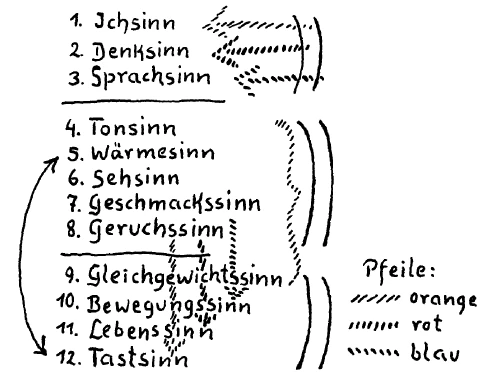
[ 29 ] Wir sehen da, wie es schon notwendig ist, das Augenmerk zu richten auf jenen Gleichgewichtszustand, der das Wesentliche, das Bedeutungsvolle ist, der hergestellt werden muß zwischen Ahrimanischem und Luziferischem in der Welt. Denken Sie, daß gewissermaßen an den äußersten Enden das Ich des Menschen beteiligt ist, hier gewissermaßen das Ich von außen, am Tastsinn das Ich von innen. (Siehe Zeichnung, orange Pfeile.) Ebenso ist der astralische Leib am Denken beteiligt, aber am Lebensorganismus wiederum von innen beteiligt (rote Pfeile). Der Ätherleib ist beteiligt hier, wenn das Sprechen nicht geschieht, aber ebenso beteiligt am Bewegungssinn von innen (blaue Pfeile). In der Mitte haben wir gewissermaßen dasjenige, woran «ich taste denke — lebe — spreche — bewege», weniger beteiligt sind, eine Art Hypomochlion, wie es die Waage hat in der Mitte, wo sie ruht. Je mehr man gegen die Mitte kommt, desto mehr bleibt der Waagebalken ruhig. An den Seiten schlägt er aus. So hätten wir in der Mitte eine Art Ruheverhältnis.
[ 29 ] We see here how it is already necessary to focus our attention on that state of balance—which is the essential, the significant—that must be established between the Ahrimanic and the Luciferic in the world. Consider that, in a sense, the human “I” is involved at the outermost ends: here, so to speak, the “I” from the outside, and in the sense of touch, the “I” from the inside. (See diagram, orange arrows.) Similarly, the astral body is involved in thinking, but is also involved in the life organism from the inside (red arrows). The etheric body is involved here when speech is not taking place, but is equally involved in the sense of movement from within (blue arrows). In the center, we have, so to speak, that which is less involved in “I feel—think—live—speak—move”—a kind of hypomochlion, like the center of a balance where it rests. The closer one gets to the center, the more the balance beam remains still. It swings out at the sides. Thus, we would have a kind of state of equilibrium in the center.
[ 30 ] Da enthüllt sich uns schon die menschliche Wesenheit, in einer bedeutungsvollen Weise von zwei Seiten her beeinflußt. Und es ist notwendig, daß das Ahrimanische und das Luziferische in der rechten Art ins Auge gefaßt wird, wenn man den Menschen verstehen will in seinem Aufbau, wie auch in seiner heutigen Betätigung.
[ 30 ] Here, the human being is already revealed to us as being significantly influenced from two sides. And it is necessary to view the Ahrimanic and the Luciferic in the right way if one wishes to understand the human being in his constitution as well as in his present-day activities.