

The Karma of a Person's Profession
in Relation to Goethe's Life
GA 172
6 November 1916, Dornach
Translated by Steiner Online Library
Third Lecture
[ 1 ] I would now like to approach the problem we are working on in these reflections from a different starting point. For in the spiritual sciences, it must be the case that one, so to speak, encompasses the problem from various angles and also approaches it from various angles. When we consider a life such as Goethe’s, we must—I would say—notice, at least in broad terms, something that can become a great mystery in the development of humanity, even when we initially consider repeated earthly lives and consult them in shaping a person’s life. I am referring to the problem: What is it, actually, that enables individual human beings—such as Goethe, for example—to create, from within themselves, something as significant as what Goethe created, particularly through his Faust, and to exert such a significant influence on the rest of humanity through such creations? How is it that, in a sense, certain individuals are set apart from the rest of humanity and, as it were, called by the course of world history to achieve something so significant? — We then compare the life and work of each individual with such significant creations and ask ourselves: What do we find in the difference between the life of each individual and the lives of these so-called outstanding individuals?
[ 2 ] This question can only be answered by examining life a little more closely using the tools provided by spiritual science. For one thing, everything that human beings can perceive—especially in our time—is designed to conceal and mask certain things, and to keep them beyond the reach of unbiased human observation. This also makes it necessary that, in many cases, one must first speak in spiritual science in a way that adapts to what can be understood initially. Now, in spiritual science, we usually describe things by saying: The human being, as he appears to us in life, consists of his physical body, the etheric body, the astral body, and the I. — And we then describe—by characterizing the transitional states between waking and sleeping—that during waking, the “I” and the astral body are inside the physical body and the etheric body; during sleep, the “I” and the astral body are outside. — This is, for the time being, entirely sufficient for understanding the matter and is entirely consistent with the facts of spiritual science. But the point is that by describing it in this way, we present only a part of the full reality. We can never encompass the full reality in a single description; in fact, whenever we describe anything, we are always presenting only a part of the full reality, and we must always first seek light from other perspectives in order to illuminate the described partial reality in the proper way. And here it must be said: It is generally the case that sleeping and waking truly represent a kind of cyclical movement for the human being. Strictly speaking, during the state of sleep, the ego and the astral body—apart from the physical and etheric human bodies—are located only outside the head; yet precisely because the ego and the astral body are outside the physical and etheric head of the human being during sleep, they exert all the more vigorous activity and influence on the rest of the human organism. Everything in the human being that is not the head—that is, the rest of the human organism—is, precisely during the state of sleep, in which the “I” and the astral body, so to speak, act upon the human being from the outside, under a much stronger influence of this “I” and this astral body than during the waking state. And one can indeed say: During sleep, the effect that the human ego and astral body exert on the head during the waking state is exerted on the rest of the organism. — We can therefore rightly compare, in a certain sense, the human “I” to the sun, which, when it is day for us, illuminates our region; when it is night for us, this sun is not merely outside, but it illuminates the other side of the Earth and makes it day there. Thus, in a certain sense, it is day in the rest of our organism when it is night for our sensory perception—which is, after all, primarily bound to the head—and conversely, it is night for the rest of our organism when it is day for our head; that is to say, the rest of our organism is more or less withdrawn from the “I” and also from the astral body when we are awake. This is yet another factor that must be taken into account to shed light on the full reality if one wishes to understand the whole human being.
[ 3 ] The point is that, in this sense as well, one must correctly grasp the connection between the human soul and the human body if one wishes to properly understand what I have just stated. I have often emphasized that the nervous system of the physical organism is a unified system, and in fact, it is nothing but sheer nonsense—not even justified by anatomy—to divide nerves into sensory and motor nerves. The nerves are all organized as a unified whole, and they all have a function. The so-called motor nerves differ from the so-called sensory nerves only in that the sensory nerves are designed to serve the perception of the external world, while the so-called motor nerves serve the perception of one’s own organism. A motor nerve is not intended to move my hand—that is sheer nonsense—but rather the motor nerve, the so-called motor nerve, is intended to perceive the movement of the hand, that is, to perceive it internally, while the sensory nerve is intended to serve the perception of the external world. That is the entire difference. Now, as you know, our nervous system is divided into three parts: those nerves whose main center is the brain—that is, those centered in the brain—then those nerves centered in the spinal cord, and those nerves that we classify as part of the so-called ganglionic system. These are essentially the three types of nerves that humans have. The question now is to recognize: What relationships exist between these three types of nervous systems and the spiritual members of our organism? Which is, so to speak, the most advanced, most refined member of the nervous system, and which is the least advanced member of the nervous system?
[ 4 ] It goes without saying that those who today come from the conventional scientific worldview will answer this question as follows: “Well, the nervous system of the brain is, of course, the noblest, for it is what distinguishes humans from animals.” — But that is not the case. This nervous system of the brain is essentially connected to the entire organization of our etheric body. Of course, there are other connections everywhere, so that our entire brain system naturally also has connections to the astral body or to the “I,” but these are secondary connections. The primary, original connections are between our brain’s nervous system and our etheric body. This has nothing to do with the view I once expounded—that the entire nervous system was brought into being with the help of the astral body; that is something entirely different, and one must make a clear distinction between the two. It was established in its original form during the Lunar period, but it has continued to develop, and other relationships have been established since its initial formation, so that in fact our brain-nervous system has the most intimate and significant relationships with our etheric body. The spinal cord system has the most intimate and primary connections to our astral body, as we now possess it as human beings, and the ganglion system to the “I,” to the true “I.” These are the primary connections as we now have them.
[ 5 ] If we consider this, we can easily imagine that a particularly active relationship exists during sleep between our “I” and our ganglion system, which is primarily distributed throughout the trunk, encases the spinal cord in bundles, and so on. But these connections are loosened during waking hours; they are present, but they are loosened during waking hours. They are more intimate during sleep. And more intimate than during waking hours are the connections between the astral body and the spinal nerves during sleep. So we can say: During sleep, particularly close connections arise between our astral body and our spinal nerves, and between our “I” and our ganglion system. During sleep, we live more or less in close union within our “I” with our ganglion system. Once one studies the mysterious world of dreams more closely, one will recognize this, which I mention here based on spiritual scientific research.
[ 6 ] But then, when you consider this, you will also find a bridge to the other essential, significant thought: that something very important for life must be provided by the fact that a rhythmic alternation occurs in the interaction of the “I,” for example, with the ganglion system, and of the astral body with the spinal cord system—a rhythmic alternation that is identical to the alternation of sleep and wakefulness. For it will not seem all too surprising to you when one says: Because the “I” is actually quite at home in the ganglionic system and the astral body is quite at home in the spinal cord system during sleep, the human being is, in relation to the ganglionic system and the spinal cord system, awake during sleep and asleep during wakefulness. — One can only ask: How is it, then, that we know so little about this active state of wakefulness, which must actually be developed during sleep? Well, if you consider how the human being came to be—that the human “I” only took its place within the person during earthly existence, and is thus, in a sense, the baby among our human members—then it will come as no surprise to you that this “I” is not yet able to bring to consciousness what it experiences in the ganglion system during sleep, whereas it can indeed bring to consciousness what it experiences when it is in the fully developed head, which is, after all, primarily the result of all those impulses that have been brought about by the Moon, the Sun, and so on. What the “I” can bring to consciousness depends on the instrument it has at its disposal. The instrument it uses at night is still relatively delicate. For I have explained to you in earlier lectures that the rest of the organism was actually developed only later, that it was added only later to the more perfected head organism of the human being, and that it is an appendage of the head organism. When we speak of the human being having passed through more or less lengthy stages of physical development originating from Saturn, we can only say this with reference to the head. That which is attached to the head is in many cases a later formation—a lunar formation, and in some cases even an earthly formation. Hence, the active life that unfolds during sleep—and which often has its organic seat in the spinal cord and the ganglion system—is initially scarcely perceived by consciousness; yet it is no less active, indeed a significantly active life. And one might just as well say that during sleep, a person should be given the opportunity to descend into their ganglion system, just as, while awake, they are given the opportunity to ascend to their senses and their brain system. Certainly, you will say: How complicated—and perhaps even: How confused—this makes everything we have come to understand! — But human beings are complex beings, and one cannot learn to understand them unless one truly allows this complexity to sink in.
[ 7 ] Now imagine that what I described to you in reference to Goethe actually happens to a human being: that the etheric body is loosened. Then, when the etheric body is loosened, a completely different relationship arises in the waking state between the soul-spiritual and the organic, physical aspects of the human being. As I described yesterday, the human being is placed on a kind of isolation stool. But such an effect can never occur without entailing another. It is very important to bear this in mind. Such a relationship does not occur unilaterally; rather, it entails another. If we were to describe this relationship—which I characterized yesterday—in somewhat cruder terms, we could also say: Because the etheric body is loosened, the human being’s entire waking life is, in a certain way, affected and influenced. But this cannot happen without the human being’s sleep life being influenced at the same time. The consequence of this is simply that the human being enters into looser relationships with his brain impressions when something like what happened to Goethe occurs in him. As a result, they also enter into more intimate, stronger relationships with their spinal nerves and the ganglion system while awake. This is what happened at the time Goethe fell ill: he developed, so to speak, a looser relationship with his brain, but at the same time a more intimate relationship with his ganglion system and his spinal cord system.
[ 8 ] But what actually happens as a result? What does it mean to say that a more intimate relationship develops with the ganglion system, with the spinal cord system? For this brings a person into a completely different relationship with the outside world. We are, after all, always in an intimate relationship with the entire external world; we simply do not pay attention to just how intimate our relationship with the external world actually is. But I have often drawn your attention to this: The air that you hold within you at one moment is outside the next, and different air is inside; what is now outside takes on the form of the body in the next moment and unites with your body. It is only seemingly that the human organism is separate from the outside world; it is a part of this outside world; it belongs to this entire outside world. So when a change in the relationship to the outside world occurs, such as the one described, it has a powerful effect on human life. Now one might say: As a result, the lower nature of a person like Goethe—for what is connected to the spinal cord and the ganglionic system is usually referred to as the lower nature—should actually come to the fore particularly strongly. The forces withdraw from the head; the ganglionic system and the spinal cord system draw more upon them.
[ 9 ] One only gains an understanding of what is actually happening there when one comes to realize that what we call intellect and reason is not, in fact, as closely bound to our individuality as is commonly assumed. It is precisely regarding these matters that our present age, in accordance with all its fundamental assumptions—one might say as a matter of course—holds the most completely inverted notions. It is these matters that our present age struggles with the most. This has been particularly evident in what one might call the “dalketed” —I don’t know if the term is widely understood; it refers to a certain way of approaching things that combines dullness with stupidity—in the way our era, even in the most learned circles, has behaved toward what was to come to light through certain experiments conducted with “trained animals”: dogs, monkeys, horses, and so on, As you know, news suddenly spread around the world about trained horses that can do arithmetic and all sorts of other things, about a highly trained dog that caused a sensation in Mannheim, and about a trained monkey at a Frankfurt zoo that was taught arithmetic along with other things—details of which one does not like to describe in polite company, but can only hint at. The Frankfurt chimpanzee, in contrast to other members of the ape family, has—in response to certain needs—allowed itself to be trained to behave not as apes normally do, but as humans do; I do not wish to elaborate further on this topic. But all of this has astonished not only the general public but also scholarly circles. Not only laypeople but also scholars were overcome with a kind of rapture, especially when the Mannheim dog wrote a letter after the death of a beloved family member: how this beloved family member, the dog’s offspring, would now be with the primordial soul, how he would fare there, and so on. It was a very intelligent letter that the dog wrote. Well, of course, there’s no need to go into the particularly complex displays of intelligence here, but still: all these different animals were capable of performing arithmetic. A great deal of effort was then devoted to investigating what such animals are capable of. Something quite special came to light regarding the Frankfurt monkey. It was found, in fact, that when presented with a calculation that was supposed to yield a specific number as the result, he would point to that number in a row of numbers placed side by side; he would point to the correct number, and the sum would result, for example, from individual additions. It was then realized that this learned monkey had simply gotten into the habit of orienting himself precisely according to the direction of his trainer’s gaze. Some who had previously been amazed were already saying: “Not a trace of a mind—it’s all training.” — It is actually nothing more than a somewhat complicated procedure, like when a dog retrieves an object: if you throw a stone at it, it fetches it; in the same way, the monkey picked out from a row of numbers the one that was not where the throw was directed, but simply where his trainer’s gaze fell.
[ 10 ] Upon closer examination, similar results will certainly be obtained with other animals as well. One really need only ever be amazed by one thing: that people are so astonished when such animals occasionally accomplish something that appears human-like. For how much more spirit, how much more intellect—if one considers intellect objectively—is naturally inherent in all that is well known in the animal kingdom, in what is accomplished through so-called instinct! For there, in fact, something immensely significant is accomplished, and there lie deeply meaningful connections within it that lead one to admire the wisdom that reigns wherever phenomena come to light. We do not possess wisdom solely within our heads; wisdom is what surrounds us everywhere like light, what is at work everywhere, and what also works through the animals. Only those who have not seriously engaged with scientific developments at all are merely astonished by such extraordinary phenomena. To all those who today write such scholarly treatises on the Mannheim dog and similar dogs, on horses, on the Frankfurt monkey, and so on—to them I would like—among other things, for this is not an isolated case—to read just one passage from Carus’s book Comparative Psychology, published as early as 1866; since the others aren’t listening to me, I will first read this passage to you. Carus writes on page 231: “If, for example, a dog is treated by its master with kindness and affection for a long time, human traits become imprinted on the animal, even though it has no sense of the concept of kindness in itself, they become concretely imprinted, amalgamate with the mental image of this person whom the dog often sees, and enable the dog to recognize this personality—even without the sense of sight, for example, merely through smell or hearing—as the one from whom it once received kindness. If, therefore, harm is now inflicted upon this person—perhaps even depriving him of the opportunity to bestow further kindness upon the dog—the animal perceives this as an evil inflicted upon itself and is thereby moved to anger and revenge; all of this, then, without any abstract thought, but always and only through one sensory image following another.”
[ 11 ] It is certainly true that one sensory image follows another in the dog; but reason and wisdom prevail throughout the entire event.
[ 12 ] “It remains strange, however, just how much such a peculiar interweaving, separation, and reconnection of inner mental images can nevertheless come close to real thinking and resemble it in its consequences! — “I once saw a well-trained white poodle”—that was not the Mannheim dog, for this was written in 1866— “which, for example, correctly selected and arranged the letters of words dictated to it, which seemed to solve simple arithmetic problems by gathering individual numbers—written on separate sheets, just like the letters—which seemed to count how many ladies were present in the company, and the like. — Of course, if this had involved a genuine understanding of numbers—as a mathematical concept—none of this would have been possible without actual thought; but it ultimately turned out that the dog had merely been trained to pick up, at a very faint signal from his master, the sheet bearing the specified letter or the corresponding number from the row laid out before him, along which he paced back and forth, and, at the signal of another equally faint sound (such as a snap of the thumbnail and the nail of the ring finger), to place the card back down in a different row, thereby performing such an apparent miracle.”
[ 13 ] As you can see, not only has the phenomenon been known for a long time, but so has the solution—which scholars are only now rediscovering with great effort, because people pay no attention to what has been achieved in scientific development. That is the sole reason why such things come about—things that bear witness not to our advanced science, but to our advanced ignorance! But on the other hand, a valid objection has been raised. If, once again, we were dealing solely with explanations such as those put forward today, one might just as easily find such explanations naive; for Hermann Bahr rightly said: Well, so Mr. Pfungst has come along and shown how horses react to very subtle cues that the trainers do not perceive but rather act upon unconsciously—cues that he himself was only able to perceive after spending a long time in his physiological laboratory constructing apparatus to detect these minute expressions. — Hermann Bahr rightly objected that it is, after all, a peculiar interpretation to suggest that horses are supposedly so clever as to observe such expressions, while a private lecturer first had to spend many years—I believe it took him ten or even more years—constructing devices to perceive them! There is, of course, a grain of truth in all such matters; but one must simply look at things properly. And when viewed properly, it becomes clear that these things can only be explained if, just as with instinctive actions, one imagines objective wisdom and objective reason embedded within them—if one conceives of the animal as part of a whole system of objective connections of wisdom that pervade the world; in other words, if one does not limit oneself to thinking that wisdom came into the world solely through human beings, but recognizes that wisdom reigns throughout the entire world and that human beings are merely called upon, through their special organization, to perceive more of this wisdom than other beings. This is what distinguishes human beings from other beings: that, through their organization, they can perceive more of this wisdom than other beings. Yet the other beings, through the wisdom implanted within them, can accomplish deeds just as wise as those of human beings—only of a different kind. And the extraordinary manifestations of wisdom’s workings are, in fact, far less important to those who take their contemplation of the world seriously than those that are constantly spread out before our eyes. Those are the far more important ones. If you take this into consideration, you will no longer find what follows incomprehensible.
[ 14 ] Animals are so deeply embedded in the wisdom of the world that they are intimately connected to it, much more so than humans. In a sense, animals are given a much more fixed course to follow than humans. Human beings are left much freer than animals; this also enables them to conserve energy for recognizing these interconnections. The main point is this: in animals—and particularly in higher animals—the physical body is integrated into the same cosmic interconnections into which, in human beings, only the etheric body is integrated. Therefore, humans know more about these cosmic interrelationships, but animals are much more intimately and closely embedded within them, much more deeply integrated into these cosmic interrelationships. So when you consider objectively governing reason and say to yourself: “All around us there is not only air and light; all around us there is also governing reason everywhere. When we walk, we walk not only through the space of light, but also through the space of wisdom, through the space of governing reason”—then you will grasp what it means when, in regard to the finer relationships of his organs, a human being is integrated into the world in a different way than he usually is. Now, in normal life, a human being is integrated into the spiritual world in such a way that the connection between the “I,” the ganglion system, the astral body, and the spinal cord system is severely impaired for waking life; because this connection is severely impaired and dampened, a person in ordinary, normal life pays little attention to what is happening around them—things they could only perceive if they were truly perceiving with their ganglion system in the same way they otherwise perceive through their head.
[ 15 ] But when, in such an exceptional case as that of Goethe, the astral body—because the etheric body has been drawn out of the head—has been brought into a more active relationship with the spinal cord system, and the “I” with the ganglion system, then a much more active interaction also arises with that which always surrounds and envelops us—and which is veiled from us solely because, in normal human life, we only enter into a relationship with our spiritual environment during the hours of night sleep. This, however, leads you to understand how something like what Goethe described was simply a matter of perception for him—a real perception, one that naturally could not be as brutally bright as the perceptions we derive from the external world through our senses, but which was nevertheless brighter than the perceptions a person otherwise has of their surroundings, insofar as these surroundings are spiritual.
[ 16 ] Well, what did Goethe perceive with particular intensity in this way? Let’s examine what Goethe perceived with particular intensity, using a specific example. Goethe was, by virtue of his particular karma, destined to grow into the life of a scholar, into the life of knowledge—through complications of karma, as I have hinted to you—yet not in the same way as a run-of-the-mill scholar. What does he experience in this way? Well, you see, for many centuries, a person who grows into the life of a scholar has experienced a significant inner conflict. This conflict is even more hidden today than it was in Goethe’s time. But everyone experiences a certain conflict because, within established science, there is an immensely broad field in which one can find what has been preserved, more or less, from the fourth post-Atlantean epoch. It is preserved in the terminology, in the systems of words that one is compelled to adopt. We delve much deeper into words than we realize. This was mitigated by the fact that, in the 19th century, a great deal of experimentation gradually took place, and that through this we grew so deeply into knowledge that we saw more than had been seen before, and that, at least to a certain extent, sciences such as jurisprudence have come down from the particularly lofty pedestal on which they previously sat. But when jurisprudence and theology still occupied those particularly lofty positions, the system of words into which one first became immersed was truly all-encompassing, and so much of what one had to assimilate was a legacy of the fourth post-Atlantean epoch. Alongside this, what stems from the needs of the fifth post-Atlantean epoch—the immediate life arising from the great achievements of modern times—has become increasingly prominent.
[ 17 ] Someone who is simply shuffled from class to class doesn’t feel this, but a person like Goethe felt it to the very highest degree. I say: A person who is simply shuffled from class to class does not feel it, but that does not mean they do not go through it. They truly go through it. And here we are already touching upon a certain mystery of modern life. Students going through their studies—we can assess them based on what they go through and what they themselves know about it; but what they go through is not the whole story. Their inner world is something entirely different. And if these people, who are passing through these interwoven layers—the fourth and fifth post-Atlantean epochs—were to know what a certain aspect of their being, without their realizing it, is going through with them, then they would have an entirely different understanding of what Goethe, even in his youth, had already enshrined in his Faust, for unconsciously, countless people are experiencing this as they immerse themselves in today’s educational path. So one must say: Through everything Goethe cultivated within himself by virtue of his special karma, the people he came into close contact with during his youth were something entirely different to him than they would have been had he not possessed this special karma. For he sensed and felt how the people with whom he grew up must actually have been numbed in order to have numbed the Faustian life within themselves—rather than truly possessing it. He was able to sense this because what lived in a mysterious way within his fellow human beings made such an impression on him as is otherwise only made by one person on another when particularly intimate relationships arise—that is to say, when love develops between one person and another. When love develops between one person and another, the connection between the ego and the ganglion system, and between the astral body and the spinal cord system, is also at work to a high degree unconsciously in ordinary life. Something quite special comes into play there. But what is otherwise active only within this loving relationship manifested for Goethe in a broader context, in that he felt an immense, more or less subconscious compassion for the poor fellows—forgive the expression—who did not know what their inner selves were going through, while outwardly they were driven from class to class, from exam to exam. He felt this; it gave him a rich experience,
[ 18 ] Experiences become ideas. Ordinary experiences become the ideas of everyday life; these experiences became the ideas that Goethe poured out in his Faust. They are nothing other than experiences—experiences he had in the broadest sense, brought about by the fact that, so to speak, his ganglionic and spinal cord life was called upon to a greater state of alertness than usual. And that was the opposite pole to the dimming of his mental life. But this predisposition had been present in him since boyhood. One can see this from the description he gives when he recounts how not only what usually occupies people came into play—say, during piano lessons—but the whole person. Goethe simply engaged with the goings-on of reality as a whole person to a much greater extent than anyone else. So that one must say: Goethe was more awake during the day than other people. He was more awake during the day in the period when he was working on Faust as a young man. That is why he also needed what I described to you yesterday as the “sleep period” of his ten years in Weimar. That was necessary: yet another period of winding down.
[ 19 ] Now, I would say that this is really just the same thing, albeit in a somewhat more active form—something that occurs in all people to a greater or lesser extent throughout their lives. Goethe was simply drawn, in a somewhat more conscious way than other people, into the surrounding, wisdom-filled activity—into the purely spiritual activity. He perceived what lived and wove mysteriously within human beings. But we are always immersed in what lives and weaves there. What, though, is that actually? When we are cast into the world in our ordinary, brutal waking life, we are cast into this world with our “I”; we are connected to it through the senses and through our ordinary conceptions. But as you can see, we are now connected to this world in a much deeper way. Our “I” is, in fact, in a particularly intimate relationship with our ganglion system, and the astral body with the spinal cord system. Through this relationship, we truly have a much more comprehensive connection to our environment than through our sensory system, than through our head. Now consider that human beings need the rhythmic alternation that consists in their ego and astral body being within the head during waking hours and outside the head during sleep; and that, precisely because they are outside the head during sleep, they develop an active inner life in conjunction with the other system, as I have indicated to you. The “I” and the astral body therefore need this alternation: to withdraw into the head and to emerge from the head. When a human being is outside the head with their “I” and astral body, they not only develop intimate relationships with the rest of the organism through the ganglion system and the spinal cord system, but they also develop spiritual relationships with the spiritual world on the other side. They develop these as well. So that we can say: The particularly active interaction with both the spinal cord system and the ganglion system corresponds to an active soul-spiritual interaction with the spiritual world. — So if we must assume for the night that the soul-spiritual is outside the head and that this particularly active life thereby develops for the rest of the organism, then I must say: For daytime life, when the “I” and the astral body are more centered in the head, we in turn have a spiritual interaction with our spiritual environment. We immerse ourselves, as it were, in a spiritual inner world during sleep, but in a spiritual environment upon waking.
[ 20 ] This connection with the spiritual world is more vivid only in a person like Goethe; he dreams, as it were, just as a person dreams while asleep and does not merely sleep in a dull state. Thus, people very rarely dream consciously while awake; but people like Goethe slip into dreaming even while awake. As a result, what remains unconscious in other people becomes, so to speak, a dream-like structure of life for them.
[ 21 ] Now you have an even more precise picture. Of course, based on this description, you might form a very arrogant notion; you might say to yourself: “So, actually, we could all write a Faust, because we experience Faust by reaching out into our surroundings during our daily lives and living in harmony with the spiritual world.” That is also true. We experience Faust; only we experience it in the same way that one otherwise experiences the opposite pole at night with the “I” and the astral body, when one is not dreaming. And so Goethe did not merely experience this unconsciously; rather, he dreamed this experience, and through that he was able to express it in Faust. He dreamed this experience. For people like Goethe, what they create stands in relation to what other people experience unconsciously just as a dream and deep sleep do on the other side of life. This is a full reality: just as with dreams and deep sleep, so do the creations of great spirits stand in relation to the unconscious experiences of other people.
[ 22 ] Yes, some things still remain a mystery. But keep in mind that this gives you insight into something that is intimately connected with human life. Keep in mind that this gives you insight into a reality that can be characterized in roughly the following way. We could actually always have much, much to say about the connection between our being and our surroundings, if we could awaken—even in our dreams—to this connection with our surroundings. One would only need to awaken—even in one’s dreams—and one would experience and be able to describe something immense. But this would have a significant consequence—a very significant consequence. Just imagine, to put it simply, if all people were so conscious that they could describe everything in their surroundings—if, for example, all people could truly describe experiences that could be expressed in the same way as Goethe’s experiences as depicted in Faust—where would that lead us? Where would the world end up? The world would—strangely enough, but it is so—the world would come to a standstill; the world could not go on. At the very moment when all people were to dream in a way that is an entirely different kind of dreaming—as a poet like Goethe dreams Faust—if everyone were to dream their connection to the outside world, at that very moment people would direct the forces they develop from within toward such a task, pour them into it, and human existence would, in a certain sense, consume itself. You can form a faint idea of what would happen if you look at the many devastating effects that already occur today because many people—though they do not actually dream—imagine themselves to be dreaming by parroting or rewriting reminiscences they have absorbed from elsewhere. This is connected to the fact that there are far too many poets; for who today does not believe that he is a poet or a painter or the like! The world could not exist if that were the case, for all good things also have their dark sides—real dark sides,
[ 23 ] Schiller was also a significant poet who dreamed of many things in the way I have just described, But just imagine if all those who, like Schiller in their youth, were groomed to become medical students and doctors were to give up medicine just as Schiller did—and if they were then, out of necessity, appointed later through all sorts of patronage—without actually being prepared, without having studied history—as “professors of history”! Schiller did give very stimulating lectures, but in the end, the students did not learn what they needed to know from Schiller’s university lectures in Jena. And Schiller also gradually let these university lectures peter out and was glad when he no longer had to give them. Just imagine if it were like that with every such history professor or every aspiring doctor! So, of course, every virtue also has its downside. The world must, in a sense, be protected from coming to a standstill. That is why not all people—it sounds trivial when you say it, but it is a profound, almost mystical truth—that is why not all people can dream in this way. For the energies with which these people dream must first be genuinely applied in the external world to something else, so that in this other endeavor the foundations may be laid for the further development of the Earth, which would come to a standstill if all people were to dream in the manner described.
[ 24 ] And now we have reached a point where something particularly paradoxical emerges. What, after all, are these forces—which have been alluded to—actually used for by people in the world? If we examine from a spiritual-scientific perspective what these forces are used for—forces about which you might say, “If only they were used for dreaming by all people!”—but they are not used for dreaming, rather for deep sleep—then what are they actually used for? They are used for everything that is poured out over human development in the most diverse forms of professional work. All of this flows into the most diverse forms of professional work. And professional work stands in the same relationship to such work as that performed on Faust or on Schiller’s Wallenstein as deep sleep does to dreaming. But we are asleep in our professional work! You may find this strange; you will say that in professional work you are, after all, awake. But this so-called wakefulness is, in fact, a great illusion, for what truly comes about through professional work is not something in which a person is active with full waking consciousness. Some of the effects of one’s profession on one’s soul do, of course, become consciously apparent, but people know nothing of what actually exists within the entire fabric of professional work that they are constantly weaving all around the earth. It is even striking to realize how these things are connected. Hans Sachs was a “shoemaker and poet as well”; Jakob Böhme was a shoemaker and a mystical philosopher as well. Here we have, through a special constellation—which one can also discuss—what I would call alternating between sleeping and dreaming. One can pass from one into the other.
[ 25 ] But what does this interplay—this alternating life between his professional work—for someone like Jakob Böhme, who, after all, really did make shoes back then for the good people of Görlitz—and his mystical-philosophical writings—actually mean? Some people have strange views on these matters. I’ve already told you what we learned when we were once in Görlitz and struck up a conversation with a man there one evening before a lecture. I was just about to give a lecture on Jakob Böhme in Görlitz. That’s when I got into a conversation with a high school teacher about the Jakob Böhme monument, which we had just seen there in the park. The people of Görlitz—as we were often told—call this monument the “Park Shoemaker.” We remarked that the monument was very beautiful, and this high school teacher said he didn’t think so, because it looked like Shakespeare—but he was, after all, a shoemaker, and you couldn’t tell by looking at him that he was a shoemaker. If one were to depict Jakob Böhme, one would have to be able to tell at a glance that he was a cobbler. — Well, there’s certainly no need to have anything to do with such a mindset. As a person like Jakob Böhme wrote down his great mystical-philosophical views, he brought forth the result that could only have come about because humanity has developed through the Saturn era, through the Sun era, through the Moon era, up to the Earth era—where, one might say, a broad stream flows that has finally found expression in these effects. It is only in a manner brought about by specific karmic circumstances that this stream finds expression in such a personality. But just as everything that preceded a human being on Earth through the Sun and Moon eras is absolutely necessary, so too was it naturally necessary—albeit in a special way—to bring about what was present in Jakob Böhme.
[ 26 ] But then Jakob Böhme sat down again and made shoes for the good people of Görlitz. How does that fit together? Certainly, the fact that a person could acquire the skill to make shoes is also connected to this movement. But once the shoes are finished, they serve other people; they go out into the world, separating themselves from the person who made them. In what they do out there, they no longer have anything to do with dexterity and so on, but rather with covering and warming feet and so on. They go their own way; there they also perform certain functions. They detach themselves from the person, and what they bring about out there only has its effects later—that is merely a beginning. And this is how it is: If I were to sketch the initial effect of the mystical-philosophical activity of Jakob Böhme just described in such a way that I were to draw the first seed there (see drawing, cross beneath the first circle, Saturn state), then I would have to draw the first seed of his shoemaking here (cross in the fourth circle, Earth state), and that flows on and will have matured in the future volcanic development to a perfection similar to what arose from the Saturn development and flowed into the mystical-philosophical activity of Jakob Böhme. This (small circle beneath the fourth circle) is, in a sense, an end; his shoe-repairing is a beginning (small circle with a plus sign in the fourth circle). We say that the Earth is the Earth today. Of course, it is. If we could trace it back from Saturn, even further back, we could say: In certain respects, the Earth is a volcano; there (on the far left), we would then assume Saturn. But as it is, we can view everything relatively. We can say: The Earth is Saturn, and the volcano is, in a sense, the Earth. What happens on Earth in a professional endeavor such as that of Jakob Böhme—not in the free creative work he does beyond his professional work, but what he does as his professional work—is the starting point for something that will be as significant on the volcano as what happened on Saturn is now for the Earth. And something similar had to happen on Saturn so that Jakob Böhme on Earth could write his mystical philosophy—just as he himself did while mending shoes—so that something similar can be done on the volcano, just as his writing of mystical philosophy is on Earth.
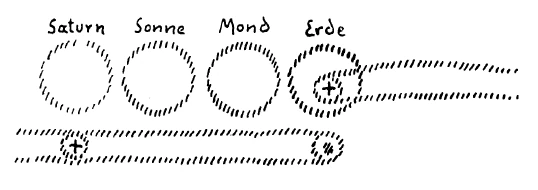
[ 27 ] There is something truly remarkable about this. For it suggests that what is often so little valued on Earth is valued so little precisely because it is the starting point for something that will only be valued in the future. By their very nature, people are, of course, much more closely connected to the past; for they must first grow to be one with that which is a beginning. That is why they often cherish what is a beginning far less than what comes to them from the past. It is only from the full scope of that into which we must still be placed during the Earth period—so that something special can emerge on Vulcan once the Earth has developed further through the Jupiter and Venus periods up to the Vulcan period—that such full consciousness as that found in something like Jakob Böhme’s philosophy on Earth will then arise. Therefore, what is actually significant in human external work today is shrouded in such unconsciousness as the human being was shrouded in unconsciousness on Saturn; for it was only on the Sun that the human being developed sleep consciousness, on the Moon dream consciousness, and on Earth waking consciousness in relation to his present circumstances.
[ 28 ] And so human beings truly live in a state of deep, sleep-like consciousness with regard to everything they immerse themselves in—whether it be a particular profession—for it is precisely through this profession that they create the values of the future—not through what brings them joy in their work, but through what develops without them being able to influence it. If someone manufactures a nail and manufactures a nail again and again, well, of course that doesn’t bring any particular joy today. But the nail, which stands apart, has certain tasks. People don’t concern themselves further with what happens through the nail. One does not track every nail one produces. But everything that is shrouded in the unconscious, in deep sleep, is destined to come to life again in the future.
[ 29 ] In this way, we have been able to juxtapose what the most ordinary person does—the most insignificant work, at least in a professional context—with what appears to be the highest achievement. The highest achievements are an end; the most insignificant work is always a beginning.
[ 30 ] I wanted to begin by juxtaposing these two concepts, because we cannot consider the way in which a person is connected through their karma in their profession unless we first understand how professional work—which is often associated with the person in a purely external way—relates to the overall process of development in which the person is immersed. And so we will proceed shortly to explore the actual question of karma in one’s profession. But I had to address these matters first so that we might at least gain a universal understanding of what flows from the human being into one’s profession. These matters are also all very well suited to shaping our moral sensibilities in the right way. For our judgments are often incorrect because we do not view things in the right way. A seed sometimes seems quite inconspicuous when it lies next to a beautifully developed flower. Yet within that seed lies the beautifully developed flower of future evolution. Today I wanted to explain to you, using human creativity as an example, how the seed and the flower are connected in the evolution of humanity.