

The Karma of a Person's Profession
in Relation to Goethe's Life
GA 172
12 November 1916, Dornach
Translated by Steiner Online Library
Fourth Lecture
[ 1 ] Perhaps someone might say that, when it comes to a question such as the one now weaving its way into our discussions—which all tend, to a greater or lesser extent, to boil down to the so-called “vocational question”—humanities-based considerations are among the least interesting. But that is not the case, and one must recognize that it is particularly not the case in our fifth post-Atlantean period. For in this fifth post-Atlantean period, all the conditions within which human beings live will in fact change quite significantly compared to the conditions that existed in earlier Earth periods, and they will change in such a way that human beings themselves, out of their own freedom, must contribute more to this change than they did in earlier times, when the task assigned to them within Earth’s evolution could unfold almost instinctively, and when, in a sense, the direction they were to take in one respect or another was laid out for them.
[ 2 ] If, for example, we look back at Egyptian-Chaldean culture or at other cultures of earlier times, we will find that as much as is now—and this will increasingly be—placed in the hands of human beings with regard to shaping their external destiny was not placed in their hands in earlier times. In the Egyptian-Chaldean period, to a certain extent, the fact that a person belonged to a particular social class—into which they were, as it were, forced, though not in such a rigid sense, but nevertheless in a certain sense, much like an animal belongs to its species—meant that they were deprived of the freedom that is now often regarded as part of human freedom. However, there was a counterbalance to this restriction of freedom in those earlier times. You can bring this counterbalance to mind if you consider what we have discussed in the context of these lectures. Very often today, in the history of external culture—which thinks so short-sightedly—people imagine that it must have been the same in earlier times, as if those who were the leaders of human affairs had guided these affairs out of the same human impulses as today’s leading figures. But remember that in ancient times there were very specific processes within the mysteries through which the leaders and guiding figures were instructed not about what earthly beings desire, but about what the beings who guide earthly life from extraterrestrial regions desire. I have told you that at certain times—which we need not specify in detail now—the ancient sacrificial priests performed certain mystery rites. These mystery rites essentially involved connecting certain suitable individuals in the temples to the universe, to the cosmos, and to extraterrestrial conditions, so that beings who guided earthly events from extraterrestrial regions would then enter the consciousness of these particularly suitable individuals, and that, based on what was thus inspired through the will of the guiding spiritual beings, one allowed oneself to be guided in the undertakings that were one’s duty.
[ 3 ] So let’s imagine—this doesn’t happen in our time, but I want to use a hypothetical scenario to illustrate how such things used to take place in earlier times—that Christmas were not celebrated as it is today, when for most people it remains, more or less, an external celebration. Let’s assume that Christmas would unfold in such a way that we know: During this time of year, when Christmas occurs, our Earth, as a being, is particularly suited to receiving ideas into its aura—ideas that, for example, cannot enter the Earth’s aura at all during the summer months. In earlier reflections, I have explained how the Earth, so to speak, is awake during the winter season and how one of the brightest moments of this wakefulness is precisely the Christmas season. During this time, the Earth’s aura is permeated and interwoven with thoughts. One could say that during this time, the Earth reflects on the universe outside itself in the same way that we humans, when we are awake during the day, reflect through our thoughts on what surrounds us. In summer, the Earth sleeps. Therefore, certain thoughts cannot be found within it at that time. In winter, it is awake, and it is most alert during the time when Christmas falls. Thoughts permeate the Earth’s aura, and from these thoughts one can discern what the cosmos intends for the processes taking place on Earth.
[ 4 ] If they educated certain individuals in such a way that these individuals became sensitive and receptive to what lived within the Earth’s aura, then these educating sacrificial priests in the temples could experience this cosmic will by, so to speak, connecting the individuals they had educated to the earthly thoughts that express the cosmic will. And then, based on what they experienced there—as it were—as the Will of Heaven, they could determine who should remain within a certain social class and who should be initiated into the Mysteries to assume some leading position in ancient public life or in the ancient priestly order. Humanity has outgrown these things. In this regard, it is now, as it were, at the mercy of chaos. We simply must be very clear about this. The transition from the old, very specific conditions—in which people discerned from the will of the gods what was to take place here on Earth—to our present conditions has taken place. These ancient customs have given way, through the fourth post-Atlantean epoch—in which, so to speak, human individuality has emancipated itself from the will of the cosmos—to our present, already more chaotic conditions. Everything tends toward more being placed in human hands. All the more, however, it is necessary for the will of the cosmos to penetrate earthly conditions in a different way.
[ 5 ] It would take an extraordinary amount of time to explain how, even in the Egyptian-Babylonian—that is, the third post-Atlantean—cultural period, within that which works and weaves in the earthly realm—well, let us call it—in a way adapted to our circumstances—how, within the various human professions, something was at work and weaving that was, to a high degree, a reflection of the will of the cosmos. This came about in the manner described. This began to fade even during the fourth post-Atlantean period; but it has become completely obscured in the fifth post-Atlantean period, in which we live and which, as we know, began around the 15th century. If people today paid more attention to what is happening—if they did not recount a “fable convenue” instead of history—then they would be able to recognize, even from external circumstances alone, how everything in human professional life has changed to a certain degree, particularly since the 14th and 15th centuries; and from present-day conditions, one would recognize how everything will become more and more different in the future. However, a kind of anarchy would truly have to descend upon the human race if there were no one at all to grasp these deeper connections and to convey to human spiritual life ideas that could take into account these changes brought about by the natural course of evolution. What can already be observed in external history—namely, the resurgence of what we might call “professional life” since the 15th century—would astonish anyone who has even the slightest sense for contemplating human life. If such a person were to allow all that can be recognized in this way to sink in, he would, in a sense, reproach himself for living so listlessly and for not giving thought to what is, in the most eminent sense, connected with the ever-evolving destiny of humanity.
[ 6 ] I pointed out here last time that what constitutes real professional life is by no means as insignificant for the entire cosmic context as it might initially appear. I have pointed out to you that we, as human beings, have successively gone through the Saturn phase, during which the first rudiments of the physical human body were formed; the Sun phase, during which the etheric human being was formed; and the Moon phase, during which the astral human being was formed. We are now going through the Earth period, during which the “I” is developing. But other periods will follow these: the Jupiter period, the Venus period, and the Vulcan period. And we can say: Just as the Earth is, so to speak, the fourth stage leading to Saturn, so is Vulcan the fourth stage leading to the Earth. The Earth is, so to speak, the Saturn of Vulcan. Just as processes took place on ancient Saturn—which I designate as 1—that are so closely connected to evolution that we owe to these processes the first rudiments of our physical body, which still continue to work within us today, so too must something be taking place on Earth that continues to influence evolution and that will attain a fourth stage of development on Vulcan, just as certain processes on Saturn underwent a certain fourth stage of development during the Earth era. And I have drawn your attention to the fact that these processes, which will correspond to the Volcano, correspond to what we have on Earth from Saturn’s development and thus represent that which is active and alive in the various professions that people pursue on Earth. As people lead a professional life, something develops on Earth within the activity of the professions that is the first seed of the Volcano, just as Saturn’s activity was the first seed of our physical human body.
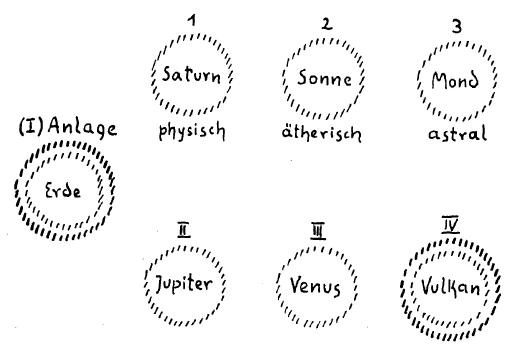
[ 7 ] If you consider that, particularly since the fifth post-Atlantean epoch, professional life has undergone such a tremendous transformation, you will realize how increasingly necessary it will become to conceive of professional life as embedded within the entire course of world evolution, using the perspectives that can be developed through spiritual science. For it is only by first becoming acquainted with the objective aspects of professional life that we can form appropriate concepts of the karma of the profession. We must be even more interested in where professional life is actually heading—where it intends to develop from our present point in time onward—because this gives us a clearer picture than the conditions that exist today.
[ 8 ] The future development of professional life will consist—as one can easily see if one simply looks at the world today with common sense—in professions becoming increasingly differentiated and increasingly specialized. It is hardly sensible today when people sometimes speak critically of the fact that professions have become more specialized in recent times, whereas perhaps not even that many centuries ago, a person could still grasp, within his or her profession, the connection between what he or she produced and what it meant for the world, and could take an interest in shaping and designing his or her products in a certain way, because he or she had a direct understanding of what those products would become in people’s lives. While this was the case in earlier times, it is no longer the case for a large portion of people today.
[ 9 ] Today, to take a radical example, a person is thrust into the factory by fate. He may not even produce a single nail, but only a part of a nail, which is then assembled by another person with another part of the nail, and the person in question cannot develop any interest in how what he does from early morning until late evening fits into the overall context of human life. If one compares the craft life of the past with today’s factory life, one immediately sees a radical difference between the present and what existed not so long ago. What has already taken place to a great extent in the various branches of human activity today will continue to unfold more and more. There will inevitably be ever-increasing specialization and differentiation in professional life. It is not particularly wise to criticize this, because it is a necessity of evolution; it will simply happen and will continue to happen more and more.
[ 10 ] And what kind of prospect does this, so to speak, open up? Yes, essentially, the prospect is that people would then—as one might imagine—have to lose more and more interest in precisely that which fills the greater part of their lives, that they would, so to speak, have to be mechanically devoted to their work in the external world. But that would not even be the most essential point. The most essential point is, in fact, something else. The most essential point is that a person’s external work must, of course, leave its mark on their inner being. And anyone who considers the historical development of humanity will see to what a high degree people in the more recent development—in the fifth post-Atlantean epoch—have, so to speak, become imprints of their professions, and how professional life influences their spiritual life and specializes the human being themselves. You must not, of course, take as your standard the majority of those who perhaps still live within our Anthroposophical Society today, for they are often in the fortunate position of being able to detach themselves from the context of life—in the fortunate position, I might just as well say, in the unfortunate position! For this is often a form of happiness only for the subjective, egoistic human sensibility; it is often not a form of happiness for the world. For the world will one day demand more and more of people that they achieve specific accomplishments, that they be able to specialize.
[ 11 ] The question will only become more and more pressing: What else must happen besides people specializing? The very necessity of global development will ensure that they do specialize. But what else must happen? In the not-too-distant future, this question will become one of the most important—if I may use the expression—family issues for humanity. A family issue, because one will have to understand this question if one wants to raise children. To take a sensible stance on the entire course of human development when the question arises: How do I place my child within this human development? — that will depend entirely on an understanding of this question. For what is still possible in many ways today—but is merely a remnant of bygone times, to which people still cling out of a certain complacency—will soon prove to be nothing more than empty rhetoric: those fine-sounding phrases that are so widely admired today—that one should observe children’s aptitudes and let them become what corresponds to those aptitudes. It is precisely this that will very soon turn out to be nothing more than an empty phrase. For, first of all, people will see that those born from now on will refer back to their earlier incarnations in a more complex way than was the case even in the fourth post-Atlantean epoch; they will exhibit complexities in their systems of aptitudes that were previously unimaginable. In earlier times, these systems of aptitudes were much simpler. And people who consider themselves particularly qualified to assess the aptitudes of older children to determine whether they are suited to this or that profession may well find that such insights into aptitudes are nothing more than the fanciful delusions of the self-important individuals in question.
[ 12 ] But apart from that, people’s lives will become so complicated in the not-too-distant future that the word “vocation” will take on a completely different meaning. Today, people still often imagine a vocation as something internal, even though for most people a vocation by no means presents itself as something internal. Today, people imagine a vocation as something to which a person is called by virtue of their inner qualities. If one were to objectively investigate—especially in our cities—how many people would answer: “I am in my profession because I realize that this is the only profession that corresponds to my aptitudes and inclinations from childhood onward”—if one were to ask this question of at least most city dwellers—one would probably receive very few answers in which people would say they are in precisely the profession that corresponds to their inclinations and aptitudes—as they themselves have perceived them—from their youth onward. I believe that, based on your observations of life, you would by no means believe this. A profession is already, to a high degree, and will increasingly become, that to which one is called by the objective course of world events. Outside, I would say, is the organism, the interconnected system—call it a machine if you like, it doesn’t matter—that demands something of people, that calls to them.
[ 13 ] Precisely through all of this—which is undergoing ever-increasing intensification—what humanity accomplishes through its professional activities is, at the same time, becoming detached from human beings themselves and growing more objective. And as a result, it is increasingly becoming something that, in its further development through Jupiter, Venus, and Vulcan, undergoes a process similar to what the Earth underwent through Saturn, the Sun, and the Moon—precisely through this detachment. It is remarkable that, as a spiritual scientist, one generally cannot speak in a way that pleases people, especially when dealing with matters very close to human life. Spiritual science will be increasingly less exposed to this danger, for it will speak according to the model of wisdom expressed in the words:
And at most one major, state-level action
With excellent pragmatic maxims,
Just as they should be spoken by the puppets!
[ 14 ] The spiritual sciences, however, will not be capable of this. They will often be compelled to present precisely what people do not want as something significant and great for the development of the worlds. And so it cannot be otherwise than that what some people today—who consider themselves brilliant because they have carried a bit of philistinism up into their little heads—easily dismiss as: “Oh, that’s a prosaic, external matter—professional life”—appears quite different in the light of true spiritual science. The reality is such that one must say: In professional life, there is a necessity to develop relationships that have cosmic significance, precisely because professional life detaches itself in a certain way from human interests. — So, some might say, a sad prospect for the future emerges. More and more, people must be drawn into the rat race of life. And spiritual science cannot even console people for being thrust into the rat race of life. — But it would be a great delusion to conclude that from what has been said, for it is a fact of the universe that things operate through polar balance. Just consider how these polar balances impose themselves upon you in the world! Positive and negative electricity, in their mutual relationship, produce their effects, their balances; positive and negative electricity are necessary for one another. The masculine and the feminine are necessary for the procreation of the human race. Out of these polarities, totality develops in the evolution of the universe.
[ 15 ] Such a principle also underlies what we have just explained. It must be that, in our professional work—which is detached from the human being—we create the first cosmic foundations for the further development of the world. For everything that happens in the development of the world is related to the spiritual. And in what we create—whether through physical or so-called spiritual work within our professions—lies, so to speak, the starting point for the embodiment of spiritual beings. Now, during the Earth period, these spiritual beings are still of an elemental nature; one could say: of the fourth degree of elemental nature. But they will already be elemental beings of the third degree by the time the Jupiter phase of evolution arrives, and so on. Our work, which is performed specifically within the objective professional process, is separated from us and becomes the outer shell for elemental beings who continue to develop through evolution. But only under a certain condition. While, on the one hand, we must acknowledge that we are only beginning to understand the meaning even of that which is often disparaged as “mundane life,” we must also be clear that this meaning will only be fully revealed when we fully comprehend the matter within the greater context of the world. What we create in our professional lives can take on significance for volcanic evolution, but something else is also necessary for this. The other pole is necessary for this. Just as positive electricity is necessary for negative electricity, and the masculine is necessary for the feminine, so too is something else—an opposite pole—necessary for what, as professional activity, will increasingly detach itself from humanity. Such polarity, based on opposites, was already present for humanity in earlier epochs of development. Of course, something entirely new does not simply arise out of nowhere; something similar already existed. However, if you look back at earlier cultural periods—even just a few centuries back—you will find that people were much more deeply immersed in their professional lives through their feelings, their passions, and their entire emotional life than is possible today. If you compare the sum of the joys a person could derive from their profession even a hundred years ago with the discontent that many must already feel today when they have nothing but their profession, you will get an idea of what is actually being said.
[ 16 ] Such matters are actually given far too little consideration these days, simply because the people who talk about the nature of professions, the character of professions, career choices, and so on, are mostly those who are good at talking. Schoolteachers write about it, as do writers or pastors—the very people who, relatively speaking, are least aware today of the downsides of professional life in modern times. That is why, when one hears these matters discussed in contemporary literature—including educational literature—one really finds that people are talking about colors as if they were blind. For, of course, someone who, due to certain social circumstances, goes through school, attends high school, and afterward—well, perhaps takes a brief look around at some university—can easily come across as very clever today, precisely because he has absorbed so many ideas, when he acts like a reformer of humanity who now knows exactly how everything should be. There are, after all, many such people. To anyone who truly understands life, these people usually speak the most foolishly about what the future should be. One simply doesn’t notice it because, even today, people still have a very strong respect for those who have gone through such a course of development. The time has yet to come when people will more or less come to feel that a man of letters, a newspaper columnist, or a schoolteacher—educated according to the model by which schoolteachers are educated today—understands the interconnections of life the least. This must gradually develop into more than just a general opinion.
[ 17 ] The point is that we need to gain a clearer understanding of how professional life in earlier times was intertwined with human emotional life, and how the most essential aspect of development in this area lies in the fact that professional life has evolved—and will continue to evolve more and more—out of human emotional life. Therefore, the other pole that must be added to professional life must be different from what it used to be. What, then, was it that used to be added to professional life? You can still see it before you today if you allow what has more or less become the shell of culture—and must increasingly become the shell and covering of culture—to take effect upon you: the buildings in which professions are carried out, surrounding the church in the center. Six days of the week are devoted to one’s profession; Sunday is devoted to what a person must take in solely for the sake of their soul. These were the two poles: professional life and life lived according to religious beliefs.
[ 18 ] It would be the greatest mistake that could be made today to believe that this other pole—as it is still conceived today by religious denominations—could remain as it is, because it is tailored to a professional life that is still tied to emotions. The entire human life would wither away if insight did not take hold precisely in this area. As long as what human beings produced in their professions in terms of elemental spirituality—for they did produce elemental spirituality in the sense just described—did not become detached from them, the old religious concepts were, in a certain sense, sufficient. Now they are no longer sufficient, and will become less and less so the further we advance into the future. What is necessary is precisely what is most vigorously opposed by certain quarters: that the other pole enter into human development, which consists in being able to form concrete conceptions of the spiritual worlds.
[ 19 ] Those who still represent religious creeds today will very often say: “Oh, spiritual science talks about many spirits, many gods; what matters is one God!” Isn’t that enough for us? — Even today, one can still make a certain impression on people by teaching them the great advantage of attaining a god—especially over coffee and family music—by mocking more recent endeavors, by presenting things to people in a particularly selfish and philistine manner. But what is at stake is precisely this: that people’s perspectives must broaden—that is, they must learn to recognize that everything is not merely permeated by a divine spirituality, which one imagines as vaguely as possible, but that spirituality is everywhere, and specifically, concrete, particular spirituality. One will have to learn this while standing at the lathe: just as sparks fly, so too are elemental spirits generated, which enter into the world process and have their significance within it. — “That’s nonsense,” some might say, believing themselves to be particularly clever. These elemental spirits will come into being even if someone stands at the lathe who has absolutely no idea that they are being created. They will come into being all the same. But what matters is that they come into being correctly, that they are created properly—not merely that they come into being at all. For elemental spirits can thus arise that either disrupt the world process or serve it.
[ 20 ] You will best understand what I mean if you consider it in a specific field, for in all these matters we are today at the beginning of a development that—I would say—is right around the corner. Some people are already beginning to sense something of it. If one were to sense something and put it into practice without at the same time turning to spiritual scientific endeavors, that would be the very worst thing that could happen to the Earth. What has mainly occurred in the course of the fourth post-Atlantean epoch is that human beings have first been detached from the outer, inorganic world, which they embody in their tools. He will once again be brought together with what he embodies in his tools. Today, machines are being constructed. Of course, machines today are objective; there is still little of the human in them. But it will not always remain that way. The course of world history is such that a connection is emerging between what a human being is and what a human being creates—what a human being brings forth. This connection will become ever more intimate. It will first emerge in those areas that establish a closer relationship between human beings—for example, in the handling of chemical substances that are processed into medicines. Today, people still believe that if something consists of sulfur and oxygen and some other substance—such as hydrogen or something else—then the resulting product contains only the effects derived from the individual substances. To a large extent, this is still true today, but the course of world development is heading in a different direction. The subtle pulsations inherent in human volitional and spiritual life will become increasingly interwoven with and integrated into what human beings produce, and it will matter whether a prepared substance is received from one person or another.
[ 21 ] Even the most extreme, coldest form of technological development tends toward a very specific goal. Anyone who can form even a vague idea of the future of technological development today knows that, in the future, entire factories will operate individually, depending on the person who manages the factory. One’s mindset will enter the factory and be reflected in the way the machines operate. Humanity will become one with objectivity. Everything we touch will gradually bear the imprint of human nature. And there will come a time—as foolish as this may still seem to intelligent people today—but even St. Paul said that what people consider wise is sometimes folly before God—when a mechanism will stand there, remaining at rest; a person will approach, knowing that he must make one hand gesture in this way, another in a certain manner, and a third in yet another way; and through the vibrations that arise as air waves—which are the result of a specific signal—the motor will be set in motion, tuned to that signal.
[ 22 ] And economic development will take on such a form that foreign patents and the like will be completely ruled out, for what lies in such things will be replaced by what I have just explained. In return, however, everything that bears no relation to human nature will be eliminated. This will make it possible to achieve something very specific. For just imagine a truly good person in the future—a person who is truly at a special level of human character—what will he be able to do? He will be able to design machines and set parameters for them that can only be executed by people who share his mindset—that is, who are also of good will. And all those of ill will will, through that parameter, generate a completely different vibration, and the machine will not work!
[ 23 ] People today, I said, already have some inkling of this. It was not for nothing that I pointed out to you how certain people see flames dancing under the influence of specific tones. Once research is pursued further in this direction, one will find the path to what I have just hinted at, one might also say, find our way back to certain ancient times, when one alchemist—who sought only to line his own pockets—could achieve nothing through the very same process by which another—who did not seek to line his own pockets but rather wished to perform a sacrament in honor of the gods and for the salvation of humanity—did achieve something.
[ 24 ] As long as what emerged from professional work carried, so to speak, the aura of people’s emotions—the joy they poured into their work—it was impervious to the kind of influence I have just described. To the same extent that what is produced through human professional work can no longer be done with particular enthusiasm—because that is a necessary condition—to that same extent, what flows and radiates from people in this way can become a driving force. It is the case that human beings, in a sense, restore the chastity of the mechanical world—which arises from their work or serves their work—by no longer being able to connect it with their emotions. In the future, it will no longer be possible to, as it were, impart one’s own human warmth to things from the very heart of joyful professional work. Instead, however, we will place them more “chaste” into the world, thereby also making them more receptive to what, in the manner described, can be determined for things by human beings themselves as a motor force emanating from them. But that which can give human development such a direction can come only from the concrete insights into the spiritual forces that can be explored through spiritual science. It can come only from this. And for something like what has just been described to happen, it depends on a greater number of people in the world increasingly finding the other pole—the pole of coming together from person to person in that which transcends all professional work and, at the same time, can illuminate and permeate all professional work. What forms the basis of human coexistence capable of uniting all professions is life within the spiritual science movement. Purely external progress in professional development would lead to the dissolution of all human bonds. It would lead to a situation where people would understand one another less and less and would be able to develop fewer and fewer relationships in accordance with the requirements of human nature. People would increasingly pass each other by, seeking nothing but their own advantages, and would be unable to enter into any relationships with one another other than those of competition. This must not be allowed to happen, for otherwise the human race would sink into complete decadence. To prevent this from happening, spiritual science must spread.
[ 25 ] And there is a way to properly describe what many people today—even if they deny it—unconsciously strive for. You know, there are many people today who say: “Oh, talking about the spiritual—that’s just old nonsense!” We’re developing the purely physical sciences in all fields. That is precisely human progress; that is what will truly move humanity forward. And if only people could rise above this old nonsense of speaking of spiritual things, then, in a sense, it would be paradise on earth.—But it would not be paradise that would come to earth as a result; rather, hell would come if nothing else were to govern the human race but competition and the pursuit of profit—in the sense that the pursuit of profit is supposed to be the balancing principle. For after all, there would have to be another pole if things were to go on at all. If one were not to seek a spiritual pole, one would have to have an Ahrimanic pole. If professions become specialized, one could still maintain a sense of unity by saying: Certainly, one is this, another is that, but they all share the common goal of wanting to earn as much as possible through their profession, and that is what makes them all the same.—Certainly, but it is a purely Ahrimanic principle. To believe that the world can cope with the one-sided development that proceeds purely on the outer plane, as we have just described it—that is, to believe the same thing in this area as if someone were to find—let’s assume there were such a strange oddball, or let’s say, out of politeness, an oddball woman, who would take the position that: men have all become worse and worse over time and are actually impossible for the world to tolerate today, and that they should be exterminated—only then would world development unfold accordingly on the physical plane! It would be a strange old woman, wouldn’t it, who would believe that, for nothing at all would result from exterminating all men. Because that is how it is in the physical world, people understand it. In the spiritual world, they do not understand such eccentricity. And yet, in spiritual terms, it is exactly the same when someone thinks that only external evolution can continue. It cannot continue. And just as the earlier periods of development called for abstract religions, so does the more recent development call for the more concrete spiritual knowledge sought within the spiritual science movement. The elemental spirits generated by detached professional work must be nourished by the human soul through what the human soul absorbs from the impulses ascending to the spiritual regions. Not that this is the sole task of spiritual science, but in the face of an advancing, transforming professional life, this is the task of spiritual science. Therefore, as demanded by world evolution on Earth itself, the realization must come into human hearts that, to the same extent that professions mechanize people, the counterpole will gradually become more and more active—especially for those who are becoming specialized and mechanized—consisting in the fact that the human being fills his or her soul with that which brings him or her closer to every other human soul, regardless of how specialized they may be.
[ 26 ] But this leads to much more; as we will also hear, it leads to the emergence—out of our —I would say, a time of indifference to life and withdrawal from it, which is all too common among career-oriented people—a completely different kind of time will emerge: a time in which people will once again create out of entirely different impulses—impulses that will truly be no worse than the good old professional impulses, but which cannot be renewed and must instead be replaced by others. And in this regard, we can already point today—not merely in an abstract way—to a human ideal that spiritual science seeks to develop, but in a very concrete way to an ideal that will show what a vocation will become for human beings if people understand how to heed the signs of the times in the right way.
[ 27 ] Tomorrow we will continue our reflections on all these matters and their significance for human individuality and karma.