

Reflections on Contemporary History III
The Reality of Occult Impulses
GA 173c
14 January 1917, Dornach
Translated by Steiner Online Library
Eighteenth Lecture
[ 1 ] Human nature is complex, and there is much going on within a person that, in its actual unfolding, remains more or less below the threshold of consciousness, with only its effects rising into consciousness. True self-knowledge cannot be attained without gaining insight into the workings of these subconscious soul impulses that operate beneath the surface of consciousness—impulses that, to use a metaphor, take place in the deep sea of consciousness and emerge at the surface only through the ripples they create. For ordinary consciousness, only these rising ripples are perceptible, and one usually does not know how to interpret them within oneself, so that true self-knowledge is not possible. Mere reflection on what thus rises into consciousness does not lead to self-knowledge; for things are often quite different in the depths of the soul than they are on the surface of ordinary, everyday consciousness. Today, let us first take a brief look into this human nature in order to form, once again from a certain perspective, an idea of what the workings of the subconscious soul impulses in the human being are actually like.
[ 2 ] Of course, in matters such as these, one can only ever proceed in a more or less figurative way. But if you take into account much of what has been discussed so far within our anthroposophical movement, you will understand what kinds of realities these images seek to express. We can say: The invisible nature of the human being—his “I,” his astral body, his etheric body—acts through his visible nature, and the unseen, one might also say, acts through the visible. —Now, of course, the way the unseen acts through the visible is very complicated. But if one gradually studies the individual parts of this complex process, one arrives—by holding them together—at an overall view of the human being’s nature. Of course, this too will always remain incomplete, for the human being’s nature is infinitely ramified. But in this way, one can nevertheless arrive at a certain foundation of the human being’s nature that is suitable for self-knowledge.
[ 3 ] Today, let us consider how the individual aspects of human nature are expressed, in a certain sense, more or less pictorially and schematically through physical life. Let us assume we have the human being here. To illustrate this, I will begin with what we recognize as the human essence that consciously concerns us as members of the human race on Earth: the “I.” I would like to expressly note that in figurative representations, misunderstandings can very easily arise when what was said earlier appears to contradict what is said later. Anyone who looks more closely at these matters will already notice that such contradictions do not actually exist.
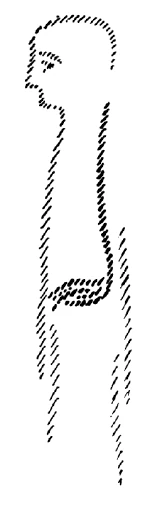
[ 4 ] Let us first assume, then, that we are dealing with the “I”-nature of the human being—that aspect of the human being that we call the “I.” This “I”-nature is, of course, entirely supersensible; indeed, it is the most supersensible thing we have at first, but it acts through the sensible realm. The means by which the “I” primarily exerts its influence—in an intellectual sense—within human physical nature is the nervous system known as the ganglionic system, the nervous system that originates in the solar plexus. Schematically, we can represent this nervous system—this ganglionic system, this solar plexus system—as shown here (see drawing, in black). It unfolds an activity that, at first glance, seems to have nothing in particular to do with what one might call, in a materialistic sense, “nervous life.” Nevertheless, it is the actual point of entry for genuine “I” activity. The fact that, when a person begins to look at themselves occultly, they must perceive the center of the “I” primarily in the head does not contradict this, since we are, after all, dealing with something supersensible in the “I” member of the human being, and the point at which a person experiences the “I” is different from the point of action through which the “I” primarily works within the human being.
[ 5 ] The meaning of the word: “The ‘I’ acts through the solar plexus”—one must fully grasp this. This meaning lies in the following: The human ‘I’ itself is actually endowed with a very dull consciousness. The “I”-thought is something other than the “I.” The “I”-thought is, so to speak, that which surges up into consciousness like a wave, but the “I”-thought is not the real “I.” The real “I” intervenes as a formative force through the solar plexus into the entire human organism.
[ 6 ] Certainly, one can say that the “I” extends throughout the entire body. But its main point of action, where it particularly intervenes in human plasticity and human organization, is the solar plexus—or rather, since all the branches belong to it, the ganglionic system, this nervous process living in the subconscious that takes place within the ganglionic system. Since the ganglionic system helps determine the entire circulation of the blood, this does not contradict the fact that the “I” finds its expression in the blood. In these matters, one must take what has been said quite literally. It is one thing to say that the “I” intervenes through the ganglion system in the formative forces and in the entire life processes of the organism, and quite another to say that the blood, with its circulation, is the expression of the “I” in the human being. Human nature is, after all, complex.
[ 7 ] To fully bring home the significance of what is being said here, it is helpful to answer the following question: What, exactly, is the relationship between the “I” and this ganglion system and everything connected with it? How, so to speak, is this “I” anchored in the human abdominal organs? The fact is that when a person lives in a normal, healthy state, this “I” is, as it were, bound within the solar plexus and everything connected with it. It is bound by this solar plexus. What does this mean? This human “I,” which was bestowed upon humanity in the course of Earth’s evolution as a gift from the Spirits of Form, was, as we know, exposed to Luciferic temptation. Just as the human being possesses this “I,” it would actually—since it is infected by Luciferic forces—be the bearer of evil forces. This must be recognized truthfully. It is not by its very nature that the “I” is the bearer of evil forces; but because the “I” is infected with Luciferic forces through the Luciferic temptation, it is in itself the bearer of truly evil forces—forces that, due to the Luciferic infection, are inclined to distort what the “I”’s life of thought signifies into evil. Ever since human beings acquired an “I,” they have been able to think. If there had been no Luciferic temptation, they would think well of all things. But since the Luciferic temptation did occur, the “I” does not think well, but rather, infected by Lucifer, thinks in the way that is characteristic of Earth’s evolution: treacherously, insidiously. It thinks in such a way that it wants to place itself in the light everywhere and everything else in the shadows. It is infected with all manner of selfishness. That is simply how the “I” is, since it is infected by Lucifer. What now lives in human beings as the ganglion system, as the solar plexus, has already come over from the lunar stage of development and, in a sense, represents the “house” for the “I”; the “I” fits into it in a certain way. It can therefore be bound and restrained within it. And so the following fact holds true: Due to its Luciferic infection, the “I” has a constant tendency to behave treacherously and deceitfully, to place itself in the light and everything else in the shadows; but it is restrained by the nervous system of the lower abdomen. There it must be held in check. Through the nervous system of the lower abdomen, the forces that have arisen through the development of Saturn, the Sun, and the Moon—and which are steadily advancing—compel the “I” not to be a demon in the evil sense of the word. Thus, we carry our “I” within us in such a way that it is bound to the organs of the lower abdomen.
[ 8 ] Now imagine for a moment that the abdominal organs are in some way unhealthy, that they are not in their normal state. Not being in their normal state means not being willing to fully take in that which spiritually fits within them, that which spiritually belongs to them. The “I” can, in a certain sense, become free in its activity when the abdominal organs are not entirely healthy. Then, if this liberation is brought about by a particular physical overactivity, human nature can express itself in such a way that the “I” is, so to speak, released into the external world, whereas it is otherwise bound. And when the “I” then behaves freely, we have a case in which the human being appears mentally ill by manifesting the characteristics of the Lucifer-infected “I”: then the characteristics of the “I” that I have spoken of come to the fore. One certainly need not become a materialist simply because one fully understands the bondage of the spiritual—that is, here, the “I”—to the physical organs in the life between birth and death—though in a higher sense than the materialist imagines—and even if one also realizes that, so to speak, all hell can break loose and the “I” can be freed from its bonds. Therein lies one case of mental illness.
[ 9 ] The emergence of the “I”’s freedom does not necessarily indicate a mental disorder; other factors may also be at play. In such cases, however, it is not a true disease of the lower abdomen, but rather, in a sense, a suspension of its normal activity. This is the case in the vast majority of instances of somnambulism. In such cases, the ganglion system and its function in the lower abdomen are altered—whether by nature itself or by various magnetic influences—so that the “I” cannot fully maintain control over it. The “I” is then able to interact more freely with its surroundings. It is then not embedded in the ganglionic system and can therefore use those channels of connection with the world that enable it to perceive all manner of things from a distance in space and time—things that are normally embedded within the ego, within the ganglionic system, and thus cannot be perceived. It is therefore important to know: There is a certain kinship between somnambulism—which, I would say, merely suppresses, in a mild form, the ordinary activity of the processes bound to the ganglionic system during wakefulness—and certain forms of insanity, which are caused when this suppression occurs due to deformation or disease of certain organs in the lower abdomen. Such a pathological episode is therefore always associated with the ego becoming, as it were, free, feeling, so to speak, liberated from its bonds, and feeling connected not to its body but to the spiritual forces of its surroundings—just as is the case in insanity. This is why, in certain forms of insanity, the very characteristics of malice, deceitfulness, mischievousness, and cunning appear—everything that stems from Luciferic infections—the need to place oneself in the light and everything else in the shadows, and the like.
[ 10 ] Now you will understand that the psychological constitution depends on the entire nature of the shell in which the ego is bound. To avoid using humans as an immediate example—and to be less offensive to human sensibilities—let us compare the lion, as a ferocious carnivore, with the bull or the ox. There is a difference, even though the lion represents a group ego and the human an individual ego; but we can still make use of the comparison. What is the difference between the nature of the lion and that of the ox? The lion is a pronounced carnivore; the ox, as you know, is essentially a vegetarian. Well, the difference is that in the lion, that which corresponds to the group ego is less constrained; in a sense, due to the vigorous activity of what corresponds to the abdominal organs, the group ego is freer, more open to its surroundings, whereas in the vegetarian ox, the group ego is more bound to the abdominal organs. The ox therefore lives more within itself.
[ 11 ] You can now see that there is good reason for a person to become a vegetarian—provided, of course, that they want to. For what does this achieve? It is precisely through a vegetarian diet that the lower abdomen is made even more capable of restraining the ego, and as a result—if I may put it paradoxically—a person becomes somewhat gentler. His evil demon retreats more into his inner self and manifests itself less in his interactions with his surroundings. However, no one should delude themselves into thinking that they no longer have this evil demon. They still have it; it is simply locked away within them. And a decisive experiment—an experimentum crucis—could very easily be conducted by comparing, in a given situation, how hungry meat-eaters and hungry vegetarians behave. When one is hungry, one generally tends to let the “bound one” loose a little more; and it could very well be that hungry vegetarians, in particular—because they have become accustomed to keeping the bound one especially tightly bound through their vegetarian diet—will then release him with a certain fury. For hunger consists in the fact that the abdominal organs alter their activity and, as a result, cannot bind the ego to the same extent as when one is sated. I do not mean to claim that what I said applies absolutely, since in the case of meat-eaters the “bound self” is not as strongly bound to begin with as it is in vegetarians; but I said: comparatively speaking, the hungry vegetarian, in relation to his sated state, may under certain circumstances exhibit a much more furious disposition than the hungry meat-eater in relation to his sated state. Human nature is indeed very complicated, and it is precisely when one considers the relationship between the spiritual and the physical that one arrives at certain insights which can serve as the foundation for true, genuine self-knowledge in life. In any case, it must be said that vegetarians should take care not to become too severely undernourished. For if they become undernourished, they will harm themselves by weakening their “fetter”—the prison for their inner devil, for the one who acts with malice, lies, and so on—and they will then either unleash the unfettered one upon those around them, and those around them will have their hands full with him—in Austrian, one says “G’frett”— or he will have trouble with himself, unable to cope, because on the one hand he constantly has the urge to act out the various bad qualities of the ego, but on the other hand—if he has been properly educated—he has the urge to keep these in check, and so it may happen that he is unable to cope with himself. This gives rise to all kinds of unfulfilled states of the soul. It is important to keep this in mind.
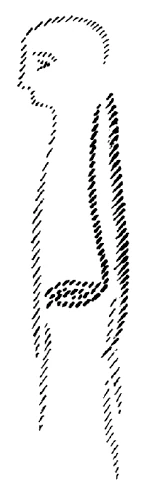
[ 12 ] Just as the “I” has its point of entry in the ganglionic system, so the astral body has its point of entry in all the processes associated with the spinal nervous system. Of course, the nerves run throughout the entire physical body; but here we have a second point of entry. This naturally includes all the processes associated with this nervous system. This is not yet the cerebral nervous system, but rather the spinal cord system, which, for example, is connected to our reflex movements and serves as a regulator for many functions in the human body. And when speaking as I am now, one must always bear in mind that all processes regulated by this nervous system are included. Now, the matter can again only be understood in such a way that the astral body is either bound to everything connected with the spinal cord system, or that it can be freed through illness or the partial suppression of these processes—through magnetism or the like. Here you have another bound being who acquired his Luciferic qualities—which are somewhat mixed with Ahrimanic qualities—as early as the Old Lunar Age. They are therefore weaker than the Luciferic qualities of the ego, but Luciferic qualities are also contained within the astral body. If you wish to bring before your soul the process through which this Luciferic infection crept into the astral body, then you must study what is described in my Outline of Esoteric Science as the separation of the Moon from the entire evolution. This infection entered during the Moon phase of evolution. Here you have yet another reason why human beings develop somnambulistic qualities—higher somnambulistic qualities that are primarily connected to the chest organs and which convey something higher than the abdominal organs; but at the same time, you have the opportunity to see that if something is amiss there—so that the astral body cannot be held in check—then something else occurs that must be regarded as a mental illness or a mental disorder. Thus, both the ego can be unleashed, leading to symptoms of madness, and the astral body can be unleashed, which likewise causes symptoms of madness.
[ 13 ] When the ego is unleashed, it develops, as I have told you, traits such as malice, mischief, cunning, taking advantage of others, putting oneself in the spotlight, casting everything else into the shadows, and so on. When the astral body is unleashed, it develops flight of ideas, discontinuous logic, manic states, or, conversely, escapism, melancholy, and hypochondria. And again, there is a connection between such pathological phenomena and the corresponding somnambulistic phenomena. The difference is that in somnambulism, the organs are not diseased but merely suppressed in their normal physical functions, a state that can be induced by the influence of hypnotists, magnetizers, and the like.
[ 14 ] Much in our human nature must be bound. We are already, in a certain sense, of the devil, and it is only because the divine-spiritual powers—which unfold regularly through the development of Saturn, the Sun, and the Moon—have bound the devils within us that we are, to some extent, decent human beings, a state for which we do not even have a particularly strong predisposition due to the various temptations we face. And certain mood swings, certain states of mind—even in our soul life—are connected to the fact that a person comes into contact with the demonic elements living within them. All this demonic nature stems from the fact that what is bound within them can be unleashed. We will have to speak about this on another occasion: how that which is actually bound by our physical nature during life—between birth and death—is then bound between death and a new birth. For you can surely see that we have much to be grateful to the order of the worlds for possessing our physical organism here between birth and death; for otherwise we would not have this prison necessary for our higher members. — When the higher members are released after shedding the physical body, other circumstances arise, which we will discuss on other occasions. They are not entirely unfettered then either.
[ 15 ] Just as the astral body is bound in this way to the spinal cord system and all the processes of organic life associated with it, so too is the etheric body bound to the brain system and everything that belongs to it. The etheric body thus has its point of attachment through the brain system. And here, too, something similar could be said. Our head is the prison for our etheric body. States of madness or somnambulism occur when the body is not quite right and the etheric body is unleashed. Now, when left to its own devices—that is, when not confined within the prison of the head—the etheric body has a particular tendency to multiply, thereby becoming alien to itself, to pass over into the world, so to speak, and to live itself into other things. This characterizes those states that occur when the jailer releases the etheric body.
[ 16 ] Thus, there is this threefold possibility of mental illness, as well as this threefold possibility of becoming detached from the physical body. This threefold possibility must certainly be taken into account—but in a completely different way—if a person is to be freed from their physical body through initiation. What we have been discussing is a pathological liberation in which the organs of the physical body do not remain healthy, and as a result, the physical body is unable to support the higher bodies. Cerebral somnambulism would require only a suspension of brain activity; this frees the etheric body, giving rise to somnambulistic states. In cases of brain defects, however, the “prison” can no longer hold the “prisoner”—that is, the etheric body—and so the etheric body sets out on its own adventures, attempting to live out and shape its disordered, confused life as it merges with the world. You can clearly see that mental illness essentially has its basis in a kind of liberation from those physical foundations to which the relevant higher aspects of the human being belong in the life between birth and death.
[ 17 ] When liberated, the etheric body tends to exhibit Ahrimanic qualities. In this case, envy, jealousy, greed, and the like will manifest in a pathologically intensified manner; but all of this occurs in connection with a kind of self-expression in the surroundings, with a merging into the surroundings. This, however, must be understood in such a way that, while the ego has its sole center of attraction—more or less—in the ganglionic system and what is connected to it, and the astral body in the spinal cord system, it is connected to the ganglionic system; and the etheric body in the brain system, but is connected to both the spinal cord system and the ganglionic system. In this respect, for example, the ganglion system—because it supplies everything in the subconscious-organic realm—is also connected to the brain. If the ganglion system triggers a disease process that manifests in the brain, then the etheric body, in particular, can indeed become liberated. But the cause still lies in the ganglion system. Things are, after all, quite complicated.
[ 18 ] Modern psychiatry still has no means of distinguishing these three forms of mental illness from one another. Only when we are able to distinguish between psychological abnormalities caused by the release of either the bound etheric body, the bound astral body, or the bound ego will psychiatry be able to achieve a certain degree of perfection. In a very significant way, it will then be possible to distinguish and classify the symptoms of psychological abnormalities, and it will be important to be able to classify them in this manner.
[ 19 ] From this you can also see how self-knowledge can only be based on a penetrating examination of the complex nature of the human being. Knowledge can certainly have its unpleasant sides. But knowledge should not be a toy; knowledge is the most serious matter in human life. And anyone who knows all the things that human nature entails and has even a little willingness not to take these things in a selfish sense, but to think and feel them objectively, finds in this knowledge an important healing force. Certainly, one may be weaker than this healing force; but one does have an important healing force in this knowledge. One lacks it only if one remains completely stuck in one’s subjective nature, if one does not want to break free from it.
[ 20 ] This is the great difficulty with movements such as ours: on the one hand, it is necessary to strive earnestly for the highest insights, and on the other hand, not everyone who joins such a movement is inclined to view these insights entirely objectively or to take them seriously in the fullest sense. For it is precisely through this that they have a healing effect on the individual: not reflecting on one’s own personality at every opportunity, not constantly thinking only about what I feel, what I sense, how I fare in the world, what lives within my soul, and so on, but rather detaching oneself from oneself and turning one’s reflections to the universal human concerns that touch every person. A difficulty arises only when one wants to limit oneself to one’s own self, when one cannot detach oneself from it. The more one is able to look beyond oneself and seek to understand the universal aspects of the world and of humanity, the more one finds a remedy in that very understanding. One would so dearly like to be believed on this very point. You will have a good opportunity to observe the opposite pole of what I have said, precisely in a movement such as ours. It is quite natural and also justified that people who do not easily detach themselves from their own selves also seek comfort, hope, and confidence in our movement. But if they do not have the sincere desire to detach themselves from themselves, if they are always preoccupied with their own minds and hearts—not to mention other things, which, however, occupy a great many people in our movement—then knowledge cannot be for them what it really is. One can take such an interest in knowledge that it is not merely a personal matter but a matter of universal human significance. The more the personal factor comes into play, the further one strays from what is actually healing in the knowledge of the deeper causes of the world. Now, precisely from the perspectives that have been gained here, one must be clear about how certain impulses in human nature are connected with the liberation of the psychological and the spiritual, whether in somnambulism or in madness. — For liberation is always connected with a merging into the spiritual. This, however, is connected with a certain voluptuousness—a genuine voluptuousness—both directly and indirectly. For that which has been liberated—be it the etheric or astral body or the “I”—pours out, as it were, into the spiritual world. And this pouring out is thoroughly connected with inner feelings of bliss. It is precisely the psychically abnormal person who feels a certain satisfaction in his or her abnormal mental activity and is therefore so reluctant to let it go. And one can observe the experience that has been made throughout the ages precisely by those who have endeavored to heal the psychically abnormal: When these individuals were treated by discerning physicians, it very often happened that, as recovery approached, the patients no longer felt this sense of freedom and immersion in the spiritual environment; a certain sense of ecstasy and bliss was lost to them, and they began to hate the one who had taken that ecstasy away from them. While with others—those who are not mentally ill—one can observe that gratitude is shown toward the healing physician, the opposite is true in efforts directed toward the mentally ill. This is an observation you will find documented in the literature, for doctors have repeatedly noted that when healing occurs—or even when an attempt is made to overcome the condition—the pleasure subsides and people begin to find the healer himself repulsive: He takes away from them what they actually enjoy—what is also cherished in the subconscious, even as they rationalize against it in their conscious mind.
[ 21 ] When you contemplate these things, you gain insight into the profound mysteries of the nature of the human soul as it operates. On the other hand, however, you will understand that when the “I,” or the etheric body, or the astral body, has initially endeavored to work with the aid of its physical instruments, and when it then becomes free and is still strong, still retaining the form impressions it had in the physical realm, it can then unfold certain powers more easily than they can be unfolded within the diseased organs. That is why such patients, who periodically—for there are cyclical, periodically abnormal states of the soul—step out of their organism, very often feel that they possess abilities they do not otherwise have. This, in turn, brings great satisfaction, and when they then return to their physical body and retain a certain awareness of what has happened to them, they can even have a very clear sense of self regarding these things. In the first half of the 19th century, a famous physician, Willis, cured a madman—that is, he enabled him to think rationally about himself again. And this cured madman, who was intelligent, wrote down the following as a retrospective account of his state of madness. You will now understand well what this intellectual madman wrote down if you take into account what I have said. He is a madman suffering from an illness in which, so to speak, all three higher members were unleashed. The patient writes: “I awaited my fits with impatience.... Bliss”—so you see, he awaits this stepping out of the body with impatience because he knew that there he would enjoy a certain bliss.
[ 22 ] “Everything seemed easy to me; there were no obstacles, neither in theory nor in practice. My memory suddenly attained a strange degree of perfection...”
[ 23 ] Anyone who sees through these things knows that he must otherwise have suffered from constipation in the lower abdomen and that this had clouded his memory. At the very moment his ego was torn away, his memory was intact.
[ 24 ] “Long passages from Latin authors came to mind. I usually have great difficulty finding rhythmic endings; but then I was able to write verse just as easily as prose.”
[ 25 ] As you can see, the man described himself in great detail, and it is understandable that he tried, in a certain way, to bring about this abnormal state. It wasn't something he could do at will, but he was glad when the state came, because he found it very pleasurable.
[ 26 ] The difficulty with mentally ill patients is that, subjectively speaking, treatment leads them not to a state of happiness but to a state of unhappiness—from their perspective—and that they are therefore actually distressed by it. On a conscious level, of course, it is different, but in reality, on a subconscious level, they are saddened by it when they are cured. Naturally, they come to the doctor and say they want to be cured; but on a subconscious level, they do not actually want to be cured. That is the difficulty. The liberated person—or the liberated people—resist with all their might being torn away from the bliss into which they have been transplanted upon their liberation. You see, in this way one does justice to what is the material foundation of our physical existence; but one does not become a materialist.
[ 27 ] Suppose, for example, that someone is more stupid than one would think from observing their outward behavior; such people do exist. Well, stupidity is really just a step on the path to a certain mental abnormality, namely insanity. This may be related to the fact that the etheric body, which is otherwise bound, is free because, in a sense, the brain is too compact and does not function with sufficient flexibility. Let’s suppose such a person shoots himself in the head, but the bullet does not kill him. Under certain circumstances, this may actually seem quite useful to someone who sees through things, provided it has not otherwise harmed him; for perhaps the resulting loosening of his compact brain will make him wise. Such cases have certainly occurred, where head injuries have awakened people to a state of greater clarity compared to their previous condition.
[ 28 ] There is truly nothing in the realm of the physically perceptible that is as complex as human nature; it is the most complex thing to be found in the world. But one must truly view the human being as I have now described if one wishes to view him in his entirety. For we have now seen that, just as the human being stands before us with his head, the main activity is, in a certain sense, based on the etheric body being properly integrated into the head. Abnormal activity arises when the etheric body becomes free, when it is unleashed. Because human beings are normally organized—possessing their sense organs and cranial nerves—the etheric body can maintain normal relationships with the ordinary environment. What a human being is through this particular connection between the etheric body and the head is what he is as a human being in general, as he exists in the physical world between birth and death. If we carried nothing else within us but the normal integration of the etheric body into the head, all human beings would be the same, nor would a human being be able to feel a connection with that part of their being that is immortal; for the head mediates for us the experiences we can have in the life between birth and death through the senses and the cranial nerves.
[ 29 ] Consider this now in connection with what I have said about the loss of the head in the course of reincarnation: What is now the head was the body in the previous incarnation; what is now the body will become the head in the next incarnation. But the human being is aware of his connection to his immortal self, which passes through births and deaths—even if, without spiritual scientific insight, this awareness is merely a matter of faith. A person can understand this connection through the head, but can possess this knowledge only because they have their spinal nerve system as an organ of the astral body. It is there that the images and sensations are brought about that place the human being in a reciprocal relationship with their immortal self, with their transpersonal self. Everything we possess for life between birth and death, we have because our organism contains an earthly, solid element. I have mentioned on another occasion that we do not have all that much solid matter within us; we are ninety-five percent a column of liquid. The solid matter within us is extraordinarily small—only five percent is incorporated—the human being is a column of water. But only this solid matter can serve as the vehicle for the ordinary thoughts of physical life, and only to the extent that we are permeated by the fluid and its pulsation do we become aware of our transpersonal nature. And this fluid and its pulsation, in turn, are connected to the spinal cord system, which primarily regulates the fluid and the pulsation. How all this relates to certain things I have already discussed—namely, the up-and-down pulsation of the fluid between the lower abdomen and the brain—I will explain tomorrow, since it would divert us too far from our actual topic today. However, the fact that human beings possess the fluid element within them not only connects them to their transpersonal nature but also, in a sense, defines their personality. If we were merely “head people,” we would all think and feel the same way. Because we are “heart people”—because we possess the fluid element, the blood and other bodily fluids—we are, in a certain sense, already defined; for through this, the hierarchy of the Angeloi has a share in our being. The hierarchy of the Angeloi can intervene within us indirectly through the fluid element.
[ 30 ] A third way in which our being can be influenced arises from the fact that, when the higher members interact normally with the ganglion system, it is possible for the airy element and everything associated with it to affect us. This occurs through the process of breathing. But this process is very complex. It matters whether we breathe here or there, whether the air we breathe contains much or little oxygen, much or little moisture, much or little solar heat, and so on. Because we carry within us this possibility of being influenced indirectly through the airy element, the hierarchy of the Archangeloi, the Archangels, has the opportunity to influence us. Everything that influences our being from the hierarchy of the Archangels—whether from those who are normally advanced or those who are lagging behind—acts indirectly through our ganglion system. And what emanates from the so-called national spirits, who also belong to the hierarchy of the Archangels, acts through this same indirect path. What emanates from the folk spirits and acts upon human beings affects the organs connected to the ganglion system. This is why folk culture is something so removed from consciousness, something with such a demonic effect. And for the reasons I have indicated, it is therefore so closely connected with everything that constitutes locality; for locality and climate are linked to the workings of the hierarchy of the Archangels far more than one might think. Climate, after all, is nothing other than that which acts upon human beings indirectly through the air.
[ 31 ] You can see how, by referring to the ganglion system, one can demonstrate how the impulses of national soul-affinity operate in the human unconscious. Now you will also understand that, more than is usually thought, it is precisely one’s sense of national identity that is connected to certain human characteristics linked to the ganglion system. For the issue of national identity is, in fact, more closely related to the sexual issue than is generally believed. For belonging to a national culture rests on the same organic foundation—the ganglion system—that also underlies sexuality. This can already be understood externally by the fact that one belongs to one’s national culture by birth, insofar as one is brought to maturity within the womb of a particular people; in this respect, the mediation is already present. There you see, through what I might call the subterranean depths of the soul, how the national problem is already connected to the sexual problem. And that is why there is so much similarity in appearance between these two impulses in life. Anyone who simply keeps their eyes open to life will find an immense number of parallels between the way a person acts out of erotic impulses and the way they act in their sense of belonging to a people. Of course, this is not meant to take a position for or against either one; but the facts are as I have described them. National impulses—which have a particularly strong unconscious effect when they are not brought into ego-consciousness by making the issue a matter of karma, as I recently described—are very similar to sexual impulses. One must not gloss over such matters by attempting—out of certain illusions and longings—to elevate an emotional form of national sentiment to a rather noble sentiment, while reducing sexual feeling to something rather ignoble; for the facts are indeed as I have explained them to you.
[ 32 ] But from this you will now also see that people can be brought to a certain degree of agreement when it comes to discussing intellectual matters. In that respect, they are all the same. If we were only minds, we would be able to understand one another very easily. It is paradoxical to say: “If we were only minds.” — But when life has brought you into contact with all sorts of people, you get used to speaking in such paradoxical terms. So I once met—let me add this in parentheses—a very important Austrian poet who also thought philosophically and who had a terrible fear of people becoming more and more intellectual. He said: “People are evolving in such a way that they are becoming more and more intellectual; eventually, they will become very small in relation to the rest of their bodies, which will wither away completely, and they will be nothing more than walking heads.” — He said this in all seriousness.
[ 33 ] If, as I said, we were minds, we could easily communicate about many things. But when it comes to what must be grasped through the spinal cord system, people find it much harder to communicate. That is why they fight one another over worldviews, religious beliefs, and everything they associate with their transpersonal realm. And that they fight one another over that which has the ganglion system as its organ—this, at least in the present day, is beyond doubt; though I do not mean external war, but rather that war in which hatred speaks against hatred; for external war need not have anything to do with what unfolds in such a terrible way as hatred against hatred.
[ 34 ] People must once again become aware of these things. For only by regaining insight into human nature will it be possible to find a way out of the chaos into which humanity has fallen. We will speak further about this very chaos tomorrow. But let us be clear about this: the knowledge and insight gained regarding the complex nature of human beings must be understood and imbued with the attitude I described earlier—an impersonal attitude.
[ 35 ] So far, I have described what are, at first glance, harmless personal attitudes: people who cannot cope with themselves, who are always talking about their hearts, or about this or that. But in the world, we also encounter a less harmless, personal, or group-egoistic attitude. Occult knowledge is not always utilized in a selfless manner, as you have seen from the reflections we have made over the course of these weeks. And one gains a deeper insight into the impulses at work in human affairs—if one can even begin to grasp human nature in all its complexity. For what one can discern about the individual human being is, in turn, connected to everything that happens among people—both in interactions between individuals and in what occurs within groups and in the relationships that arise between groups in the course of human development.
[ 36 ] I have now pointed out to you that occult knowledge has been used in certain occult brotherhoods to provide a direction, which has then been exploited in such a way that the goal is not to achieve universal human objectives, but rather group-egoistic objectives through occult impulses. I have spoken to you about the fact that within certain occult brotherhoods there were views on how Europe should be shaped and how one intended to bring about the shaping of Europe. If I add something else today to what has already come to light—something that has not yet been revealed—I do so because it seems to me that it is good for what will appear in the future, just as the partition of Austria appeared in the reply to President Wilson, to be stated at least once somewhere, even if only within a very small circle. For anyone familiar with the facts could have mapped out this partition of Austria as early as the 1890s—I won’t go any further back—based on the maps I mentioned.
[ 37 ] Well, what is ever published are only fragments; it flows into the outer, exoteric realm at the very moment when one believes that one can have an effect with it; the rest is withheld. I am speaking of what I am about to discuss not in order to be in the least bit agitational or political, but simply to share facts of knowledge with you. It simply exists in the world. And truly, I am very far from wanting to frighten anyone, or to influence anyone in such a way that they believe this or that, or become fearful in this or that direction; rather, this is solely about insights. And here I would like to sketch for you something from that map of Europe’s future, which existed in certain occult communities in a form roughly similar to how I will describe it to you. Everything will be sketched only roughly, to save time. As I said, this concerns how such occult communities envisioned the shape of Europe in the distant future (it is being sketched).
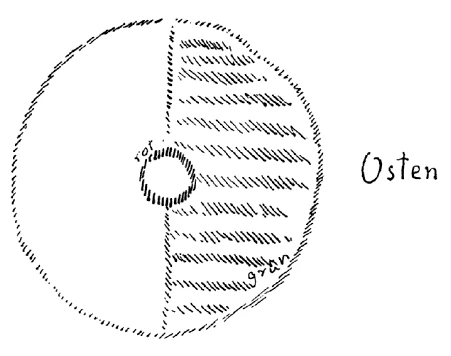
[ 38 ] The first thing that caught their attention was the Southern European, or Balkan, Confederation; this was intended, in a sense, to serve as a kind of buffer zone, a kind of bulwark against Russicism. For, of course, in the West, Russification was viewed as the opposite pole—certainly not as something with which one wished to be eternally allied, but rather as something that, in a certain sense, must always be something one seeks to combat. Since the aim was to forge a union between the current Kingdom of Italy, the Balkan Slavs, and the South Slavs—who today belong to Austria—this confederation would encompass a large part of the Apennine Peninsula, the Italian-speaking parts of Switzerland, the southern parts of Austria, Croatia, Slavonia, and Dalmatia. To this would be added a part of Greece, but only the northern part. The confederation would also include Hungary and the Danube estuaries. This would be the Balkan Confederation. — To the east of this would be everything that one would broadly conceive of as Russia. In this map-based plan—and I emphasize this explicitly—it was always, and indeed strongly, emphasized: No matter how Poland might behave, it was a necessity of world history that this country, in its entirety, must ultimately be reintegrated into the Russian Empire under all circumstances. So it was part of the plan from the very beginning that Poland, including the parts that today belong to Prussia, was to be reintegrated into the Russian Empire. Thus, according to this program, the Russian Empire would have to encompass present-day Poland, including Galicia, extending beyond the Slovaks. Everything I am hatching here would be like a peninsula jutting inward. This would be Bukovina (it is being drawn).
[ 39 ] Then there would be France, which—excluding the Rhine estuaries—would encompass the territory up to the Rhine and the present-day French-speaking part of Switzerland, and which would be bounded here by the Pyrenees and there roughly in this manner. Nothing specific has been said about the Scandinavian peoples; they will likely be granted a fairly long grace period.
[ 40 ] The rest would be: German-speaking Switzerland, along with Germany and the German-speaking regions of Austria; these would thus comprise this territory. And the areas shown here in color would more or less fall within the sphere of influence of the British Empire, however it might be defined: the Netherlands, Belgium, the coast, Portugal, Spain, the southern part of Italy—we can discuss the islands another time—and the southern part of Greece.
[ 41 ] Here we have a map that clearly shows that what we tried to outline on the blackboard yesterday is already a sort of down payment for this map, because for Central Europe, the result is roughly the same if you compare this map with what is already stated in the Entente’s note to Wilson. This is what has been regarded as an ideal division of Europe. To avoid any misunderstanding: Rome would be located here; it would, of course, remain part of Italy. — This is not something with which I in the least—I say it again—wish to influence anyone, but rather I merely wish to point out that this, as a kind of vision for the shaping of Europe—which, for me, can be clearly traced back to the 1880s and 1890s—has been taught in certain occult communities.
[ 42 ] Why people there viewed the future shape of Europe in that way, and what reasons they had for doing so, was also always explained. In a sense, it was explained in what manner and by what means—based, of course, on reasonable grounds—one would wish for such a shape for Europe. We will discuss that tomorrow. I just want to mention that I am not presenting you with anything I have made up, but rather passing on something that lived in many people’s minds as a powerful impulse—something that had to be brought about, and for which one had to do everything possible.
[ 43 ] I am well aware that ill will could very easily argue that it is inappropriate, in light of a certain point, to say such things right here in this very place. But I do not intend to stir up trouble; I do not wish to present this or that vision of the future for either the belligerent or the neutral states. I have absolutely nothing to do with these matters; rather, insofar as I am bringing them up now, they are simply presented based on the impulses that existed in those circles. And this gives us a vision of the future that has arisen from the desire to use certain impulses in the interest of group egoism. Anyone who might be alarmed by what would disappear as a result may tell themselves that the point is to focus on tasks of universal human significance. One can see through things when they are the result of group-egoistic interests and need not regard them as fate or doom. But the most disastrous stance, it seems to me, is the one I would characterize, so to speak, as a sort of “ostrich” stance—one that simply wishes to shut itself off from such insights because they are unpleasant, and because, after all, one really ought not to think such things here or there, since that would unsettle people. I am, of course, aware that one could argue here as well: “We really shouldn’t talk about such things, because that might unsettle people who wish to remain honestly neutral.” — But we should have moved beyond such unease by now. We should be able to tolerate looking at things as they are developing in the world. And when I say these things, I do so on the assumption that you are reasonable enough to take them in the right way.