

Reflections on Contemporary History III
The Reality of Occult Impulses
GA 173c
21 January 1917, Dornach
Translated by Steiner Online Library
Twenty-first Lecture
[ 1 ] Perhaps I might first draw your attention to a few things that might be of interest to you, starting with an article in the Schweizerische Bauzeitung from January 20, 1917, which discusses the Johannesbau in Dornach near Basel, based on a recent visit to the building by the Swiss Society of Engineers and Architects. The article is very encouraging and beautifully written, and it is truly an oasis, one might say, compared to much of what has been printed recently—and is still being printed—elsewhere about our endeavors, especially by those within our own circle. It is a very gratifying fact that such a positive and appreciative discussion of the building has appeared from an outside, objective, and—in particular—expert perspective. So, the article appeared in the Schweizerische Bauzeitung on January 20, 1917; I advise you to read it. I have just been informed by Mr. Englert—who at the time helped lead the Swiss Association of Engineers and Architects, whose members took such a gratifying interest in our building from both a professional and a general aesthetic standpoint—that the article will also be published in the Bulletin de technique, which appears in Geneva in French.
[ 2 ] I would also like to draw your attention to the book that has just been published—please forgive me if I cannot read the title to you in the original language—the book that has just been published by our friend Andrej Bjely, who, in the common language with which you are familiar, is known as Bugajew. The book has been published in Russian and examines, in great detail and depth, many connections between spiritual science and Goethe’s worldview. In particular, it examines the connections between Goethe’s worldview and what was once said in the Berlin lecture series on various worldviews—the series was titled “The Cosmic and the Human Thought”—as well as other aspects of what is contained in spiritual science. The connections to Goethe’s worldview are explored in a compelling and detailed manner, and it is therefore very gratifying that this book has been published in Russian by our friend Bugajew as a manifestation of our spiritual-scientific worldview.
[ 3 ] Mr. Meebold recently published a book that I would also like to mention; it was published by Piper & Co. in Munich. It is titled The Path to the Spirit, a biography of the soul, and it will certainly be of interest to you because it describes various experiences Mr. Meebold had with the Theosophical Society.
[ 4 ] These are the oases in the desert of attacks, one of which—one that has not yet reached me but is said to be particularly outrageous—has just been published once again by one of our long-standing senior members; however, I have not yet read the printed article, only reports about it.
[ 5 ] It is precisely those attacks that come from within the ranks of the members—namely, older, long-standing members—that are particularly “delightful,” because one knows that these members could know better. But as I said, I haven’t actually seen the article myself, only reports about it.
[ 6 ] Yesterday we discussed a number of points regarding humanity’s relationship to the supersensible world, insofar as this supersensible world also includes our dead—indeed, all those who have shed their physical bodies and passed through the gate of death. In our current context, it is of particular importance to realize that within that world which a human being passes through between death and a new birth, a process of development and evolution takes place just as it does here on the physical plane.
[ 7 ] We are speaking here on the physical plane when we first consider a brief period of time—for example, the post-Atlantean era, the Indian, Persian, Egyptian-Chaldean, and Greek-Latin periods, the present era, and so on— and by referring to such periods, we mean that an evolution is taking place—that, in a sense, human souls and the manifestations of those souls differ in characteristic ways across these successive eras.
[ 8 ] Similarly, if one could also grasp this concept clearly, one could speak of an evolution that takes place over such periods of time in the realm that the dead pass through; for an evolution does indeed take place there as well. And in various places where this was possible, reference was indeed made to this evolution, and various explanations were given about it. However, as easy as it is to speak of evolution on the physical plane—and as you know, that is not entirely easy in our materialistic age—as easy as this is for the physical plane, it is naturally not so for the spiritual world, for we have no well-defined concepts for the spiritual world. Language is designed for the physical plane, and all sorts of metaphors and circumlocutions are necessary when one wishes to refer to the spiritual sphere—where the dead reside—specifically with regard to evolution.
[ 9 ] Of particular significance to us, of course, is that life between death and a new birth in our fifth post-Atlantean epoch is also correspondingly different from what it was before. While the materialistic cultural epoch is unfolding here on Earth, all sorts of things are also taking place in the spiritual world. And since the dead experience matters related to evolution much more intensely than those living here on the physical plane, the fate of the dead depends in the most profound way on the manner in which a particular evolution unfolds during specific periods. The dead react even more intimately, even more subtly to what is alive in evolution than the living—if we wish to use these terms—and perhaps this is even more noticeable in our materialistic age than at any other time.
[ 10 ] Now, in these lectures, to further our understanding of various topics we intend to discuss, I would like to include precisely what has emerged from a careful observation of the facts in this regard. I must, however, dig a little deeper into this and offer various reflections today that are intended merely to prepare the ground for what actually needs to be said. I have already pointed out that human beings are properly understood in relation to the universe when we consider the individual aspects of their being separately. For spiritual contemplation, what exists here on the physical plane is, after all, more of a reflection, a revelation. And so, building on some of what we have already discussed, we can conceive of the human being—as he first appears to us as a physical being—as having four aspects.
[ 11 ] First, we have the head. As you know from earlier discussions, the form the head takes in any given incarnation is actually destined to come to an end in that incarnation. The head is most vulnerable to death. For the way our head is formed—as you will recall from earlier discussions—and the way it is organized is essentially the result of our life in the previous incarnation. How, on the other hand, our next head will be formed in the following incarnation is a result of our present physical life. I expressed this briefly some time ago when I said: The human body, except for the head, is transformed into the head in the next incarnation, and the next body grows into being, whereas the present head we bear is the transformed body of the previous incarnation, and the rest of our body has now grown upon us, more or less—all of this varies in degree—as a result of hereditary factors.
[ 12 ] This is metamorphosis. The head, so to speak, falls away in one incarnation; it is the result of the body from the previous incarnation. And the body transforms itself, metamorphosing—as in Goethe’s theory of metamorphosis, where the leaf becomes a flower—into the head in the next incarnation. However, because the head is formed from the earthly body of the previous incarnation, the spiritual world has a particularly close connection with this head between death and a new birth, for the archetype, the original form of the head, must be shaped from the spiritual world in accordance with karma. This is also why the head appears fully formed first in the embryo, because it is most strongly influenced by the cosmos. The rest of the body is actually most strongly influenced by the human constitution. Therefore, this remaining part of the body appears to develop later in the embryo than the head. The head is already—not, of course, in terms of its physical form, for the physical substance is certainly derived from heredity, but in terms of its shaping, in terms of its archetype—formed from the cosmos; it is, so to speak, from the sphere. It is no coincidence that your head is more or less spherical; the head is a reflection of the entire world sphere, and the entire world sphere contributes to the formation of the head. So we can say: the head is formed from the sphere.
[ 13 ] Just as here in life there is a flurry of activity centered on building machines, engaging in commercial pursuits, and the like, so too in the spiritual world, human beings are, among other things—though not exclusively— but among other things, with developing all the technical processes—which are now spiritual technical processes—in order to form his head for the next incarnation from the sphere, from the entire world, from the entire cosmos, in accordance with his karma in previous incarnations. Here we are looking into the deep mysteries of becoming.
[ 14 ] The second thing that must be taken into account when considering the human being as a revelation of the entire universe is everything pertaining to the chest organs, centered on the lungs and the heart. It is best to consider them separately from the head. The head is a reflection of the entire spherical cosmos. The chest organs are not. They are a manifestation of the forces that come from the east. They are formed from what one might call the hemisphere. If you imagine the cosmos in this way (see drawing on page 206), you can picture the head as a reflection of the cosmos. If you imagine the East here, you can picture the chest organs as a reflection of what radiates in from the East—that is, the hemisphere that I have hatched in green here. Only the hemisphere acts upon the chest organs. One could, if one wanted to speak paradoxically, call it a “half-head.”
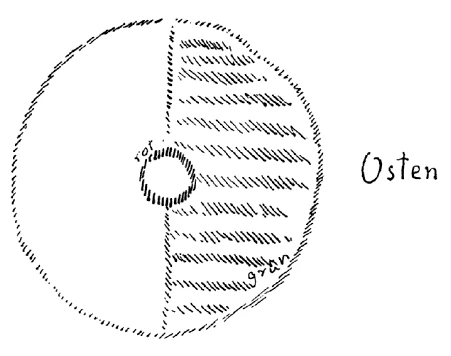
[ 15 ] This is also the basic form. The head is based on a spherical shape, while the chest organs are based on a circular section—a semicircle, so to speak. However, it is curved in various ways, and one can no longer see it clearly. You would be able to see that your head is truly a sphere if Luciferic and Ahrimanic forces had never acted upon human beings. You would see that the chest organs are truly a hemisphere if these very forces had not been at work. And, in a sense, the direction toward the center—though one might say, in terms of ordinary earthly geometric proportions, toward the infinitely distant center—is toward the east. Thus, the hemisphere points toward the east.
[ 16 ] Now, as the third category, we have everything found in the human being as sub-organs other than the head and chest organs: abdominal organs with their attached limbs. Although the term is not particularly precise, I will refer to all of this as abdominal organs. What we thus summarize as abdominal organs can now also be related to externally organizing forces, which, of course, in this area act upon the human being primarily indirectly through embryology, but they do exert this influence precisely through this indirect route, because during pregnancy the mother is dependent on the forces that must be sought out for the formation of the abdomen, just as the sphere must be sought out for the formation of the head, and the East, the hemisphere, must be sought out for the formation of the chest organs.
[ 17 ] You must imagine the forces that act in this way on the organs of the lower abdomen as coming from the center of the Earth, but differentiated by the territory where the parents or ancestors reside, by that territory and everything associated with it. So, mind you, the forces do come from the center of the Earth; but whether a person was born in North America, Australia, Asia, or Europe, they come from the center of the Earth—yet they are always differentiated: sometimes the force is differentiated by the European territory, sometimes by the American territory, sometimes by the Asian territory, and so on. So I can say: The abdominal organs are determined from the center of the Earth, differentiated by the territory.
[ 18 ] Well, if we want to consider the human being in its entirety from an occult perspective, we must also consider a fourth aspect. You might say: But we already have the whole human being. Certainly, but in occultism, a fourth aspect is always taken into account. We have now considered three parts of the human being; now we can consider the whole human being in and of itself. The whole is, in fact, also a member. So: head, torso, and lower body—but now all together, so that we have the whole as the fourth member, and this whole is in turn formed by forces. But this whole is formed by forces from the entire Earth’s circumference. So now it is not differentiated by territory; rather, the whole human being is formed by the entire circumference—that is, by the Earth’s circumference.
[ 19 ] I have now presented to you the physical human being as an image of the cosmos, just as the cosmos itself is, in a sense, an image of the forces acting together within it. We can also consider other relationships in connection with the cosmos. In doing so, we must conceive of the spiritual cosmos in relation to the human being, not merely the physical cosmos. What we have just considered was the physical human being. That is why we were able to limit ourselves to the physical cosmos. If we consider the human being as a disembodied being between death and rebirth, then we cannot limit ourselves to what is confined to space, for three-dimensional space, as we know it, is indeed decisive for the physical human being who lives between birth and death, but it is not decisive for the spiritual human being who lives between death and rebirth. One must then be clear that the dead have another world at their disposal besides the one that exists in three dimensions.
[ 20 ] Now, when one looks into the eyes of the disembodied human being—the so-called dead person—one must perhaps adopt a somewhat different perspective. One must adopt a perspective that is more attuned to the dynamic. And certainly, one can consider this from various points of view, for life between death and rebirth is just as complex as life between birth and death. But let us first take as our starting point the relationship between the human being who is here on Earth and the human being who has entered the spiritual world through death.
[ 21 ] Here we have, once again, a first link—though this one must now be understood in more temporal terms—an initial stage of development, we might also say. The deceased, so to speak, enters the spiritual world in a certain way; but he passes from the physical world into the spiritual world—he leaves the physical world and, especially in the first few days, is still connected to it. And it is very significant that the deceased departs from the physical world in a way that is very much attuned to the constellation of planetary forces that arose during his or her lifetime. As long as the deceased is still connected to his or her etheric body, the planetary forces—the constellation of these forces—resonate and vibrate wonderfully through this etheric body. Just as the Earth’s territorial forces resonate extraordinarily strongly in the amniotic fluid during the formation of the physical human being, so too do the forces associated with the constellations resonate in a very striking way within the deceased who is still in his etheric body at the very moment—the whole process being, of course, karmically determined—when the deceased has left the physical world. And one could make interesting discoveries—if only one proceeded with the necessary reverence and dignity—by applying precisely the same care that is, unfortunately, often applied—even for selfish reasons—to investigate the star constellation at the time of birth. One would obtain far more selfless, far more beautiful results if one were to draw up, so to speak, the horoscope—namely, the planetary horoscope—showing the positions of the planets at the moment of death. This is extraordinarily revealing regarding the entire nature of the spiritual human being, and extraordinarily revealing regarding the connection between karma and the occurrence of death at a specific moment.
[ 22 ] Anyone who undertakes investigations in this direction—the rules are, after all, the same as those for the natal chart—will arrive at all sorts of interesting results, especially if they have known the people for whom they are conducting the analysis more or less well in life. For in the days following death, the deceased, with his etheric body not yet separated, carries within himself something that continues to resonate, namely from the planetary constellation. Thus we can say: First stage of development: direction in the planetary constellation. This remains significant for as long as the human being remains connected to his etheric body.
[ 23 ] The second point to consider regarding the relationship between human beings and the cosmos is that, in a certain sense, one might say that a person truly leaves the physical world when he or she becomes spiritual after shedding the etheric body. This is the point at which one can still, in the true sense—and not merely in a figurative sense—apply concepts derived from the physical world to what the deceased does; for after this stage, these concepts become, to a greater or lesser extent, mere images.
[ 24 ] Now one might say: In the second stage—and here the direction is still physical, even though it extends beyond the physical—the direction toward the respective east is taken. And through the respective east, at a certain point in time, the deceased passes into the purely spiritual world. This, then, is the direction toward the east. It is important to bear this in mind, because an ancient saying from various brotherhoods—one that has been preserved from better times of occult knowledge of humanity—still draws attention to it today. In all manner of brotherhoods, it is said of the one who has died that he has “entered the eternal East.” Such things, insofar as they are not later-added frippery, correspond to ancient truths. Just as we had to speak here of the fact that the chest organs derive their structure from the East, so must we imagine the passing, the departure of the deceased through the East. But as the deceased, so to speak, passes through the East from the physical world into the spiritual, he already enters the realm of the sphere—that is, he gains the ability to participate in the forces of the spheres, which now act not centrifugally, as they do here on Earth, but centripetally toward the center of the Earth; he enters the sphere, gaining the ability to act upon the Earth.
[ 25 ] So we can identify the third stage as the transition into the spiritual world, and the fourth stage as effects or activities originating from the spiritual world—working with the forces of the spiritual world.
[ 26 ] With such ideas, we come into close contact with that which binds human beings here to the spiritual worlds. If you look at this diagram in the right way, you can even see that number 4 concludes with what number 1 begins here, namely: the work on the head from outside the sphere. This work is performed by the human being himself when he has entered the spiritual world through the East.
| Head: | Chest organs: | Abdominal organs: | The Whole: |
|---|---|---|---|
| From the Sphere | From the East | From the Center of the Earth, differentiating the Earth’s circumference through the territory | FirstRowSecondColumn |
| First stage of development: | Second stage of development: | Third stage: | Fourth stage: |
| Direction in the constellation | Direction toward the East | Transition into the spiritual world | Influences from the spiritual world |
[ 27 ] The fact that the deceased must leave the physical world by heading east is very clearly perceptible when communicating with the dead. They are, so to speak, in the world they reach through the Gate of the East. They are beyond the Gate of the East. And with regard to such matters, the experiences we are now having in the fifth post-Atlantean epoch, within the sphere of materialism, are particularly significant.
[ 28 ] You see, in this fifth post-Atlantean epoch, the dead are, in a sense, deprived of a great deal by materialistic earthly culture. Some of this will already be clear to you from what was said yesterday. If one learns about the lives of the dead in the present using the appropriate means, it becomes apparent that they have a very strong urge to intervene in the things that people here on Earth do. But in earlier times, when there was less materialism on Earth than there is now, the dead were able to intervene more easily in what was happening on Earth. They could more easily influence the earthly sphere through earthly human beings—through what earthly human beings felt and sensed as the aftereffects of the dead. Today this is very, very common, and I have observed—and it has repeatedly come as a surprise in specific cases—that people who were intensely involved in certain current events while here on Earth, who have died, and who continue to live on after death, cannot have any interest in the current events unfolding here after their death, because the connection is missing. Even among us there are such souls who, while they were here on the physical plane, took a great interest in current events, but who, over in the spiritual world, feel alienated from the events now unfolding after their death. This is often the case precisely with exceptional souls who had lively interests and great talents here. But this has been the case for a long time. It has been this way—only increasingly so—throughout the entire Fifth Post-Atlantean Epoch; it has been this way since the 15th and 16th centuries, only to a greater extent. One can observe that, since the dead have less ability to intervene in what people do, they become more involved—I’m so sorry to have to use such trivial terms, but one must simply use the terms available in the language—that is, the dead must intervene more in what people are as individual personalities. And one can see that, since the 15th and 16th centuries, the interest of the dead and the work of the dead have focused more on individual personalities than on the larger interconnections among people. And having devoted a great deal of attention to this problem specifically in this regard, I have come to the conviction that what I have just said is connected to a very specific historical phenomenon that must be particularly striking to anyone interested in such matters in our recent history. In contrast to earlier times, we have observed in recent history the curious phenomenon that people are born with very significant aptitudes—which generally manifest as great idealism and exceptional ambition—yet these individuals are unable to gain a comprehensive view of life or broaden their horizons. This has, in essence, been reflected in literature for a long time. In individual ideas, concepts, notions, and feelings that people express—whether in literature, art, or even science—strong glimpses of this can sometimes be found. But—and this is precisely why it is so difficult for people to rise to the level of comprehensive understanding required in spiritual science—people do not manage to attain a broad, comprehensive perspective. This stems largely from the fact that the dead are able to reach individual human beings more readily and work out within them what is predisposed during the childhood and youth phases of existence, whereas that which provides human beings with a comprehensive overview during the mature phases of existence is, in our materialistic age, more or less separated from the activity of the dead. For this reason, talents that remain unfulfilled or incomplete—not only in the wider world but also in the individual—are very common today, because the dead are able to reach individual souls more readily than they can reach what is socially active in human development today. The dead have a strong impulse to reach what is socially alive in human development, but it is precisely in our fifth post-Atlantean epoch that this is extraordinarily difficult for them.
[ 29 ] It is therefore of great importance, especially for the present, to familiarize oneself with another phenomenon. You see, in our time there are many concepts and ideas that must be defined with extraordinary precision; otherwise, one cannot make any headway with these ideas. Especially in modern, more mercantilistic life, concepts that are clearly defined in mathematical terms must be developed. Science has become accustomed to this, but art has also become accustomed to it. Just think of the development art has undergone in this regard! It has not been long since we left behind that artistic period when art focused on grand ideal connections, and—I would say, thank God—concepts were not sufficient to easily interpret a work of art, when works of art spoke for themselves. That is no longer the case to the same extent today. Today, people strive for naturalism, and concepts can easily keep pace, because the works of art themselves have often emerged solely from concepts, not from an elementally all-encompassing sensation. Humanity today is simply filled with certain trivialized, naturalistic concepts, which are defined by the fact that they are formed entirely on the physical plane, where things are likewise defined and individualized.
[ 30 ] Now, it is very significant that such concepts are not loved by the so-called dead. Sharply defined concepts that are not flexible, that do not live—they are not loved by the dead. One can have the most remarkable experiences here—experiences that are very interesting, if one is allowed to use such a trivial, banal expression for these venerable circumstances. As you know, I have recently been making an effort here—since we have, after all, gone through all of this together—to offer all sorts of reflections on artistic periods based on our slides. I have tried to put certain artistic phenomena into concepts. If one wants to speak about them, one must put them into concepts. Yet I have always felt the need not to clothe artistic relationships in such rigid, clearly defined terms. Even though I tried, in these reflections, to narrow down the concepts as much as possible—to cast them in words, one must define them precisely. But while developing these concepts in preparation for these reflections, I really did feel—if I may use the word—a certain reluctance to express the relationships that need to be pointed out using such meager concepts as are necessary when one wishes to articulate them. And we will only understand one another in these areas if you, so to speak, “reverse-translate” what is said in tightly defined concepts back into more broadly defined concepts.
[ 31 ] If one experiences such a thing at the same time and, I might say, has to deal with disembodied souls, one finds that precisely when one tries to take in an apparition—toward which one has the distinct feeling: “You are actually far too limited in understanding to grasp this apparition in intellectual concepts,” you see the phenomenon, but your intellect is actually not sufficient to truly capture what is seen in concepts—when you have this experience—and you can have this experience precisely when contemplating artistic phenomena—then you can find yourself in a particularly intimate connection with disembodied souls, with dead souls; for these are the very concepts—not sharply defined, but rather fluid—that allow one to move freely through the phenomena. Through sharply defined concepts—concepts similar to those formed here on the physical plane under the influence of physical-sensory conditions—the dead feel as if they were nailed down to specific places, whereas they need freedom of movement for their lives in the spiritual world. For this reason, too, the study of spiritual science is significant for entering those intimate spheres of experience where, as hinted at yesterday, the living person here can encounter the dead, because the concepts of spiritual science cannot be held as definitively as those developed for the physical plane.
[ 32 ] That is why it is very easy for malicious or narrow-minded people to find contradictions in spiritual scientific concepts, because these concepts are alive, and what is alive carries within itself—in a certain sense—if not a contradictory contradiction, then at least a dynamic quality. But this arises precisely from engaging with the spiritual. One must examine things from the most diverse angles. And this examination from the most diverse angles truly brings one closer to the spiritual world. That is why the dead feel at ease when they can enter the sphere of human concepts that are not pedantically defined, but are flexible. The dead feel most uncomfortable when they are expected to enter the most pedantic concepts that have recently been coined for the supersensible world—concepts intended for people who do not wish to live in the spiritual world at all, but who also want the spiritual world to be accessible to the sensory realm; people who, in other words, conduct spiritualist experiments in order to firmly anchor spiritual concepts within the sensory sphere. These are actually the greatest materialists. These people seek out precisely rigid concepts for their communication with the dead. That is why they torment the dead the most, because they force them—if they want to approach—to enter precisely the realm that the dead, by their very nature, cannot love. They love flexible concepts, not rigid ones.
[ 33 ] These, I believe, are experiences that one can have in a very special way in this age of the fifth post-Atlantean period, when materialism reigns here on Earth and such peculiarities as I have described exist among the dead. For it is precisely the same force that determines materialism here on Earth that also determines a very specific kind of life in the spiritual sphere. In the Greco-Roman era, the dead approached the living quite differently than they do in our time. In the spiritual sphere, I would say, there is today—in the fifth post-Atlantean epoch—more of an earthly quality—though you must, of course, imagine this imaginatively, figuratively—more earthly complexity in the substance of the dead than there was in the past. A deceased person appears to us today in a form much more closely modeled on earthly conditions than in the past; I would say the deceased are more human-like today than they were in the past. And as a result, the deceased have a more or less paralyzing effect on those living here today. That is why it is so difficult today to draw close to the deceased, because one is so easily numbed by them. Here on Earth, materialistic thoughts prevail; in the spiritual world, as a karmic consequence of this, there prevails, so to speak, the materialistic consequence—the earthbound nature of the spiritual physicality of the dead. But because the dead are, if I may use the expression, “overpowering,” they have a numbing effect. And today one must first acquire the strength through the strongest possible spiritual-scientific feelings in order to counteract this numbing effect. That is the difficulty today—one of the difficulties in entering into a relationship with the spiritual world.
[ 34 ] Well, when it comes to the earthly sphere—which can, of course, also be viewed spiritually—things appear differently when viewed spiritually than they often do when viewed from a non-spiritual perspective. We rightly say, of course—and we have often discussed this—that we live in a materialistic age. Why? Because people in this materialistic age—not the wise, but people in general—are, as paradoxical as it sounds, too spiritual. That is why they are so easily susceptible to purely spiritual influences, such as Ahrimanic and Luciferic ones. People are too spiritual. And it is precisely through this spirituality that people today easily become materialistic. After all, what a person believes and thinks is something entirely different from what they actually are. It is precisely the most spiritual people today who are easily susceptible to Ahrimanic whisperings and thereby become materialistic.
[ 35 ] As vigorously as one must oppose the materialist worldview and materialist ways of life, one must not say that the most unspiritual people are found among these materialists. Indeed, if I may add a personal observation here: I have found many spiritual people—not merely those who hold spiritual views, but who are truly spiritual—in monist societies and the like, whereas I have encountered coarse, materialistic types primarily in spiritualist societies. It is precisely there that one finds the coarsest materialistic natures, even though they speak of the spirit there as well. And truly, apart from what he often claims: Haeckel, for example, is a thoroughly spiritual person who, precisely because of his spirituality, is susceptible to an Ahrimanic worldview. Haeckel is a spiritual person, a person thoroughly imbued with spirit. This became particularly clear to me once when I was sitting in Weimar at the old “Künstlerschmiede” there—I have told this story before, perhaps even several times—and there was Haeckel at the other end of the table, with his beautiful, spiritual blue eyes and his handsome head. Seated near me was the famous bookseller Herz, who has rendered great service to the German book trade and who generally knew something about Haeckel, but did not know that this was the very Haeckel sitting at the other end of the table. When Haeckel laughed heartily at one point, Herz asked, “Who is that man over there at the table laughing so heartily?” — So I said, “That’s Haeckel.” — “That’s not possible,” he said, “bad people can’t laugh like that!”
[ 36 ] That is why the concepts of today’s materialists are so shallow—I would say, so devoid of spirituality—that they cannot come close to the manifestations of spirituality in the material world, and the spiritual and the material fall apart for them, with the spiritual becoming mere concepts. In any case, the most crass materialists today are found in societies, associations, and the like that often call themselves spiritualist. There one finds crude materialism, which has sometimes even gone so far as to officially record—for the sake of its own glorification—its own descent from apes—from a specific ape, no less—for the benefit of humanity. Not even the general descent of humans from apes was sufficient; instead, they traced themselves back to very specific ape ancestors. We have, after all, witnessed many grotesque things in this regard. For those who may not be aware, I will explain that a few years ago a book was published in which Mrs. Besant and Mr. Leadbeater specified exactly which apes they descended from in ancient times, and they traced their family tree back to specific apes, so that one can read this family tree starting from the apes. These are things that are, after all, possible even in widely read books in this day and age.
[ 37 ] And we do need these concepts that I have developed today in order to delve more deeply into certain aspects of the topic we are currently discussing. For this world here is entirely dependent on the spiritual world in which the dead reside, and is interconnected with the spiritual world. That is why I have tried today to develop concepts for you that relate to observations of the immediate present. Everything that happens here in the physical world does indeed have a certain effect extending up into the spiritual world. But the spiritual world, with the actions of the dead, also manifests itself either in what the dead can do for the physical world, or in what they cannot do—especially in the present materialistic age. And we have characterized this materialistic age insofar as it has even been over-materialized by certain occult brotherhoods, as I explained to you yesterday. Today, it is precisely this type of materialism—which one might call the mercantilist type—that underlies all world events to a high degree. And just as I ask you, on the one hand, to commit to memory for tomorrow the concepts I have presented to your soul today regarding the life of the dead, so I ask you, on the other hand, to also consider how little many things are taken for granted today that were taken for granted much more readily in less materialistic eras. The connection to these phenomena will only become fully clear to us tomorrow. Yet it is quite characteristic of our time that certain conceptual considerations are extended precisely to mercantilism—considerations that escape those who pay no attention to such contemporary phenomena. But they should not escape us. Mercantilism, on the one hand, is fine; but it must be placed in the proper light, within the context of social life. To do this, it is necessary to have certain standards for everything. But today, people often live in a chaos of concepts. And when, within this chaos of concepts, the concepts are made absolutely definite—as is the case in the materialistic age, where concepts are made absolutely definite precisely through sensory perceptions— and yet a chaos of concepts emerges once again—as is the case with today’s materialism—then this truly draws the sharpest line between the physical world, in which human beings exist between birth and death, and the supersensible world, in which human beings exist between death and new birth.
[ 38 ] In this context, just consider the fact that, in contrast to other regions where one takes a less philosophical approach, it is precisely in Central Europe that people are inclined to take a philosophical approach even to mercantilist principles, despite the fact that these are not particularly native to Central Europe. In Central Europe, people like to turn everything into a philosophy. They even philosophize about what is typical of the materialism of our age. For example, there is an interesting book—interesting precisely as a cultural phenomenon—titled Ideal and Business by Jaroslaw, published long before the war. This book contains several chapters that particularly interested me as being significant from a cultural-historical perspective. It wasn’t the content itself that interested me, but rather the cultural-historical significance; for example, I was particularly intrigued by the chapter “Plato and the Retail Trade.” It thus discusses everything pertaining to the merchant class and mercantilism. There is also an interesting chapter titled “The Astrological System of Pepper Prices.” Another chapter worth noting is “Wholesale Trade in Cicero.” Another chapter is “Portraits of Merchants by Holbein and Liebermann.” The chapter “Jakob Böhme and the Problem of Quality” is also quite interesting. “The Goddess Freya in Germanic Mythology and Free Competition” is very interesting. And “The Economic Spirit Taught by Jesus” is particularly interesting.
[ 39 ] As you can see, everything is thrown together. But it is precisely because things are thrown together in this way that they take on the very character that defines materialism. Consider this as a prelude to other reflections we will undertake tomorrow.