

Reflections on Contemporary History III
The Reality of Occult Impulses
GA 173c
21 January 1917, Dornach
Translate the original German text into any language:
Versions Available:
Reflections on Contemporary History, Volume III, tr. SOL
Einundzwanzigster Vortrag
Twenty-first Lecture
[ 1 ] Ich darf Sie vielleicht zuerst auf einiges aufmerksam machen, das für Sie doch interessant sein könnte, zunächst auf einen Artikel in der «Schweizerischen Bauzeitung» vom 20. Januar 1917, wo über den Johannesbau in Dornach bei Basel gesprochen wird, und zwar auf Grundlage des Besuches, den vor kurzem die Schweizerischen Ingenieure und Architekten diesem Bau gemacht haben. Der Artikel ist sehr erfreulich und schön geschrieben, und es ist wirklich eine Oase, könnte man sagen, gegenüber manchem, was in der letzten Zeit gedruckt worden ist, auch jetzt wiederum gedruckt wird sonst über unsere Bestrebungen, gerade auch aus unserem Kreise heraus gedruckt wird. Es ist eine sehr erfreuliche Tatsache, daß von außenstehender, objektiver und namentlich fachmännischer Seite eine so erfreuliche und den Bau würdigende Auseinandersetzung erschienen ist. Also, der Artikel ist erschienen in der «Schweizerischen Bauzeitung» vom 20. Januar 1917; ich rate Ihnen, die Sache zu lesen. Eben wird mir von Herrn Englert, der dazumal die Führung mit übernommen hat der Schweizerischen Ingenieure und Architekten, die sich in so erfreulicher Weise für unseren Bau vom fachmännischen Standpunkte aus und vom allgemein ästhetischen Standpunkte aus interessiert haben, mitgeteilt, daß der Artikel auch im «Bulletin de technique», das in Genf in französischer Sprache erscheint, veröffentlicht werden wird.
[ 1 ] Perhaps I might first draw your attention to a few things that might be of interest to you, starting with an article in the Schweizerische Bauzeitung from January 20, 1917, which discusses the Johannesbau in Dornach near Basel, based on a recent visit to the building by the Swiss Society of Engineers and Architects. The article is very encouraging and beautifully written, and it is truly an oasis, one might say, compared to much of what has been printed recently—and is still being printed—elsewhere about our endeavors, especially by those within our own circle. It is a very gratifying fact that such a positive and appreciative discussion of the building has appeared from an outside, objective, and—in particular—expert perspective. So, the article appeared in the Schweizerische Bauzeitung on January 20, 1917; I advise you to read it. I have just been informed by Mr. Englert—who at the time helped lead the Swiss Association of Engineers and Architects, whose members took such a gratifying interest in our building from both a professional and a general aesthetic standpoint—that the article will also be published in the Bulletin de technique, which appears in Geneva in French.
[ 2 ] Ferner möchte ich auf das eben erschienene Buch — Sie verzeihen, wenn ich in der Ursprache den Titel Ihnen nicht vorlesen kann — aufmerksam machen, das Buch, das eben erschienen ist von unserem Freunde Andrej Bjely, der in der bürgerlichen Sprache, in der er Ihnen bekannt ist, Bugajew heißt. Das Buch ist in russischer Sprache erschienen und setzt in sehr ausführlicher Weise und in sehr eingehender Weise viele Beziehungen der Geisteswissenschaft zur Goetheschen Weltanschauung auseinander. Insbesondere werden die Beziehungen der Goetheschen Weltanschauung zu demjenigen, was einmal in dem Berliner Vortragszyklus über die verschiedenen Weltanschauungsstandpunkte gesagt worden ist — der Vortragszyklus hieß «Der kosmische und der menschliche Gedanke» —, aber auch sonst über dasjenige auseinandergesetzt, was in der Geisteswissenschaft enthalten ist. Die Beziehungen zur Goetheschen Weltanschauung werden in eindringlicher und ausführlicher Weise auseinandergesetzt, und daher ist es sehr erfreulich, daß wie eine Manifestation unserer geisteswissenschaftlichen Weltanschauung dieses Buch in russischer Sprache von unserem Freunde Bugajew erschienen ist.
[ 2 ] I would also like to draw your attention to the book that has just been published—please forgive me if I cannot read the title to you in the original language—the book that has just been published by our friend Andrej Bjely, who, in the common language with which you are familiar, is known as Bugajew. The book has been published in Russian and examines, in great detail and depth, many connections between spiritual science and Goethe’s worldview. In particular, it examines the connections between Goethe’s worldview and what was once said in the Berlin lecture series on various worldviews—the series was titled “The Cosmic and the Human Thought”—as well as other aspects of what is contained in spiritual science. The connections to Goethe’s worldview are explored in a compelling and detailed manner, and it is therefore very gratifying that this book has been published in Russian by our friend Bugajew as a manifestation of our spiritual-scientific worldview.
[ 3 ] Herr Meebold hat vor kurzem ein Buch erscheinen lassen, auf das ich auch hinweisen möchte, bei Piper&Co. in München ist das Buch erschienen. Es heißt: «Der Weg zum Geiste», eine Seelenbiographie, und es wird immerhin interessant sein für Sie aus dem Grunde, weil mancherlei Erfahrungen, die Herr Meebold machte mit der Theosophical Society, in diesem Buche beschrieben werden.
[ 3 ] Mr. Meebold recently published a book that I would also like to mention; it was published by Piper & Co. in Munich. It is titled The Path to the Spirit, a biography of the soul, and it will certainly be of interest to you because it describes various experiences Mr. Meebold had with the Theosophical Society.
[ 4 ] Das sind die Oasen in der Wüste der Angriffe, von denen einer, der mir noch nicht zugekommen ist, der aber besonders unerhört sein soll, jetzt eben wiederum von einem unserer langjährigen älteren Mitglieder erschienen ist; aber ich habe den gedruckten Artikel noch nicht gelesen, nur Mitteilungen darüber.
[ 4 ] These are the oases in the desert of attacks, one of which—one that has not yet reached me but is said to be particularly outrageous—has just been published once again by one of our long-standing senior members; however, I have not yet read the printed article, only reports about it.
[ 5 ] Es sind ja diejenigen Angriffe, die gerade aus dem Kreise der Mitglieder, namentlich älterer, langjähriger Mitglieder kommen, die sind ja besonders «erfreulich», weil man weiß, daß diese Mitglieder es anders wissen könnten. Aber wie gesagt, den Artikel selber habe ich noch nicht zu Gesicht bekommen, sondern nur Mitteilungen darüber.
[ 5 ] It is precisely those attacks that come from within the ranks of the members—namely, older, long-standing members—that are particularly “delightful,” because one knows that these members could know better. But as I said, I haven’t actually seen the article myself, only reports about it.
[ 6 ] Wir haben gestern einiges besprochen in Anknüpfung an die Beziehungen des Menschen zur übersinnlichen Welt, insoferne in dieser übersinnlichen Welt auch unsere Toten, überhaupt die entkörperten, die durch die Pforte des Todes gegangenen Menschen gedacht werden müssen. Es ist in unserem jetzigen Zusammenhang von ganz besonderer Bedeutung, daß man sich klarmacht, wie innerhalb jener Welt, die der Mensch durchmacht zwischen dem Tode und einer neuen Geburt, ebenso eine Entwickelung, eine Evolution stattfindet wie hier auf dem physischen Plane.
[ 6 ] Yesterday we discussed a number of points regarding humanity’s relationship to the supersensible world, insofar as this supersensible world also includes our dead—indeed, all those who have shed their physical bodies and passed through the gate of death. In our current context, it is of particular importance to realize that within that world which a human being passes through between death and a new birth, a process of development and evolution takes place just as it does here on the physical plane.
[ 7 ] Wir sprechen hier auf dem physischen Plan, wenn wir zunächst einen kurzen Zeitraum ins Auge fassen, zum Beispiel den der nachatlantischen Zeit, von der indischen, der persischen, der ägyptisch-chaldäischen, der griechisch-lateinischen Periode, Gegenwartsperiode und so weiter, und meinen, indem wir auf solche Perioden hinweisen, daß eine Evolution stattfindet, daß sich gewissermaßen die Seelen der Menschen und die Offenbarungen der Menschenseelen in diesen aufeinanderfolgenden Zeiträumen in charakteristischer Weise unterscheiden.
[ 7 ] We are speaking here on the physical plane when we first consider a brief period of time—for example, the post-Atlantean era, the Indian, Persian, Egyptian-Chaldean, and Greek-Latin periods, the present era, and so on— and by referring to such periods, we mean that an evolution is taking place—that, in a sense, human souls and the manifestations of those souls differ in characteristic ways across these successive eras.
[ 8 ] Ebenso könnte man, wenn man zugleich anschauliche Begriffe bekommen könnte dafür, von einer Evolution sprechen, die für solche Zeiträume stattfindet in dem Bereiche, welchen die Toten durchmachen; denn da findet auch eine Evolution statt. Und an den verschiedensten Stellen, wo das sein konnte, wurde ja auch auf diese Evolution hingewiesen, verschiedene Ausführungen wurden darüber gemacht. Allein, so leicht wie es ist, über die Evolution auf dem physischen Plane zu sprechen — und Sie wissen ja, das ist schon nicht so ganz leicht in unserer materialistischen Zeit —, so leicht dieses also ist für den physischen Plan, ist es natürlich für die geistige Welt nicht, denn für die geistige Welt haben wir keine ordentlich geprägten Begriffe. Die Sprache ist für den physischen Plan geschaffen, und es müssen allerlei Verbildlichungen, allerlei Umschreibungen stattfinden, wenn man auf die geistige Sphäre, in der die Toten sind, hinweisen will gerade mit Rücksicht auf die Evolution.
[ 8 ] Similarly, if one could also grasp this concept clearly, one could speak of an evolution that takes place over such periods of time in the realm that the dead pass through; for an evolution does indeed take place there as well. And in various places where this was possible, reference was indeed made to this evolution, and various explanations were given about it. However, as easy as it is to speak of evolution on the physical plane—and as you know, that is not entirely easy in our materialistic age—as easy as this is for the physical plane, it is naturally not so for the spiritual world, for we have no well-defined concepts for the spiritual world. Language is designed for the physical plane, and all sorts of metaphors and circumlocutions are necessary when one wishes to refer to the spiritual sphere—where the dead reside—specifically with regard to evolution.
[ 9 ] Insbesondere für uns bedeutsam ist natürlich, daß das Leben zwischen dem Tod und einer neuen Geburt in unserem fünften nachatlantischen Zeitraum auch entsprechend anders ist als vorher. Während auf der Erde hier die materialistische Kulturepoche sich abspielt, spielt sich auch allerlei in der geistigen Welt ab. Und da die Toten noch viel intensiver solche Dinge erleben, die zusammenhängen mit der Evolution, als die hier auf dem physischen Plane lebenden Menschen, so hängt schon in intensivster Weise das Schicksal der Toten von der Art und Weise ab, wie eine bestimmte Evolution in bestimmten Perioden abläuft. Die Toten reagieren noch viel intimer, noch viel feiner auf dasjenige, was in der Evolution lebt, als die Lebendigen — wenn wir diese Ausdrücke gebrauchen wollen —, und vielleicht sogar mehr als zu irgendeiner andern Zeit ist das bemerkbar in unserer materialistischen Zeit.
[ 9 ] Of particular significance to us, of course, is that life between death and a new birth in our fifth post-Atlantean epoch is also correspondingly different from what it was before. While the materialistic cultural epoch is unfolding here on Earth, all sorts of things are also taking place in the spiritual world. And since the dead experience matters related to evolution much more intensely than those living here on the physical plane, the fate of the dead depends in the most profound way on the manner in which a particular evolution unfolds during specific periods. The dead react even more intimately, even more subtly to what is alive in evolution than the living—if we wish to use these terms—and perhaps this is even more noticeable in our materialistic age than at any other time.
[ 10 ] Nun möchte ich in diese Vorträge zum weiteren Verständnis von mancherlei, das wir besprechen wollen, gerade dieses einfügen, was sich einer sorgfältigen Beobachtung des Tatbestandes in bezug darauf ergeben hat. Ich muß allerdings mit Bezug darauf etwas weiter ausgreifen und heute allerlei Betrachtungen anstellen, die erst vorbereiten sollen zu dem, was eigentlich zu sagen ist. Ich habe ja schon darauf hingewiesen, daß der Mensch richtig betrachtet wird im Verhältnisse zum Weltenall, wenn wir seine einzelnen Wesensglieder getrennt betrachten. Für die geistige Betrachtung ist ja dasjenige, was hier auf dem physischen Plane ist, mehr eine Abbildung, eine Offenbarung. Und so können wir in Anlehnung an manches, was wir schon besprochen haben, den Menschen, so wie er uns als physisches Wesen zunächst entgegentritt, viergliedrig auffassen.
[ 10 ] Now, in these lectures, to further our understanding of various topics we intend to discuss, I would like to include precisely what has emerged from a careful observation of the facts in this regard. I must, however, dig a little deeper into this and offer various reflections today that are intended merely to prepare the ground for what actually needs to be said. I have already pointed out that human beings are properly understood in relation to the universe when we consider the individual aspects of their being separately. For spiritual contemplation, what exists here on the physical plane is, after all, more of a reflection, a revelation. And so, building on some of what we have already discussed, we can conceive of the human being—as he first appears to us as a physical being—as having four aspects.
[ 11 ] Zunächst haben wir das Haupt. Dieses ist, wie Sie aus früheren Betrachtungen wissen, in der Form, wie es auftritt in irgendeiner Inkarnation, eigentlich dazu bestimmt, in dieser Inkarnation seinen Abschluß zu finden. Das Haupt ist am meisten dem Tode ausgesetzt. Denn wie unser Haupt gebildet ist — erinnern Sie sich an frühere Betrachtungen —, wie unser Haupt organisiert ist, ist es im wesentlichen das Ergebnis unseres Lebens in der früheren Inkarnation. Wie dagegen unser nächstes Haupt, unser nächster Kopf gebildet sein wird in der folgenden Inkarnation, das ist ein Ergebnis unseres jetzigen Leibeslebens. Kurz habe ich das ausgedrückt vor einiger Zeit, indem ich sagte: Der Leib des Menschen, außer dem Haupte, wandelt sich um zum Haupt in der nächsten Inkarnation, und der nächste Leib wächst zu, während das jetzige Haupt, das wir tragen, der umgewandelte Leib der vorhergehenden Inkarnation ist, und uns unser übriger Leib jetzt aus den Vererbungsverhältnissen mehr oder weniger — das alles ist gradweise verschieden — zugewachsen ist.
[ 11 ] First, we have the head. As you know from earlier discussions, the form the head takes in any given incarnation is actually destined to come to an end in that incarnation. The head is most vulnerable to death. For the way our head is formed—as you will recall from earlier discussions—and the way it is organized is essentially the result of our life in the previous incarnation. How, on the other hand, our next head will be formed in the following incarnation is a result of our present physical life. I expressed this briefly some time ago when I said: The human body, except for the head, is transformed into the head in the next incarnation, and the next body grows into being, whereas the present head we bear is the transformed body of the previous incarnation, and the rest of our body has now grown upon us, more or less—all of this varies in degree—as a result of hereditary factors.
[ 12 ] Das ist die Metamorphose. Das Haupt fällt gleichsam ab in einer Inkarnation, es ist das Ergebnis des Leibes der vorhergehenden Inkarnation. Und der Leib gestaltet sich um, metamorphosiert sich, wie in der Goetheschen Metamorphosenlehre das Blatt zur Blüte, zum Haupte in der nächsten Inkarnation. Dadurch aber, daß das Haupt, der Kopf gebildet wird aus dem Erdenleib der vorhergehenden Inkarnation, hat die geistige Welt mit diesem Haupte zwischen dem Tod und einer neuen Geburt besonders viel zu tun, denn es muß die Urform, das Urbild des Hauptes aus der geistigen Welt gemäß dem Karma herausgearbeitet werden. Daher erscheint auch im Embryo das Haupt zuerst vollkommen ausgebildet, weil es aus dem Kosmos heraus am meisten beeinflußt ist. Durch die menschliche Organisation wird der übrige Leib eigentlich am meisten beeinflußt. Daher erscheint diese übrige Organisation im Embryo später ausgebildet als das Haupt. Das Haupt ist schon — natürlich nicht seiner physischen Gestaltung nach, der physische Stoff ist gewiß der Vererbung entnommen, aber in bezug auf seine Formung, in bezug auf sein Urbild — aus dem Kosmos herausgebildet, ist, wie man sagen kann, aus der Sphäre. Ihr Haupt ist nicht umsonst mehr oder weniger kugelförmig; es ist das Haupt ein Abbild der ganzen Weltensphäre, und die ganze Weltensphäre arbeitet mit an der Bildung des Hauptes. So daß wir sagen können: das Haupt ist aus der Sphäre gebildet.
[ 12 ] This is metamorphosis. The head, so to speak, falls away in one incarnation; it is the result of the body from the previous incarnation. And the body transforms itself, metamorphosing—as in Goethe’s theory of metamorphosis, where the leaf becomes a flower—into the head in the next incarnation. However, because the head is formed from the earthly body of the previous incarnation, the spiritual world has a particularly close connection with this head between death and a new birth, for the archetype, the original form of the head, must be shaped from the spiritual world in accordance with karma. This is also why the head appears fully formed first in the embryo, because it is most strongly influenced by the cosmos. The rest of the body is actually most strongly influenced by the human constitution. Therefore, this remaining part of the body appears to develop later in the embryo than the head. The head is already—not, of course, in terms of its physical form, for the physical substance is certainly derived from heredity, but in terms of its shaping, in terms of its archetype—formed from the cosmos; it is, so to speak, from the sphere. It is no coincidence that your head is more or less spherical; the head is a reflection of the entire world sphere, and the entire world sphere contributes to the formation of the head. So we can say: the head is formed from the sphere.
[ 13 ] Geradeso wie hier im Leben eine rege Tätigkeit ist, um Maschinen zu bauen, um merkantiles Wesen zu besorgen und dergleichen, so ist in der geistigen Welt der Mensch unter anderem, nicht ausschließlich, aber unter anderem damit beschäftigt, all die Technizismen zu entwickeln, die jetzt spirituelle Technizismen sind, um für die nächste Inkarnation aus der Sphäre, aus der ganzen Welt, aus dem ganzen Kosmos heraus sein Haupt zu bilden gemäß seinem Karma in früheren Inkarnationen. Da schauen wir in tiefe Mysterien des Werdens hinein.
[ 13 ] Just as here in life there is a flurry of activity centered on building machines, engaging in commercial pursuits, and the like, so too in the spiritual world, human beings are, among other things—though not exclusively— but among other things, with developing all the technical processes—which are now spiritual technical processes—in order to form his head for the next incarnation from the sphere, from the entire world, from the entire cosmos, in accordance with his karma in previous incarnations. Here we are looking into the deep mysteries of becoming.
[ 14 ] Das zweite, was ins Auge gefaßt werden muß, wenn der Mensch wie eine Offenbarung des ganzen Weltenalls in Betracht kommt, ist alles das, was die Brustorgane betrifft mit Mittelpunkt Lunge und Herz. Wir betrachten sie am besten getrennt von dem Haupte. Das Haupt ist ein Abbild des ganzen kugelförmigen Kosmos. Nicht so die Brustorgane. Sie sind eine Offenbarung derjenigen Kräfte, welche von Osten herkommen. Sie sind herausgebildet aus der, wie man sagen könnte, Halbsphäre. Wenn Sie sich den Kosmos so vorstellen (siehe Zeichnung Seite 206), so können Sie sich das Haupt als ein Abbild des Kosmos vorstellen. Wenn Sie sich hier den Osten vorstellen, so können Sie sich die Brustorgane als ein Abbild desjenigen vorstellen, was von Osten hereinstrahlt, also der Halbsphäre, die ich hier grün schraffiere. An den Brustorganen arbeitet nur die Halbsphäre. Man könnte, wenn man paradox sprechen wollte halber Kopf.
[ 14 ] The second thing that must be taken into account when considering the human being as a revelation of the entire universe is everything pertaining to the chest organs, centered on the lungs and the heart. It is best to consider them separately from the head. The head is a reflection of the entire spherical cosmos. The chest organs are not. They are a manifestation of the forces that come from the east. They are formed from what one might call the hemisphere. If you imagine the cosmos in this way (see drawing on page 206), you can picture the head as a reflection of the cosmos. If you imagine the East here, you can picture the chest organs as a reflection of what radiates in from the East—that is, the hemisphere that I have hatched in green here. Only the hemisphere acts upon the chest organs. One could, if one wanted to speak paradoxically, call it a “half-head.”
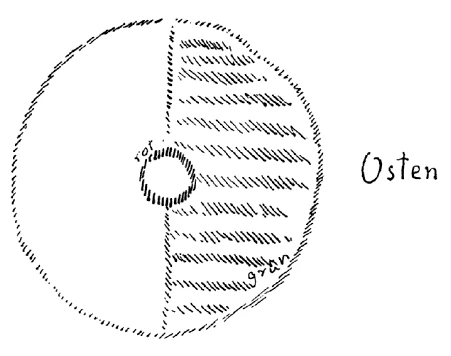
[ 15 ] Das ist auch die Grundform. Dem Kopfe liegt die Kugelform zugrunde, den Brustorganen liegt zugrunde der Kreisteil, gewissermaßen der Halbkreis. Nur ist er verschiedentlich gebogen, und man kann es nicht mehr genau sehen. Sehen könnten Sie, daß Ihr Kopf wirklich eine Kugel ist, wenn auf den Menschen nie luziferische und ahrimanische Kräfte gewirkt hätten. Sehen würden Sie, daß die Brustorgane wirklich eine Halbsphäre sind, wenn eben diese Kräfte nicht gewirkt hätten. Und gewissermaßen die Richtung nach dem Mittelpunkte — aber man könnte sagen: für gewöhnliche irdische geometrische Verhältnisse nach dem unendlich fernen Mittelpunkte — ist nach dem Osten. Also Halbsphäre: nach dem Osten.
[ 15 ] This is also the basic form. The head is based on a spherical shape, while the chest organs are based on a circular section—a semicircle, so to speak. However, it is curved in various ways, and one can no longer see it clearly. You would be able to see that your head is truly a sphere if Luciferic and Ahrimanic forces had never acted upon human beings. You would see that the chest organs are truly a hemisphere if these very forces had not been at work. And, in a sense, the direction toward the center—though one might say, in terms of ordinary earthly geometric proportions, toward the infinitely distant center—is toward the east. Thus, the hemisphere points toward the east.
[ 16 ] Jetzt haben wir als drittes Glied alles dasjenige, was sich im Menschen findet als Teilorgane außer Kopf und Brustorganen: Unterleibsorgane mit den daranhängenden Gliedmaßen. Alles das will ich, obwohl die Benennung nicht besonders genau ist, Unterleibsorgane nennen. Dieses, was wir so als Unterleibsorgane zusammenfassen, können wir nun auch ebenso beziehen auf äußerlich organisierende Kräfte, die natürlich hier auf diesem Gebiete hauptsächlich auf dem Umwege durch die Embryologie auf den Menschen wirken, aber eben auf diesem Umwege doch so wirken, weil während der Schwangerschaft die Mutter abhängig ist von den Kräften, die da aufgesucht werden müssen zu der Gestaltung des Unterleibes, ebenso wie die Sphäre aufgesucht werden muß zur Gestaltung des Kopfes, der Osten, die Halbsphäre aufgesucht werden muß zur Gestaltung der Brustorgane.
[ 16 ] Now, as the third category, we have everything found in the human being as sub-organs other than the head and chest organs: abdominal organs with their attached limbs. Although the term is not particularly precise, I will refer to all of this as abdominal organs. What we thus summarize as abdominal organs can now also be related to externally organizing forces, which, of course, in this area act upon the human being primarily indirectly through embryology, but they do exert this influence precisely through this indirect route, because during pregnancy the mother is dependent on the forces that must be sought out for the formation of the abdomen, just as the sphere must be sought out for the formation of the head, and the East, the hemisphere, must be sought out for the formation of the chest organs.
[ 17 ] Was auf solche Weise auf die Organe des Unterleibes als Kräfte wirkt, das müssen Sie sich vorstellen so, daß es vom Mittelpunkte der Erde kommt, aber differenziert wird durch das Territorium, auf dem sich die Eltern beziehungsweise Voreltern aufhalten, durch das Territorium und alles, was damit zusammenhängt. Also wohlgemerkt, es kommen die Kräfte vom Mittelpunkte der Erde; aber ob ein Mensch in Nordamerika oder Australien oder Asien oder Europa zur Welt gekommen ist, es kommt aus dem Mittelpunkte der Erde, aber immer differenziert, einmal wie die Kraft wirkt durch das europäische Territorium differenziert, einmal durch das amerikanische Territorium differenziert, einmal durch das asiatische Territorium differenziert und so weiter. Also ich kann sagen: Die Unterleibsorgane werden bestimmt aus dem Mittelpunkte der Erde, in Differenzierung durch das Territorium.
[ 17 ] You must imagine the forces that act in this way on the organs of the lower abdomen as coming from the center of the Earth, but differentiated by the territory where the parents or ancestors reside, by that territory and everything associated with it. So, mind you, the forces do come from the center of the Earth; but whether a person was born in North America, Australia, Asia, or Europe, they come from the center of the Earth—yet they are always differentiated: sometimes the force is differentiated by the European territory, sometimes by the American territory, sometimes by the Asian territory, and so on. So I can say: The abdominal organs are determined from the center of the Earth, differentiated by the territory.
[ 18 ] Nun, wenn wir okkultistisch vollständig den Menschen betrachten wollen, so müssen wir noch ein Viertes betrachten. Da werden Sie sagen: Wir haben ja jetzt schon den ganzen Menschen. Gewiß, aber im Okkultismus kommt immer noch ein Viertes in Betracht, Jetzt haben wir drei Glieder des Menschen betrachtet; jetzt können wir noch den ganzen Menschen für sich betrachten. Das Ganze ist eben auch ein Glied. Also Kopf, Rumpf, Unterleib, aber jetzt alles zusammen, so daß wir als viertes Glied das Ganze haben, und dieses Ganze ist jetzt wiederum durch Kräfte gebildet. Aber es ist dieses Ganze gebildet durch Kräfte des ganzen Erdenumkreises. Also jetzt nicht differenziert durch das Territorium, sondern das Ganze des Menschen ist gebildet durch den ganzen Umkreis, also durch den Erdenumkreis.
[ 18 ] Well, if we want to consider the human being in its entirety from an occult perspective, we must also consider a fourth aspect. You might say: But we already have the whole human being. Certainly, but in occultism, a fourth aspect is always taken into account. We have now considered three parts of the human being; now we can consider the whole human being in and of itself. The whole is, in fact, also a member. So: head, torso, and lower body—but now all together, so that we have the whole as the fourth member, and this whole is in turn formed by forces. But this whole is formed by forces from the entire Earth’s circumference. So now it is not differentiated by territory; rather, the whole human being is formed by the entire circumference—that is, by the Earth’s circumference.
[ 19 ] Jetzt habe ich Ihnen den physischen Menschen als ein Abbild dargestellt des Kosmos, wie er gewissermaßen Bild ist der aus dem Kosmos zusammenwirkenden Kräfte. Wir können auch andere Verhältnisse im Zusammenhange mit dem Kosmos betrachten. Da müssen wir dann den geistigen Kosmos in Beziehung zum Menschen denken, nicht bloß den physischen Kosmos. Was wir jetzt betrachtet haben, war der physische Mensch. Daher konnten wir auch stehenbleiben bei dem physischen Kosmos. Betrachten wir den Menschen als entkörpertes Wesen zwischen Tod und neuer Geburt, dann können wir nicht stehenbleiben bei dem, was sich im Raume erschöpft, denn der dreidimensionale Raum, wie wir ihn haben, ist allerdings maßgebend für den physischen Menschen, der zwischen Geburt und Tod lebt, er ist aber nicht maßgebend für den geistigen Menschen, der zwischen Tod und neuer Geburt lebt. Man muß sich dann klar sein, daß der Tote eine andere Welt noch zur Verfügung hat als diejenige, die in drei Dimensionen lebt.
[ 19 ] I have now presented to you the physical human being as an image of the cosmos, just as the cosmos itself is, in a sense, an image of the forces acting together within it. We can also consider other relationships in connection with the cosmos. In doing so, we must conceive of the spiritual cosmos in relation to the human being, not merely the physical cosmos. What we have just considered was the physical human being. That is why we were able to limit ourselves to the physical cosmos. If we consider the human being as a disembodied being between death and rebirth, then we cannot limit ourselves to what is confined to space, for three-dimensional space, as we know it, is indeed decisive for the physical human being who lives between birth and death, but it is not decisive for the spiritual human being who lives between death and rebirth. One must then be clear that the dead have another world at their disposal besides the one that exists in three dimensions.
[ 20 ] Nun muß man, wenn man den entkörperten Menschen, den sogenannten toten Menschen ins Auge faßt, vielleicht eine etwas andere Betrachtungsweise anstellen. Man muß eine Betrachtungsweise anstellen, die mehr in dem Beweglichen lebt. Und gewiß, man kann da von verschiedenen Gesichtspunkten Betrachtungen anstellen, denn das Leben zwischen Tod und neuer Geburt ist ebenso kompliziert wie das Leben zwischen Geburt und Tod. Aber legen wir zunächst zugrunde die Beziehung des Menschen, der auf der Erde hier ist, zu dem Menschen, der in die geistige Welt durch den Tod eingetreten ist.
[ 20 ] Now, when one looks into the eyes of the disembodied human being—the so-called dead person—one must perhaps adopt a somewhat different perspective. One must adopt a perspective that is more attuned to the dynamic. And certainly, one can consider this from various points of view, for life between death and rebirth is just as complex as life between birth and death. But let us first take as our starting point the relationship between the human being who is here on Earth and the human being who has entered the spiritual world through death.
[ 21 ] Da haben wir wiederum ein erstes Glied — aber es ist das jetzt mehr zeitlich zu fassen —, ein erstes Entwickelungsstadium, könnten wir auch sagen. Der Tote geht, so könnte ich mich ausdrücken, in einer gewissen Weise in die geistige Welt hinaus; aber er geht aus der physischen Welt in die geistige Welt hinaus, er verläßt die physische Welt und ist Ja insbesondere in den ersten Tagen noch mit der physischen Welt zusammenhängend. Und da ist es sehr bedeutungsvoll, daß der Tote aus der physischen Welt hinausgeht gar sehr angepaßt an die Konstellation, die sich für sein Leben aus der Stellung der Planeten ergibt. Solange namentlich der Tote noch mit seinem Ätherleib zusammenhängt, klingen und schwingen wunderbar nach die Planetenkräfte, die Konstellation der Planetenkräfte durch diesen Ätherleib. So wie im Embryowasser beim Entstehen des physischen Menschen außerordentlich stark mitschwingen die Erdenterritorialkräfte, so schwingen bei dem Toten, der noch in:seinem Ätherleib ist, in einer ganz auffälligen Weise die Kräfte mit, die mit den Sternkonstellationen zusammenhängen in dem Augenblicke, wo — das Ganze ist ja natürlich karmisch bedingt — der Tote die physische Welt verlassen hat. Und man könnte, wenn man nur mit der nötigen Ehrfurcht und Würde vorgeht, interessante Entdeckungen machen, wenn man eben solche Sorgfalt anwenden würde, wie man leider oftmals sogar aus egoistischen Gründen anwendet, um eine Untersuchung zu machen für die Sternkonstellation der Geburt. Viel selbstlosere, viel schönere Resultate würde man bekommen, wenn man gewissermaßen das Horoskop stellte, namentlich das planetarische Horoskop, die Stellung der Planeten für den Moment des Todes. Das ist außerordentlich aufschlußreich für das ganze Wesen des seelischen Menschen, und außerordentlich aufschlußreich für den Zusammenhang des Karma mit dem Eintreten des Todes gerade in einem gewissen Momente.
[ 21 ] Here we have, once again, a first link—though this one must now be understood in more temporal terms—an initial stage of development, we might also say. The deceased, so to speak, enters the spiritual world in a certain way; but he passes from the physical world into the spiritual world—he leaves the physical world and, especially in the first few days, is still connected to it. And it is very significant that the deceased departs from the physical world in a way that is very much attuned to the constellation of planetary forces that arose during his or her lifetime. As long as the deceased is still connected to his or her etheric body, the planetary forces—the constellation of these forces—resonate and vibrate wonderfully through this etheric body. Just as the Earth’s territorial forces resonate extraordinarily strongly in the amniotic fluid during the formation of the physical human being, so too do the forces associated with the constellations resonate in a very striking way within the deceased who is still in his etheric body at the very moment—the whole process being, of course, karmically determined—when the deceased has left the physical world. And one could make interesting discoveries—if only one proceeded with the necessary reverence and dignity—by applying precisely the same care that is, unfortunately, often applied—even for selfish reasons—to investigate the star constellation at the time of birth. One would obtain far more selfless, far more beautiful results if one were to draw up, so to speak, the horoscope—namely, the planetary horoscope—showing the positions of the planets at the moment of death. This is extraordinarily revealing regarding the entire nature of the spiritual human being, and extraordinarily revealing regarding the connection between karma and the occurrence of death at a specific moment.
[ 22 ] Wer einmal Untersuchungen anstellen wird nach dieser Richtung — die Regeln sind ja dieselben wie für das Geburtshoroskop —, der wird zu allerlei interessanten Resultaten kommen, besonders wenn er die Menschen, für die er die Sache anstellt, im Leben mehr oder weniger gut gekannt hat. Denn der Tote trägt durch Tage hindurch mit seinem noch nicht abgegliederten Ätherleib etwas in sich, was Nachschwingen ist, namentlich aus der planetarischen Sternkonstellation. So daß wir sagen können: Erstes Entwickelungsstadium: Richtung in der Sternkonstellation. Das ist bedeutsam eben so lange, als der Mensch mit seinem Ätherleibe verbunden bleibt.
[ 22 ] Anyone who undertakes investigations in this direction—the rules are, after all, the same as those for the natal chart—will arrive at all sorts of interesting results, especially if they have known the people for whom they are conducting the analysis more or less well in life. For in the days following death, the deceased, with his etheric body not yet separated, carries within himself something that continues to resonate, namely from the planetary constellation. Thus we can say: First stage of development: direction in the planetary constellation. This remains significant for as long as the human being remains connected to his etheric body.
[ 23 ] Das zweite, was nun im Verhältnis des Menschen zum Kosmos in Betracht kommt, das ist, daß der Mensch wirklich in einer gewissen Richtung, könnte man sagen, die physische Welt verläßt, wenn er selbst geistig wird nach Ablegung des Ätherleibes. Da ist es, wo man zuletzt noch im richtigen Sinne, nicht bloß im bildlichen Sinne auf dasjenige, was der Tote tut, Begriffe anwenden kann, die der physischen Welt entnommen sind; denn nach diesem Stadium werden die Begriffe mehr oder weniger Bilder.
[ 23 ] The second point to consider regarding the relationship between human beings and the cosmos is that, in a certain sense, one might say that a person truly leaves the physical world when he or she becomes spiritual after shedding the etheric body. This is the point at which one can still, in the true sense—and not merely in a figurative sense—apply concepts derived from the physical world to what the deceased does; for after this stage, these concepts become, to a greater or lesser extent, mere images.
[ 24 ] Nun kann man sagen: Im zweiten Stadium wird — und jetzt gilt eben die Richtung noch physisch, obwohl es aus dem Physischen hinausgeht — die Richtung nach dem jeweiligen Osten eingeschlagen. Und durch den jeweiligen Osten wandelt in einem gewissen Zeitpunkte der Tote in die rein geistige Welt hinein. Das ist also die Richtung nach dem Osten. Es ist wichtig, dieses sich einmal zu vergegenwärtigen, weil ein altes Wort verschiedener Brüderschaften, das aus besseren Zeiten der okkulten Menschheitserkenntnis sich bewahrt hat, heute noch darauf aufmerksam macht. In allerlei Brüderschaften wird von demjenigen, der gestorben ist, so gesprochen, daß er «eingegangen ist in den ewigen Osten». Solche Dinge, insofern sie nicht später zugesetzter Firlefanz sind, entsprechen alten Wahrheiten. Geradeso wie wir hier davon sprechen mußten, daß die Brustorgane ihre Gliederung aus dem Osten haben, so müssen wir das Hingehen, den Hingang des Toten durch den Osten uns vorstellen. Indem aber der Tote durch den Osten gewissermaßen austritt aus der physischen Welt in die geistige hinein, gelangt er schon in das Gebiet der Sphäre, das heißt, er erlangt die Möglichkeit, an den Sphärenkräften teilzunehmen, die nun nicht, wie hier der Mensch, zentrifugal, sondern zentripetal nach dem Mittelpunkte der Erde hin wirken; er gelangt in die Sphäre hinein, in die Möglichkeit, nach der Erde zu wirken.
[ 24 ] Now one might say: In the second stage—and here the direction is still physical, even though it extends beyond the physical—the direction toward the respective east is taken. And through the respective east, at a certain point in time, the deceased passes into the purely spiritual world. This, then, is the direction toward the east. It is important to bear this in mind, because an ancient saying from various brotherhoods—one that has been preserved from better times of occult knowledge of humanity—still draws attention to it today. In all manner of brotherhoods, it is said of the one who has died that he has “entered the eternal East.” Such things, insofar as they are not later-added frippery, correspond to ancient truths. Just as we had to speak here of the fact that the chest organs derive their structure from the East, so must we imagine the passing, the departure of the deceased through the East. But as the deceased, so to speak, passes through the East from the physical world into the spiritual, he already enters the realm of the sphere—that is, he gains the ability to participate in the forces of the spheres, which now act not centrifugally, as they do here on Earth, but centripetally toward the center of the Earth; he enters the sphere, gaining the ability to act upon the Earth.
[ 25 ] So daß wir also als drittes Stadium: Übergang in die geistige Welt setzen können, und als viertes Stadium: Wirkungen oder arbeiten aus der geistigen Welt, arbeiten mit den Kräften aus der geistigen Welt.
[ 25 ] So we can identify the third stage as the transition into the spiritual world, and the fourth stage as effects or activities originating from the spiritual world—working with the forces of the spiritual world.
[ 26 ] Mit solchen Ideen treten wir intim heran an dasjenige, was den Menschen hier bindet an die geistigen Welten. Sie können sogar, wenn Sie dieses Schema in der richtigen Weise betrachten, ersehen, daß Nummer 4 schließt mit dem, was Nummer 1 hier beginnt, das ist: die Arbeit an dem Haupte aus der Sphäre heraus. Sie wird von dem Menschen selbst verrichtet, wenn er durch den Osten eingezogen ist in die geistige Welt.
[ 26 ] With such ideas, we come into close contact with that which binds human beings here to the spiritual worlds. If you look at this diagram in the right way, you can even see that number 4 concludes with what number 1 begins here, namely: the work on the head from outside the sphere. This work is performed by the human being himself when he has entered the spiritual world through the East.
| Haupt: | Brustorgane: | Unterleibsorgane: | Das Ganze: |
|---|---|---|---|
| Aus der Sphäre | Aus dem Osten | Aus dem Mittelpunkteder Durch den Erde, in Differenzierung Erdenumkreis durch das Territorium | FirstRowSecondColumn |
| Erstes Entwickelungsstadium: | Zweites Entwickelungsstadium: | Drittes Stadium: | Viertes Stadium: |
| Richtung in der Sternkonstellation | Richtung nach dem Osten | Übergang in die geistige Welt | Wirkungen aus der geistigen Welt |
| Head: | Chest organs: | Abdominal organs: | The Whole: |
|---|---|---|---|
| From the Sphere | From the East | From the Center of the Earth, differentiating the Earth’s circumference through the territory | FirstRowSecondColumn |
| First stage of development: | Second stage of development: | Third stage: | Fourth stage: |
| Direction in the constellation | Direction toward the East | Transition into the spiritual world | Influences from the spiritual world |
[ 27 ] Daß der Tote in der Richtung nach dem Osten die physische Welt verlassen muß, das ist beim Verkehren mit den Toten sehr stark wahrzunehmen. Sie befinden sich gewissermaßen in der Welt, die sie erreichen durch das Tor des Ostens. Sie sind jenseits des Tores des Ostens. Und mit Bezug auf solche Dinge sind gerade die Erfahrungen, die man jetzt im fünften nachatlantischen Zeitraum in der Entwickelungssphäre des Materialismus macht, bedeutsam.
[ 27 ] The fact that the deceased must leave the physical world by heading east is very clearly perceptible when communicating with the dead. They are, so to speak, in the world they reach through the Gate of the East. They are beyond the Gate of the East. And with regard to such matters, the experiences we are now having in the fifth post-Atlantean epoch, within the sphere of materialism, are particularly significant.
[ 28 ] Sehen Sie, in diesem fünften nachatlantischen Zeitraum entbehren gewissermaßen die Toten durch die materialistische Erdenkultur sehr viel. Manches wird Ihnen schon aus dem gestern Gesagten klar sein. Lernt man das Leben der Toten in der Gegenwart mit den entsprechenden Mitteln kennen, dann ergibt sich, daß sie sehr starke Triebe haben, einzugreifen in die Dinge, welche die Menschen hier auf Erden tun. Aber in früheren Zeiten, in denen weniger Materialismus auf der Erde gelebt hat als jetzt, konnten die Toten leichter eingreifen in das, was auf der Erde geschah. Sie konnten leichter durch die Erdenmenschen, durch das, was die Erdenmenschen als Nachwirkungen der Toten fühlten und empfanden, hereinwirken in die Erdensphäre. Heute ist es sehr, sehr häufig zu erleben, und ich habe gesehen, daß es immer wieder überraschend gewirkt hat im konkreten Falle, daß Menschen, welche hier intensiv an gewissen Zeitereignissen beteiligt waren und gestorben sind und dann weiterleben nach dem Tode, kein Interesse haben können für die Zeitereignisse, die sich hier abspielen nach ihrem Tode, weil die Verbindung fehlt. Auch unter uns sind solche Seelen, die, während sie hier waren auf dem physischen Plane, großes Interesse hatten für die Zeitereignisse, drüben in der geistigen Welt aber den Zeitereignissen, die sich jetzt nach ihrem Tode abspielen, fremd gegenüberstehen. Das ist gerade oftmals bei vorzüglichen Seelen, die hier rege Interessen und große Begabungen hatten, der Fall. Das ist aber schon lange so. Es ist so, nur immer mehr zunehmend, für die ganze Zeit des fünften nachatlantischen Zeitraums, es ist so seit dem 15., 16. Jahrhundert schon, nur zunehmend. Man kann da die Erfahrung machen, daß die Toten, da sie weniger eingreifen können in dasjenige, was die Menschen tun, sich mehr beschäftigen — es tut einem so leid, daß man so triviale Begriffe gebrauchen muß, aber man muß eben die Begriffe gebrauchen, die man in der Sprache hat —, also daß die Toten mehr eingreifen müssen in dasjenige, was die Menschen als einzelne Persönlichkeiten sind. Und das sieht man, daß das Interesse der Toten und die Arbeit der Toten seit dem 15., 16. Jahrhundert mehr auf die einzelnen Persönlichkeiten geht als auf die großen Zusammenhänge unter den Menschen. Und nachdem ich viel mich gerade in dieser Richtung befaßt habe mit diesem Problem, konnte ich mir die Überzeugung verschaffen, daß damit, mit dem, was ich jetzt gesagt habe, eine ganz bestimmte Zeiterscheinung zusammenhängt, die dem, der sich für solche Dinge interessiert, besonders stark auffallen muß in unserer neueren Geschichte. Wir haben in der neueren Geschichte im Gegensatz zu früheren Zeiten die merkwürdige Erscheinung, daß Menschen geboren werden mit sehr bedeutenden Anlagen, die so im allgemeinen wirken mit großem Idealismus, mit vorzüglichem Streben, daß aber diese Menschen es nicht dazu bringen können, Überschau über das Leben zu gewinnen, große Horizonte zu gewinnen. Das drückt sich im Grunde genommen im ganzen Schrifttum seit langer Zeit schon aus. In einzelnen Ideen, Begriffen, Vorstellungen, Empfindungen, die die Leute zum Ausdruck bringen, sei es in der Literatur, in der Kunst, sogar in der Wissenschaft, finden sich manchmal starke Ansätze. Aber — und deshalb ist es ja gerade für die Leute so schwer, sich zu der Überschau, die man haben muß in der Geisteswissenschaft, aufzuschwingen — zu einer großen Überschau bringen es die Leute nicht. Das kommt zum großen Teil davon her, daß die Toten mehr an den einzelnen Menschen herankommen und bei ihm das ausarbeiten, was mehr in der Kindheitsperiode, in der Jugendperiode des Daseins veranlagt wird, während dasjenige, was dem Menschen Überschau verschafft in den Reifezeiten des Daseins, in unserer materialistischen Zeit mehr oder weniger getrennt ist von der Tätigkeit der Toten. Unvollendete, Torso bleibende Talente, nicht bloß in der großen Welt, sondern auch im einzelnen, sind heute aus diesem Grunde sehr häufig, weil die Toten mehr an die einzelnen Seelen heran können als an dasjenige, was so in der Menschheitsentwickelung heute sozial lebt. Die Toten haben einen starken Trieb, an dasjenige heranzukommen, was in der Menschheitsentwickelung sozial lebt, aber es ist eben in unserem fünften nachatlantischen Zeitraum außerordentlich schwierig für sie.
[ 28 ] You see, in this fifth post-Atlantean epoch, the dead are, in a sense, deprived of a great deal by materialistic earthly culture. Some of this will already be clear to you from what was said yesterday. If one learns about the lives of the dead in the present using the appropriate means, it becomes apparent that they have a very strong urge to intervene in the things that people here on Earth do. But in earlier times, when there was less materialism on Earth than there is now, the dead were able to intervene more easily in what was happening on Earth. They could more easily influence the earthly sphere through earthly human beings—through what earthly human beings felt and sensed as the aftereffects of the dead. Today this is very, very common, and I have observed—and it has repeatedly come as a surprise in specific cases—that people who were intensely involved in certain current events while here on Earth, who have died, and who continue to live on after death, cannot have any interest in the current events unfolding here after their death, because the connection is missing. Even among us there are such souls who, while they were here on the physical plane, took a great interest in current events, but who, over in the spiritual world, feel alienated from the events now unfolding after their death. This is often the case precisely with exceptional souls who had lively interests and great talents here. But this has been the case for a long time. It has been this way—only increasingly so—throughout the entire Fifth Post-Atlantean Epoch; it has been this way since the 15th and 16th centuries, only to a greater extent. One can observe that, since the dead have less ability to intervene in what people do, they become more involved—I’m so sorry to have to use such trivial terms, but one must simply use the terms available in the language—that is, the dead must intervene more in what people are as individual personalities. And one can see that, since the 15th and 16th centuries, the interest of the dead and the work of the dead have focused more on individual personalities than on the larger interconnections among people. And having devoted a great deal of attention to this problem specifically in this regard, I have come to the conviction that what I have just said is connected to a very specific historical phenomenon that must be particularly striking to anyone interested in such matters in our recent history. In contrast to earlier times, we have observed in recent history the curious phenomenon that people are born with very significant aptitudes—which generally manifest as great idealism and exceptional ambition—yet these individuals are unable to gain a comprehensive view of life or broaden their horizons. This has, in essence, been reflected in literature for a long time. In individual ideas, concepts, notions, and feelings that people express—whether in literature, art, or even science—strong glimpses of this can sometimes be found. But—and this is precisely why it is so difficult for people to rise to the level of comprehensive understanding required in spiritual science—people do not manage to attain a broad, comprehensive perspective. This stems largely from the fact that the dead are able to reach individual human beings more readily and work out within them what is predisposed during the childhood and youth phases of existence, whereas that which provides human beings with a comprehensive overview during the mature phases of existence is, in our materialistic age, more or less separated from the activity of the dead. For this reason, talents that remain unfulfilled or incomplete—not only in the wider world but also in the individual—are very common today, because the dead are able to reach individual souls more readily than they can reach what is socially active in human development today. The dead have a strong impulse to reach what is socially alive in human development, but it is precisely in our fifth post-Atlantean epoch that this is extraordinarily difficult for them.
[ 29 ] Dann ist es insbesondere für die Gegenwart von einer großen Bedeutung, sich mit einer andern Erscheinung bekanntzumachen. Sehen Sie, in unserer Zeit leben viele Begriffe, viele Vorstellungen, die außerordentlich bestimmt sein müssen, sonst kommt man mit diesen Vorstellungen nicht weiter. Insbesondere in dem modernen, mehr merkantilistischen Leben müssen rechnerisch stark umrissene Begriffe ausgebildet werden. Daran hat sich die Wissenschaft gewöhnt, daran hat sich aber auch die Kunst gewöhnt. Denken Sie nur, welche Entwickelung in dieser Beziehung die Kunst durchgemacht hat! Wir haben noch nicht lange jene Kunstperiode hinter uns, wo die Kunst auf die großen idealen Zusammenhänge gegangen ist, und — ich möchte sagen, Gott sei Dank — Begriffe nicht ausreichten, um in leichter Weise ein Kunstwerk zu interpretieren, wo die Kunstwerke vielsagend waren. Das ist heute nicht mehr in demselben Maße der Fall. Heute strebt man nach Naturalismus, und die Begriffe können leicht nachkommen, weil die Kunstwerke selber oftmals aus Begriffen nur hervorgegangen sind, nicht aus der elementar umspannenden Empfindung. Die Menschheit ist heute eben angefüllt mit bestimmten trivialisierten, naturalistischen Begriffen, welche dadurch bestimmt sind, daß sie ganz am physischen Plane ausgebildet sind, wo die Dinge eben auch bestimmt sind, individualisiert sind.
[ 29 ] It is therefore of great importance, especially for the present, to familiarize oneself with another phenomenon. You see, in our time there are many concepts and ideas that must be defined with extraordinary precision; otherwise, one cannot make any headway with these ideas. Especially in modern, more mercantilistic life, concepts that are clearly defined in mathematical terms must be developed. Science has become accustomed to this, but art has also become accustomed to it. Just think of the development art has undergone in this regard! It has not been long since we left behind that artistic period when art focused on grand ideal connections, and—I would say, thank God—concepts were not sufficient to easily interpret a work of art, when works of art spoke for themselves. That is no longer the case to the same extent today. Today, people strive for naturalism, and concepts can easily keep pace, because the works of art themselves have often emerged solely from concepts, not from an elementally all-encompassing sensation. Humanity today is simply filled with certain trivialized, naturalistic concepts, which are defined by the fact that they are formed entirely on the physical plane, where things are likewise defined and individualized.
[ 30 ] Nun ist es sehr bedeutsam, daß solche Begriffe von den sogenannten Toten nicht geliebt werden. Scharf umrissene Begriffe, die nicht beweglich sind, nicht leben, sie werden von den Toten nicht geliebt. Man kann da die merkwürdigsten Erfahrungen machen, Erfahrungen, die sehr interessant sind, wenn man eben solch einen trivial-banalen Ausdruck für diese ehrwürdigen Verhältnisse brauchen darf. Ich habe in der letzten Zeit mich hier bemüht, wie Sie wissen, denn wir haben ja das alles zusammen hier absolviert, auch allerlei Betrachtungen anzustellen über Kunstperioden in Anlehnung an unsere Lichtbilder. Ich habe mich bemüht, manche künstlerische Erscheinung in Begriffe zu bringen. Wenn man reden will, so muß man sie in Begriffe bringen. Allein ich hatte immer das Bedürfnis, die künstlerischen Zusammenhänge nicht in so stramme, festumrissene Begriffe zu kleiden. Wenn ich auch bei den Betrachtungen versucht habe, die Begriffe so weit als möglich zu schnüren: um sie in Worte zu prägen, muß man sie schon bestimmt fassen. Aber ich hatte während der Ausbildung der Begriffe in der Vorbereitung zu den Betrachtungen hier wirklich, ich möchte sagen, einen gewissen Widerwillen, wenn ich das Wort gebrauchen darf, die Zusammenhänge, auf die da hinzuweisen ist, mit so dürftigen Begriffen zu geben, wie sie eben gegeben werden müssen, wenn man sich aussprechen will. Und verstehen werden wir uns auf diesen Gebieten nur dann, wenn Sie gewissermaßen wieder zurückübersetzen dasjenige, was in engmaschigen Begriffen gesagt ist, in weitermaschige Begriffe.
[ 30 ] Now, it is very significant that such concepts are not loved by the so-called dead. Sharply defined concepts that are not flexible, that do not live—they are not loved by the dead. One can have the most remarkable experiences here—experiences that are very interesting, if one is allowed to use such a trivial, banal expression for these venerable circumstances. As you know, I have recently been making an effort here—since we have, after all, gone through all of this together—to offer all sorts of reflections on artistic periods based on our slides. I have tried to put certain artistic phenomena into concepts. If one wants to speak about them, one must put them into concepts. Yet I have always felt the need not to clothe artistic relationships in such rigid, clearly defined terms. Even though I tried, in these reflections, to narrow down the concepts as much as possible—to cast them in words, one must define them precisely. But while developing these concepts in preparation for these reflections, I really did feel—if I may use the word—a certain reluctance to express the relationships that need to be pointed out using such meager concepts as are necessary when one wishes to articulate them. And we will only understand one another in these areas if you, so to speak, “reverse-translate” what is said in tightly defined concepts back into more broadly defined concepts.
[ 31 ] Wenn man nun zu gleicher Zeit solches erlebt und, ich möchte sagen, zu tun hat mit den entkörperten Seelen, so findet man, daß gerade dann, wenn man eine Erscheinung überblicken will, der gegenüber man so recht die Empfindung hat: Du bist eigentlich viel zu wenig verständig, um diese Erscheinung in Verstandesbegriffe zu fassen, du schaust die Erscheinung, aber der Verstand reicht eigentlich nicht aus, um das, was geschaut wird, wirklich in Begriffe zu schnüren —, wenn man dieses Erlebnis hat, und man kann dieses Erlebnis gerade bei der Betrachtung künstlerischer Erscheinungen auch haben, dann kann man sich ganz besonders intim mit den entkörperten Seelen, mit den toten Seelen finden; denn diese lieben Begriffe, die nicht scharf umrissen sind, die sich mehr beweglich durch die Erscheinungen hindurchtragen lassen. Durch scharf umrissene Begriffe, durch solche Begriffe, die ähnlich sind denen, die hier auf dem physischen Plan unter der Einwirkung der physisch-sinnlichen Verhältnisse gebildet werden, fühlen sich die Toten wie angenagelt an bestimmte Orte, während sie ein freies Bewegen für ihr Leben in der geistigen Welt brauchen. Daher ist die Beschäftigung mit der Geisteswissenschaft auch aus diesem Grunde bedeutsam, um in jene intimen Erlebenssphären hineinzukommen, wo nach dem gestern Angedeuteten der lebende Mensch hier sich mit dem Toten begegnen kann, weil die geisteswissenschaftlichen Begriffe schon nicht so bestimmt gehalten werden können wie diejenigen, die für den physischen Plan ausgearbeitet werden.
[ 31 ] If one experiences such a thing at the same time and, I might say, has to deal with disembodied souls, one finds that precisely when one tries to take in an apparition—toward which one has the distinct feeling: “You are actually far too limited in understanding to grasp this apparition in intellectual concepts,” you see the phenomenon, but your intellect is actually not sufficient to truly capture what is seen in concepts—when you have this experience—and you can have this experience precisely when contemplating artistic phenomena—then you can find yourself in a particularly intimate connection with disembodied souls, with dead souls; for these are the very concepts—not sharply defined, but rather fluid—that allow one to move freely through the phenomena. Through sharply defined concepts—concepts similar to those formed here on the physical plane under the influence of physical-sensory conditions—the dead feel as if they were nailed down to specific places, whereas they need freedom of movement for their lives in the spiritual world. For this reason, too, the study of spiritual science is significant for entering those intimate spheres of experience where, as hinted at yesterday, the living person here can encounter the dead, because the concepts of spiritual science cannot be held as definitively as those developed for the physical plane.
[ 32 ] Daher haben böswillige oder beschränkte Menschen es sehr leicht, in geisteswissenschaftlichen Begriffen Widersprüche zu entdecken, weil die Begriffe lebendig sind, und das Lebendige trägt in einem gewissen Sinne, wenn auch nicht den kontradiktorischen Widerspruch, so doch das Bewegliche in sich. Aber das kommt gerade durch die Beschäftigung mit dem Geistigen. Man muß da die Dinge von den verschiedensten Seiten beleuchten. Und dieses Beleuchten von den verschiedensten Seiten bringt einen nun wirklich der geistigen Welt nahe. Daher fühlen sich die Toten wohl, wenn sie hereinkommen können in die Sphäre von Menschenbegriffen, die nicht pedantisch umrissen sind, sondern die beweglich sind. Am unwohlsten fühlen sich die Toten, wenn sie hereinkommen sollen in die allerpedantischesten Begriffe, die für die übersinnliche Welt in der letzten Zeit geprägt worden sind für die Menschen, die nun ganz und gar nicht in der geistigen Welt leben wollen, sondern die auch für die geistige Welt Sinnliches haben wollen, die also spiritistische Experimente machen, um auch die geistigen Begriffe in die sinnliche Sphäre ganz fest hereinzubekommen. Das sind eigentlich die größten Materialisten. Diese Menschen suchen für den Verkehr mit den Toten gerade starre Begriffe auf. Daher martern sie die Toten am allermeisten, weil sie sie zwingen, wenn sie herankommen wollen, gerade in das Gebiet einzutreten, das der Tote seiner ganzen Organisation nach nicht lieben kann. Er liebt die beweglichen Begriffe, nicht die starren Begriffe.
[ 32 ] That is why it is very easy for malicious or narrow-minded people to find contradictions in spiritual scientific concepts, because these concepts are alive, and what is alive carries within itself—in a certain sense—if not a contradictory contradiction, then at least a dynamic quality. But this arises precisely from engaging with the spiritual. One must examine things from the most diverse angles. And this examination from the most diverse angles truly brings one closer to the spiritual world. That is why the dead feel at ease when they can enter the sphere of human concepts that are not pedantically defined, but are flexible. The dead feel most uncomfortable when they are expected to enter the most pedantic concepts that have recently been coined for the supersensible world—concepts intended for people who do not wish to live in the spiritual world at all, but who also want the spiritual world to be accessible to the sensory realm; people who, in other words, conduct spiritualist experiments in order to firmly anchor spiritual concepts within the sensory sphere. These are actually the greatest materialists. These people seek out precisely rigid concepts for their communication with the dead. That is why they torment the dead the most, because they force them—if they want to approach—to enter precisely the realm that the dead, by their very nature, cannot love. They love flexible concepts, not rigid ones.
[ 33 ] Das sind, glaube ich, Erfahrungen, welche man ganz besonders machen kann in diesem Zeitalter der fünften nachatlantischen Periode, wo hier auf Erden der Materialismus herrscht und unter den Toten solche Eigentümlichkeiten, wie ich sie beschrieben habe. Denn es ist durchaus das gleiche, was hier auf der Erde den Materialismus bestimmt, und dafür ein ganz bestimmtes Leben auch in der geistigen Sphäre bestimmt. In der griechisch-lateinischen Zeit traten die Toten doch anders an die lebenden Menschen heran als in unserer Zeit. In der geistigen Sphäre ist, möchte ich sagen, heute in der fünften nachatlantischen Zeit mehr Irdisches — aber Sie müssen sich das natürlich imaginativ, bildlich vorstellen —, mehr irdische Zusammengesetztheit in der Substantialität der Toten als früher. Ein Toter erscheint einem heute in einer viel mehr den irdischen Verhältnissen nachgebildeten Gestalt als früher, menschenähnlicher, möchte ich sagen, ist der Tote heute, als er früher war. Und dadurch wirken die Toten heute auf die hier Lebenden mehr oder weniger paralysierend. Deshalb ist es so schwer heute, den Toten nahezukommen, weil man so sehr leicht betäubt wird durch sie. Hier auf der Erde herrschen die materialistischen Gedanken; in der geistigen Welt, als einem Karma daraus, herrscht gewissermaßen die materialistische Folge, die Verirdischung der spirituellen Leiblichkeit bei den Toten. Dadurch aber, daß die Toten, wenn ich den Ausdruck gebrauchen darf, überkräftig sind, dadurch wirken sie betäubend. Und man muß sich heute durch möglichst starke geisteswissenschaftliche Empfindungen erst die Kraft aneignen, um gegen diese Betäubung aufzukommen. Das ist die Schwierigkeit heute, eine der Schwierigkeiten, mit der geistigen Welt in Beziehung zu treten.
[ 33 ] These, I believe, are experiences that one can have in a very special way in this age of the fifth post-Atlantean period, when materialism reigns here on Earth and such peculiarities as I have described exist among the dead. For it is precisely the same force that determines materialism here on Earth that also determines a very specific kind of life in the spiritual sphere. In the Greco-Roman era, the dead approached the living quite differently than they do in our time. In the spiritual sphere, I would say, there is today—in the fifth post-Atlantean epoch—more of an earthly quality—though you must, of course, imagine this imaginatively, figuratively—more earthly complexity in the substance of the dead than there was in the past. A deceased person appears to us today in a form much more closely modeled on earthly conditions than in the past; I would say the deceased are more human-like today than they were in the past. And as a result, the deceased have a more or less paralyzing effect on those living here today. That is why it is so difficult today to draw close to the deceased, because one is so easily numbed by them. Here on Earth, materialistic thoughts prevail; in the spiritual world, as a karmic consequence of this, there prevails, so to speak, the materialistic consequence—the earthbound nature of the spiritual physicality of the dead. But because the dead are, if I may use the expression, “overpowering,” they have a numbing effect. And today one must first acquire the strength through the strongest possible spiritual-scientific feelings in order to counteract this numbing effect. That is the difficulty today—one of the difficulties in entering into a relationship with the spiritual world.
[ 34 ] Nun, für die irdische Sphäre, die man ja auch geistig ansehen kann, nehmen sich die Dinge, wenn man sie geistig ansieht, anders aus, als man oftmals urteilt, wenn man die Dinge nicht geistig ansieht. Wir sagen selbstverständlich mit Recht, und wir haben es oft auseinandergesetzt: wir leben in dem materialistischen Zeitalter. Warum? Weil die Menschen in diesem materialistischen Zeitalter — nicht die Verständigen, aber die Menschen im allgemeinen —, so paradox es klingt, zu geistig sind. Daher sind sie so leicht zugänglich reinen Geistigkeiten wie ahrimanischen und luziferischen Einflüssen. Die Menschen sind zu geistig. Und gerade durch die Geistigkeit werden die Menschen heute leicht materialistisch. Nicht wahr, das, was der Mensch glaubt und denkt, ist ja etwas ganz anderes, als er ist. Gerade die geistigsten Menschen sind heute leicht zugänglich für ahrimanische Einflüsterungen und werden dadurch materialistisch.
[ 34 ] Well, when it comes to the earthly sphere—which can, of course, also be viewed spiritually—things appear differently when viewed spiritually than they often do when viewed from a non-spiritual perspective. We rightly say, of course—and we have often discussed this—that we live in a materialistic age. Why? Because people in this materialistic age—not the wise, but people in general—are, as paradoxical as it sounds, too spiritual. That is why they are so easily susceptible to purely spiritual influences, such as Ahrimanic and Luciferic ones. People are too spiritual. And it is precisely through this spirituality that people today easily become materialistic. After all, what a person believes and thinks is something entirely different from what they actually are. It is precisely the most spiritual people today who are easily susceptible to Ahrimanic whisperings and thereby become materialistic.
[ 35 ] So scharf man die materialistische Weltanschauung und die materialistischen Lebensgestaltungen bekämpfen muß, man darf nicht sagen, daß in den Kreisen dieser Materialisten die ungeistigsten Menschen sind. Wirklich, wenn ich da ein Persönliches einfügen darf: Ich habe viele geistige Menschen gefunden, nicht solche, die geistige Ansichten haben, sondern die geistige Menschen sind, in Monistenvereinen und dergleichen, dagegen grobe materialistische Naturen vorzugsweise in Spiritistenvereinen. Gerade da findet man, wenn auch dort vom Geiste geredet wird, die am gröbsten materialistischen Naturen. Und wirklich, abgesehen von dem, was er oftmals behauptet: Ein durchaus geistiger Mensch, der gerade aus Geistigkeit heraus zugänglich ist einer ahrimanischen Weltanschauung, ist zum Beispiel Haeckel. Haeckel ist ein geistiger Mensch, ein ganz durchgeistigter Mensch. Mir trat das einmal besonders deutlich vor Augen, als ich in Weimar in der dortigen alten «Künstlerschmiede» saß — ich habe die Sache schon einmal erzählt, vielleicht sogar mehrmals — und da war Haeckel am andern Ende des Tisches, mit seinen schönen geistigen blauen Augen und seinem schönen Kopfe. In meiner Nähe befand sich der berühmte Buchhändler Herz, der sehr viele Verdienste um den deutschen Buchhandel hat und der so im allgemeinen etwas von Haeckel wußte, aber nicht wußte, daß das der Haeckel ist, der da am andern Ende des Tisches saß. Als Haeckel einmal so herzlich lachte, fragte Herz: Wer ist denn der Mann, der da unten so lacht an dem Tische? — Da sagte ich: Das ist der Haeckel. — Das ist nicht möglich —, sagte er, böse Menschen können so nicht lachen!
[ 35 ] As vigorously as one must oppose the materialist worldview and materialist ways of life, one must not say that the most unspiritual people are found among these materialists. Indeed, if I may add a personal observation here: I have found many spiritual people—not merely those who hold spiritual views, but who are truly spiritual—in monist societies and the like, whereas I have encountered coarse, materialistic types primarily in spiritualist societies. It is precisely there that one finds the coarsest materialistic natures, even though they speak of the spirit there as well. And truly, apart from what he often claims: Haeckel, for example, is a thoroughly spiritual person who, precisely because of his spirituality, is susceptible to an Ahrimanic worldview. Haeckel is a spiritual person, a person thoroughly imbued with spirit. This became particularly clear to me once when I was sitting in Weimar at the old “Künstlerschmiede” there—I have told this story before, perhaps even several times—and there was Haeckel at the other end of the table, with his beautiful, spiritual blue eyes and his handsome head. Seated near me was the famous bookseller Herz, who has rendered great service to the German book trade and who generally knew something about Haeckel, but did not know that this was the very Haeckel sitting at the other end of the table. When Haeckel laughed heartily at one point, Herz asked, “Who is that man over there at the table laughing so heartily?” — So I said, “That’s Haeckel.” — “That’s not possible,” he said, “bad people can’t laugh like that!”
[ 36 ] Daher sind auch die Begriffe der Materialisten der Gegenwart so dünn, möchte ich sagen, so dünn von Geistigkeit, daß sie nicht herankommen an die Offenbarungen der Geistigkeit im Materiellen, und ihnen das Geistige und das Materielle auseinanderfällt, das Geistige zu bloßen Begriffen wird. Jedenfalls findet man die klotzigsten Materialisten heute in den vielfach spiritualistisch sich nennenden Gesellschaften, Vereinigungen und dergleichen. Klotzigen Materialismus findet man da, der es manchmal sogar dazu gebracht hat, zu seiner eigenen Verherrlichung seine eigene Affenabstammung — von einem bestimmten Affen noch dazu — für die Menschheit besonders zu registrieren. Nicht einmal mit der allgemeinen Affenabstammung des Menschen war man zufrieden, sondern man führte sich auf ganz bestimmte Affenvorfahren zurück. Man hat ja in dieser Beziehung manches Groteske erlebt. Für diejenigen, die es nicht wissen sollten, erkläre ich, daß ja vor ein paar Jahren ein Buch erschienen ist, in dem Mrs. Besant und Mr. Leadbeater genau angegeben haben, von welchen Affen sie abstammen in uralten Zeiten, und sie haben ihren Stammbaum bis auf bestimmte Affen zurückgeführt, so daß man dort diesen Stammbaum von den Affen her lesen kann. Das sind Dinge, die immerhin in vielgelesenen Büchern im heutigen Zeitalter auch möglich sind.
[ 36 ] That is why the concepts of today’s materialists are so shallow—I would say, so devoid of spirituality—that they cannot come close to the manifestations of spirituality in the material world, and the spiritual and the material fall apart for them, with the spiritual becoming mere concepts. In any case, the most crass materialists today are found in societies, associations, and the like that often call themselves spiritualist. There one finds crude materialism, which has sometimes even gone so far as to officially record—for the sake of its own glorification—its own descent from apes—from a specific ape, no less—for the benefit of humanity. Not even the general descent of humans from apes was sufficient; instead, they traced themselves back to very specific ape ancestors. We have, after all, witnessed many grotesque things in this regard. For those who may not be aware, I will explain that a few years ago a book was published in which Mrs. Besant and Mr. Leadbeater specified exactly which apes they descended from in ancient times, and they traced their family tree back to specific apes, so that one can read this family tree starting from the apes. These are things that are, after all, possible even in widely read books in this day and age.
[ 37 ] Und diese Begriffe, die ich heute entwickelt habe, die brauchen wir schon, um nun in manche Stellen unseres gegenwärtig zu besprechenden Themas tiefer einzudringen. Denn diese Welt hier ist durchaus abhängig von der geistigen Welt, in welcher die Toten sind, und hängt zusammen mit der geistigen Welt. Daher versuchte ich, Ihnen heute solche Begriffe zu entwickeln, die sich auf die Beobachtungen der unmittelbaren Gegenwart beziehen. Es ist wirklich alles dasjenige, was hier in der physischen Welt geschieht, von einer gewissen Wirkung hinauf in die geistige Welt. Aber auch die geistige Welt mit den Taten der Toten zeigt sich entweder in dem, was die Toten tun können für die physische Welt, oder auch in dem, was sie nicht tun können gerade in dem gegenwärtigen materialistischen Zeitalter. Und wir haben dieses materialistische Zeitalter charakterisiert, insofern es sogar übermaterialisiert worden ist durch gewisse okkulte Brüderschaften, wie ich Ihnen gestern auseinandergesetzt habe. Es ist heute im hohen Grade gerade der Typ des Materialismus allen Weltereignissen zugrunde liegend, welchen man den merkantilistischen Typ nennen kann. Und wie ich Sie bitte, auf der einen Seite sich für morgen gut zu merken die Begriffe, die ich in bezug auf das Leben der Toten heute vor Ihre Seele hingestellt habe, so bitte ich Sie, auf der andern Seite auch ins Auge zu fassen, wie wenig selbstverständlich heute vieles genommen wird, was in weniger materialistischen Zeitaltern viel selbstverständlicher genommen wurde. Der Zusammenhang mit diesen Erscheinungen wird uns erst morgen ganz klar werden. Allein, es ist doch ganz charakteristisch für unsere Zeit, daß man immerhin gerade auf das Merkantilistische gewisse Begriffsbetrachtungen ausdehnt, die dem, der keine Aufmerksamkeit hat für solche Zeiterscheinungen, entgehen. Aber sie sollten einem nicht entgehen. Merkantilismus auf der einen Seite, gut; aber er muß ins richtige Licht gestellt werden, in dem er im sozialen Leben drinnensteht. Dazu ist es notwendig, daß man gewisse Maßstäbe hat für alles. Aber heute lebt man vielfach im Chaos der Begriffe. Und wenn im Chaos der Begriffe die Begriffe ganz bestimmt gemacht werden, wie es im materialistischen Zeitalter der Fall ist, wo gerade an den sinnlichen Vorstellungen die Begriffe ganz bestimmt gemacht werden, und dann doch wiederum ein Begriffschaos herauskommt, wie es beim heutigen Materialismus der Fall ist, dann ist dieses wirklich so, daß es den schärfsten Strich zieht zwischen der physischen Welt, in der die Menschen zwischen Geburt und Tod sind, und der übersinnlichen Welt, in der die Menschen zwischen Tod und neuer Geburt sind.
[ 37 ] And we do need these concepts that I have developed today in order to delve more deeply into certain aspects of the topic we are currently discussing. For this world here is entirely dependent on the spiritual world in which the dead reside, and is interconnected with the spiritual world. That is why I have tried today to develop concepts for you that relate to observations of the immediate present. Everything that happens here in the physical world does indeed have a certain effect extending up into the spiritual world. But the spiritual world, with the actions of the dead, also manifests itself either in what the dead can do for the physical world, or in what they cannot do—especially in the present materialistic age. And we have characterized this materialistic age insofar as it has even been over-materialized by certain occult brotherhoods, as I explained to you yesterday. Today, it is precisely this type of materialism—which one might call the mercantilist type—that underlies all world events to a high degree. And just as I ask you, on the one hand, to commit to memory for tomorrow the concepts I have presented to your soul today regarding the life of the dead, so I ask you, on the other hand, to also consider how little many things are taken for granted today that were taken for granted much more readily in less materialistic eras. The connection to these phenomena will only become fully clear to us tomorrow. Yet it is quite characteristic of our time that certain conceptual considerations are extended precisely to mercantilism—considerations that escape those who pay no attention to such contemporary phenomena. But they should not escape us. Mercantilism, on the one hand, is fine; but it must be placed in the proper light, within the context of social life. To do this, it is necessary to have certain standards for everything. But today, people often live in a chaos of concepts. And when, within this chaos of concepts, the concepts are made absolutely definite—as is the case in the materialistic age, where concepts are made absolutely definite precisely through sensory perceptions— and yet a chaos of concepts emerges once again—as is the case with today’s materialism—then this truly draws the sharpest line between the physical world, in which human beings exist between birth and death, and the supersensible world, in which human beings exist between death and new birth.
[ 38 ] Betrachten Sie in diesem Zusammenhange nur einmal die Tatsache, daß im Gegensatze zu andern Gebieten, wo man weniger philosophisch zu Werke geht, man gerade in Mitteleuropa auch mit dem merkantilistischen Wesen, trotzdem es in Mitteleuropa nicht so heimisch ist, gern philosophisch zu Werke geht. In Mitteleuropa macht man gern aus allem eine Philosophie. Man philosophiert auch über dasjenige, was im Materialismus unseres Zeitalters typisch ist. So gibt es ein interessantes Buch, interessant eben als Kulturerscheinung, das heißt: «Ideal und Geschäft», von Jaroslaw, lange vor dem Krieg erschienen. In diesem Buche sind einige Kapitel, die mich als kulturhistorisch bedeutsame besonders interessiert haben. Nicht das, was darin steht, hat mich interessiert, aber als kulturhistorisch interessant hat mich zum Beispiel besonders interessiert das Kapitel «Plato und das Detailgeschäft». Es ist also die Rede von allem, was den Kaufmannsstand, das Merkantilistische, betrifft. Da ist auch ein interessantes Kapitel «Das astrologische System der Pfefferpreise». Ein nicht uninteressantes Kapitel ist auch «Der Großhandel bei Cicero». Ein anderes Kapitel ist «Kaufmann-Porträts bei Holbein und bei Liebermann». Gar nicht uninteressant ist auch das Kapitel «Jakob Böhme und das Qualitätsproblem». Ganz interessant ist «Die Göttin Freia in der germanischen Mythologie und die freie Konkurrenz». Und besonders interessant «Der Wirtschaftsgeist, den Jesus lehrt».
[ 38 ] In this context, just consider the fact that, in contrast to other regions where one takes a less philosophical approach, it is precisely in Central Europe that people are inclined to take a philosophical approach even to mercantilist principles, despite the fact that these are not particularly native to Central Europe. In Central Europe, people like to turn everything into a philosophy. They even philosophize about what is typical of the materialism of our age. For example, there is an interesting book—interesting precisely as a cultural phenomenon—titled Ideal and Business by Jaroslaw, published long before the war. This book contains several chapters that particularly interested me as being significant from a cultural-historical perspective. It wasn’t the content itself that interested me, but rather the cultural-historical significance; for example, I was particularly intrigued by the chapter “Plato and the Retail Trade.” It thus discusses everything pertaining to the merchant class and mercantilism. There is also an interesting chapter titled “The Astrological System of Pepper Prices.” Another chapter worth noting is “Wholesale Trade in Cicero.” Another chapter is “Portraits of Merchants by Holbein and Liebermann.” The chapter “Jakob Böhme and the Problem of Quality” is also quite interesting. “The Goddess Freya in Germanic Mythology and Free Competition” is very interesting. And “The Economic Spirit Taught by Jesus” is particularly interesting.
[ 39 ] Sie sehen, zusammengeworfen wird alles. Aber gerade dadurch, daß es so zusammengeworfen wird, gewinnen die Dinge denjenigen Charakter, der den Materialismus macht. Nehmen Sie dieses als eine Vorbereitung für andere Betrachtungen, die wir morgen anstellen werden,
[ 39 ] As you can see, everything is thrown together. But it is precisely because things are thrown together in this way that they take on the very character that defines materialism. Consider this as a prelude to other reflections we will undertake tomorrow.