

Reflections on Contemporary History III
The Reality of Occult Impulses
GA 173c
21 January 1917, Dornach
Translated by Steiner Online Library
Twenty-second Lecture
[ 1 ] If you recall specific passages from the Vienna Cycle on “The Inner Life of the Soul and Life Between Death and a New Birth,” you will find concepts—or rather, inner soul experiences—that a person can undergo, and through which they can draw closer to those worlds we spoke of yesterday, which we share with disembodied human souls—souls that have passed through the gate of death and are preparing for a new earthly existence. Above all, you will be able to bring to life a concept that is indispensable if one wishes to gain true insights into the spiritual world, namely that much—and I emphasize this expressly: much, not everything—when viewed from the perspective of the spiritual world, appears to be the very opposite of what is revealed in the physical world. Let us take these ideas as our foundation and, with their help, consider how human beings continue to live and perceive the spiritual world after death.
[ 2 ] Here, while we are awake—that is, in the state between waking and falling asleep—we are bound to our physical body, using this physical body as a tool for our experience in the world; here we feel a certain inability, as it were, to grasp the spiritual world or to hold onto its revelations. As long as we are confined within the physical body, we need the coarse instruments of the physical body in order to perceive anything. We must use them. And when we cannot use them—as is the case between falling asleep and waking up—our astral and “I” beings, which indeed originate from the Lunar and Earth periods, are, so to speak, too thin, too subtle to grasp anything. The spiritual world is, after all, always around us, just as surely as the air is around us. And if we were, I might say, sufficiently dense in our astral and “I” nature, we would always be able to grasp and perceive that which is spiritually present in the spiritual world around us. We cannot do so because we are simply too thin in our astral and “I” nature; because these are not yet developed instruments like the physical senses or like the brain, which the imagination uses to arrive at the soul’s waking experiences.
[ 3 ] Once a person has passed through the gate of death, then—as you know—they essentially exist in the same state of substance in which we exist during our sleeping state, at least for the next few decades. This state of being cannot remain as subtle as it is during our physical incarnation; otherwise, all experience between death and a new birth would remain unconscious. And indeed, it does not remain so; on the contrary, a consciousness—admittedly of a different kind, but much brighter and much more powerful—arises between death and a new birth than is present while we dwell in the physical body. We must ask: How does this consciousness come about when we dwell in the astral body and in the “I”-essence?
[ 4 ] Well, here in physical life we do indeed have the physical instrument, in that we are permeated—or, one might also say, clothed—by the elements that make up the physical world, that is, the mineral, plant, and animal kingdoms. What is prepared for us there as physical corporeality is our instrument of waking life. In a similar way, an instrument is also prepared for us between death and a new birth. The first thing that is, so to speak, prepared for us after death—by virtue of the fact that we are human beings at all, something that must absolutely be prepared for us as soon as we have shed our etheric body—is that which comes from the hierarchy of the Angeloi. We are, so to speak, permeated by the substance of the hierarchy of the Angeloi. A being from the hierarchy of the Angeloi belongs, after all, to our very being; it is, so to speak, the guiding entity of our human individuality. But as we grow upward into the spiritual world, other beings from the hierarchy of the Angeloi join this being from the hierarchy of the Angeloi with whom we are initially connected, and a kind of Angeloi organism forms, so to speak, within us—or rather, for us—which is, however, structured differently from our physical organism.
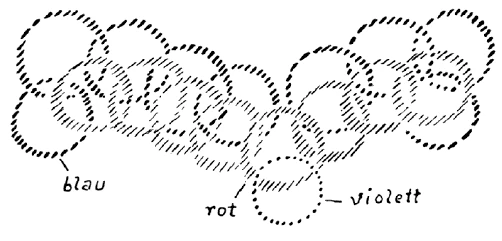
[ 5 ] If one were to visualize what I am speaking of here in a schematic way, one could do so as follows: We ascend through the gate of death into the spiritual world. Schematically, this represents our own individuality (see illustration on p. 224, violet), and connected to it is the being we perceive as having been assigned to us from the hierarchy of the Angeloi (red). But as we shed our etheric body, this Angeloi being of ours enters into relationship with other beings from the hierarchy of the Angeloi, joins with them, and we feel this entire world of the Angeloi within us. We feel them within us; we experience them as an inner experience, apart, of course, from the outer experiences that are conveyed to us through them.
[ 6 ] This immersion in the world of the Angeloi also makes it possible for us to enter into relationships with disembodied human beings—with other people who have previously passed through the gate of death. I would like to say: Just as our senses here convey the external world to us, so this being embedded in the world of the Angeloi conveys to us a relationship with spiritual beings, including the people we encounter in the spiritual world. Just as here in the physical world—depending on the conditions of the physical world—we possess an organism organized in one way or another, so, in a sense, we possess a spiritual organism brought about by this network of angelic substances. How this network of angelic substances takes shape, however, depends very much on how we work our way up into the spiritual world. If we work our way up into the spiritual world in such a way that we have little sensitivity to the spiritual world—that we have too many, far too many echoes of physical pleasures, desires, and instincts, as well as physical sympathies and antipathies—then the formation of this Angeloi organism becomes difficult. And that is precisely why the time of dwelling in the soul world, as we have called it, exists: to free us from that which permeates us in the manner described from the physical world, and which prevents us from developing this Angeloi organism in the appropriate way. It is gradually developed during the time we dwell in the soul world. We grow into this Angeloi organism. But at the same time, another necessity arises: the necessity not only to become imbued with this Angeloi organism, but also to become imbued with a further substance, namely an Archangeloi organism. Our consciousness in the spiritual world between death and a new birth would remain very dull if we could not become imbued with the Archangeloi organism. In a sense, if we were imbued only with the Angeloi organism, we would remain dreamlike beings in the spiritual world—I might say, woven from all manner of imaginative material from the spiritual world; but we would spend our existence between death and a new birth in a dreamlike state. So that we do not waste this time in a dreamlike state, so that a strong, clear consciousness may arise, we must be permeated by the Archangeloi organism (see drawing, blue).
[ 7 ] This makes our consciousness correspondingly bright. As a result, we begin, so to speak, to awaken to the spiritual world. But to the extent that we awaken to the spiritual world, we also develop a free relationship to the physical world here. And we must have this free relationship to the physical world here. For one must ask: What is the relationship between the physical world and the disembodied human beings who have passed through the gate of death? You can also glean this from those Vienna lectures. Here in the physical world, no matter how strong a person’s longing may be, it is difficult for them to rise with their thoughts and feelings to a perception of the spiritual world, the heavenly world. Human beings yearn for ideas about the heavenly world, but they do not easily develop the strong power of imagination needed to bring this heavenly world into their own sphere. In a certain sense, this is the opposite of our experience in the spiritual world between death and a new birth. There, what we first carry with us is what we have experienced in the physical world; what has meaning in the physical world, what is perceived here—that is what follows us there. It follows us in a very peculiar way, in fact. The examples I will give you will provide you with an idea of the complexity of these matters. To the physical imagination of human beings, these examples sometimes appear grotesque or paradoxical, but one cannot truly immerse oneself in the spiritual world unless one also takes such ideas into account.
[ 8 ] The perception of what exists in the mineral kingdom is actually lost the moment a person has passed through the gate of death. Here in the physical world, because human beings have senses, they possess the greatest capacity for perception—one might almost say the almost exclusive capacity for perception—precisely with regard to the mineral kingdom. For a human being perceives little else besides the mineral kingdom when initially limited to their senses. You might say, “We also perceive animals; we also perceive plants.” But why? You see, if you have a plant here, there are mineral products within that plant. You know that, of course. It is filled with mineral products. And what pulsates and flows as a mineral force—what is contained in the plant as a mineral substance—is what we actually perceive in the plant—and likewise in the animal. So one can indeed say that, through their senses, human beings perceive almost exclusively the mineral realm. And this mineral realm that human beings perceive is gradually fading away. Let’s take a specific example. Every day you see table salt on your table; you see it as an external mineral substance. The disembodied human being who has passed through the gate of death cannot see this table salt in the salt shaker. But when you put the salt in your soup and swallow it, this sets in motion a process within you, and what takes place within you—namely, the process accompanied by the sensation of saltiness—is what the deceased perceives. So from the moment the salt begins to evoke a taste on the tongue—that is, from the moment a process takes place within you—from that moment on, the deceased can perceive the salt in its mode of action; that is how things are. But we can say this: Just as the mineral kingdom here is solidified, no longer exerting its effects on a human, animal, or plant organism, so too can the deceased, after passing through the gate of death, not perceive the mineral kingdom. From this alone you can see that what one might call the external environment of the deceased is entirely different from what human beings are accustomed to describing as their external world here between birth and death.
[ 9 ] One thing, however, remains perceptible to the dead—and it is important to focus specifically on this—namely, that into which human thoughts and feelings have flowed; and it is precisely these human thoughts that are then perceptible. The deceased therefore does not perceive salt as a natural product, as it is in the salt shaker. Nor does he perceive the salt shaker itself, which may be made of glass or some other material; but to the extent that human thoughts have become embedded in the salt shaker during its manufacture, the deceased perceives these human thoughts. If you imagine how, everywhere in our surroundings, wherever we look, human thoughts—in a sense—leave their signatures on everything that is not merely a natural product, according to which these things are arranged, then you will gain an idea of what the deceased can perceive. The deceased also perceives all relationships between beings—that is, the relationships between people and so on; all of this is alive for them.
[ 10 ] But the point here is that, with regard to certain things here in the physical world, the ‘Iote’ also has the desire to rid itself of them from its conceptions, from its soul experiences—to rid itself of them, to wipe them away, as it were—just as the physical human being here has the longing to gain certain conceptions of the world beyond. Here, one has the longing to form ideas about the afterlife. After death, one has—with regard to certain human matters here on Earth (and this Earth is then the afterlife for the dead)—the longing to erase these things, to wipe them away. But to do this, it is necessary to be permeated by the substantialities of these higher hierarchies of the Angeloi and Archangeloi. For it is through being permeated by their substantialities that one can erase from one’s consciousness that which must be erased. This gives you an idea of growing into the spiritual world—of the way in which a human being grows into the spiritual world by, so to speak, permeating their own individuality with the substantialities of the beings of the higher hierarchy. Now it is very important to understand the following: In order first of all to remove from consciousness everything that is more or less personally connected with human beings—and these are, after all, all the man-made objects we use, about which I told you: because they embody human thoughts, the dead can see them—in order to remove these, it is necessary above all that the human being be properly permeated by the substance of the Angeloi. But other things must also be shed; other things must, so to speak, be tempered, so that the human being can find his proper place in the spiritual world.
[ 11 ] Well, as strange as this may sound to you from an earthly perspective, it is nevertheless true that there is an obstacle, a hindrance to growing into precisely that which gives us clear, bright consciousness in the spiritual world, and this obstacle, which prevents us from easily growing into the spiritual world, is—as strange as it may sound—human language, the language we use here on Earth for physical communication between people. The deceased must gradually outgrow language; otherwise, remaining bound by the affinities that tie them to language would prevent them from growing into the realm of the Archangels. Language is truly meant only for earthly conditions, but within those earthly conditions, human beings have become deeply intertwined with language on a soul level. For many people today, especially in this materialistic age, thinking is, in a sense, virtually contained within language. People today, in this materialistic age, hardly think in thoughts at all, but rather think intensely in language, in words. That is why they are so satisfied when they have found an expression for something. But such expressions, such verbal designations, are really only suitable here for physical life, and after death, the task is to detach oneself from these verbal designations.
[ 12 ] Even with regard to such matters, the spiritual-scientific approach offers a certain opportunity to immerse oneself in the realm of the supersensible. For how often have I told you that one can only approach the true concept—by, as it were, drawing a circle around the subject and the words—and arrive at it in an approximate way. How often have I shown you that one must try, by examining the matter from all sides and using the most diverse words, to free oneself from the words themselves in order to arrive at the concept? Spiritual science emancipates us, in a certain sense, from language. It does so to the fullest extent. Therefore, it brings us into that sphere which we share with the dead.
[ 13 ] So the emancipation from language is intimately connected with growing into the substantiality of the Archangeloi. This creates a bridge between here and the spiritual world, in that we emancipate ourselves from language through spiritual science, creating concepts through spiritual science that are more or less independent of language.
[ 14 ] Now, take a close look at what I have just said; then you will have grasped an important connection between this world and the spiritual world, and if you think through this idea vividly, you will gain an important tool for understanding many of the impulses that emanate from those brotherhoods of which I have spoken to you several times in recent weeks. These brotherhoods—as you can gather from some of the explanations I have given—have made it their task, to a greater or lesser extent, to preserve human beings in the material realm. And we have seen in recent days that these brotherhoods are even concerned with “over-materializing” materialism—in a sense, as I have called it, creating an Ahrimanic immortality for the members of such brotherhoods. They can achieve this most effectively by representing group interests and group egoisms, and they do so to the utmost degree. And the very effort to represent a group interest lies in the fact that, in a sense, the most influential of these brotherhoods proceed from the perspective I have outlined for you: to completely permeate the fifth post-Atlantean cultural period with everything that speaks English. For this is, after all, how these brotherhoods define the fifth post-Atlantean period: everything that belongs to the people of the fifth post-Atlantean period is that which speaks English—the English-speaking people. Thus, the very first principle already contains a narrowing down to a selfish group interest.
[ 15 ] This refers to something of immense spiritual significance. It means nothing less than exerting an influence not only on human individualities insofar as they are embodied in the physical body between birth and death, but on all human individualities, including those living between death and a new birth. For what is being strived for here is to enable the human individuality to live its way into the spiritual world, to be permeated by the hierarchy of the Angeloi, but not to ascend to the hierarchy of the Archangeloi. In a sense, the aim is to separate the hierarchy of the Archangeloi from human evolution!
[ 16 ] If you pay close attention to various things that may have come to your attention—perhaps not among the younger members—I mean those who have been members for a shorter time—but among the older members of our Society—you will yourself perceive clear signs of these things even within the Theosophical Society. Certainly, those who have experienced the life of the Theosophical Society will recall that certain influential members of this Society—above all the notorious Mr. Leadbeater—have stated outright that, in many respects, life between death and a new birth is a kind of dream life. It is precisely those who were long-standing members of the Theosophical Society who know that these ideas were widely disseminated.
[ 16 ] If you pay close attention to various things that may have come to your attention—perhaps not among the younger members—I mean those who have been members for a shorter time—but among the older members of our Society—you will yourself perceive clear signs of these things even within the Theosophical Society. Certainly, those who have experienced the life of the Theosophical Society will recall that certain influential members of this Society—above all the notorious Mr. Leadbeater—have stated outright that, in many respects, life between death and a new birth is a kind of dream life. It is precisely those who were long-standing members of the Theosophical Society who know that these ideas were widely disseminated.
[ 18 ] You might well say, however: How can people be so foolish as to deliberately break away from normal development and venture into an entirely different spiritual path? — But that is a very short-sighted judgment, one that fails to consider that certain impulses can indeed lead people to yearn to seek their immortality in worlds other than those we call “normal.” I would say: the fact that you have no desire to participate in this Ahrimanic immortality—well, that’s quite all right! But just as many other things are incomprehensible to the most immediate concepts, you must admit that there may be something incomprehensible about it when people want to break away from the world we call “normal”—including, now, the life between death and a new birth—and, so to speak, say to themselves: We no longer want Christ as our guide—who is, after all, the guide through this normal world—we want a different guide; we want to place ourselves in direct opposition to this normal world. —Through the preparations they undergo —I have, after all, spoken to you about these preparations—, which are brought about by ceremonial magic, the idea that this world of Ahrimanic forces is actually a much stronger spiritual world, that there, above all, they can continue what they have acquired here in physical life, that they can make the material experiences of physical life immortal.
[ 19 ] Now is the time to take a closer look at these matters. For whoever is unaware of these things, whoever does not know that such things are being pursued today, is unable to see through what is happening in our present time; for behind everything physically visible, behind everything physically perceptible, lies the superphysical, lies that which is physically imperceptible. And there are indeed quite a few people today who, whether for good or for ill, work with means that are impulses lying behind the sensory realm. The means for breaking free from this world—a world of which we can say that it can attain its proper development when people place themselves in the service of Christ— these means are indeed very diverse, and it is not easy to speak of some—even quite obvious—means, because one touches upon something quite obvious of which people have no idea that, as it spreads in human minds, it is at the same time an occult impulse with an immensely powerful effect.
[ 20 ] You know—to mention something obvious—that at a certain point in time, the dogma of so-called infallibility was established. This dogma of infallibility—and this is the important point—is accepted and embraced by many people. Anyone who is a true Christian might ask themselves: What about this dogma of infallibility? — For example, they might ask themselves: What would the early Church Fathers, who were still closer to the original spirit of Christianity, have said about the dogma of infallibility? — They would have called it blasphemy! And in the Christian sense, that would probably hit the nail on the head. But this would point to an extraordinarily effective occult means—namely, arousing faith through something that is, in the most eminent sense, anti-Christian. Yet this faith is an important occult impulse directing one toward a specific path, in order to break away from normal Christian development. You see, one can touch upon the next stage, and one finds occult impulses everywhere in the world.
[ 21 ] Likewise, it was a powerful occult impulse—one that ultimately failed—that Mrs. Besant sought to achieve by organizing the Alcyone spectacle. Had this belief in the incarnated Jesus in Alcyone found wider acceptance, it would have been a powerful occult impulse. Now, you see that even in the dissemination of certain concepts, in the dissemination of certain ideas, there lie powerful occult impulses. And since those brotherhoods I spoke of have made it their task to turn the fifth post-Atlantean period into the overarching impulse of Earth’s evolution for the sake of selfish group interests, and to eliminate from Earth’s evolution that which is to come in the sixth and seventh post-Atlantean periods, it will seem understandable to you that the things I have described as originating from them actually do originate from these brotherhoods. Impulses must be created for these very things that are significant not only for incarnate human beings but also for disincarnate human beings. And the time has now come when at least some individuals must gain insight into such matters so that they may have an idea of what is actually happening, of what is actually taking place.
[ 22 ] But this must go hand in hand with the formation of increasingly accurate concepts regarding human life on Earth. It is impossible for those concepts to persist that are causing so much harm, especially in our time. For the more people there are who gain accurate understandings of certain things, the more impossible it will be for certain forms of occultism to fish in troubled waters. However, as long as people in Europe can speak about the relationship between nations the way they do now—the way they deliberately speak now, distorting the truth at every turn—so long will many occult forces remain at work to throw Earth’s evolution off course from the sixth post-Atlantean epoch. For this sixth post-Atlantean epoch, after all, holds momentous events in store. I have emphasized this, strongly emphasized it: Christ died for individual human beings. We must regard this as something quite essential to the Mystery of Golgotha. Christ has an important task to perform in the fifth—let us set that aside for now—but also in the sixth post-Atlantean epoch: namely, to become a helper for the Earth in overcoming, in ultimately overcoming, everything that arises from the national principle. However, to prevent this from happening—to ensure that precautions are taken in due time so that the Christ has no influence in the sixth post-Atlantean epoch—the impulses of those brotherhoods serve, which seek to preserve the fifth post-Atlantean epoch in the manner I have indicated and explained to you.
[ 23 ] This can only be countered by acquiring correct concepts that gradually come to life and become ever more alive. For these correct concepts must become alive. Nations could live together peacefully if they strove to view their relationship in terms of correct concepts and ideas. It is not through programs, nor through all sorts of abstract ideas—as I have already discussed—that we arrive at what must come to pass, but solely through concrete, correct concepts. As difficult as this may be in the face of the commonly held notions of today—by which, of course, even our friends are sufficiently infected—attention must nevertheless be drawn to certain things that lead to correct concepts. After all, you all have the materials for these correct concepts; it’s just that these materials are poorly illuminated. As soon as they are properly illuminated, you will already gain the correct, concrete ideas.
[ 24 ] Let us now return to something we have already discussed from a certain perspective. Here on our Earth, in our European world, people today speak of the relationships between nations in such a way that the dead experience true torment because of this talk, since all the ideas and concepts people form are derived from the peculiarities of language. And by forming concepts about nationalities based on the peculiarities of language, people are constantly tormenting the dead. One can see for oneself just how the dead can be tormented, and how one can be unkind to them, by participating in spiritualist séances. There, the dead are practically forced to manifest themselves in a specific language. The dead person is expected to speak in a specific language, for even when the table is rapping, the manifestation is supposed to be in a specific language. You can quite rightly compare what you do to the dead person—by forcing them to express themselves in a specific language—to taking red-hot tongs and constantly pinching a living being here in the flesh with those tongs. Thus, spiritualist séances that aim to have the deceased express themselves in a specific language cause great suffering to that deceased person. For their normal life is directed toward freeing themselves from the differentiation of languages.
[ 25 ] Simply by forming ideas about the relationships among European people based on language, we are doing something about which there is hardly any communication with the dead. Therefore, I could also say: It is necessary today—or at least it is beginning to become necessary—to form such concepts that one can also discuss with the dead, about which one can communicate with the dead. — Of course, this does not mean spreading a Volapük-like language—or whatever all those lovely things are called—across the earth, for even if it is true that all people put on clothes, not everyone needs to wear the same clothes. But neither can it be a requirement that we regard these garments as part of ourselves. And so we cannot regard that which is necessary for the physical world—the differentiation of languages that the spiritual realm already conveys to us for the physical world—as belonging to our very essence; one must simply be very clear about this.
[ 26 ] Well, how can one arrive at concepts that gradually rise above that form of ethnography which is limited almost exclusively to language? In this regard, too, anthroposophy must grow beyond mere anthropology, which, after all, has no other means of approaching an answer to this question than to take into account the differentiation inherent in languages.
[ 27 ] I said that the peoples of Europe could live in peace if they could find appropriate concepts—vivid concepts. I would like to say that we have already taken a step toward arriving at such living concepts back when we pointed out the so-called law of sound shift. I have shown you how certain languages have remained at earlier stages. We have successive stages: Gothic, Anglo-Saxon—modern English—and then High German. High German has, so to speak, evolved, while English has remained at a certain stage. This is not a value judgment, but a fact that must be viewed objectively, just like a law of nature. In English, we have a “d” where we have a “t” in High German, and we have seen that this corresponds to a very specific law—the law of so-called sound shift. This law of sound shift, however, is, in a certain area, an expression of deeper conditions that are present throughout European life. And it is very curious that certain concepts and ideas seem to work toward causing misunderstandings with almost unconscious delight. Please consider these matters with complete objectivity as well.
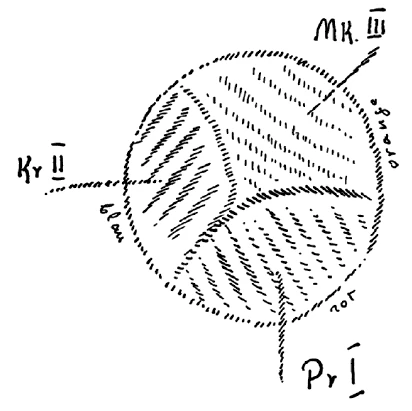
[ 28 ] Based on what we have already discussed, one could say: Central Europe was, in a sense, the primordial mass from which what spread to the periphery—namely, toward the West—originated. Let us visualize this primordial mass (see illustration on page 239). It has long been customary for the people who represent this “primordial broth” to call themselves the German people. The peoples of the West have, in a sense, already taken their revenge on this people by refusing to refer to them by the term with which they designate themselves—a term that reflects a deep instinct: They are called Teutons, Allemands, Germans—all sorts of things—but when speaking in a Western language, people simply refuse to say “Germans,” even though this very designation is deeply connected to the essence of this people. It is, so to speak, the primordial mass. One ray has extended southward. We have characterized it by drawing attention to its cultic, papal, and hierarchical aspects. The other ray has extended westward. We have characterized it by pointing to its diplomatic and political aspects. The third ray has extended northwestward. We have characterized it by pointing to its mercantilistic aspects. What remained in the center was that which has, in fact, retained a fluid development; for you need only consider that language itself has remained stagnant in its sounds on the periphery, while Central European German, through sound shifts, has preserved the possibility of growing beyond those sounds and ascending to the next level of sounds.
[ 29 ] What is actually underlying this? Well, the fact is this: The primordial mass is, in a sense, still undifferentiated and contained within itself all the elements that have radiated out from it. They have indeed radiated out. The peoples migrated all the way down through Italy, and those who are Italians today are not, after all, descendants of the ancient Romans, but rather the result of the mixture of the migrating Germanic peoples. The whole process began, after all, with the fact that even when the Romans were waging war against the Germans, they fought these wars with people who were themselves German and had been assimilated by them; these were, in fact, their very best warriors. And then it simply continued as you know from history. And so the Franks migrated westward, and the Anglo-Saxons to the northwest. How can we arrive at accurate concepts of what actually took place there?
[ 30 ] You see, the undifferentiated also contains a certain structure of humanity, even though it is undifferentiated. And one has a correct understanding when one distinguishes between this undifferentiated state and the later differentiated state. This primordial mass does, however, contain that which has drifted down toward the south; but it is contained as a single element, as a part. This one part that is contained there (red) has drifted down toward the south in its one-sidedness. If, in turn, one goes back to the ancient caste divisions known to people, one can say: Toward this south, the one caste with a predisposition toward the priestly has moved—the priestly caste. The priestly thus always emanated from that part of the periphery, in whatever form it appeared; for even the most recent phase of this emanation has, albeit in a peculiar sense, possessed a thoroughly priestly character. Not only is the impulse “sacred” egoism—Sacro egoismo—but how could one even use words more priestly than those employed by the famous d’Annunzio? Right down to the reworked Beatitudes, what emerged there was clad in priestly garb. For better or for worse: priestly. What remained has become the opposition, as I have explained to you. What then came to light during the Reformation was the element that had remained in the primordial mass—the element that opposed the one-sidedly developed priestly element. The fact that nothing of this priestly element is perceptible today—or that only what is actually there is perceptible—stems simply from the hollowing out I have spoken of.
[ 31 ] To the West, the second has emerged: the warrior caste, the royal caste, the monarchy. We’ve already discussed this, of course. The West has, after all, only fallen into republicanism due to an anomaly. In truth, it is thoroughly warlike and organized along royal lines, and will always revert to the warlike-royal. However, this is again a form of radiation, so that the one element that has migrated westward is also contained here in the primordial mass and must in turn form the opposition to the West (blue).
[ 32 ] And to the northwest: the mercantilist element. It is, of course, again included as a component (orange) and stands in opposition to that which has developed one-sidedly. — This is not meant to pass any value judgments, for no one should believe that I in any way subscribe to those opinions so commonly held, as if mercantilism were something contemptible in comparison to the priestly. We must regard all of this as different, certainly, but not as something to which certain value labels are attached. As we have explained, the mercantilist element is in fact a quite essential element of the fifth post-Atlantean epoch. But one must see the realities that exist; one must absolutely see them. And even if people do not see them today, they will certainly see them in the future.
[ 33 ] Just as, on the one hand, many occult impulses have emanated that utilized the priestly nature for group interests, and, on the other hand, occult impulses have emanated that utilized the warlike nature, so too today, in the manner indicated, occult impulses are emanating from a third side that primarily utilize the mercantilistic nature as a means. They will be stronger, for 1 and 2 are merely repetitions of the third and fourth post-Atlantean epochs, respectively, whereas 3 is appropriate to the fifth post-Atlantean epoch. Therefore, the impulses coming from the third side will be stronger than all those coming from the first and second sides; they will be the strongest because they coincide with the fundamental character of the fifth post-Atlantean epoch. They will be as strong as certain impulses of Egyptian culture were in the third post-Atlantean epoch, and as certain impulses—which originated specifically in the Near East and were transmitted through Greece and Rome—were in the fourth post-Atlantean epoch. The magic of the ancient Egyptians and the practice of blood sacrifice are the harbingers of what will emanate from these occult brotherhoods we are discussing here, but it will not be the same. It will all have, I would say, a more trivial character, in the ordinary human sense, because it makes use of the mercantilistic nature.
[ 34 ] One must be absolutely clear about these things. Only when a person feels fully immersed in what is can salvation come into evolution. And only in this way can one learn to distinguish the true from the false within the course of events—and we have heard how necessary it is to learn to distinguish the true from the false, from that falsehood which today is surging like a tremendous wave in all the impulses now sweeping through the world. In many false ideas, there lies a powerful occult force precisely because people believe them.
[ 35 ] And just as other media in the past served as sources of inspiration, so too in our fifth post-Atlantic era do the art of printing and everything associated with the mercantilist spirit serve this purpose. We already have a foretaste of the evil that is to come in the strong dependence of what is produced by the art of printing—as the press today—on mercantilist groups, on people who want anything but what they say in their publications. They want to do business or achieve this or that through business, and to that end they have the means to disseminate views whose truth does not matter, but which serve to further certain business interests and the like. Today, it is indeed wise, when it comes to much of what is printed and circulated around the world, not to ask: “What does the person in question mean?”—but rather: “In whose service does he stand? Who is paying for this or that opinion?”—That is what matters in many cases today. Not to suppress this, but to promote it as an important occult means—that is precisely what those occult brotherhoods want, because it serves their purposes. And when what is said matters less and less, and what matters is only that something—acting in a certain direction in the service of certain groups—has an effect on people, then an important goal has been achieved for such occult brotherhoods.
[ 36 ] The key is to view these things as clearly as possible, as objectively as possible. And one can really only gain a sufficiently—I would say—nuanced understanding of these things when one considers them properly in the context of the spiritual worlds. This also draws one’s attention to the symptoms, and, as I told you, it is the “symptomatic history” that matters. Of course, you need not immediately suspect black magic in everything. But the things that are already there are put to the service of gray or black magic. Nor do you need to pass moral judgment on everything; you need only see them in the right light. Thus, for those who wish to see things in the right way, it will certainly be unforgettable—and not only unforgettable, but something more—when, in that great speech with which Sir Edward Grey introduced England’s participation in this European war, among many less important points—even if it was important to say them so that people would believe them— one comes across certain words that are imbued precisely with the blood of the fifth post-Atlantean epoch—I mean the spiritual blood. For these words are not only true, but embody a fundamental truth, a truth drawn from what lives materialistically in the fifth post-Atlantean epoch. “We,” said Grey, “I fear, will suffer greatly from this war, whether we become involved in it or not. Trade with foreign countries will cease, not because the lines of communication will be severed, but because business at the other end has come to a complete standstill. The continental nations, which are embroiled in a desperate struggle with their entire populations, all their forces, and all their wealth, cannot continue their trade with us in the same way they did in peacetime, whether we are participants in this war or not,” and so on.
[ 37 ] All of Western Europe is today dominated by a single question of power. This talk of business—and the idea that, above all else, it is a matter of mercantilist considerations that one should not stay out of the war but rather participate in it—contains a deeper truth than anything else in this speech, which was said only to be believed. But what matters today is not what people say merely to be believed. After all, they may say such things unconsciously. Nor is the intention here to pass moral judgment on anyone; rather, what matters is to recognize, from the inner truth of human evolution, where the truth is being spoken. And here, the truth has been spoken in the most eminent sense. And it is the same facts that have been spoken here in truth; it is the same impulses that have been spoken in truth, which—when appropriately developed by those brotherhoods to which I have alluded—lead precisely to the interweaving of occult impulses with mercantilist currents.
[ 38 ] Humanity must one day experience this, must one day go through it. For if it did not go through it, it would not become strong enough. It must steel itself by resisting what lies within the impulses that have been described. In the past, tyranny existed because certain people were compelled for a time to regard as true only what Rome recognized. Tyranny will be far greater when the time comes when the basis of belief will not be what the philosopher decides, nor what the scientist decides, but rather what the authorities of those occult brotherhoods permit to be believed: that nothing other than what that side prescribes be believed in any human soul, and that no customs other than those prescribed by that side be introduced into the world. That is what those brotherhoods strive for. And it is a naïve belief held by some idealists—not that this is meant as a criticism of idealists; idealism is, in any case, a good quality—to think that the things they are striving for are only temporary and will cease once the war has ended. The war is only the beginning of all that, as has been characterized, things are tending toward. And the possibility of moving beyond these things lies solely in a clear, correct understanding of what is; everything else is of no use. Therefore, even if certain quarters will not want to hear or see this and will take measures against it, there will always have to be people who truly point out the full, complete intensity of what is happening—people who do not allow themselves to be deterred from pointing out the full, complete intensity of what is happening.
[ 39 ] To introduce these observations, I said that the Germans have called themselves “Germans.” They have not, of course, found any acceptance for this designation; they are called “Germans” and so on, which, in their view, is impossible, for the Germans themselves define as “Germanic” everything that is linguistically related at a level that is not Modern High German or German in general. Thus, the Scandinavians, the Anglo-Saxons, and the Dutch certainly belong to the “Germans,” which refers to nothing other than a linguistic kinship lying beneath the surface. “Germans” therefore does not actually mean anything special in the German sense, because it no longer corresponds to any present-day reality. And when the term “Pan-Germanic” is coined outside of Germany, it is something that Germans cannot relate to at all, for the simple reason that, for Germans, the “Germanic” can no longer be a real, substantive entity. Other ethnic groups have differentiated themselves, and if one were to consider the term “Pan-Germanic” purely theoretically, it would simply refer back to an earlier historical period and could not denote anything that has anything to do with the future or the present. But there is a deep instinct embedded in the term “German.”
[ 40 ] In a sense, these are the three castes—the first, second, and third—that have differentiated themselves from what I have called the “primordial mass,” emerged from it, and developed. The fourth caste—which I described some time ago as consisting of those who really just want to be human beings, nothing more, who do not want to be differentiated—has always lagged behind; consequently, it has undergone a development that is peculiar to it and grotesque to the others, similar to that which resulted from the first sacramental stage of alliteration, with its further development in sound shift. This is extraordinarily interesting because it is one link among many others. One can therefore say: Certain differentiations of the people have moved on; what has remained behind is “the people,” “diet.” Dietrich, for example, means “the rich among the people”; “diet” later became “German,” and to be German means nothing other than “to be the people.” The people who have remained are the fourth group. The other three have moved on; the people have remained.
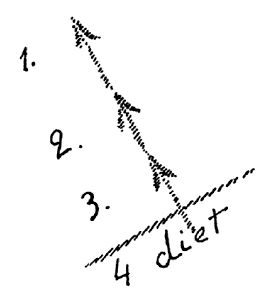
[ 41 ] This is the instinct inherent in the matter itself; the fourth is simply the human element. Therefore, that which has remained within the “people” is also predisposed not to be perceived as something organic, but rather its development has remained fluid, so that it truly transcends all the details. Certainly, the priestly element is also present there, but the potential exists to move beyond the priestly element. The warlike element is also present there, but the potential exists to move beyond the warlike element. The mercantilist element is also present, but the potential exists to move beyond the mercantilist element, just as the potential existed in the older linguistic form—which then passed on to the other languages—but also the possibility of moving beyond it.
[ 42 ] This, however, is connected to a phenomenon that, understandably, gives rise to an infinite number of misunderstandings. Viewed in a deeper sense, these are sad misunderstandings, but they arise precisely because, naturally, this primordial mass contains much that holds the seeds of what later reemerges on the periphery. But while it is characteristic of the periphery—and is considered appropriate there—it is regarded as highly abnormal precisely in the primordial mass. Take militarism, for example. It is by no means appropriate to the German character; rather, it is precisely appropriate to the French character. But there, it is not criticized because it has developed organically. Among Germans, however, it is viewed as inappropriate; it should not exist there. That is why it is criticized when it arises from some predicament—which I have sufficiently characterized—namely, from the geographical situation. What has been identified in certain people as “Junker-like” and the like is, in Central Europe, nothing other than precisely that from which has developed what is commonplace in the British Empire—what is taken for granted. It is only because it has developed in its own way in Central Europe that it stands out there in particular, and people find it striking and provocative. This gives rise to endless misunderstandings, just as the world today is full of misunderstandings and subjective perceptions of reality. One can touch upon this here and there today; one finds nothing but ideas that actually crumble when one touches them—ideas that crumble by their very nature. Those who truly understand things cannot make sense of any of this; those who think from reality cannot make sense of it, and yet these things play a role as impulses, for they have the effect of dynamite on public opinion. They take root in this public opinion. Some things would be infinitely funny if they weren’t so infinitely sad.
[ 43 ] Take, for example, a phenomenon like this: Treitschke is portrayed by the people of the Entente as a monster, as a man whose views are terrible for Europe, and he is presented as an integral part of those Central European views through which Central Europe must suffer the fate we have described. Now, one can engage with Treitschke’s individual views; let us, for example, single out one view that Treitschke held regarding the Turks. Treitschke believed that the Turks must disappear from Europe, that they should not live in Europe, and that they should disperse throughout Asia. What we read today in the note to Wilson is precisely Treitschke’s view! So Treitschke is criticized, but the view he held on this one point—and I could cite countless others—is adopted and actively advocated. One could simply have copied Treitschke’s views on Turkey and inserted them into Wilson’s note, for it is exactly the same view. — That’s what I call a fragile concept, because if you examine it with knowledge and insight, it shatters. And so do other concepts; you just need a little knowledge. But today everyone speaks without knowledge, and that is a stroke of luck for those who wish to spread their concepts—the ones meant to be effective—in a murky way. How often do people speak today of how “humane” it is to encircle and starve Central Europe. Among the various justifications offered to legitimize this most “humane” way of waging war, people point out that the Germans did not act any differently in 1870, that they, too, found it “humane” in 1870 to besiege and starve Paris, and that, after all, the size of the territory does not matter—it is all the same. — But only someone who knows nothing about history could speak this way—of course, I do not mean the history that appears in the newspapers. But what were the facts, actually?
[ 44 ] In 1870–71, Bismarck, who was responsible for this matter, was absolutely opposed to subduing Paris through starvation, and when one reads Bismarck, one sees how upset he was at the time that the impetus to subdue Paris not by any other means but through starvation had come, indirectly, from the future Empress Friedrich of England. He writes: “Unfortunately, we must allow ourselves to be compelled by the Englishwoman to apply ‘this humane method’ to Paris”—he is thus referring to this humane English method.
[ 45 ] There you see the historical context. But one must be aware of this if one wants to judge things, so as not to form fragile concepts. It seems so incredibly true when one compares one thing with another; but one thing is often not the other when compared with due regard for everything that underlies the matter. For even with regard to the starvation of Paris, the “humanity” of starving people is certainly an English invention in modern history. So this objection should not be raised when dealing with realities, and that is precisely the point—to deal with realities—and nothing else can lead to salvation except understanding things from reality itself.
[ 46 ] That is why, building on the reflections we usually engage in regarding other areas, and in response to the wishes of many of our friends, we must also offer some reflections here on current events—so that the gravity of the situation may sink into our souls, for it is essential to view things as they truly are. If only a few people can be found who are willing to view things as they truly are, then after the dark times we are now facing, times of salvation will come again. The seeds must, of course, ripen. But they are true, ripening seeds if you take thoughts of reality into your soul today, and we can say quite plainly: such thoughts are ones on which one can be in agreement even with the dead. For this is often such a painful phrase now that it is said from all sides that we are “indebted to the dead for this or that.” Where this event—which, out of convenience, is still called “war” today, even though it has already become something entirely different—where there is a desire to continue this event, what all sorts of things are declaimed about what we supposedly owe the fallen, the dead! If people knew what blasphemy they are uttering when they claim that the continuation of these bloody events is what we owe the dead—if people knew how the dead feel about this, then they would at least refrain from this blasphemy!
[ 47 ] And so, my dear friends, you can see from the details of what emanates from human beings just how necessary it is to build a bridge between the living and the dead. And spiritual science will build this bridge; it will make communication possible even with those who have passed through the gate of death. A shared life will entwine itself around human souls—those who are in the body and those who are in the life between death and a new birth—once the human being is understood in its foundations, for life in the body and life without a body are merely two different forms of one and the same all-encompassing life. But in this realization—that human beings have two different forms of life, whether in the body or without a body—in this realization, understood concretely, lies the salvation of the future, but only if people truly allow these ideas to permeate their lives.