

The Spiritual Backgrounds of the Outer World
The Fall of the Spirits of Darkness
GA 177
6 October 1917, Dornach
Translated by Steiner Online Library
Fourth Lecture
[ 1 ] In my previous reflections, I stated that, from this time forward, it will become necessary for humanity to come to know certain truths about the spiritual underpinnings of the external world. If people are not willing to accept these truths—one might say, of their own free will—they will simply be compelled, through the force of terrible events over the course of time, to learn from these events themselves.
[ 2 ] Now the question may arise: Why is it necessary for humanity today to become acquainted with such truths—some of which are deeply unsettling—since these truths have, of course, existed since ancient times and humanity at large has been shielded from accepting them? In the Mysteries, many such truths were carefully guarded in the manner familiar to you, because people in the wider world could not be exposed to the jarring nature of these truths. Now, as we have often said: It is the fear of the great truths that prevents people today from accepting them. — Those who harbor this fear today—and they are very numerous—might naturally ask: Why shouldn’t humanity continue to be kept, so to speak, in a kind of slumber with regard to these truths? Why should humanity, which has become so nervous in recent times, be exposed to these great, shattering truths?
[ 3 ] We would like to address this question briefly; first, let us focus on how it is that, from now on, humanity must, so to speak, be treated differently from the spiritual world than it has been throughout the post-Atlantean era thus far.
[ 4 ] In my previous reflections, I have already spoken of the border region—namely, that spiritual world which directly adjoins our physical-sensory world. It is this spiritual world, above all, that humanity must come to know in the very near future. Now, as soon as one enters the realms of a spiritual world, things look quite different there than they do here in the physical-sensory world. One encounters certain beings, above all beings whose sight is hidden from frail humanity—and by “sight” I also mean that which is conveyed through knowledge and concepts. Why, then, has human attention been diverted from this nearest world in the post-Atlantean era?
[ 5 ] This is because even in this borderland—beyond which lie the other higher spiritual worlds—there are beings who, until now, were only permitted to be revealed to human beings under certain conditions—beings who have a specific task within the entire universe, and who, in particular, play a role in the development of humanity itself. There are a wide variety of border beings there.
[ 6 ] Today I would like to speak to you about one class of these beings—namely, the class that, within the context of the universe, has a role to play in the birth and death of human beings. One must not, however, believe that the birth and death of human beings are exactly what they appear to be to external sensory observation. When a human being enters this physical world from the spiritual world, and when he or she again departs from this physical world into the spiritual world, spiritual beings are at work in these processes. Let us call them today—for the sake of having names—the elemental spirits of birth and death. It was indeed the case that those individuals who had previously been initiated into the Mysteries regarded it as their most sacred duty to refrain from speaking to the wider public about these very elemental beings of birth and death. For when one speaks of them—of the entire way in which these elemental spirits of birth and death live—one speaks of a realm that, to human beings as they have developed spiritually and psychologically thus far in the post-Atlantean era, seems like a glowing coal. One could also choose another comparison. If a person comes to know the nature of these elemental spirits of birth and death more precisely and with full consciousness, they actually come to know forces within these beings that are hostile to life here on the physical plane. This alone must be a shattering truth for a soul with even a modicum of normal sensitivity when it hears that the divine spiritual beings—in order to bring about human birth and death in the physical world—must make use of such elemental spirits, which are in fact hostile to everything that human beings seek and desire here on the physical plane as their well-being and prosperity. If only everything that humans desire were brought about—that they might live comfortably here on the physical plane, that they might wake and sleep in good health, and perform their work in good health—if only there were beings presiding over this comfortable course of life, then birth and death could not take place. In order to bring about birth and death, the gods need beings who, in their entire mindset and worldview, are driven to destroy and devastate precisely that which brings humans their well-being here on the physical plane.
[ 7 ] One must come to terms with the idea that the world is not arranged the way people would like it to be, but that there exists in the world what was called “iron necessity” in the Egyptian mysteries. And part of this iron necessity is that the gods make use of such beings—who are hostile to the physical course of the world—so that human birth and death can take place. Here we look toward a world that borders directly on our own, one that interacts with ours daily, hourly, for on Earth the processes of birth and death occur daily, hourly. And the moment a human being crosses the threshold into this world, he enters into an activity, into a life of beings who, in their entire conduct, in their desires, and in their worldview, are destructive to the ordinary physical life of human beings. If, outside the context of the Mysteries, people had been made aware to the greatest possible extent that such beings exist—if they had been taught concepts regarding these beings—the following would most certainly have happened. People who are completely unable to cope with their instincts and drives, with their passions—if they had known that destructive beings are constantly around us—would have made use of the powers of these destructive beings—not in the way the gods make use of them at birth and death, but within physical life. If people had felt the urge to act destructively in this or that area, they would have been offered ample opportunity to take these beings as their servants, for it is easy to take these beings as one’s servants. To protect ordinary life from the destructive beings of the elemental spirits of birth and death, this wisdom was kept secret.
[ 8 ] Now the question is: Shouldn’t we perhaps continue to keep this a secret? — That is not possible; for certain reasons, it is not possible. It is not possible for a reason connected to a great and significant universal law. I can explain this universal law to you more clearly—rather than through a general formula—by pointing to its concrete manifestation in our time and in the near future. As you know, in recent times, more and more cultural impulses have entered the course of human development—impulses that were not present before but are characteristic of contemporary culture. Just try, for a moment, to transport yourself in your thoughts back to times that are, relatively speaking, not very far behind us. You will find times when steam locomotives had not yet been introduced, times when electricity was not yet used as it is today, times when, at most, thinkers like Leonardo da Vinci had conceived ideas—through thought and experimentation—of how to fly through the air using human-made instruments. All of this has been realized in a relatively short time. Consider how much depends today on the use of steam, on the use of electricity, on the use of that distribution of air pressure that led to airship travel, or on that aerodynamics that led to aviation. Let us consider for a moment all that has recently entered into the development of humanity. Think of such destructive forces as dynamite and so on, and you will easily be able to imagine, given the speed with which all this has happened, that humanity will strive for entirely different, fabulous things in this direction in the future. You can easily picture that it does not correspond to humanity’s ideal for the near future for there to be more and more Goethes; rather, it corresponds to the ideal for there to be more and more Edisons. That, for now, is the ideal of present-day humanity.
[ 9 ] Now, modern people do believe that all of this—the telegraph, the telephone, the use of steam power, and so on—takes place without the involvement of spiritual beings. But that is not the case. The further development of human civilization, even if people are unaware of it, also occurs with the involvement of elemental spirits. And it is not—as modern, materialistic humanity imagines—merely the ideas that humans have “sweated out” of their brains that have led them to construct the telephone and the telegraph, to drive steam engines across the earth and through the fields; rather, everything humans do in this way is under the influence of elemental spirits. They are at work and lending a hand everywhere. In this realm, human beings do not lead alone; rather, they are guided. In laboratories, in workshops—and especially wherever an inventive spirit prevails—the sources of inspiration are certain elemental spirit beings.
[ 10 ] Now, those elemental spirits that have been providing the impetus for our culture since the 18th century are of the same kind as those the gods use to bring about birth and death. This is one of the mysteries with which human beings must become acquainted in the present. And the law of world history, as I have called it, consists in the fact that development proceeds in such a way that, in a certain realm of elemental spirit beings, the gods are always the first to reign, and afterward human beings themselves enter this realm and make use of these elemental spirit beings. So while in earlier times the elemental spirits of birth and death were essentially servants of the divine-spiritual rulers of the world, from our time onward—and this has indeed been underway for some time now—these elemental spirits of birth and death have become the servants of technology, industry, and commercial human activity. It is important that we allow this shattering truth to take effect upon our souls with all its strength and intensity.
[ 11 ] Something is taking place—beginning with the fifth post-Atlantean cultural epoch, in which we now find ourselves—that is similar to a phenomenon I have often drawn attention to, one that occurred during the Atlantean era; only, at that time, it took place during the fourth Atlantean cultural epoch. For back then, during the Atlantean era, the divine-spiritual beings who guided human evolution made use of certain elemental beings up until the fourth Atlantean cultural epoch. They had to make use of these elemental beings because, at that time, it was not only birth and death that had to be guided—as is the case now—but also, I might say, something else that was closer to the Earth that had to be guided. Recall some of the descriptions I have given regarding the Atlantean era—how human beings were still malleable in their entire material being, how they could grow to great stature through the soul or remain dwarfs, and how their outward form was shaped by the nature of the soul. Remember all of this. Whereas today the service that certain elemental beings render to the divine-spiritual beings at birth and death is clearly visible outwardly, it was the case back then that, even throughout human life—when the outer form was shaped in accordance with the inner being—certain elemental beings served the gods. When the Atlantean era entered its fourth cultural period, human beings, so to speak, once again became rulers over these very same elemental beings whom the gods had previously used for the growth and physiognomic development of humanity as a whole. Human beings became rulers over certain divine powers, and they made use of these divine powers. The consequence of this was that, from a certain point in the Atlantean era onward—roughly in the middle of the Atlantean era—it became possible for an individual to desire to harm his fellow human beings by inflicting all manner of things upon them: by keeping them stunted during their growth or turning them into giants, or by allowing their physical organism to develop in such a way that the person in question became either a clever individual or an idiot. This resulted, in the middle of the Atlantean epoch, in something that was a terrible power in the hands of human beings. And as you know, I have pointed out that this secret was not kept. But this is not because the secret was not kept out of any kind of malice; rather, according to a certain law of world history, what had previously been the work of the gods alone had to become the work of human beings. All of this, however, led to that great folly during the Atlantean epoch—it led to all manner of acts of violence; You need only recall what indeed occurred during the Atlantean era and has been described here on several occasions—that chaos which made it necessary to lead the entire Atlantean culture toward its downfall over the course of the last four or three Atlantean cultural periods. And it was from Atlantis that our culture was saved and brought over, as has often been described.
[ 12 ] In a similar way, the worship of the gods is entrusted to humanity, starting with our fifth post-Atlantean epoch, for the last three or two cultural periods, respectively, of the post-Atlantean culture of the fifth world of Earth’s evolution. We are only at the beginning of that activity of technology, industry, and commerce into which the elemental spirits of birth and death are exerting their influence. This will become stronger and stronger; it will have an ever more decisive impact. Humanity cannot be shielded from this, for culture must progress. And the culture of our age and the future must be such that the elemental spirits of birth and death—who, up to a certain point, have so far acted only in the physical coming into being and passing away of human beings under the direction of the gods—will act within technology, industry, commerce, and so on with the same forces with which they act at birth and death. But this is linked to something very specific.
[ 13 ] As I have already explained to you, these elemental spirits are beings that are, in fact, hostile to the welfare of humanity and have a destructive disposition. So let us simply understand the matter correctly; and if we do understand it correctly, let us not delude ourselves about the significance and profound impact of what is actually at stake here. Civilization must advance in the technical, industrial, and commercial sense. But civilization that advances in this way cannot, by its very nature, serve the well-being of human beings on the physical plane; rather, by its very nature, it can only contain something destructive to that well-being.
[ 14 ] Such a truth is uncomfortable for those people who never tire of resorting to grandiloquent speeches when they talk about the great, tremendous advances of civilization, because they are abstract thinkers and know nothing of the ebb and flow of human development. And just as what I have hinted at regarding the Atlantean era led to its downfall so that a new humanity could emerge, so too does what is now emerging as a commercial, industrial, and technical culture contain the elements that will lead to the downfall of the fifth Earth period. And only those who admit to themselves: “With this, we are beginning to work toward what must bring about the catastrophe”—only they see clearly, only they see things as they are.
[ 15 ] This is what it means to immerse oneself in the ironclad necessities. Human convenience might say: “Well, then I won’t ride an electric train”—and might even go so far as to refuse to board trains at all, though not even the members of the Anthroposophical Society would go that far. But all that would be nonsense, pure nonsense. For it is not a matter of avoiding anything, but of gaining clarity and insight into the iron necessities of humanity’s progress. Culture cannot follow a steadily ascending line; rather, it can only proceed in waves that rise and fall again and again.
[ 16 ] But something else may come to pass—something about which, admittedly, present-day humanity does not yet wish to know much, but which consists precisely of that with which present-day humanity must become acquainted: Insight, a clear look into what is truly necessary—that is what must take hold of people’s minds. But this will necessarily require many things that will fundamentally change the state of mind and the worldview of souls. Humanity will have to allow itself to be permeated by inner impulses that people today still tend to reject, wanting to keep them out of their comfortable lives. Many such concepts and inner impulses—which people would gladly do without in their comfortable lives—can be cited. Let me give just one example.
[ 17 ] People today—especially if they want to be truly good people, people who want nothing for themselves but always act selflessly for others—naturally strive for certain virtues. These are also ironclad necessities. Now, of course, this is not meant to speak against the pursuit of virtue, but people do not merely strive for virtue. Striving for virtue is certainly a good thing, but people do not strive merely for virtue; and in the present day, the situation is still mostly such that the actual pursuit of virtue is of little concern to people, if one delves into the deeper, subconscious layers of the mind. What is far more important to people is the feeling of being virtuous, of really immersing themselves in the mindset: “I am a selfless person—how I do everything not for my own sake! I am a perfect person, a benevolent person; I am a person who believes in no authority.”—Afterward, however, they run after all kinds of authorities. But to revel, so to speak, in the comforting awareness that one possesses this or that virtue—that is infinitely more important to people today than actually possessing the virtue itself. The pleasure of knowing oneself to be endowed with virtue—that is what matters far more to people than practicing that virtue.
[ 18 ] This then deters people from certain mysteries related to the virtues. People instinctively do not want to know much about these mysteries, especially when—driven by the very lust just described—they are idealists of the present. All kinds of ideals are, after all, espoused in society today. People create programs and so on, establishing social principles that call for striving for this or that. All these things that people strive for may well be quite beautiful. But abstract appreciation of beauty is not enough. People must learn to think in a way that is grounded in reality. And here, with regard to virtue, one can also draw attention to what is grounded in reality. Perfection, benevolence, noble virtues, justice: all of these are beautiful things for outward human coexistence. But when someone says: “We systematically strive for this or that perfection, this or that form of benevolence; we try to realize this or that justice”—then they usually say this with the idea that this is something absolute and that it can now be realized as something absolute. Well, why shouldn’t that also be beautiful—says the person of the present—to become more and more perfect! — And what could be more ideal than making it one’s program to become more and more perfect! But this does not accord with the law of reality. It is, of course, right and good to become more and more perfect—or at least to want to become so—but if one specifically strives toward a particular direction of perfection, after a while this striving for perfection turns around and becomes the reality of imperfection. After a while, the pursuit of perfection turns into weakness. Goodwill turns into prejudiced behavior after a while. And no matter what right you may have—no matter how good it may be—over time it becomes wrong. There is nothing absolute in this world. That is reality. No matter what good you strive for—through the course of the world, it becomes evil. Therefore, one must strive anew again and again, in ever-changing forms. That is what matters. With regard to such human striving, there is an oscillation, a back-and-forth swing. And nothing is more harmful to humanity than the belief in absolute ideals, because they contradict the actual course of world development.
[ 19 ] When one wants to explain something like this—not to prove anything, but simply to illustrate it—one often uses certain concepts. In a certain sense, scientific concepts can also symbolically illustrate intellectual concepts. Imagine this: We have a pendulum attached here (it is drawn). Isn’t it true that when this pendulum swings out here—so that it swings to one side—and you then let it fall, it returns to its equilibrium position here? It travels this path.
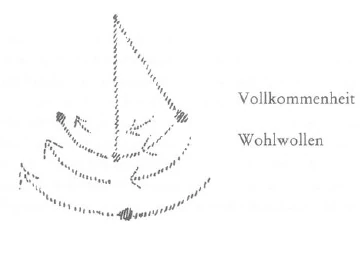
[ 20 ] Why does the pendulum follow this path? Because gravity acts on the pendulum—or so they say. It falls down, but once it reaches the bottom, it does not stop there. As it falls, it gains a certain amount of momentum, and this causes it to swing off in the exact opposite direction. Then it falls back down again. That is to say, as the pendulum follows this path, it absorbs so much energy from the fall that, driven by this energy of its own, it swings to the other side, just as high as it was before. To clarify this or that point afterward, one needs such a comparison. One might say: Any virtue—perfection, benevolence—follows this path quite correctly, but then swings off in the opposite direction. Perfection becomes weakness, benevolence becomes prejudiced flattery, and right becomes wrong in the course of development.
[ 21 ] People today are reluctant to accept such concepts. Just think for a moment: if one were to explain to the staid, narrow-minded citizen of today—who founds his club on the basis of certain ideals—that “What you now hold up as an ideal will, if you integrate it into the course of development, bring about the opposite in a relatively short time”—yes, he would believe that one were not only not an idealist, but a veritable devil. For how could the striving for perfection not lead ever further toward perfection, and how could what is right not remain right further and further on! Replacing one-sided, abstract concepts with the concepts of reality is particularly difficult for present-day humanity. But present-day humanity must learn this; otherwise, it will not make any progress. And so it must also come to terms with the fact that cultural development itself gradually makes it necessary to deal with the elemental spirits of birth and death. And in doing so, humanity must come to understand the introduction of a destructive element into human development.
[ 22 ] In certain instances, even those who refuse to familiarize themselves more extensively with spiritual science—which is, after all, the only means of arriving at the correct understanding of these matters—instinctively come to realize these things. What, then, does what I have just told you actually mean? These elemental spirits of birth and death are, of course, messengers of Ahriman. Out of the iron necessity of world evolution, the gods must make use of Ahriman’s messengers to regulate birth and death. They do not allow the forces of these messengers to enter the physical plane for the purpose of their actions. But in the descending phase of cultural development, beginning with the fifth post-Atlantean epoch, these forces must once again enter into cultural development itself—precisely so that the catastrophe can occur. Human beings themselves must work with these forces. Thus, the messengers of Ahriman are necessary—absolutely necessary—to bring about the destruction that will be the next step in cultural progress. This is a terrible truth, but it is so. And in the face of this truth, nothing helps but to familiarize oneself with it and look clearly into it. We will speak more about this later. You will see what the proper attitude toward these truths requires.
[ 23 ] Instinctively, I say, some people realize that something like this is necessary. For example, one writer who has authored many fine contemporary books—though none that seriously touches on spiritual science—came to this realization instinctively; I am referring to Ricarda Huch. And what is truly remarkable—not because of insight, but because of the instinct that prevails in this book—is her latest work on “Luther’s Faith.” If you read the first chapters of this book, you will find in them a strange cry—one might say—a cry for humanity to once again come to know something that has actually been lost to humanity since Luther’s time, up to which point atavistic clairvoyance in this field still extended. Ricarda Huch says that what is actually most necessary for humanity today is to get to know the devil. She does not consider it so necessary to become acquainted with God; she considers it far more necessary for humanity today to become acquainted with the devil.
[ 24 ] Of course, Ricarda Huch does not know why this is necessary. But she instinctively feels that it is necessary. Hence this urgent cry for the recognition of the Devil in the first chapters of this book, which is very symptomatic and significant for the present day. She thinks to herself: People will become acquainted with God again if only they knew that the Devil is prowling around them. — Of course, people who aren’t willing to engage with spiritual science will always find, will always seek excuses for such things. Ricarda Huch senses that the Devil, as a real being, should once again be recognized by people; but she immediately excuses this by saying that, of course, it isn’t as if one should imagine him running around the streets with a tail and horns. — Well, he is running around! “The little people never notice the Devil, even if he’s already got them by the collar.” The abstract-minded person of the present simply needs an excuse right away, even when they instinctively recognize what is urgently necessary. But a good, genuine instinct for the present underlies this cry for the devil. People should not simply grow into—blindly, sleepily—what an iron necessity demands of them for the time to come: to deal with the devil’s emissaries in the laboratory, in the workshop, in the bank, everywhere. People must do this for the sake of cultural progress; but they must know the devil; they must know that the moment they, say, unlock the steel chambers, the power of the devil lies in the power of the key. Ricarda Huch senses this instinctively. People must know this, for knowledge alone leads the way into the future. And it is already of immense significance that there are people who instinctively emphasize the necessity of not passing by the ever-more-powerful devil while asleep.
[ 25 ] Perhaps this, too, is characteristic—I say this only as an aside: In Paradise, after all, it was also a woman who instinctively introduced the devil’s role into that Paradise. I believe that, in secular culture, it does not particularly reflect well on men that they still largely reject this superstition and have, for the time being, left it to women once again; it is perhaps characteristic that Ricarda Huch, as a woman, calls out to the devil, just as Eve once let the devil into Paradise. But I say this only as an aside.
[ 26 ] But this devil is precisely the being that will—and must—be the bearer of the culture of the future. It is a bitter but important truth. This truth is intimately connected with the fact that destructive forces must intermingle with this cultural journey into the future. In particular—and I will speak about this tomorrow—if the matter is not guided wisely, destructive forces must intermingle with the entire educational system, especially in the upbringing of children. But destructive forces will also increasingly infiltrate the entire social life of human beings—due to general culture, social customs, and human emotions—forces that, above all, will increasingly undermine the relationships among human beings themselves.
[ 27 ] People should strive to put Christ’s words into practice: “Where two are united in my name, I am there among them.” But our technical, commercial culture does not make this the truth, but rather the opposite: Where two or more are united in my name to quarrel, argue, and fight, there I am in their midst. — And this will increasingly permeate social life. This, however, makes it difficult to introduce truths that unite humanity today.
[ 28 ] And now, to conclude—at least for the time being; we will continue discussing these matters tomorrow and the day after—let us clarify what people’s state of mind is, in general, when it comes to receiving truths. People today are reluctant to accept truths because they do not believe at all that truths could be something that enters directly from the spiritual world and reaches people. People today believe that truth can only be something that grows entirely from within themselves. If you’re in your twenties today, you have your own point of view; you don’t need to be convinced of the truth first; the truth doesn’t need to be revealed to you first—you already have your own point of view. And someone may come along who has struggled with all his zeal for the truth—the twenty-four-year-old Dachs, who has just graduated from university and perhaps still attended lectures on philosophy; he has his own point of view, which he then discusses with the other person who has also struggled with all his zeal for the truth. Today, everyone has their own point of view, and everyone believes that absolute, uniquely certain truth grows even on unprepared ground. People are not inclined to accept truths; rather, they appoint themselves as the owners of the truth. That, after all, is the defining characteristic of the present.
[ 29 ] Ricarda Huch also had some very beautiful words to say about this. She pointed out how our current worldview—or whatever one wishes to call it—which is steeped in chauvinism, was preceded among enlightened Europeans by Nietzscheanism, which stood far above all fatherlands and all chauvinism. People have become followers of Nietzsche. How many have become followers of Nietzsche! Nietzsche established the ideal of the “blond beast.” People understood very little of it. But Ricarda Huch says: Anyone who doesn’t even have the potential to become a respectable guinea pig has imagined himself to be the “blond beast” in Nietzsche’s sense. — Yes, that is, in fact, the standpoint of the petty bourgeoisie today. One really doesn’t have the potential to be a respectable guinea pig, but if an ideal—no matter how lofty—is set forth somewhere, then one is it! One is simply that because one thinks one is, without doing anything to achieve it, because one does not strive to develop, because one cannot bear to first become something, because one merely wants to be something. But this splits people into atoms of humanity. Everyone has their own point of view. No one can understand the others anymore.
[ 30 ] There you see—precisely in this atmosphere, where no one can understand anyone else anymore—the reign of destructive forces within the human social order itself. This drives people apart. It was the devil himself who tempted people, as followers of Nietzsche, to become “blond beasts.” They did not become so. But even if people have not become “blond beasts” in Nietzsche’s sense—something has nonetheless come of these 19th-century impulses that destroy sociality in the 20th century. We will discuss this further tomorrow.