

The Spiritual Backgrounds of the Outer World
The Fall of the Spirits of Darkness
GA 177
8 October 1917, Dornach
Translated by Steiner Online Library
Sixth Lecture
[ 1 ] Today, if we are to proceed properly with these reflections, we must consider the nature of the human being and his place within historical development. First, let us turn our attention to the fact that human beings possess an intellectual power, an intellectual gift. What does this intellectual gift consist of? Well, it consists in our ability to form thoughts. For the time being, we need not ponder where these thoughts come from when we arrange this or that in our imagination. This life of thought accompanies us throughout our entire waking consciousness; and we also have the feeling, for example, when we walk, stand, or perform any other action, that it is our thoughts that guide us, that we follow what first presents itself in our thoughts. Well, whether that is really the case is something we will discuss later in the course of these lectures. For now, I simply want to state what we have in our ordinary, everyday consciousness: these are our thoughts. But the world of thought as such is something entirely different. And one cannot understand a person’s relationship to their thoughts unless one takes into account what the world of thought as such is actually all about.
[ 2 ] In reality, wherever we stand, walk, or lie down, we are not only in the world of air and light and so on, but we are always in a surging world of thought. The best way to imagine this is to think of it this way: When you walk through a room as an ordinary, physical human being, you walk through it while breathing; you walk through a space filled with air. But in a sense, you are also moving through a space filled with thought. The substance of thought fills the space around you. And this substance of thought is not some vague sea of thoughts. It is not something like a nebulous ether, as people sometimes like to imagine, but this substance of thought is actually what we call the elemental world. When we speak of beings of the elemental world in the broadest sense of the word, these beings of the elemental world consist of this substance of thought—precisely this substance of thought. There is simply a certain difference between the thoughts that flit about out there—which are actually living beings—and the thoughts we have within us. I have pointed out this difference here on several occasions. In my forthcoming book, which I mentioned yesterday, you will again find references to this difference.
[ 3 ] You can ask yourself this question: If we have some kind of being—an elemental being—out there in the realm of thought, and I, too, have thoughts within me—how do my thoughts relate to the thought-beings that are out there in the realm of thought? You will gain a true understanding of this relationship between your own thoughts and the thought-beings out there in space if you imagine the relationship between a human corpse—which remains behind after a person has died—and the living human being who walks about. In doing so, however, you must consider the thoughts you gain from the external sensory world in waking consciousness. For our thoughts are, in fact, thought-corpses. That is the essential point. The thoughts that we carry with us from the external sensory world through our waking consciousness are actually thought-corpses—they are paralyzed, dead thoughts; out there, they are alive. That is the difference.
[ 4 ] So we are actually bound to the world of thought-elementals by the fact that, as we take in our perceptions from the environment and process these perceptions into thoughts, we kill the living thoughts. And by holding these thought-corpses within us, we think. That is why our thoughts are abstract. Our thoughts remain abstract precisely because we kill living thoughts. We actually go about with our consciousness in such a way that we carry thought corpses within us and call these thought corpses our thoughts, our ideas. That is how it is in reality.
[ 5 ] But these living thoughts that exist out there are by no means without a connection or relationship to us; they have a living relationship with us. I can make that clear to you right away. But you must not be alarmed by the grotesqueness of this unfamiliar idea. Imagine you’re lying in bed in the morning; there are two ways you can get up. In everyday life, you don’t notice the difference between these two ways of getting up, because you usually mix the two together and because you don’t pay any attention at all to the very moment of getting up. But there are two ways to get out of bed. You can get up without really thinking about it at all—simply out of habit—or by forming the precise thought: “I am going to get up now.”—I say you mix the two together; “half he was drawn up, half he sank down.” In everyday life, it does happen to some people that, following habit or necessity, they allow themselves to get up, and at the same time have the thought faintly surfacing: “I am going to get up now.” — As I said, some people confuse the two, but one can distinguish between them in the abstract. These are the extreme cases that can be distinguished. You can get up thoughtlessly, completely without thought—without thinking anything about it yourself—or you can do so fully consciously. There is a great difference between these two ways of getting up. If you get up completely thoughtlessly, merely out of ingrained habit, then you are following the impulses of the spirits of form, the Elohim, just as they shaped human beings as earthly beings at the beginning of the Earth’s creation. So imagine that you were to switch off your own thinking and always get up like a machine; in that case, you would not be getting up without thoughts, but merely without your own thoughts. But the very fact that you can get up, in this entire sequence of movements, involves thoughts—objective, not subjective, inner thoughts; and these thoughts are not your own, but the thoughts of the Spirits of Form.
[ 6 ] If you were terribly lazy and didn’t really want to get up at all, if it were completely against your nature to get up and you were to get up only out of a sense of duty—if you were to get up against your nature, out of a mere subjective thought—then you would be following Ahrimanic spirituality; you would be following only your head; in that case, you would be following Ahriman. In everyday life, as I said, people confuse these things. What applies to getting out of bed applies, in fact, to everything a person does. For a human being truly consists of these two entities, which are externally and physically distinct: the head and the rest of the physical body. The human head is, after all, an extraordinarily significant instrument, far older than the rest of the physical body. Just as the human head is constructed—I spoke about this last year—it is, in its basic form, already the result of the lunar evolution. It has already come through the Saturn, Sun, and Moon evolutions. But if human beings had developed on Earth in the same way they had come over from the lunar evolution, they would not have become what they are today; they would look different. If people were to see one another, they would see one another differently than they do now.
[ 7 ] Schematically, one could say (see illustration on the left): Human beings would be a kind of ghost, from which only the shape of the head would protrude somewhat more clearly. That was actually what human beings were meant to be. The rest of the physical body was not supposed to be as visible as it is now. One must take these things into account, because otherwise one cannot truly understand the development of the human being on Earth. The rest of the physical body would be elemental essence, mere elemental essence; and everything—I call it “a”—that is the legacy of the lunar existence transformed by the Earth would then be active in the head. So what I call “a” here—the legacy of the lunar being transformed by the Earth—is actually the human being. The human being, in reality, is actually the head with only a very slight base.
[ 8 ] The other thing that human beings still possess—let us call it “b” and, for now, consider it merely as this elementary, air-like entity—is not, in reality, the human being; rather, this other entity, “b,” is the manifestation of the spirits of the higher hierarchies, from the spirits of form downward. We can call “b” the configuration of the cosmic hierarchies. You are imagining the human being correctly if you picture him in such a way that the cosmic hierarchies have created what I have summarized here as “b.” And just as from the bosom of the cosmic hierarchies, the human being—that which has become of him since the Saturnic Age—emerges. So if you conceive of the human being’s extra-cranial nature in a spiritualized way—but you must conceive of it in a spiritualized way, at least in an etherealized way—you actually have the body of the cosmic hierarchies.
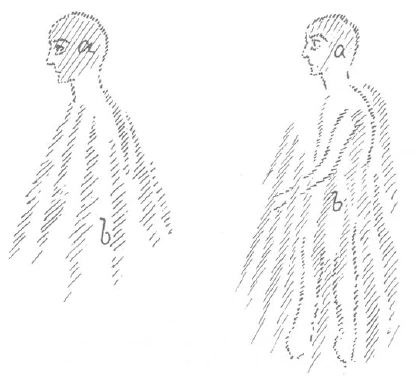
[ 9 ] Now, in the midst of this entire development, the Luciferic temptation intervened (as illustrated below; see drawing on the right), which caused this entire, more elemental physicality to condense into the rest of the human body. This, of course, also had an effect on the head. From this, you can gain an idea of what the human being actually is in reality. The human being—if we disregard the head, which is a remnant from earlier development—would actually be, if his body had not become entrenched in physical flesh, the outer manifestation of the Elohim. And it is only through the Luciferic temptation that his physicality has become condensed into this outer manifestation of the Elohim.
[ 10 ] This, however, has given rise to something very strange—something I have often alluded to as an important mystery—namely, that human beings are the very image of the gods precisely in those organs that are usually called the organs of their lower nature. Only this image of the gods, as the human being exists on Earth, is corrupted. Precisely that which is the higher aspect of the human being—that which, from the cosmos, should be spiritual—has become his lower nature. Please do not forget that this is an important mystery of human nature. What is now the human being’s lower nature is low because of the Luciferic influence; it is actually destined to be his higher nature. This is the contradiction inherent in the human being. It is something that solves countless mysteries of the world and of life when grasped in the right way.
[ 11 ] One can therefore say: Human evolution proceeded in such a way that, through the Luciferic intervention, human beings turned that which was meant to continually emerge from the cosmos into their lower nature. Even many historical phenomena will become clear to you if you consider what the leaders of the ancient mysteries knew—people who were not yet as frivolous, cynical, and philistine as people are today. Certain symbols of the ancient peoples—which today are understood only in a sexual sense, symbols drawn from the lower nature—become understandable when we realize that the ancient mystery priests who instituted them actually intended these symbols to express the higher aspect of humanity’s lower nature.
[ 12 ] You can see how delicately these matters—which are contained in the symbols—must be handled if one is to avoid falling into frivolity, a trap into which modern people naturally fall all too easily, for they cannot even conceive that there is anything in human beings other than sensuality, which is, in fact, the Luciferic aspect of the higher nature. Consequently, it can very easily happen that people misinterpret historical symbols in this area. It requires a certain refined sensibility not to interpret the ancient symbols in a base sense, even though they can often be interpreted that way. But this also makes it clear to you that when thoughts from the elemental world—that is, living thoughts, not the abstract, dead thoughts that arise in the mind—come to a person, these living thoughts must come from the whole human being. And this does not happen through mere thinking. Today people believe that one can always arrive at thoughts simply by thinking. Today people believe that if a person simply thinks, they can think about anything, provided only that the things they wish to think about are accessible to them. But that is nonsense. The truth is rather that the human race is in a process of development, and that, for example, the thoughts conceived by Copernicus and by Galileo at a certain time could not have been arrived at beforehand through mere thinking. Why? Because through thinking, human beings fabricate the thoughts that prevail in their minds. But when such a thought emerges in the course of world history—when it emerges in such a way that it makes a profound impact on the entire course of human development—then it is given by the gods through the whole human being. Then it first surges through the whole human being—overcoming the Luciferic—and only then, from the whole human being, into the mind. I believe this can already be understood. Therefore, certain thoughts can only be expected in certain historical eras if human beings do not merely think, if something is not merely conveyed to them through their eyes and ears, but if something is inspired into them from the hierarchical world through their entire being, which is a reflection of the hierarchies.
[ 13 ] If you consider this, you will also find that much is implied in what was suggested yesterday. We live in this age—beginning with the fifth post-Atlantean epoch—in a far more inner way than in the past, than, for example, in the Greek era, when the external environment provided much more of a spiritual dimension. Inner life refers to this emergence of thoughts through the whole human being. In earlier times, during the fourth post-Atlantean epoch, humanity’s relationship with the gods was much more external than it is now. It has now become much more intimate. Human beings are always in contact with the gods; it is just that their heads are generally unaware of this, because the head grasps only human thoughts—in fact, only the “corpses” of thoughts. As a whole human being, a person is always in communion with the gods. But this communion has become more intimate in more recent times. Therefore, even the nature of clairvoyance today involves a different relationship to the gods and to disembodied spirits in general than was the case in the past. When the human soul communicates with spirits or with the dead today, that communication is very subtle. One interacts with spiritual beings in much the same way, I might say, as one’s own thought interacts with one’s own will within the soul. This is very intimate. And this intimacy corresponds to the present age. It corresponds both to the nature of human beings here on Earth and to the nature of the dead who today pass through the gate of death into the spiritual world. In order for this intimate communion to come about, certain aspects of humanity’s relationship with the cosmos had to take on a different form than they had in the past. Today there are people who have a relationship with the spiritual world that, when it becomes conscious, expresses itself in a far more intimate way than it did in the past. Certain abilities had to be lost so that this more intimate communion with the gods could develop. This is why, during the Greco-Roman era and even well into the Middle Ages, people—as I said—still perceived the spiritual directly from their external environment, not merely seeing material colors or hearing material sounds as we do today, but perceiving the spiritual within those very colors and sounds. And they were also still given the opportunity to use what has today become a chaotic dream as a means of entering the spiritual world in a far less subtle way than is the case today. I would like to say: Communication with the spiritual world was coarser in earlier times than it is today; today it has become more subtle. In the past, it was relatively easy to make contact with spirits and the dead. Today, ordinary dreams no longer have the same value; but they did have it well into the Middle Ages. Some people retained this ability for a long time. Consequently, people in earlier times also perceived everything happening around them in the elemental world of thought described to you as if in a dream. Human beings were not so cut off from the surrounding spiritual world; rather, their very being still extended into it. And they were aware of this and acted and behaved accordingly.
[ 14 ] Of course, people today believe in these things only in the sense that they regard them as old superstitions. But when something significant emerges within this “old superstition,” modern science is no longer able to make sense of it. I’ll give just one example: The well-known historical figure Kimon had a friend named Astyphilos; Astyphilos was an expert in the interpretation—the correct intellectual interpretation—of dreams, and he foretold Kimon’s death—who, before the Egyptian campaign, had dreamed of a vicious, yapping dog—by saying: “You dreamed of a vicious, yapping dog; you will meet your death on this campaign.” — This is recounted by Horace.
[ 15 ] A wise man of our time who has written about dreams—but from a materialistic perspective—naturally believes: That was just an ordinary dream of Kimon’s, and Astyphilos was a charlatan who interpreted dreams. — But this modern scholar does, however, make the curious addition: “And as chance would have it, his prophecy came true.” — I could show you books from which it irrefutably follows that the prophecies have come true. Then people say: “As chance would have it.” — That is just one example among many. People today simply think that souls have always been as they are today, and that there is actually no real development of the soul at all.
[ 16 ] Just as external sensory perception was even more spiritual, so too was the connection with the surrounding world of thought-elementals, in a sense, even more imaginative. Dreams still had the value of imaginations that pointed toward the future. Just as memory points to the past, so these imaginations pointed to the future—though not, of course, in the same way. We must therefore conceive of the constitution of souls in earlier times quite differently: the ordinary sensory perception of waking life was, so to speak, interwoven with blurred dream images that nevertheless pointed to realities in the workings of the elemental world. One might say: The material world of sensory perceptions was not yet so firmly condensed into a mineral state. Spiritual elements still radiated everywhere from colors and sounds. But in return, the human capacity to dream while awake, so to speak, was still present, and this waking dreaming was reality in the elemental, objective world of thought. To establish and affirm human freedom, human beings were removed from this connection with the external world, and their inner life became more intimate, just as I have described it to you.
[ 17 ] But now we must consider something that is very important. One can reflect on natural phenomena using ordinary intellectual faculties, but one cannot reflect on social phenomena using ordinary intellectual faculties; that is simply not possible. Today, people believe that the kind of thinking that enables them to reflect on the external workings of the sensory world can also be applied to discover social laws and political impulses. They do this for the time being, but these are merely superficial. Something like what you still read about in Roman history—and you could trace such things later as well, if history hadn’t been turned too much into legend—namely, that Numa Pompilius drew inspiration for his state institutions from the nymph Egeria, points out to you that in those days, when people wanted to establish state institutions, they appealed to the gods. It was not considered possible to develop political structures through reflection alone. Today, it is believed that the individual is indeed incapable of devising political structures, but if one were to multiply the individual by a certain number, then he would indeed be capable. So when the enlightened parliaments convene in modern democracies, three hundred minds, through reflection, would be capable of what one person, of course, is not capable of. This does contradict a saying by Rosegger that I have often quoted: “One is a human being, several are people, and many are beasts!” but in practice, one wouldn’t actually apply something like that, would one! And just imagine what the modern, enlightened world would say if—not in the old form, but in a new one—the news were to spread one day that Woodrow Wilson had been inspired by a nymph to issue some decree.
[ 18 ] So these things are different at first, even if they haven’t exactly become any smarter. This will be difficult to understand, of course, but one must come to terms with the fact that genuine, sound ideas for social structures will only emerge again when people appeal to the spirit. This need not take the old form—and indeed, it will not—but this appeal to the spirit must take place again; otherwise, people will bring forth nothing but trivialities regarding political principles, social structures, and ideas. A living awareness must arise that we live within the world of thought-elements and must draw inspiration from it.
[ 19 ] Today, we can still laugh about these things. But humanity will have to gain, through pain and suffering, an awareness of inspiration in the creative realm of social order. And in doing so, we are pointing, in an even more intimate way, to something that will become increasingly necessary for humanity from this day forward.
[ 20 ] Only when human beings come to realize that they must prepare themselves now to seek a connection once again with the spiritual world—in order to bring into the realm of this world a realm that is not of this world, yet which permeates the realm of this world everywhere—will salvation come to the chaotic social structure of humanity.
[ 21 ] To achieve this, however, it will be necessary for people to overcome their reluctance to engage with the intimate relationship between humans and the surrounding world. For the more significant branches of human endeavor, it will be necessary to delve deeper into the nature of the human relationship to the environment during the fourth post-Atlantean epoch, in order to orient oneself to it and to truly recognize that humanity once had a different relationship to the environment than it does now. This can still be studied. We simply need to overcome this “legend”—in the pejorative sense of the word—which is called historical science today. We must go back to historical reality, at least as far as the Mystery of Golgotha. This can happen when external historical research is enriched by research in the spiritual sciences. But people will have to make the effort to familiarize themselves with research in the spiritual sciences. The problem is that concepts today are such that it sometimes seems quite grotesque to a person when they begin to enter the spiritual world, because they actually have the instinctive notion that the spiritual world must look exactly like the sensory world. They want nothing more than to find a refined sensory world there. That they encounter something entirely different there—something that surprises them even in the smallest details—is something people today cannot comprehend. I am telling you something that is absolutely true, my dear friends. But just think how implausible this will seem to the philosopher of today, who is accustomed only to the physical plane.
[ 22 ] Let’s suppose that a philosopher today—a typical university professor—were—it would be something of a miracle, but let’s suppose that miracle were to happen—to be inspired for five minutes to ask the spiritual world whether he is a true philosopher by inner calling. What do you think the answer would be, roughly speaking? He would have a vision, and that vision would be the correct answer—but one must interpret visions in the proper sense. Really, I’m not telling you anything that hasn’t happened in countless cases. Such a philosopher would, in fact, receive the answer by having dog-ears placed on his ears. And from this vision, he would have to conclude: “So I am a true philosopher.”—This is no joke, but rather it is based on the fact that certain concepts, which are of a certain nature on this physical plane, are exactly the opposite on the spiritual plane. Having dog-ears is no distinction on the physical plane; in the spiritual world, having dog-ears as an imagination is worth far more than the highest order on the physical plane for any professor of philosophy.
[ 23 ] But now imagine someone who is accustomed only to the physical plane and who suddenly—as I said, through a miracle—became clairvoyant and saw himself with donkey ears: he would believe he was being mocked; he would believe he was being deceived. For that reason alone, he would dismiss it as a mere illusion. Even in the details, things look quite different in the spiritual world than they do here in the physical world, and one really needs to interpret what one experiences in the spiritual world in order to correctly interpret the corresponding phenomena in the physical world. I didn’t just want to make a joke with the donkey ears. If you look in ancient writings, you will find that the dreams the philosophers had to convince themselves of their inner philosophical calling are cited there. What I have described to you is a typical depiction, a typical dream. By seeing themselves with donkey ears, the philosophers convinced themselves that they truly had a philosophical calling.
[ 24 ] People will therefore have to experience some surprising and startling things if they wish to become acquainted once again with the peculiarities of the spiritual world. When you read The Chemical Wedding of Christian Rosenkreutz in the Year 1459, you will sometimes feel that you ought to laugh at the grotesque things in it. — Nevertheless, they are deeply significant, because the path hinted at there must not be viewed merely with sentimentality, but with a certain superior sense of humor.
[ 25 ] I said that one could also find analogies in later times for what is recounted in Roman history regarding Numa Pompilius’s instruction by the nymph Egeria. Such things are no longer revealed to people today; but that is precisely why history is really known only as a fable convenue. Consider that at the end of the 16th and the beginning of the 17th centuries, Jakob Böhme still appeared with his profound intuitions, which truly allow the intuitions of an earlier time to shine through in grand, powerful insights. Among Jakob Böhme’s students were many people from later times; and one of Jakob Böhme’s last conscious students was Saint-Martin. Saint-Martin, especially in his book Des erreurs et de la vérité, is entirely based on Jakob Böhme, though it is already a somewhat diluted version of Jakob Böhme. But he still retains enough of what has come down from earlier times to know this: If one wishes to have thoughts about social structures, if one wishes to have genuine, effective political ideas, then one must not merely devise them; rather, these ideas must have flowed in from the spiritual world. — And in his book Des erreurs et de la vérité, Saint-Martin does not merely offer thoughts on external nature and its course, on history and its course, but he also presents political ideas—very specific political ideas. Today, when states are the sole political structure, one would call them ideas about the state. But within these discussions there is a very specific, significant concept, and it is telling that such a concept is found precisely at the forefront of Saint-Martin’s political thought. There he speaks of the “original human adultery.” This adultery is said to have taken place at a time when sexual intercourse between a man and a woman had not yet occurred on Earth. So he does not mean ordinary adultery; he means something entirely different—something over which he weaves a very thick, dense veil, something to which the Bible alludes when it says: “And the sons of the gods saw that the daughters of men were beautiful, and they took them as wives.” It is, after all, the very event that gave rise to all the confusion in the Atlantean world, an event that is also mysteriously connected to the fact that human beings have materialized their elemental-spiritual nature. One can only allude to this event, which Saint-Martin calls “the original adultery”; he, too, merely alludes to it.
[ 26 ] But one can see in Saint-Martin that he recognizes this necessity: If one wishes to reflect on politics, one must not merely consider the external relationships among human beings, as is done today, but one must be able to go back to those times when one could know anything about human beings only by going beyond the sensory world into the spiritual world. One must, in fact, lay the foundations of political thought from the spiritual world. Saint-Martin already knew this at the end of the 18th century—for he did not die until 1804—and what he says in Des erreurs et de la vérité has already been translated into German. The book is also available in German. It is, after all, not uninteresting to mention this, because a certain pastor—speaking here quite nearby against us, who in turn wish to cultivate the spiritual life here—said that in the face of such follies, one must remember the simple, down-to-earth Matthias Claudius. And then he quoted a stanza by Matthias Claudius to refute us. But it is precisely Matthias Claudius who translated Saint-Martin’s book Des erreurs et de la vérité in order to make accessible to his people what corresponded to spiritual science at that time. The gentleman in question thus merely demonstrated his colossal ignorance regarding Matthias Claudius—not to mention that he quoted only a single stanza of the poem; for if he had quoted the preceding stanza, he would have immediately contradicted himself. But that one stanza, which he believed was appropriate, was enough for him to cite it against anthroposophy.
[ 27 ] Even in the 18th century, Saint-Martin recognized that a bridge must exist between human thought and spiritual knowledge—the spiritual influences of higher worlds—if one is to have fruitful political ideas. No earlier century was as godforsaken as the 19th century or the beginning of the 20th century. It is important to bear this in mind. Yet no earlier century was as vain about its godforsakenness. However, if people today were to read the political philosophy advocated by Saint-Martin—I believe it would turn the stomachs of all those who now sit together as the “wise ones” and seek to steer the fate of the world. For there is a tendency today to familiarize oneself as little as possible with what truly exists all around us. Now, one can certainly banish spiritually alive thoughts from one’s consciousness; one can decide to operate solely with dead ideas, but human action is not governed by that. What people do becomes woven into living thoughts. And when people, with their dead thoughts, refuse to live out the living thoughts at all, chaos is the result. This chaos must be overcome. To do so requires those clear insights I have repeatedly spoken of in these lectures. But in some respects, this also requires a complete reversal of what is currently regarded as right and ideal.
[ 28 ] Above all, such a change of course will be necessary very soon; indeed, it would be best if this change were to take place in the immediate present, on the broadest possible scale, in the very areas where the task of appointing educators—for both the youngest and the older members of society—is at stake. For in no other field has humanity become as materialistic as in the field of education.
[ 29 ] In closing, let me present the idea that will occupy us in the coming days, for it is very interesting and very important for everyone. But let me present it in such a way that you can first reflect on it for a few days—I would say, within your own soul—so that you will then be better prepared to contemplate this idea.
[ 30 ] The children, as they enter life today—we must view them in such a way that we truly understand: Their outward appearance is withering and fragmenting, as I have discussed in recent days; but deep within there is something that is the true human being—something that no longer expresses itself outwardly as it did up until the 15th century. We will have to become increasingly aware that, especially in the case of children, the inner human being cannot be fully discerned from the outside based on the way they behave, the way they think and speak, and the gestures they make. The inner human being is simply no longer fully expressed in the outer appearance, and this is most evident in children. In many ways, the child today is already something quite different from what is expressed outwardly. There are even extreme cases. Children may outwardly look like the most unruly rascals, yet they may have such a good core within them that they will later become the most valuable people, while one can find numerous well-behaved children who are not the least bit unruly—who do not put a finger in their mouths or pull their noses—who study well and who may one day become good bank directors, good schoolteachers by today’s standards, and indeed good lawyers, but who simply do not become useful human beings—forgive the harsh word—because they do not find inner harmony with themselves and the true world around them. Precisely in the field of pedagogy and education, the principle must first take hold that human beings today are, inwardly, something fundamentally different from what is expressed outwardly. But this means that in the future, educators and teachers must not be selected in the same way they are now, but according to entirely different principles; for looking into an inner world that is not expressed outwardly requires a certain prophetic gift. It will therefore be necessary to structure the examinations for educators in such a way that those who possess intuitive, prophetic gifts are allowed to pass with particular ease, while those who lack such intuitive, prophetic gifts are made to fail the exam, no matter how much else they may know.
[ 31 ] Today, we are far from taking into account people’s prophetic gifts when training them for the teaching profession. But then again, we are quite far removed from many things that are bound to happen. Nevertheless, the imperative of human development will force us to gradually embrace such principles. Admittedly, many materialistic thinkers of our time would consider it a completely crazy idea to say that educators should become prophets. — But it will not always remain that way. People will be compelled to acknowledge precisely such things.
[ 32 ] Next time, starting from this point, let’s take a closer look at the circumstances.
[ 33 ] Our friends in Zurich have asked me—so that they can better accommodate the schedule—not to speak on Saturday, Sunday, and Monday, but rather on Friday, Saturday, and Sunday. So we will meet again on Friday at 7 a.m., Saturday at 7 a.m., and Sunday at 4 p.m. I will then give the lecture on art on Monday; that stands on its own.