

How Individual Spirit Beings Work in the Human Soul
GA 178
11 November 1917, Dornach
Translated by Steiner Online Library
6. On Psychoanalysis II
[ 1 ] An attempt to gain insights into the realm of the soul using inadequate means of knowledge—that is how I described yesterday what is known as analytical psychology or psychoanalysis. Perhaps nothing is as well-suited as psychoanalysis to highlight how, in our present age, everything is pushing toward the emergence of an anthroposophically oriented spiritual science, and how, on the other hand, people—driven by subconscious prejudices—are reluctant to engage with a spiritual-scientific perspective on the matter. Yesterday I again presented you with an example from which you can see how one can point out the grotesque leaps into which the thinking of modern scholarship falls when it ventures into psychological problems, and how one can, so to speak, intercept such leaps in the thought processes of modern scholars. We have pointed out that one of the better psychoanalysts, Jung, arrived at a distinction between the more thinking and the more feeling human being; that, proceeding from this, he then posits emotional impulses in the subconscious of the thinking person, which surge upward against the thinking present in consciousness and thereby bring about psychological conflicts, or, conversely, that thoughts residing in the subconscious surge against the emotional life and provoke psychological conflicts.
[ 2 ] Now one might say: Yes, these issues are being debated within academic circles, and we could wait until people get around to overcoming their subconscious prejudices against anthroposophically oriented spiritual science. However, it is difficult to remain entirely passive when such matters do not merely remain in the theoretical realm, but seek to intervene in the practical aspects of life and in cultural development. And psychoanalysis seeks to be active not only in the field of therapy—which might be less of a cause for concern, since there it hardly seems, at first glance, to differ all that much—but I say “seems”—from certain other therapeutic methods; but it also seeks to be active in the field of education; it seeks, in a sense, to become the foundation of educational practice. And this is where it becomes necessary to draw attention to the dangers inherent in half-truths more strongly than is the case within a purely theoretical discussion.
[ 3 ] Today, however, we will have to broaden the scope of our discussion if we wish—at least for now, since everything relevant to the matter can only be addressed over time—to shed some light on one aspect or another. First of all, I would like to point out that the facts available to psychoanalysis would in fact be capable of pointing to an important spiritual realm that modern man, at least, does not wish to enter—not precisely, not exactly—and which he would very much like to leave in all sorts of subconscious, nebulous regions; for nothing is more dear to the contemporary mindset—which remains afflicted by materialism even in such realms—than—if you’ll allow the paradox—an obscure, mystical drifting among all manner of undefined concepts. Indeed, one finds the most grotesque mysticism, the most repulsive mysticism, precisely within materialism, when mysticism is used in the sense of drifting about in all sorts of nebulous concepts and refusing to develop one’s worldview into clear, sharply defined concepts. The very realm to which the facts of the psyche compel psychoanalysts is the realm of unconscious mental activity, of rational activity. How often have I—I would say, merely touching on these things without going into detail—because this is actually self-evident to the scholar of the human sciences. —as to what needs to be said in this regard—but how often have I pointed out in this context that rational activity, intellectual activity, and wisdom are not merely present in human consciousness, but everywhere; that we are surrounded by active intellectual activity just as we are surrounded by air; thus, human beings are completely enveloped in active intellectual activity, and so are other beings.
[ 3 ] Today, however, we will have to broaden the scope of our discussion if we wish—at least for now, since everything relevant to the matter can only be addressed over time—to shed some light on one aspect or another. First of all, I would like to point out that the facts available to psychoanalysis would in fact be capable of pointing to an important spiritual realm that modern man, at least, does not wish to enter—not precisely, not exactly—and which he would very much like to leave in all sorts of subconscious, nebulous regions; for nothing is more dear to the contemporary mindset—which remains afflicted by materialism even in such realms—than—if you’ll allow the paradox—an obscure, mystical drifting among all manner of undefined concepts. Indeed, one finds the most grotesque mysticism, the most repulsive mysticism, precisely within materialism, when mysticism is used in the sense of drifting about in all sorts of nebulous concepts and refusing to develop one’s worldview into clear, sharply defined concepts. The very realm to which the facts of the psyche compel psychoanalysts is the realm of unconscious mental activity, of rational activity. How often have I—I would say, merely touching on these things without going into detail—because this is actually self-evident to the scholar of the human sciences. —as to what needs to be said in this regard—but how often have I pointed out in this context that rational activity, intellectual activity, and wisdom are not merely present in human consciousness, but everywhere; that we are surrounded by active intellectual activity just as we are surrounded by air; thus, human beings are completely enveloped in active intellectual activity, and so are other beings.
[ 5 ] One could say: If the opportunity with the horses—which was, moreover, reinforced by her earlier association with the horse accident—had not presented itself, another opportunity would simply have arisen; the lady would only have needed to faint. And one can say with a certain degree of hypothetical certainty: she would most certainly have fainted if the opportunity presented by the approaching cab had not arisen. She would have collapsed unconscious on the street, and she would then have been carried back into the house. Or if she had not fainted, another means would have been found. One might say: The subconscious overlooked all the reservations that the conscious mind does not overlook. The subconscious took the position that whoever wants to achieve an end must also choose the means, regardless of what the concepts of propriety or impropriety may happen to entail. Thus, in such a case, one is referred to what Nietzsche—who had some inkling of such things—calls “great reason” as opposed to “small reason”: the all-encompassing reason that does not come to consciousness, that operates below the threshold of consciousness, and through which people do the most diverse things that they do not admit to themselves in their consciousness. Through ordinary consciousness—external consciousness—human beings are connected to the sensory world, but also to the entire physical world, and thus to everything that lives within the physical world. These are, above all, the concepts of propriety, bourgeois morality, and so on. All of this belongs to the physical plane; it is through this consciousness that human beings exist.
[ 6 ] In the subconscious, however, human beings are connected to an entirely different world—the one of which Jung says the soul needs because it is simply connected to this world, but about which he also says it is foolish to ask whether it exists. Yes, that is precisely the case; as soon as the threshold of consciousness is crossed, a person is not merely in a material connection with his soul, but in a connection where thoughts reign—thoughts that can be very sophisticated.
[ 7 ] Well, Jung is quite right when he says that modern man—the so-called “cultured man” of today—has a particular need to be attentive to such things. For this so-called contemporary culture has the peculiarity of pushing numerous impulses down into the subconscious, which then assert themselves in such a way that so-called irrational actions—that is, entirely irrational human behavior—come about. When people speak of the power drive and the love drive, this stems solely from the fact that the moment a person enters the subconscious regions with his soul, he draws closer to the regions where these drives reign. It is not these drives that are the causes, but rather the fact that the person, with his subconscious reason, plunges into the regions where these drives are at work.
[ 8 ] For any matter that interested her less than her romantic relationship with the man, the lady would not have gone to the trouble of first letting her subconscious cunning take the lead; it was precisely this particular interest that made it necessary. And the fact that romantic interest often plays a role here stems precisely from the fact that romantic interest is a very common one. But if psychoanalysts were to focus more of their attention on other areas—if, I might say, they were not to focus on psychoanalytic sanatoriums, where, as it seems to me, the majority of the residents are still women—this is, after all, a criticism leveled at anthroposophical institutions as well, but I believe one could accuse such institutions of this with even greater justification—if psychoanalytic researchers were more well-versed in other fields—which is indeed partly the case—and if there were more patients in the sanatoriums from other fields, then perhaps a more profound understanding could be achieved. Let us assume, for example, that a sanatorium were established specifically to provide psychiatric treatment for people who have become nervous or hysterical as a result of stock market speculation. There, just as Freud introduced the concept of love into the subconscious, one could introduce entirely different concepts. There, one would see the extensive, subconscious, and sophisticated mental framework with which, for example, a stock market speculator operates. There, I would say, through the process of elimination, sexual love would not be able to play a special role, and yet one would be able to study the workings of subconscious sophistication, subconscious cunning, and so on to the highest degree. Nor would the power drive always be what one could articulate; rather, entirely different “drives”—those that reign in the subconscious regions, into which one sinks with one’s soul when one enters the subconscious at all—would come into play. And if one were to establish a sanatorium for scholars who have become hysterical, then even among the forces at work in the subconscious, little could be directly attributed to the libido; for anyone sufficiently familiar with the facts in this area knows for certain that, under present-day conditions, scholars are driven very little by love for their science, but rather by entirely different drives that would then reveal themselves if they were brought to the surface through psychoanalysis. But what is the overarching factor is precisely that the soul is led down from the conscious regions into the subconscious regions—which can only be brought to consciousness through spiritual research—and in which the drives that live within the human being reign, without the human being being able to master them, because he can master only that which is within his consciousness.
[ 9 ] Yet another rather uncomfortable truth. For, of course, one must then admit—to an even greater extent than psychoanalysts do—that human beings can be quite cunning creatures in their subconscious realms, much more cunning than they are in their ordinary state of consciousness. Well, even in this field, one can have strange experiences precisely through conventional science. And you can read a chapter about these experiences in the second chapter of my new book *On the Mysteries of the Soul*, which will be published shortly, where I address the chapter that the academic Dessoir devoted to anthroposophy in his book *Beyond the Soul*. This second chapter of my book *On the Mysteries of the Soul* may also serve as a useful contribution for thinking people today who wish to form a judgment about the ethical standards of contemporary scholars. As you read this chapter, you will see what kinds of opposition one is actually up against. Of the points of view presented there, I would like to mention just a few that are not entirely unrelated to today’s topic.
[ 10 ] For example, this man finds all sorts of objections to this and that and always cites passages he takes from my books. In a charming aside, he also explains how I distinguish between successive cultural periods: the Indian, the Proto-Persian, the Chaldean-Egyptian, the Greek-Latin, and—according to Steiner—we are now living in the sixth, he says.
[ 11 ] Well, this matter highlights the need to refute it in a schoolmasterly manner; for it shows one the path one must first take to tackle such an individual. Amid all his other nonsense, how does this Max Dessoir come to say that I claimed we are now living in the sixth post-Atlantean cultural period? It is easy to prove if one has some practice in the application of philological methods. I spent six and a half years at the Goethe Archive in Weimar and am somewhat familiar with philological methods; I could easily demonstrate, using philological methods, how Dessoir came to attribute this sixth cultural period to me now. Namely, he has read my book *An Outline of Esoteric Science*. In this book, *Die Geheimwissenschaft*, there is a sentence that introduces the discussion of the fifth post-Atlantean cultural epoch—the present. There I say that things are slowly coming into being, and in one section I state that the events which then emerged in the 14th and 15th centuries were prepared in the 4th, 5th, and 6th centuries. So I say: “...in the 4th, 5th, and 6th centuries...” in one line, and four or five lines later it states that this 6th century was the preparation for the fifth post-Atlantean epoch. Dessoir reads, as is his custom, superficially; then, as is common among some scholars, he quickly looks up the passage he’s noted in the margin with a red or other pencil, and when reviewing my book *The Secret Science*, he confuses what’s written five lines later—the post-Atlantean cultural period—with what’s written about the 4th, 5th, and 6th centuries, and there he says, “sixth cultural period” instead of fifth, because he shifted his gaze up four lines!
[ 12 ] So you see just how incredibly superficially such an individual actually works. Here we have an example where one can directly refute such “scholarship” through philological analysis. Errors of this sort permeate the entire chapter of this piece of trash. And while Dessoir claims to have studied a whole series of my writings, I could in turn demonstrate philologically what this entire series of writings actually consists of. He has, in fact, read—and understood very little of—*The Philosophy of Freedom*; regarding it, he formulates a statement that is sheer nonsense. But then he read *The Secret Science*, though he read it in such a way that the kind of nonsense I have just described to you comes out of it. Then he also read the treatise on *The Spiritual Guidance of Man and Humanity*, the short treatise on *Reincarnation and Karma*, and *Blood Is a Very Special Juice*. That is all he has read of my work; this can be verified from the essay he wrote. He has read nothing else. Such is the scholarly ethic of our time! It is important to take a moment to examine the state of scholarship today in a case like this. In this instance, this scholar has at his disposal only the small number of my books I just mentioned, and upon these—along with a thoroughly corrupt way of thinking—he now bases his entire arguments. But this is how numerous scholars of today generally proceed. When they speak, for example, about animals, they do not have sufficient source material at their disposal, but rather about as much knowledge of animal life as Dessoir has gleaned from my writings. One could write a fascinating chapter if one were to examine Max Dessoir’s subconscious. Yet Dessoir himself provides an opportunity, at a particular point in his book, to give his subconscious a little consideration. He recounts, in a rather grotesque manner, that it sometimes happens to him when he is speaking at a gathering that he suddenly realizes: without his soul being present, his thoughts continue to flow; he then keeps speaking for a while longer, and only from the way the audience reacts does he notice that his thoughts have taken a different direction than his attention. He recounts this quite naively. Now just imagine: based on this fact, he then goes on to discuss all sorts of peculiarities of human consciousness. I gently pointed out that Dessoir is revealing himself in a curious way here. I said it was entirely impossible that he meant himself; it could only be that, in this case, he speaks as one does when identifying with other clumsy speakers and speaking in the first person by putting oneself in the other’s place; for it would be too great a demand to expect him to characterize himself in this context. But—he does, in fact, characterize himself! It’s true. Well, when discussing such matters, one sometimes has to point out very peculiar things. He addresses *The Philosophy of Freedom* only in a footnote, in which he formulates a trivial sentence from it that, while Dessoir-esque, does not originate with me. This whole thing is crazy. But in doing so, he says: “In Steiner’s debut work, *The Philosophy of Freedom*.” So one is really compelled—since *The Philosophy of Freedom* is not my first book, but the culmination of ten years of writing—to point out such outpourings of academic paranoia, of academic madness, in the face of such a handling of scholarly ethics. I know, of course—even though I have shown in this chapter how corrupt this entire account is—that people will keep coming back and saying: “Well, Dessoir has refuted Steiner,” and so on. Of course, I know that very well. I know that today it’s like talking to a brick wall when one has to break through what people today lack entirely—belief in authority—because they’ve abolished it!
[ 13 ] This chapter alone will demonstrate the difficulties that spiritual science must contend with in the current cultural climate, simply because it is compelled to point to clear, sharply defined concepts and concrete spiritual experiences. For example, in the case of an individual such as Dessoir, there is not even the remotest mention of logic—not in the remotest sense. And logic is entirely absent, to the greatest extent, from contemporary so-called scientific literature.
[ 14 ] These are the reasons why official scholarship and official schools of thought—even when they emerge from the most inferior sources, such as university psychiatry or psychology—are unable to get off the ground, because they lack the very first requirement: a genuine contemplation of life. As long as the conviction does not take hold in the broadest circles that what is today presented as scientific literature—I say not as science, but as scientific literature—and often forms the content of university lectures and, in particular, popular lectures, is far removed from genuine research and a genuine sense of reality; as long as this blind faith in authority is not broken in the broadest circles, there can be no salvation. These things must be said, even if one has the greatest respect for the scientific way of thinking, even if one repeatedly and consistently emphasizes the great achievements of that very way of thinking. One must come to terms with the fact that such things interfere with life in contradictory ways. Well, after this digression, I would like to return to the topic at hand. Dessoir finds it particularly serious—on an occasion when he allows himself yet another combination of objective untruth and slander—that in the little book *The Spiritual Guidance of Man and Humanity* to an important, subconscious influence of spiritual impulses, by showing that in the child whose brain is still developing, a wiser wisdom is at work than the one that later becomes conscious once the brain is fully developed. You are familiar with this chapter from *The Spiritual Guidance of Man and Humanity*. A sound science should actually take its starting point from such normal effects of the subconscious. But this science also requires something else. If you turn to the text *How Does One Attain Knowledge of the Higher Worlds?*, you will find the mystery of the threshold discussed there. You will find this mystery of the threshold discussed in such a way as to show that, after crossing the threshold into the spiritual worlds, a separation—in a certain sense, a differentiation—of the three fundamental forces of soul life takes place: thinking, feeling, and willing. Just recall how, in the discussion of the Keeper of the Threshold in the book *How to Attain Knowledge of the Higher Worlds*, it is shown how that which, in ordinary consciousness, interacts in a certain sense so that it cannot really be separated—thinking, feeling, and willing—how this separates, each becoming independent, so that I can say, if I were to sketch this: If here (drawing on p. 160) is the boundary between ordinary consciousness and that region in which the soul lives—that is, within the spiritual world—then I would have to schematically depict thinking, feeling, and willing in such a way that this would be the realm of willing (red), which, however, immediately adjoins the realm of feeling (green), and this, in turn, is immediately adjacent to the realm of thinking (yellow). If I were to sketch the path into the spiritual world after crossing the threshold, I would have to schematize the following and provide the following schematic drawing: I would have to show how thinking, on the one hand, becomes independent (yellow, right); feeling becomes independent (green, right) and separates from thinking; willing becomes independent (red, right), which I am illustrating schematically here. Thus, thinking, feeling, and willing fan out and separate from one another.
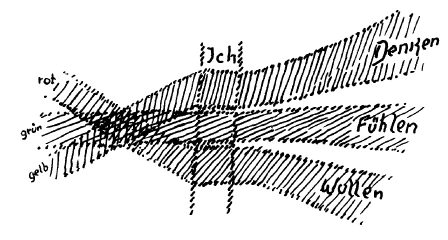
[ 15 ] You can find this explained in my book *How Does One Gain Insight into the Higher Worlds?*. The fact that these three activities—which operate separately yet adjoin one another—interact in the proper way at the threshold, without becoming confused, is brought about by the fact that, in a sense, the threshold has a certain breadth within which our ego itself lives. And when the “I” functions healthily, when the “I” possesses its full spiritual health, then thinking, feeling, and willing—interacting with one another—are held in such a way that they do not tumble into one another, yet still influence one another by adjoining one another—this is the essential secret of our “I”—so that thinking, feeling, and willing are held side by side; so that they influence one another in the right way, but one cannot spill over into the other. When we cross the threshold into the spiritual world, they cannot spill over into one another because they actually separate.
[ 16 ] Philosophers such as Wundt, for example, argue that the soul should not be divided into three parts because the soul is a unity. In doing so, Wundt also confuses the whole matter. But the fact is that in the spiritual world, thinking, feeling, and willing originate in three distinct ways; in the soul, however, they work together as a unity. That is what one must take into account. And when it is said—as is said to have been said at one time or another, whether recently or long ago—that anthroposophy actually distinguishes between three souls, whereas there is really only one soul, and that this alone shows that anthroposophy has no basis—one must object: it does not, of course, disturb the unity of the human being that he has two hands.
[ 17 ] Here, however, we have (see the drawing in the center and on the right) the relationship between the soul forces acting within the “I,” together with the “I” itself, and the way they operate beyond the threshold of consciousness into the spiritual world. But the opposite situation can also arise. This can occur when the “I” is weakened by some factor. Then, in a sense, the threshold is crossed in the opposite direction; thinking veers off (see diagram, yellow, left) and mingles with feeling (green, left) and with willing (red, left), and you have a jumble of thinking, feeling, and willing in the soul; they tumble into one another. But this occurs when, let’s say, thinking is somehow exposed to the danger of not being fully encompassed, but instead asserts itself independently in consciousness. And because the “I” is not functioning properly, thinking slips into the sphere of feeling or even into that of the will. Instead of thinking, feeling, and willing proceeding side by side, thinking—without the “I” being able to carry out its activity—takes hold of feeling or even the will.
[ 18 ] This occurs in cases described by psychoanalysts as hysterical or nervous cases. In a sense, thinking, feeling, and willing veer off in the opposite direction from the healthy path that would lead into the realm of the mind.
[ 19 ] If one has a genuine aptitude or talent for examination, can one then see things—I would say—vividly as they happen? Take, for example, the woman sitting at her father’s bedside, whose strong sense of self has been subdued by many sleepless nights—the slightest thing can happen, and a thought will not run properly alongside the feeling, but will tumble down into the realm of emotions. But then the thought is immediately swept up by the waves of emotion, which are stronger than the waves of thought; and the result is that, in such a case, the organism is overwhelmed by the waves of emotion. For the organism is overwhelmed by the waves of emotion at the very moment when thinking is not strong enough to keep itself apart from the emotions.
[ 20 ] It is essential that modern human thinking become increasingly capable of remaining aloof from the surges of emotion and the surges of the will. If thinking in the subconscious—here is the superconscious (see diagram, right), here is the conscious (center), here is the subconscious (left)—if thinking becomes entangled with the emotional surges in the subconscious, then something disorderly occurs in the organism. This is extremely important.
[ 21 ] Now you can imagine how, in this modern life, where so much is presented to people that they do not properly understand—that they cannot fully grasp—thoughts constantly flow down into their feelings. But: only thinking is oriented toward the physical plane; feeling is no longer confined to the physical plane alone, but is, by its very nature, connected to the spiritual world. Feeling is truly connected to all those spiritual beings whom we must speak of as real. So that when a person plunges into their emotional life with inadequate concepts, they come into conflict with the gods—if one may put it that way—but also with the evil gods. That is where these conflicts arise. And that is where all these conflicts occur, stemming from the fact that human beings immerse themselves with inadequate means of knowledge. They must immerse themselves with inadequate concepts, since there is far more in the sphere of feeling than in the ordinary sphere of the intellect. In the realm of feeling, human beings cannot emancipate themselves from their connection to the spiritual world. If, in this materialistic age, they emancipate themselves in the realm of the intellect, they will always enter their world of feeling with inadequate concepts, and they are bound to become ill.
[ 22 ] What, then, would be the only way to restore people to comprehensive health? To lead them back to concepts that also encompass the emotional sphere; that is, to speak to modern people once again about the spiritual world—to speak about the spiritual world in the broadest sense. It is not the psychoanalyst’s therapeutic methods, tailored to the individual, that come into consideration here, but rather spiritual science as it applies to the general public. If one truly takes in the concepts of spiritual science—not everyone who hears them or reads about them actually does so—if one truly takes them in, then one cannot allow the three spheres of the soul — thinking, feeling, and willing — become chaotically entangled in the subconscious, which is in fact the basis of all hysteria and nervousness that originates within the soul—and this is precisely what psychoanalysis refers to.
[ 23 ] To do this, however, it is necessary to have the courage to approach the concrete workings of the spiritual worlds, to have the courage to acknowledge that we are living in a crisis in our time that is fundamentally connected to a crisis we have already identified for the year 1879 and whose aftereffects we are still experiencing. As I said yesterday, certain things must be viewed quite differently from the way they are viewed by the materialistic mindset of our time; and I pointed to the example of Nietzsche: Nietzsche was born in 1844; in 1841, the struggle in the spiritual world of which I have spoken began; for three years, Nietzsche was caught up in this struggle. Richard Wagner did not initially take part in it; he was born in 1813. So Nietzsche lived in the spiritual world for three years after this struggle began. There he absorbed all the impulses he could take in under the influence of this struggle in the spiritual world; he brought them down with him. Now, if you read Nietzsche’s early writings, you can see how the spirit of this struggle permeates his writing; how, in every sentence, I would say, there is an aftereffect of what he experienced during those three years of his spiritual sojourn, from 1841 to 1844. This is what gives Nietzsche’s early writings their very special character. But then there is another important point, as I have explained to you: he was a sixteen-year-old boy when Schopenhauer died; he then read Schopenhauer’s writings. A real connection takes place, emanating from Schopenhauer’s soul in the spiritual world and entering into Nietzsche’s soul. Nietzsche reads every sentence of Schopenhauer in such a way that this impulse from the spiritual world penetrates him. For Schopenhauer ascends to the spiritual world in 1860, while the struggle is still raging above. What does Schopenhauer want? Under the influence of this struggle, Schopenhauer wants not so much to ensure the continued influence of his writings as that of his thoughts. Nietzsche truly continues Schopenhauer’s thoughts, but he does so in a peculiar way. Schopenhauer sees, upon passing through the gate of death: down here, he composed his writings during an era in which the spirits of darkness were drawing near; they were not yet here; he wants his thoughts to continue—the impulses that arise from them. Thus, even as he witnesses the struggle of the spirits of darkness against the spirits of light in the spiritual world above, he wishes to see his writings continued; he implants the impulses to continue his thoughts into Nietzsche’s soul. What enters Nietzsche’s soul from the spiritual world contrasts with what happens on the physical plane in his personal interactions with Wagner. This is how Nietzsche’s inner life is composed; this is how Nietzsche’s career as a writer is composed.
[ 24 ] Now the year 1879 is approaching. The struggle that took place in the spiritual realms is beginning to play out here on earth, now that the spirits of darkness have been overthrown. In 1883, Wagner ascends into the spiritual world. Nietzsche, due to his entire karma—which I have now included his concrete relationship to the spiritual world—is exposed to a certain danger. He is exposed to the danger that the spirits of darkness will lead him down particularly terrible paths. Schopenhauer had, I would say, a transcendental-egoistic foundation. As a soul, he is present within the spiritual world, inspiring Nietzsche so that he continues his thoughts. This is a transcendent-egoistic foundation that endures posthumously. Egoism, after all, need not always be evil. But when Wagner ascends into the spiritual world, the spirits of darkness are already down there. He ascends, so to speak, into a completely different atmosphere. He becomes—and here one must state things that are indeed paradoxical, yet nonetheless true—he becomes, in a non-egoistic way, Nietzsche’s guide from the spiritual world. He does not allow his own thoughts to take over, but rather lets Nietzsche navigate the course that is precisely appropriate for him, by granting Nietzsche the blessing of being spiritually bewildered at the right moment; he protects him from venturing into perilous regions in his consciousness. This, of course, seems very paradoxical, but it is fundamentally the unselfish way in which Richard Wagner’s soul acts upon Nietzsche from the purer regions—unlike the way Schopenhauer’s soul initially acted, for Schopenhauer was still in the midst of the struggle between the spirits of darkness and the spirits of light over there in the spiritual world. What Wagner truly wants for Nietzsche is, as far as possible, to protect him within his karma from the spirits of darkness that have now already descended to Earth.
[ 25 ] And Nietzsche has been spared, to a large extent, from these spirits of darkness. For whoever allows Nietzsche’s later writings to take effect upon them in the proper way will find that one can discover great ideas in them, precisely by setting aside the strong resistances—or the things that have arisen from those strong resistances. I have indeed endeavored, in my book *Friedrich Nietzsche, a Fighter Against His Time*, to present the great intellectual impulses, separated from everything that arose in Nietzsche from conflicting impulses.
[ 26 ] Yes, the world is profound, and there is truly some truth to what Nietzsche himself said: “The world is profound, and more profound than the day is thought.” And one must not seek to critique the vast realms of spiritual life with ordinary consciousness. One can understand the wise governance of the world only if, when delving into the concrete details of how the world is guided, one knows how to keep selfish thoughts at bay, and if one is also able to place even the tragic manifestations of the world’s development within the course of this wise governance. And one encounters many, many uncomfortable passages when one truly wants to see things through.
[ 27 ] Anyone who wishes to gain insight into a life like Nietzsche’s—a life oriented toward the future—will no longer be able to make do by merely describing the events that took place here on earth in Nietzsche’s immediate surroundings. The examination of life will have to extend to the spiritual world. And just as if by instinct, people are made aware of the necessity of this expansion by the very events that are now before the psychoanalyst—events he attempts to master with inadequate means of understanding, but will not succeed in doing so. Therefore, human society would be driven into difficult situations if psychoanalysis were to be followed, particularly in the field of education. Why?
[ 28 ] Consider the fact that thinking slips down into the realm of emotion. Yes, as soon as one lives with the soul in the emotional sphere, one no longer lives in the life bounded by birth and death (a) or by conception and death, but rather one already lives within the entire world, which expands—if that is the ordinary course of life (see diagram)—one lives, through the emotional sphere, even in the period from the last death to this birth (b), and through the will, even in the previous incarnation (c).
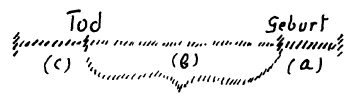
[ 29 ] Consider the relationship between an educator who wishes to adopt a psychoanalytic approach and a student or a patient. By approaching the inner life of the individual—which extends into the emotional sphere—the educator does not merely engage with the individual’s personal life, but with the comprehensive life that extends far beyond the individual. However, with regard to this comprehensive life, the connections between people cannot be exhausted by mere ideas; rather, they lead into real-life contexts—this is very important! So if you imagine that such a relationship were to take place between the psychoanalytic educator and the student, what unfolds there could not take place merely in the realm of the imagination—by teaching the person in question something—but real karmic relationships would have to be established, because one is intervening much more deeply in life. One would, so to speak, tear the individual in question out of their karma, altering the course of their karmic development. It is not possible to treat that which extends beyond the individual on an individual basis; rather, it must be treated generally, in a universally human way. We have been brought together in a particular epoch, so a common force must be at work as soon as one goes beyond the individual. This means that it must not be a matter of one individual facing off against another and treating the individual therapeutically or pedagogically, as a psychoanalyst does; rather, something universal must come into play. Something must enter the culture of the times that directs the soul toward what would otherwise remain subconscious; and what emerges must simply become part of the milieu, not a matter that plays out from individual to individual.
[ 30 ] This is the great mistake that is being made—one of immense consequences and enormous significance. Instead of directing our efforts toward permeating spiritual life with what knowledge of the spiritual world can become—as it must be in the present—we confine those souls in whom the pathological effects of repressed spiritual life are evident to sanatoriums and treat them individually. This can never lead to anything other than the formation of karmically entangled relationships; rather than what takes place between individuals resulting in a genuine elevation of the subconscious soul content, karmic relationships are formed between the practitioners and the patient, because the process encroaches upon the individual sphere.
[ 31 ] You see, one enters into real, concrete life—a life one must not treat lightly, a life one can master only when one strives for nothing other than what is universally human in this realm. One must learn these things precisely through people’s concrete relationships with the spiritual world. Therefore, it would be helpful if people were willing to stop talking in abstract terms—as Jung does—about how human beings experience everything that humanity has gone through, all manner of demons; but he turns them into abstract demons, not realities, by stating outright that discussing their existence is foolish. He turns them into abstract demons, into mere demons of the mind. Yes, mere demons of the mind could never make a person sick; they can never be in the subconscious, but can only be in the conscious mind. That is the crux of the matter: that people who indulge in such theories are themselves working with so many unconscious notions that they cannot arrive at the truth. People end up absolutizing certain concepts. And I must say again and again: wherever concepts begin to be absolutized, one always ends up at a dead end, or one comes face-to-face with a pit into which one’s thinking falls.
[ 32 ] A person like Dr. Freud is compelled to extend the realm of sexuality to encompass the entire human being, so that he can explain, from within the realm of sexuality, everything that occurs in such psychological phenomena. I have told various people who approach me with psychoanalytic leanings that a theory, a worldview, must be able to hold up when applied to itself; otherwise, it crumbles into nothing. I said that the simple logical fallacy is the model, if one only extends it concretely enough. “All Cretans are liars,” says a Cretan. If a Cretan says this, and if it were true, it would have to be a lie, and then this assertion negates itself; it destroys itself. So it is not possible for a Cretan to say, “All Cretans are liars”—with the pretense that the statement is absolutely true. This is merely the pattern—the logical pattern—of absolutization. But every theory must be able to be tested against itself in this way without crumbling. Test Freud against Freud, the way he brings up his subconscious matters, and then you must say: Freudian theory stems from sexual life; it is merely a result of sexual life. — Just as the assertion “All Cretans are liars” must stem from a lie and crumble when applied to a Cretan, so too does the assertion of the universality of sexualism crumble when tested against the facts themselves. And so it is with other things. Admittedly, one can understand such a principle for a long time without applying it in a thoroughly vital, realistic way. But precisely this will be a special achievement of anthroposophically oriented spiritual science: that it can also be applied to itself in this way.