

Historical Necessity and Freedom
The Influence of Fate from the World of the Dead
GA 179
10 December 1917, Dornach
Translated by Steiner Online Library
Third Lecture
[ 1 ] I would like to briefly touch on a few facts that have been mentioned as an introduction, because we will need them as we proceed with our discussion. I have said that within the human being himself—including on the soul level—lies what we might call the threshold between the ordinary sensory-physical world and the soul-spiritual world. And this is so in the sense that in the ordinary waking consciousness with which human beings are endowed between birth and death, we are actually fully awake only in relation to sensory perceptions—that is, in relation to the perception of everything that comes to us through our senses— and also with regard to everything we develop in the form of ideas—whether these are ideas we form about what we have sensed, or ideas that arise from within us to comprehend and bring the world to life. Even a very ordinary act of self-reflection teaches us—and no clairvoyant gift is necessary for this—that ordinary human consciousness, even when fully awake, cannot encompass more than the realm of the life of the imagination and the realm of sensory perceptions. Within our own soul, moreover, we experience our world of feelings and our world of will. But we have said that we experience our emotional world only in the same way that we experience a dream, that the life of dreams extends into ordinary waking consciousness, and that, in fact, by being sentient human beings, we are dreamers of life. For at the very foundation of emotional life, things are taking place of which waking consciousness knows nothing through imagination or sensory perception. Waking consciousness knows even less about the actual processes of the life of the will. In ordinary waking consciousness, a person dreams away their emotional life and sleeps through their volitional life. Thus, beneath our life of imagination lies a realm in which we ourselves are embedded, and which is only partially known to us—known to us only through the waves that wash over its surface.
[ 2 ] Furthermore, we have emphasized that in this realm—which human beings thus dream away and sleep through—the human souls live together with us in the state of existence between death and a new birth. We are thus separated from the so-called dead only in that we are unable, with our ordinary consciousness, to perceive how the forces of the dead, the life of the dead, and the actions of the dead interplay with our own lives. For these forces, these actions of the dead, continually permeate our emotional and volitional lives. We therefore live with the dead. And it is indeed significant to realize, in our present time, how spiritual science has the task of developing this awareness of our connection with the souls of the dead.
[ 3 ] The rest of Earth’s evolution cannot unfold—if it is to unfold for the benefit of humanity—without humanity developing this vivid sense of connection with the dead. For the lives of the dead influence the lives of the so-called living in manifold and indirect ways.
[ 4 ] And it is not without reason that, in the course of the public lectures, attention has been drawn to how historical life—that is, what a person experiences historically and socially, and what they experience in relation to ethical processes among human beings—actually has the nature of a dream or sleep; that the impulses a person develops when they step outside their own personality—that is, when they act within the human community—are impulses of dreaming and sleep.
[ 5 ] People will view history quite differently once they have come to a vivid awareness of this. They will no longer regard history as that “fable convenue” which is generally called history today, but they will realize that historical life can only be understood if one seeks within that historical life what is, to ordinary consciousness, dreamlike and overlooked—but into which, as we have seen, the impulses, deeds, and actions of the so-called dead first come into play. The actions of the dead are interwoven with the feelings and the impulses of the will of the so-called living. And that is, in fact, history.
[ 6 ] A person does not cease to be active within the human community once they have passed through the gate of death. They continue to be active, albeit in a different way than they must be active here in the physical body. But much of what a person, due to their illusions, believes they are doing—because it flows from their feelings and impulses of will—actually flows down to our own time, where we carry out the corresponding actions, from the actions of those who have passed on.
[ 7 ] The realization that, at the very moment when one’s life within human community is at stake, one is also acting in communion with the dead—this will be a significant factor in the future development of humanity. Of course, such an awareness—which essentially relates to the life of feeling and will—must also be grasped through feeling and will. Abstract, dry concepts will never be able to grasp this, but concepts drawn from the realm of spiritual science will be able to do so. In many respects, however, people will have to get used to forming entirely different concepts.
[ 8 ] As you all know, anyone who is deeply immersed in grasping the impulses of spiritual science can try to remain in contact with those who have passed through the gate of death. And among the thoughts of spiritual science—the ideas we form about the processes in the spiritual worlds—there are certain thoughts that are comprehensible to us earthlings, but which are also comprehensible to the souls of the dead. And from this arises what we call “reading aloud to the dead.” When we read aloud from spiritual science texts while thinking of the dead, this is a true communal life with the dead. For spiritual science speaks a language that is common to both living and dead souls. But the point is to approach these things more and more through our emotional life—through an emotional life that has been illuminated.
[ 9 ] For consider some of what I said yesterday. Between death and a new birth, human beings live in an environment that is essentially permeated not only by life, but by sentient life. That, I said, is already their lowest realm. Just as the insensate mineral kingdom is what surrounds us during our sensory life, so too is there a realm of this nature surrounding the dead, such that if they touch anything within it, they evoke pain or joy. Thus it is with the dead: it is as if, in life, we knew that as soon as we touch a stone or a tree leaf, we evoke feelings. There is nothing the dead person can do without evoking feelings of joy, feelings of pain, feelings of tension, feelings of relaxation, and so on in their surroundings. By being in connection with the dead person—as is the case when reading aloud—that communion we have already spoken of then arises for the dead person themselves, but specifically in this particular instance of reading aloud. Through this, the deceased enters into connection with the soul who is reading to him here, with the soul to whom he is somehow particularly connected karmically. And just as the deceased, in his lowest realm—which we had to associate with the animal kingdom—exists in such a relationship that everything he does evokes joy, suffering, and so on, so, too, is he connected to everything that arises in connection with human souls—whether they are human souls living here on Earth or human souls who have already shed their physical bodies and are living between death and a new birth—in such a way that, through what is taking place in other souls, he experiences either an uplifted or a numbed sense of life.
[ 10 ] Think about this for a moment. When you read aloud to a so-called living person here, you know that—in the sense of human understanding—he understands what you are reading to him. The dead person lives within it; the dead person lives in every word you read to them; the dead person penetrates what passes through your own mind. The dead person lives with you; he lives more intensely with you than he ever could have lived during his life between birth and death. This can lead you to an understanding of communion with the dead. And this communion with the dead is actually, when sought, quite intimate, and this togetherness with the dead is deepened through contemplative consciousness.
[ 11 ] If a person truly and consciously enters that realm which we share with the dead, then communication with the dead is as follows: If, for example, you read aloud or recite something to the deceased, you will hear from them—as if from a ghostly echo—what you yourself are reading. One must familiarize oneself with such concepts if one wishes to gain a true understanding of the concrete spiritual world. Things are different in the spiritual world than they are here. Here, you hear yourself speak, or are aware that you are thinking, when you speak or when you think. If you speak to the dead, or enter into a connection with them through thought, then—when the connection is consciously perceived—what you speak to them, or what you direct toward them in thought and imagination, resounds from within the dead person themselves.
[ 12 ] Furthermore, when you send a message to the deceased, you feel a deep sense of connection. And if he responds to that message, you initially have a vague awareness: the deceased is speaking. You have the vague awareness that the deceased has spoken, and you must now draw from your own soul what he has said. From this, you realize how essential it is for true spiritual communication to hear from the other what you yourself think and imagine, and to hear from within yourself what the other is saying. This is a kind of reversal of the entire relationship between beings. But this reversal takes place when one truly enters the spiritual world.
[ 13 ] Because the spiritual world is so fundamentally different from the physical world, and because, since roughly the 15th century, people have sought to form only concepts that are shaped in the image of the physical world, they are blocking and hindering their own access to the spiritual world. If people were only willing to at least consider the possibility that there might be a world which, in a certain sense, not in every respect, is the opposite of what humans here call the “real world”—if people are ever willing to form ideas that might seem utterly absurd to those who wish to live only in a materialistic world—only then will they transform their souls in such a way that they gain the ability to truly look into this spiritual world, which is, after all, constantly all around us. It is not that human beings are necessarily separated from the spiritual world by their very nature; rather, it is because, through habit and hereditary influences, people have, since the 14th and 15th centuries, completely lost the ability to form concepts other than those borrowed from the physical world here. This has even come to be true of art! What else does contemporary art seek to create other than what is modeled after, and what also forms out there in nature? Even in art, people no longer wish to accept what arises freely as a reality from the soul’s spiritual life. But people cannot erase what is active and effective in historical events, in ethical and moral coexistence, and in social coexistence itself as something that arises freely—even if they dream it away or sleep through it. As soon as a person goes even the slightest bit beyond what are his very own, most personal affairs—and he does go beyond them in every moment of life—the spiritual world, that world which we—I must emphasize this again and again—share with the dead, works through his arm, through his hand, through his word, through his gaze.
[ 14 ] The deceased now settles into the realm I have already spoken of, just as we, as we grow from childhood onward, settle into life between birth and death—into the mineral, plant, animal, and human physical worlds. As the deceased thus becomes accustomed to the lowest realm, which is related to the animal kingdom, and to the second realm, in which a community forms with all the souls with whom the deceased has a direct or indirect karmic connection, the deceased simultaneously develops the capacity to acclimate to the realm of those beings who now—if I may use the expression, although it can only be meant somewhat figuratively—stand above humanity: first and foremost, the realm of the Angeloi, Archangeloi, and Archai.
[ 15 ] Here in the physical world, human beings stand—as many are so fond of emphasizing—as the crown of physical creation. Here, they feel themselves to be the highest of all beings. The mineral beings are the lowest, then come the plant beings, then the animal beings, and finally human beings. They feel they belong to the highest kingdom. This is not the case with the dead in the spiritual realm; for the dead feel themselves to be connected to the hierarchies that stand above them: the hierarchies of the Angeloi, Archangeloi, Archai, and so on. Just as human beings here in the physical world feel, in a sense, as though they are emerging and growing out of the mineral, plant, and animal kingdoms—the physical human kingdom—so do the dead feel held and supported by the hierarchies above them in the life between death and a new birth.
[ 16 ] The way in which a person gradually becomes attuned to these realms—the realms of the Angeloi, Archangeloi, Archai, and so on—can be described as follows: one feels it as a detachment from oneself. — Once again, we must form a conception of these things that cannot be gained at all in the physical-sensory world. In the physical-sensory world, as we grow from childhood onward, we gradually come to know things: first our immediate surroundings, then what is to become our life experience in the wider world, and so on. We come to know things in such a way that we are aware they approach us step by step. This is not the case between death and a new birth. From the moment we realize that we are now in relationship with the angels, we feel as if we had been connected to them since time immemorial, as if we belonged to them, were one with them—but as if consciousness can develop only by our, so to speak, detaching the idea of the angels from ourselves. Here in the physical world, we gain our experiences by taking in these concepts. In the spiritual world, we gain our experiences by, so to speak, detaching these concepts from ourselves. We know we carry them within us; and we know we are completely filled with them. But in order to bring them into consciousness, we must detach them from ourselves. And so we detach the concepts of the Angeloi, the Archangeloi, and the Archai.
[ 17 ] Through the lowest kingdom, as it were, human beings are connected to the animal nature, which they must master in the sense I have already explained. Then the kingdom above it takes shape in the souls with which human beings are connected karmically, either directly or indirectly. Then they experience their connections to the realm of the Angeloi. It is through these connections to the realm of the Angeloi that much of what establishes the proper relationships with the realm of human souls first comes into being. Thus, it is actually difficult to distinguish, in the life between death and a new birth, between what a human being must do with other human souls and what they must do with the beings from the realm of the Angeloi. Human beings and beings from the realm of the Angeloi have a great deal to do with one another. One can say—although, of course, one can only speak of these things in relative terms, and although all speech can only offer hints—that it is nevertheless true— just as here in physical life our memory carries us back to some event we have experienced, so in the life between death and a new birth a being from the realm of the angels carries us toward something to which we are to be led, something we are to experience. The beings from the realm of the angels are, in fact, the mediators for everything that takes shape in the life of the so-called dead person.
[ 18 ] And the Archangels help with everything a human being must do between death and a new birth in regard to mastering the animal nature—for he must, after all, implant his own animal nature into his spiritual being so that he may prepare himself for the next incarnation. Then, when you grasp this in the right sense, you will say to yourself: By becoming a participant in communion with the angels between death and a new birth, a human being is enabled to establish the right relationships and connections with the souls with whom he is meant to form such bonds. By entering into a relationship with the realm of the Archangels, a person is enabled to prepare in the proper way for what is to unfold in the next earthly incarnation.
[ 19 ] The Archai, those beings whom we have also called the beings of the Zeitgeist, are, however, the beings who work collectively in their tasks for the dead and for the living. From my remarks, you can infer that, essentially, the deceased has a relationship with the Angeloi in that they regulate his relationship with other souls; that the Archangeloi regulate his relationship with his successive incarnations. As for the relationship the deceased has with those beings belonging to the hierarchy of the Archai, this is a relationship—on common ground with the so-called living—with those who are incarnated here in the physical body. The deceased, in the life between death and a new birth, and the so-called living here between birth and death, are both equally embedded in something that is woven by the spirits of the age like a flowing cosmic wisdom and cosmic will-activity. What, in turn, is woven by the spirits of the age is history, is the ethical and moral life of an age, is the social life of an age.
[ 20 ] One might say that we can look up into the realm of the spirit and tell ourselves: There are the so-called dead; what they experience in their realm is governed—insofar as these experiences concern their own affairs—by the angels and archangels; what they experience in common with the so-called living is woven by the beings who belong to the hierarchy of the Archai. And so we cannot act fruitfully in social, historical, or ethical-moral life without being aware that this action must grow out of the elements we share with the dead; it must grow out of the element of the Archai, the spirits of the ages.
[ 21 ] These zeitgeists, however, succeed one another in terms of their mission. We have, after all, spoken about this repeatedly. Such a spirit of the age weaves its influence into the destiny of the ongoing historical, social, and moral-ethical currents of human life over the course of certain centuries; then it is succeeded by another spirit of the age. The moments when one spirit of the age succeeds another are the most crucial for observing what is actually taking place within the development of humanity. For one cannot understand human development unless one grasps with the eye of the soul the living influence of the spirits of the age—and thus of the entire spiritual world; one cannot understand what is actually happening among human beings unless one takes the realm of the spirit into account.
[ 22 ] People think in abstract, highly abstract terms about what is happening socially, ethically and morally, and historically. Just as if history were a continuous stream in which one thing follows another, so humans imagine the flow of time in which events unfold. They ask: Why are the events at the beginning of the 20th century the way they are? — Because they were caused by the events at the end of the 19th century. Why did the events at the end of the 19th century turn out that way? — Because they were caused by those in the middle of the 19th century. And the events in the middle of the 19th century, in turn, were caused by the events at the beginning of the 19th century, and so on.
[ 23 ] It is this way of looking at things—which always regards historical events as consequences of the immediate past—that is about as sensible as if a farmer were to say: “The wheat I’ll have this year is the result of last year’s wheat—the seeds remained; last year’s wheat, in turn, is the result of the wheat from the year before last.” — One thing follows another; effect always follows cause. But that doesn’t happen unless a hand is lent! For the farmer must, of course, intervene personally: he must first sow the seed so that effect may arise from cause. Effect does not arise from cause of its own accord. From a certain point of view, this is in fact the most terrible illusion of the materialistic age—that people believe effect arises from cause, and that they are unwilling to give even the simplest thought to the truth of these relationships.
[ 24 ] I have already cited an event as an example that is a sensational occurrence in human life. But it is often the case that people pay more attention to such sensational events than to other events that are of exactly the same nature but take place constantly—every hour, indeed every moment—within our lives. I have drawn your attention to how such an event unfolds: A man is accustomed to taking a walk along a mountainside; he has done so daily for a long time. But one day, as he sets out and reaches a certain spot on the path, he hears—as if a voice were speaking to him—something like: “Why, exactly, are you walking this path? Do you really need to do this?”—something like that. He becomes concerned when he hears this voice; he steps aside and reflects for a moment on the strange event that has just occurred—a boulder comes crashing down, which would certainly have crushed him had he not stepped aside because of the voice. It is a sensational event. But for those who view the world soberly yet spiritually, it is nothing more than the kind of event that takes place at every moment of our lives. For at every moment of our lives, something else could also happen if this or that were to occur.
[ 25 ] The very intelligent person—we know that people today, in particular, are very intelligent—says: Yes, why wasn’t that man killed? —Because he walked away! That is the cause. — All right; but let’s suppose he hadn’t walked away and had been struck dead—then the very clever person of today would say: The falling rock is the cause of that person’s death.
[ 26 ] From a purely formal, outwardly abstract perspective, it is indeed correct: the falling stone is the cause, and the man’s death is the effect. But he does not consider that the cause has not the slightest thing to do with the effect—for the same thing applies to the falling stone whether the man is standing there or not. This cause has not the slightest thing to do with that effect. Just think about that carefully for a moment, and then try to understand what all this talk of cause and effect actually means. The so-called cause need not have the slightest connection to its effect. For the stone, exactly the same process would take place if the man were not standing there, and it does take place: as far as the stone is concerned, nothing different has happened even though the man was warned and walked away.
[ 27 ] I cited this as an example to show that even in such external, purely formal matters, the so-called cause need not have anything to do with the so-called effect. This entire conception of cause and effect arises solely from abstraction. Speaking of cause and effect is only valid within certain limits. Suppose, for a moment, that you had a tree here with its roots here. Well, what goes on in the roots can certainly be described, in a certain sense, as the cause of what grows there; what goes on in the branches can, in turn, with some justification, be described as the cause of what goes on in the leaves. The tree is, in a certain sense, a whole; and the concrete view of life focuses on totalities, on the whole; the abstract view of life, on the other hand, always links one thing to another without asking: where is a self-contained whole? For the spiritual view of life, however, it is significant to become aware of a wholeness. For you see, where the outermost leaves are, there the tree ceases with what are the inner causes of what happens there. Where the leaves end, there the causative forces also end. But where the causative forces end, something else intervenes. Here, where the causal forces cease—if you look with spiritual eyes—you see the tree surrounded by spiritual essence, by spiritual elemental beings; there begins, if I may put it that way, a “negative” tree that extends into infinity—only seemingly into infinity, for it fades away after some time. The tree’s outward growth is met by an elemental existence, and where the tree ends, it comes into contact with an elemental existence growing toward it (see drawing on p. 66). Such is the way of nature. The plant, as it shoots up out of the ground, comes to an end. The causes end where the plant ends. But an elemental existence grows toward the plant from the cosmos.
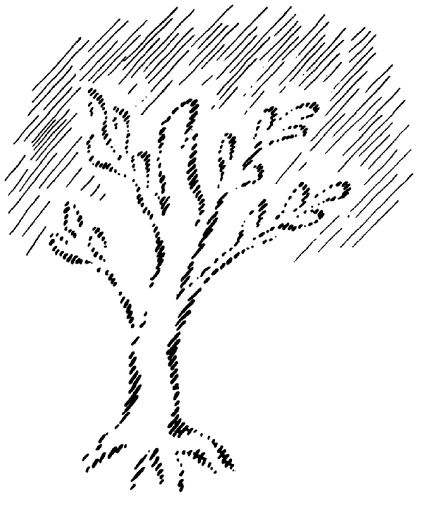
[ 28 ] I have just touched on this to some extent in the lecture titled “Human Life from the Perspective of Spiritual Science.” Plants grow upward from the ground, while the spiritual grows downward from above toward the plants. This is true of all beings. What you see here in nature, however, is present in all of existence. Above all, there is a current of social, ethical-moral, and historical development. What has happened is not such a continuous current; rather, one spirit of the age reigns for a certain time, another replaces it, a third replaces it, a fourth replaces it, and so on. And at the points where one zeitgeist succeeds another, there is also a difference in the stream of continuous events—a break so marked that one cannot say that what follows is the direct effect of what preceded it. It is not the effect of what preceded it in the sense that one might imagine.
[ 29 ] Regularity is already present in what occurs in succession. But what is commonly called “necessity” is an illusion if one understands it as it is often understood today. In the flow of ongoing events, it is quite similar to a place where the tree ends and the elemental tree begins; except that in nature, here a being of the visible, the sensually visible realm, borders on a being that is sensually invisible, that is supersensory. Here, the sensory borders on the supersensory—here, in the stream of time, things of the same kind border on one another; but just as here the visible tree ends and the elemental tree begins, so too here one thing ends and another begins.
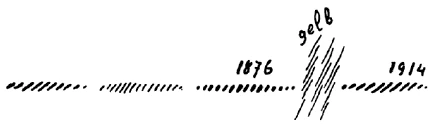
[ 30 ] There are thus periods in history when the old events and the old impulses, so to speak, come to an end and new ones must take their place. At such times, people often cling to Lucifer and Ahriman and hold on to what has in reality already died. In consciousness, one can still hold on to what has in reality already died. In nature, this is not possible. If someone in 1914 wants to cultivate ideas of exactly the same kind as were valid in 1876, they can do so. They can do so because, in the continuous flow of human events—in which one clings to Ahriman and Lucifer—one can preserve the old, even if it is in reality already dead. But it is the same as if someone wanted to make a tree keep growing so that it does not stop when it has reached its natural limits. In history, it usually happens that people do not find the way to properly confront a new epoch in the appropriate manner—that is, to place themselves in the service of the new spirit of the times.
[ 31 ] And this is of a very special, profound importance, especially for our time. Throughout these past weeks, we have spoken of the spiritually significant events that took place in 1879 (see illustration, yellow). An era came to an end then; something died; something ceased, just as the tree here comes to an end. From that point on, it was necessary—and has, of course, remained necessary to this day, and will continue to be necessary for a long time to come—for people to become receptive to ideas and impulses that originate from the spiritual world itself. Otherwise, the old is transformed into Ahrimanic and Luciferic forces.
[ 32 ] This remark conveys something of extraordinary importance. For this final third of the 19th century was a crucial period in human development. It was necessary then, and it remains necessary now, for people to open their minds to the influence of inspired ideas; to this end, people must become receptive. Admittedly, viewed from the outside—though we will not merely consider the matter from the outside but will delve into a deeper, inner perspective—viewed from the outside, it initially appears as if things were actually quite bleak. Impulses had already come from the spiritual worlds, flowing in and working to guide people through this period of the year 1879 in such a way that they would become receptive to inspired ideas. The impulses were already there to give people the thought that, even at the end of the 19th century, they could have had the awareness that: When we act historically, socially, and ethically and morally in community life, then our dead, the angels, the archangels, and the Archai act among us. — That was there. The impulses were there; they simply passed many people by without leaving a trace at first.
[ 33 ] I’d say that today I’m looking at this primarily from an external perspective, and it’s good to take a moment to realize just how seemingly without a trace everything has passed. There were indeed important developments and significant impulses in this second half of the 19th century, as there were already people who had meaningful thoughts and presented them. If you look at these today, these thoughts themselves certainly appear to be abstract, but they are not abstract thoughts. Nor should they remain as they were back then. I’ll repeat it once more: today we’re looking at this from an external perspective; tomorrow we’ll look at it from an internal perspective.
[ 34 ] This was almost always the case in all areas of today’s educational world. Who, for example—to mention another example—here in this country, Switzerland, would look at life in such a way that they would say to themselves: Here in Switzerland, in the 1850s, there was a man who harbored significant ideas—ideas that were, admittedly, philosophical at the time, but which needed to be taken up and popularized by two or three others, and which could have had a most fruitful impact and imbued the entire history of Switzerland with a spiritual dimension! — Who, for example, realizes that a mind of the first order—Otto Heinrich Jäger—was active in the mid-19th century, one of the greatest minds to have created here in Switzerland? Where is his name; where is he mentioned? Where is the awareness that, although his ideas came to light in an abstract form—seemingly abstract—they could nevertheless have become concrete, flourished, and borne fruit, because something truly great passed through this mind, which taught at the University of Zurich and wrote books on the most important ideas — which ought to be breathed into contemporary life —, on the idea of human freedom and its connection to the entire spiritual world. From a different perspective than that from which my philosophy of freedom emerged in the 1890s, Otto Heinrich Jäger created a kind of philosophy of freedom here in Switzerland.
[ 35 ] And just like this one example, one could cite countless others everywhere. The most fruitful ideas sprang up and flourished. But what is recounted today as the intellectual history of the 19th century and into the 20th century is the most insignificant part of what actually took place. And the most significant, the most impressive aspects, have been overlooked. This is how things appear, at least when viewed from the outside. A deeper examination may reveal a more comforting picture.