

Historical Necessity and Freedom
The Influence of Fate from the World of the Dead
GA 179
11 December 1917, Dornach
Translated by Steiner Online Library
Fourth Lecture
[ 1 ] The topic we are now discussing is very broad, and we will not be able to cover it as thoroughly today as I had actually intended, but we will, of course, continue these reflections. For in these reflections, I would like above all to lay the foundation for understanding freedom and necessity in such a way that you gain a picture of what, from an occult perspective, is relevant for understanding the course of social, historical, and ethical-moral human life.
[ 2 ] We have emphasized that, in terms of being fully awake, life between birth and death consists only of what we experience through our sensory perceptions—that which stems from sensory impressions and is experienced in our mental images. In contrast, human beings dream away everything that lives as reality in their feelings, and they sleep through everything that actually lies within the impulses of the will as a deeper necessity—as a deeper reality. In our emotional and volitional lives, we inhabit the same spheres in which the so-called dead are present alongside us.
[ 3 ] Now it would be good if we first formed an idea of what actually lies behind our sensory life as it appears to the outside world. We can imagine sensory impressions as if they were spread out before us like a carpet. Of course, we must imagine this carpet as also encompassing auditory impressions—all the impressions of the twelve senses, as we know them from anthroposophical considerations. You know that the actual number of senses is twelve. This sensory carpet, so to speak, conceals a reality that lies behind it. We must not imagine this reality lying behind sensory perceptions in the same way that, for example, the natural scientist imagines the atomic world, or as a certain philosophical school speaks of the “thing-in-itself.” For I have even emphasized in my public lectures: To search for a “thing-in-itself,” as contemporary philosophy does, as Kantianism does, would be roughly the same as trying to ascertain the reality of the beings one sees in a mirror by breaking the mirror to see what lies behind it. — In this sense, I am not speaking of something that lies beyond sensory perceptions, but rather of something that lies beyond sensory perceptions as a spiritual realm in which we ourselves are embedded, yet which is beyond the reach of the ordinary human consciousness that one possesses between birth and death. At the moment when we were, so to speak, to unravel the tapestry of the senses at a first stage, so that we would see outwardly more than the multiplicity of sensory impulses—what would we see at this first stage of the spiritual unravelling of the tapestry of the senses? Let us consider this question.
[ 4 ] At first, it may come as a surprise what must be identified as the very thing one sees first. What one sees there at first is a sum of forces, all of which are directed toward impelling our entire life from birth—or, let us say, from conception—until death. We would not see our life in individual events if we were to unravel the tapestry of the senses, but rather in its entire nature. We would not find something entirely alien at first; we would find ourselves at the first stage of unraveling sensory perceptions—but not ourselves as we are at this very moment, rather ourselves as we are constituted throughout this entire life between birth and death. This life, which does not play out in our physical body and therefore cannot be perceived by the physical senses, plays out in our etheric body, in our body of formative forces. And our body of formative forces is essentially an expression of this life, which we would be able to survey if we were to shut off the senses and sensory perceptions. If, so to speak, the veil of the senses were to be torn away—and it is torn away when a person ascends to the realm of vision—then the person finds themselves as they truly are for this earthly incarnation in which they are making the observation in question. But as I said, the senses are not suited to perceiving this.
[ 5 ] What is capable of perceiving this? Human beings already possess what is capable of perceiving this; but they possess it at such a stage of development that there can be no question of actual perception at present. What would be perceived there does not enter the eye or the ear, nor does it enter the sense organs; rather—and I ask you to understand this clearly—it is inhaled, drawn in with the breath. And that which underlies our lungs on the etheric level—for we cannot speak of the physical lungs here at all, since the lungs, as they are, are not direct organs of perception—that which underlies our lungs on the etheric level is actually an organ of perception, but for human beings between birth and death, it is an organ of perception that cannot be used to perceive what is inhaled there. In the air we breathe in, our deeper reality actually lies in every breath, as it fits into the overall rhythm of life from birth to death. It is simply the case that what underlies the entire lung system is, on the physical plane, undeveloped in human beings; it has not progressed to the point of being able to perceive. If what actually constitutes our respiratory system—that which lies at its etheric foundation—were to be examined and properly understood, it would essentially prove to be exactly the same as what, physically and for the physical world, our brain and the sense organs are. In what underlies our respiratory system, we have a brain at an earlier stage of development—at a stage one might call still childlike. In this respect, too, we carry within us, so to speak—and I say expressly: so to speak—a second human being. And you are not mistaken in imagining that, in addition to the physical head that a human being carries, there is also an etheric head, which is not yet usable as a sense organ in ordinary life, but which, in its potential, possesses the capacity to perceive what lies behind the form-forming body—that which creates this form-forming body. But this—what lies behind the form-forming body, creating it—is that into which we enter when we pass through the gate of death. We then shed the form-forming body itself, but we enter into that which creates it, that which produces it. It may be a difficult concept to grasp; yet it is good if you try to really think this idea through to its conclusion. Schematically, we could still clarify the matter for ourselves.
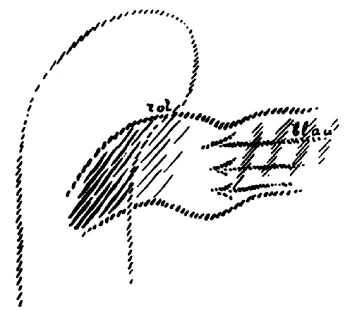
[ 6 ] We visualize the physical system of the head, and we visualize the physical system of the lungs (see diagram, red), with cosmic impulses (blue arrows) flowing in from the cosmos and expressing themselves rhythmically in the movements of the lungs (red hatching). Through our lungs, we are connected to the entire cosmos, and the entire cosmos works upon our etheric body. We shed the etheric body itself when we pass through the gate of death, but we enter into that which plays a part in our pulmonary system; this is connected to the entire cosmos. Hence that remarkable correspondence between the rhythm of human life and the rhythm of breathing. As you know—I have explained this here before—if you calculate the 18 breaths a person takes per minute to determine the number of breaths in a day, that is 18 times 60 per hour; multiplied by 24 for the day, that makes 25,920 breaths in a day. A person inhales and exhales; this provides their rhythm, their smallest rhythm to begin with. But then there is another rhythm in our lives, as I have already hinted to you: it consists in the fact that every morning upon waking, we inhale our soul, the “I,” and the astral body into our physical system, so to speak, and exhale them again when we fall asleep. We do this throughout our entire physical life. If we assume an average human lifespan, we can calculate it as follows: 365 times a year, we breathe ourselves out and breathe ourselves in. If we assume an average human lifespan of, say, 71 years, that comes to 25,915. As you can see, essentially the same number—though life is not the same for every individual—25,920 times over the course of a life between birth and death, we breathe in and out that which we call our true self. So we can say: Just as we relate to the elements around us with each breath, so do we relate to the world to which we ourselves belong. We live in harmony with the cosmos throughout our lives, in the same rhythm that we maintain through our breathing during the day. And again, if we take our life—say, roughly 71 years—and regard this human life as a cosmic day—let’s call a human life a cosmic day—then a cosmic year would be 365 times that amount, 25,920, which is, again, approximately one year. But that is the time it takes for the Sun to return to the same constellation: 25,920 years. If the Sun appears in Aries in a given year, after 25,920 years it will rise again in Aries, for the Sun moves through the entire zodiac in the course of 25,920 years. Thus, a year of human life—exhaled from the cosmos—is a breath of the cosmos that relates to cosmic becoming, to the cosmic cycle of the Sun through the zodiac, just as a breath relates to daily life. A profound inner law! You see, everything is built upon rhythm. We breathe in threefold ways, or at least we are involved in a threefold breathing process. First, we breathe through our lungs within the elements—in a rhythm determined by the number 25,920. We breathe throughout the entire solar system when we regard the rising and setting of the sun as running parallel to our falling asleep and waking up. We breathe throughout our entire life in a rhythm that is, in turn, determined by the number 25,920. And finally, the universe exhales us and inhales us again in a rhythm that is, in turn, determined by the number 25,920—determined by the Sun’s orbit around the zodiac.
[ 7 ] Thus we are placed within the entire visible cosmos, which is now underpinned by the invisible cosmos. We enter this invisible cosmos when we pass through the gate of death. Rhythmic life is the life that underlies our emotional life. We enter into the rhythmic life of the cosmos during the time we experience between death and a new birth. This rhythmic life, as our etheric life, lies spread out behind the veil of the senses, determining our existence. At the moment one attains a contemplative consciousness, one would see this cosmic rhythm—which is, in a sense, a rhythmically undulating cosmic sea—now in its astral form. And in this rhythmically undulating astral sea are also present the so-called dead, the beings of the higher hierarchies, and that which belongs to us but lies beneath the threshold—from which only the feelings that are dreamt away and the impulses of will that are slept through in their own reality rise up.
[ 8 ] The question may be raised—we may put it this way, comparatively and without falling into teleology: Why has the wise guidance of the universe arranged things so that human beings, as they are between birth and death, do not perceive what lies behind the veil of the senses as rhythmic life? Why is the human head—the hidden head of the human being, corresponding to the respiratory system—not suited to such perception? Indeed, this leads to a truth which, one might say, has been kept as a secret by the relevant occult schools right up to our own age, because this secret is connected to other secrets that are not to be, and should not be, revealed—at least not yet. But in our time, the era has finally arrived in which such things must be brought to the consciousness of humanity.
[ 9 ] The occult schools that have been established here and there still preserve such things in many cases today, for reasons that will not be discussed here, even though these things must now necessarily be brought within the reach of human consciousness. But since the last third of the 19th century, means and ways have been available through which what the occult schools—in many cases unjustifiably—withhold can be overcome. This is connected to the event I spoke to you about, which occurred in the fall of 1879. For now, we can only touch upon the very edge of this mystery. This outermost fringe of the mystery alone ranks among the most significant insights into the human being. It is indeed a head that we carry within us as the head of a second human being; it is a head—but what belongs to this head is also a body, and the body that belongs to it is, at first, an animal body. Human beings therefore carry a second human being within themselves: this second human being has a fully developed head, but an animal body attached to it—a true centaur. The centaur is indeed a truth. It is, in fact, an etheric truth.
[ 10 ] What is significant is that this being possesses a relatively great wisdom—a wisdom that relates to the entire cosmic rhythm. What the head belonging to this centaur perceives is the cosmic rhythm in which human beings, as beings living between death and new birth, are also embedded. It is that rhythm of the worlds, which has itself been demonstrated numerically in three ways here, that rhythm upon which many mysteries of the cosmos are based. This head is far wiser than our physical head. All human beings carry within themselves another, very wise human being—namely, the centaur. But at the same time, despite its wisdom, this centaur is endowed with all the wild instincts of the animal realm.
[ 11 ] Now you will understand the wise guidance of the worlds. It could not give human beings a consciousness that is, on the one hand, powerful and able to perceive the rhythm of the worlds, but on the other hand, unbridled and driven by wild impulses. But what is animalistic in this centaur in one incarnation—and please consider what I am about to say in conjunction with other lectures in which I have illuminated this topic from a different perspective—will be tamed in the next incarnation as he passes through the world of the rhythm of the worlds between death and new birth. What underlies our respiratory system in the present incarnation—what is hidden there—appears as your physical head, which is then, however, diminished to its limited sensory knowledge; and in the next incarnation, it appears as the whole human being, now also tamed in regard to its wild impulses. What is a centaur in this incarnation is the sensually perceiving human being in the next incarnation.
[ 12 ] And now you will understand something else. Now you will understand why I said that between death and a new birth, the lowest realm for human beings is the animal realm, and they must master its forces. What, then, must they do? In what must he participate between two incarnations? He must participate in transforming the centaur—the animal nature within him—into the human nature for the next incarnation. This truly requires knowledge that must extend across the impulses of the entire animal kingdom—impulses that, in their attenuated form, were atavistically inherent in the people of the age in which Chiron lived. Even though the insights Chiron speaks of are attenuated forms of this incarnation, they are of this nature. But you see the connection. You see why, between death and a new birth, the human being needs this lower kingdom, in which he must become a master: he needs it because he must transform the centaur into a human being.
[ 13 ] What anthroposophically oriented spiritual science offers had, until now, actually only been grasped in isolated flashes of insight outside the occult schools. But there have always been individuals who have come upon such things as if through flashes of light in their lives. Especially in the 19th century, I would say with a sense of foreboding, certain minds came to realize that within human beings lies something akin to wild, yet tamed, instincts. There are writers who speak of this. And from the way they speak of it, one can see how alarmed they are by this realization. Indeed, these higher truths are not as easy to digest intellectually as today’s scientific findings. These higher truths do indeed sometimes have the quality of making one recoil in fear at their reality. And there were minds in the 19th century who were terrified, who were deeply shaken when they perceived what actually speaks from the sometimes bewildered gaze of a human being or from other aspects of the human being. One of the 19th-century writers expressed this starkly when he said: “Every human being actually carries a murderer within.”—He was referring to this centaur that had come into his consciousness in an unclear way.
[ 14 ] The fact that there is something mysterious at the core of human nature—something that people must gradually come to understand—is something that must be emphasized again and again. These things must be faced with courage and composure. But they must not be trivialized, for they bring human consciousness face to face with the profound seriousness of life. And to penetrate the seriousness of life—that is what is set before humanity for this time to come, a time that has now begun amid such terrible signs.
[ 15 ] This is one aspect through which I wish to lay the groundwork for a certain line of thought, which we will then continue shortly. The other aspect is as follows: A person passes through the gate of death; as I mentioned last time, the entire experience then becomes quite different, for I hinted to you that communication with a deceased person actually proceeds in such a way that what one communicates to them seems to speak from within them, and what they communicate to you seems to speak from the depths of your own being. The mutual relationship is virtually reversed in communication with the deceased. When you interact with a living person here, you speak. You hear yourself saying what you are communicating to the other person. From them, you hear what they are communicating to you. When you communicate with the dead, what they say rises up from your own soul, and what you have communicated to them echoes back to you from them. In and of itself, you do not perceive what you have communicated to them; rather, you perceive it in them. I wanted to give this merely as an example of the radical difference that exists between the physical world here, in which we live between birth and death, and the world in which we live between death and a new birth.
[ 16 ] We look into it by viewing this world from one side: by looking through the tapestry of the senses, we look into the rhythm of the world. But this rhythm has two sides. I would like to illustrate these two sides of the rhythm schematically by first drawing a number of stars—let’s say planets—here (in red). Let these be a number of stars, planets. For the sake of argument, let this be the planetary system to which our Earth belongs. The human being passes through this planetary system during the time that lies between death and a new birth. There is a series of lectures, now in print, where you can learn about these things. The human being passes through the system. But as they pass through what is still the visible world, they also enter—in the time between death and a new birth—the world that is no longer visible, that is not even spatial. These are difficult concepts to discuss, however, because human beings are accustomed—based on their experiences here in the physical world, where they can imagine anything at all—to conceiving of things in spatial terms. But there is a world beyond what is perceptible to the senses, one that is, however, no longer spatial. I can only express it schematically in spatial terms.
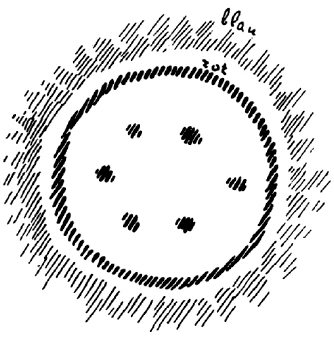
[ 17 ] The ancients said: Beyond the planets lies the fixed-star sky—though that is not strictly accurate, it doesn’t matter now—and beyond that lies the supersensible world. — The ancients depicted it spatially, but that is only a figurative representation of it (see drawing, blue).
[ 18 ] Once a person has entered this supersensible world during the time between death and a new birth, one can say—even though this is again a figurative expression—that the person is then beyond the stars, and the stars themselves serve as a kind of reading material for them. So the stars serve as a kind of reading material for the human being between death and a new birth. Let’s be very clear about what this means. How do we read when we read here on Earth? When we read here on Earth, we have about twelve consonants and seven vowels with various nuances. We combine these letters into words in the most diverse ways. We jumble them up, the letters. Imagine how a typesetter jumbles things up in the type case so that they become words. After all, all words are formed from the specific letters we have. What these letters are for a person here on the physical plane—these roughly twelve consonants and seven vowels with their various nuances—are, for the dead, the fixed stars of the zodiac and the planets. The fixed stars of the zodiac are the consonants, and the planets are the vowels. Once one is beyond the starry sky, one sees peripherally. A person sees centrally while between birth and death; their eye is here, and from there they gaze outward toward various points. It is hardest to imagine that this is reversed after death: there, one sees peripherally. One is actually on the periphery and sees from the outside the stars of the zodiac—the consonants—and the planets—the vowels. And so one looks in from the outside at what is happening on Earth. And depending on which part of one’s being one activates, one sees—you must not imagine this from Earth’s perspective, but rather the other way around, looking down upon Earth—through Taurus and Mars down to Earth, or you see through Taurus, between Mars and Jupiter. You read as you, as a deceased person, circle the Earth; you read with the help of the star system. Only you must now imagine this reading somewhat differently. After all, we could also read differently; it just wouldn’t be as technically convenient as our current reading system. One could also read differently. One could read in such a way that we have the letters in sequence: a, b, c, d, e, f, g, and so on, or according to some other system—and instead of tossing them back and forth in the type case, we could read in such a way that, for example, when “der” is to be read, a beam of light falls on the “der”; if “geht” is to be read, a beam of light would fall on “geht.” So the order of the letters could come last, and they could be illuminated one after another in that sequence. It wouldn’t be very convenient technically, but you could at least imagine a life on Earth in which reading would be accomplished in such a way that one takes an alphabet, and then there would be some kind of device that always illuminates one letter at a time; then one reads the sequence of illuminated letters one after another—and it would result in Goethe’s Faust. Of course, this isn’t easy to imagine, but there is a way to picture it, isn’t there?
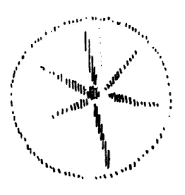
[ 19 ] But this is how the dead man reads with the help of the star system: The fixed stars remain stationary, and he moves, for he is within the movement. The fixed stars remain stationary; he moves. If he is to read the Lion above Jupiter, he moves his being in such a way that the Lion stands above Jupiter for him, just as we read “der” by bringing the “d” together with the “e,” and so on. This reading of earthly conditions from the cosmos—which includes the invisible cosmos—thus consists in the fact that what spiritually underlies the stars can be read by the dead. However, the entire system is designed for stillness; this entire divine system of reading from the cosmos is designed for stillness. What does that mean? It means: According to the intentions of certain beings of the higher hierarchies, the planets should actually be still, should present a still form. Then only the being that behaves as a reader from the outside would be in motion. It would be possible to read the Earth correctly from the cosmos if the planets were at rest, if they were in a state of stillness.
[ 20 ] They are not! Why are they not? They would be if the creation of the world had proceeded in such a way that the spirits of form—the Exusiai, as we call them—had brought the world into being on their own. But, as you know, Luciferic spirits intervened, interfering in the world. Luciferic spirits brought over from the Earth’s lunar phase—during which certain things, which later passed into the power of the spirits of form, were subject to the spirits of motion—this system of motion: they set the planets in motion. The fact that the planets are in a specific motion is a Luciferic element in the cosmos. In a certain sense, this introduces unrest into the Elohimic order; it introduces a Luciferic element into the cosmos. It is precisely this Luciferic element that human beings must come to know between death and a new birth; they must come to know it precisely by learning to subtract, as it were, from what they perceive, that which arises from the movement of the planets, the wandering or changing stars. They must subtract this, they must account for it; only then will they arrive at the truth.
[ 21 ] One does indeed learn a great deal between death and a new birth about the workings and interplay of the Luciferic forces in the cosmos. And such things as the course of the variable stars and the course of the planets are connected with the Luciferic forces.
[ 22 ] This is the other side I wanted to draw your attention to. But you can see from this how that other life—the one we live between death and a new birth—is connected to our life here. One might say that the world has two sides. Here, between birth and death, we perceive one side through the senses. From the other side, we view it with the eye of the soul during the time between death and a new birth. And between death and a new birth, we learn to interpret the conditions here on Earth in relation to those of the spiritual world.
[ 23 ] Let us be very clear about this; let us try to put ourselves in these circumstances. We will have to admit that there is indeed a profound meaning to the statement that the world, which human beings initially come to know through their senses and their intellect, is a maya. As soon as one approaches the real world, however, the world one knows relates to this real world in the same way that what appears inside a mirror relates to what is in front of the mirror—as something living that is merely reflected in the mirror.
[ 24 ] Well, if you have a mirror here and there are various figures inside it, that indicates that there are figures outside the mirror that are being reflected. Suppose you look into the mirror as an uninvolved observer. (A drawing is made.) The two figures I’ve drawn there are fighting—as you can see, they’re fighting. While this does indicate that the figures reflected in the mirror are doing something, you cannot claim that Figure A inside the mirror is beating up Figure B inside the mirror. What appears in the mirror is an image of the fight because the figures outside the mirror are doing something. If you believe that Figure A, who is in the mirror as a reflection, is doing something to Figure B, who is also in the mirror, then you are laboring under a completely mistaken belief. You cannot establish relationships or connections between the mirror images; rather, you can only say: What is expressed in the mirror images points to something in the world of reality that is being reflected. — But the world that humans have as a given is a mirror, is a Maya, and in this world, humans speak of causes and effects. When you speak of causes and effects in this world, it is exactly as if you believed that reflection A inside there is beating up reflection B. Something happens in the real beings that are reflected; but the impulses of the beating do not lie within reflection A or reflection B.
[ 25 ] Examine the entire natural order: as it first appears to the senses, it is a maya, a reflection, something mirrored. Reality lies beyond the boundary I have indicated, which lies between the life of the imagination and the life of feeling. Even your own reality is not even contained within what waking consciousness encompasses. But this reality of your own is contained within spiritual reality, into which the dreaming and sleeping powers of feeling and will plunge. So, as you can see, to speak of causal necessity within Maya is an absurdity; it is also an absurdity to speak of cause and effect in the historical sequence of events. An absurdity! To what I have said, I would add that it is an absurdity to say that the events of 1914 are a consequence of the events of 1913, 1912, and so on. That is just as sensible as saying: “Oh, that A in the mirror—he’s a bad guy; he’s beating up B in there!” — To get to the true reality—that is what matters. And the true reality lies beneath the threshold that is crossed downward from our world of feeling and will, but which does not enter ordinary waking consciousness. And that is also where the centaur I spoke of lives.
[ 26 ] You can see that the notion—“Something had to happen” or “Something was necessary”—must be understood differently than it is in conventional history or even in the natural sciences; that one must raise the question: What are the real entities that brought about the fact that what occurs at a later point in time follows what occurred at an earlier one? — The so-called historical events of the past are merely reflections; they cannot bring about what happens afterward.
[ 27 ] But that, in turn, is only one side of the matter. The other side will become clear to you when you consider that, in the life of the imagination and the senses, waking reality is actually only a mirror of true life—a Maya. But this Maya cannot bring about anything. This Maya cannot be a cause; it cannot be any real cause. Human beings, however, are capable of allowing their pure ideas to guide their actions. This is an empirical fact of life: when a person is driven not by passions, instincts, or desires, but by pure ideas. This can happen, and it is possible; a person can be motivated by pure ideals, by pure ideas. But these ideas themselves cannot bring about anything. So I can perform an action under the influence of a pure idea; but the idea itself cannot bring about anything.
[ 28 ] To understand this, compare it once again to the idea of a reflection. Yes, the image in the mirror cannot cause you to run away. It doesn’t have to please you, or it has to be something that has absolutely no connection to the mirror image at all for you to run away. The mirror image itself cannot pick up a whip and cause you to run away. That cannot be the cause. But when a person acts under the influence of his mirror images—that is, his ideas—then he acts out of Maya; he acts, in fact, out of the mirror of the world: It must be he who acts; therefore, he acts freely. When he follows his passions, he does not act freely; not even when he follows his feelings does he act freely. When he follows his ideas—which are merely mirror images—he acts freely. This is why I explained in The Philosophy of Freedom that when a person follows pure ideas—that is, pure thought—he is a freely acting being, because pure ideas cannot bring about anything; thus, the bringing about must come from elsewhere. I elaborated on this point using this same image once again in my book The Riddle of Man. Precisely because what initially surrounds us is a Maya that can bring about nothing, yet we act under the influence of this Maya, we are free human beings. Our freedom rests on the fact that our world of perception is Maya. Our being unites with Maya and is thereby a free being. If the world we perceive were reality, then that reality would compel us, and we would not be free beings. We are free beings precisely because the world we perceive is not reality; therefore, it cannot compel us, any more than a mirror image can compel us to run away. Herein lies the secret of the free human being: in recognizing the connection between the perceived world as Maya—the mere reflection of a reality—and the human being’s self-impulsion. The human being must impel himself if that which influences his actions does not, in fact, determine him.
[ 29 ] Freedom can be rigorously proven if one bases this proof on the premise that the world, as it is given in perception, is a reflection and not a reality.
[ 30 ] These are the preliminary ideas I wanted to share with you regarding what lies at the very foundation of human nature. The centaur—which would perceive realities but is not yet mature enough to do so in one incarnation, and which only becomes human in a weakened form in the next incarnation—would perceive truth and reality; but the centaur does not yet perceive. What is perceived today is not yet reality. But human beings can allow themselves to be guided by that part of their being which is no longer—or not yet—a centaur: then they act as free beings. The mystery of our freedom is intimately connected with the taming of our centaur nature. Our centaur nature relates to us in such a way that it is chained and bound, so that we perceive not the reality of the centaur, but merely Maya. When we are driven by Maya, we are free.
[ 31 ] This is how it appears from this perspective. From the other perspective, we come to recognize the world between death and a new birth, as that which otherwise surrounds us as the cosmos shrinks into a means of reading within the cosmos, the physical letters being its reflection here. The fact that there are more letters in languages today—the Finnish language still has only twelve consonants—is merely because nuances have been created; but essentially there are twelve consonants and seven vowels imbued with various nuances. The various nuances of the vowels are what has been added as Luciferic. What sets the vowels in motion corresponds to planetary motion.
[ 32 ] You see the connection between what takes place on a small scale in human life—reading—and the connection between reading the letters we have here on paper and what exists out there in the cosmos. Human beings are born out of the cosmos; they are not merely another effect of what preceded them through heredity.
[ 33 ] These are some of the fundamentals needed to gradually arrive at a true understanding of freedom and necessity in historical, social, and ethical-moral events.