

Historical Necessity and Freedom
The Influence of Fate from the World of the Dead
GA 179
15 December 1917, Dornach
Translated by Steiner Online Library
Fifth Lecture
[ 1 ] If we wish to penetrate to the essence of what underlies the two impulses that intervene in human life—so-called freedom and so-called necessity—then we must add a few more premises to the various ones we have already established. And that is what I intend to do today, so that tomorrow we will be in a position, so to speak, to draw a conclusion regarding the concepts of freedom and necessity in human, social, moral, and historical activity. When discussing such matters, it becomes increasingly apparent that people—and especially people of the present—strive to grasp the highest, most important, and most significant things using the simplest possible concepts and ideas. To understand a clock—as I have often mentioned—one considers various kinds of knowledge necessary, and one would not attempt to explain the workings of a clock in detail off the cuff without having at least a glimmer of how the gears interact or the like. In fact, people want to be experts on freedom and necessity in every situation of life, without having learned anything fundamental about these matters. When it comes to the most important, the most essential things—which can only be understood within the broader context of human nature—people would prefer not to educate themselves but to know and judge everything as if it were self-evident. This, in particular, is the longing of our time. When it is argued that the human being is a complex, multifaceted entity—an entity that, on the one hand, delves deeply into everything connected with the physical plane and, on the other hand, delves deeply in a spiritual sense into everything connected with the spiritual worlds—it is all too easy to retort that such things are dry and intellectual, and that the most important and essential things must be understood in an entirely different way.
[ 2 ] The world will have to come to know—and perhaps it is already learning this to some extent through the current catastrophic events—all that lies hidden within the human being and in his or her connection to the course of world development. For years we have emphasized that we can distinguish, in its raw form, what is called the physical nature of the human being: the physical body, the etheric body—which I call the body of formative forces—the astral body, which is already of a soul nature, and the true “I.”
[ 3 ] We have recently emphasized from a wide variety of perspectives that, in the way a person lives from the moment they wake up until they fall asleep, that is, in ordinary waking consciousness, actually knows only a little about the impressions of his sensory perceptions and his ideas; but that he dreams away the actual content of his emotional life and sleeps through the actual content of his volitional life. Dreams and sleep encroach upon the ordinary world of wakefulness, and in our ordinary waking consciousness we are no more aware of our emotional life than we are of a dream. A person is no more aware of the true content of their will than they are in dreamless sleep. For through our feelings, through the content of our will, we plunge into the very same world—as we have emphasized in these reflections—in which we live together with the dead among the beings of the higher hierarchies: the Angeloi, Archangeloi, Archai, and so on. As soon as we live in a feeling—and we do, after all, live continually in feelings—everything that exists in the realm of the dead lives along with us in the sphere, in the realm of that feeling.
[ 4 ] Now another aspect comes into play. In our ordinary waking consciousness, we speak of our “I.” But in ordinary waking consciousness, we can actually speak of this “I” only in a rather impropriate sense. For what is the true nature and essence of this “I”? It cannot be recognized in ordinary waking consciousness. When the contemplative consciousness delves into the true nature of the “I,” the true “I” of the human being is of a volitional nature. What the human being has in ordinary consciousness is merely the concept of the “I.” Therefore, it is easy for the natural-scientific psychologist to deny the existence of this “I” altogether, even though, on the other hand, this denial is utter nonsense. Such natural scientists and psychologists speak of the “self” as something that actually develops gradually, claiming that a person arrives at this “self” in the course of their individual development. In this way, they do not arrive at the “self,” but rather at the concept of the “self.” And it is easy to deny its existence because, in ordinary consciousness, it is merely a concept—a reflection of the real, true, authentic “self.” The genuine “I” lives in the same sphere of existence as the true reality of our will. And what we call the astral body—which we can describe as the actual life of the soul—in turn lives in the same sphere as our emotional life. If you take the two things we have considered together, you can see from this that with our “I” and our astral body we plunge into the same realm that we share with the dead. At the moment when we descend clairvoyantly into our true “I,” we are just as much among the “I’s” of the dead as among the “I’s” of the so-called living.
[ 5 ] One need only make this point very clear to oneself in order to fully realize how deeply human beings, with their ordinary consciousness, live in the so-called illusory world—or, as it is called in an Eastern expression, in Maya. We live with waking consciousness in our sensory world and in our world of imagination. But sensory impulses give us only that part of the world that unfolds as nature. And our world of imagination also gives us nothing other than that which is within us and appropriate to our nature—but only between birth and death. That which is our eternal nature does not, in essence, step out of the world that we share with the dead. It remains, in essence, in the world where the dead also are, even when we enter the life of the physical plane through incarnation.
[ 6 ] But in order to fully understand these things, we need to grasp certain concepts that—and I can’t help but say this, because that’s just the way things are—are not entirely easy to think through; they require effort to fully comprehend. At first, a person does not have such concepts in the course of their ordinary waking consciousness. In ordinary waking consciousness, a person is familiar with what is spatially extended and what unfolds in time. And they would actually like to be content with what is spatially extended and what unfolds in time. In fact, people often suffer from the tendency to conceive of even what is contained in the spiritual world as spatial as possible—even if it is nebulous, even if it is thin and misty—but they still want to imagine it spatially in some way: they want to imagine souls flying around in space and the like. One must go beyond the concepts of space and time to more complex concepts if one truly wishes to penetrate these matters. And today I would like to hint at something that is important for understanding human life as a whole.
[ 7 ] Let us once again consider—as I said, in broad terms—that we initially possess this fourfold nature: the physical body, the form-body or etheric body, the astral body, and the I. When one speaks from the standpoint of ordinary waking consciousness and asks: How old is a person, this particular person A, actually? How old is he? — Well, someone will state his age—let’s say thirty-five years—and believe he has said something serious. From the standpoint of the physical plane and ordinary waking consciousness, they have indeed said something meaningful by stating that they are thirty-five years old. But from the standpoint of the spiritual world—that is, from the standpoint of the human being’s total being—this statement is only partially accurate. For when you say, “I am thirty-five years old,” you can actually only say this with regard to your physical body. You would have to say: “My physical body is thirty-five years old”—then the statement would be correct. But as far as the etheric body—or body of formative forces—and the other members of the human being are concerned, you have not said anything at all with that statement. For the idea that your “I,” for example, is also thirty-five years old when your physical body is thirty-five years old is a mere illusion; it is even pure fantasy. For you see, here we encounter the concept of the different rates of development—the varying speeds of development—of the various members of the human nature.
[ 8 ] You can understand this by looking at the following figures. A person reaches, say, seven years of age; but this means nothing other than that their physical body has reached the age of seven. Therefore, their etheric body—their body of formative forces—is not yet seven years old; rather, their body of formative forces does not keep pace as quickly; it has not yet reached that age. The reason people do not consider these things is simply that they imagine time as a uniform, flowing stream and cannot conceive that different things within time proceed at different speeds. This physical body, which is seven years old, has developed at a certain rate. The etheric body has developed more slowly, the astral body even more slowly, and the I most slowly of all. This etheric body is only five years and three months old when the physical body is seven years old, because it progresses at a slower pace. The astral body is three years and six months old. And the “I” is one year and nine months old. So you must realize that when a child is seven years old, its “I” is only one year and nine months old. This “I” undergoes a slower development on the physical plane. On the physical plane, this “I” moves at a slower pace—that very pace which one can also experience in communion with the dead. Why, then, does a person fail to grasp what takes place in the stream of the dead’s experiences? Because they do not accustom themselves to adopting the slower pace in holding onto thoughts—and especially in holding onto feelings—at the pace at which the dead remain.
[ 9 ] So if a person is twenty-eight years old in terms of their physical body, their “I”—which is the very essence of their being—is only seven years old. You can therefore only claim that, with regard to your “I”—which is the very essence of your being—you develop at a much slower pace than you do with regard to your physical body. The difficulty lies in the fact that speeds are otherwise understood only as external speeds. When things move alongside one another, we say: one moves faster and the other moves slower—because we have time as a point of comparison. But here, the speed within time is different. Without this insight—that the various aspects of human nature have different paces of development—it is impossible to understand what pertains to the actual, deeper essence of the human being.
[ 10 ] But you can see from this how, in ordinary consciousness, people simply lump together things that are actually quite different within human nature. Human beings have this fourfold being, and the four parts of this being are so different from one another that they even have different ages. Yet human beings succumb to a considerable illusion by relating everything to their physical body. They say something that makes absolutely no sense to the spiritual world when they claim that their “I” is twenty-eight years old simply because their physical body is twenty-eight years old. It would only make sense if he were to say: “My ‘I’ is seven years old”—though, of course, a year in this context would be four times as long.
[ 11 ] One could also put it this way: the four different aspects of the human being operate according to entirely different measures of time. The “I” simply considers a year to be four times as long as the physical body does. And figuratively speaking, you could imagine it this way if you wanted to project it onto the physical plane. For example, while a person grows normally and reaches the age of twenty-eight, a child grows more slowly and, after twenty-eight years, is still a seven-year-old child. At first glance, the whole thing seems like an abstract truth, but it is a profound reality within the human being. For consider that within our “I” we carry what we call our intellect, our self-conscious thinking. If we have our intellect—our self-conscious thinking—within our “I,” then our intellect and our self-conscious thinking are actually much younger than we appear to be based on our physical bodies. And indeed they are—they truly are!
[ 12 ] Yes, but you’re beginning to see it: if such a person is twenty-eight years old and gives the impression of having the intellect of a twenty-eight-year-old, then only a quarter of that intellect actually belongs to him. It’s no use: even if we possess a certain amount of intellect at the age of twenty-eight, only a quarter of it belongs to us; the rest belongs to the general world—the world into which we are immersed through our astral body, our etheric body, and our physical body. But we are directly aware of these only through ideas and through sensory perceptions—and thus, once again, within the “I.” This means that as human beings develop between birth and death, we are actually mere illusions of reality. We give the impression of being four times as intelligent as we actually are. That is true! Everything we possess beyond that one-quarter, we owe to what prevails in the historical, social, and moral workings of that world which we dream away, which we sleep through. Dreams and sleep impulses, which we share with the general public, bubble up over the horizon of our existence and enrich the intellectual and soul quarters of our being, making them four times as strong as they actually are.
[ 13 ] This is the point where the deception arises regarding human freedom. Human beings are free beings; that much is true. But only the true human being is a free being—that one-quarter I just spoke of is a free being. The other three-quarters are influenced by other entities; they cannot be free. And this is how the illusion regarding freedom arises, leading people to constantly ask: Is the human being free, or is he not free? A human being is free when he applies this concept of freedom to that one-quarter of his being in the sense I have just explained. If a human being wishes to possess this freedom as his own impulse, then he must, of course, develop this one-quarter in a correspondingly independent manner. In ordinary life, this one-quarter cannot come into its own, for the simple reason that it is overwhelmed by the remaining three-quarters. In the remaining three-quarters, everything that a person carries within—their instincts, desires, emotions, and passions—is at work. These stifle their freedom, for it is through the instincts, emotions, and passions that the impulses common to all humanity exert their influence.
[ 14 ] This raises the question: What can we do to truly liberate that one-quarter of our inner life that is a reality within us? We must relate this one-quarter to that which is independent of the remaining three-quarters.
[ 15 ] From a philosophical standpoint, I have just attempted to answer this question in my Philosophy of Freedom, by striving at the time to show how human beings can realize the impulse of freedom within themselves only if they place their actions and deeds entirely under the influence of pure thought, if they come to be able to make pure thought impulses the driving forces of their actions—impulses that are not derived at all from the external world. For everything that has developed from the external world does not allow us to realize freedom. Only that which develops in our thinking—independently of the external world—as the driving force of our actions allows us to realize freedom.
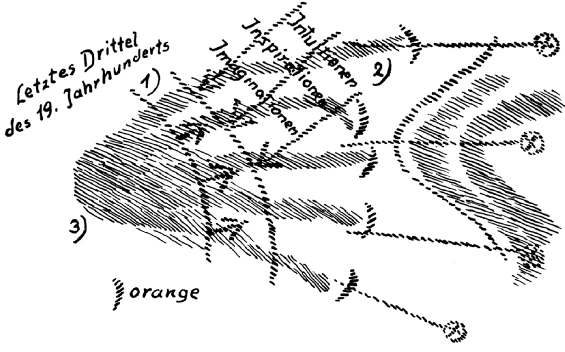
[ 16 ] Where do such impulses come from? Where does that which does not come from the external world come from? Well, it comes from the spiritual world. A person does not need to be clairvoyantly aware in every situation of life of how these impulses come from the spiritual world, but they can still be present within him. However, they will necessarily have to be perceived somewhat differently. When we rise to the first level of the spiritual world through contemplative consciousness, we enter the world of imagination; the second level is the world of inspiration, as you know; the third level is the world of intuition. So instead of allowing the impulses of our will and our actions to rise from our physical, astral, and etheric bodies, we can—if we do not receive impulses from this side but rather receive them from the spiritual world—simply receive them as imaginations, behind which lie inspirations and intuitions. But this need not be consciously experienced as clairvoyant awareness—as in, “Now I want this, and behind it lie intuitions, inspirations, and imaginations”—rather, the result of this appears as a concept, as pure thought, looking just like a concept created in the imagination. Because this is the case—because such a concept, which underlies free action, must appear to ordinary consciousness as a concept created out of the imagination—I called what underlies free action “moral imagination” in my Philosophy of Freedom. What, then, is this moral imagination? This moral imagination is, I would say, the opposite of a mirror image. What we have spread out around us as external physical reality is a mirror image; there, things are reflected back to us. The moral imagination is the tableau through which we cannot see. Hence, things appear to us as fantasy. Behind them, however, lie the actual impulses: imaginations, inspirations, intuitions that are at work (see drawing on p. 102). If one is unaware that these are at work, but only perceives in consciousness—in ordinary consciousness—what they bring about, then it appears to be a fantasy. And these results of moral imagination—these impulses to act that are not derived from drives, passions, or emotions—are free impulses.
[ 17 ] But how does one arrive at them? If one were to rise to clairvoyant consciousness without further ado, one would arrive at them consciously through clairvoyance. But that is not at all necessary. Even a person who is not clairvoyant can develop moral imagination. Everything that has signified true progress for humanity has always sprung from moral imagination, insofar as this progress lay in the ethical realm. It is simply a matter of the human being first developing a feeling, and then an intensified feeling—we will hear more clearly in a moment what is meant by this intensified feeling—that they are here on this earth to do things that concern not merely their personality or individuality, but to do things through which what the spirit of the times desires is realized.
[ 18 ] At first glance, it seems as though there is something quite special behind the idea that human beings should realize what the spirit of the times desires. A time will come, however, when this will be understood much better than it is today. And a time will come when the content of human education will be different from what it is today, when even the most highly educated are taught only concepts related to nature. For what is taught to people with regard to ethics and social life consists mostly of insubstantial, shadowy abstractions—extreme abstractions.
[ 19 ] In this regard, we have not yet attained what earlier times had. It is just that it is very difficult for people today to imagine what life was like in earlier times. Earlier times had myths—myths that were intertwined with the living reality of the people, myths that permeated poetry, art, and all manner of things. And what were these myths about? In Greek mythology, people spoke of Oedipus, of Hercules, and of other heroes whom they aspired to emulate—heroes who had accomplished deeds that served as the starting point for further actions, and whose footsteps people sought to follow. Every individual wanted to follow in their footsteps. The thread of imagination, the thread of thought, the thread of feeling led backward. People felt at one with those long since deceased. That which had emanated from the dead as an impulse was recounted in myth, and these people lived by experiencing the myth and identifying with the impulses of the myth.
[ 20 ] Something similar must be created again—and will be created—if the impulses of spiritual science are properly understood. However, the spiritual vision of the future will be directed less toward the past and more toward the future. But what must become the content of public education is that which connects human beings to the unfolding of time, and thus to the impulses of, above all, the spirit of the age—the corresponding being from the hierarchy of the Archai—about whom I said in an earlier reflection that the so-called dead stand opposite him just as much as the living do. In the public education of the future, one will learn what constitutes the essence of an age such as the one that began with the 15th century and simultaneously brought the Greco-Latin era to a close; one will learn what the universal cosmos actually intends in this fifth post-Atlantean epoch. One will absorb the impulses of this fifth post-Atlantean epoch. People will know: this must come to pass between the 15th century and a century in a subsequent millennium. And people will know: one belongs to one’s age in such a way that the impulses of this present age flow through one. Just as children in the future will learn to name flowers and stars—something they do less often today, though at least that is something external and real—so will they learn to absorb the true spiritual impulses of the age. To do this, however, they must first be educated; and to achieve this, what is now told as “history” must first cease to be called history. Instead of all the things that history tells us about today, in the not-too-distant future people will speak of the spiritual impulses that lie behind historical development and that are dreamed of by human beings. For these spiritual impulses are what call human beings to freedom and set them free, because they elevate them to the world from which intuitions, inspirations, and imaginations arise. For what happens externally on the physical plane—what is history in the external sense—as I have explained in public lectures—has already lost its significance once it is over; in reality, it does not mean that one can say: What came before is always the cause of what follows. — There is nothing more nonsensical than recounting history in such a way that one describes Napoleon’s deeds at the beginning of the 19th century and then believes that what happened later, after Napoleon was exiled, was the consequence of what Napoleon did in his time. There is nothing more nonsensical than that! For what one can say about Napoleon means, in reality, exactly the same thing as it does in the life of a human being when I describe his corpse three days after his death. What is now called history is, in relation to the reality of historical becoming, a cadaverous event—even if the narration of this cadaverous event means an extraordinary great deal in the consciousness of some people.
[ 21 ] What has happened externally only becomes a reality when it is shown to have sprung from spiritual impulses. Then it will become apparent in many cases that what a person does—say, in a particular decade of a century—is the result of something they experienced before they entered their own earthly incarnation, and not at all the result of what took place decades earlier in the course of physical experience on Earth, and so on. Precisely with regard to history, and with regard to social and moral life, anthroposophically oriented spiritual science will have to exert a deepening, enriching influence, particularly in the field of history. This knowledge of spiritual impulses—which, when raised to meet the demands of our time, will be something akin to what immersion in the living myth was for ancient times—will fill people with impulses for their actions and deeds that set them free. These things must first be understood; then, as understanding spreads more and more, they will already begin to take effect in real life.
[ 22 ] But there is yet another point that becomes clear to you precisely from these considerations. It becomes clear to you that the emotional impulses and the volitional impulses with which we exist in the same sphere of life as the so-called dead are a higher, more intense reality than what we know through our waking consciousness as ideas and sensory perceptions. Therefore, what has just been called for—that this must also become a subject of public education—can only bear fruit if it is not merely grasped by the intellect, but if it passes into the impulses of feeling and the impulses of will.
[ 23 ] This can only happen if spiritual science is seen as a real reality, and not merely a doctrine. It is easy to view spiritual science as merely a doctrine, a theory. But spiritual science is not merely a doctrine; it is not merely a theory; spiritual science is a living word. For what is proclaimed as spiritual science is the revelation from the worlds we share with the higher hierarchies and with the world of the so-called dead. This world itself speaks to us through spiritual science. And whoever truly understands spiritual science knows that what resounds within it is the music of the soul from the spiritual world. That which is now read not from dead letters but from actual events in the spiritual world—it can already permeate our feelings with living life, if we understand spiritual science in this sense as something that speaks to us from the spiritual world.
[ 24 ] I emphasized how this is the case when I discussed how, since the year 1879, on the one hand there has been an opportunity for spiritual life to flow down onto the physical plane in a way that did not exist before, while on the other hand, of course, it encounters opposition from the spirits of darkness of whom we have spoken. And precisely with regard to this integration of spiritual-scientific content into feeling and will, everything—absolutely everything—still has to happen, so to speak. And this can only happen if certain things—with regard to which people have currently reached a veritable cultural impasse—change fundamentally.
[ 25 ] And one must come to terms with this: On the one hand, development proceeds in such a way that historical events can indeed be compared to a growing tree; but once the leaves have developed all the way to its outer periphery, it stops growing—that is when the process of withering begins. So it is with historical events. Let us stick with the image I have used earlier in these reflections: There is a very specific set of historical events that have their roots in the last third of the 18th century—I will speak more clearly about this tomorrow—to which are added other influences in the course of the 19th century, and so on. And you see, these historical events spread out and reach their outer limits (see drawing). But those limits are not like those of a tree or a plant, where growth simply stops at the periphery; rather, a new root of historical events must take hold. In the truest sense, we have been living for decades now in an age in which such new historical events must arise from immediate intuitions (right half of the drawing). However, in the historical life of human beings, illusions can easily take hold even regarding these matters. After all, you can observe a plant—which, by its inner law, grows only up to a certain point—growing naturally only up to that point. But now you could create an illusion: you could attach wires, hang sheets of paper from the wires, and give in to the illusion that the plant extends that far.
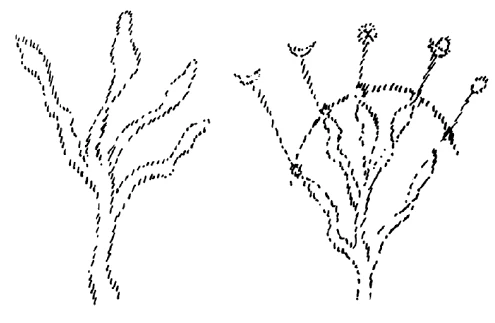
[ 26 ] Such threads do exist, however, in historical events! Even though a different course of historical events should have long since taken hold, such threads still exist. It’s just that, in the unfolding of history, these threads are human prejudices and human comforts that perpetuate what has long since died in the form of dead threads. Then certain people attach themselves to the ends of these dead threads, and the people who attach themselves to the ends of these dead threads—that is, to the outermost tendrils of human prejudices—are often regarded as historical figures, indeed often as the true historical figures. And one has no idea to what extent these figures are attached to such threads of human prejudice! Forming even a slight judgment as to how many figures who are regarded as “great” in the present are dangling from such strands of human prejudice is indeed one of the important tasks of our time.